Wednesday, February 9, 2022

TV You Might Have Missed 1 — Crash Landing on You

A sudden storm leads to a successful South Korean businesswoman and heiress crashing her paraglider in the North Korean portion of the DMZ. She meets an army captain in the Korean People's Army who decides he will help her hide. How will she get back to her own life and escape prison in North Korea? Over time, they fall in love, despite the divide and dispute between their respective countries.

I came for the accurate depiction of North Korean life. I stayed for the charming actors, the romance and the drama itself. Granted, the drama can be pretty sparse in some episodes when the romance is front and center, but there are some genuinely bad guys and interesting dramatic tension. 

We're only halfway through but have learned some fascinating things about North Korean life. The writer interviewed North Korean defectors to get those details right.

Also it is sweet in the same way that I like in Indian movies. The romance is winning, the side characters are fun (the four Korean soldiers are great, as are the village women who interfere in the captain's life). 

Rose has seen enough K-dramas (Korean dramas) to clue us in to typical behavior or plot devices, but you don't need that to enjoy this. You do need to have time to watch a 19-episode show with each episode lasting between 1-1/2 to 2 hours. We often split them up in order to fit them in our schedule.

 It definitely is worth trying.

Monday, February 7, 2022

Three Hearts and Three Lions by Poul Anderson

 The gathering forces of the Dark Powers threatened the world of man. The legions of Faery, aided by trolls, demons and the Wild Hunt itself, were poised to overthrow the realms of light. And alone against the armies of Chaos stood one man, the knight of Three Hearts and Three Lions. Carlsen, a twentieth century man snatched out of time to become again the legendary Holger Danske to fight for the world he had helped to build.

I really enjoyed this a lot. Bronson Pinchot is a favorite narrator of mine and the story was a great "back in time/parallel universe" story. 

I especially appreciated the way that Poul Anderson kept the right attitudes for the people from the past. Even though the modern man could explain some things with scientific explanations, he also is bound by the current social, religious, and cultural standards, which are all taken seriously. That was refreshing.

Friday, February 4, 2022

His parish is literally a three-ring circus!

"There are about 40 traveling circuses in the United States, and they involve large numbers of personnel, both performers and workers. And our job is to be a pastoral presence to all of those folks around the country."

A fascinating interview with a circus priest. Get it at The Pillar.

Februari

Februari, Theo van Hoytema


We had a kettle; we let it leak:

We had a kettle; we let it leak:
Our not repairing made it worse.
We haven't had any tea for a week...
The bottom is out of the Universe.

Rudyard Kipling


We've all been there. Maybe not with a tea kettle, but certainly we know the feeling.

Thursday, February 3, 2022

Chicken-Rice Soup with Garbanzos and Green Chile

Like us, are you having a very icy, very snowy, very cold day? Here's a very easy, very delicious soup that  was easy, homey, and perfect for a cold night in Texas. It makes a huge batch and, based on my breakfast the next day, the flavor improves over time.

 Get it at Meanwhile, Back in the Kitchen.

In the Synagogue

Alfred Wolmark, In the Synagogue
via Gandalf's Gallery

Human science and God's science

Human science is but the backward undoing of the tapestry web of God's science. ... Is oxygen and hydrogen the divine idea of water? There is no water in oxygen, no water in hydrogen; it comes bubbling fresh from the imagination of the living God, rushing from under the great white throne of the glacier. The very thought of it makes one gasp with elemental joy.
George MacDonald
That idea of picking apart God's tapestry is so apt. Science has its own delights, but in this context it does take the wonder away from nature to think of water as molecules. It makes me think of C.S. Lewis's book Out of the Silent Planet where he pulls from the medieval mindset and makes one feel the wonder and joy and life of outer space instead of the vacuum that we learn first from modern science. It really is all about context.

Wednesday, February 2, 2022

Psalm 31 — Into Your Hands I Commend My Spirit

When you see yourself hated and persecuted by all your relatives and friends
because of the truth, do not be downcast either for them or for yourself;
and when all your acquaintances turn away from you,
do not be frightened, but withdraw from them
and keep your eyes fixed on the future, singing Psalm 31.

Athanasius, On the Interpretation of the Psalms

Jesus quotes this psalm as his last words before dying on the cross:

Jesus called out with a loud voice, “Father, into your hands I commit my spirit.” When he had said this, he breathed his last. (Luke 23:46)

Into thy hand I commit my spirit;
thou hast redeemed me, O Lord, faithful God. (Psalm 31:5)

This should make Christians look from two angles. What are we to take from these last words? Also, since Jesus is "quoting" from this psalm, as a faithful Jew, what context would there have been for a listener who may have prayed this as part of daily devotions? 

German words from Psalms 31:15 ("My times are in thy hand")
on a sundial on the tower of the Marienkirche in St. Johann

 Saint Augustine had a lot to say about this psalm, most notably about enemies. He examines them from many angles and I'm going to include several quotes because I found each so insightful. These are all from Psalms 1-50 (Ancient Christian Commentary on Scripture).

31.4 Freed from the Net

The Double Trap of the Enemy. Augustine. The enemy's trap is stretched out ready; there are twin loops in it, error and terror: error to entice, terror to break and grip us. You must shut the door of greed against error and the door of fear against terror; and then you will be led clear of the trap. Expositions on the Psalms.

===========

31.8 Set in a Broad Place
The Broad Plane of Freedom. Augustine. You have not imprisoned me with no possible hope for liberty; you have not handed me over to the endless power of the devil. ... The charity that is in me has been released from cramping fear and can walk unhindered forever into the broad stretches of freedom, for I know my Lord's resurrection and the promise of my own. Expositions on the Psalms.

===========

31.15 In Your Hands
Praying For and Against Enemies. Augustine. We have to distinguish between enemies against whom we must pray. Human enemies, of whatever kind, are not to be hated, lest a good person hates a bad person who is causing trouble, the result is two bad people. A good person must love even the bad person he or she has put up with, so that at any rate there is only one who is bad. The enemies against whom we need to pray are the devil and his angels. ... Even when human enemies assail us, it is only as the instruments of these evil spirits. When the apostle Paul warns us how careful we must be to guard against those enemies, he is speaking to God's servants who are being harassed, and probably by the factions and dishonesty and hostility of human beings; yet he says to them, "It is not against flesh and blood that you have to struggle" — not against human enemies, then — "but against principalities and powers and the rulers of this world."  Expositions on the Psalms.

Sources are here and an index of psalm posts is here.


Tuesday, February 1, 2022

February

February, Très Riches Heures du duc de Berry
Winter in a peasant village. The inhabitants of a farm are shown warming themselves by the fire, while in the background daily life - cutting wood, taking cattle to the market - goes on as normal.

A Movie You Might Have Missed #60: Departures

It's been 11 years since I began this series highlighting movies I wished more people knew about. I'm rerunning it from the beginning because I still think these are movies you might have missed.

The gift of last memories.


When the small orchestra that Daigo plays for is disbanded, he and his wife move back to his small home town to start over. Misunderstanding a job description, he finds himself being trained as an "encoffiner" to prepare corpses before their cremation. This ceremony is carried out before the families of the deceased. This puts him in an uncomfortable position since handling the dead is a taboo subject for Japanese.

By turns moving, funny, and inspirational, this is one I've thought of a lot since I saw it. As we learn the rhythm of the encoffinments we see that this ceremony is not only a sincere expression of respect for the deceased but is also healing for the mourners.

There is much more to the movie than encoffinment, although that is the spoke around which the wheel turns. Each character from the town, the encoffinments, and Daigo's life, no matter how small, is a significant part of the whole story — much as each instrument in an orchestra comes together to play a symphony. Highly recommended.

Monday, January 31, 2022

Kingfisher

Kingfisher, Remo Savisaar

The most important autobiography

The most important autobiography anybody could ever write is written on the hearts of their children.
Ben Affleck, WSJ Magazine, Dec. 2021
Truer words were never spoken.

Friday, January 28, 2022

May Sun

Josef Mehoffer, May Sun, 1911
via Arts Everyday Living


Drowning evil in abundance of good.

"The task of a Christian is to drown evil in an abundance of good. It is not a question of negative campaigns, or of being "anti" anything. On the contrary, we should live positively, full of optimism, with youthfulness, joy and peace. We should be understanding with everybody, with the followers of Christ and with those who abandon him, or with those who have never known him at all. Understanding does not mean holding back, or remaining indifferent, but being active (Josemaria Escriva, Furrow)." We need to have initiative, to want everyone to see the lovable face of Christ.
Francis Fernandez, In Conversation with God, Vol. 3
It is easy to forget this, in the chaotic world where we see protesters and "anti" this and that everywhere. But we are naturally drawn to what is lovely and good ... and that includes the sort of Christians that St. Escriva describes above. Am I providing that breath of fresh air in the world?

Thursday, January 27, 2022

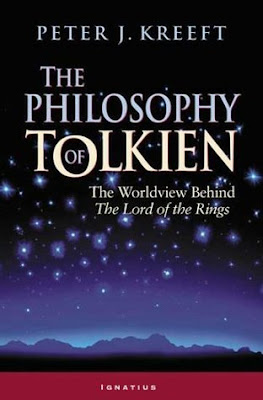
The Philosophy of Tolkien: The Worldview Behind The Lord of the Rings by Peter Kreeft


Oh, no! Not another book on Tolkien!
Why should you read this one?

This is the opening to Peter Kreeft's introduction and it is a fair question. It is why I waited so long to try it. I've got a lot of excellent books about The Lord of the Rings and it was hard to see how this was going to add anything new. Except, of course, that Peter Kreeft is a philosopher and so he looks at everything a little differently than most other authors.

This was like a class in applied philosophy. Peter Kreeft looks at the philosophies embodied in The Lord of the Rings and also explains basic philosophical concepts along the way. It is obvious that Kreeft just loves The Lord of the Rings and it is hard not to join in with that enthusiasm. I was able to grasp the philosophical concepts with an ease that I usually don't feel.

I was startled by his idea that it is our generation's Divine Comedy. But the more I thought about it, the more it made sense. No wonder it has inspired so many and hung on so long as a great book. No wonder I have so many excellent commentaries. How did people feel when the Divine Comedy came out? Possibly just the same! I like that feeling of fellowship with long ago readers of another book that I really love (though I do not understand the Divine Comedy nearly as well as LOTR, but then LOTR is my age's great book so it is written for me).

Virtues can be classified in many ways. One is "hard" versus "soft." Our ancestors were better at the "hard" ones, like courage, duty, honor, chastity, and obedience. We are better at the "soft" ones, like pity, mercy, sensitivity, and humility. We are shocked at their cruelty; they would be equally shocked by our laxity.
Highly recommended.

Wednesday, January 26, 2022

Psalm 30 — Praise for Healing

In dedicating your house—the is, your soul, which welcomes the Lord,
and the bodily house in which you dwell corporeally—
rejoice and sing Psalm 30
Athanasius, On the Interpretation of the Psalms

We've all had the experience that the psalmist describes here: "Complacent, I once said, “I shall never be shaken.”

LORD, you showed me favor, established for me mountains of virtue. But when you hid your face I was struck with terror. (NAB translation)

How many times have I felt I will never have my faith falter and then when things go wrong I am filled with dismay? I feel as if God is absent because he isn't dashing in to fix my problems immediately. That's not really the way of faith and often the experience I gain in having to trust while working out my own solution is invaluable. I know also so well the absolute joy of God's presence after the crisis has passed and realizing what He's done in my life.

There's some good commentary on this below, as well as a look at how this is a Biblical type in the Old and New Testaments. Interesting stuff!

Text from Psalm 30:5,
"Heaviness may endure for a night, but joy cometh in the morning",
illustrated on a window in St Giles, Codicote, Hertfordshire, UK

This psalm reflects feelings so universal that it is a "type" or foreshadowing of events in the Old and New Testaments.
30:5 Joy Comes with the Morning
Biblical Types. Theodoret of Cyr: Now things turned out like this both in the case of Hezekiah and in the case of the salvation of everyone. After the Assyrians applied those awful threats and moved the city to weeping, they sustained the blow at night and in the morning they filled with good cheer those whom they had forced to weep. The divine Isaiah brought Hezekiah the sentence of death in the evening, and towards morning brought him in turn the good news of life. And it happened likewise in the case of the salvation of everyone: the sacred apostles and the believers along with them lamented that passion of the Lord, but toward morning the women came and brought the joy of the resurrection. Commentary on the Psalms.
Psalms 1-50 (Ancient Christian Commentary on Scripture)

Here we have some good insights for modern application.

For most of us, life is full of similar moments when our awareness of God's presence waxes and wanes. I am talking about our awareness of God here, not the reality of his presence or absence. God is always present, whether we realize it or not. This psalm, however, illustrates how our feelings, our perceptions, can either strengthen or undermine our confidence in facing the circumstances of our lives.

Clearly our perceptions are not always the best judge of reality. ... Nevertheless, our reaction to our circumstances can be immensely altered by our sense of God's presence or absence. As the psalmist indicates, the ability to perceive God at work in the midst of a troubled time made all the difference in the world. Wailing turned to a dance of joy, and rich festal garments replaced sackcloth and ashes.
Psalms vol. 1 (The NIV Application Commentary)
Sources are here and an index of psalm posts is here.

Tuesday, January 25, 2022

The Best Years of Our Lives

We watched this as part of our occasional William Wyler series. Coming after Mrs. Miniver, which was one of my favorite movies of 2021, it is appropriate to see the aftermath in three American military men's lives after the war is over and they return home. They struggle to come to terms with the adjustments of post-war society and how their loved ones may not be able to adjust to the people they have become.

Over 70 years later, some of the story lines may seem conventional at first, but we soon saw the relevance to modern life. For one thing it kept coming up in conversation around the house which is one of the surest sign of a movie that speaks to the universal condition. I really liked the contrasts between these three regular guys — in age, income, families, and prospects. Their stories showed what they'd learned and what they'd lost, and how often the only people who really understood them were other military men. The themes and topics are modern enough that we don't really need other movies on the topic — this one covers it all.

The direction was masterful, although it may not be immediately obvious. For one thing, Wyler uses long takes during conversations, allowing actors to pause and consider instead of rushing to the next line. This makes it seem like real life. Also keep an eye on the deep background. Sometimes there are a lot of things happening back there while major characters are sorting things out in the foreground. My favorite technique was his use of mirrors, which are everywhere in this movie. What are we seeing? Is it the reflection a character wants everyone to see? Or is it something that they themselves haven't noticed until it was looking back at them?

This movie had so many side characters that I loved, while the three main stories held my attention the whole time. Harold Russell as Homer totally deserved to get two Oscars for his role — which he did! Marie was a wonderfully selfish and clueless gold digger. Fred's father and stepmother were sweet, as was Homer's father. And Hoagy Carmichael was the Uncle Butch I wish I'd always had.

More than anything I liked knowing this was the movie that made families all over the country know they weren't alone in their struggles adjusting after the war.

Friday, January 21, 2022

Shakespeare in India

An American's Guide to Bollywood podcast is partway through their coverage of films which are Indian adaptations of Shakespearean plays.

I love all these films, both for how they interpret the plays and for how they incorporate key parts of Indian life and culture. So far they have covered Omkara (Othello) and Haider (Hamlet).

Each episode has a brief coverage of the film and who would be a good audience for it. Then spoilers follow. So you can check out whether the film sounds interesting before watching.

Coming up they'll cover a Bollywood version of Romeo and Juliet (Ram Leela) and a South Indian version of Macbeth (Veeram) that I can't wait to watch again.

My reviews of Omkara, Haider, and Ram-Leela can be read here.

For those who follow A Good Story is Hard to Find podcast, Scott and I have covered Omkara and Ram-Leela (Romeo and Juliet). Our episodes are best listened to after watching the films.

As I notice his lips moving I hasten to his side ...

He finally staggers up to the last resting place of the late Slats Slavin and falls there with the blood pumping from the hole that Johnny Brannigan drills in his chest and as I notice his lips moving I hasten to his side figuring that he may be about to utter the name of the horse Slats gives him for me.
Damon Runyon
Since watching Guys and Dolls on New Year's Eve I've been dipping into Damon Runyon's stories. They are hilarious (mostly) and the phrasing is priceless.

Thursday, January 20, 2022

Snow

Camille Pissarro, Louveciennes, Chemin de Creux, Snow, 1872

Our weather has been like a roller coaster all winter. It drops to much lower than usual and then slowly rises to much higher than usual. All within the period of a week. And then it does it again. We haven't had any snow but this picture makes me think of growing up in Kansas when the light on the snow snow looked exactly like that. Exactly!

Wednesday, January 19, 2022

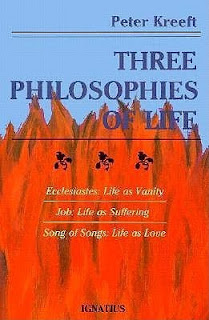
Three Philosophies of Life: Ecclesiastes—Life As Vanity, Job—Life As Suffering, Song of Songs—Life As Love by Peter Kreeft

Ancient ethics always dealt with three questions. Modern ethics usually deals with only one, or at the most two. The three questions are like the three things a fleet of ships is told by its sailing orders. (The metaphor is from C. S. Lewis.) First, the ships must know how to avoid bumping into each other. This is social ethics, and modern as well as ancient ethicists deal with it. Second, they must know how to stay shipshape and avoid sinking. This is individual ethics, virtues and vices, character building, and we hear very little about this from our modern ethical philosophers. Third, and most important of all, they must know why the fleet is at sea in the first place. What is their mission, their destination? This is the question of the summum bonum, and no modern philosophers except the existentialists seem even to be interested in this, the greatest of all questions. Perhaps that is why most modern philosophy seems so weak and wimpy, so specialized and elitist, and above all so boring, to ordinary people.
I'd been wanting to read this book for years. When our podcast's season 12 opening guest chose Ecclesiastes as the book to discuss, that was all the excuse I needed!

Author Peter Kreeft considers Ecclesiastes, Job, and Song of Songs in a series of meditations. Looking at them as pieces of philosophy, he is able to show how each relates to attitudes still held today. He compares the three books thus: Life as Vanity (Ecclesiastes, where "vanity" means "a puff of air"), Life as Suffering (Job), and Life as Love (Song of Songs).

I really found it valuable to compare these books of wisdom literature which are some of the most difficult of the Old Testament – for me anyway. I am used to commentaries but Kreeft's philosophical approach felt unique as he considered what they teach us about the human experience. I especially enjoyed his take on them as a very early take similar to Dante's Divine Comedy — a journey through hell, purgatory, and heaven. And I found it inspiring as well as useful for my own life.
To understand the world of things, you need science and suspicion and the method of doubt; accept nothing until it is proven. Every idea is guilty until proven innocent. but to know people, you need the opposite method: trust, love, openness. Persons are innocent until proven guilty. You cannot hear them unless that is your attitude. Suspicion never reaches the other's heart.

Tuesday, January 18, 2022

Vorhor, the Green Wave

Vorhor, the Green Wave by Georges Lacombe, 1897

North of Pont-Aven, Lacombe found this dramatic crag overlooking the sea and rendered it even more spectacular with vivid hues of turquoise, mauve, and gold. He also anthropomorphized the rocks, finding human shapes in them, and transformed the waves into decorative patterns similar to Japanese prints.
I was struck by the bold colors and shapes but it never occurred to me to look for the human shapes and Japanese-style decorative patterns.

Monday, January 17, 2022

A Movie You Might Have Missed #59: Chuck Norris vs. Communism

It's been 11 years since I began this series highlighting movies I wished more people knew about. I'm rerunning it from the beginning because I still think these are movies you might have missed.

A documentary about the magic of film and the power it has to change lives.

As good as its name and you've got to admit it — that name is pretty darned good.

I had no idea that bootleg, dubbed video tapes were ever available in communist Romania. Certainly I didn't realize they were a widespread source of information about the West and inspiration for how life could be.

That's the subject of this documentary which is a well told tribute to the power of story as well as a previously untold chapter of the fight against communism.

Thursday, January 13, 2022

Seeing the light in all its purity and brightness.

When, therefore, our Lord Jesus Christ shall come, and, as the apostle says, bring to light things hidden in darkness and make plain the secrets of the heart, so that everyone may receive his condemnation from God, then lamps will no longer be needed. When that day is at hand, the prophet will not be read to us, the book of the Apostle will not be opened, we shall not require the testimony of John, we shall have no need of the Gospel itself. Therefore all Scriptures will be taken away from us, those Scriptures which in the night of this world burned like lamps so that we might not remain in darkness.

When all these things are removed as no longer necessary for our illumination, and when the men of God by whom they were ministered to us shall themselves together with us behold the dear and true light without such aids, what shall we see? With what shall our minds be nourished? What will give joy to our gaze? ...

You will come to the fountain, with whose dew you have already been sprinkled. Instead of the ray of light which was sent through slanting and winding ways into the heart of your darkness, you will see the light itself in all its purity and brightness. It is to see and experience this light that you are now being cleansed.
St. Augustine, treatise on John

When I copied this into my quote journal from the daily reading in the Liturgy of the Hours, my imagination was caught by all the aids we have on earth to help us get a glimpse of God. The idea of not needing them anymore was astounding, logical, and something that made the second coming seem a little more real, a little more like something I can grasp.

Today I read it with slightly different focus because my brother-in-law's funeral is this afternoon. It comes after a long battle with cancer so his death wasn't a shock. And yet since I've heard the news his voice occasionally sounds in my ears, with that kindly smile and flash of blue eyes. He's ahead of me on the journey. I like to think of his astonishment and joy at beholding the ultimate reality of Jesus, who I know he loves.

Wednesday, January 12, 2022

Caesar at the Rubicon

Caesar at the Rubicon by Wilhelm Trübner, 1880.


How often any fond dog owner has seen this acted out! Certainly I have, most recently when the Christmas cookies were all on the sideboard and Jeeves, our male Boxer, had his eye out for opportunity! 

 I have seen the phrase about crossing the Rubicon before but never really knew what it meant. There's a whole article on it at Wikipedia, of course! So for anyone else who wonders, now we know.

Julius Caesar's crossing the Rubicon river on 10 January, 49 BC[1] precipitated the Roman Civil War, which ultimately led to Caesar's becoming dictator for life (dictator perpetuo) and the rise of the imperial era of Rome. Caesar had been appointed to a governorship over a region that ranged from southern Gaul to Illyricum (but not Italy). As his term of governorship ended, the Roman Senate ordered Caesar to disband his army and return to Rome. He was explicitly ordered not to take his army across the Rubicon river, which was at that time a northern boundary of Italy. In January 49 BC, Caesar brought the 13th legion across the river, which the Roman government considered insurrection, treason, and a declaration of war on the Roman Senate. According to some authors, he uttered the phrase alea iacta est—the die is cast—as his army marched through the shallow river.

Today, the phrase crossing the Rubicon is a metaphor that means to pass a point of no return.

Tuesday, January 11, 2022

A Movie You Might Have Missed #58: The Search for General Tso

It's been 11 years since I began this series highlighting movies I wished more people knew about. I'm rerunning it from the beginning because I still think these are movies you might have missed.

Who was General Tso, and why are we eating his chicken?
 
This feature documentary explores the origins and ubiquity of Chinese-American food through the story of an iconic sweet and spicy chicken dish.
Incredibly enjoyable. I knew a lot about Chinese food in America already and this still held my attention. When they did the profile on Springfield, Missouri's Chinese specialty of Cashew Chicken I knew these people had done their research. I spent many formative years in Springfield and you just weren't living if you hadn't had some Cashew Chicken recently.

It is just as described, delightfully insightful, bringing out all the important elements without dwelling on any of them so long that the story gets bogged down.

Wednesday, January 5, 2022

A Movie You Might Have Missed #57: The Apostle

It's been 11 years since I began this series highlighting movies I wished more people knew about. I'm rerunning it from the beginning because I still think these are movies you might have missed.

The hardest soul to save was his own.
 
Robert Duvall gives a tour de force performance as a zealous Pentecostal preacher hiding from his past. Now in a small Louisiana town, Sonny goes by the name of "Apostle E.F." and opens a new church with the help of a retired reverend.
Duvall gives us the story of a main character, Sonny, who is fully, tragically, joyfully human and who is always returning to God. Some of the scenes seem long but afterwards the viewer realizes that such immersion was needed to understand Sonny's world and soul.

At the end of this movie all I could think of was King David in the Old Testament. Beloved of God, loves God, inspirational, beloved by his people, and yet terribly a terribly flawed man who sent a trusting subordinate off to sure death so he could take his wife.

It is fascinating that Robert Duvall evokes these echoes in The Apostle, especially since watching the extras Duvall kept speaking of believers as "those people." He didn't mean it in a derogatory way but just that for him they are "other," a people who he is not a part of. He pulls it off because he's absolutely honest as a story teller and as an actor.

Tuesday, January 4, 2022

Best of 2021 — Movies

Here are my top 10 picks from the over 130 movies we watched last year.  This year, in addition to the usual sprinkling of Indian movies, there are some silent movies. I'd had some of them on my 2021 Challenge list and was surprised to fall in love with this way of storytelling. If you also haven't tried a silent movie this is your chance to try something very old that is also brand new to most of us!

As always, the movies may be old, but my viewing was brand new in 2021. In no particular order.

I began my "Best of" lists way back in 2008. To see them, check the label cloud in the sidebar under "Best of ..."


2021 BEST MOVIES

Metropolis

This movie was nuts. In a good way — a sexy female robot, mad scientist, forbidden love, a rooftop chase with fistfight, and a  horrifying chase of the heroine through the catacombs. All in a silent film that kicked off my instant interest in seeing what else silent movies had to offer (as you may see below).

Avane Srimannarayana

With a name like that you know its Indian and yet it feels unremittingly like a Western as exemplified by four gunfighters who wear cowboy hats, leather dusters, and dhoti. This is a bonkers mashup of a Western, an action thriller, a swashbuckler, rivalry between murderous brothers, putting on a play, and an Indian mythological fantasy of sorts. A lot of the fun lies in all the genres that are ruthlessly shoved together with humor, excellent production values, and entertaining dialogue.

The Phantom Carriage

What made me want to watch this silent movie was that it was ahead of its time in using multiple superimpositions and double exposure to create ghostly effects. I was expecting a ghost story with lots of over-the-top horror. I didn't expect there to be multi-layered stories within stories, nonlinear timelines, and some of the most affecting, subtle acting I've seen in any movie.

Soul

Joe is a teacher who wants nothing more than to be part of a jazz band. When he is accidentally killed right after having his dream come true, he feels cheated.But Joe's got more to learn. Directed by Pete Docter who also did Up and Inside Out, this was one of Pixar's finest in years, old style like they used to be. And I was so inspired by the end. A wonderful jazz improv on living, passion, love, and sparks that comes together in one fantastic and imaginative movie.

The Man Who Feels No Pain

Surya cannot feel pain. Hearing that most children with this condition never live past the age of four, his grandpa uses martial action movies to train him to be like Bruce Lee. This seems counter intuitive, but actually works. Surya and  his childhood friend, Supri, who has her own problems, set out to right wrongs.

That's just the first part of this Indian movie and when the story heads into Surya's adulthood is when the real action begins. It is fun and funny, goofy and heart-felt, and shouldn't be missed.

Mulk (Country)

This was based on a true case where a terrorist's entire family was taken to court and accused of being a terrorist cell. We were invested on the family's side, as most American viewers would be, and as the movie intended everyone to be. It was also very interesting to see how the top terrorist persuaded the family son to his cause. 

Mrs. Miniver

An English middle-class family, the Minivers, experience life in the first months of World War II.  This is a classic for good reason and I fell in love with it. It is simply stunning in the way that it takes you into this family's life and then shows the effects of war on the British as WWII breaks out.

C/o Kancharapalem

From a schoolboy’s crush to a middle-aged bachelor’s office romance, four love stories spanning age, religion and status unfold in a small Indian town.
Kancharapalem is the name of a little neighborhood, which some of the residents actually call their village, in a small Indian town. Telugu is spoken there so this is not a Bollywood film but a Tollywood film, as the Telugu-language film industry is called. This movie features four very sweet love stories which engaged us from the beginning. 


 Vikram Vedha

This neo-noir film is a classic story of cat-and-mouse between criminal and policeman which kept us guessing, especially when Vedha's moral questions kept throwing new light on the investigation. It's an exciting thriller that also makes us think as each time Vedha says "let me tell you a story" with a wicked twinkle in his eye. We see new light shed on our judgment of the characters as Vikram is forced to reassess himself and the situation.

Rama Rama Re

A mesmerizing and often humorous road trip with an escaped convict, an old man with a mission, and an eloping couple fleeing their enraged families. As happens with such journeys they encounter other people on missions of their own and in the end the encounters interweave to a connected tale.
 
This is a movie we enjoyed even as we gradually became aware that it was echoing parts of  the Ramayana which is an epic tale that we have encountered many times in other Indian movies. As a result, this made us think of favorite movies which depend heavily on Christian religious symbolism for deep layers of meaning below the obvious surface story. It is challenging but oh so good.

Monday, January 3, 2022

Best of 2021 — Books

My top 10 picks from the over 150 books I read last year. PLUS the book I'm proudest of having read.

You may find old books here but if they're on this list, then they were new to me! In no particular order.

Note: I've been doing this since 2008 — check the label cloud in the sidebar for "Best of" to see other lists.

PERSONAL ACCOMPLISHMENT

Les Miserables
by Victor Hugo
After rewatching Les Mis starring Hugh Jackman I was inspired yet again to try to read this book. It was the third time I was so inspired and this time it took! I wasn't a fan of the long, long asides but what the heck. It all came together nicely in the end. The bishop's chapters at the beginning will continue to be favorites but I'm not sure I'll ever read the entire thing again. I'm happy I read it. Anyone interested in a deep dive will like The Les Miserables Reading Companion Podcast.


2021 BEST BOOKS

All Things Made New

by Stratford Caldecott
Caldecott studies the symbolism and meaning of the Book of Revelation, as well as the prayers and meditations of the Rosary, including the Apostles' Creed and the Our Father. The examination of the actions of the Son and Holy Spirit as reflected in the Creed were especially illuminating as were  his reflections on the the way of the cross.
(Full review here.)

A Gentleman in Moscow

Amor Towles
I didn't expect to love a book about a gentleman under hotel arrest during the Russian revolution (and after) to be so wonderful. It is a wonderful balance of whimsy and history, fairy tale and reality. It tells us how to survive the rules imposed by others and how to turn dreams into reality.  This book was from my 2021 Book Challenge which just made it more gratifying that I loved it so much.

All Systems Red

(Book 1 of the Murderbot Diaries)
by Martha Wells

The first thing you need to know about Murderbot is that it doesn't like humans. Even though its job is to protect them.

The second thing you need to know is that Murderbot would really rather be watching TV. Specifically the most unrealistic soap-opera science fiction available.

These books are the most fun I've had reading for a long time. The story plots are somewhat beside the point, just as in a big, splashy action thriller where what you want is action and thrills. And yet, the plots do matter because that's where we find out that Murderbot actually does care about more than watching TV.

And, you know, we kind of wind up loving Murderbot, so we care too.

(My full review of the series here.)


One Corpse Too Many

by Ellis Peters
Brother Cadfael is a monk in England in 1138 who solves murders while helping at least one young couple out of difficulties in every book. I'd tried them before but they never grabbed me. This one somehow worked. Perhaps because it was more adventure than mystery. I'm always able to guess the culprit early on but in this book I was engaged the entire time in Brother Cadfael's battle of wits with Hugh. It opened the door for me to enjoy Patrick Tull's narrations of more of the series.

Genesis: The Book of Beginnings

by Rabbi Jonathan Sacks
The first book of a series of essays which work their way through the Torah in a year. Sacks has an  easy style while giving indepth, brilliant, compassionate commentary that often surprised me and sometimes changed my whole perspective on a Biblical person or their actions. Sacks is good at comparing ancient and modern worldviews. This not only clarifies Biblical context but often shows just how different our current ideas are.

Orthodoxy

by G.K. Chesterton
I've often been urged to read this classic but couldn't get into it. Luckily I discovered the Pints with Chesterton podcast which made me begin reading a chapter at the time. When I got to chapter five I was hooked and couldn't put it down, zooming through the rest of this work of genius.

Monsignor Quixote

by Graham Greene
Father Quixote is a descendant of the famous book's hero. Yes, he knows the book is fictional. When he's promoted to Monsignor he goes on a road trip in his aged car Rocinante, with his friend Sancho who is the newly deposed Communist mayor of the town. 

I know just enough broad plot points from Don Quixote to see where Greene uses them in his own updated way for this charming book. The rambling trip and conversation are amusing, thought provoking, and inspiring.

Psalms & Canticles

by St. John Paul II
Toward the end of his life and pontificate, John Paul II began a series on of homilies on the psalms and canticles of morning prayer in the Liturgy of the Hours. They were collected in this book. When I began dabbling in the Liturgy of the Hours I picked it up. It is a real  treasure.

Reclaiming Vatican II

 by Father Blake Britton
During the past five decades, the Second Vatican Council has been alternately celebrated or maligned for its supposed break with tradition and embrace of the modern world. But what if we’ve gotten it all wrong? Have Catholics—both those who embrace the spirit of Vatican II and those who regard it with suspicion—misunderstood what the council was really about?

Short review: simply excellent. Inspirational as well as informative. All Catholics should read this book.

Three Philosophies of Life

(Ecclesiastes—Life as Vanity, Job—Life as Suffering, Song of Songs—Life as Love)
 by Peter Kreeft
"I've been a philosopher for all my adult life and the three most profound books of philosophy that I have ever read are Ecclesiastes, Job, and Song of Songs." These are the opening lines of Kreeft's Three Philosophies of Life. He reflects that there are ultimately only three philosophies of life and each one is represented by one of these books of the Bible—life is vanity; life is suffering; life is love.
 
This was an excellent deep-dive into three Wisdom books which are famously difficult to understand. 

January

January, Les Très Riches Heures du duc de Berry

The month of giving New Years' gifts (a custom which seems to have died out now). Jean de Berry himself can be seen on the right, wearing the brilliant blue robe.

Friday, December 31, 2021

2022 Book and Movie Challenge

2021 was the year I read Les Miserables on a whim — and it wasn't even on my list!

And it was the year that I fell in love with silent movies. In a big way.

 BOOKS

In 2021 I discovered some new favorites and was even inspired to read a book not on my list at all that I'd dropped twice before — Les Miserables. I didn't read every single book on my list. But even the ones I dropped (sorry War and Peace!) were given a fair try. And that's all I promise any book on my list. Read all about the 2021 reading challenge it here.

As usual, I'll have some challenging reading coming my way just because of outside influences. Two of Scott's choices for A Good Story is Hard to Find podcast sound rip-roaring - cowboys and Vikings!

  •  Lonesome Dove (Update - to my chagrin this book is one that I hated although I really wanted to love it. I read 100 pages before calling it quits.)
  •  Njal's Saga (a real Viking saga that's really long).  (Update - liked it well enough.)

My Catholic women's book club will be making me face a book I've managed to avoid until now:

  • The End of the Affair by Graham Greene.  (Update - loved it!)

 The literary podcasts I listen to are doing the same with books I either have ignored or avoided. Close Reads has hit several for me this year.

  • Anna Karenina — quite good with a lot of insight. I didn't love Anna herself but maybe I wasn't supposed to? At any rate, I'm glad I read it.
  • 1984 — a great cautionary tale, not a great novel. I appreciated it but didn't love it.
  • Laurus — magical realism, holy fool, Russian literature. What was I thinking? I hate all those things and so it makes sense that I couldn't get too far with this book. Abandoned it.
I hardly need to add to this list, do I? And yet ... I have a few that people keep pushing at me and I keep ducking. Let's see where an honest try takes me!

(Titles are marked in red when finished, with a few words on how they hit me.)


  • Speaker for the Dead by Orson Scott Card — because my brother-in-law (and others) will not stop telling me it is better than Ender's Game and that I should read it. Okay, okay!
    DID NOT READ — I just couldn't make myself read more than a few pages. It turns out mentally I am done with Ender's story and that universe. To be fair, I already had to struggle to read the first book, though I did wind up really liking it.

  • The Word is Murder by Anthony Horowitz. I tried a book by Horowitz once and didn't get too far. But, again, people just won't stop pushing this author in my face. I like the sound of this series where he writes himself in as the Watson to the main detective.
    FINISHED — I liked this pretty well. Horowitz does love to go on and on about himself and being an author which I liked at first and got tired of later. I did like his recreation of a modern Sherlock style detective. Without an adoring Watson (like the original stories) we see how annoying that type of person is. And also how brilliant. I don't know if I'll read any others in the series. Going to see how it settles as I think about it.

  • Station Eleven by Emily St. John Mandel — I tried this a couple of times and was never interested enough to pick it up after putting it down. However, my daughter, Hannah, really liked it and recommended it. Heck, maybe the third time is the charm. FINISHED — mixed feelings on this one. I loved the writing style but something about the ending felt as if it was off. It seemed to trail off into nothing. It didn't feel like real science fiction and then when I looked up the author I found she's a novelist who liked the idea on speculating about 15 years after civilization collapses. And then wrote a novel about it. Which was unsatisfying. So I didn't love it and I didn't hate it.

  • The City of God by St. Augustine — I got halfway through and then put it down, the way you do with a super duper long theology discussion. Nothing against it, but I'd read a lot and was ready for a change. Now is the time to pick it back up! NOT EVEN PICKED UP — I just couldn't get in the mood so this one isn't happening this year!

  • Vanity Fair by William Makepeace Thackeray — This one's my daughter Rose's fault. She talked about how funny it is and that hooked me. To be fair, I forgot I meant to read this next year and began listening recently. What a snarky, fun novel so far!
    FINISHED — Aside from the humor, it was also surprisingly action packed. However, there were very long sections which today would have been cut. For me the section when the little boys were growing up was too long, but that is my modern sensibility coming through. Otherwise, though I can highly recommend it for someone who would like a big helping of snarky humor with their novel.

  • Piranesi by Susanna Clarke — I had to be forced to read Clarke's previous novel Jonathan Strange and Mr Norrell which I liked overall. I tried this and wasn't crazy about it. However, a lot (and I mean a lot) of people love it. So I'm going to give it a better try.
    DID NOT READ — the lyrical descriptions of The World were beautiful and haunting, but 50 pages in almost nothing had happened aside from some sea gulls and The Other, both of whom I feel will be instrumental later in the book. But I just didn't care and was bored with the continual descriptions of that world when nothing else was going on.

  • Barchester Towers by Anthony Trollope — recommended by my daughter Hannah who fell in love with Trollope's novels this year.
    FINISHED — loved this one. So funny and insightful. Rather reminded me of the overall tone in Vanity Fair except not quite as snarky and moved along at a brisk pace.

More silent films - yay! Also, Batman. (Yay?) And I will finally venture out of India for my foreign Shakespearean adaptations.

  • Grand Hotel starring Greta Garbo and John Barrymore — somehow watching Our Man Godfrey this year made me think of this movie which I saw a really long time ago.

  • Freaks directed by Todd Browning — Rose has long pushed this movie and after seeing Browning's direction of the original Dracula this Halloween I am finally on board.

  • Sherlock, Jr. starring Buster Keaton (silent) — the ultimate (perhaps original) meta-film where a bored film projectionist daydreams himself into the movies he is showing. FINISHED —A slight but sweet little film but good escapist entertainment.

  • Dark Knight trilogy directed by Christopher Nolan — I never saw the last movie of the Dark Knight trilogy and it's been so long that I've got to rewatch them all now. FINISHED — The third movie solved my big problems with the way that the second movie ended. Well done.

  • It starring Clara Bow (silent) — Not the horror movie but the movie that made Clara Bow a star and defined sex appeal for the Jazz Age. FINISHED —Not as hilarious now as it probably was back in the day, but Clara Bow was adorable and a really modern woman. She really had "It."

  • Throne of Blood directed by Akira Kurosawa — Lear, Japanese-style. I tend to like foreign adaptations of Shakespeare better than seeing English or American ones. I've explored Indian versions and now am going to see what the master in Japan did with the Bard.

  • Ran directed by Akira Kurosawa — MacBeth, also by the Japanese master.

  • Hamlet starring David Tennant — I love Hamlet and I also love David Tennant. So why not?

  • It Could Happen to You — Rose's recommendation of a romcom with a cop and a waitress who share a winning lottery ticket. FINISHED - fine, but nothing to write home about.

Wednesday, December 29, 2021

A Movie You Might Have Missed #56 — Winning: The Racing Life of Paul Newman

It's been 11 years since I began this series highlighting movies I wished more people knew about. I'm rerunning it from the beginning because I still think these are movies you might have missed.

"In the Oscars someone votes for you or votes against you.
Racing, you do that yourself."*


Paul Newman's famous for a lot of things: acting, popcorn, salad dressing. But I tend to forget that he also raced cars. I never realized racing absorbed him so much that he ignored his acting career for it. That's just one of the many interesting facets opened up in this film.

I picked this up because my husband loves documentaries and race cars. This seemed tailor made. I expected to tolerate it but instead I fell in love with this well rounded, subtle picture of a deeply private man.

As the documentary tracked Newman's increasing love and dedication to racing, we saw him through the eyes of acting buddies like Robert Redford, racing team members, his brother, and his wife, Joanne Woodward. Archival footage fills in the gaps but it is the heart felt stories that draw the viewer in. The film winds up not just being about racing but about everything that Paul Newman loved and his talent for focusing on what absorbed him. In the process, we also learn more about what racing means to those who participate in it.

In that sense it reminded me of Muscle Shoals where we came for the music but found surprising depth. Most documentaries don't have that sort of range but Winning is a welcome addition to documentaries that left me feeling inspired and that I could gladly watch again.

* Paraphrased.

Tuesday, December 21, 2021

He wil rejoice over your with gladness, and renew you in his love ...

Look at the options for the first readings for today's Mass. I can't tell you how the first always grabs my attention, coming as it does far into Advent. This is Jesus joyfully bounding toward us as his incarnation becomes reality. This is his love for each of us as he comes to bring us salvation. What a lovely, personal, and evocative image. The second is so happy and joyful at finally having the time of waiting over.

Hark! my lover–here he comes springing across the mountains, leaping across the hills. My lover is like a gazelle or a young stag. Here he stands behind our wall, gazing through the windows, peering through the lattices. My lover speaks; he says to me, “Arise, my beloved, my dove, my beautiful one, and come! “For see, the winter is past, the rains are over and gone. The flowers appear on the earth, the time of pruning the vines has come, and the song of the dove is heard in our land. The fig tree puts forth its figs, and the vines, in bloom, give forth fragrance. Arise, my beloved, my beautiful one, and come!

“O my dove in the clefts of the rock, in the secret recesses of the cliff, Let me see you, let me hear your voice, For your voice is sweet, and you are lovely.”
Song of Songs 2:8-14
or
Shout for joy, O daughter Zion! Sing joyfully, O Israel! Be glad and exult with all your heart, O daughter Jerusalem! The LORD has removed the judgment against you, he has turned away your enemies; The King of Israel, the LORD, is in your midst, you have no further misfortune to fear. On that day, it shall be said to Jerusalem: Fear not, O Zion, be not discouraged! The LORD, your God, is in your midst, a mighty savior; He will rejoice over you with gladness, and renew you in his love, He will sing joyfully because of you, as one sings at festivals.
Zephaniah 3:14-18a
This is followed by the Gospel of reading of Luke 1:39-45 where Mary goes to Elizabeth immediately after Jesus' conception. Notice how she went "in haste." From the first seconds of his time among us Jesus hurries to see us (a la the Father in everyone's favorite parable of The Prodigal Son). Also, it is impossible to miss that Mary's role as servant is always to show us Jesus, to point the way to her Son.

Thursday, December 16, 2021

Wednesday, December 15, 2021

A Movie You Might Have Missed #55: Ushpizin

It's been 11 years since I began this series highlighting movies I wished more people knew about. I'm rerunning it from the beginning because I still think these are movies you might have missed.

You see a lemon. They see a miracle.
 
In Jerusalem's orthodox neighborhoods, it's Succoth, seven days celebrating life's essentials in a sukkah, a temporary shack of both deprivation and hospitality. A devout couple, Moshe and Mali, are broke and praying for a miracle. They can't afford to build a sukkah, they can't afford food for a feast, and they have no guests. Their prayers are answered. But those answers bring their own tests of faith, beginning with the Ushpizin, the guests that unexpectedly show up on their doorstep.
I really can't believe I haven't mentioned this movie here before. It became an instant favorite as soon as we watched it.

Above all, the story is that of Moshe and Mali as we watch their relationship tested. Their chemistry and love is undeniable and forms the backbone of the story. Each wants the best for their marriage and each other and yet, as is always the case, life and especially the upcoming holiday throws unexpected challenges their way.

This is a tale of love and living your faith to the fullest which is, of course, why it resonates with me. The fact that this is managed in a light, humorous piece about such a foreign culture just goes to show the artistry that went into this film.

What's helpful to know before you watch:
  • Succoth is a 7-day Jewish festival when meals are eaten in a sukkah, a temporary booth of both deprivation and hospitality. Men also sleep there. It is considered a blessing to have guests at that time.
  • Moshe's orthodox Braslov Hasidism particularly emphasizes personal and emotional connection to God.
  • The four species are four plants mentioned in Torah in connection with succoth, one of which is the etrog (citron fruit).
  • Low level criminals in Israel can get out for a while on leave, evidently being on the honor system for showing back up again.
If you want more background information after watching, read Joseph Suzanka's review which I how I first heard of it. He has some wonderful insights and the background of the movie is almost as good as the movie itself.

Scott and I also discussed it at A Good Story is Hard to Find, where Leah's comments on the blog gives some excellent clarification on questions of the faith and attitudes in the film.

An Advent Reflection: Confessionals

Those confessionals scattered about the world where men declare their sins don't speak of the severity of God. Rather do they speak of his mercy. And all those who approach the confessional, sometimes after many years weighed down with mortal sins, in the moment of getting rid of this intolerable burden, find at last a longed-for relief. they find joy and tranquility of conscience which, outside Confession, they will never be able to find anywhere.
John Paul II, Homily, 16 March 1980
Quoted in In Conversation with God by Francis Fernandez
Daily Meditations Vol. 1: Advent and Christmastide
My parish has confession scheduled 6 days between now and Dec. 23. I need it.

And yet, looking over the extensive schedule I don't see anything that doesn't inconvenience me somehow, that doesn't seem to be too much trouble.

That's gratitude for you. I'll be absolved, find tranquility, and it just isn't convenient enough for me.

Hey, I told you I need it. That's just proof positive.

Friday, December 10, 2021

Thursday, December 9, 2021

Finch


A man, a robot and a dog form an unlikely family in one man's quest to ensure that his beloved canine companion will be cared for after he's gone. Tom Hanks stars as Finch, a robotics engineer and one of the few survivors of a cataclysmic solar event that has left the world a wasteland. But Finch, who has been living in an underground bunker for a decade, has built a world of his own that he shares with his dog, Goodyear. He creates a robot, played by Caleb Landry Jones, to watch over Goodyear when he no longer can.

This rather reminded me of The Terminal in that it was charming but had a lot of missed opportunities to be a great movie instead of a good movie. It was enjoyable enough as it was and has the virtue of being that rare thing these days, a fairly cheerful post-apocalyptic movie. Acting, direction, and production values were all great — it was just the story that was lacking. And even that was good enough. Just not great. My sister, however, really liked this for the questions it left her with after viewing — so your mileage may vary.