Wednesday, December 11, 2019

What I'm Reading During Advent: The Radiance of Being, The Art of Advent, Sister Wendy on the Art of Christmas


The book is in three parts, concerned respectively with the nature of nature, the nature of God, and the nature of divine Wisdom. It opens in Part One with some reflections on the history of science and cosmology, using the metaphor of "light" to suggest a bridge between scientific and religious thought. Part Two, about our conceptions of God, is largely concerned with the notion of the Trinity, which makes Christianity so unique among the religions of the world. Part Three explores the intimate relationship between God and man — man viewed as the link or mediator between God and the rest of creation.

The doctrine of the Trinity ... makes sense of human life as a whole. It is the Key that opens every lock, an insight that reveals the center of the universe. It shows us the pattern that underlies physics, history, psychology, economics, and the arts. It is the most beautiful, elegant, and simple doctrine in the world — a true "theory of everything.
This is my latest book crush. The way that Stratford Caldecott honestly and unsparingly looks at the nature of science and world religions (which is as far as I've gotten) and sees where they might show us something new about the Catholic faith has been mind blowing. And, never fear, just when you think he's tipping over the edge into something that doesn't agree with the faith, he pulls up and reorients everything so that we see the orthodox faith shining through. Really extraordinary.


I loved a couple of Jane Williams' previous books — Faces of Christ: Jesus in Art, Angels — so I've had my eye on this Advent book for some time. It does not disappoint. Every day of Advent I've found food for thought and inspiration. Sometimes the art leads to other reflections than directly on the painting but it is the way that Williams opens up the art, connecting it with Advent, that I love most.

Here's a bit on the Holman Hunt painting, Light of the World.
Holman Hunt's picture is full of symbolism, all of it taking us more deeply into Advent reflection. There are three light sources in the painting, but they all cluster around Jesus. Behind him is the dawn light, struggling to make its way through the dark woods, towards that central figure. Then there is the lantern that Jesus is carrying, a bright, homely light to welcome wandering travellers. And finally, there is the light that shines around Jesus' head, his own inner brightness, from which the other lights take their meaning. Behind Jesus are threatening, twisted trees, shedding rotting fruit to the ground. They are the trees that Adam and Eve ate from, and the tree on which Jesus dies, and all our long family trees, waiting to be lit up and filled with life again. The lantern that Jesus is holding throws a reddish light back on to his cloak, which makes it look similar to the wood of the door. After all, Jesus said that he is the door or the gateway (John 10:7). So we have two doorways, facing each other, as we wait to see whether one will open to the other. ...


This one was a quick read so I just finished it. But very worthwhile.

Excellent meditations not only on art portraying the major events of Advent and Christmas, but on what these mean to us personally. It is fairly short so you can fit the 14 reflections into a busy schedule. I loved the scene of everyone in Bethlehem lined up for the census with a man leading a donkey carrying a woman almost lost in the crowd. How easy it is to be so busy, even with necessary things, that we don't notice signs of God right next to us? Each painting opened my eyes a little more, thanks to Sister Wendy.

Tuesday, December 10, 2019

The definition of freedom

Much of the time we think we are loving and free when in reality we do not even know what these words imply. for example, the whole world currently seems to believe that freedom grows with the number of options placed before us. But God's love teaches us something different. "Perfect freedom is the total inability to make any evil choice," says Thomas Merton. "Therefore, the simplest definition of freedom is this; it means the ability to do the will of God."
Stratford Caldecott, The Radiance of Being

Monday, December 9, 2019

The Trinity: The Key That Opens Every Lock

Perhaps they [clergy explaining the Trinity] feel a bit like quantum physicists, trying to explain to laymen how light can be a particle at the same time as being a wave.

But the doctrine of the Trinity does not just make sense of a few experimental observations in a laboratory. It makes sense of human life as a whole. It is the Key that opens every lock, an insight that reveals the center of the universe. It shows us the pattern that underlies physics, history, psychology, economics, and the arts. It is the most beautiful, elegant, and simple doctrine in the world — a true "theory of everything."
Stratford Caldecott, The Radiance of Being
From my newest book crush.

A Kiss for a Horse

14-month old Jeanne Anne Evans kisses her horse near Marfa, Texas, in 1955.
Traces of Texas

Monday, December 2, 2019

Fortitude and the Salt of the Earth

Fortitude is the virtue that helps us to confront bodily and spiritual dangers. Often while citing an intention to be kind and benevolent, some have extinguished genuine Christine fortitude. Jesus tells us that we are the salt of the earth, not the sugar of the earth!

[...]

Jesus himself tells us: "You are the salt of the earth; you are the light of the world." What a responsibility! What a commission! To give up being the salt of the earth is to condemn the world to being insipid and flavorless; to give up being the light of the world is to condemn it to darkness. We must not be persuaded to do that. It even happens that some pastors, wishing to "meet the world," deliberately neglect this faith perspective in order to adopt a profane view. What a loss!

Cardinal Robert Sarah,
The Day is Now Far Spent

Wednesday, November 27, 2019

On the Menu ...


Die Schwarze Pump (The Black Pump), 
Edward B. Gordon
We're cooking up a storm today, preparing for Thanksgiving of course! Here's what's on the menu and links to a lot of the recipes.

Tuesday, November 26, 2019

Turkey in a Courtyard

Turkey in a Courtyard by John Singer Sargent, circa 1879-1880
via J.R.'s Art Place

Sharing food ...

Sharing food with another human being is an intimate act that should not be indulged in lightly.
M. F. K. Fisher
Having just rewatched Babette's Feast and with Thanksgiving on the horizon, I could not agree more.

Monday, November 25, 2019

Pulp Adventure Fiction: The Mucker Series by Edgar Rice Burroughs

It's no secret that I have a real fondness for pulp fiction of the type that was serialized in various magazines around the turn of the 20th century. It is perfect for light relaxation and almost always has an underlying moral sense that I find refreshing these days.

This series by Edgar Rice Burroughs has additional interest because he begins with a completely unlikable and seemingly unredeemable character.


Billy Byrne is a low class American born in Chicago's ghetto. He grows up a thief and a mugger. He is not chivalrous nor kind, and has only meager ethics - never giving evidence against a friend or leaving someone behind. He chooses a life of robbery and violence, disrespecting those who work for a living. He has a deep hatred for wealthy society.
As I said, this book takes an interesting and unusual turn in telling about a man with no redeeming qualities whatsoever whose participation in a kidnapping leads to a change of perspective. We expect Billy's redemption when he crosses paths with a millionaire's daughter, but she loathes him as much as he hates everything about her. And for a very good reason which is one I never could figure out how they would get past. Their exotic adventures together, thanks to fate, make great escapist reading.


The Mucker in Mexico in the days of Pancho Villa. With a new best friend hobo who recites poetry. What a coincidence that Barbara's father happens to own a ranch nearby that they're visiting when the banditos/revolutionaries get violent...

The Kindle collection I was reading had this book as part 2 of The Mucker, but evidently it has usually be published as an independent sequel, which makes complete sense.


No Mucker, but we do get an adventure with his pal Bridge, the poetry quoting hobo. And burglars, murderers and a ghost. It was originally titled Bridge and the Oskaloosa Kid and is actually fairly short, more of a novella than a book. The twists are fairly predictable but I enjoyed seeing Bridge have his own adventures.

Wednesday, November 20, 2019

A Girl Knitting

A Girl Knitting, Shirataki Ikunosuke, 1895
via J.R.'s Art Place

One day at a time

Let's try to live today as we should, according to the paths of the Kingdom, in trust and simplicity, seeking God and abandoning ourselves to him. And God will take care of the rest.

One day at a time. This is very important. Very often we exhaust ourselves going over the past again and again and also our fears about the future. But when we live in the present moment, we mysteriously find strength. We have the grace to live through what we encounter today. If tomorrow we must face more difficult situations, God will increase his grace. God's grace is given at the right time for it, day by day.

Jacques Phillipe, The Way of Trust and Love:
A Retreat Guided by St. Therese of Lisieux

Monday, November 18, 2019

Eastern Frisia 2

Taken by Marc Fabian Erdl

God's grace changes and re-orders the soul.

God's grace is not external; it actually changes and re-orders the soul and its loves, so that "God becomes the life of the soul as the soul is the life of the body." This begins now and is perfected in Heaven; in fact if it does not begin now, the soul could not endure Heaven.

Peter Kreeft, Socrates' Children
Vol. II: Medieval Philosophy
(chapter on Augustine)

Thursday, November 14, 2019

Self Portrait with Pipe

Autoportrait à la pipe, self-portrait, 1892, Louis Anquetin

Lagniappe: Women and cats ...

Women and cats will do as they please, and men and dogs should relax and get used to the idea.
Robert A. Heinlein

Wednesday, November 13, 2019

Eastern Frisia

Eastern Frisia, Marc Fabian Erdl

Trusting in God Instead of Ourselves

Sometimes we manage to do what is right, lead a good and virtuous life, have great trust in God, without the slightest problem; and then a difficult time comes. For instance, we commit a fault that really humiliates us. Or we make a wrong decision, which is unpleasant, especially when other people notice it. We are brought face-to-face with our defects, and we become sad and discouraged. All our great trust in God melts away like snow in the sun.

This simply means that what we called trust in God was in fact trust in ourselves. If trust disappears when we do wrong, it shows that our trust was based on ourselves and our deeds. Discouragement is a clear sign that we've put our trust in ourselves and not at all in God.

... And it is vital that our trust should rest not on our personal achievements but only on God's love, his tenderness, his infinite mercy, on the fact that he is our Father and can never abandon us. Otherwise we will never be truly free but will always be afraid of failure, of our weaknesses and somewhat centered on ourselves instead of centered on God.

Jacques Phillipe, 
The Way of Trust and Love: A Retreat Guided by St. Therese of Lisieux

Tuesday, November 12, 2019

Crested Tit

Crested Tit, Remo Savisaar

What God secretly sows in our hearts

We would like to feel that we're making progress, improving and advancing, and sometimes we do see it: we're aware that God has untied a knot, as he did for Therese that Christmas. But very often we don't feel anything. Yet God is still acting and one day we will see the fruits. Like the seed the Gospel speaks of, a tiny little gran of mustard seed, God has secretly sown something in our hearts; then, whether we wake or sleep, the seed grows, bears fruit and becomes like a tree in which the birds of the sky can find refuge.* These are the fruits of the secret working of grace for our benefit and our neighbors'; they grow by themselves, so to speak, and we end up seeing how the poor lost birds of today's world find consolation, hope, encouragement, acceptance, and tenderness with us.

So the underlying issue, in the human and spiritual life, is to discover (and practice) the inner attitudes, the dispositions of heart, that make us permeable to God's grace and attract it unfailingly: small and poor, yet attracting God's grace in an absolutely certain way. Not because anyone can manipulate God. If anyone can't be manipulated, it's God. But he is faithful and he loves us, and so we can find absolutely unfailing ways of attracting his grace.
Jacques Phillipe, The Way of Trust and Love: A Retreat Guided by St. Therese of Lisieux

* See the parables about the mysterious growth of the Kingdom, cf. Matthew 4:31-33 and Mark 4:26-29.

Monday, November 11, 2019

Veteran's Day Tribute

Photo credit: Kate Gardiner
It Is The Soldier
It is the Soldier, not the minister
Who has given us freedom of religion.

It is the Soldier, not the reporter
Who has given us freedom of the press.

It is the Soldier, not the poet
Who has given us freedom of speech.

It is the Soldier, not the campus organizer
Who has given us freedom to protest.

It is the Soldier, not the lawyer
Who has given us the right to a fair trial.

It is the Soldier, not the politician
Who has given us the right to vote.

It is the Soldier who salutes the flag,
Who serves beneath the flag,
And whose coffin is draped by the flag,
Who allows the protester to burn the flag.

by Charles M. Province, U.S. Army • November 1, 2004
  • Recta Ratio has good comments on the day and how our lack of true celebration is a commentary in itself on our culture.
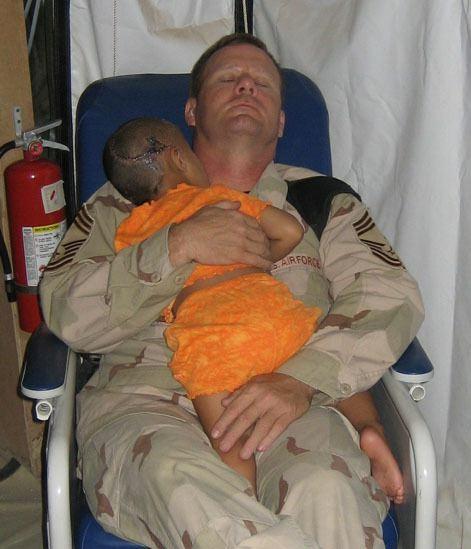
For me, nothing says it better than this, also pulled from 2006, which shows just why our soldiers and veterans are so worthy of our thanks and pride. I look at this and think of my brother who has said several times, with becoming modesty, that he really just wanted to help other people.


This moving photograph shows Chief Master Sgt. John Gebhardt, superintendent of the 22nd Wing Medical Group at McConnell Air Force Base in Kansas, holding an injured Iraqi girl. The picture was taken in October 2006, while Sgt. Gebhardt was deployed to Balad Air Base in Iraq. According to the Air Force Print News, the infant girl Sgt. Gebhardt held in his arms "received extensive gunshot injuries to her head when insurgents attacked her family killing both of her parents and many of her siblings."

Sgt. Gebhardt is now back home in Wichita, Kansas, with his wife and two children. An Air Force Link article about the sudden fame he gained as the subject of this photograph reported that:
The chief had a knack for comforting [the injured Iraqi girl] and they often would catch a cat nap together in a chair.

"I got as much enjoyment out of it as the baby did," he said. "I reflected on my own family and life and thought about how lucky I have been."

While deployed to Iraq, the chief tried to help out any way he could. He figured holding a baby that needed comforting that would free up one more set of arms that could be providing care to more critical patients.

"I pray for the best for the Iraqi children," he said. "I can't tell the difference between their kids and our kids. The Iraqi parents have the same care and compassion for their children as any American."
Source: Snopes
I haven't said it enough because none of us really can but to our veterans as well as those serving now ... thank you from the bottom of my heart.

We notice a self-hatred in the Western world that is strange ...

Here we notice a self-hatred in the Western world that is strange and that can be considered pathological; yet, the West is making a praiseworthy attempt to be completely open to understanding foreign values, but it no longer loves itself; from now on it sees its own history only as a blameworthy and destructive, whereas it is no longer capable of perceiving what is great and pure. In order to survive, Europe needs a new ... acceptance of itself, that is, if it wants to survive.

Joseph Ratzinger, Europe Today and Tomorrow
quoted in The Day is Now Far Spent, Cardinal Robert Sarah
I am, of course, aware of this self-hatred which is flung at Americans. We're not allowed to honor or praise ourselves in a lot of ways without having fellow Americans tell us why we are terrible.

Reading this quote it struck me that if Ratzinger was describing a person instead of the Western world, we would worry about suicide or abuse. Certainly we'd think of depression accompanying such self loathing. We would build the person up, not tear them down every chance we got. And yet this is how we as Americans, as Westerners, are treated. No wonder we are suffering cultural crisis on so many levels.

The Swan, No. 1

The Swan, No. 1 by Hilma af Klint, 1915
via J.R.'s Art Place

Friday, November 8, 2019

The Star Lovers

Illustration for The Star Lovers by Grace James
Illustrated by Warwick Goble
Read the story at Childhood Reading
This illustration makes me think of Bridge of Birds by Barry Hughart, which he graciously allowed me to read aloud for Forgotten Classics.

God awaits us in our own nature.

We must rediscover the fact that our own nature is not an enemy or a prison. It extends a hand to us so that we might cultivate it.

Through our nature, ultimately the Creator himself is the one who extends his hand to us, who invites us to enter into his wise and loving plan for us. He respects our freedom and entrusts our nature to us as a talent that is to be made productive. In the gender ideology, there is a deep rejection of God the Creator. This ideology has real-life theological and spiritual consequences. In opposing it, the Church is not making herself the intransigent, inflexible guardian of a supposed moral order. She is fighting so that each human being may encounter God. The first place where he awaits us is precisely our nature, our profound being that he offers us as a gift.
Cardinal Robert Sarah, The Day is Now Far Spent

Thursday, November 7, 2019

Peanuts and Bananas

We've got two new recipes that are going to be making repeat appearances ... Whole-Grain Banana Bread (don't worry - it is not healthy tasting, just delicious) ... and Curried Peanut Sauce (suitable for simmering any combo you like of meat and vegetables). Both are also super simple!

All at Meanwhile, Back in the Kitchen.

Gospel of Matthew: Come to the desert to be baptized in the Jordan

Matthew 3:1-2

I'm going to back up for a second to look at just a little of the deep symbolism of John the Baptist's ministry. His garb screamed prophet to the Jewish people and that connection is easy to see if you look back over the different Old Testament prophets.

But I never thought about how the place he chose for baptism would have elevated the event. No wonder everyone is hurrying to see him.

St. John the Baptist Preaching, c. 1665, by Mattia Preti
John the Baptist's ministry was based at the Jordan river, probably on the southern stretch of the river that flows by the Judean desert, just before emptying into the Dead Sea. To get there, crowds from Jerusalem would travel about twenty miles through rugged terrain in a hot, barren wilderness. One might wonder why John would base his movement out there.

To appreciate John's strategy in choosing this location we first must understand that the Jordan was more than a river for the Jews: it was a powerful symbol of hope and new life. God did great things at the Jordan. He healed Naaman the Syrian of his leprosy there (2 Kings 5:1-14), and he took the prophet Elijah up to heaven in a fiery chariot at the Jordan (2 Kings 2:1-11). Most of all God led the Israelites across the Jordan River at the end of their forty-year journey from Egypt to the promised land. Thus the Jordan represented the climax of the exodus story and the fulfillment of God's plan to bring Israel to the land of Canaan.

The Judean desert carried rich symbolism for the Jews. It too recalled the exodus story, for it was in a desert that Israel became established as God's covenant people as they journeyed to the promised land. ... The prophets foretold that God would lead his people back to the desert to renew his covenant with them. Hosea, for example, described how God would lovingly draw his sinful people back to him like a husband wooing an unfaithful wife. (Hosea 2:16, 20-21)

This background helps explain why John called the people to come out to the desert and be baptized in the Jordan. Such a summons would have signaled that everything the Jews had been longing for was about to be fulfilled. In this particular place, the ritual of baptism was a powerful symbolic action. In calling the people to journey into the wilderness to step into the Jordan River to be baptized, and to reenter the promised land, John was summoning them to reenact the exodus story. ...
Quote is from Catholic Commentary on Sacred Scripture. This series first ran in 2008. I'm refreshing it as I go.

Wednesday, November 6, 2019

Flower Girl

Flower Girl, Childe Hassam

Man's dignity consists of being fundamentally a debtor and an heir.

Man's dignity consists of being fundamentally a debtor and an heir. How beautiful and freeing it is to know that I exist because I have been loved! I am the product of a free decision by God, who, from all eternity, willed my existence. How sweet it is to know that one is the heir of a human lineage in which children are born as the most beautiful fruit of their parents' love. How productive it is to know that one is indebted to a history, to a country, to a civilization. I do not think that it is necessary to be born an orphan in order to be fully free. our freedom has meaning only if other persons give substance to it for us, gratuitously and through their love. What would we be if our parents did not teach us to walk and talk? To inherit is the condition for any true freedom.
Cardinal Robert Sarah, The Day is Now Far Spent

Tuesday, November 5, 2019

Impressions from Eastern Frisia: On the road

Taken by Marc Fabian Erdl

The True Nature of Our Liberty

We urgently need to discover the true nature of our liberty, which flourishes and is strengthened by agreeing to be dependent through love. Indeed, all love creates a relation with the object of our love that is a bond, a gift, a free dependence.
Cardinal Robert Sarah, The Day is Now Far Spent

Monday, November 4, 2019

Worlds of Crime and Post-Apocalyptic


Somehow it escaped me that two different SFFaudio episodes aired which featured books I dearly love. Maybe that's because I picked the books!

The Angel of Terror by Edgar Wallace is a most unusual crime novel from 1922 where no one will believe the one man who has evidence that a criminal mastermind is a woman — because she's so beautiful, how could she be evil? We discuss it in episode 547.

Mockingbird by Walter Tevis is set in a world run by androids where everyone has forgotten how to read. (Truly a terrible place!) This is the book that Jesse continually thanks my mother for discovering. My own review is here. We discuss it in episode 549.

Welcome Jeeves!


We didn't mean to get a puppy so soon after Wash died, but keeping an eye on Craig's List for Boxer puppies led us to this sweet little guy. Though "little" is a relative term. He was the biggest in the litter and weighed 15 pounds at 10 weeks old.

He's Jeeves because we never had a Boxer who didn't take an active interest in the mail, the housework, the social activities, and all the things that a good butler has to manage to keep everyone's lives on an even keel. What has surprised us is how few people (at the vet, for instance) have heard of the Jeeves name before. Oh civilization, what cost progress when we leave behind the gentle P.G. Wodehouse references?

Usually I never worry about bringing a puppy home to another dog. The adult understands that a puppy gets special license. But Kaylee is very dog aggressive. Wash is the only dog she was ever friends with so we weren't sure if her mothering instincts would kick in automatically.

We spent a week with them alternating crates to get to know each other, a day with them on leashes around the house ... and then Kaylee took things into her own hands, racing up and down in play mode. Off came the leashes and no one has looked back. Jeeves is delighted. He's hero worshipped Kaylee since he set eyes on her, plastering himself to her crate and whining.

Kaylee spent a day being very dominant (as is right and proper) and then settled down to enjoying playing and correcting when Jeeves forgets his place (which is fairly often - you know how fun it is to jump on someone's head - how do you just not do that?).


Now we're all settling down to the job of keeping socks and shoes off the floor, endless pull toy playing, and lots of fun as this little guy explores the big world. And at the end of the day ... we're all ready for a good rest.


Wednesday, October 23, 2019

Gospel of Matthew: Allow It Now

Matthew 3:13-17

I never caught the subtlety of this wording and certainly haven't ever heard anyone else mention it. What an eye opener as to God's continuing respect of our free will, as Jesus shows us here.
15 Jesus said to him in reply, "Allow it now, for thus it is fitting for us to fulfill all righteousness." ...

Jesus tells John to allow him to receive baptism because that is fitting for us: God's plan involves John as well as Jesus. God invites and requires our cooperation, as well; we must allow God to carry out his saving activity in and through us. Then he allowed him: John accepts Jesus' words and acts in accordance with them.

For reflection: What is God asking that I allow him to accomplish in and through me?
Quote is from Bringing the Gospel of Matthew to Life. This series first ran in 2008. I'm refreshing it as I go.

Friday, October 18, 2019

The Chinese Fishmonger

Theodore Wores, The Chinese Fishmonger

Satan has a fierce hatred of priests.

Satan has a fierce hatred of priests. He wants to defile them, to make them fall, to pervert them. Why? Because by their whole life they proclaim the truth of the Cross. Priests and consecrated persons cannot leave the world indifferent. They proclaim down to the flesh this truth of the Cross. They will always be a subject of scandal for the world. They take Christ's place. ... Priests and consecrated persons, by their humble, dedicated lives, are a formidable challenge to the power of the world.

[...]

The devil tries to tear the Church apart, first by attacking the priesthood. Satan intends to destroy priests and the teaching of doctrine. He is horrified by the liturgy, the sacraments, and the apostolic succession. In trying to take out his hatred on consecrated persons, he means to ridicule the Church. Priests frighten him because they are the ministers of mercy. He knows that he will be vanquished by mercy. He seeks to instill lukewarmness and doubt in priests. He seeks to win the hearts of some to to draw them ro renounce chastity. Worse yet, he has driven some priests to profane the bodies of children. How can we not see Satan's work in these lives of priests or bishops who have behaved like predators, spreading evil and spiritual death all around them? How can we not see that, in attacking both priests and children at the same time, the demon reveals his hatred of two reflections of God's goodness?
Cardinal Robert Sarah, The Day is Now Far Spent

Wednesday, October 16, 2019

The Last Dance by Martin L. Shoemaker


In space, mutiny means death—that’s why Inspector General Park Yerim is taking her investigation so seriously. The alleged mutineer is Captain Nicolau Aames, whose command of the massive Earth-Mars vessel Aldrin has come under fire. The vast System Initiative says he disobeyed orders, but his crew swears he’s in the right.

En route to Mars, Park gathers testimony from the Aldrin’s diverse crew, painting a complex picture of Aames’s character: his heroism, his failures, even his personal passions. All eyes are on Park: one way or another, her findings will have astronomical implications for the Aldrin and the future of space travel.
The last time I enjoyed a new science fiction author this much was when I read Leviathan Wakes. Like that book, this one feels like something from the Golden Age of Science fiction, while being something brand new.

Inspector General Park conducts a series of "off the record" interviews while investigating charges of mutiny against the captain of a Martian-bound spaceship. That's the framework for a series of stories that range from mystery to Martian survival to estranged love. All are building blocks in the overall question of figuring out the accused captain's motivations and guilt or innocence. It's space opera in fine form.

I burned through this in two days and am already looking forward to the second in the series, though I'll have to wait a year for it.

Spectacular view in Llano County

Jason Merlo Photography

Gospel of Matthew: Nazareth is Not a Backwater

Nazareth, 1942
We all picture Jesus growing up in a burg, right? I know I did — until I was set straight by historical context.
It was in Nazareth that Joseph settled, and it was in Nazareth that Jesus was brought up. It must not be thought that Nazareth was a little quiet backwater, quite out of touch with life and with events.

Nazareth lay in a hollow in the hills in the south of Galilee. But a lad had only to climb the hills for half the world to be at his door. He could look west and the waters of the Mediterranean, blue in the distance, would meet his eyes; and he would see the ships going out to the ends of the earth. He had only to look at the plain which skirted the coast, and he would see, slipping round the foot of the very hill on which he stood, the road from Damascus to Egypt, the land bridge to Africa. It was one of the greatest caravan routes in the world.

It was the road by which centuries before Joseph had been sold down into Egypt as a slave. It was the road that, three hundred years before. Alexander the Great and his legions had followed. It was the road by which centuries later Napoleon was to march. ... Sometimes it was called The Way of the South, and sometimes the Road of the Sea. On it Jesus wou;d see all kinds of travelers from all kinds of nations on all kinds of errands, coming and going from the ends of the earth.

But there was another road. There was the road which left the sea coast at Acre or Ptolemais and went out to the East. It was the Road of the East. It went out to the eastern bounds and frontiers of the Roman Empire. Once again the cavalcade of the caravans the their silks and spices would be continually on it; and on it also the roman legions clanked out to the frontiers.

Nazareth indeed was no backwater. Jesus was brought up in a town where the ends of the earth passed the foot of that hilltop. From his boyhood days he was confronted with scenes which must have spoken to him of a world for God. ...

So now the stage is set; Matthew has brought Jesus to Nazareth and in a very real sense Nazareth was the gateway to the world.
Quote is from The Daily Study Bible Series. This Matthew study first ran in 2008. I'm refreshing it as I go. 

Friday, October 11, 2019

Hurrying

There are more important things to do than hurry.
Robert Farrar Capon
Really countercultural. Really true.

Portrait of a Young Woman

Portrait of a Young Woman, Edgar Maxence (1871-1954)

Wednesday, October 9, 2019

Oct. 25 - Shah Rukh Khan on Letterman's "My Next Guest Needs No Introduction"

It took me about a year (and 100 Hindi movies, most of them not with him) to get there, but I have to admit that I'm hooked. I'm an SRK fan.

So it's no surprise that I've been waiting for this since they taped it.


Gospel of Matthew: When Life Takes Unexpected Turns


The Flight into Egypt by Giotto di Bondone

Matthew 2:13-18

It's easy to think of Joseph being serene and simply floating along in his role as Mary's husband and Jesus' father. Of course, only a second's thought shows that is highly inadequate. The poor man must have been wracked with doubts otherwise God wouldn't have needed to send him dreams of direction. If he had been floating serenely then God might have sent down a congratulatory "Good show!" but no more would have been necessary. I especially like the way that George Martin points out what Matthew does and does not show us.
Joseph and his family can be looked upon as patron saints for today's political refugees. Yet Matthew does not dwell on the hardships they might have experienced. Matthew portrays Joseph as a man living an upright life that periodically takes sudden turns. Joseph is betrothed to Mary--but discovers she is pregnant, and learns from an angel that it is through the Holy Spirit. In due course her child is born—then magi arrive, quickly followed by angelic instructions to flee to Egypt. We might think of Joseph as a patron saint for those whose lives take unexpected turns as they try to remain faithful to God.

For reflection: What unexpected turns has my life taken? What can I learn from the example of Joseph?
Quote is from Bringing the Gospel of Matthew to Life. This series first ran in 2008. I'm refreshing it as I go.

Tuesday, October 8, 2019

A Waffle Making Dad

Darwin Catholic makes waffles for the family and muses about fatherhood and ... of course ... waffle making. Being Darwin, he gets to some interesting places. Here's some:
I've read compelling writing by women writers about the emotional labor they do to keep a family going. I wouldn't claim that for my tribe, we waffle making dads. We're not particularly emotional. But we try to do our labor. We make weekend breakfasts and dinner once or twice a week when we're around in time do to the prep. We do the "you'll have to talk to your father when he gets home" conversations, and the careful diffusing conversations with daughters entering their teens who at times decide that their mothers don't understand them at all and Dad is the only person they will listen to. We mow the lawn and take the trash out and get the oil changed more or less on time. We pay the bills and track the finances and deal with a host of practical issues while having the unfortunate tendency to assume that everything is okay in people's emotional lives unless they actually tell us otherwise.

The waffle making dad can seem like a pretty out-dated archetype these days. The up to the moment guy is a sensitive feminist ally who admires kick-ass women and decries male privilege ...

I'm not sure how to address that whole set of ideals and concerns, the people who snappily say that women are giving up a lot to teach a young man to make waffles, so I'll just leave that to one side. My words are to the young men of the world. And I'll say: being a waffle making dad is not a bad aspiration. In a world that can't seem to make up its mind what, if anything, it wants from masculinity, many of the archetypes available out there are not great. ...
Now go read the whole thing!

A Capacity to Receive

After all, you must have a capacity to receive, or even omnipotence can’t give. Perhaps your own passion temporarily destroys the capacity.

For all sorts of mistakes are possible when you are dealing with Him. Long ago, before we were married, H. was haunted all one morning as she went about her work with the obscure sense of God (so to speak) ‘at her elbow,’ demanding her attention. And of course, not being a perfected saint, she had the feeling that it would be a question, as it usually is, of some unrepented sin or tedious duty. At last she gave in—I know how one puts it off—and faced Him. But the message was, ‘I want to give you something’ and instantly she entered into joy.
C.S. Lewis, A Grief Observed
That's what happens when you think you know it all. Ahem - which would never happen to me! Of course not!

I wish I didn't identify so well with H's putting it off.

Monday, October 7, 2019

The End to Our Double Boxer Era — Goodbye to Wash


On Thursday, our gentle 11-year-old giant Wash suddenly went down. On Friday morning we had him put to sleep. Of all the dogs I've known in my lifetime I now realize that he was "my dog" more than any of them. He was embedded in my routine in a dozen tiny ways I never thought about.

As Tom said on Facebook, Wash was the opposite of Zoe, our other Boxer who died a few months ago. He was happy, curious, and playful as a Boxer should be. His soulful eyes added greatly to the Boxer look of "concerned curiosity" and he took that look seriously, he had to sniff every package or mail that came into the house.

Wash always was more aware of the television than other dogs we've had.
He particularly responded to dogs, sometimes without even hearing barking —
in the instance above the animated dog hadn't made a sound. Wash will bound over to
the television and brace himself on the console so he can bark back "in person."
When the dog disappeared mysteriously, he'd look for the interloper behind the TV
and then around the house.

We took it as a good omen that he died on the feast day of St. Francis. I am really glad that right before everything went downhill he went on a walk where he warned the other dogs that this was his street (by aggressively eating a mouthful of grass, an intellectual connection that the other dogs totally missed every time), drank from sprinklers, and checked out all the Halloween decorations in yards. In other words, he got to enjoy his life to the fullest to the very end.

He was a good dog and he will be missed by everyone who knew him.

In the meantime, Kaylee is doing her best to fill the void. As Tom says, "Even though we lost a pair of Boxers this year, we still have a half pair of briefs. (Sorry for the pun)"


Here are a couple of memories from the "double boxer" years.

The early years, Wash and Zoe

More grown up and tired out from "watching" football with the family.

Friday, October 4, 2019

First Friday Fast - for the Church and Our Priests

Bread and Water by Duane Keiser
Dear friends, your pastors are full of faults and imperfections. But despising them is no thte way to build Church unity. Do not be afraid to demand of them the Catholic faith, the sacraments of divine life. ... If you think that your priests and bishops are not saints, then be one for them. Do penance, fast to make reparation for their defects and their cowardice. That is the only way that anyone can bear another's burden.
Cardinal Robert Sarah, The Day is Now Far Spent
Since soon after the reports about Cardinal McCarrick's heinous behavior came out, as well as the horrifying reports about how many highly placed Church officials overlooked his actions, I have been observing a fast on the first Friday of each month. I offer it up for purification and support of the Church and our priests.

I didn't mention it, thinking of Jesus' direction to not bring attention to one's own fasting and prayer. Cardinal Sarah's words gave me new resolve in what had become a somewhat perfunctory observance. It also made me think that I needed to go public, recommend the practice, and ask you to join in unity, observing what penance seems good to you. So join me!

Thursday, October 3, 2019

Stunning Moments of Forgiveness and Mercy in the Name of Christ

I was stunned when I saw the extraordinary Christlike behavior of murder victim Botham Jean's brother toward Amber Guyger, the former Dallas police officer convicted of murder in Jean’s 2018 shooting death.

I've noticed that a lot of news sources are reporting the hug, but not the strong Christian message that was key to Brandt Jean's message, as well as to the judge's follow up (below). So I'm sharing the videos here.
This was Brandt Jean’s chance to tell Guyger exactly what he thought of the former Dallas officer after she was sentenced to 10 years in prison for murdering his brother last year when she mistook his apartment for hers....

Instead, Jean told Guyger that he wanted what Botham would have wanted.

"I think giving your life to Christ would be the best thing that Botham would want for you," he told her. "I love you as a person, and I don't wish anything bad on you."

He told Guyger that he didn't even want her to go to prison.

"Can I give her a hug, please?" Brandt asked. "Please."
See it all below.


Equally extraordinary was the moment of grace extended by the judge. After speaking to the family, she spoke with Guyger and then ...
The judge appeared to be overcome in the moment, and left the courtroom. She returned a moment later, a small Bible in her hand.

“You can have mine,” the judge said to Guyger. “I have three or four at home.”

She then began to counsel Guyger. The pair were talking low, barely audible, just the two of them. “This is your job,” the judge said, opening the book.

The judge mentioned John 3:16, saying this will strengthen her. Guyger nodded her head.

“You just need a tiny mustard seed of faith,” the judge said. “You start with this.”
See the news report below which contains much more.

Gospel of Matthew: Follow That Star!

Edward Burne-Jones, Star of Bethlehem

Matthew 2:1-12

One of the favorite things I learned recently when reading up on the pagan prophet Balaam is that he prophesied the star of Bethlehem. We see this time and again. God uses everyone and anyone in order to work for the good of us all and our salvation. Even a pagan prophet who doesn't know enough to listen to his talking ass! (Numbers 22-24)

I always figured that star was a bonus, tied into ancient expectations about the symbols which accompanied a king. And that is also true. But to see it tied into Balaam's prophecy is really wonderful. Then looking at how that story foreshadows the events of Jesus' birth, as we're shown below ... well it just keeps getting better and better.
The account of the magi following a star and searching for a king underscores Jesus' kingship by recalling the prophecy of Balaam in Nm 24. In this episode the Moabite king, Balak, called upon a seer named Balaam to pronounce a curse on Israel. However, each time Balaam tried to curse Israel God took control of his speech and words of blessing came out of his mouth instead. In his last attempt to curse Israel, the Spirit of God came upon him and he prophesied about a future king arising out of Israel. According to this oracle, a star would be the sign of the great king's arrival (Num 24:17).

All this foreshadows the events associated with Herod, the magi, and the birth of Jesus. Just as Balak sought to use the pagan seer Balaam to destroy Israel, so Herod seeks to use the pagan magi to destroy the Christ child. And just as Balaam failed to cooperate with the king's plan, uttering blessings instead of curses, so the magi fail to assist Herod in his plot to destroy Jesus, paying the child homage instead of reporting his location to Herod.
Quote is from Catholic Commentary on Sacred Scripture. This series first ran in 2008. I'm refreshing it as I go. 

Friday, September 27, 2019

Tiffany Pitcher

Tiffany and Company Pitcher, New York City, 1878
Public domain, courtesy of The Art Institute of Chicago
An asymmetrical water scene, realized through a combination of hammering, engraving, and applied metal elements, wraps around the body of this pitcher. The vignette was almost certainly inspired by the work of Katsushika Hokusai, a Japanese artist known for his dynamic woodblock prints of the natural world. Tiffany and Company’s design library included three volumes of Hokusai’s work, many featuring the same graceful irises, enlivened dragonflies, and splashing carp visible on this pitcher.

Thursday, September 26, 2019

A Great Beginning to a Catholic History Series: The Church and the Roman Empire by Mike Aquilina


The Church and the Roman Empire (301–490)
Constantine, Councils, and the Fall of Rome
by Mike Aquilina


This brand new history series is just what I've been wanting — truthful Catholic history that's easy to read and that busts some of the ubiquitous myths about Catholicism. Author Mike Aquilina keeps the history easy to understand while adding depth to the bits that I already knew ... or thought I knew.

Occasional "Up Close and Personal" boxes showcase different personalities or aspects of Christianity from that time, such as looking at the Catholic bishop before Patrick or listing five who chucked everything for a life of solitude. "You Be the Judge" boxes examine common questions and set the record straight on topics like "Didn't Christianity harm the status of women?" or "Do Christians exaggerate the persecutions?"

One of Aquilina's strengths is the way that he makes the scenes come alive. Here's a bit from the Council of Nicaea.
It was a grand spectacle to see so many bishops at once, and the general public filled the spectators' areas to listen to some of the preliminary debates. Even pagan philosophers joined the fun—some out of genuine curiosity, others to make fun of the Christians. People from town came just to see the parade of bishops of all nations. Even Scythia, exotic land of barbarian cowboys, and Persia, traditional enemy of Rome for generations, were represented. ...

And of course everyone wanted a glimpse of the two men who had started the whole uproar, Arius and Alexander. Alexander, a frail old man who needed help to get around, was a bit of a disappointment, although his young archdeacon and assistant Athanasius looked like a man to watch. But Arius was a rock star. he was tall, a good speaker, and a very thoughtful-looking man. Fangirls followed him wherever he went. He must have something to say.
It really makes me feel the excitement in the air. Very much not the way I usually think of the Council of Nicaea!

Highly recommended. I can't wait for the other books in the series to be published.

Wednesday, September 25, 2019

Gospel of Matthew: Jesus' Family Tree

Having recently been focusing on the prophets, for a book that will be coming out next year, it seemed natural to look at Matthew mostly because he is so good at quoting the Old Testament and reminding us to ponder the whole Bible. So I'm gonna take you along for the ride. This won't be any sort of comprehensive study. Just some of the interesting things I find on the way.

Rose window in Basilica of Saint-Denis, France,
depicting the ancestors of Jesus from Jesse onwards
Matthew 1:1-17
Ah yes, that interminable genealogy at the beginning of Matthew. Like me, you may have come across various explanations as to why particular people are included, their significance to Jesus' message to us, and why the thing is so darned long.

The ancient Jews loved genealogies. Every name called a story to mind and pointed to a particular part of salvation history. It has a theological content but also shows that these were real people and that Jesus broke into real time and history. So if you're telling the story of the Son of God coming to earth, wouldn't you start with where he fits in salvation history?

Two names in particular stand out from the very beginning. Jesus is called the "son of David" which reminds us of the promise God made that the Messiah would come from the line of David and establish a kingdom that would endure forever. Jesus is also called the "son of Abraham" which reminds us of God's promise that Abraham's descendants would become a great nation and that all nations would find blessing through his family. In Jesus these promises are fulfilled, Matthew is telling us.

Most interesting to me is the inclusion of four women in the genealogy — Tamar, Rahab, Ruth, and Bathsheba. It isn't unprecedented, but it is unusual. Especially when you consider that they are all Gentiles and three of them are associated with sexual immorality. Yet, they are specifically called out for our attention among Jesus' ancestry.
Matthew thus selects three of the most prominent Gentile women in the ancestral line of David along with the most famous of David's wives to highlight how Gentile blood flowed into the royal line of David. This underscores God's concern for Gentiles, demonstrating that he brought them into the story of Israel even in the Old Testament. It also lays a foundation for the universal mission of Jesus' kingdom, which will gather Gentiles into God's covenant family ...
All that in one genealogy! Which I'd have skipped without the commentary to show me what I was missing by not paying attention.

---------

Quote is from Catholic Commentary on Sacred Scripture: Gospel of Matthew. This series first ran in 2008. I'm refreshing it as I go.

Tuesday, September 24, 2019

This Just In: The Day is Now Far Spent by Cardinal Robert Sarah

Christians are trembling, wavering, doubting. I want this book to be for them To tell them: do not doubt! Hold fast to doctrine! Hold fast to prayer! I want this book to strengthen faithful Christians and priests.
I ordered this book as soon as I heard about it. I liked Cardinal Sarah's previous books, especially God or Nothing. This one looked like the shot of inspiration and support that I have been craving in the midst of the Church's crisis. I've only read the introduction but am already heartened.

The whole intro is available as a sample from Amazon and I urge you to read it.

Sources for Gospel of Matthew Bible Study

The last time we looked at the Gospel of Matthew together it was 2008!

So we're way past time to take a second look at some of the things that bring Matthew alive for me. Here are my favorite resources. I may not quote all of these, but I'll have looked through them and over the years they have added to my overall knowledge.

Simone Cantarini , St. Matthew and the Angel
The Navarre Bible: Matthew
The Navarre commentaries are consistently excellent and have a lot of thoughts from Church Fathers, Popes, saints, and the Catechism. They add wisdom from the 2,000 years of Church contemplation on scripture since Jesus.

Life Application Study Bible: New International Version
This Protestant Bible is an interesting resource. The footnotes are fresh, interesting, and a good resource for historical questions such as how threshing was done when Ruth met Boaz for example. They also have maps and occasional one page essays about main figures of the Bible. There is a tendency to ask questions at the end of commentary such as, "Do you listen to God like this person, etc.?" which I find rather annoying but they may not strike everyone that way. I would advise the NIV version as I have been told that translation is more accurate than the New Living Translation.

Catholic Commentary on Sacred Scripture: The Gospel of Matthew
The structure is such that you are generally covering just a little scripture at a time. Each reading is followed with cross references to the Old Testament, New Testament, Catechism, and Liturgy. These are followed by the commentary, in which words from the scripture reading are bold whenever they are used. Although I saw some people complaining about that practice, I found it useful. Sometimes a bold word would make me suddenly pay attention and go back to the scripture, thinking, "Did it really say that? Why haven't I ever noticed before?"

There are also a few maps, occasional photos when they'd be helpful, and sidebar boxes with Biblical background and living tradition (Catechism, Fathers of the Church, saints) information that enriches understanding.

In Conversation with God by Francis Fernandez
A daily devotional that follows the daily Mass readings. Topics range from the sacraments and virtues to family interaction and friendship. The sensible and down-to-earth writing is enhanced by quotes from saints, Church Fathers, popes, cross-references with other scripture than in the day's readings, Church documents, etc. I've been using this for 20 years off and on.  Full review here.

The Word on Fire Bible: The Gospels
From the Word on Fire ministries headed by Bishop Robert Barron, this is a commentary bible loaded with observations from the Church Fathers, newer Catholic writers like Fulton Sheen and G.K. Chesterton, and Bishop Barron himself. The primary purpose is evangelization of those not affiliated with organization or Christianity and poses the question throughout of "Who is God? and "Who is Jesus Christ?"

Opening the Scripture series: Bringing the Gospel of Matthew to Life
This is the one that I used for my first Gospel of Matthew series of posts, way back in 2008. It's still good. Read my full review here.

Ignatius Matthew Study Bible
This has since been gathered into the Ignatius Study New Testament by Scott Hahn and Curtis Mitch. I already had it in this individual little book. The commentary is excellent, as one would expect.

Word Among Us
Available in print or digital format, this monthly magazine has the daily Mass readings with a little commentary. There are also a few articles covering the monthly theme.

The Daily Study Bible Series — The Gospel of Matthew, Revised Edition
I'm a real fan of William Barclay's commentaries on the New Testament books. Barclay's strengths are his phenomenal knowledge of the Greek language, the Jewish culture and religion, and the Roman occupation during the New Testament era. He is wonderful at conveying this knowledge in a way that simple and easily understandable. He puts it in context so that you can understand what events meant to the people to whom Jesus spoke to 2,000 years ago.

However, I have to always include this caveat when mentioning William Barclay ... his theology can be very wonky if you are Catholic. For example, his commentary on the gospels with nativity stories include a number of reasons Jesus' virgin birth didn't necessarily have to be virgin. Sorry. That's really nonnegotiable. He also often includes pointed commentary about why Roman Catholic teachings are wrong. So there's that ...

But if one reads with a knowledgeable eye, Barclay's work is really wonderful.

NOTE: the recently revised versions (1990s and beyond) have been heavily edited to be more politically correct. I'm not sure what that has done to Barclay's original work so I just go with the second revision, done under Barclay's eye. I'm not so thin skinned that I can't stand a little old fashionedness.

Thursday, September 19, 2019

Being Mortal: Medicine and What Matters in the End by Atul Gawande


The simple view is that medicine exists to fight death and disease, and that is, of course, its most basic task. Death is the enemy. But the enemy has superior forces. Eventually, it wins. And in a war you cannot win, you dn't want a general who fights to the point of total annihilation. You don't want a Custer. You want Robert E. Lee, someone who knows how to fight for territory that can be won and how to surrender it when it can't, someone who understands that the damage is greatest if all you do is battle to the bitter end.
This is about the conversation no one wants to have — as we grow older and frailer or face incurable disease (no matter our age) — how do we cope? What should we ask our doctors and our loved ones in order to try to ensure the best outcome, under circumstances in which "complete cure" may not be possible? This book looks at all sorts of situations, from the person in a senior care home who needs a sense of purpose to a young mother with terminal cancer.

I read this at the urging of my daughter whose book club had discussed it. As other reviewers have noted it can be depressing. However, so are some of the circumstances in which we may find ourselves by the end of our lives. It is worth pushing through to the end because author Atul Gawande works through the physical difficulties of aging and disease to look at what makes us have our best days. I especially appreciated the questions he asks to help people identify what's most important to them when their world has narrowed because they are on their way out of it. How do we finish our story in the way that is most meaningful to us?

At the end I was in tears, but they were good tears. This is a thoughtful and honest book which I wholeheartedly recommend.