Eating Crow
 by Jay Rayner
Travels with My Donkey
 by Tim Moore
Murder in Belleville
 by Cara Black
by Jay Rayner by Tim Moore by Cara Black
by Cara Black
by Jay Rayner by Tim Moore by Cara Black
Maybe I'll try Anna Karenina next.Leo Tolstoy
History controls everything we do,
so there is no point in observing individual actions.
Let's examine the individual actions of over 500 characters at great length.
THE END
Fifth, "Go make disciples of all nations" means all nations -- the whole world and all its peoples. Jesus is not just "an" answer for some people. Or "the" answer for Western culture. He is not just a teacher like Buddha, or a prophet like Mohammed. He is the Son of God. And what that means is this: Jesus is the answer for every person, in every time, in every nation. There is no other God, and no other Savior. Jesus Christ alone is Lord, and the Catholic Church is the Church he founded. If anyone is saved, he is saved only through Jesus Christ and his Church, whether he knows the name of Jesus or not.
Ecumenical and interreligious dialogues are enormously valuable things. They form us in humility; they deepen our understanding of God; and they teach us respect for our brothers and sisters who don't share our faith but who sometimes radiate Christ's love far better than we do. And yet even our sinfulness does not exempt us from preaching and defending the truth. If we really believe the Catholic faith is the right path to God, then we need to share it joyfully, firmly, with all people and in all seasons. We need to defend it with passion, courage -- and also with charity.
The bottom line is this: Our mission is to advance God's work of redeeming and sanctifying the world. Our mission is to bring all people to salvation in Jesus Christ. That is our mission in community as the Catholic Church and individually as Catholic believers. It's a task of both truth-telling and of love.Archbishop Charles Chaput
from the introduction to
How Not to Share Your Faith:
The Seven Deadly Sins of Apologetics
by Mark Brumley

Fourth, Jesus does not ask the impossible. If he tells us to teach all nations, it is because it can be done. Nothing is impossible with God. When Paul began his work, conversion of the Roman world seemed impossible. But it happened. When Mother Teresa began her work in Calcutta, no one had any idea she would touch people of all nations with her example of Christ's love. But it happened. Do not worry about the odds. They do not concern us. Never be afraid to speak up for the truth. God will do the rest.To be continued ...Archbishop Charles Chaput
from the introduction to
How Not to Share Your Faith:
The Seven Deadly Sins of Apologetics
by Mark Brumley
 and Samuel Shellabarger for my historical fiction.
Third, if Jesus speaks to each of us personally, it is because each of us personally makes a difference. God did not create us by accident. He made us to help him sanctify this world, and to share his joy in the next. The biggest lie of our century is that mass culture is so big and so complicated that an individual cannot make a difference.To be continued ...
This is false. This is the Enemy's propaganda, and we should never believe it. We are not powerless. Twelve uneducated Jews turned the Roman world on its head. One Francis Xavier brought tens of thousands of souls to Jesus Christ in the Far East. One Peter Canisius brought tens of thousands of fallen-away Catholics back to the Church.
If Christians were powerless, the world would not feel the need to turn them into martyrs. The gospel has the power to shake the foundations of the world. It has done so many times. It continues to do so today. But it cannot do anything, unless it is lived and preached, taught, explained, and defended. This is why the simplest Christian is the truest and most effective revolutionary. The Christian changes the world by changing one heart at a time.Archbishop Charles Chaput
from the introduction to
How Not to Share Your Faith:
The Seven Deadly Sins of Apologetics
by Mark Brumley
 . (By the way Barbara I remember that I owe you a review of this book and fear it never may happen ... that's what happens when I have no specific deadline...perhaps this excerpt will help a little.)
The season of Advent carries a double meaning. On the one hand, people feel a desire to prepare themselves for the coming of Christ into the world, into their lives. And, looking ahead to the Second Coming, the Last Judgment, they attempt to examine their consciences, to repent. Advent, then, has always been, like Lent, a period of prayer and fasting.Catholic Culture has some Advent activities listed that you may find enhance the anticipation while helping keep our eyes firmly on the real reason for the season.
But Christians everywhere have felt that there was a great difference between Lent and Advent. Lent is a very somber period, leading to the Cross. Advent is intrinsically more joyful: after all, what it leads up to is Christ's birth. So if Advent is a period of spiritual preparation, of prayer, works of mercy, frequent visits to church, it is nonetheless suffused with Christmas joy.
How are we to observe this season of happy yet prayer-filled anticipation? How can we keep Advent from being swallowed in the worldly Christmas season? Many people find that abstaining from meat, wine, sweets, or other food that they care about for two or three (or more) days a week is most helpful in reminding them that it isn't Christmas yet, that this is a time to prepare the heart. Some focus on the needs of the poor, even greater at this season than usual: not only is it cold out there (just think of the Holy Family, seeking shelter, so long ago), but poor families need money in order to have a Christmas dinner and to give their children gifts. Thinking about poor children can be very important for our children, most of them so amply endowed with possessions. Try letting each child pick out a toy, perhaps even contribute something from his or her allowance, for someone who has no toys. Such an experience can be a great builder of compassion.
Advent has its authentic pleasures. These are anticipatory joys, such as the setting up of a creche, one figure at a time perhaps. Day by day open the windows of an Advent calendar. Play and sing the music of Advent: "O Come, O Come, Emmanuel."
Second, Jesus is not talking to somebody else. He is talking to you and me. "Go and make disciples of all nations" could not be more personal. Jesus wants you. The work of evangelizing -- and its sibling, apologetics -- is not just a job for "professionals." We are the professionals by virtue of our baptism. If the responsibilities of your life prevent you from going to china or Africa, then witness to and defend your faith where you are -- to your neighbors, you coworkers, your friends. Find ways to talk about your faith with the people you know. Work to conform your life to the things you say you believe. Make your actions support your words, and your words, your actions.To be continued ...Archbishop Charles Chaput
from the introduction to
How Not to Share Your Faith:
The Seven Deadly Sins of Apologetics
by Mark Brumley
Go therefore, and make disciples of all nations, baptizing them in the name of the Father and the Son and of the Holy Spirit, teaching them to observe all that I have commanded you; and lo, I am with you always, to the close of the age (Matt. 28:18-20).To be continued ...
Simple, direct, no-nonsense. These words of Jesus are the greatest mission statement ever written. But in hearing this Scripture so many times in daily life, we can easily become dull to its power. So let's examine it.
First, it is not a suggestion or a request. It is a command. If we say we believe in Jesus Christ, we must preach the gospel. We must teach the faith, and we must also explain and defend it. There is no Option B. Jesus does not need our polite approval. He does not want our support from the sidelines. He wants us -- our love, our zeal, our whole being -- because through us he completes the work of salvation, which has never been more urgent for the world than right now.Archbishop Charles Chaput
from the introduction to
How Not to Share Your Faith:
The Seven Deadly Sins of Apologetics
by Mark Brumley
 * by Tim Bete
When I was in kindergarten, I prayed for proof that God existed. I wasn't looking for God to reveal himself through the biggest miracle. I was only five so I was practical. I wanted God to place some graham crackers in a plastic bag in my coat pocket. Every day when I went into the coatroom, I dug my hands down deep into my pockets -- but they were always empty. When I graduated to first grade, I gave up asking God for graham crackers because I was convinced he wasn't going to produce.Tim Bete writes a la Erma Bombeck ... if Erma had been a Catholic father. He looks at his life with his family of small children through a lens of laughter and the appreciation of small everyday miracles. Covering such subjects as fending off questions about impending additions to their large family, what happens when the caterpillars from a butterfly garden escape captivity into your household, and watching your five year old's T-ball game, Bete looks for the humor in every side of every situation.
Thirty-five years passed. Then one day, I put my hand in my pocket and felt a plastic bag. I pulled it out and there in the bottom of the bag where three graham crackers. Sure, they belonged to one of my kids, but who's to say God didn't just take the slow fulfillment route -- using my daughter as the delivery girl -- to grant my kindergarten prayer?
But that wasn't all. As I dug my hand deeper into my coat pocket, I discovered two rubber bands, a dandelion, some pebbles, and a Happy Meal prize. When God answers prayers, he does it in abundance. I showed these treasures to a friend, who showed me the contents of his pocket -- two licorice sticks, three pennies, and a feather. I didn't have to ask him what he prayed for in kindergarten.
Help wanted: MotherI will say that I never could appreciate Erma Bombeck so this is not really my sort of book. Bete seems determined to milk every bit of laughter he can and sometimes went over the top. However, so did Bombeck from my point of view so one must take that into account. I appreciated the fact that he always connected details of his family life with the big picture of God working our lives everyday. I did find some parts of the book quite funny and so did my husband, who got a big laugh from the excerpts featured here.
Seven-day workweek with twenty-four hour shifts. Some vacation time accrues after first eighteen years. Must be able to cook at least ten dishes none of the kids will eat. Ability to tune out crying a must. Should be able to carry infant and three bags of groceries at same time. Must have chauffeur's license and advanced degrees in nursing, veterinary medicine, and education while not too proud to be a seamstress and maid. Must be able to juggle schedules while balancing a checkbook as well as be willing to be spit-up upon. Requires willingness to change dirty diapers, flat tires, and plans at the last minute. No previous experience necessary because no previous experience can prepare you for this job. Children willing to break in new recruits.
If you imagine yourself on the hillside when Jesus multiplied the five loaves and two fish to feed more than 5,000, I think you'll see my point. There must have been a thousand children present. By my calculation, immediately after the miracle, 400 kids would have said they "didn't like fish." three hundred and fifty children would have complained that their "bread was touching their fish," and therefore they couldn't eat it. One hundred and fifty kids would have whines that the fish was "inedible without tartar sauce." Seventy-five would have asked for "fish sticks instead of the whole fish." Finally, twenty-five children must have dropped their fish on the ground and cried because it was dirty, even though they never would have eaten it in the first place.
I could be wrong, but that's what would have happened if my kids were on that hillside. Because Jesus was in charge, however, two miracles occurred. First, he multiplied the loaves and fish. Second, all the kids ate it. You decide which was the greater miracle.
 . It is lengthy but I love it and think it speaks to the scientific attitude about many things today so I'm putting the entire thing up.
Hammond sighed, and sat down heavily. "Damn it all," he said, shaking his head. "It must surely not have escaped your notice that at heart what we are attempting here is an extremely simple idea. My colleagues and I determined, several years ago, that it was possible to clone the DNA of an extinct animal, and to grow it. That seemed to us a wonderful idea, it was a kind of time travel -- the only time travel in the world. Bring them back alive, so to speak. And since it was so exciting, and since it was possible to do it, we diced to go forward. We got this island, and we proceeded. It was all very simple."
"Simple?" Malcolm said. Somehow he found the energy to sit up in the bed. "Simple? You're a bigger fool than I thought you were. And I thought you were a very substantial fool."
Ellie said, "Dr. Malcolm," and tried to ease him back down. But Malcolm would have none of it. He pointed toward the radio, the shouts and the cries.
"What is that, going on down there?" He said. "That's your simple idea. Simple. You create new life-forms about which you know nothing at all. Your Dr. Wu does not even know the names of the things he is creating. He cannot be bothered with such details as what the thing is called, let alone what it is. You create many of them in a very short time, you never learn anything about them yet you expect them to do your bidding, because you made them and you therefore think you own them; you forget that they are alive, they have an intelligence of their own, and they may not do your bidding, and your forget how little you know about them, how incompetent to do the things that you so frivolously call simple ... Dear God ..."
He sank back coughing.
"You know what's wrong with scientific power?"Malcolm said. "It's a form of inherited wealth. And you know what assholes congenitally rich people are. It never fails."
Hammond said, "What is he talking about?"
Harding made a sign, indicating delirium. Malcolm cocked his eye.
"I will tell you what I am talking about," he said. "Most kinds of power require a substantial sacrifice by whoever wants the power. There is an apprenticeship, a discipline lasting many years. Whatever kind of power you want. President of the company. Black belt in karate. Spiritual guru. Whatever it is you seek, you have to put in the time, the practice, the effort. You must give up a lot to get it. It has to be very important to you. And once you have attained it, it is your power. It can't be given away: it resides in you. It is literally the result of your discipline.
"Now what is interesting about this process is that, by the time someone has acquired the ability to kill with his bare hands, he has also matured to the point where he won't use it unwisely. So that kind of power has a built-in control. The discipline of getting the power changes you so that you won't abuse it.
"But scientific power is like inherited wealth: attained without discipline. You read what others have done, and you take the next step. You can do it very young. You can make progress very fast. There is no discipline lasting many decades. There is no mastery; old scientists are ignored. There is no humility before nature. There is only a get-rich-quick, make-a-name-for-yourself-fast philosophy. Cheat, lie, falsify -- it doesn't matter. Not to you, or to your colleagues. No one will criticize you. No one has any standards. They are all trying to do the same thing: to do something big, and do it fast.
"And because you can stand on the shoulders of giants, you can accomplish something very quickly. You don't even know exactly what you have done, but already you have reported it, patented it, and sold it. And the buyer will have even less discipline than you. The buyer simply purchases power, like any commodity. The buyer doesn't even conceive that any discipline might be necessary."
Hammond said, "Do you know what he is talking about?"
Ellie nodded
"I haven't a clue," Hammond said.
"I'll make it simple," said Malcolm. "A karate master does not kill people with his bare hands. He does not lose his temper and kill his wife. The person who kills is the person who has no discipline, no restraint, and who has purchased his power in the form of a Saturday night special. And that is the kind of power that science fosters, and permits. And that is why you think that to build a place like this is simple."
"It was simple," Hammond insisted.
"Then why did it go wrong?"
One side (dubbed "Pilgrims" in the book) wants to legally coerce any religious conscience with which they disagree while the other side (called "Park Rangers") thinks that all religion must be purely private. Both seem prepared to battle to the death over these issues. The rest of us, that vast majority in the middle, duck and cover as best we can while wondering why we must always fight every detail of anything to do with religion. After all, it didn't used to be this way. Did it?My latest for Spero News is a review of The Right to Be Wrong: Ending the Culture War Over Religion in America
 * which, though surprisingly short at 147 pages, packs a powerful punch. Highly recommended reading.
And let us not grow weary in well-doing, for in due season we shall reap, if we do not lose heart.If you haven't read The Screwtape LettersGalatians 6:9
In "The Screwtape Letters," C. S. Lewis' senior demon, Screwtape, explains to a junior demon, Wormwood, why God sends us "dry times:"
He will set them off with communications of His presence which, though faint, seem great to them, with emotional sweetness, and easy conquest over temptation. But He never allows this state of affairs to last long. Sooner or later He withdraws, if not in fact, at least from their conscious experience, all those supports and incentives. He leaves the creature to stand up on its own legs--to carry out from the will alone duties which have lost all relish. It is during such periods, much more than during the peak periods, that it is growing into the sort of creature He wants it to be. Hence the prayers offered in the state of dryness are those which please Him best. We can drag our patients along by continual temptation, because we design them for the table, and the more their will is interfered with the better. He cannot "tempt" them to virtue as we do to vice. He wants them to learn to walk and must therefore take away His hand; and if only the will to walk is really there, He is pleased even with their stumbles. Do not be deceived, Wormwood. Our cause is never more in danger than when a human, no longer desiring, but still intending to do our Enemy's will, looks round upon a universe from which every trace of Him seems to have vanished, and asks why he has been forsaken, and still obeys.
 (and I'm always suprised by just how many people haven't) then it is hard to appreciate just how much good advice we get from C.S. Lewis in living a Christian life on a day-to-day basis. This gives a little sample.
The tragedy of sin is that it diverts divine gifts. The person who has a genuine capacity for loving becomes promiscuous, maybe sexually, or maybe by becoming frivolous and fickle, afraid to make a commitment to anyone or anything. The person with a gift for passionate intensity squanders it in angry tirades and, given power, becomes a demagogue.... The goal of the monks was to know themselves as they truly were, warts and all, and to be able to call it "good," not in order to excuse bad behavior but to accept the self without delusions. The point was to know the material you were working with, in order to give a firmer foundation to your hope for change.
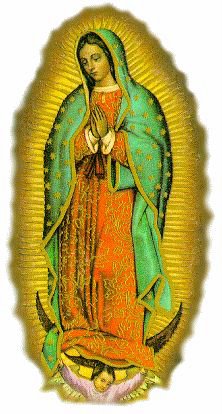
One of the interesting things about the image of Our Lady of Guadalupe is its teaching potential. Though she looks glorified, with stars and rays of sun coming from her as was predicted in Rev. 12, she is no goddess. Her hands are folded in supplication, her posture indicating that she is interceding for us at the throne of the God.Indeed, he is right. There is so much in that image that speaks to Catholic hearts through symbolism.
The miraculous image produced on the apron or tilma of Blessed Juan Diego is rich in symbolism. The aureole or luminous light surrounding the Lady is reminiscent of the "woman clothed with the sun" of Rev. 12:1. The light is also a sign of the power of God who has sanctified and blessed the one who appears. The rays of the sun would also be recognized by the native people as a symbol of their highest god, Huitzilopochtli. Thus, the lady comes forth hiding but not extinguishing the power of the sun. She is now going to announce the God who is greater than their sun god.
The Lady is standing upon the moon. Again, the symbolism is that of the woman of Rev. 12:1 who has the "moon under her feet". The moon for the Meso-Americans was the god of the night. By standing on the moon, she shows that she is more powerful than the god of darkness. However, in Christian iconography the crescent moon under the Madonna's feet is usually a symbol of her perpetual virginity, and sometimes it can refer to her Immaculate Conception or Assumption.
The eyes of Our lady of Guadalupe are looking down with humility and compassion. This was a sign to the native people that she was not a god since in their iconography the gods stare straight ahead with their eyes wide open. We can only imagine how tenderly her eyes looked upon Blessed Juan Diego when she said: " Do not be troubled or weighed down with grief -- Am I not here who am your Mother?"
The angel supporting the Lady testifies to her royalty. To the Meso-American Indians only kings, queens and other dignitaries would be carried on the shoulders of someone. The angel is transporting the Lady to the people as a sign that a new age has come.
The mantle of the Lady is blue-green or turquoise. To the native people, this was the color of the gods and of royalty. It was also the color of the natural forces of life and fecundity. In Christian art, blue is symbolic of eternity and immortality. In Judaism, it was the color of the robe of the high priest. The limbus or gold border of her mantle is another sign of nobility.
The stars on the Lady's mantle shows that she comes from heaven. She comes as the Queen of Heaven but with the eyes of a humble and loving mother. The stars also are a sign of the supernatural character of the image. The research of Fr. Mario Rojas Sanchez and Dr. Juan Homero Hernandez Illescas of Mexico (published in 1983) shows that the stars on the Lady's mantle in the image are exactly as the stars of the winter solstice appeared before dawn on the morning of December 12, 1531.
The color of the Madonna's dress is rose or pale-red. Some have interpreted this as the color of dawn symbolizing the beginning of a new era. Others point to the red as a sign of martyrdom for the faith and divine love.
The gold-encircled cross brooch under the neck of the Lady's robe is a symbol of sanctity.
The girdle or bow around her waist is a sign of her virginity, but it also has several other meanings. The bow appears as a four-petaled flower. To the native Indians this was the nahui ollin, the flower of the sun, a symbol of plenitude. The cross-shaped flower was also connected with the cross-sticks which produce fire. For them, this was the symbol of fecundity and new life. The high position of the bow and the slight swelling of the abdomen show that the Lady is "with child". According to Dr. Carlos Fernandez Del Castillo, a leading Mexican obstetrician, the Lady appears almost ready to give birth with the infant head down resting vertically. This would further solidify her identification with the woman of Rev. 12 who is about to give birth.

 which is what prompted me to try this book (thanks for the recommendation y'all!).
Considering "good old sin," in the sense that the ancient monks understood it, exposes the vast difference between their worldview and our own. These days, when someone commits an atrocity, we tend to sigh and say, "That's human nature." But our attitude would seem wrong headed to the desert monks, who understood human beings to be part of the creation that God called good, special in that they are made in the image of God. Sin, then, is an aberration, not natural to us at all. This is why Gregory of Nyssa speaks so often of "[returning] to the grace of that image which was established in you from the beginning." Gregory, in fact, saw it as our lifelong task to find out what part of the divine image God has chosen to reveal in us. Like the other early monks, he suggest that we can best do this by realistically determining how God has made us -- what our primary faults and temptations are, as well as our gifts -- not that we may better "know ourselves" or in modern parlance, "feel good about ourselves," but in order that we might become instruments of divine grace for other people and eventually return to God.This actually ties in quite well with Steven Riddle's post Self-Knowledge and Christ's Knowledge which starts out considering what he has learned about himself and ends with a love letter to St. Blog's. A quite remarkable read and highly recommended (as is practically everything Steven writes ... yes, I'm a fan).
So meddling in things that are beyond me has taught me a great deal about the masks I wear and the image I would like to project. It has also taught me not to be ashamed of the fact that I am ultimately driven more by feeling than by intellect. There are those who would have one feel bad about such an arrangement, but so long as the feelings are as informed as one possibly can do, it seems that they may provide a solution when the intellect alone cannot resolve the perceived difficulty.
This dismantling of self is very painful, but also very productive. I discovered in it abilities that I had long thought were beyond me. I found ways of listening and ways around some of my own obstacles. I found in this dismantling a hint of who I am in Christ.
