Tuesday, May 9, 2023

The Carp Streamers Bless Children

Calligraphy and View, The Carp Streamers Bless Children

 I love the way these carp streamers look as if they are swimming in the blue sky as if it is the sea. The blogger tells us:
In the Far East, the carp is an auspicious fish.
They had continued swimming the festival history more than 1000 years.

Now, I am seeing wind.
The carp streamers ( Koinobori ) are swimming in the deep blue firmament.

Time, Space, Existence,   Eternally..  Stream of Universe...

Monday, May 8, 2023

Kingfisher

Remo Savisaar, Kingfisher

This looks like a beautiful painting.

Couldn't Put It Down — West of Eden by Harry Harrison

But what if history had happened differently? What if the dinosaurs had survived to evolve intelligent life?

In West of Eden, bestselling author Harry Harrison has created a rich, dramatic saga of a world where the descendants of the dinosaurs struggled with a clan of humans in a battle for survival.

Here is the story of Kerrick, a young hunter who grows to manhood among the dinosaurs, escaping at last to rejoin his own kind. His knowledge of their strange customs makes him the humans' leader ... and the dinosaurs' greatest enemy.
Ah 1984. The year I got married. The year I read West of Eden. So many good things happened that year!

I loved this book from the beginning and reread it a lot but I haven't picked it up for a long time. When it was selected for an upcoming podcast episode, I was curious if it would hold up. It is 400 pages long and I read 300 of them last night. Plus I've been sneaking a few pages here and there as I have gaps in my morning routine. I guess that means I like it as much as ever!

The worldbuilding is simply wonderful. The contrast between the two ways of innovation, adaptation, and tradition are also interesting. Kerrick as the person bridging the two worlds of intelligent dinosaur and nomadic humans brings just the whole story into focus.

Plus it's a darned good adventure.

Friday, May 5, 2023

With a friendly welcome, as if the soul had been in pain and imprisoned, [Jesus] says sweetly ...

Then we hope that God has forgiven us our sins, and that it is true. Then our courteous Lord shows himself to the soul most merrily and with a glad expression. With a friendly welcome, as if the soul had been in pain and imprisoned, he says sweetly, “My darling, I am glad you have come to me. In all this misery I have ever been with you. Now you see my loving and we are made one in bliss.”
Julian of Norwich
This really says it all, doesn't it?

The Little Owl

Albrecht Durer, 1506, The Little Owl
via WikiPaintings
Albrecht Durer is probably most famous for his painting of a hare, but I couldn't resist this little fellow.

Thursday, May 4, 2023

An Invitation From Someone You Have Longed to Meet

Just imagine if one fine day an invitation arrived that you have been waiting for for a very long time, from someone you have been waiting to meet. A person with whom you have longed to stay, to spend a long time talking together. On the day that invitation arrived, how great would be your joy?

Death is God’s invitation, and it is with this joy in my heart that I await it. I know well how good and beautiful God is and how tenderly He takes care of me. For this reason, when I finally receive His invitation, I will be very happy to accept it.

[…]

The fact that He holds in store His greatest gift, death, until the last moment, is precisely the loving gesture of a Father. In fact, I think, as a parent, I too would do the same if I had something beautiful to give as a gift to my children. I would keep it hidden until the last moment, to bring it out as a surprise, when they least expect it. I could then enjoy the sudden amazement and joy painted on their faces. In the same way, God will rejoice when he sees my surprise when I accept death’s invitation.
Takashi Nagai, Thoughts from Nyokodo
I love this so much.

Dodo Head

Dodo head (detail)
via Biblipeacay
This detail comes from a much more thorough post at BibliOdyssey containing Zoological Atlas pages that are a treat for the eyes. I'm sad there's no chance of ever seeing a Dodo in real life but grateful for the images.

Wednesday, May 3, 2023

What was the first temptation?

We know what the first sin was: Adam and Eve disobeyed God by eating the forbidden fruit. But do you know what the first temptation was? "You will be like gods" (Genesis 3:5). This is the first temptation that has always plagued humanity.
Word Among Us, Feb. 26, 2023
Holy moly. Yes.

Cat in a Window

Utagawa Hiroshige
One Hundred Famous Views of Edo #101, "Asakusa Ricefields and Torinomachi Festival"
via Wikipedia

I was looking for cat art thanks to Pangur Ban and found it very difficult to locate. Then I came across this by Utagawa Hiroshige whose 100 Views of Edo are on my coffee table as I leisurely go through them. Perfect!

Tuesday, May 2, 2023

Turtles

Claude Aubriet (1665-1742) - Album de coquillages et poissons
via Biblipeacay
I'm a sucker for turtles. Real turtles that is. Old fashioned drawings of turtles are a close second. Aren't these simply fantastic in coloring and details?

A Movie You Might Have Missed #80 — Shall We Dance? (1996, Japan)

It's been 12 years since I began this series highlighting movies I wished more people knew about. I'm rerunning it from the beginning because I still think these are movies you might have missed.

Passion is about to find two unlikely partners.

A middle-aged Japanese businessman’s dull life takes an interesting turn when he signs up for a ballroom dance class just to meet the beautiful instructor. But he keeps the lessons secret because in Japan ballroom dancing —where you hold a stranger closely in public — is considered perverted.

Meanwhile, his wife feels the changes in the behavior of her happier husband, and hires a private eye to investigate whether he is having an affair.

This charming and funny movie gives foreigners real insight into Japanese life in the city and suburbs and the cultural restraints that everyone must live with daily in modern life. It isn't really about dancing or romance so much as it is about social commentary on several levels, albeit with a light hand.

When you dance you’re exposing your inner self. You are out there for the world to see. This has so much potential for embarrassment. You have to ignore that if you want to enjoy what you’re attempting. You have to allow yourself to trust or you don’t get the full experience in living — to varying degrees everyone in the movie makes that connection.

I originally watched this in 1997 with an intern fresh from Japan who had seen it twice already. She was surprised at some of the places the American audience laughed and had to ask why some things were funny. Clearly the director had a good understanding of both Japanese and English speaking audiences to be able to hit both so accurately!

NOTE

Scott and I discussed this on episode 105 of A Good Story is Hard to Find.

Monday, May 1, 2023

Rembrandt's Elephants


I love this because (a) I love elephants, (b) I love Rembrandt, (c) Sam in Lord of the Rings loves oliphants, and (d) I really, really loved seeing an elephant in Eden. Check out the next drawing.

Be sure to go to lines and colors to see why Rembrandt's elephants were featured and for more of his olliphant drawings.


Water into Wine

If Christ could change water into wine, why could He not change wine into His own Blood?
St. Cyril, Catechetical Lecture XXII
Genius! I don't know why that never occurred to me.

Friday, April 28, 2023

Ideal Christianity

Ideal Christianity doesn't exist, because anything the human being touches, even Christian truth, he deforms slightly in his own image. Even the saints do this.
Flannery O'Connor, letter 1963
Depressing but true.

Thursday, April 27, 2023

Sin and Evil

Sin is interesting but evil is not. Sin is the result of an individual's free choice, but evil is something else.
Flannery O'Connor, letter 1957
An interesting distinction isn't it?

Bull Dog

Antique Produce Crate Label

Wednesday, April 26, 2023

The Golden Age in the City of Lights: Woody Allen's Midnight in Paris

This review ran in 2011 when we originally saw the movie. This is part of our mini-festival showing my mother our favorite Woody Allen movies. So I thought I'd share the review again.


Owen Wilson plays a dreamer who has made a fortune writing screenplays but longs to find a sympathetic soul to read his first novel. His fiancee and her family seem wrong for him in every way but he doesn't notice because he's so busy longing for the Golden Age of 1920's Paris when the American writers and artists mingled. One evening, lost in a dark side street, sitting forlornly on the steps, he hears midnight chime and a very old yellow taxi pulls up. The merry group inside beckon him in and he joins them only to find himself literally swept away to meet his idols.

Midnight in Paris has a surprisingly straight-forward story and moral, albeit one told with a romantic eye to the artists in 1920s Paris and those who yearn nostalgically for the past. This is a love letter to Paris, a nod to comedy, a commentary on modern Americans in Paris, and above all a reminder that now is all the time we have and we may be living in a golden age in the present. Sweet, charming, and funny. A winner all 'round.

I give it four stars out of five because there were a few details which didn't work with the logic of the story quite right, and which we all noticed. They don't make that much of a difference but catching them would have gotten a bit closer to perfection.

UPDATE
My favorite people were Hemingway and Dali but I must also add that I've never understood people who say that Marion Cotillard is beautiful. Until now. She is luminous in this film. Kathy Bates was also perfectly cast as Gertrude Stein. All were just a joy to behold in this film.

A Blockade Runner

A Blockade Runner, Briton Riviere

Monday, April 24, 2023

Sympathy

Briton Riviere, Sympathy, c. 1878

 This is one of my favorite paintings featuring, as it does, a dog doing what they do best — empathizing with their loved ones.

When a misfortune is a grace

What in the eyes of the world appears only as a misfortune, for the saints is a grace: the place of the path to self-perfection.
Takashi Nagai, Thoughts from Nyokodo
This is the necessary reminder that Jesus loves us and doesn't give us things that are bad. We understand imperfectly, see in a dim reflection of a mirror.

Friday, April 21, 2023

Dogs from Europe

Hashimoto Kansetsu (1883 - 1945), Dogs from Europe
via Wikipedia

 I really love thinking of some art lover in Japan marveling over these exotic dogs. To be fair, they seem fairly exotic to me, but not in the way they would to someone from the other side of the world who'd never seen the breeds at all at all.

A Terrible Book Hangover

You can't put the book you just finished behind you because you still want to live in it. You have a terrible book hangover, and it lasts three days. Ibuprofen does nothing for it. You're sad because whatever you read next can't possibly be as good as the book you just finished. You depair because nothing you read can possibly be as good, ever again.
Anne Bogel, I'd Rather Be Reading
This doesn't happen to me often but when it does it's terrible. And wonderful — to have read such a book, such wonderful writing, such depth of feeling. And so forth. But in the meantime, what does one read until one recovers? I mean, you've gotta read something. You can't just not read for three days. It's a tough way to live.

Thursday, April 20, 2023

Your friends may use the word obsessed ...

Cull duplicates. If you have two copies of a book, keep the prettier one. If you can't bring yourself to get rid ofyour duplicates, buy a third copy. When it comes to books, two is the loneliest number. Multiple copies of a single title are acceptable. Many many multiples are preferable to two or three; excess makes you look interesting. Your friends may use the word obsessed, but they can't deny your obsession is interesting.
Anne Bogel, I'd Rather Be Reading

I do have duplicates, and more than two, of several books. To be fair, most of those are because I like different translations, such as for Dante's Divine Comedy. The Lord of the Rings, on the other hand, is because I have lightweight paperbacks for reading in bed, a one volume version that has notes written in it (yes, I know, notes), and a third with Tolkien's own illustrations throughout. I can't guarantee I won't buy another one with Alan Lee's illustrations — if I can find such a thing or afford it — but that's for the future to worry about. I also confess to duplicate copies of Uncle Tom's Cabin and Dracula because one copy has notes in it.

 And, of course, the Bible for different translations or commentaries. But the Bible is in a category all its own.

Bedouins Preparing a Raiding Party

Giulio Rosati - Bedouins Preparing a Raiding Party [1895] via Gandalf's Gallery

As is common for Rosati, the artist has used strong colours to pick out one or two characters in particular, in this case the figure in the foreground on the right, who discusses with his companions how best they should plan their attack. A few particular details reveal the extraordinary attention Rosati has not only paid to his motif, but also to the composition. For example, the main figure's shoes echo the curl of the butt of his gun, while the brilliant blues of the figure on the left tie the group of men to the sky, and help to balance the dominating colours of his companion.

Wednesday, April 19, 2023

I quite feel that an apology is due for beginning a novel with two long dull chapters full of description.

I quite feel that an apology is due for beginning a novel with two long dull chapters full of description. I am perfectly aware of the danger of such a course. In so doing I sin against the golden rule which requires us all to put our best foot foremost, the wisdom of which is fully recognised by novelists, myself among the number. It can hardly be expected that any one will consent to go through with a fiction that offers so little of allurement in its first pages; but twist it as I will I cannot do otherwise. I find that I cannot make poor Mr Gresham hem and haw and turn himself uneasily in his arm-chair in a natural manner till I have said why he is uneasy. I cannot bring in my doctor speaking his mind freely among the bigwigs till I have explained that it is in accordance with his usual character to do so. This is unartistic on my part, and shows want of imagination as well as want of skill. Whether or not I can atone for these faults by straightforward, simple, plain story-telling—that, indeed, is very doubtful.
Anthony Trollope, Doctor Thorne
Indeed. I had just finished those long, boring chapters and was mentally reviewing the much faster start of The Warden and Barchester Towers, the first two books in the series. And then this came along. I had to laugh and forgive him, however annoyed I was. And I was annoyed. I now expect a rousingly good tale.

Old Veliky Novgorod

Apollinary Vasnetsov - Old Veliky Novgorod [1901], via Gandalf's Gallery

Apollinary Mikhaylovich Vasnetsov (Vasnetsov, July 25, 1856 - Moscow, January 23, 1933) was a Russian painter and graphic artist. He specialised in scenes from the medieval history of Moscow. Vasnetsov did not receive a formal artistic education. He had studied under his older brother, Viktor, also a famous painter.

Tuesday, April 18, 2023

The Romantics documentary series — the legacy of Yash Chopra and Yash Raj Films


Featuring archival footage and in-depth celebrity interviews,
this docuseries celebrates the life and legacy of Hindi filmmaking titan Yash Chopra.
Over the course of four episodes, director Smriti Mundhra covers Hindi cinema in a way that almost no one ever has, from Chopra’s early work to the rise of his sons Aditya and Uday in the ’90s and 2000s, to the shifting sensibilities of the industry and effects of Chopra’s death in 2012. The project was born out of Mundhra’s own love of Hindi cinema and documentary expertise, and a realization that she had never seen a film retrospective about the culture and movies that raised her.
IndieWire interview
A really excellent documentary. Well edited, conceived and executed.

This series is something that Indians will enjoy and that true film fans will appreciate. Other than that, only people like us — a true minority of Indian film lovers who are not ourselves Indian — will appreciate.

We've seen so many of the Yash Raj movies, especially the more recent ones. I loved seeing the story of Yash and Aditya Chopra - it was a wonderful behind-the-scenes view of something we love.

(Also I was stunned to realize that Ali from the Dhoom series was played by Uday Chopra. That took me completely by surprise. That's how out of touch I was with who the family members are.)

Monday, April 17, 2023

He would have been the hero of our tale ...

The one son and heir to Greshamsbury was named as his father, Francis Newbold Gresham. He would have been the hero of our tale had not that place been pre-occupied by the village doctor. As it is, those who please may so regard him. It is he who is to be our favourite young man, to do the love scenes, to have his trials and his difficulties, and to win through them or not, as the case may be. I am too old now to be a hard-hearted author, and so it is probable that he may not die of a broken heart.
Anthony Trollope, Doctor Thorne
And then we get two chapters about this character and his family.

Thursday, April 13, 2023

I'd Rather Be Reading: The Delights and Dilemmas of the Reading Life by Anne Bogel


We are readers. Books are an essential part of our lives and of our life stories. For us, reading isn’t just a hobby or a pastime; it’s a lifestyle. We’re the kind of people who understand the heartbreak of not having your library reserves come in before you leave town for vacation and the exhilaration of stumbling upon the new Louise Penny at your local independent bookstore three whole days before the official publication date. We know the pain of investing hours of reading time in a book we enjoyed right up until the final chapter’s truly terrible resolution, and we know the pleasure of stumbling upon exactly the right book at exactly the right time.
This is light, fluffy fun for anyone who is a dedicated reader. You continually recognize yourself as Anne Bogel talks about book hangovers, rearranging bookshelves, Then there are the lists - many chapters are rapid-fire, run-on lists of contradictory yet complementary reader-centric behavior. And she did all this while tossing off examples which didn't fall into any category I regularly read. So we know there isn't science fiction mentioned. And not many mysteries. Some behavior just crosses all genres.

She gets me.
You take five books to the pool because you can’t decide what to read next. You can’t comfortably manage your purse because you shoved three books in on the way out the door, unable to decide what to read next. You pack twelve books for a five-day vacation because you can’t decide what to read next.

Tuesday, April 4, 2023

A Song for Nagasaki: the Story of Takashi Nagai: Scientist, Convert, and Survivor of the Atomic Bomb by Paul Glynn

I just finished reading this book for an upcoming podcast episode. It was moving and inspirational to read this during Holy Week. I already love the book but this combination is extremely powerful.  

Therefore, I'm reposting this review from 2014 when I first read the book. 


In 1928 young Takashi Nagai was a medical student at the top of his class. An atheist, he passionately believed that science held the key to the future of the human race. He loved his country and believed the "spirit of Japan" would improve his nation's future.

Then came a telegram that sent him racing home to be with his mother as she died.  And his world changed.

"I rushed to her bedside. She was still breathing. She looked fixedly at me, and that's how the end came. My mother in that last penetrating gaze knocked down the ideological framework I had constructed. This woman who had brought me into the world and reared me, this woman who had never once let up in her love for me ... in the very last moments of her life spoke clearly to me! Her eyes spoke to mine, and with finality, saying: 'Your mother now takes leave in death, but her living spirit will be beside her little one, Takashi.' I who was so sure that there was no such thing as a spirit was not told otherwise; and I could not but believe. My mother's eyes told me that the human spirit lives on after death. All this was by way of an intuition, an intuition carrying conviction."
In an unlikely turn of events, Nagai turned to Blaise Pascal's Pensées in his grief and bewilderment, having been attracted to the Catholic poet-scientist in a high school literature class. This was the first step into a spiritual journey that ended in Nagai becoming known as the "saint of Urakami" after the atomic bomb hit Nagasaki.

Nagai's biography is captivatingly told. Paul Glynn combines vivid descriptions, character insights, and just enough Japanese history so that we have context. As a result I wound up admiring the Japanese people even more than I did already. I never realized how many of the Japanese ideals combine with saintly living, especially as seen through Takashi Nagai's eventful life.
At Mass on Sundays and feast days, the Nagais often heard Father Moriyama speak on the beauty of the simple family life at Nazareth. It showed, he said, the great worth of ordinary family life and the grace of God present in humdrum daily work. This reminded Nagai of his boyhood, when his mother taught him how to find the universe in a bowl of rice: "Look at the rice carefully, and discover behind it the countless generations of farmers who pioneered wild land and nurtured rice paddies through droughts and floods, poverty, war and pestilence. See generations of artisans too in the simple, practical beauty of the bowl and chopsticks and in all the merchants who handled Them. See your parents took, who worked hard to be able to buy and cook the rice." Nagai's mother would conclude her lesson by joining her hands and bowing in a gesture of profound gratitude, reciting a prayer that explained all this, and the universe as well: "Namu Amida Butsu. We depend on our utterly, Amida Buddha."

... [The Japanese character] Shigoto, "work," is made of two ideographs meaning "something that is a service." All are the beneficiaries of countless other "workers," and we owe it to the community to do our own job well, not primarily for material recompense but out of gratitude. This was the boy's introduction to Japan's famous work ethic. Nagai the Christian recalled his mother's gentle homespun spirituality with gratitude.

I am really struck by how many modern issues Nagai struggled with: belief in science as ultimate good, humanism, the atom bomb, cancer, and more. His faith gave him peace and the way he lived it in unimaginable circumstances gave that peace and faith to others. I also really admired his absolute dedication to truth, so much so that when he became curious about Christianity he decided to carry out a scientific experiment by boarding with a Japanese Catholic family.

This is much more than a simple biography, needless to say. Because we're following Nagai's spiritual journey, we are invited to look deeper within ourselves and journey also. This book is fascinating and inspirational.

How fitting that this is the first book I finished in 2014. Not only is it the Solemnity of Mary, which Nagai would have very much appreciated, but it is the beginning of a New Year where I am taking Takashi Nagai as my patron for the year. So ... it seems meant to be on several levels.

Highest recommendation.

ALSO - Scott and I discuss it at A Good Story is Hard to Find.

Monday, April 3, 2023

Bholaa


An ex-convict must undertake a perilous, violent journey in order to meet his daughter after years of imprisonment.
We saw this at the theater with our daughters and son-in-law. We all gave this top marks. First, let's talk about the fun stuff, which I will quote from my daughter Hannah's review.
I think everyone should see this, ideally in theaters.

Unless you think you’d spend whole thing thinking things like:
“You can’t pull a trident through two guys handle first!”

“How can he be lifting someone off the ground who has already been shown to be taller than he is?”

“You can’t punch a motorcycle out of the air!” with a slight frown on your face.
In which case, I’m sorry you hate fun. That must be really hard for you.

Also — it was a compelling story with clearly drawn characters, excellent acting, clever twists, stylish choreography and imagery, and over the top action very well done.

Ajay Devgn's direction showed an impressive creative vision, all the more so when you consider how good the first half of his Runway 34 was - and how different the requirements of the two stories were. Many directors can't do as well and we look forward to more of his directed films.

Once again, we appreciated his acting, so clearly conveying what he is thinking often without doing much physically. That's not easy and not seen often in Indian movies. Tabu was impressive, as always. It had to be fun to play such a kick ass character.

Recommended for beginners. Rated for older teens.

Enjoyable all round.

ALSO — Discussed in An American's Guide to Bollywood.

Friday, March 31, 2023

Write a check, kiss it up to God ...

Write a check, kiss it up to God, and move on with our lives. Remember: Even if the money itself gets wasted, the generosity never is. There is no such thing as a wasted act of love; and something done out of love, either for neighbor or for God, is worth more than the hugest impersonal donation in the world.

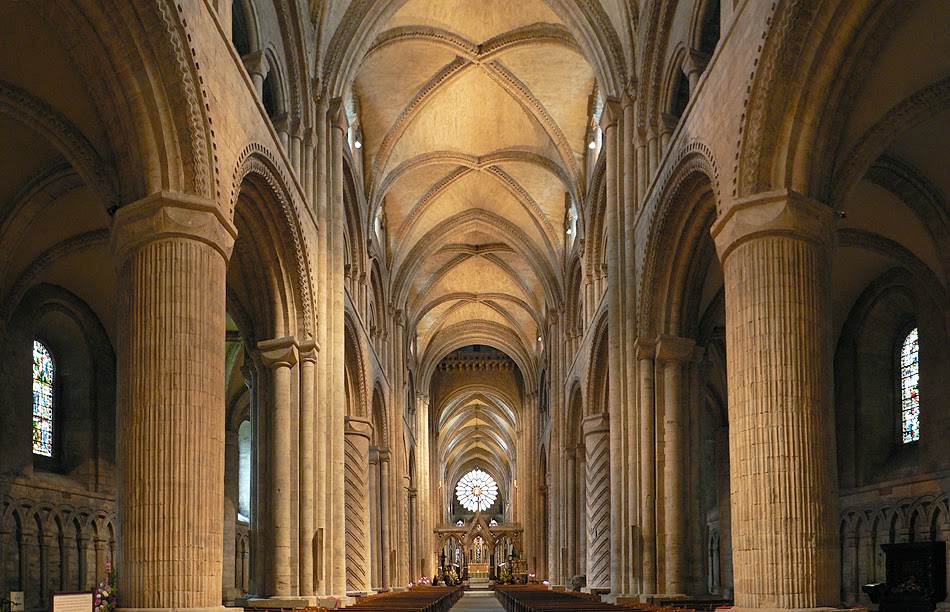
Durham Cathedral

Durham's massive patterned columns hold aloft the finest cathedral in northern Europe, built (between 1093 and 1128) to symbolise the power of the conquering Normans, and embodying revolutionary technology.
Description from Paul Johnson, photo via Wikipedia.

 Absolutely gorgeous isn't it? A bit about cathedrals in general from Paul Johnson's Art: A New History.

The liturgical demands of the cathedral, which were complicated and exacting and continually becoming more so, meant that it had to be designed from the inside outwards. The dynamic force pushing the designer against the frontiers of his technology was the insistence of bishop and chapter, backed by the public, that he provide an ever-larger enclosed space in the middle of the church. This was reinforced by a religious and aesthetic urge to let in more light by building the walls higher and higher. To the early medieval man, the church was an epitome of his cosmology. The stone with which it was built symbolised eternity. The walls upheld the firmament above. There God dwelt to receive his voice and prayers ascending upwards. Worship was a rising motion and the higher the ceiling the closer man's prayer and song, which filled it with sound, would come to God. And the higher the roof, the more detached it was from the clayey prison of the earth beneath. Height was therefore an escape from earth to Heaven and that was why the cathedral had to provide it.
He goes on to talk about why Durham is so revolutionary and the constraints the artist was working with in order to built a fitting tribute to God.

Thursday, March 30, 2023

An affectionate letter from a bishop must surely be the most disagreeable missive which a parish clergyman can receive.

His state became still worse when he received an affectionate but solemn letter from the Bishop warning him of his danger. An affectionate letter from a bishop must surely be the most disagreeable missive which a parish clergyman can receive. Affection from one man to another is not natural in letters. A bishop never writes affectionately unless he means to reprove severely. When he calls a clergyman his "dear brother in Christ," he is sure to go on to show that the man so called is altogether unworthy of the name.
Anthony Trollope, Dr. Wortle's School

Book of Durrow

The Book of Durrow (seventh century) is a masterpiece of calligraphy,
 drawn from late Roman models, and merged into Celtic passion for abstract decorative forms.

 The above caption comes from Art: A New History by Paul Johnson. This book is a simply marvelous way to read about history, as focused through the lens of artistic development.

I've always loved illuminated manuscripts and I wish that there was a version of them produced in modern times. I would snap up a Bible thusly illustrated. Think how it would enrich one's meditation to have art and words working together to raise our communication with God to a higher level.

My wishes aside, our modern age does allow us to enjoy illustrated manuscripts from ages past. I particularly love the page above with the dragon-ish capital N.

These artistic instincts and skills were in due course Christianised, and put to work in the monastic scriptoria which were springing up all over western Europe. The result was a kind of art which, in its intricacy of line and colour, has never been excelled. ...

These monasteries began, from the early seventh century, to produce illuminated manuscripts of great beauty and elaboration. It is not always possible to discover which house produced which book, and scholarly argument, reflecting modern nationalism, rages round the provenance. ... Then follow the three "luxury" manuscripts, prepared by great artists as a feast for the eyes of Dark Age kings: the Book of Durrow, from about 670 (Dublin, Trinity), the Lindisfarne Gospels, c. 700 (British Library) and the Book of Kells, c. 800 (Dublin, Trinity). These three masterpieces have never been excelled in the history of book production: the concentrated skill they display astonishes, mystifies, overwhelms and even alarms modern eyes. It is hard for us to get inside the mind of the scribe-artist who spent months, perhaps years, decorating a single page with a combination of abstract motifs, zoomorphic or terrestrial stylised figures, major initials and elaborate script, all integrated in designs which are self-perpetuating patterns of dynamic movement.

The workmanship is so close to perfection that it is almost impossible to detect signs of fatigue or flagging invention. ...

Wednesday, March 29, 2023

On First Looking into Chapman's Homer

On First Looking into Chapman's Homer
By John Keats

Much have I travell'd in the realms of gold,
And many goodly states and kingdoms seen;
Round many western islands have I been
Which bards in fealty to Apollo hold.
Oft of one wide expanse had I been told
That deep-brow'd Homer ruled as his demesne;
Yet did I never breathe its pure serene
Till I heard Chapman speak out loud and bold.

Then felt I like some watcher of the skies
When a new planet swims into his ken;
Or like stout Cortez when with eagle eyes
He star'd at the Pacific—and all his men
Look'd at each other with a wild surmise—
Silent, upon a peak in Darien.

I never knew that the famous lines "Then felt I like some watcher of the skies when a new planet swims into his ken" came from a poem about reading a great translation of Homer. 

I know exactly how this feels, albeit minus the translation aspect. I've been reading 25 pages a day of The Lord of the Rings for my Lenten lectio divina and it has been transformative — both for my prayer life and for my feelings about the book itself. I am coming up on the Battle of the Pelennor Fields and am in the grip of just such a feeling.

Tuesday, March 28, 2023

St. Mark

Donatello, St. Mark (1411-13)
via Wikipedia
... it also remains true that Italian sculptors, like those north of the Alps, were moving relentlessly in the same direction: the discovery and representation of the individual human being, with truth and dignity. It was a move away from mere human symbols and archetypes toward actual flesh-and-blood men and women. For the Christian faith taught that humans were not types. Each had an immortal soul, and the carvers began to look for it in the faces and bodies they saw. But whereas the northern sculptor had no theory and worked by instinct—and his instinct for realism, as we have seen, was overwhelmingly strong—the Italian sculptors were beginning to learn about humanism, the knowledge from the past which directed fierce attention on the human body and psyche, created in God's image and the potential master of the universe and all it contained. The human being was all-important and sacrosanct, and to portray him accurately and vividly was a God-like act, worthy of the utmost pains and the highest genius.
Paul Johnson, Art: A New History
Amen.

I really, really like it when historians are not afraid to acknowledge all sorts of influences on people, including their faith. And to go to the trouble to understand the faith enough that they can see how it influences the people.

Monday, March 27, 2023

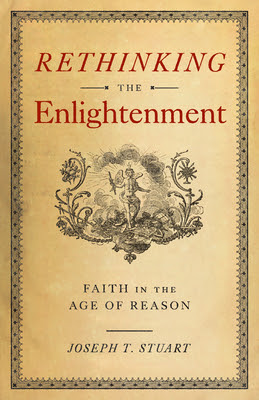
Rethinking the Enlightenment: Faith in the Age of Reason by Joseph T. Stuart

The Enlightenment is a fascinating example of the relationship between religion and culture. As common ways of life, Christian culture and Enlightenment culture both conflicted and overlapped with each other—or diverged altogether. Christians interacted with the Enlightenment thought conflict, engagement, and retreat. Each of these strategies possessed different emphases, strengths, and weaknesses.
I got interested in this after hearing the author on Catholic Answers Focus. I'd never heard of the Catholic Enlightenment or how many ways the Christian culture intentionally overlapped with the secular Enlightenment. The author did a great job of explaining the Enlightenment's origins and main players before going into the three Christian responses that led to the Conflictual Enlightenment, the Catholic Enlightenment, and the Practical Enlightenment.

Focusing on key people and events, he is able to tell this complex story so clearly that I was able to keep track of it the entire time. I grew very fond of some of the people involved. In fact, Pope Benedict XIV is now a new favorite of mine. And Edmund Burke — what a clear-headed thinker! I'd already read about some of these people, such as Susannah, Charles, and John Wesley. However, Stuart had more in-depth information than I'd seen. I really enjoyed seeing how they fit into the historical jigsaw puzzle, often bumping into others who I'd never have thought of connecting.

I also was fascinated by his examination of why the French didn't experience a religious revival as they eventually did in the English-speaking world. Comparing their situation to the American experience, which was that of Practical Enlightenment, was really eye opening. In fact, Practical Enlightenment is so key to the American psyche that, as I was reading, I felt right at home. That's still how we think, for the most part. Or has been until fairly recently, anyway.

This is just an excellent piece of history, explanation, and story telling. We are left with the message that our times are not lost or hopeless. We can regain what is being lost. It was done before and we can do it again.

Queen of Time, Selfridges

Gilbert Bayes, The Queen of Time, at Selfridges
Source 

 Isn't this magnificent? If ever I get to London again I will certainly be sure to go to see it and all the other wonderful art at Selfridges. I first came across the reference to this glorious piece of art in Art: A New History by Paul Johnson.

Be sure to go to the source link for more photos and information about the art of Selfridges. For more of this artist's work, check out the page at The Victorian Web.

Friday, March 24, 2023

Voting democracy and market democracy

The United States was the first to introduce voting democracy. Almost equally central to the ethos of the country was market democracy, in which ordinary people voted with their wallets and, in doing so, insured that they got what they wanted. Salesmanship, market research, advertising, the rapid response of production machinery to perceived customer requirements‚all these forms of materialism which, in their more raucous aspects, are identified as American failings or rather excrescences, are in fact central to its democratic strength. The story of Sears Roebuck, for instance, is a tale of how high-quality products, once the preserve of the rich, were humbled and distributed literally everywhere.

Paul Johnson,
A History of the American People

Iron Rolling Mill

Adolph Menzel (1815–1905), The Iron Rolling Mill
Source

 I originally came across this when reading Paul Johnson's Art: a New History. I love these big subjects with the humanity reflected in the little scenarios around the corners, like the fellows in the bottom right having a quick meal. Click through on the link so you can really look at the details closely.

Thursday, March 23, 2023

America as a great cultural nation

That the United States, lifted up by an extraordinary combination of self-created wealth and native talent, became a great cultural nation in the second half of the 19th century is a fact which the world, and even Americans themselves, have been slow to grasp.

Paul Johnson,
A History of the American People

Niagara Falls

Niagara Falls, 1857, Frederic Edwin Church
via Wikipedia

I love these sorts of pieces by painters who did such a splendid job of showing North America's natural beauty. They're often called the Hudson River School or the Luminous School but Paul Johnson in Art: A New History argues that that is limiting the artists too much.

This painting reminded me of the breathtaking paintings we saw at the Hudson River School show at the Amon Carter Museum years ago. There is simply nothing like seeing these (or any) paintings in real life.

The computer can't do it justice but do be sure to click through on the link above to see the painting in as large a size as possible.

Wednesday, March 22, 2023

What we lose track of in Exodus

The stories of the plague of Egypt, and the other wonders and miracles which preceded the Israelite break-out, have so dominated our reading of Exodus that we sometimes lose sight of the sheer physical fact of the successful revolt and escape of a slave-people, the only one recorded in antiquity.
Paul Johnson, A History of the Jews

Melk Staircase

Stift Melk, staircase near church, photographed by David Monniaux, Creative Commons licensing

 I first saw this gorgeous piece of architecture in Art: A New History by Paul Johnson. I could look at this all day.

Tuesday, March 21, 2023

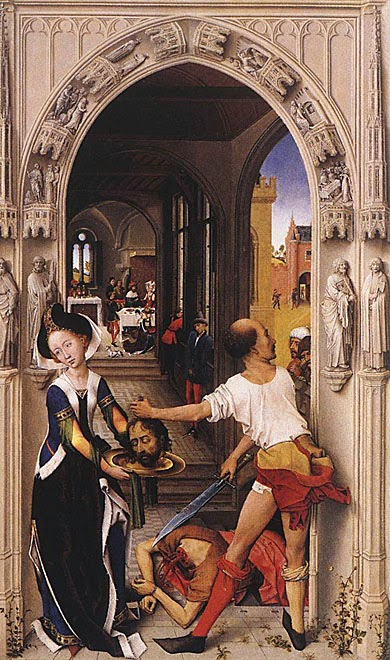
The Beheading of John the Baptist

Rogier van der Weyden, in his Beheading of John the Baptist (c. 1455-60),
transforms a horrific act into a scene of
elegance, subtle feeling and beauty-in-depth. (Paul Johnson)

This selection and the appreciation below are from Paul Johnson's Art: A New History which is an unusual window into history. This does not show us history as much as help to understand what the artist was trying to get across. It certainly helps me to understand why so many artists portrayed historical scenes with contemporary clothing and details.

If this seems like too much text to bother with, be sure at least to read the last couple of sentences. It is the essence of the thing and also may pique your interest for the rest.

... Rogier introduced many cunning innovations in presenting his work—shifting the angles, moving the main figures closer to the viewer, then pushing them back, framing them in architectural fantasies, windows and painted surrounds, devices which then become standard in northern art.

But in one respect, Rogier was faithful to his tradition. He loved detail, and it was always contemporary detail. Of his many large-scale works, the one which brings this out best is his Scenes from the Life of John the Baptist in Berlin. These three pictures convey an enormous amount of detail. Salome has certainly not been performing a dance. She is dressed in the height of Brussels fashion, c. 1450, and holds the dish to receive the severed head disdainfully, as though she was not accustomed to handling platters of any description. Every detail of her presentation is perfect. The executioner must have been done from life at a ceremonial chopping, of which there were many the artist could have witnessed. The way the man has stripped himself of most of his garments to get a perfect swing to his sword, itself rendered in fearsome detail, is unforgettable. Behind the pair and the ghoulish head, which glows with recently dead pallor, is a passageway, closely guarded, which opens in to the banquet scene itself, in the far distance but lovingly rendered so that we have a good idea of what was being eaten before the head made its entrance. The story of the head, which never failed to arouse interest anywhere in Europe for a thousand years—it was still going strong in the days of Oscar Wilde and Aubrey Beardsley—is here used as an excuse for a piece of dramatised genre painting. The details told the viewers two things. First, "All this is true," and secondly, "Take note of these events, they are part of your life also."

You are a temple, you are a great cathedral

Our culture has solved many of life's problems by its wonderful science and technology, and it has attained unprecedented power and comfort and freedom from pain. Yet it no longer loves life, no longer feels gratitude for life. Its suicide rate is far higher than it is in poor, primitive cultures. It lacks lasting joy. It is in the wilderness without a temple and without the manna from heaven, without the two temples that we know: our bodies in secual intercourse and Christ's Body in the Mass. They are the two holiest places in the universe and the two places where Goid literally performs a miracle millions of times every day around the world. Whenever we procreate mortal bodies, God creates new immortal souls, and whenever our priests echo his words of consecration, he transubstantiates our bread and wine into Christ's Body and Blood. ...

You are a temple; you are a great cathedral; you are God's masterpiece. Much more than that, you are God's children.
Peter Kreeft, Food for the Soul: Cycle A, Seventh Sunday in Ordinary Time

Thursday, March 16, 2023

The Sacrifice of Isaac

The Sacrifice of Isaac, The Tunesian Jews Synagogue, Akko
Taken by: Geagea

The whole purpose of sacrifice ...

Isaac was chosen as the offering not only because he was Abraham's most precious possession but because he was a special gift of God's under the covenant, and remained God's like all the rest of his gifts to man. This underlines the whole purpose of sacrifice, a symbolic reminder that everything man possesses comes from God and is returnable to him.
Paul Johnson, A History of the Jews

Monday, March 13, 2023

Double Boxer

In honor of the Dickens' excerpt today, here's a picture from our double Boxer days, which were crazy. Zoe and Wash, gone now but not forgotten.

Friday, March 10, 2023

The Bible is a work of history

The Bible is not a work of reason, it is a work of history, dealing with what are to us mysterious and even inexplicable events. It is concerned with the momentous choices which it pleased God to make. It is essential to the understanding of Jewish history to grasp the importance the Jews have always attached to God's unrestricted ownership of creation. Many Jewish beliefs are designed to dramatize this central fact. The notion of an elect people was part of God's purpose to stress his possession of all created things.
Paul Johnson, A History of the Jews

Dormant apostles in Gethsemane garden

Dionyz Stanetti, The carved relief of the dormant apostles
as the detail of prayer in Gethsemane garden (1744 - 1751) by

Tuesday, March 7, 2023

God made us creators

Creativity, I believe, is inherent in all of us. We are the progeny of almighty God. God is defined in many ways: all-powerful, all-wise, and all-seeing; everlasting; the lawgiver; the ultimate source of love, beauty, justice, and happiness. Most of all, he is the creator. He created the universe, and those who inhabit it; and, in creating us, he made us in his own image, so that his personality and capacities, however feebly, are reflected in our minds, bodies, and immortal spirits. So we are, by our nature, creators as well. All of us can, and most of us do, create in one way or another. We are undoubtedly at our happiest when creating, however humbly and inconspicuously. ...

... the only problem is how to bring it out. A farmer is creative—none more so—and so is a shoemaker. A ticket collector on a red double-decker once remarked to me: "I run the best bus route in London." His pride was proprietorial, and clearly he felt he was creating something, rather like Pascal, the moral philosopher, who in the mid-seventeenth century first conceived the idea of an omnibus service for big cities like Paris. I sometimes talk to a jovial sweeper, who does my street, and who comes from Isfahan, in Persia, wherein lies the grandest and most beautiful square in the world, the work of many architects and craftsmen over centuries, but chiefly of the sixteenth. I asked him if he felt himself creative, and he said: "Oh, yes. Each day they give me a dirty street, and I make it into a clean one, thanks be to God." People do not always discern the creative element in their lives and work. But those who do are more likely to be happy.
Paul Johnson, Creators
I was really stunned to read this in the introduction to Paul Johnson's book. As a personal witness it can't be beat. Plus, of course, being true.

Weepers

Philip the Bold, Duke of Burgundy, was the leading art patron of fourteenth-century France. His tomb, by Claus Sluter and Claus de Werve, is inhabited by alabaster hooded figures, known as "weepers." Description from Paul Johnson, image via Wikipedia

I really love these figures with their individual features and positions. Paul Johnson, Art: A New History, delights in this eloquently. Of course, I am going to share his comments!
Sluter was obliged to interrupt his work to attend to Philips tomb, a grand affair mainly in alabaster ... Sluter was bidden to attend the funeral and observe it, and his contract specified that he had to provide, in addition to the effigy of Philip, fifty-four angels and forty "Images pleurants." The angels are lost but the "weepers," as they were known--cowled figures common in late medieval art--were all done from life, and may have been actual participants in the obsequies. Slater was a master of the draped figure and its folds, in which he took exquisite delight, especially when working in a soft, luminous stone like alabaster. But he also put in wrinkles and beards, even the stubble, and all the details of costume under the drapes, down to buttonholes and laces. What strikes one most, however, is not such details as rosary beads, important though they are in creating verisimilitude, so much as the facial expressions, which though convey shamelessly the mixed emotions of a funeral: genuine and feigned grief, joy that one is still alive, sharp observation of how other people are behaving. Even funeral fashions are attended to, for each figure is clothed according to rank and personality, and each has a distinctive, often slyly observed,life of its own. After looking at these works, we feel we have a clear idea of what a grand early-fifteenth-century funeral was like. And that was Sluter's intention, for he did not want to change the world, merely to record it truthfully. If only all great artists were like him!

Monday, March 6, 2023

The excitement and inspiration of Job's prologue

[The Book of Job's] prologue with God's wager with Satan about Job's piety in the face of continual testing makes it one of the most exciting and inspirational books of the Old or New Testament.
Bob Dylan, The Philosophy of Modern Song
Well, that was unexpected. But it makes me want to go read the Book of Job!

Man Riding on a Horse

Bhimbetka rock painting showing a man riding on a horse, India

Today's quote by Bob Dylan about the Book of Job sent me looking for an illustration of one of my favorite passages from that book. I didn't expect to find something this ancient but it fills me with pleasure to think of how long men and horses have had an association.
Do you give the horse his strength,
and clothe his neck with a mane?
Do you make him quiver like a locust,
while his thunderous snorting spreads terror?
He paws the valley, he rejoices in his strength,
and charges into battle.
He laughs at fear and cannot be terrified;
he does not retreat from the sword.
Around him rattles the quiver,
flashes the spear and the javelin.
Frenzied and trembling he devours the ground;
he does not hold back at the sound of the trumpet;
at the trumpet’s call he cries, “Aha!”
Even from afar he scents the battle,
the roar of the officers and the shouting.

Job, 39:19-25

Friday, March 3, 2023

A powerful antidote to contemporary arrogance

The study of history is a powerful antidote to contemporary arrogance. It is humbling to discover how many of our glib assumptions, which seem to us novel and plausible, have been tested before, not once but many times and in innumerable guises; and discovered to be, at great human cost, wholly false.
Paul Johnson

Doge Leonardo Loredan

Giovanni Bellini, portrait of Doge Leonardo Loredan
via Wikipedia
The Doge Leonardo Loredan (1501-1505) by Giovanni Bellini shows how a great master can turn a formal state portrait into both a penetrating study of character and an image of beauty. ...He had a wonderful eye for a face and huge skill at getting it down on panel. He broke the old Venetian tradition that a ruler could only be presented in a formal "medal" profile, by showing the Doge Leonardo Loredan in an almost frontal position, a faultless work which many would rate one of the best half-dozen portraits ever painted.
Paul Johnson, Art: A Modern History
All I know is that when I look at this portrait it almost looks as if someone photographed a modern face and stuck it between the hat and cape. Simply amazing.

Thursday, March 2, 2023

The Meeting Scene

Andrea Mantegna (1431–1506), The Court of Mantua
via Wikipedia
I love how realistic this is. I discovered it in Paul Johnson's "Art: A New History" where he tells us:
The Camera delgi Sposi, being an exercise in contemporary realism, is perhaps the most authentic presentation of court life in Italy's golden age that we possess. The painter actually witnessed it, and the two main scenes, one outdoors (The Meeting), one indoors (The Signing of the Contract), take us straight into the world of marriage diplomacy, ceremony, intrigue and secret manoeuvering we read about in letters and chronicles. That world was later described by Machiavelli in The Prince and by Castiglione in The Courtier. But Mantegna's cold brush brings it horribly to life. I say horribly because, though there is exquisite beauty in the room, particularly in the rendering of the young, their elders have hearts of ice. ... there are no tricks about the figures, which have a Flemish realism. They are the actual faces of living people--fifteenth-century Italians of the urban, courtly breed, whispering in ready ears, hiding their deepest thoughts, making honeyed speeches, dissimulating and boasting, Cutting a bella figura while keeping their poignards sharp, strutting for effect and feigning every kind of emotion ... As in all Mantegna's works, one learns a great deal because, though a master of illusionistic devices, he always tells the truth.

Truly this man was the Son of God!*

In short, we must dismiss any idea of Jesus being a simple figure. His actions and motives were complex and he taught something which was hard to grasp... How could the intentions of God be conveyed so as to be understood by all men and for all time? Equally, how could any solution contain elements meaningful for all types and temperaments of men, as well as all races and generations: the activist, the militant, the doctrinaire, the ascetic, the obedient, the passive, the angular, the scholar, and the simple-hearted? How could it impart both a sense of urgency and immediacy, and at the same time be valid for all eternity? How could it bring bout, in men's minds, a confrontation with God which was both public and collective, and individual and intimate? How could it combine a code of ethics within a framework of strict justice and a promise of unprecedented generosity? These were only a few of the evangelical problems confronting Jesus. Moreover, he had to resolve them within a preordained series of historical events which could be adumbrated [suggested or disclosed partially] but not forecast and whose necessary enactment would terminate his mission.
I never looked at Jesus' ministry in those terms. What an impossible task and, yet, He did it perfectly. It just affirms, in my mind, His divinity and God's omnipotence. *Mark 15:39

Wednesday, March 1, 2023

The Garden of Earthly Delights

(Center panel) The Garden of Earthly Delights (1503-1504) by Hieronymus Bosch,
the best of his forty works that survive, uniquely combines medieval and renaissance,
horror and humour, religious and secular values, and figures and landscape. (Paul Johnson)

 I read an entire large art book on Bosch and wound up with a real appreciation for his work, as bizarre as it often looks. The author's premise was partly based on disproving what Paul Johnson mentions in his Art: A New History, that Bosch was a member of a quasi-heretical congregation. This was the first time, to be honest, that it occurred to me that these large art books could be written to prove or dispute others' scholarship. Silly of me, I know, since that goes on in every other field so why wouldn't that be the case for art?

At any rate, the point I enjoy the point Johnson makes about how "reading art" was a popular pastime. Popular or not, it's something we've lost in our age and which I appreciate learning a bit about under Johnson's tutelage.

Yet there was laughter in art, even if double-faced. It is a common modern view that Hieronymus Bosch (c. 1450-1516) painted the horrors of life and death, and aimed to terrify and to enforce repentance, by his alarming compositions. ... But he also aimed to excite, to thrill, to fascinate and to amuse. There is literary evidence, unearthed by the sharp reader of texts as well as pictures Ernst Gombrich, that collectors bought Bosch for that reason. He made them laugh at folly and its consequences, as Hogarth was to do 250 years later. The minute events of his gruesome tales were fantasies and obviously so. Yet by painting them in the Flemish tradition of realism and attention to detail, he made them seem credible at a certain level, and because credible hilarious. So the men laughed uproariously when, alone with their wine, they collectively considered a Bosch work, and put on straight faces and didactic expressions when their women fold appeared and asked to have the painting "explained."

Religion, Government, and de Tocqueville

What makes de Tocqueville's account memorable is the way in which he grasped the moral content of America. Coming from a country where the abuse of power by the clergy had made the anticlericalism endemic, he was amazed to find a country where it was virtually unknown. He saw, for the first time, Christianity presented not as a totalitarian society but as an unlimited society, a competitive society, intimately wedded to the freedom and market system of the secular world. "In France I had almost always seen the spirit of religion and the spirit of freedom pursuing courses diametrically opposed to each other," he wrote, "but in America I found that they were intimately united, and that they reigned in common over the same country." He added: "Religion ... must be regarded as the foremost of the political institutions of the country for if it does not impart a taste for freedom, it facilitates the use of free institutions." In fact, he concluded, most Americans held religion "to be indispensable to the maintenance of republican institutions." And de Tocqueville noted on an unpublished scrap of paper that, while religion underpinned republican government, the fact that the government was minimal was a great source of moral strength:
One of the happiest consequences of the absence of government (when a people is fortunate enough to be able to do without it, which is rare) is the development of individual strength that inevitably follows from it. Each man learns to think, to act for himself, without counting on the support of an outside force which, however vigilant one supposes it to be, can never answer all social needs. Man, thus accustomed to seek his well-being only through his own efforts, raises himself in his own opinion as he does in the opinion of others; his soul becomes larger and stronger at the same time.
This strikes me as something we all would do well to remember these days.

Tuesday, February 28, 2023

If Only More Americans Felt This Way

From A History of the American People by Paul Johnson
This book is dedicated to the people of America -- strong, outspoken, intense in their convictions, sometimes wrong-headed but always generous and brave, with a passion for justice no nation has ever matched.
Dedication
I have not bowed to current academic nostrums about nomenclature or accepted the fly-blow philacteries of Political Correctness. So I do not acknowledge the existence of hyphenated Americans, or Native Americans or any other qualified kind. They are all Americans to me: black, white, red, brown, yellow, thrown together by fate in that swirling maelstrom of history which has produced the most remarkable people the world has ever seen. I love them and salute them, and this is this is their story.
From the Preface
How refreshing.

Mr. Lee Wing

Mr. Lee Wing, via Traces of Texas
This is via Traces of Texas which, as far as I am aware, is only on Facebook. For those not on Facebook, here's the story that goes with this wonderful photo.
Circa 1900, Mr. Lee Wing, owner of a Chinese laundry in El Paso. The story of the Chinese in El Paso is not generally known: I will relate it in further detail in a subsequent post. Suffice to say that quite a few Chinese laborers were brought in to build the railroads, particularly in south Texas. When the job was completed, many of them remained in El Paso which, to this day, has a vibrant Chinese community. In fact, if you go to the Concordia cemetery in El Paso, there is a large, walled off, separate section for folks of Chinese descent ----- the only such section that I am aware of in any cemetery in Texas.