At first chili was a hellish food for me, but now I almost can swallow it like a Mexican.Today we're celebrating Texas and here's part of that rich cultural mix which has gone to make our great state so unique. Talk about a culture clash!German Immigrant Ernst Kohlberg, 1876letter to family in Germany
Thursday, September 21, 2023
Chili


Wednesday, September 20, 2023
The Young Eel Angler
 |
| The Young Eel Angler, Myles Birket Foster |
Tuesday, September 19, 2023
Blood of St. Januarius ‘completely liquefied’ on feast day
“We have just taken from the safe the reliquary with the blood of our patron saint, which immediately completely liquefied,” the abbot of the chapel of the treasury of the Naples Cathedral announced on Sept. 19. ...
“It’s a testimony that is present, living, current, and capable of speaking to the heart of every believer, pushing him to more consistency, beyond courage, to a life of giving, steeped in sharing.” (Bishop Battaglia).
This is one of those miracles that seems impossible or the result of feverish, over-devout wishful thinking. However, with video handy, you can see the actual liquefied blood of St. Januarius, which was first recorded in 1389.
I myself have never been attracted to these sorts of miracles so I've not paid much attention in the past. However, recently, I heard a friend talking about how his faith grew because of this sort of miracle and the inability of scientific investigations to explain it.
Here's everything you need to know about the miracle of the liquefication of St. Januarius's blood. Of special interest to me was the fact that there is no scientific explanation.
Here's the CNA story which reports the bishop's speech in full.
Men, pennies and the King
A religion is a thing which, by its nature, does not think of men as more or less valuable, but of men as all intensely and painfully valuable, a democracy of eternal danger. For religion all men are equal, as all pennies are equal, because the only value in any of them is that they bear the image of the King.This is why I love G. K. Chesterton. He gets it so right with such unique images as examples.
G. K. Chesterton, Charles Dickens

Monday, September 18, 2023
Before the Coffee Gets Cold by Toshikazu Kawaguchi

In a small back alley of Tokyo, there is a café that has been serving carefully brewed coffee for more than one hundred years. Local legend says that this shop offers something else besides coffee—the chance to travel back in time.This was so much more than I realized it would be. Within this simply told tale are the stories of four people who go to a special cafe in order to time travel. The rules are strict, the time is very limited, and it seems impossible that they could accomplish much. However, each is surprised by what they find. And therein lies a wonderful, charming tale.
Over the course of one summer, four customers visit the café in the hopes of making that journey. But time travel isn’t so simple, and there are rules that must be followed. Most important, the trip can last only as long as it takes for the coffee to get cold.
Before the Coffee Gets Cold explores the age-old question: What would you change if you could travel back in time?
Scott Danielson and I discuss this in episode 331 of A Good Story is Hard to Find podcast.
“Mr. Toulouse paints Mr. Lautrec”, a double-exposure photograph of Toulouse-Lautrec
 |
| “Mr. Toulouse paints Mr. Lautrec”, a double-exposure photograph of painter Henri de Toulouse-Lautrec by his friend Maurice Guibert, 1891. |
Isn't this great? So imaginative and fun! Via J.R.'s Art Place.
Friday, September 15, 2023
Wedding at Cana (in the style of Japanese art)
We're off for the weekend to help St. Joseph's parish with their Beyond Cana retreat. After this one, their retreat team will be completely made up of their own parishioners! This seemed like the perfect piece of art for today.
I get excited every time I get one of Daniel Mitsui's newsletters. I know there it is always going to include at least one piece of art that thrills me. I'm such a fan of Asian art that I haven't been able to stop examining this depiction of the wedding at Cana.
Of this piece, Daniel says:
 |
| Wedding at Cana by Daniel Mitsui This image is under copyright. The artist has given me permission to share his images on this blog. |
Of this piece, Daniel says:
The original was created on private commission. This is the fifth commission I have received to transpose traditional subjects from medieval European art into the style of Japanese art. Various Japanese woodblock prints of the 18th and 19th centuries were used for visual reference. Paintings by Hinrik Funhof, Hieronymus Bosch, Gerard David and Bertram von Minden were among the occidental works that influenced the content and arrangement.There is much more, which you can read here. For example the images on the jars and both sets of screens have very specific symbolic significance.
The Wedding at Cana is depicted in the middleground as a Japanese marriage ceremony, with the bride wearing the traditional garb, about to sip sake. Christ and Mary converse in the foreground, while a servant fills the six stone jars with water.
Wednesday, September 13, 2023
Apples in a Basket
 |
| Apples in a Basket, William Joseph McCloskey |
Nothing is more evocative of Autumn. Unless it is football, which we watched last night with the sense that the seasons are again turning.
Tuesday, September 12, 2023
A Movie You Might Have Missed #91 — Imitation of Life (1934)
.jpg)
A struggling widow and her daughter take in a black housekeeper and her fair-skinned daughter. The two women start a successful business but face familial, identity, and racial issues along the way.This was the final movie we watched from the 1935 Oscars as we work our way through Oscar winners and selected nominees. We were all surprised at how much we liked this tale of two mothers — one black, one white — who become good friends as they struggle together against the world in raising their daughters and earning a living. It tackled issues in a manner really surprising when you consider everyday life for black Americans in 1934.
I really love the 1935 winner - It Happened One Night - but we think Imitation of Life was robbed by not winning. I was especially interested to see Claudette Colbert in her third movie nominated for an Oscar that year. She was red hot that year and her performance here was good.
However, it was Louise Beavers who really stood out. We'd seen her previously in She Done Him Wrong, the Mae West film that was nominated for the 1934 Oscars. Beavers played a stereotyped, giggling, joking maid in that one. However, here she was allowed a role that was very unusual for any black actor of the time. Most definitely she was robbed by having no Oscar nomination for her performance, most probably because she was black as newspapers at the time noted.
I especially liked the portrayal of the friendship between the two women after reading that the book from which the story was adapted was inspired by a road trip to Canada the author took with her friend, the African-American short-story writer and folklorist Zora Neale Hurston.
This is one worth watching for a lot of reasons.
Self Portrait - Reubens Santoro
 |
| Self Portrait, Reubens Santoro |
I love artists' self portraits. Selfies are now commonplace but just recently they were thought of as new, exciting, indulgent, and more. But we can see that they are as old as the urge to create art.
Monday, September 11, 2023
9/11, Our Choices and Making a Stand
I originally wrote this for my Free Mind column at Patheos. It is still posted there.
Two days after 9/11, my father-in-law had a massive stroke. My husband and I drove from Dallas to the hospital in Houston. Largely in shock between the double burden of terrorist attacks and personal tragedy, we were nevertheless stirred with pride at the many flags and hand-made signs we saw along the road. Tears sprang to my eyes when we passed a battered pick-up truck complete with obligatory shotgun rack and "We are all New Yorkers today" written on the rear window.
My husband said, "Those terrorists don't know what they have done. This guy would've spit on a New Yorker last week. And now he'd fight for them."
We were lucky. We didn't know anyone, then, who had died or been in the attacks. But we still suffered with the rest of the nation. It changed us as a people and as individuals.
It taught me a big lesson in forgiveness; as I expressed my forceful wish to see the people behind this attack "killed," a gentle friend from our parish looked at me with a troubled face. "I don't know," she said slowly. "But that doesn't seem right either."
I was taken aback and began to pray, even as I expressed anger. Gradually, the anger faded and the ability to forgive crept in.
Today, I mourn the 9/11 attacks as much as ever. Easy tears still spring to my eyes when I look over the old pictures, video footage, and exchange "what I was doing when I heard" stories with others.
I also think about the opportunity that we had to go forward as a people united—to bring something good out of the evil. We are more divided than ever, and ruder than ever. We squabble and complain about the red states, the blue states, the liberals, the conservatives, the Muslims, the Catholics, and on and on it goes.
Some of this is basic human nature, as old as the stories in Genesis, of brother striking brother. It seems to me, though, that some of it is Evil pushing its way into the world, and we are failing to push back for the common good. We listen to the siren call of "my way," which goes hand in hand with pride.
 As always, when it comes to thinking things through, I find that others have pondered the matter so much more thoroughly than I could. Recently I picked up one of my favorite "good versus evil" books and found the words defining my thoughts.
Following their dreams, two communities begin to form—Mother Abigail's in Boulder and Flagg's in Las Vegas—and the stage is set for a final "stand" between Evil and God.
King has expressed frustration that so many fans call The Stand their favorite work, even though he has written scores of books since its publication.
Well, it's a heck of a book for one thing, so it's no wonder people love it. And although this is a horror novel, it is very translatable to our own lives. We no longer worry about bio-terrorism the way we did back then, but we can still relate to the scenario King paints.
In The Stand, King holds up the mirror to us. God and evil are present, of course, but they work through men, as ever, and we recognize ourselves in the pages.
Harold Emery Lauder was the quintessential misunderstood nerd, picked on in school, crossed in love, and finding power in hatred. His note could have been written by any of the terrorists who flew those planes into the World Trade Center. I imagine that, like Harold, their betrayal of innocents was the culmination of a long trail of choosing their own desires first. King shows us enough of Harold's choices—sometimes made despite the screaming of his own instincts—so that we can see a little of him in every selfish choice we make.
Harold's end is not a good one, and it is made pitiful by the fact that he is tossed aside like a worn out doll when evil is done using him for its own purposes. We cannot hold onto our anger at him because he has been misled so completely. In a similar way, when I think of those terrorists and their deliberate evil, I have a bit of that pity for them as well.
Once they were somebody's babies. I don't know what led them astray, but I lament the loss of the people they could have been.
King directly juxtaposes a rock star, Larry Underwood, against Harold.
Larry is no different than you or me, or anyone who can see themselves with a modicum of self awareness. None of us are "nice guys" deep down because we are all stained with Original Sin. And we know it.
We have help, though, that Stephen King didn't give Larry Underwood. We have the grace of Christ, the sacrament of reconciliation, and our faith to strengthen us. Like Larry, though, we have to keep picking ourselves up and trying again. We must practice until we are more perfectly "nice guys."
9/11 has presented us with a chance to practice forgiveness over and over again. We're all in this together and lifting our thoughts (or hands) in hatred belittles us and our targets. We are Christ’s followers, charged to see Him in everyone they meet. We all have the same choice. Do we embrace Harold's way, or Larry's?
Two days after 9/11, my father-in-law had a massive stroke. My husband and I drove from Dallas to the hospital in Houston. Largely in shock between the double burden of terrorist attacks and personal tragedy, we were nevertheless stirred with pride at the many flags and hand-made signs we saw along the road. Tears sprang to my eyes when we passed a battered pick-up truck complete with obligatory shotgun rack and "We are all New Yorkers today" written on the rear window.
My husband said, "Those terrorists don't know what they have done. This guy would've spit on a New Yorker last week. And now he'd fight for them."
We were lucky. We didn't know anyone, then, who had died or been in the attacks. But we still suffered with the rest of the nation. It changed us as a people and as individuals.
It taught me a big lesson in forgiveness; as I expressed my forceful wish to see the people behind this attack "killed," a gentle friend from our parish looked at me with a troubled face. "I don't know," she said slowly. "But that doesn't seem right either."
I was taken aback and began to pray, even as I expressed anger. Gradually, the anger faded and the ability to forgive crept in.
Today, I mourn the 9/11 attacks as much as ever. Easy tears still spring to my eyes when I look over the old pictures, video footage, and exchange "what I was doing when I heard" stories with others.
I also think about the opportunity that we had to go forward as a people united—to bring something good out of the evil. We are more divided than ever, and ruder than ever. We squabble and complain about the red states, the blue states, the liberals, the conservatives, the Muslims, the Catholics, and on and on it goes.
Some of this is basic human nature, as old as the stories in Genesis, of brother striking brother. It seems to me, though, that some of it is Evil pushing its way into the world, and we are failing to push back for the common good. We listen to the siren call of "my way," which goes hand in hand with pride.
It is said that the two great human sins are pride and hate. Are they? I elect to think of them as the two great virtues. To give away pride and hate is to say you will change for the good of the world. To vent them is more noble; that is to say the world must change for the good of you. I am on a great adventure.Twenty-three years before 9/11, Stephen King published one of his best-known and best-loved books, The Stand. It tells a tale of the United States, laid to waste when a biological weapons-grade virus inadvertently gets loose. As survivors roam the post-apocalyptic ruins, they begin to have dreams about an incredibly old holy woman, named Mother Abigail, or of a supernatural entity—Randall Flagg—who is her opponent.
Harold Emery Lauder, in Stephen King's The Stand
Following their dreams, two communities begin to form—Mother Abigail's in Boulder and Flagg's in Las Vegas—and the stage is set for a final "stand" between Evil and God.
King has expressed frustration that so many fans call The Stand their favorite work, even though he has written scores of books since its publication.
Well, it's a heck of a book for one thing, so it's no wonder people love it. And although this is a horror novel, it is very translatable to our own lives. We no longer worry about bio-terrorism the way we did back then, but we can still relate to the scenario King paints.
In The Stand, King holds up the mirror to us. God and evil are present, of course, but they work through men, as ever, and we recognize ourselves in the pages.
Harold Emery Lauder was the quintessential misunderstood nerd, picked on in school, crossed in love, and finding power in hatred. His note could have been written by any of the terrorists who flew those planes into the World Trade Center. I imagine that, like Harold, their betrayal of innocents was the culmination of a long trail of choosing their own desires first. King shows us enough of Harold's choices—sometimes made despite the screaming of his own instincts—so that we can see a little of him in every selfish choice we make.
Harold's end is not a good one, and it is made pitiful by the fact that he is tossed aside like a worn out doll when evil is done using him for its own purposes. We cannot hold onto our anger at him because he has been misled so completely. In a similar way, when I think of those terrorists and their deliberate evil, I have a bit of that pity for them as well.
Once they were somebody's babies. I don't know what led them astray, but I lament the loss of the people they could have been.
King directly juxtaposes a rock star, Larry Underwood, against Harold.
"You ain't no nice guy!" she cried at him as he went into the living room. "I only went with you because I thought you were a nice guy" . . . A memory circuit clicked open and he heard Wayne Stuckey saying, "There's something in you that's like biting on tinfoil."After the plague, Larry is haunted by those words, "you ain't no nice guy"—they jump to mind whenever he contemplates a selfish or cowardly act. Ultimately, he actually becomes a "nice guy" by consistently choosing the nobler act, if only to prove those words wrong.
The Stand
Larry is no different than you or me, or anyone who can see themselves with a modicum of self awareness. None of us are "nice guys" deep down because we are all stained with Original Sin. And we know it.
We have help, though, that Stephen King didn't give Larry Underwood. We have the grace of Christ, the sacrament of reconciliation, and our faith to strengthen us. Like Larry, though, we have to keep picking ourselves up and trying again. We must practice until we are more perfectly "nice guys."
9/11 has presented us with a chance to practice forgiveness over and over again. We're all in this together and lifting our thoughts (or hands) in hatred belittles us and our targets. We are Christ’s followers, charged to see Him in everyone they meet. We all have the same choice. Do we embrace Harold's way, or Larry's?
There's always a choice. That's God's way, always will be. Your will is still free. Do as you will. There's no set of leg-irons on you. But . . . this is what God wants of you.
Mother Abigail, The Stand
Have Mercy on Me Now and at the Hour of My Death. Amen.
I was "assigned" Captain Daniel O'Callaghan when Project 2,996 began. What an honor it has been every year to be allowed to bring this tribute of a fine American hero to everyone.
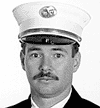
It has been a real privilege to read through the tributes of those who knew Daniel O'Callaghan and to learn about his life. Gradually this man I never heard of before has taken on real personality to me. Part of a large Irish clan, he was full of energy, loved children, loved joking around, and loved his family and job. In short, he loved life and made it better for everyone who was lucky enough to meet him.
I think of him and feel that he had to be saying the rosary or at least thinking it in those final moments with the beads firmly in hand. I remember a friend told me that she read somewhere about someone who is devoted to Mary. That when they who stand before God for judgment they will see Mary come forward and tell Jesus, "This is one of mine" as she puts her arm around that person. Surely, from what I have read of Captain Daniel O'Callaghan's life he had no need of Mary coming forward but just as surely I feel that she was there with Jesus to greet him as he entered heaven.
I feel that I got to know Captain O'Callaghan just a bit as I searched for pieces of his life to show others. In fact, I have gotten into the habit of turning to him for intercession when in prayer. I look forward to meeting this loving, energetic, Irish firefighter if I make it to heaven myself. In fact, I'm asking him to help me get there.
My heart goes out to his family, especially his wife and young children. If I feel this way after simply reading about him then surely they must miss him sorely. My prayers are with them.
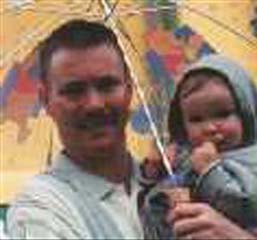
Sources:


Captain Daniel O'Callaghan, 42, Smithtown, N.Y.
It has been a real privilege to read through the tributes of those who knew Daniel O'Callaghan and to learn about his life. Gradually this man I never heard of before has taken on real personality to me. Part of a large Irish clan, he was full of energy, loved children, loved joking around, and loved his family and job. In short, he loved life and made it better for everyone who was lucky enough to meet him.
When I was growing up, even though we didn't see the O'Callaghan's very much, it was always something to look forward to. We always had fun, laughter, jokes, & stories to tell. It didn't matter how long it had been since you'd seen each other, everyone was part of a big happy, loving family that hung together. Friends or family, it didn't matter; you were one of the family. It was wonderful.I, myself, love the heart of someone who relished his job so ... and you've gotta love the image of those glow-in-the-dark boxers.
Though he came from a family chock-full of police officers - including six active officers and eight retired from forces in New York City and on Long Island - O'Callaghan, 42, switched to the fire department 18 years ago, after three years as a cop.That energy was one of Daniel O'Callaghan's main characteristics. It was mentioned time and again by all who knew him.
He was "born to be a fireman," said his friend and fellow firefighter, Paul Pfeifer.
His brother firefighters marveled at the constant energy displayed by "Danny O.," as he was known. "He was a ball of fire," said Pfeifer. In the engine house, he recalled, O'Callaghan "would have his pants and boots on already, like he was waiting for the next fire." And, Pfeifer said, at a fire scene, "You would turn around to see where he was, and he was already ahead of you."
O'Callaghan was also the one to provide comic relief when it was most needed. Pfeifer chuckled as he recounted one instance involving O'Callaghan and his glow-in- the-dark boxer shorts.
"We'd had a fire early in the evening that really beat the hell out of us," Pfeifer said. Most of the men were resting in the darkened bunk room, but not O'Callaghan, who never slept on the job.
"All of a sudden, he ran into the bunk room, and all you could see was the boxer shorts, jumping from bed to bed, and all you could hear was him laughing, and then he went out the door," Pfeifer said. "Everyone sat there, and was like, 'What was that?' I just said, 'That was Danny O.'"
"Outstanding" This was always Danny's response...When I look back on it now though I realize it was his energy. It was his energy towards the two things he loved the most. His first would be his love for his beautiful family of Rhonda, Rhiannon and Connor. The other would be his other family. Being part of the NYFD. We should all be so lucky to have a loving family they we leave at home to join another that we work with.I was especially impressed by the fact that although his shift was over, he turned back to help in the emerging disaster that was September 11, 2001. That is just the kind of guy that he was. Born to be a firefighter, from a family with a history of public service.
It was his energy that could always be counted on when asked to assist in a family project or loan a hand in a task at ones home. Energy when telling a story or joke and always lighting up the place with his presence. His laugh was always robust and full of life...
Excerpts from John Caspar's tribute which was read at the memorial service
The motto of the station, which is located in the Broadway area, is inscribed on the fire engine and fittingly reads: "The Pride of Manhattan. Never missed a performance."Anybody who lived life to the full the way that Daniel O'Callaghan did would also live his faith just as large.
It is a motto that probably befits Daniel O'Callaghan, who was not supposed to even be on duty that Tuesday. As the station was called out to the attack site, Daniel O'Callaghan was busy shaving in the station's bathroom before attending class to become a captain.
Maureen O'Callaghan was told her brother's shaving cream and clothes were found inside the station's bathroom, as he must have hurried to New York's aid with only half his face shaved, she said.
"Much later, Anderson said, 'officials were able to identify Danny's remains in part by the Knights of Columbus rosary they found still firmly clenched in his hand.'"I thought that I read somewhere that he was always fingering the rosary which he kept in his pocket, but couldn't find that reference again when I was looking around. Regardless, he had it when it counted most.
I think of him and feel that he had to be saying the rosary or at least thinking it in those final moments with the beads firmly in hand. I remember a friend told me that she read somewhere about someone who is devoted to Mary. That when they who stand before God for judgment they will see Mary come forward and tell Jesus, "This is one of mine" as she puts her arm around that person. Surely, from what I have read of Captain Daniel O'Callaghan's life he had no need of Mary coming forward but just as surely I feel that she was there with Jesus to greet him as he entered heaven.
I feel that I got to know Captain O'Callaghan just a bit as I searched for pieces of his life to show others. In fact, I have gotten into the habit of turning to him for intercession when in prayer. I look forward to meeting this loving, energetic, Irish firefighter if I make it to heaven myself. In fact, I'm asking him to help me get there.
My heart goes out to his family, especially his wife and young children. If I feel this way after simply reading about him then surely they must miss him sorely. My prayers are with them.
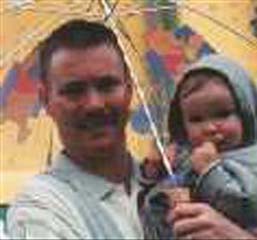
Sources:
- Legacy.com Guest Book
- Knightline - September 27, 2003
- September 11, 2001, Victims
- Knights of Columbus newsletter
- Newsday
- Vero Beach Press Journal

2,996 is a tribute to the victims of 9/11.
2,996 volunteer bloggers
are joined together in a tribute to the victims of 9/11.
Each person is paying tribute to a single victim.
We honor them by remembering their lives,
and not by remembering their murderers.
Project 2,996 is here.
2,996 volunteer bloggers
are joined together in a tribute to the victims of 9/11.
Each person is paying tribute to a single victim.
We honor them by remembering their lives,
and not by remembering their murderers.
Project 2,996 is here.
Friday, September 8, 2023
Rereading (again) — The Time of the Dark by Barbara Hambly
I haven't reread this since the last time, which was way back in 2014. This series is the first that Hambly got published and, in my opinion, are still the best she's ever written. That was confirmed again for me this time through.
The great thing about rereading something that you know really well is that you know the big story points but have forgotten enough of the smaller twists that then surprise you with pleased recognition. The last time this happened to me is talked about below.

The first book begins with a wonderful premise. What if you've been having a series of recurring dreams, set in a strange world, where you're in the middle of a panicking crowd all running from an ineffable horror? Then, one night, you wake up and you are in the middle of the city. It's no dream. It's real.
That's what happens to scholar Gil Patterson in The Time of the Dark. Where Barbara Hambly takes the adventure from there is a great ride.
You wouldn't normally think of a comfort book as one where you are fleeing with refugees from amorphous enemies (the Dark) in a parallel universe, where it is always freezing and there is never enough food, where you may never get home again because that might let the Dark into your own world ... but there you go. This is a much loved story that I fell back into last night, thinking "why has it been so long?"
Partly this is because I love Barbara Hambly's early books. Gil, Rudy, Ingold, the Ice Falcon, are all well drawn characters. They are realistic, imperfect heroes, just as the villains are sometimes people we can understand and relate to, despite the fact that one loves to hate them.
My mind is smoothed to the contours of their world and their struggles. I am really enjoying rediscovering the bits I'd forgotten, such as seeing just how Hambly built in the the underlying story logic through tiny details that show up very early int he book.
Overall this is really a great adventure and world to visit.


The great thing about rereading something that you know really well is that you know the big story points but have forgotten enough of the smaller twists that then surprise you with pleased recognition. The last time this happened to me is talked about below.

That's what happens to scholar Gil Patterson in The Time of the Dark. Where Barbara Hambly takes the adventure from there is a great ride.
You wouldn't normally think of a comfort book as one where you are fleeing with refugees from amorphous enemies (the Dark) in a parallel universe, where it is always freezing and there is never enough food, where you may never get home again because that might let the Dark into your own world ... but there you go. This is a much loved story that I fell back into last night, thinking "why has it been so long?"
Partly this is because I love Barbara Hambly's early books. Gil, Rudy, Ingold, the Ice Falcon, are all well drawn characters. They are realistic, imperfect heroes, just as the villains are sometimes people we can understand and relate to, despite the fact that one loves to hate them.
My mind is smoothed to the contours of their world and their struggles. I am really enjoying rediscovering the bits I'd forgotten, such as seeing just how Hambly built in the the underlying story logic through tiny details that show up very early int he book.
Overall this is really a great adventure and world to visit.


Thursday, September 7, 2023
That's Interesting — Flannery O'Connor Movie, Ulma Family Beatification, Name that Pope, McCarrick Coverage
Ethan Hawke on Deciding to Direct Flannery O’Connor Biopic "Wildcat," Portrait of an "Immensely Complex Human Being"

Ethan Hawke, prompted by his daughter Maya, directs a movie about Flannery O'Connor. As surprising as that news was to me, I was even more interested in Hawke's own telling of his discovery of the author and his exploration into the criticisms that she was racist. It left me eager to see the film.
Here's a bit, but do go read his piece in full.
The more I learned, the more clearly Flannery O’Connor grew as a knotty but extremely important subject for exploration. As O’Donnell puts it, “The voices of artists who offer a perspective that seems out of step with our moment are often the very people we should be harkening to. The canceling of a writer who possesses the wisdom and the power of Flannery O’Connor demonstrates our impoverished imaginations, our narrowness, and our inability to embrace complexity.
Ulma Family to be Beatified on Sept. 10
This is the first time that an entire family has been beatified at one time. They lived in Poland during World War II and had the family members of three Jewish families, eight in all, living with them for 2 years before being informed on.
The most unusual feature of the beatification is that their youngest child, who it is thought was born during the family's martyrdom, is also declared a saint. The Pillar has a good breakdown of the entire situation, including the fact that the family was targeted because they were Christian.
In the early hours of March 24, 1944, Nazi police descended on the Ulma family home. They forced all the occupants to line up and shot dead the eight Jewish residents. They then killed Józef and Wiktoria, and their children: Stanisława, aged 7, Barbara, 6, Władysław, 5, Franciszek, 4, Antoni, 2, and Maria, 1.
The house was set on fire, the bodies hastily buried, and the murderers celebrated the massacre with vodka and laughter.
A week later, the bodies were dug up to give them a more dignified burial. The diggers noticed that beside the body of Wiktoria, who had been seven months pregnant, was a newborn child. It was thought that she had entered labor at the time of her execution.
Although the child was never baptized, the Vatican says that the child is eligible for beatification through the time-honored concept of “baptism of blood.”

Let's play, 'Name that pope!' The Pope Francis vs. St. Pope John Paul II edition
You may have read the story about Pope Francis "blasting the “backwardness” of some conservatives in the U.S. Catholic Church, saying they have replaced faith with ideology and that a correct understanding of Catholic doctrine allows for change over time. — AP headline."
As with so many things from popes there's a need to place statements in context. GetReligion is an invaluable resource for context since they report on how the media reports on religion. They've got a great piece where they see if you can identify which pope said which seemingly damning quote. It's a long piece but highly informative for helping us keep an open mind instead of simply following sound bytes. Read it all here.
In conclusion, let me say that journalists are not out of bounds when they spotlight clashes between strong supporters of Pope Francis and Catholic leaders who keep quoting John Paul and Benedict. I believe, however, that journalists need to dig deeper before settling for the convenient, highly political, framework of nasty, backward “pelvic issues” Catholics vs. a loving, forward-looking pope seeking social justice.
Mainstream press (again!) fails to put McCarrick's past and victims into proper context
Ex-cardinal Theodore McCarrick was judged mentally incompetent to stand trial to stand trial in a sex abuse case. GetReligion, again providing context, shows that the mainstream media didn't give much information to explain the importance of this story and what it meant overall.
In fact, all the coverage was similar when it came to the facts of what happened in the courtroom and in this particular case. Where the coverage differed was the lack of proper background information regarding McCarrick’s past and his powerful influence on the church in this country and Rome, which he had discussed (included claims to have helped elect Pope Francis) in public remarks. The coverage also needed additional background information about the clergy sex-abuse scandal as a whole. ...That's a good reminder to me because McCarrick's shameful actions still loom large for me. I forget that many regular readers don't have that context. GetReligion shows how well Catholic media, specifically CNA, covered the story. This is another long one but read it all here.
It matters because background and context help readers understand stories better. In McCarrick’s case, context matters because the ex-cardinal hasn’t been in the news for some time. It also matters because McCarrick is a complicated figure who needs explaining. ...
A Movie You Might Have Missed #90 - Father Stu
GOD WANTED A FIGHTER. AND HE FOUND ONE.

The true-life story of boxer-turned-priest. When an injury ends his amateur boxing career, Stuart Long moves to Los Angeles to find money and fame. While scraping by as a supermarket clerk, he meets Carmen, a Sunday school teacher who seems immune to his bad-boy charm. Determined to win her over, the longtime agnostic starts going to church to impress her. However, a motorcycle accident leaves him wondering if he can use his second chance to help others, leading to the surprising realization that he’s meant to be a Catholic priest.This is that rare find, a well done Christian movie. Usually we avoid faith based films like the plague because they are terribly schmaltzy, poorly acted and produced, and painfully obvious. We gave this a chance because we were intrigued not only by the basic story but by Mark Wahlberg's dedication to getting it produced.
It definitely is made for a specific audience which includes our family and it has the familiar beats of such a story. However, they were done in so well that it hit the mark in a big way. We were all pleasantly surprised by the high quality of acting and production which accompanied this inspiring story.
Note: some Catholics are put off by the very vulgar language. We felt it told the story of Stu's background and how far he comes. However, there is a PG-13 version where the language has been cleaned up called Father Stu Reborn.

Monday, September 4, 2023
A Cotton Office in New Orleans
 |
| A Cotton Office in New Orleans, Edgar Degas, 1873 via Wikipedia |
Only man is capable of work, and only man works
On Labor Day I thought I'd put some Catholic thought on the nature of humans and work. Where better to look than John Paul II's Laborem exercens (Through Work). I didn't even know this existed.
THROUGH WORK man must earn his daily bread and contribute to the continual advance of science and technology and, above all, to elevating unceasingly the cultural and moral level of the society within which he lives in community with those who belong to the same family. And work means any activity by man, whether manual or intellectual, whatever its nature or circumstances; it means any human activity that can and must be recognized as work, in the midst of all the many activities of which man is capable and to which he is predisposed by his very nature, by virtue of humanity itself. Man is made to be in the visible universe an image and likeness of God himself, and he is placed in it in order to subdue the earth. From the beginning therefore he is called to work. Work is one of the characteristics that distinguish man from the rest of creatures, whose activity for sustaining their lives cannot be called work. Only man is capable of work, and only man works, at the same time by work occupying his existence on earth. Thus work bears a particular mark of man and of humanity, the mark of a person operating within a community of persons. And this mark decides its interior characteristics; in a sense it constitutes its very nature.I love this basic statement. It seems so simple, yet it conveys so much about who we are as children of God.
Subscribe to:
Comments (Atom)