 |
| 14-month old Jeanne Anne Evans kisses her horse near Marfa, Texas, in 1955. Traces of Texas |
Featured Post
On the road again — back July 6!
Back July 6! My husband and I are taking a road trip through Utah. We're going to Zion National Park, Brice Canyon and eventually we...

Monday, December 9, 2019
A Kiss for a Horse

Monday, December 2, 2019
Fortitude and the Salt of the Earth
Fortitude is the virtue that helps us to confront bodily and spiritual dangers. Often while citing an intention to be kind and benevolent, some have extinguished genuine Christine fortitude. Jesus tells us that we are the salt of the earth, not the sugar of the earth!
[...]
Jesus himself tells us: "You are the salt of the earth; you are the light of the world." What a responsibility! What a commission! To give up being the salt of the earth is to condemn the world to being insipid and flavorless; to give up being the light of the world is to condemn it to darkness. We must not be persuaded to do that. It even happens that some pastors, wishing to "meet the world," deliberately neglect this faith perspective in order to adopt a profane view. What a loss!
Cardinal Robert Sarah,The Day is Now Far Spent
Wednesday, November 27, 2019
On the Menu ...

We're cooking up a storm today, preparing for Thanksgiving of course! Here's what's on the menu and links to a lot of the recipes.
Tuesday, November 26, 2019
Turkey in a Courtyard
 |
| Turkey in a Courtyard by John Singer Sargent, circa 1879-1880 via J.R.'s Art Place |
Sharing food ...
Sharing food with another human being is an intimate act that should not be indulged in lightly.Having just rewatched Babette's Feast and with Thanksgiving on the horizon, I could not agree more.
M. F. K. Fisher
Monday, November 25, 2019
Pulp Adventure Fiction: The Mucker Series by Edgar Rice Burroughs
It's no secret that I have a real fondness for pulp fiction of the type that was serialized in various magazines around the turn of the 20th century. It is perfect for light relaxation and almost always has an underlying moral sense that I find refreshing these days.
This series by Edgar Rice Burroughs has additional interest because he begins with a completely unlikable and seemingly unredeemable character.


The Mucker in Mexico in the days of Pancho Villa. With a new best friend hobo who recites poetry. What a coincidence that Barbara's father happens to own a ranch nearby that they're visiting when the banditos/revolutionaries get violent...
The Kindle collection I was reading had this book as part 2 of The Mucker, but evidently it has usually be published as an independent sequel, which makes complete sense.

No Mucker, but we do get an adventure with his pal Bridge, the poetry quoting hobo. And burglars, murderers and a ghost. It was originally titled Bridge and the Oskaloosa Kid and is actually fairly short, more of a novella than a book. The twists are fairly predictable but I enjoyed seeing Bridge have his own adventures.
This series by Edgar Rice Burroughs has additional interest because he begins with a completely unlikable and seemingly unredeemable character.

Billy Byrne is a low class American born in Chicago's ghetto. He grows up a thief and a mugger. He is not chivalrous nor kind, and has only meager ethics - never giving evidence against a friend or leaving someone behind. He chooses a life of robbery and violence, disrespecting those who work for a living. He has a deep hatred for wealthy society.As I said, this book takes an interesting and unusual turn in telling about a man with no redeeming qualities whatsoever whose participation in a kidnapping leads to a change of perspective. We expect Billy's redemption when he crosses paths with a millionaire's daughter, but she loathes him as much as he hates everything about her. And for a very good reason which is one I never could figure out how they would get past. Their exotic adventures together, thanks to fate, make great escapist reading.

The Mucker in Mexico in the days of Pancho Villa. With a new best friend hobo who recites poetry. What a coincidence that Barbara's father happens to own a ranch nearby that they're visiting when the banditos/revolutionaries get violent...
The Kindle collection I was reading had this book as part 2 of The Mucker, but evidently it has usually be published as an independent sequel, which makes complete sense.

No Mucker, but we do get an adventure with his pal Bridge, the poetry quoting hobo. And burglars, murderers and a ghost. It was originally titled Bridge and the Oskaloosa Kid and is actually fairly short, more of a novella than a book. The twists are fairly predictable but I enjoyed seeing Bridge have his own adventures.
Wednesday, November 20, 2019

One day at a time
Let's try to live today as we should, according to the paths of the Kingdom, in trust and simplicity, seeking God and abandoning ourselves to him. And God will take care of the rest.
One day at a time. This is very important. Very often we exhaust ourselves going over the past again and again and also our fears about the future. But when we live in the present moment, we mysteriously find strength. We have the grace to live through what we encounter today. If tomorrow we must face more difficult situations, God will increase his grace. God's grace is given at the right time for it, day by day.
Jacques Phillipe, The Way of Trust and Love:A Retreat Guided by St. Therese of Lisieux
Monday, November 18, 2019

God's grace changes and re-orders the soul.
God's grace is not external; it actually changes and re-orders the soul and its loves, so that "God becomes the life of the soul as the soul is the life of the body." This begins now and is perfected in Heaven; in fact if it does not begin now, the soul could not endure Heaven.
Peter Kreeft, Socrates' ChildrenVol. II: Medieval Philosophy(chapter on Augustine)
Thursday, November 14, 2019

Lagniappe: Women and cats ...
Women and cats will do as they please, and men and dogs should relax and get used to the idea.
Robert A. Heinlein
Wednesday, November 13, 2019

Trusting in God Instead of Ourselves
Sometimes we manage to do what is right, lead a good and virtuous life, have great trust in God, without the slightest problem; and then a difficult time comes. For instance, we commit a fault that really humiliates us. Or we make a wrong decision, which is unpleasant, especially when other people notice it. We are brought face-to-face with our defects, and we become sad and discouraged. All our great trust in God melts away like snow in the sun.
This simply means that what we called trust in God was in fact trust in ourselves. If trust disappears when we do wrong, it shows that our trust was based on ourselves and our deeds. Discouragement is a clear sign that we've put our trust in ourselves and not at all in God.
... And it is vital that our trust should rest not on our personal achievements but only on God's love, his tenderness, his infinite mercy, on the fact that he is our Father and can never abandon us. Otherwise we will never be truly free but will always be afraid of failure, of our weaknesses and somewhat centered on ourselves instead of centered on God.
Jacques Phillipe,The Way of Trust and Love: A Retreat Guided by St. Therese of Lisieux
Tuesday, November 12, 2019

What God secretly sows in our hearts
We would like to feel that we're making progress, improving and advancing, and sometimes we do see it: we're aware that God has untied a knot, as he did for Therese that Christmas. But very often we don't feel anything. Yet God is still acting and one day we will see the fruits. Like the seed the Gospel speaks of, a tiny little gran of mustard seed, God has secretly sown something in our hearts; then, whether we wake or sleep, the seed grows, bears fruit and becomes like a tree in which the birds of the sky can find refuge.* These are the fruits of the secret working of grace for our benefit and our neighbors'; they grow by themselves, so to speak, and we end up seeing how the poor lost birds of today's world find consolation, hope, encouragement, acceptance, and tenderness with us.
So the underlying issue, in the human and spiritual life, is to discover (and practice) the inner attitudes, the dispositions of heart, that make us permeable to God's grace and attract it unfailingly: small and poor, yet attracting God's grace in an absolutely certain way. Not because anyone can manipulate God. If anyone can't be manipulated, it's God. But he is faithful and he loves us, and so we can find absolutely unfailing ways of attracting his grace.
Jacques Phillipe, The Way of Trust and Love: A Retreat Guided by St. Therese of Lisieux
* See the parables about the mysterious growth of the Kingdom, cf. Matthew 4:31-33 and Mark 4:26-29.
Monday, November 11, 2019
Veteran's Day Tribute

Photo credit: Kate Gardiner
It Is The Soldier
It is the Soldier, not the minister
Who has given us freedom of religion.
It is the Soldier, not the reporter
Who has given us freedom of the press.
It is the Soldier, not the poet
Who has given us freedom of speech.
It is the Soldier, not the campus organizer
Who has given us freedom to protest.
It is the Soldier, not the lawyer
Who has given us the right to a fair trial.
It is the Soldier, not the politician
Who has given us the right to vote.
It is the Soldier who salutes the flag,
Who serves beneath the flag,
And whose coffin is draped by the flag,
Who allows the protester to burn the flag.
by Charles M. Province, U.S. Army • November 1, 2004
- Recta Ratio has good comments on the day and how our lack of true celebration is a commentary in itself on our culture.
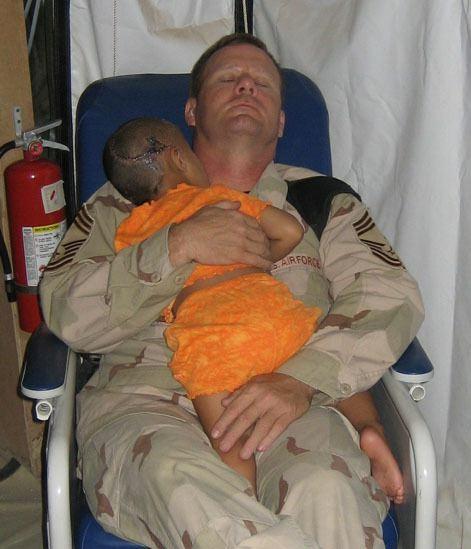
This moving photograph shows Chief Master Sgt. John Gebhardt, superintendent of the 22nd Wing Medical Group at McConnell Air Force Base in Kansas, holding an injured Iraqi girl. The picture was taken in October 2006, while Sgt. Gebhardt was deployed to Balad Air Base in Iraq. According to the Air Force Print News, the infant girl Sgt. Gebhardt held in his arms "received extensive gunshot injuries to her head when insurgents attacked her family killing both of her parents and many of her siblings."I haven't said it enough because none of us really can but to our veterans as well as those serving now ... thank you from the bottom of my heart.
Sgt. Gebhardt is now back home in Wichita, Kansas, with his wife and two children. An Air Force Link article about the sudden fame he gained as the subject of this photograph reported that:
The chief had a knack for comforting [the injured Iraqi girl] and they often would catch a cat nap together in a chair.
"I got as much enjoyment out of it as the baby did," he said. "I reflected on my own family and life and thought about how lucky I have been."
While deployed to Iraq, the chief tried to help out any way he could. He figured holding a baby that needed comforting that would free up one more set of arms that could be providing care to more critical patients.
"I pray for the best for the Iraqi children," he said. "I can't tell the difference between their kids and our kids. The Iraqi parents have the same care and compassion for their children as any American."
Source: Snopes
We notice a self-hatred in the Western world that is strange ...
Here we notice a self-hatred in the Western world that is strange and that can be considered pathological; yet, the West is making a praiseworthy attempt to be completely open to understanding foreign values, but it no longer loves itself; from now on it sees its own history only as a blameworthy and destructive, whereas it is no longer capable of perceiving what is great and pure. In order to survive, Europe needs a new ... acceptance of itself, that is, if it wants to survive.I am, of course, aware of this self-hatred which is flung at Americans. We're not allowed to honor or praise ourselves in a lot of ways without having fellow Americans tell us why we are terrible.
Joseph Ratzinger, Europe Today and Tomorrowquoted in The Day is Now Far Spent, Cardinal Robert Sarah
Reading this quote it struck me that if Ratzinger was describing a person instead of the Western world, we would worry about suicide or abuse. Certainly we'd think of depression accompanying such self loathing. We would build the person up, not tear them down every chance we got. And yet this is how we as Americans, as Westerners, are treated. No wonder we are suffering cultural crisis on so many levels.

Friday, November 8, 2019
The Star Lovers
 |
| Illustration for The Star Lovers by Grace James Illustrated by Warwick Goble Read the story at Childhood Reading |
Subscribe to:
Posts (Atom)