 |
| Mrs. Walter Rathbone Bacon, Anders Zorn, 1897 |
Thursday, October 13, 2016

Wednesday, October 12, 2016

Well Said: Who is the most holy?
It is not those who commit the least faults who are most holy, but those who have the greatest courage, the greatest generosity, the greatest love, who make the boldest efforts to overcome themselves, and are not immoderately apprehensive of tripping.
Francis de Sales
Genesis Notes: Noah and the Flood
GENESIS 6-8
The last study looked at how the people cleansed in the flood had a clear choice between right and wrong. This brings us to the other question my girls asked when little, "What about the poor animals? It isn't fair to them." True enough and a question that always tugged at my heart strings also. When I read why the animals had to be included the light bulb really went on. This explanation ties in with things I've read in other sources (notably Peter Kreeft's work) which talks about the universe being created for man.
The last study looked at how the people cleansed in the flood had a clear choice between right and wrong. This brings us to the other question my girls asked when little, "What about the poor animals? It isn't fair to them." True enough and a question that always tugged at my heart strings also. When I read why the animals had to be included the light bulb really went on. This explanation ties in with things I've read in other sources (notably Peter Kreeft's work) which talks about the universe being created for man.
 |
| Noah's Ark (1846), Edward Hicks. |
For animals to be included in the cleansing of the earth suggests the inseparable relationship between man and the rest of creation. The dominion God had given him has real meaning - when man goes down, so does all the rest of the earth. This helps us to see clearly how all the elements of creation led up to the creation of man. He was not just one player among many. Without man, the rest has no meaning. (Genesis: God and His Creation)The other question that comes up every time in this classic tale is just how the animals were collected in the first place.
Many have wondered how this animal kingdom roundup happened. Did Noah and his sons spend years collecting all the animals? In reality the creation, along with Noah, was doing just as God had commanded. There seemed to be no problem gathering the animals. God took care of the details of that job while Noah was doing his part by building the ark. Often we do just the opposite of Noah. We worry about details over which we have no control, while neglecting specific areas (such as attitudes, relationships, responsibilities) that are under our control. Like Noah, concentrate on what God has given you to do and leave the rest to God. (Life Application Study Bible)I also liked reading this description of the size of the ship, which boggles the mind. It's bad enough to build a regular boat with no visible hope of water to float it but what God asked Noah to do seemed preposterous if you didn't have faith.
... Picture yourself building a boat the length of one and a half football fields and as high as a four-story building. The ark was exactly six times longer than it was wide -- the same ratio used by modern shipbuilders. This huge boat was probably built miles from any body of water by only a few faithful men who believed God's promises and obeyed his commands. (Life Application Study Bible)This series first ran in 2004 and 2005. I'm refreshing it as I go. For links to the whole study, go to the Genesis Index. For more about the resources used, go here.
Tuesday, October 11, 2016

Saturday, October 8, 2016
In which we fix Carstairs breakfast. And find out more about Heloise and Handsome Lover Boy.

Chapter 3 of Oh, Murderer Mine at Forgotten Classics podcast.
Rated G for sassy girl teachers, Handsome Lover Boys, gigantic Great Danes, and deceptively pudgy detectives.
Friday, October 7, 2016
Worth a Thousand Words: Europa, Discover Life Under the Ice
 |
| Europa via my husband who recalled Will Duquette featuring these on Facebook |
Astonishing geology and the potential to host the conditions for simple life make Jupiter's moon Europa a fascinating destination for future exploration. Beneath its icy surface, Europa is believed to conceal a global ocean of salty liquid water twice the volume of Earth's oceans. Tugging and flexing from Jupiter's gravity generates enough heat to keep the ocean from freezing. On Earth, wherever we find water, we find life. What will NASA's Europa mission find when it heads for this intriguing moon in the 2020s.
Thursday, October 6, 2016
Lagniappe: Still like that.
"Lydia. You're still like that, huh?" He shook his head, smiling. "You're still like that."
I wasn't completely sure what it was I was still like, but I knew I was still like that.
S.J. Rozan, China Trade
Prayers for Family in Hurricane's Path
My mother, sister and BIL (haha, his name is Bill too) are in Melbourne, Florida, in the path of Hurricane Matthew.
They're hunkering down at Mom's place and hopefully will have the cheerful hurricane party experience that my husband recalls from his Houstonian childhood experiences.
Please keep them in your prayers.
As well as all of those in the storm's path, like Bridget!
St. Medard, patron saint for protection against bad storms, pray for them!
As well as all of those in the storm's path, like Bridget!
St. Medard, patron saint for protection against bad storms, pray for them!
Wednesday, October 5, 2016
Lagniappe: Trembling Inside
Mike's widow, to whom I'd said a few clumsy words, sat by the coffin. She was quiet, but she seemed to be trembling inside, like a teardrop.
S.J. Rozen, Concourse

Genesis Notes: Left Behind
GENESIS 6-8
Now Genesis brings us to a character who even the smallest child is familiar with, Noah and his ark of animals. When the girls were little and we would read picture books of this story they always were saddened by the animals and people left behind. Truth to tell, I was saddened by those pictures too. I never had a good reason as to why they got left behind. That's because I hadn't yet looked below the surface of Genesis. Get ready to look into Romans for some help with this subject in a way that relates directly to life today.
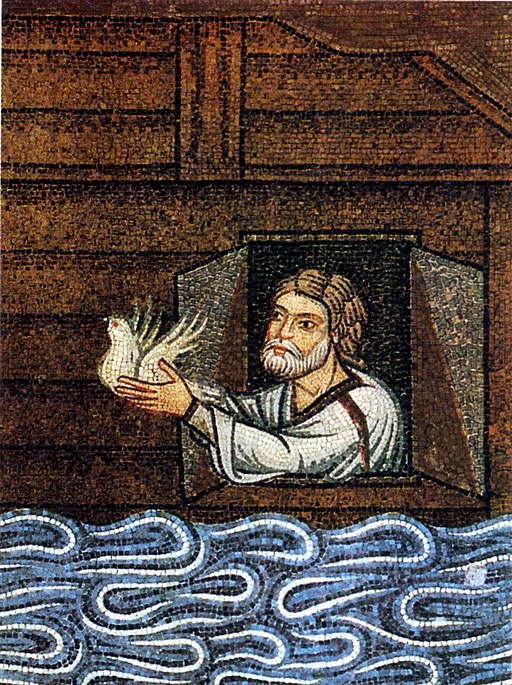
When they get to why the animals had to be included the light bulb really went on. This explanation ties in with things I've read in other sources (notably Peter Kreeft's work) which talks about the universe being created for man.
The other question that comes up every time in this classic tale is just how the animals were collected in the first place.
Now Genesis brings us to a character who even the smallest child is familiar with, Noah and his ark of animals. When the girls were little and we would read picture books of this story they always were saddened by the animals and people left behind. Truth to tell, I was saddened by those pictures too. I never had a good reason as to why they got left behind. That's because I hadn't yet looked below the surface of Genesis. Get ready to look into Romans for some help with this subject in a way that relates directly to life today.

When you read the account of the Flood, realizing that everyone except Noah's family died because of God's judgment, did you ever have a twinge of wondering if that was fair? After all, if some human civilizations developed away from the covenant-keepers, thus becoming intensely evil, perhaps we want to say that they didn't know any better. Maybe we think they never really had a chance to live their lives the way Noah did.
St. Paul, in his epistle to the Romans (1:19-25), helps us to understand better just exactly what was going on among men whose lives were given over to wickedness ...
Here we see that St. Paul says that anyone who lives on the planet Earth, whether he lives among covenant keeping people or not, knows enough about God to live in the right way. Why? Because God has revealed Himself in His works. Looking around at the world in which he lives, a man is capable of recognizing that (1) there is a God (2) He is powerful (3) He deserves to be honored and thanked (Rom. 1:20-21). When a man chooses not to act on what he knows to be true, he suppresses the truth. It isn't that he has been deprived of it-he simply refuses to live by it.
When that happens, things go downhill fast, as St. Paul tells us (Romans 1:28-32) ... This is a description of what happened in the early history of man and what continues to happen when men, like Cain, know what is right to do but refuse to do it. When that happens, the most merciful thing God can do is to punish man. It is often only when men are faced with suffering and death that their autonomy crumbles to ash, and they are willing to cry out to God, Whom they are finally ready to acknowledge as the only One who can help...
The people swept away in the Flood were not necessarily eternally lost. Their death was a temporal punishment until Christ preached to them the message of redemption they needed to hear. Those who were merely ignorant surely responded with great joy. But those who, like Cain, had hardened their hearts through sin, might well have had the same reaction to Christ as Cain had to God — "Thanks, but no thanks." We should never worry about the justice and fairness of God (see CCC 632-635).
When they get to why the animals had to be included the light bulb really went on. This explanation ties in with things I've read in other sources (notably Peter Kreeft's work) which talks about the universe being created for man.
For animals to be included in the cleansing of the earth suggests the inseparable relationship between man and the rest of creation. The dominion God had given him has real meaning — when man goes down, so does all the rest of the earth. This helps us to see clearly how all the elements of creation led up to the creation of man. He was not just one player among many. Without man, the rest has no meaning.
The other question that comes up every time in this classic tale is just how the animals were collected in the first place.
Many have wondered how this animal kingdom roundup happened. Did Noah and his sons spend years collecting all the animals? In reality the creation, along with Noah, was doing just as God had commanded. There seemed to be no problem gathering the animals. God took care of the details of that job while Noah was doing his part by building the ark. Often we do just the opposite of Noah. We worry about details over which we have no control, while neglecting specific areas (such as attitudes, relationships, responsibilities) that are under our control. Like Noah, concentrate on what God has given you to do and leave the rest to God.
Tuesday, October 4, 2016

Lagniappe: A dozen scientists and engineers
Confine a dozen scientists and engineers to a seemingly endless desert of hard-packed sand with no recreational diversions and, inevitably, they will design and build a golf course.
P.J. Tracy, The Sixth Idea
Friday, September 30, 2016

Thursday, September 29, 2016
Blogging Around
A Single Phrase Helped Save This Marriage
Finally, hoarse and broken, I sat down in the shower and began to cry. In the depths of my despair powerful inspiration came to me. You can’t change her, Rick. You can only change yourself. At that moment I began to pray. If I can’t change her, God, then change me. I prayed late into the night. I prayed the next day on the flight home. I prayed as I walked in the door to a cold wife who barely even acknowledged me. That night, as we lay in our bed, inches from each other yet miles apart, the inspiration came. I knew what I had to do.Read it all here.
Beware the (Online) Culture of Wrath
Stephen D. Greydanus on how to avoid poisoning your soul, or those of others, on social media. He's got good ways to do a self examination checking for unseen problems in your own participation. And some excellent common sense guidelines.What My Dying Friend is Teaching Everyone Around Her About Faith
Her luminous witness of a peaceful spirit despite real and ever present danger has directed the attention of everyone around her away from the cancer to the Divine Physician. She is embracing her cross like a lover, revealing thus the one she loves.Read it all here.
Why a Hawk is a Hummingbird
You know what they say about location and real estate. Hummingbird nests often appear in clusters, but for years researchers couldn’t figure out what attracted the birds to certain areas. Turned out the answer was, “good neighbors.”Fascinating. Read it all here.
Wednesday, September 28, 2016
Well Said: Tolkien's concern
The Ring is less morally ambiguous than the average realistic novel, but that's primarily because Tolkien wasn't especially interested in the problem of knowing right from wrong. His concern was to explore the psychology of the moment when you know right from wrong but aren't sure whether you have the courage and fortitude to do the right thing.Yep. And that is why The Lord of the Rings is endlessly fascinating.
Alan Jacobs
Tuesday, September 27, 2016
Well Said: What wonder you do not understand...
We are talking about God. What wonder is it that you do not understand? If you do understand, then it is not God.
St. Augustine


Genesis Notes: Adam's Descendents
GENESIS 5
Genesis 5 shows the descendents from Adam to Noah and is one of those endless seeming lists of names that make my eyes glaze over.
There's nothing for modern people in these lists. Right? Au contraire!

Genesis 5 shows the descendents from Adam to Noah and is one of those endless seeming lists of names that make my eyes glaze over.
There's nothing for modern people in these lists. Right? Au contraire!

The Bible contains several lists of ancestors, called genealogies. There are two basic views concerning these lists: (1) they are complete, recording the entire history of a family, tribe, or nation; or (2) they are not intended to be exhaustive and may include only famous people or the heads of families. "Became the father of" could also mean "was the ancestor of."This series first ran in 2004 and 2005. I'm refreshing it as I go. For links to the whole study, go to the Genesis Index. For more about the resources used, go here.
Why are genealogies included in the Bible? The Hebrews passed on their beliefs through oral tradition. For many years in many places, writing was primitive or nonexistent. Stories were told to children who passed them on to their children. Genealogies gave a skeletal outline that helped people remember the stories. For centuries these genealogies were added to and passed down from family to family. Even more important than preserving family tradition, genealogies were included to confirm the Bible's promise that the coming Messiah, Jesus Christ, would be born into the line of Abraham.
Genealogies point out an interesting characteristic of God. People are important to him as individuals, not just as races or nations. Therefore God refers to people by name, mentioning their life span an descendants.
Life Application Study Bible, emphasis added
Subscribe to:
Comments (Atom)