 From Lifehacker, via Tom.
Saturday, December 22, 2007

Friday, December 21, 2007
Who Should Direct the Hobbit?
Since Peter Jackson is declining. Jeffrey Overstreet suggests Brad Bird and I second that suggestion. Read the reasons why at his place ...
Thursday, December 20, 2007
"Rescuing your people ... I can't really say it is our prime objective."
Are we ready for Lost? I know I am.
What Does "the Incarnation" Really Mean?
Our church bulletin insert from last Sunday.
Considering the Truth of the Incarnation“No worldly mind would ever have suspected that He Who could make the sun warm the earth would one day have need of an ox and an ass to warm Him with their breath; that He Who, in the language of Scriptures, could stop the turning about of Arcturus would have His birthplace dictated by an imperial census; that He, Who clothed the fields with grass, would Himself be naked; that He, from Whose hands came planets and worlds, would one day have tiny arms that were not long enough to touch the huge heads of the cattle; that the feet which trod the everlasting hills would one day be too weak to walk; that the Eternal Word would be dumb; that Omnipotence would be wrapped in swaddling clothes; that Salvation would lie in a manger; that the bird which built the nest would be hatched therein—no one would have ever suspected that God coming to this earth would ever be so helpless. And that is precisely why so many miss Him. Divinity is always where one least expects to find it. ...
No man can love anything unless he can get his arms around it, and the cosmos is too big and too bulky. But once God became a Babe and was wrapped in swaddling clothes and laid in a manger, men could say, “This is Emmanuel, this is God with us.” By His reaching down to frail human nature and lifting it up to the incomparable prerogative of union with Himself, human nature became dignified. So real was this union that all of His acts and words, all of His agonies and tears, all of His thoughts and reasonings, resolves and emotions, while being properly human, were at the same time the acts and words, agonies and tears, thought and reasonings, resolves and emotions of the Eternal Son of God.”Archbishop Fulton Sheen, Life of Christ-------------------------------------------------------In our meditations upon the Incarnation we encounter many familiar images. This is natural and to be expected. It is automatic to think sentimentally and comfortably about the little babe, the adoring parents, singing angels, startled shepherds, and Magi with gifts, while traditional carols echo in our ears.
However, as Fulton Sheen reminds us, the reality of the Incarnation is not comfortable at all. It is God breaking into human time and nature and history to effect a miracle so outrageous that no one would have thought it up in their wildest dreams. The Second Person of the Trinity willingly takes on our limited human nature, purely for love of us. Shocking? Yes. Amazing? Yes. But comfortable? No.
This also is a good reminder that it is very easy to read into Scripture what we would like to see. Pulling the truth out of Scripture, also called exegesis, is considerably more difficult. That truth may prove quite a bit more surprising than we expect. God does have a habit of showing us truth in surprising ways.
To think of the Christ child at Christmas is natural. Undeniably those are the images of the season. However, the meaning of this baby for us and for all mankind is far from a sentimental picture. Jesus comes to us as a baby so we will learn something of his real nature and of the beginning of the path that he will tread and that we must follow.
Pope Benedict XVI helps us to consider further the layers of meaning in the Incarnation. In a Christmas homily* he said:
“God’s sign is the baby in need of help and in poverty. … God’s sign is simplicity. … God’s sign is that he makes himself small for us. This is how he reigns. He does not come with power and outward splendour. He comes as a baby – defenceless and in need of our help. … He asks for our love: so he makes himself a child. He wants nothing other from us than our love, through which we spontaneously learn to enter into his feelings, his thoughts and his will – we learn to live with him and to practise with him that humility of renunciation that belongs to the very essence of love. ...”
In our meditations upon the Incarnation we encounter many familiar images. This is natural and to be expected. However, let us not settle for comfort. Let us dig deeper and discover the true nature of the Lord, he who is Love incarnate, who came to show that love for you and for me.-------------------------------------------------------* Read online Pope Benedict XVI’s entire homily from Midnight Mass, Solemnity of the Nativity of the Lord.

Wednesday, December 19, 2007
Now That is Giving It Up For Your Art ... Matt Frewer I Salute You!

Everyone thought that Max was computer generated, but computers couldn’t do that in 1986. In reality our actor, Matt Frewer, had to spend hours every day having makeup and prosthetics applied to him, including plastic hair and shiny chest piece.Creative Cow reminds me of how much Tom and I loved Max Headroom, which still inexplicably is available only on old VHS ... the show that still holds up after all these years.
He was then shot on greenscreen, the video was squashed in the Ampex ADO effects box, and the moving graphics were composited into the background in the switcher.
Some video editing (linear, of course) introduced his unique “scratch” effect, complemented with audio effects. Finally, the whole thing was output to a monitor and reshot on set with live actors. Not a computer to be found.
Download the current issue of Creative Cow in pdf form at their website.
Tuesday, December 18, 2007
The Helpful Catholic's Guide to Discerning Other People's Vocations For Them
One of Disputations' best charts ever. Its funny because its true. (I'll be snickering for a while over this one ...)
You Can Know God's Will. But Will You Want to Do It?
Over and over again this past week, I've found that the challenge is not usually knowing what God's will is...it's following it. There have been some occasions where I really don't know what I am supposed to do and can only go forward in meekness and blind trust. But, more often, when I pray about my anxiety, God's path for the resolution of the situation is actually pretty clear: it involves stuff like smoothing over tense interpersonal situations with great humility and love; resolving financial stress by admitting things I don't want to admit and committing to sacrifices I don't want to make; making overwhelming situations manageable by taking a hard look at my priorities (like, say, stopping half way though a blog post I really wanted to finish to open mail instead) and asking for help when I need it. And so on and so on. Not surprisingly, it keeps coming down to stuff like sacrifice, humility, loving openly and selflessly, patience, being willing to be vulnerable, etc. In other words: really hard stuff that I don't want to do.I feel ya, sistah!Jen at Et Tu?
I realized earlier this year that I almost always know what I should do but spend quite a lot of mental effort trying to justify my way out of doing it. Often this is over a real no-brainer and something fairly simple like attending a Holy Day of Obligation Mass (If only they picked more convenient mass times. What would those convenient times be? Well, to be honest ... how about never?)
I don't have to get in a prayerful mindset the way that Jen describes (of course, I'm battling out and out disobedience here, not dealing with anxiety as she is and that's a whole different problem). I already know. I'm like the three-year-old who is coming up with excuse after excuse, trying them out all the while knowing that none of them are good enough.
When I finally give up and give in? Oh, the relief of not struggling any more!
Now that I have realized this pattern, I try to recognize it earlier and just give in ASAP. No matter what I will have to do the "right thing" that I am trying to avoid ... but now without all the added stress of arguing with Papa about it.
I will double back and add that the times I haven't known what to do and prayed about what to do in a tough situation, I almost always get that "little thought" floating from the back of my mind that shows the way. Sometimes when I'm extra dense I get a stern, smackdown. Yes, it's happened. (Which was one of the things that convinced me I wasn't just "making up" what I wanted to hear. I'm always much gentler with myself than God sometimes is.) Nothing makes you jump up and follow marching orders like getting yelled at.
Go read all of Jen's post. There's much more and, as always, it's all good stuff.
Monday, December 17, 2007
I Am Legend. Go See It.
That's Scott Nehring's advice and I, for one, think its always a good idea to follow Scott's advice. He says, intriguingly:
Now if I'd only not realized that it is ONE WEEK AND ONE DAY away from Christmas. Excuse me while I breathe into a paper bag to calm my hyperventilating ... at least the thought of Will Smith and zombies will help keep me calm while I whirl around finishing things up.
I am Legend is very much worth seeing. Not only do you get a very effective zombie flick (if its fair to call it that) the piece is very Christian in its approach and overall theme. It is very rare to see God place such a central role in a major release film.They had me at "zombie." Well, to be honest, they really had me at Will Smith. Ahem. Anyway, Nehring's recommendation has my interest to a fever pitch.
Now if I'd only not realized that it is ONE WEEK AND ONE DAY away from Christmas. Excuse me while I breathe into a paper bag to calm my hyperventilating ... at least the thought of Will Smith and zombies will help keep me calm while I whirl around finishing things up.
A Few Reactions to Frankenstein. Ok, Really Just One Reaction.
To the book, not any of the movies.
I'm listening along with CraftLit , about one episode behind. As Heather at points out, Young Frankenstein really is not a bad representation of the book at all, especially Gene Wilder's take on Frankenstein's character.
... what a SHALLOW IDIOT Frankenstein is!
First, when he said he was going to make his creation 8 feet tall, I was waiting for a reason to do this. Oh silly me, no reason. Just seemed like a good idea at the time I suppose.
THEN, when he is horrified at his creation because he's ugly. And what does he do? Goes off to take a nap!
Then Frankenstein comes back with a friend and is only HAPPY to find the monster gone? No thoughts about where he's gone, what he might be doing ... just worry that his friend might have seen him.
I'd like to give that guy a good slap!
Of course, this resonates all the more because I read this morning that scientists think they are on the verge of creating original DNA strands and inserting them in cells to see what happens. I think they all need to read Frankenstein first ...
I'm listening along with CraftLit , about one episode behind. As Heather at points out, Young Frankenstein really is not a bad representation of the book at all, especially Gene Wilder's take on Frankenstein's character.
... what a SHALLOW IDIOT Frankenstein is!
First, when he said he was going to make his creation 8 feet tall, I was waiting for a reason to do this. Oh silly me, no reason. Just seemed like a good idea at the time I suppose.
THEN, when he is horrified at his creation because he's ugly. And what does he do? Goes off to take a nap!
Then Frankenstein comes back with a friend and is only HAPPY to find the monster gone? No thoughts about where he's gone, what he might be doing ... just worry that his friend might have seen him.
I'd like to give that guy a good slap!
Of course, this resonates all the more because I read this morning that scientists think they are on the verge of creating original DNA strands and inserting them in cells to see what happens. I think they all need to read Frankenstein first ...
"But, Jeff, ... what are you doing for the kingdom?"

More Than a Dream: How One School's Vision Is Changing the World by G.R. Kearney
Jim Gartland walked toward a group of four gangbangers who stood in the shadows next to a brick building, just beyond the yellow light cast by a a nearby street lamp. He was scared. Their gang affiliation was clear in the way they wore their clothes, their hair, their shoes. They were out on patrol. It was a hot night in September, and Gartland--dressed in a Roman collar, comfortable chinos, and a pair of Teva sandals--was walking the neighborhood and talking to people. He slowly approached the group, his hands in his pockets, and tried to look self-assured. He knew they were watching him His white face shone in a sea of Latinos.If you had told me at the beginning of the weekend that I'd be reading a book about a school start-up and absolutely riveted, I'd have scoffed.
This was one of Gartland's first face-to-face-interviews, and it's worth nothing that as he approached the young gang members, no one had his back. In a literal sense, he walked the streets alone, following the clearest orders he received form his superiors, to "go out and meet people and tell us what, if anything, we should do." In a figurative sense, Gartland was conducting the feasibility study with very little support from his fellow Jesuits. Even as he walked the streets, many of them were voicing their opposition to the idea of a new ministry, particularly a school. ...
As Gartland drew near the gangbangers standing in the shadows, they turned slowly to face him. He was surprised by how young they seemed, with thin mustaches and beards, and tattoos emblazoned on their shoulders and arms. Still, they succeeded at appearing menacing. Gartland could barely manage to say, "Hi , guys."
As happens so often, I'd have been wrong.
This is a book of all the little stories that add up to a big picture, in this case the opening of a school based on a completely original learning approach in the poor Hispanic ghetto laden with crime, gangs, and no dreams of a future. We see intertwined the lives of students, the lives of those who will run the school, and the unfolding of the story in a compelling documentary style. I am loathe to share many of the details of the story because part of what has left me so fascinated is watching each hurdle arise and actively wondering how it is going to be overcome. This is not only an amazing story, it is storytelling in a immersive style as we travel with each person on the way. We not only see the personalities, they share with us their personal growth along the way.
The rope course was a hit with the students and an epiphany for Kendall. "At the end of the day, the students were all climbing this wall and I remember one of the girls looking up and saying, 'I'm not going.' I said, 'I won't force you. But you should try. I'll go up there with you.' I thought it'd be a piece of cake.It is also an education into those who would label the Jesuit order as being of a "type." It is a reminder that there are many good people who want to make a difference but simply don't know how until they are offered the opportunity. It is a wake up call that many of those mired in gangs and crime don't aspire to that life, they simply have no clue of how to live a "normal" life that seems as far from their experience as a moon landing.
"We climbed the wall, and when I got up there, I started looking down. I kept telling myself I was safe--I was strapped into a safety harness and wearing a helmet--but every part of my body was telling me I wasn't. My legs were shaking and my heart was pounding. It was really scary. I only realized then how much I'd been asking the students to do. All year I'd been telling them they had noting to be scared about at work. Standing up on the ropes course, I realized how I hadn't been aware of their fear. When we came down, the girl looked up at the wall and said, 'You know, Mr. Kendall, I never thought I could do that, but I did.' She was just gazing up at the wall. And that's when I realized that this was the best thing we'd done all year. I wanted every one of our students to be able to say, 'I never thought I could, but I did.'"
... During admissions interviews, Kendall, Judy Murphy, and Rosy Santiago learned that some of the incoming students had literally never left their neighborhoods. Some had never been downtown, never been in an elevator or on an escalator ...In spite of all this ... the lack of funds, the lack of interest on the part of most potential students, the lack of any sensible model to follow, the fear and opposition of those who saw it threatening established schools ... a diverse group of people all found themselves immersed in the dream to serve those who needed it most and who could themselves help to make a difference in the neighborhood of Pilsen. The story is compelling and you will want to read it.
Kudos to Loyola Press for continuing to publish books (They Come Back Singing, A Jesuit Off-Broadway) that take us into other, sometimes uncomfortable, parts of society and our world to remind us that our cozy little corners are not the only thing there is and that God is at work in all of them.
Sunday, December 16, 2007
"Because of love!"
This was my favorite chapter from They Come Back Singing (reviewed here). I read it three times because the dynamics of the people's responses and the way the teaching built gripped me by the throat. I loved it. This is long but worth it.
Much thanks to Loyola Press for allowing me to excerpt this chapter. I typed this in myself so if you see typos let me know.
Much thanks to Loyola Press for allowing me to excerpt this chapter. I typed this in myself so if you see typos let me know.
Kogwon Narju
Every day here takes me into new experiences, deeper experiences, yet linking me with the past. I am an old tree growing steadily but always with a new growth of leaves and blossoms. Grace and love move in my heart, and each place and event becomes a new sanctuary of the mystery of my faith.
Yesterday I traveled to the west side of the Nile with Ratib to do a one-day seminar in the settlement village of Cochi. When we arrived, after two hours of driving in the rain and ferry delays, I talked strategy and plans for the seminar with my lead catechists, Kenyi and Osura, as people were coming in to the chapel. Nearly a hundred people there.
It is Lent, so I focused on the theology of the season and how it fits into the church year. That led into a discussion of the life of Christ and why God even bothered to send his Son. What I asked, is the point of Jesus' suffering and dying for us? In these seminars, I use Scripture and lots of acting to engage the group as much as I can in a dialogue about our topic. I know that they have the truth within them. My job is to tease it out and help them claim it.
We were at it for more than three hours.
At the heart of the teaching was the fact that we sin and are forgiven and loved by the one who creates us, the one who sent his only Son as the promise of his love and forgiveness. We are loved sinners.
I asked everyone: "Well, what is sin?"
They gave a variety of answers: "murder," "adultery," "gossip," stealing," selfishness," "hate," "not being faithful to God."
"Are we all sinners?"
The congregation, in a convinced chorus: "Yes, all are sinners."
I pointed to a man in the front row. "Even this old man here?"
"Yes, all are sinners."
"Even this beautiful young mother and her child?"
"Yes, all."
"But surely not Kenyi, your good and holy catechist?"
Lots of nodding and laughs. "yes, all." (Kenyi cracked up as I shook my head at him in mock disapproval."
"But surely not me, the priest? A sinner?"
Now there were lots of snorts, and a chorus of "You, too!" I acted hurt. More laughing from the congregation.
Then I asked, "Did Jesus tell us any stories about how God forgives our sins and loves us in spite of our sin?
There was hesitation, and then a hand went up: "yes, the prodigal son."
"Could you tell us that story?"
The woman stood up and utterly nailed the parable; she was animated, capturing all the attendant emotions and convictions of the story. I asked her to come forward to play the role of the parent of the child who spends his inheritance and then returns to fall on his parent's mercy. She was a frail-looking woman, maybe forty-five, wearing a colorful green and black headpiece. Another person was chosen to be the wayward child, and they acted out the moment of the boy's return after blowing all his inheritance in Kampala. The son fell on his knees, begging forgiveness from his mother. She picked him up and embraced him, showing unconditional acceptance of her son.While he was still a long way off, his father saw him and was moved with pity. He ran to the boy, clasped him in his arms and kissed him tenderly. (Luke 15:20)To the woman, I said: "Why did you forgive your boy?"
She responded, "Well, he is my son. I must welcome him and forgive him."
"But why must you forgive your son?"
From the back of the chapel, an old woman exclaimed, "Kogwon narju!" It is the Bari for "Because of love!" -- the ultimate explanation of the mother's act and of the Incarnation. The mother in the drama nodded her head in agreement. So did I.
To the boy, I asked: "Why did your mother forgive you?'
"Because I am her son."
"But you are a selfish and greedy son."
"But she loves me."
I kneaded this truth; Kenyi was pacing me now, figurative fingers on the pulse of my heart, seamlessly tying toegther in Bari my theology and rhetoric.
I instructed the actors to sit down' everyone present applauded. Then I asked a man and a woman in the chapel, Josephina and Mawa, both parents, to come up.
I asked Josephina: "Would you buy exercise books for your daughter who needs them for school?"
"Yes."
"Why?"
"I want her to have the right materials so she can finish school."
"Why?"
"Kogwon narju--because I love her."
I turned to Marwa and asked the same question.
"Yes," he said, for the same reason.
I said to everyone in the chapel: "Now remember, we are trying to understand how much God loves us."
Then I said to Mawa: "You daughter has to go to Kampala for a medical procedure. Will you raise the money so she can go, and so you can go with her?" Such a trip costs forty dollars in this land where one dollar is a fortune.
"Yes, if I can, I will do everything in my power."
"Why?"
"Because I love her."
When I asked Josephina the same question, she didn't miss a beat: "I will cut firewood and sell grain and borrow from friends so that she can go."
"Why?"
Before she could answer, I turned to the congregation, listening intently, and asked them for the answer.
In a single voice they responded: "Kogwon narju."
I turned to Josephina again: "And if the doctor says your child's kidneys are failing, but she can be saved by a transplant of one of your kidneys--a serious operation in which she will probably live and you might die--would you do it? Would you give one of your kidneys?" (Everyone in the chapel was gripped now, leaning forward, trying to answer the question for themselves.)
"Yes," Josephina answered firmly. "I have lived my life"--said this woman in her early thirties--"and my daughter deserves to live." Smiles, nods, and sighs from the people.
"Why would you do this?"
"I love her. Kogwon narju."
Now I asked Mawa what he would do.
He hesitated, then said, "I have two other girls; if I die, who would provide fo rthem? Perhaps it is best that my daughter die." In a flash I was thinking of all the families I have known in three different refugee settlements who have lost at least one child, some five or six or seven.
"And if the doctor says you will not die if you donate one of your kidneys?"
"Then I will gladly give one of my kidneys."
"Why?"
"Kogwon narju."
I asked them to sit down. The chapel was buzzing. It was a good drama, but it was not over.
The next question I posed to all. "Suppose a doctor comes to you and is trying to find a volunteer for a kidney transplant for a sick person in the village. You look like a possibility as a donor. The person will die without a transplant, and in giving your kideny you may die. Would you do it?
Someone in the back asked: "Who is it?"
I answered slowly: "It is your worst enemy."
Silence.
Then lots of head shaking, nervous laughter, bewildered looks; an old man in the back walked out, waving his arms as if to say, "This is crazy talk." Kenyi laughed as he translated the gentleman; I think he softened it for me. But the old man returned, interested to know what people would say. A mother, nursing her baby directly in front of me, couldn't stop laughing. There were lots of puzzled looks as the people sunk their teeth into the question.
The hands started to go up.
"No way."
"Never for my enemy."
"I would give my kidney. Jesus died for his enemies; am I his follower or not?"
"Humanly, this is impossible. Perhaps with the grace of God, but who has that grace?"
"How is it possible to love this person if in our death our dependents will be without us?"
The chapel was abuzz; everyone was talking--to themselves, to me, to their neighbor, to God--a hundred people engaging their faith, engaging the spirit of God's heart. I reminded them of our question: How great is God's love?
After much discussion, we concluded the seminar. Kenyi and Osura took everyone through a recap of the day's teaching in Bari, with no English to obstruct things. Then they asked the people for an evaluation of the day. They were unanimous: this has been good teaching; we must do it again.
As we left, happiness moved across my heart like the Nile's morning breeze over my face, It was stiflingly hot, I was tired and hungry, the trip ahead would be long and bumpy, I was surrounded by so much poverty--yet I was filled with consolation. It can't be just joy at a job well done. Is it not the joy of the Spirit in me, the joy of God in me?
Ratib smiled reflectively as he downshifted over the last difficult terrain to the main road. He was happy that the day had gone well and that the people were appreciative. Ratib, a Muslim, is my biggest fan.
Saturday, December 15, 2007
"You know, Mom, we're just thinking about your immortal soul."
Hannah's words when she and Rose recovered from a fit of hearty laughter after hearing of the one-too-many compliments I received this week.
Ah, yes, sweet humility. Always delivered so well by those you love most. I can always count on the girls to keep my feet firmly on the ground.
Although, those very words left me feeling well satisfied. When your 19-year-old is reminding you to think of your immortal soul you get a feeling that you've done ok in her catechesis.
Ah, yes, sweet humility. Always delivered so well by those you love most. I can always count on the girls to keep my feet firmly on the ground.
Although, those very words left me feeling well satisfied. When your 19-year-old is reminding you to think of your immortal soul you get a feeling that you've done ok in her catechesis.
Friday, December 14, 2007
Dear Baby...
The baby-keeper-cause film of the year has been Bella, an earnest indie by University of Texas alum Alejandro Monteverde about a pregnant waitress (yes, another one) befriended by a soccer star. Bella has been endorsed by everyone from Texas Gov. Rick Perry, who wrote a "review" of the film, to Laura Bush. Here's guessing the same people won't be singing the praises of Juno. They certainly didn't give it up for Knocked Up. When I called Knocked Up a family movie in my review I was bombarded by e-mailers appalled at its partying and swearing. This just in: People who party and swear have families too. Sometimes they're even happy.Vognar makes a good point in his article from earlier this week in the Dallas Morning News. There are many movies this year involving unwanted pregnancies that variously and ultimately resolve the conflict with the baby being born. That is good news these days and perhaps a sign that the culture is every so slightly on the move for a change from "a woman's choice" being the vanguard phrase. A very good article and one that I recommend. I think registration is required but its free.Read the rest here: Chris Vognar, Dallas Morning News
God, Are You Really Going to Pull This Off?
 They Come Back Singing: Finding God With the Refugees
by Gary Smith, SJ
An African Journal
How can something be sad and glad at the same time? ... "All unhappiness," says Mrs. Quin, "as you live with it, becomes shot through with happiness; it cannot help it; and all happiness, I suppose, is shot through with unhappiness." ...Although the above quote is from a different book entirely, it is the one that kept coming to me when I struggled with summarizing this book. In its simplest form it is a compilation of letters, journal entries, and scene-capturing essays by a Jesuit priest, Father Gary Smith, of his six years spent in Uganda ministering to the Sudanese refugees. As he is immersed in ministering to this pilgrim people who have suffered what seem unsurvivable hardships and sorrows, he also is lifted up by their complete trust in God's loving kindness. In a country where the people are displaced, every family has lost a minimum of two children, where the lack of three dollars can mean the difference between medicine and death, one does not expect to find perpetual joy in God's presence and plan for them. Yet it is always there. This also is a continual witness to Smith's own experience of God's loving kindness which he sees expressed through the people and through his own sufferings in this place of privation. Perhaps it is best expressed by Bishop Drandua one day in conversation.Rumer Godden,China Court
... "I have been nourished by my position," he told me, "just as surely as the faithful are nourished by me. I believe that the Spirit is constantly renewing the church; it is a river which cannot be dammed. So the Spirit renews the bishops." He paused and added, "If they are open." His reflection was as powerful in its simplicity as it was in its theology. Drandua's conviction that the Spirit renews the church, now and forever, educated or uneducated, stands strong in its truth. Maybe that is the convert in me talking. God will not abandon the church and it will always grow, if not in numbers, then in the quality of love found in its members and in its capacity to be renewed and transformed by the Holy Spirit.Just as Smith was, we are immersed in the people of Africa. I was personally touched by the fact that these people are from the Sudan. As I have mentioned before, a nearby parish has a ministry helping Sudanese refugees, and the local Central Market has a large number of them as workers. I especially feel connected because we have a lot of Sudanese refugees in our neighborhood working at the local grocery store. It thrills me to see them work their way up from grocery cart fetchers and bag boys to checkers. They invariably are the most considerate and careful workers (and this is in a store that is chock FULL of very good workers, believe it or not). I always go to one of them if I can and have struck up a friendship (superficial I admit) with several of them. They will wave me into their line or chide me for not being around lately. So as I read the book I could easily picture picture the people being like these fellows that I already know slightly. However, you do not need any personal connection to feel involved with the people in this book. Smith shows us their hearts and his as well.
This is a good book for more than one reason. As with the best books of this sort this is both uplifting and thought provoking. Just this week in Scripture study, our priest reminded us that we are incredibly privileged compared to most of the world. We talked of the parable of the rich young man and thought of all the "things" we have and all the "things" we want. Inevitably I thought of this book as I was about halfway through at that point. I must hasten to add, Catholic theology points out that there is nothing wrong with "things" as long as we view them rightly in the big picture and are unattached. However, here we are shown a people who often have no "things," whose only earthly attachment possible is to the people around them who often taken by sickness and death, and who still praise God's goodness. The contrast with our lives is striking. We see much sadness but as Mrs. Quin says above, it always is shot through with happiness. It changes Smith's view of the world around him, raises him to God often, and if we read it with an open heart, will do the same for us.
This book will be out in February and I submit that it would make a superb Lenten reading devotional. We then can ponder wealth, attachments, love, faith, and service to those around us. I have a favorite chapter that I have received permission to excerpt which you can read here.
Loyola Press has another chapter available to read here.
Highly recommended.
Cross posted at Catholic Media Review.
Thursday, December 13, 2007
Who should be the Grande Conservative Blogress Diva 2008?
We all know it is The Anchoress, right? She really, really wants to win so if you love The Anchoress like I love The Anchoress, go vote!
Wednesday, December 12, 2007
Faith, Reason, and the War Against Jihadism: A Call to Action by George Weigel
I am waiting for my copy to arrive and this review by The Curt Jester is just whetting my appetite. I like Wiegel's logic and writing style as a rule so this should be interesting. Go check it out.
The Anchoress hasn't finished but gives the first four chapters a solid thumbs-up.
Now I really can't wait to get it.
The Anchoress hasn't finished but gives the first four chapters a solid thumbs-up.
... frankly, I am hoping that every presidential candidate, every prospective cabinet member and every serious journalist will read it.She has some specifics from the books to share.
Now I really can't wait to get it.
Discerning Truth in Popular Culture
The bulletin insert from last week, obviously timed to coincide with the release of The Golden Compass.
How Do We Discern Truth in Popular Culture?“It is not, then, that we hold the same opinions as others, but that all speak in imitation of ours. Among us these things can be heard and learned from persons who do not even know the forms of the letters, who are uneducated and barbarous in speech, though wise and believing in mind; some, indeed, even maimed and deprived of eyesight; so that you may understand that these things are not the effect of human wisdom, but are uttered by the power of God.”St. Justin Martyr, The First Apology*
-------------------------------------------------------
The Da Vinci Code. The Chronicles of Narnia. The Golden Compass.
These are just the latest in a long string of controversial works that often make Christians mount massive boycotts sight unseen. If the book or movie is for children the result is often that the works are forbidden, also sight unseen, by worried parents. This often has the result of making that forbidden fruit seem all the sweeter. An unintended consequence of such behavior is to confirm to the secular world that a Christian’s basic behavior is to condemn something.
Conversely, there always are plenty of “gurus” ready to direct our minds and take our money. Most recently this is evidenced by The Secret, which promises to reveal “the Law of Attraction” which has been passed on through the ages to make all our dreams come true. Promises such as these are often offered with the “Christian” label on them and just as often are swallowed hook, line, and sinker without a second thought.
We know that not everything good must be called “Christian” in order to have value, as St. Justin Martyr reminds us above. Essentially he is pointing out that, whatever the source, truth is from God who Himself is all Truth. St. Augustine and St. Thomas Aquinas, to name but a few, would not have been able to mine Greek philosophy for the nuggets of truth that contributed so richly to the bedrock of Catholic theological understanding if that were not the case.
Likewise, not everything presented in the secular world as “Christian” is always true. Where there is money to be made, there are people who will trade on good will to take hard earned dollars. Even when something is reliably “Christian” it does not necessarily contain the full truth that is found in our Catholic faith.
How do we discern what is harmful and what is not? There is one simple solution in both situations. We need to know our faith. We need to consider the world around us through the lens of that faith. If one is already in the habit of considering advertisements, television, movies, books, news, politics and more in a Catholic context, then assessing new material is a matter of course.
We must be educated, find trustworthy information, weigh opposing opinions, ask questions, and possibly review the actual material in question. Only then should we reject or accept stories and ideas, whether fully or in part. In short, it means taking responsibility and teaching our children to think and discern just as responsibly.
This can be quite a challenge. However, it is a challenge that is rewarded richly and that becomes easier and more enjoyable with time.
A side benefit is that you will have some fascinating conversations with your children or friends that may be broader and deeper than ever before. This not only educates us but adds to the richness and interest of everyday life. You can’t lose!
Our faith does not reject stories and ideas simply because of so called code words like “magic.” Our faith does not embrace hollow promises which come without the basic truth of Christ. God has given us Christ and the truth, the Church and her teachings, and our hearts and minds to use in His service. Let us put them all to good use in discerning true from false in popular culture.-------------------------------------------------------* St. Justin Martyr’s First Apology was written around 155 A.D. in Rome to the emperor as a defense of Christianity.
Our Lady of Guadalupe
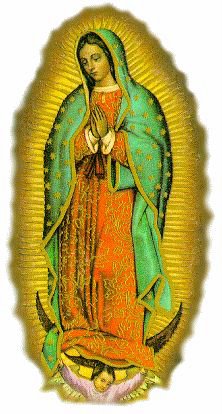
MEMORIAL
The Blessed Virgin Mary appeared to Juan Diego on Tepayac hill near Mexico City on the 9th of December 1531 to ask for the construction of a church there in her honour. After the miraculous cure of his uncle, Bernardo, this Indian peasant brought to his Bishop some roses that he received from Our Lady as a sign of her request. As the flowers fell from his cloak to the ground before the astonished Prelate, the image of the blessed virgin, which is venerated in the Basilica of Guadalupe to this day, was miraculously impressed on the simple garment before their eyes.What has always fascinated me is the symbolism of the image that was on the cloak. TSO says:In Conversation With God Vol 7: Feast Days, July-December
One of the interesting things about the image of Our Lady of Guadalupe is its teaching potential. Though she looks glorified, with stars and rays of sun coming from her as was predicted in Rev. 12, she is no goddess. Her hands are folded in supplication, her posture indicating that she is interceding for us at the throne of the God.Indeed, he is right. There is so much in that image that speaks to Catholic hearts through symbolism.
However, there is much more to Our Lady of Guadalupe's image than that. As with all good Catholic images there is abundant symbolism that was specifically designed to speak to the hearts of the people to whom she brought her message ... the Aztecs. I remember when our priest put out a flyer about this and I was just knocked out at how meaningful every single thing in the image is. I really like this explanation.
The miraculous image produced on the apron or tilma of Blessed Juan Diego is rich in symbolism. The aureole or luminous light surrounding the Lady is reminiscent of the "woman clothed with the sun" of Rev. 12:1. The light is also a sign of the power of God who has sanctified and blessed the one who appears. The rays of the sun would also be recognized by the native people as a symbol of their highest god, Huitzilopochtli. Thus, the lady comes forth hiding but not extinguishing the power of the sun. She is now going to announce the God who is greater than their sun god.You can read about this apparition of Our Lady in more depth here.
The Lady is standing upon the moon. Again, the symbolism is that of the woman of Rev. 12:1 who has the "moon under her feet". The moon for the Meso-Americans was the god of the night. By standing on the moon, she shows that she is more powerful than the god of darkness. However, in Christian iconography the crescent moon under the Madonna's feet is usually a symbol of her perpetual virginity, and sometimes it can refer to her Immaculate Conception or Assumption.
The eyes of Our lady of Guadalupe are looking down with humility and compassion. This was a sign to the native people that she was not a god since in their iconography the gods stare straight ahead with their eyes wide open. We can only imagine how tenderly her eyes looked upon Blessed Juan Diego when she said: " Do not be troubled or weighed down with grief -- Am I not here who am your Mother?"
The angel supporting the Lady testifies to her royalty. To the Meso-American Indians only kings, queens and other dignitaries would be carried on the shoulders of someone. The angel is transporting the Lady to the people as a sign that a new age has come.
The mantle of the Lady is blue-green or turquoise. To the native people, this was the color of the gods and of royalty. It was also the color of the natural forces of life and fecundity. In Christian art, blue is symbolic of eternity and immortality. In Judaism, it was the color of the robe of the high priest. The limbus or gold border of her mantle is another sign of nobility.
The stars on the Lady's mantle shows that she comes from heaven. She comes as the Queen of Heaven but with the eyes of a humble and loving mother. The stars also are a sign of the supernatural character of the image. The research of Fr. Mario Rojas Sanchez and Dr. Juan Homero Hernandez Illescas of Mexico (published in 1983) shows that the stars on the Lady's mantle in the image are exactly as the stars of the winter solstice appeared before dawn on the morning of December 12, 1531.
The color of the Madonna's dress is rose or pale-red. Some have interpreted this as the color of dawn symbolizing the beginning of a new era. Others point to the red as a sign of martyrdom for the faith and divine love.
The gold-encircled cross brooch under the neck of the Lady's robe is a symbol of sanctity.
The girdle or bow around her waist is a sign of her virginity, but it also has several other meanings. The bow appears as a four-petaled flower. To the native Indians this was the nahui ollin, the flower of the sun, a symbol of plenitude. The cross-shaped flower was also connected with the cross-sticks which produce fire. For them, this was the symbol of fecundity and new life. The high position of the bow and the slight swelling of the abdomen show that the Lady is "with child". According to Dr. Carlos Fernandez Del Castillo, a leading Mexican obstetrician, the Lady appears almost ready to give birth with the infant head down resting vertically. This would further solidify her identification with the woman of Rev. 12 who is about to give birth.
Some more about conditions in Mexico at the time Our Lady appeared as well as a prayer for abortion victims can be read at Ave Maria. She also provides a link to further symbolic information as well as details about the images seen in Mary's eyes.
UPDATE
The Curt Jester has some myth-busters about this apparition, which he hastens to assure us he does regard as a miraculous event. However, it is a good reminder that it is just too tempting sometimes to make a miraculous thing even better by embellishing ... tch, tch, tch.
Tuesday, December 11, 2007
Speaking of Pop Culture
Rev. Lovejoy: Wait a minute! That sounds like rock and/or roll.Sympathy for the Devil is Abp. Chaput's header for his review of The Golden Compass.The Simpsons
Nice...
Now I've got that bluesy-rock sound rollin' round in my head for the drive home.
Again. Nice...
Thanks Abp! (No wonder I love that guy!)
Subscribe to:
Posts (Atom)