Thanks to Jo March (a.k.a. Recovering Dissident Catholic) for this one!Which Classic Heroine are You?
Wendy Darling
Wendy loves to tell her brothers stories about Peter Pan, the boy who never grows up, and magical Neverland. One night, Peter Pan comes and the three children fly away with him to adventures of Indians, pirates and fairies. But Wendy knows that she cannot stay in Neverland forever, and eventually she must leave Peter and grow up.
Thursday, January 25, 2007
This Displeases Me ...
... yet, dutifully, I will report the findings.

Poetry Thursday
A repeat offering from Rose ... just because I like it.
Kipling
Because Rudyard Kipling grew up in the Far East
That is what he wrote about until he was deceased
For the smog of London never did look quite so fine
When he thought back to the jungles of Indian design.
But his poetry would speak about whatever he could see
And what he would say never left a mystery
For what he said, he said quite plainly, stating all in black and white
Which is why some critics said that he never got it right.
Not Seeing God
... these experiences of darkness had opened me up to a new way of seeing -- or, more accurately, not seeing God. Benedictine prioress Mary Margaret Funk writes about the three traditional renunciations required of monks: "First, we must renounce our former way of life and move closer to our heart's desire, toward the interior life. Second, we must do the inner work (of asceticism) by renouncing our mindless thoughts ... Third, and finally, we must renounce our own images of God so that we can enter into contemplation of God as God." In other words, we must give up our natural human longing to understand what is beyond our capacity to do so. If we do not, we risk worshiping an idol.This idea of renouncing our own ideas of God is one that stays with me. We try to understand things, to puzzle out where they fit, how they work, what they look like (even if only in our mental landscape). That is how we are made, of course, part of our essence to think like that.By Way of Grace: Moving from Faithfulness to Holiness
by Paula Huston
But God is beyond our comprehension. After reading St. Theresa of Avila's thoughts about the soul's beauty in The Interior Castle, our book club discussion centered a lot on how we don't know our soul's intrinsic beauty and so we ignore it in ignorance. That is why we must work so hard to clear the way to see things and especially our souls clearly.
Thinking of the above quote, which is also similar to something that St. Theresa says in the book, we basically came to the same conclusion as Paula Huston. We will let God show us what of Himself that He will. Our job lies elsewhere.
Tags: Catholicism, Christianity
Tuesday, January 23, 2007
Charles Dickens, Master Storyteller
A Tale of Two Cities by Charles Dickens (a Librivox free audio book)
I know this is news to nobody except me but I just finished listening to this tale of love and hate, evil and redemption, and noble sacrifice in the midst of the French revolution. I mean to say I was literally riveted by the last two chapters and brought to sudden, unexpected tears by the last sentences of the book.
I think I have been overexposed to Oliver Twist and Great Expectations, both through being forced to read them in school and watching seemingly endless movie adaptations. In the midst of all that overexposure I never realized Dickens' ability to slyly imply humor, twist a plot like a pretzel in delightful ways, and, in short, tell a heck of a thumping good story.
I was totally intrigued by the fact that Dickens was giving us a series of contrasts in that way ... nobility versus selfishness, love versus hate, abuse of power over those who are powerless ... and then FLIPS it completely (almost) in the second part of the book. The hated noblemen become the powerless victims, the poor peasants become a bloodthirsty, mindless mob ... Characters who seem so kindly and reasonable and then filled with blood lust and hatred ... someone who was presented as a buffoon who I blew off and then shows unexpected depths. All the contrasts of human nature, the heights and depths to which we can rise or fall ... and he shows that many of us are capable of all of it. Not all of his characters are so changeable but it is a fascinating look at human nature. AND he did it while concocting cliffhangers for the newspaper serials! I have to take my hat off to him. Wow!
What a delightful discovery. I will definitely be reading more Dickens.
I know this is news to nobody except me but I just finished listening to this tale of love and hate, evil and redemption, and noble sacrifice in the midst of the French revolution. I mean to say I was literally riveted by the last two chapters and brought to sudden, unexpected tears by the last sentences of the book.
I think I have been overexposed to Oliver Twist and Great Expectations, both through being forced to read them in school and watching seemingly endless movie adaptations. In the midst of all that overexposure I never realized Dickens' ability to slyly imply humor, twist a plot like a pretzel in delightful ways, and, in short, tell a heck of a thumping good story.
I was totally intrigued by the fact that Dickens was giving us a series of contrasts in that way ... nobility versus selfishness, love versus hate, abuse of power over those who are powerless ... and then FLIPS it completely (almost) in the second part of the book. The hated noblemen become the powerless victims, the poor peasants become a bloodthirsty, mindless mob ... Characters who seem so kindly and reasonable and then filled with blood lust and hatred ... someone who was presented as a buffoon who I blew off and then shows unexpected depths. All the contrasts of human nature, the heights and depths to which we can rise or fall ... and he shows that many of us are capable of all of it. Not all of his characters are so changeable but it is a fascinating look at human nature. AND he did it while concocting cliffhangers for the newspaper serials! I have to take my hat off to him. Wow!
What a delightful discovery. I will definitely be reading more Dickens.
What the Hell: Dante Lite, Hell, and Acquiring Virtue
Gregory was convinced, as were his desert-dwelling predecessors, that the Christian life is a life of spiritual warfare on an invisible battlefield. The stakes here are the highest: eternity in the kingdom of heaven or everlasting perdition. Those who can see clearly owe help to those who cannot; souls are at stake, and lack of spiritual vision can be deadly. For Gregory, this meant that the saint and the holy man are absolutely essential to the Christian community: "To lesser mortals blinded by the Fall, they reveal the invisible world which is always very much present." It is the role of these mediators between carnal and the spiritual realms to reveal what they see, no matter how dire the vision and unwelcome the message.Dante is one of those guides who has been sent to reveal the invisible world. In fact, the power of Dante's Inferno is such that even a prosaic retelling such as Inferno by Larry Niven and Jerry Pournelle has a sobering effect.By Way of Grace: Moving from Faithfulness to Holiness by Paula Huston
I only wish I could say that it's scaring the sin out of me. Alas, I am all too human so my sins are none so easy to banish. However, reading this book definitely is making me consider my own life in a light I hadn't before. Specifically, I recognized something that heretofore I had not considered to be a big deal. Not having read the original book (which I plan on doing), I have to give Niven and Pournelle credit for applying larger sins to specific, modern traits. Here is a vivid example.
"Fortune tellers," Benito said before I could ask. "They tried to see the future by magic." ...Please note that the authors were pointing out that this teacher deliberately used the "dyslexic" label for any child she had trouble teaching to read, without actually bothering to find out if they had any learning disabilities.
Then I recognized one of the damned.
A little elderly lady, very prim and proper. She'd been a teacher in my nephew's school. Now she walked with her head turned backward, and tears ran down her spine and between her buttocks. I screamed. The damned looked up at me.
"Mrs. Herrnstein! Why?" I shouted.
She looked away. Then she stopped and looked up. Face and back turned toward us. She's always been thin, and I'd never thought of her as particularly feminine. Certainly she wasn't feminine now. "I belong here, Mr. Carpentier," she called. "Please leave. I don't want to be watched."
"You belong here?" I could not see Mrs. Herrnstein with a crystal ball.
"Yes. Whenever I had a pupil who had difficulty learning to read, I used -- I was a bad teacher, Mr. Carpentier."
"You were a good teacher! You taught Hal more in a year than he learned in five!"
"I was a good teacher with good pupils. But I could not be bothered with the ones who weren't so bright. If they had trouble learning to read, I said they had dyslexia."
"Are you here because of bad diagnoses?" This was monstrous!
"Dyslexia is not a diagnosis, Mr. Carpentier. It is a prediction. It is a prediction that says that this child can never learn to read. And with that prediction on his record --- why, strangely enough, none of them ever do. Unless they happen on a teacher who doesn't believe in educationese witchcraft."
"But--"
"It was witchcraft, Mr. Carpentier. Please go now." She walked on, crying uncontrollably, her face toward us as she walked away. I watched until she was out of sight.
Considering my own life in light of the circle after circle of sins after sins has left me with a much better understanding of those holy saints who constantly referred to themselves as weak and pitiful sinners. It is not a false humility they were applying but their vivid understanding of what sins do to our souls and what the punishment is likely to be if we do not repent and try to correct our faults.
During this consideration, it was quite fortunate that Steven Riddle's ruminations led me to also reflect on how to try to change destructive patterns of recurring sin.
It is these recurrent sins that give me the clues to the particular virtues I need to cultivate to combat them. ...That "one-time by one-time" really resonated with me. It makes me remember something that I read (and now don't remember where) that I believe a saint said about it being all very well to think about changing our ways but that we must make the effort to forcibly apply our will to the problem. That is our cooperation with Jesus. Sometimes it is all too easy to dismiss sins as small and nonconsequential and, when we continue in our patterns, to say, "Jesus please help me!" while we sit back and wait for ourselves to automatically change.
Self-denial then, is one step, one positive thing that we can assent to, that leads us away from the predominant fault. We can recognize the pattern, recognize the root, make use of the sacraments and pray for the strength to stay away from that fault. Moreover, we would do well in addition to praying against to pray in the presence of what we seek. Looking at Jesus is probably more efficacious in the fight against sin than putting up arms against a sea of troubles. Because no matter what we think, it is not our own opposition that ends them.
... God will give the grace, Jesus will supply the strength and the moment. However, none of this will be efficacious if we do not first seek guidance and understanding about what is tempting us and then (with the strength of the sacraments and Grace) resolutely decide not to give in just this one time. When we do this one-time by one-time, God gradually gives us victory over the sin--often allowing us to go our own way to show just how weak we are on our own. But nevertheless, it is the repeated pattern that will give us the focus and the spirit of clinging to God that will gradually lead us away from our sins.
No.
We must apply the effort. Then if we fail on that particular issue we have at least been fighting instead of sitting back and waiting for change to be dropped in our laps. Yes, I am so very guilty of this.
It is also a matter of keeping in mind that if we keep "glancing at God" to see if we are on the right track we will then be able to apply it to our lives in general. And it is along that path that we will find positive change and growth.
The practice of the virtue of faith in our daily lives adds up to what is commonly known as supernatural outlook. This consists in a way of seeing things, even the most ordinary, apparently quite commonplace things, in relation to God's plan for each person as regards his own salvation and the salvation of many others. It leads us to accustom ourselves to undertake our daily activities as though we were constantly glancing at God to see whether what we are doing is really his Will whether ours is the way He wants us to do things. It leads us to get used to discovering God in people, to recognize him behind what the world calls chance or coincidence, in fact, to see his mark everywhere. (F. Suarez, On being a Priest)I originally intended this to be a book review and it turned into a quite different reflection. (See here for a partial review.) However, I think that you can see Dante's vision peering through the lens used by these two science fiction writers. It is still a very good read just from a sci-fi point of view. I disagree with their lack of a "hard stance" on souls having earned damnation. They shied away from this and turned it into Purgatory's front steps. However, in the sci-fi realm that is quite acceptable.In Conversation With God Vol 3: Ordinary Time, Weeks 1-12
I hear that the authors are working on Inferno II which I assume will be about Purgatory. Not only do I eagerly await that book but I hope that perhaps it will make the publishers consider republishing Inferno. It is something that I can quite easily see our book club tackling ... reading "Dante lite" to interest people in the real thing.
RELATED LINKS
- The Divine Comedy, translated by Longfellow, was just published a few days ago by Librivox as a free audiobook. How's that for timing?
- One of the other effects of this book was to make me quite annoyed with the fact that no one "on the watchtower" (this would be homilists) do enough to remind us of the reality of Hell. Yeah, maybe Hell and Purgatory are painful just because of our separation from God but maybe, just maybe, all those stories about flames and torments are true. I don't seem to remember Jesus saying, "Oh by the way y'all, this is just symbolic" when he talked about Hell time after time after time. All that is to say, here is a link to the Pertinacious Papist's reflections about Hell, using an essay by Tom Bethell as a springboard.
- Fascinating reading, after I finished the book, was found in this essay which compares Inferno to Dante's original work. I do not necessarily agree with every conclusion the author draws about the Niven's and Pournelle's modernization of the story (again, for example, I disapprove of their softening of the finality of Hell) but these are very slight differences of opinion between us and I highly recommend it. Note: spoilers necessarily are included, especially about Inferno.
- Into the Deep has a series about Spiritual Combat which has just begun. It ties in quite nicely with this overall theme.
Tags: Catholicism, Christianity
Monday, January 22, 2007
The New Self-Evident Truths
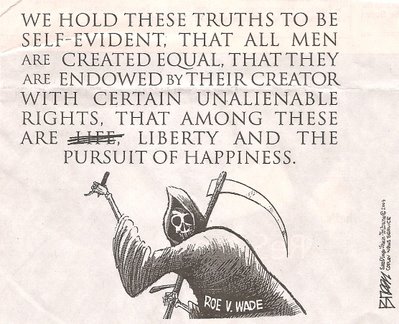
Shamelessly ripped off from Into the Deep.
Also go read Mark's thoughtful View from Ground Zero.
Tags: Catholicism, Christianity
A Little Useless Information
It is a very sad thing that nowadays there is so little useless information. -- Oscar Wilde
"Knitting for Britain" became quite competitive [at school]. Who could knit the fastest or make the longest scarf or make the most noise with his needles? A good many of us took up knitting seriously and made socks, sweaters and woolen hats. We would knit in bed after lights out and, some of us, even more surreptitiously, in chapel. Finally, the headmaster had to take steps to limit the activity.Clinton Trowbridge, "When Knitting Was a Manly Art"
Rumer Godden and In This House of Brede
Jean asked if I had written a review of In This House of Brede. Certainly I should have since it is one of my favorite books and has been since I was a teenager. It makes me smile to think of my atheist mother having that book in our library and me, a searching agnostic for most of my life, reading and rereading it ever since I was in high school. Godden is a truly gifted writer whose prose would make anyone appreciate her storytelling whether religious or not. However, her books are so infused with the search for meaning and holiness that it is difficult to imagine her not having an impact on those who read her works.
In my own particular case, not only was I enthralled with the details of life behind the walls of a cloistered convent, but Godden's many entwining plot strands and mysteries gradually revealed were a delight as well. I don't remember it having a direct impact on my except for the fact that I probably always was fascinated with Catholicism's many devotions ... the mysteries, if you will, of how they practiced their faith.
Godden had a definite talent for looking into the heart of what makes us truly human, both good and bad. She looks unflinchingly at the evil we are capable of and sometimes it hurts just as much as reading Flannery O'Connor although Godden is definitely a British writer to the core and there is nothing in her stories that one could call "grotesque." However, she also knows that one cannot examine the depths without revealing the heights as well and her stories all have light and redemption as the ultimate goal. Specifically here, I am also thinking of my other favorites: China Court: The Hours of a Country House, An Episode of Sparrows (New York Review Children's Collection), The Battle of the Villa Fiorita, and Thursday's Children.
Encountering Godden as I did, when fairly young, I read and reread the books that appealed to me and ignored the others, especially those that seemed to contain too much hurt, such as Five for Sorrow, Ten for Joy which is about a prostitute who enters an order of nuns who work with the prostitutes themselves. That probably was a wise, if unknowing, protection at the time. However, now I look at all the literary treasure to be plundered and am excited at the possibilities. Five for Sorrow, Ten for Joy is a book I am going to read for the Dante to Dead Man Walking list and just opening its pages and reading the first chapter brought me back to a familiar, well-loved writing style that made me feel at home again.
Most libraries have several if not many of Rumer Godden's books and I encourage you to seek them out.
I have done all this writing and haven't yet reviewed In This House of Brede. Others have already done all the heavy lifting for me so I am going to refer you to them.
Therese Z. at Exultet wrote a wonderful commentary about Godden and In This House of Brede. I am stealing most of it and posting it here.
Also, Canticle of Chiara has a thoughtful and thorough review (in my browser one must scroll all the way to the bottom of the sidebar before the review shows up but it is there).
In my own particular case, not only was I enthralled with the details of life behind the walls of a cloistered convent, but Godden's many entwining plot strands and mysteries gradually revealed were a delight as well. I don't remember it having a direct impact on my except for the fact that I probably always was fascinated with Catholicism's many devotions ... the mysteries, if you will, of how they practiced their faith.
Godden had a definite talent for looking into the heart of what makes us truly human, both good and bad. She looks unflinchingly at the evil we are capable of and sometimes it hurts just as much as reading Flannery O'Connor although Godden is definitely a British writer to the core and there is nothing in her stories that one could call "grotesque." However, she also knows that one cannot examine the depths without revealing the heights as well and her stories all have light and redemption as the ultimate goal. Specifically here, I am also thinking of my other favorites: China Court: The Hours of a Country House, An Episode of Sparrows (New York Review Children's Collection), The Battle of the Villa Fiorita, and Thursday's Children.
Encountering Godden as I did, when fairly young, I read and reread the books that appealed to me and ignored the others, especially those that seemed to contain too much hurt, such as Five for Sorrow, Ten for Joy which is about a prostitute who enters an order of nuns who work with the prostitutes themselves. That probably was a wise, if unknowing, protection at the time. However, now I look at all the literary treasure to be plundered and am excited at the possibilities. Five for Sorrow, Ten for Joy is a book I am going to read for the Dante to Dead Man Walking list and just opening its pages and reading the first chapter brought me back to a familiar, well-loved writing style that made me feel at home again.
Most libraries have several if not many of Rumer Godden's books and I encourage you to seek them out.
I have done all this writing and haven't yet reviewed In This House of Brede. Others have already done all the heavy lifting for me so I am going to refer you to them.
Therese Z. at Exultet wrote a wonderful commentary about Godden and In This House of Brede. I am stealing most of it and posting it here.
When I was in seventh grade, I was required to read a book called "The River." In true student fashion, because I had to read it, I loathed it. (The same goes for "A Tale of Two Cities" and "David Copperfield;" I'll have to re-read my way through my high school bibliography again someday....)Brede's most vociferous supporter is The Anchoress. She also has some background information on Godden's sources during the writing of the book. I know from reading the forward to the Loyola Press new edition that Godden converted to Catholicism halfway through her two-year stay at those abbeys while research the book.
The author of "The River" is Rumer Godden (1907-1998), whose books were often peopled with nuns and priests. Several were explicitly about Anglican or Catholic themes, but nearly all were flavored with a yearning towards God. I was surprised that the author of my hated assignment was also the author of some of my favorite light-reading books.
Ms. Godden was fascinated primarily by holiness: in people, in history and in places. She edges around the holiness, at least her child characters do, expressing their desire to know God by concentrating on one piece of religious life: lighting a candle (A Candle for St. Jude), building a garden within sight of a statue of Mary seen through the wall of a bombed-out church (An Episode of Sparrows), making an icon without the slightest idea of what the devotion means (one dear to me, The Kitchen Madonna). One and all the characters have no religious training or example until the story ensues, which I think was symptomatic of England then (and now, sadly), but they learn something of God from these little gifts. Haven't we all been drawn a little closer by a hymn, or a picture, or a movie? Her adult characters seem to move towards God knowing they won't necessarily like the journey, but must undertake it to live.
The first time you read her books, with their characteristic between-wars Englishness, you will be struck by her reverence for religious life. She combines that with a prim, earnest, serious style, with wit and intellect however muted, recalling Barbara Pym and Josephine Tey. All her women are well-bred, well-shod and are genteelly broke. They all are longing starkly for something, and in Ms. Godden's novels, it's love and God.
In her most explicitly religious novel, In This House of Brede, a grown woman finds a vocation to the cloistered religious life and becomes a Benedictine nun. It is a touching and probably quite accurate struggle of a woman, alone after widowhood, rising in business, comfortable in life, growing into the silence and humility and charity necessary to be in community with others seeking to know God. It took me many reads over many years to realize that, superb as her characterization is, and intense as her storyline is (a great deal is revealed about the personal lives of each of the nuns in the convent), what Ms. Godden never seemed to know anything about was the experience of prayer and of receiving the Eucharist. Maybe it's because the nuns in the story are Anglican, which fact startled me because it all sounded so Roman Catholic. This doesn't weaken the book, or any of her books, but when you put one down with a satisfied sigh, you realize only after reflection that she shows no desire to be close to Jesus in prayer and sacrament. I'd be willing to bet that Ms. Godden herself didn't attend church, or if she did, she remained aloof, proper, a little afraid of intensity, too polite to offer her life to the Lord and accept His Life and Love in return. I'm sorry for that: she had the right equipment to write deeply of a deepening faith.
Two other novels are about nuns: Five for Sorrow, Ten for Joy and The Black Narcissus. The first is an intense telling of the life of nuns who work with prostitutes and the entry into the convent of one of the prostitutes. The second is about a convent built in India, to help the poor, and its failure (that's revealed in the opening pages, I'm not giving anything away). The second book was made into a medium-lousy movie, if you've seen it, read the book anyway. It's much better.
Ms. Godden, and her sister Jon, are not out of print, but are largely out of mind these days, along with their English sisters. But consider them as an addition to your library pile.
Also, Canticle of Chiara has a thoughtful and thorough review (in my browser one must scroll all the way to the bottom of the sidebar before the review shows up but it is there).
Tags: Catholicism, Christianity
Saturday, January 20, 2007
Good News for Those of Us Who Have Trouble Reading Chesterton
I happen to know there is more than one of us out there.
Maria Lectrix has begun reading The Everlasting Man. Which, now that I come to think of it, is on my Dante to Dead Man Walking list (Christian classics). Just download from her site or through iTunes (where you can subscribe to all of her feed for the complete set ... six (?) ... of books she is reading to us). Woohoo!
By the way, I think that I am going to have to stop taking on the quarterly reading challenges. That "Dante" list is never going to get tackled if I keep loading on other books, especially when I consider that I am going to keep sliding in cookbooks, mysteries, science fiction and other such reading to lighten the load. Otherwise my reading will become too much of a chore and that never will do!
Maria Lectrix has begun reading The Everlasting Man. Which, now that I come to think of it, is on my Dante to Dead Man Walking list (Christian classics). Just download from her site or through iTunes (where you can subscribe to all of her feed for the complete set ... six (?) ... of books she is reading to us). Woohoo!
By the way, I think that I am going to have to stop taking on the quarterly reading challenges. That "Dante" list is never going to get tackled if I keep loading on other books, especially when I consider that I am going to keep sliding in cookbooks, mysteries, science fiction and other such reading to lighten the load. Otherwise my reading will become too much of a chore and that never will do!
Tags: Catholicism, Books
"You're certainly a funny girl for anybody to meet who's just been up the Amazon for a year."
The Lady Eve
After a year up the Amazon studying snakes, wealthy but naive Charles Pike (Henry Fonda) meets con-artist Jean Harrington (Barbara Stanwyck) on a ship. They fall in love but her father disapproves and his valet is suspicious ... with hilarious results.
This is one of a string of old movies I have beenforcing on bestowing upon the family. It occurs to me that not having VCRs or cable was actually quite an education in old movies for anyone who liked to watch the Saturday afternoon or Sunday night movies on television as I did. I have more than a speaking acquaintance with a wide variety of classics featuring everything from gangsters to werewolves (will I ever forget Michael Landon in his letter jacket?) to reprobates and schoolgirls marooned on South Pacific islands to King Kong to ... zany Hollywood comedies.
The best thing about Netflix to me is that one can line up a list of these old classics and then not be distracted by the newer, glitzier films as one strolls along the aisles of the movie rental store. Although, as Rose rightfully points out, one also must have heard of the movie first instead of being able to browse and find something that is old and "new." Luckily we have an excellent independent rental location near us. Therefore, when our Netflix gift certificate runs out we will be returning to aisle browsing. Hopefully, this extended exposure to old comedies, westerns, and dramas will help make me remember to go down those aisles as well as the "New" section.
Back to the movie. This is one that Rose, at least, seemed highly dubious about. However, it only took about five minutes and we were all laughing aloud at the clever script and excellent acting. This is a light and frothy comedy that, as with all old movies, also gave us a glimpse into a world long gone.
It also can be occasionally shocking in a quite unintended way. After watching the movie we watched the movie trailer. By this time we were used to Henry Fonda repeating that he hadn't seen a woman since he'd been up the Amazon for a year. It was startling to hear the trailer voice-over announce that he "hadn't seen a white woman" for over a year. We actually gasped ... such a thing never had occurred to us. Then we remembered the valet accepting a flower necklace from one of the native women before leaving. 1941 was certainly a different time and that was an interesting reminder that it isn't always just about our lack of elevator attendants and cocktails before dinner.
HC rating: Nine thumbs up!
After a year up the Amazon studying snakes, wealthy but naive Charles Pike (Henry Fonda) meets con-artist Jean Harrington (Barbara Stanwyck) on a ship. They fall in love but her father disapproves and his valet is suspicious ... with hilarious results.
This is one of a string of old movies I have been
The best thing about Netflix to me is that one can line up a list of these old classics and then not be distracted by the newer, glitzier films as one strolls along the aisles of the movie rental store. Although, as Rose rightfully points out, one also must have heard of the movie first instead of being able to browse and find something that is old and "new." Luckily we have an excellent independent rental location near us. Therefore, when our Netflix gift certificate runs out we will be returning to aisle browsing. Hopefully, this extended exposure to old comedies, westerns, and dramas will help make me remember to go down those aisles as well as the "New" section.
Back to the movie. This is one that Rose, at least, seemed highly dubious about. However, it only took about five minutes and we were all laughing aloud at the clever script and excellent acting. This is a light and frothy comedy that, as with all old movies, also gave us a glimpse into a world long gone.
It also can be occasionally shocking in a quite unintended way. After watching the movie we watched the movie trailer. By this time we were used to Henry Fonda repeating that he hadn't seen a woman since he'd been up the Amazon for a year. It was startling to hear the trailer voice-over announce that he "hadn't seen a white woman" for over a year. We actually gasped ... such a thing never had occurred to us. Then we remembered the valet accepting a flower necklace from one of the native women before leaving. 1941 was certainly a different time and that was an interesting reminder that it isn't always just about our lack of elevator attendants and cocktails before dinner.
HC rating: Nine thumbs up!
Tags: Movies
Friday, January 19, 2007
Shhh, I'm working on the sequel to Citizen of the Galaxy.
 | I am:Robert A. HeinleinBeginning with technological action stories and progressing to epics with religious overtones, this take-no-prisoners writer racked up some huge sales numbers. |
Thursday, January 18, 2007
Well, well, well ... no wonder Jack is back!
SPOILERS
We just finished watching the first four hours of 24. As always, what a great ride! I especially like watching the Deep Space Nine doctor as Al-Assad. He hasn't had much to do but I always was fond of Julian so it is nice to see him again.
We all agreed that the family being held hostage were not looking at the big picture. And made a pact then and there that should we wind up in a similar situation the hostages would be ready to give it up for the country. (Luckily I doubt we will ever be in such a situation ... but if we are, that decision has been made! One more thing to cross off my "to do" list.)
I have to say that for someone who was tortured in a Chinese prison Jack found the time to build up a nice assortment of muscle. And he cleans up well (and quick) with quite the professional haircut considering he was in an airplane hangar with a bowl, a pitcher, a mirror and some scissors. But that's Jack ... capable of rising to any occasion no matter how limited the resources.
However, he does seem appropriately mentally tortured which is playing havoc with his ability to hang in there and save the country. I especially liked the scene after he was forced to shoot Curtis where Jack was going to lie by the tree and just sob a little. Heck, the poor guy is released from prison, instantly told he is being given up as a sacrifice to a terrorist, and then sent running into the usual tortuous "24" day. Anyone would need a little crying time to get back to normal.
Until the nuke went off. No one sets off nukes in the U.S. without Jack getting his head back in the game and taking them down.
We just finished watching the first four hours of 24. As always, what a great ride! I especially like watching the Deep Space Nine doctor as Al-Assad. He hasn't had much to do but I always was fond of Julian so it is nice to see him again.
We all agreed that the family being held hostage were not looking at the big picture. And made a pact then and there that should we wind up in a similar situation the hostages would be ready to give it up for the country. (Luckily I doubt we will ever be in such a situation ... but if we are, that decision has been made! One more thing to cross off my "to do" list.)
I have to say that for someone who was tortured in a Chinese prison Jack found the time to build up a nice assortment of muscle. And he cleans up well (and quick) with quite the professional haircut considering he was in an airplane hangar with a bowl, a pitcher, a mirror and some scissors. But that's Jack ... capable of rising to any occasion no matter how limited the resources.
However, he does seem appropriately mentally tortured which is playing havoc with his ability to hang in there and save the country. I especially liked the scene after he was forced to shoot Curtis where Jack was going to lie by the tree and just sob a little. Heck, the poor guy is released from prison, instantly told he is being given up as a sacrifice to a terrorist, and then sent running into the usual tortuous "24" day. Anyone would need a little crying time to get back to normal.
Until the nuke went off. No one sets off nukes in the U.S. without Jack getting his head back in the game and taking them down.
Podding Around
These podcast can all be found through iTunes.
KEEPING TELEPATHS AT BAY
Geek Survival Guide points out that the best way to ward off telepaths is not the much vaunted tinfoil hat. No, it is to always have a catchy tune running through your mind. To help us even further, Zach plays three catchy tunes to help us out. After all, who can listen to Code Monkey without wanting to hum along? My favorite was the song about the zombie co-workers but I fell in love with that after hearing it used in How to Succeed in Evil.
INTO THE DEEP IS BACK
After a period of adjustment to allow one member to move to Austria, the Into the Deep podcast is again posting new episodes. Their new series is spiritual combat and it is well worth listening to as are the rest of their offerings.
CLASSIC SCI-FI STORIES
Thanks to the SSFaudio Challenge we now have more classic science fiction stories available on both Podiobooks and Librivox. It has been interesting to watch various podcasters deliver on the challenge. And, of course, gratifying for those of us who like to listen to science fiction.
KEEPING TELEPATHS AT BAY
Geek Survival Guide points out that the best way to ward off telepaths is not the much vaunted tinfoil hat. No, it is to always have a catchy tune running through your mind. To help us even further, Zach plays three catchy tunes to help us out. After all, who can listen to Code Monkey without wanting to hum along? My favorite was the song about the zombie co-workers but I fell in love with that after hearing it used in How to Succeed in Evil.
INTO THE DEEP IS BACK
After a period of adjustment to allow one member to move to Austria, the Into the Deep podcast is again posting new episodes. Their new series is spiritual combat and it is well worth listening to as are the rest of their offerings.
CLASSIC SCI-FI STORIES
Thanks to the SSFaudio Challenge we now have more classic science fiction stories available on both Podiobooks and Librivox. It has been interesting to watch various podcasters deliver on the challenge. And, of course, gratifying for those of us who like to listen to science fiction.
Tags: Catholicism, Christianity
Wednesday, January 17, 2007
Baby, It's Cold Inside
It is obvious that I have lived in Texas sufficient years to not appreciate cold weather as much as I thought I did! It has been around freezing or less for several days and that is enough for me.
Perhaps I feel this way because the heat in my office is not working properly. When the maintenance man came in to fix it, I wound up with a stream of cold air coming in which just made things worse. I worked in my parka and felt as one with Bob Cratchit, wishing for a pair of those clever gloves without fingers so I could type with warm hands.
Today, we will be holding this fellow's feet to the fire (if we can find any!) and getting some relief.
Perhaps I feel this way because the heat in my office is not working properly. When the maintenance man came in to fix it, I wound up with a stream of cold air coming in which just made things worse. I worked in my parka and felt as one with Bob Cratchit, wishing for a pair of those clever gloves without fingers so I could type with warm hands.
Today, we will be holding this fellow's feet to the fire (if we can find any!) and getting some relief.
Tags: Catholicism, Christianity
Monday, January 15, 2007
"No wonder I had to date an 11th grader when I was a senior."
So says Tom after reading the group emails suddenly being sent by his former classmates at the American School in London. Suddenly life histories are getting much more detailed than he would have thought, with a seemingly endless string of people proudly proclaiming their gay partnership.
The funny thing is, he knows of one old classmate who is living in a gay relationship with someone famous ... and that person simply chatted about children, job, and life in general. Guess she rightly figured that her private life was ... private!
The funny thing is, he knows of one old classmate who is living in a gay relationship with someone famous ... and that person simply chatted about children, job, and life in general. Guess she rightly figured that her private life was ... private!
Tags: Catholicism, Christianity
Claw of the Conciliator
Elliot asked if there is anything in particular I prefer about his blog, which explores the intersection of religion, mainly Christianity, with the genres of science fiction and fantasy.
I'll just answer here. No, I love it all. It is rare that Elliot writes something that doesn't provide an interesting and worthwhile link or thought provoking subject. Check it out.
I'll just answer here. No, I love it all. It is rare that Elliot writes something that doesn't provide an interesting and worthwhile link or thought provoking subject. Check it out.
Tags: Catholicism, Christianity
The Retreat
I just wanted to let y'all know that the Beyond Cana marriage enrichment retreat was a huge success!
Personally, I have never seen any event with so many factors (flu, babysitters backing out, rain and threatened freezing weather, etc.) combining to make it extremely difficult for everyone who had committed to help.
Every single person on the retreat team impressed the heck out of Tom and me with their dedication and determination to overcome all obstacles. There were people leaving sick babies with parents and coming in to do their part before hurrying back to care for their little one. A very sick wife gave her husband her blessings to go and do his part. Rain came down in sheets, making two people's journey take two hours when it normally would have taken 15 minutes. One person's flight home arrived at 7 a.m. instead of the night before ... he joked that there is nothing like sleeping on an airport floor all night to give you a good presentation edge. I could go on and on (and in fact I see that I already have). It was almost like a comedy to see what problem was going to turn up next.
Tom and I weren't personally called upon to jump through fire to be there ... but Hannah and Rose made huge personal sacrifices for us to be there. We left for the retreat on Friday morning and she went back to college on Saturday. Her only hint of feelings was to cuddle with "Mommy" for an hour Thursday night. Rose was the victim of a fender bender on Saturday morning in the rain (no easy thing for a driver of only one month's experience) and refrained from calling because "you were on retreat." (Thank heavens she had access to therapists Ben and Jerry for help in soothing her jangled nerves before we called her at 9 p.m.) Yes, we were very proud of both and so I pass that on.
Every time situations were handled with good humor and grace, thinking only of others. Which is to say that we saw sacrifice being made by everybody for the good of the couples on the retreat and to do God's work. What a privilege to get to see it in action.
I looked at all that and thought how many adversarial conditions we were facing throughout. So I also thought of the great Adversary and how he might be involved in these problems. Naturally that led to thoughts of what a very great blessing from God this retreat must be in people's lives for us to face this much adversity.
Tom pointed out that it showed the huge difference already showing in people's lives and marriages for the team to go to those lengths to make sure it happened. As we both know full well from the difference in our lives after attending Beyond Cana in San Antonio.
We agreed that we are both right on this one.
We got to see the fruit of that determination yesterday morning at Mass. Those couples were glowing. That glow was from personal encounters these couples had with the Holy Spirit in their lives and in their marriage this weekend.
Thank you so much for keeping this event in your prayers. You made this possible by holding us all up to God. And we can't thank you enough.
Please continue to hold this ministry in prayer as our parish continues with it.
Personally, I have never seen any event with so many factors (flu, babysitters backing out, rain and threatened freezing weather, etc.) combining to make it extremely difficult for everyone who had committed to help.
Every single person on the retreat team impressed the heck out of Tom and me with their dedication and determination to overcome all obstacles. There were people leaving sick babies with parents and coming in to do their part before hurrying back to care for their little one. A very sick wife gave her husband her blessings to go and do his part. Rain came down in sheets, making two people's journey take two hours when it normally would have taken 15 minutes. One person's flight home arrived at 7 a.m. instead of the night before ... he joked that there is nothing like sleeping on an airport floor all night to give you a good presentation edge. I could go on and on (and in fact I see that I already have). It was almost like a comedy to see what problem was going to turn up next.
Tom and I weren't personally called upon to jump through fire to be there ... but Hannah and Rose made huge personal sacrifices for us to be there. We left for the retreat on Friday morning and she went back to college on Saturday. Her only hint of feelings was to cuddle with "Mommy" for an hour Thursday night. Rose was the victim of a fender bender on Saturday morning in the rain (no easy thing for a driver of only one month's experience) and refrained from calling because "you were on retreat." (Thank heavens she had access to therapists Ben and Jerry for help in soothing her jangled nerves before we called her at 9 p.m.) Yes, we were very proud of both and so I pass that on.
Every time situations were handled with good humor and grace, thinking only of others. Which is to say that we saw sacrifice being made by everybody for the good of the couples on the retreat and to do God's work. What a privilege to get to see it in action.
I looked at all that and thought how many adversarial conditions we were facing throughout. So I also thought of the great Adversary and how he might be involved in these problems. Naturally that led to thoughts of what a very great blessing from God this retreat must be in people's lives for us to face this much adversity.
Tom pointed out that it showed the huge difference already showing in people's lives and marriages for the team to go to those lengths to make sure it happened. As we both know full well from the difference in our lives after attending Beyond Cana in San Antonio.
We agreed that we are both right on this one.
We got to see the fruit of that determination yesterday morning at Mass. Those couples were glowing. That glow was from personal encounters these couples had with the Holy Spirit in their lives and in their marriage this weekend.
Thank you so much for keeping this event in your prayers. You made this possible by holding us all up to God. And we can't thank you enough.
Please continue to hold this ministry in prayer as our parish continues with it.
Tags: Catholicism, Christianity
A Hell of a Book
I finally scored a copy of Inferno by Larry Niven and Jerry Pournelle that didn't cost a lot. I have been trying to get my hands on a copy of this for over a year after I discovered that this is their take on Dante's Inferno.
It has been out of print for some time so usually copies list for an outrageous sum like $80 and our library doesn't have a copy. It was waiting for me when we returned from the retreat. I read the first couple of chapters before sliding into a nap and it is fascinating so far. I think it might be a good intro to the real thing which I will be reading sometime as it is on my Christian classics list, Dante to Dead Man Walking.
The story so far is great, although you must keep in mind that I am a fan of the Niven-Pournelle collaborations in general. It is from the point of view of a science fiction writer who has been sent to hell and is trying to find his way out. Thus far, he has continually been filtering everything he sees through his sci-fi sensibilities ... maybe it is an alternate universe ... possibly a different planet, etc.
Check out the Amazon comments for further insight if you are interested. I have only begun it.
UPDATE
Meep gives a link to a paper she wrote: Dante's vs. Niven & Pournelle's Inferno. It looks fascinating but I am going to wait until I've read Inferno. Can't wait though!
It has been out of print for some time so usually copies list for an outrageous sum like $80 and our library doesn't have a copy. It was waiting for me when we returned from the retreat. I read the first couple of chapters before sliding into a nap and it is fascinating so far. I think it might be a good intro to the real thing which I will be reading sometime as it is on my Christian classics list, Dante to Dead Man Walking.
The story so far is great, although you must keep in mind that I am a fan of the Niven-Pournelle collaborations in general. It is from the point of view of a science fiction writer who has been sent to hell and is trying to find his way out. Thus far, he has continually been filtering everything he sees through his sci-fi sensibilities ... maybe it is an alternate universe ... possibly a different planet, etc.
Check out the Amazon comments for further insight if you are interested. I have only begun it.
UPDATE
Meep gives a link to a paper she wrote: Dante's vs. Niven & Pournelle's Inferno. It looks fascinating but I am going to wait until I've read Inferno. Can't wait though!
Tags: Catholicism, Christianity
Sunday, January 14, 2007
Gone Retreatin'
Off to help with our parish's marriage retreat. Back on Sunday or Monday.
Please keep us in your prayers.
Please keep us in your prayers.
Tags: Catholicism, Christianity
Thursday, January 11, 2007
Apple may have the sexy iPhone, but Google has Neil Gaiman’s son.
Via my husband who watches a different part of the blogosphere, as one of the uber-geeky Internet groupies who follow Matt Cutts. No wonder because Cutts is cool enough to really understand Neil Gaiman. (Not that I liked either the Sandman series or Stardust ... but do read Neverwhere and Good Omens which are two of my favorite books. I also would throw American Gods in there).
And if you don’t know who Neil Gaiman is, then I feel sorry for you. But also happy, because you get to read Neil Gaiman for the first time:On the other hand if you are asking who Matt Cutts is ... he is currently the head of the Google's Webspam team. Yes, that calls for uber-geekdom.
- Start with the Sandman series of graphic novels.
- Then get dark and eerie with Neverwhere if you want to know the real secrets of London. Mr. Croup and Mr. Vandemar are two of the most delightful villains I’ve had the pleasure of meeting.
- Lighten up with the hilarious Good Omens, which Gaiman wrote with Terry Pratchett.
- Round it out with Stardust, which wins my award for “Best use of the word ‘f***‘ in small print, exactly once, in a book.” You’ll have to read it to understand.
Subscribe to:
Posts (Atom)