Featured Post

On the road again — back July 6!

Back July 6!  My husband and I are taking a road trip through Utah. We're going to Zion National Park, Brice Canyon and eventually we...

Tuesday, September 16, 2025

And the Winner Is — 1941

  Our family is working our way through Oscar winners and whichever nominees take our fancy. Also as they are available, since these early films continued to be hard to find.

Nominated films that we didn't watch either because we'd seen them recently or frequently were The Letter, Our Town, Philadelphia Story. We couldn't get a captioned copy of All This & Heaven Too so we skipped it because my mother couldn't watch it.

WINNER

A young woman marries a fascinating widower only to find out that she must live in the shadow of his former wife, Rebecca, who died mysteriously several years earlier. The young wife must come to grips with the terrible secret of her handsome, cold husband, Max De Winter. She must also deal with the jealous, obsessed Mrs. Danvers, the housekeeper, who will not accept her as the mistress of the house.
1941 Best Picture so it is our first stop in our next series of watching Oscar winners and nominees. It was stunningly well directed, acted, and shot. I myself have never liked the basic story of Rebecca, whether in print or film. But I can see why this won.

 NOMINEES

American crime reporter John Jones is reassigned to Europe as a foreign correspondent to cover the imminent war. When he walks into the middle of an assassination and stumbles on a spy ring, he seeks help from a beautiful politician’s daughter and an urbane English journalist to uncover the truth.
A lively spy thriller from Hitchcock. Very entertaining but the best thing about it was George Sanders in a rare good-guy role.


Dictator Adenoid Hynkel tries to expand his empire while a poor Jewish barber tries to avoid persecution from Hynkel’s regime.
One of the earliest movies to try to motivate US participation in WWII. This movie has its moments but it just didn't age well for us.


A hard-working, white-collar girl falls in love with a young socialite, but meets with his family’s disapproval.
Ho hum. Kitty makes a lot of bad choices in the middle of this film although I am sure that when this was made they were seen as brave, feminist choices. Regardless, it can't hold a candle to that year's winner, Rebecca.


The crew of the merchant ship Glencairn hope to survive a transatlantic crossing during World War II.
This was surprisingly good although you have to wait for the end for everything to pay off. It is a slow build through the movie as we learn the characters, see them struggle with each other and their own problems, and so forth. It was my favorite of the nominees that didn't win.

Tom Joad returns to his home after a jail sentence to find his family kicked out of their farm due to foreclosure. He catches up with them on his Uncle’s farm, and joins them the next day as they head for California and a new life… Hopefully.
How about that John Ford — nominated for two best pictures in one year! An amazing movie if this is the kind of movie you like. It isn't the kind we like.


Monday, September 15, 2025

Our Lady of Sorrows

William-Adolphe Bouguereau (French, 1825-1905), Pietà, 1876
Behold, this child is destined for the fall and rise of many is Israel and for a sign that shall be contradicted. And your own soul a sword shall pierce, that the thoughts of many hearts may be revealed.
Luke 2:34-35
Any mother suffers when their child suffers. It is like a sword piercing their heart. Mary was no ordinary mother and her son was no ordinary son. John Paul II, in his encyclical Redemptoris Mater, commented:
Simeon's words seem like a "Second Annunciation" to Mary for they tell her of the historical circumstances in which the Son is to accomplish his mission, namely in misunderstanding and sorrow ... They also reveal that she will have to live her obedience of faith in suffering at the Saviour's side and that her motherhood will be mysterious and sorrowful.
If we stop to consider it, Mary must overcome many troubling and sorrowful circumstances through her life, beginning with trusting that Joseph will understand her pregnancy before their marriage. The circumstances of Jesus' birth, their flight into Egypt, then the trip to Nazareth where they must become established yet again, Jesus' disappearance in Jerusalem, and much more are her lot. Jesus sees fit to spare her none of these experiences, including witnessing his death inflicted in the most shameful manner the Romans can invent as the result of lies and conspiracy.

It is especially appropriate that this feast day is the day after the Exaltation of the Holy Cross, when Mary stood at the foot of the cross watching the death of her son, the Son of God.
Today's feast is an occasion for us to accept all the adversity we encounter as personal purification, and to co-redeem with Christ. Mary our Mother teaches us not to complain in the midst of trials as we know she never would. She encourages us to unite our sufferings to the sacrifice of her son and so offer them as spiritual gifts for the benefit of our family, the Church, and all humanity.

The suffering we have at hand to sanctify often consists in small daily reverses. Extended periods of waiting, sudden changes of plans, and projects that do not turn out as we expected are all common examples. At times setbacks come in the form of reduced circumstances. Perhaps at a given moment we even lack necessities such as a job to support our family. Practicing the virtue of detachment well during such moments will be a great means for us to imitate and unite ourselves to Christ ...

The particular circumstances are frequently the most trying dimension of sickness. Perhaps its unexpected duration, our own helplessness or the dependence on others it engenders is the most difficult part of all. Maybe the distress due to solitude or the impossibility of fulfilling our duties of state is most taxing ... We ask Jesus for an increase of love, and tell him slowly and with complete abandonment as we have perhaps so often told him in a variety of situations: Is this what you want Lord? ... Then it is what I want too.
Is this what you want Lord? ... Then it is what I want too.

That is what hit me hard about this reflection. How often in my life should I say that instead of trying to dodge around what I know I should do? Way too often is my sorry response.

NOTE
Except for this last bit, everything here is either quoted directly or paraphrased from In Conversation with God: Daily Meditations, Volume Seven, Special Feasts: July - December.

Sunday, September 14, 2025

Feast of the Exaltation of the Holy Cross

Exaltation of the Cross, Russian icon

Some time ago I read Anthony Esolen's commentary in Magnificat about the elevation of the cross from the point of view of an English monk's meditation written in the Middle Ages from the point of view of the cross itself. It has haunted me, in a good way I hasten to add, as I would come upon small annoyances and inconveniences and then remember the image of the young Hero as a warrior striding toward the cross. Shame on me if I do not at least attempt to match that valiant attitude.
For it is not a shy and effeminate Jesus, this Savior of ours, the Healer, the Chieftain. No courageous German could respect a man who did not fight. And will Christ own us, if we do not fight for him? The poet dares to make us see Calvary in a way that we are not used to -- but in a way that is right and just nevertheless. Says the cross:

Then the young Hero ungirt himself -- that was God almighty,
strong, stiff-willed, and strode to the gallows,
climbed stout-hearted in the sight of many; intended to set men free.


Yes, Jesus sweated blood in Gethsemane. But he took the cross to himself, suggests our poet, as eagerly as the warrior takes the battlefield, or the bridegroom takes the bride. He needs no armor here. He strips himself, he climbs. And though it all the cross, as the first and most loyal follower of the Chieftain, stands firm; trembles, but does not bow; is drenched with blood and driven through with the same spikes that pierce the body of Christ. 
Applying this to my daily life with its small and petty sacrifices, this helps immeasurably when I am reminding myself that my time is not really my own, that making a meal for a friend in need takes priority over my previous plans, and that even such a small thing is a step toward becoming a warrior in the young Hero's footsteps. It is surprising how contented one can be when embracing the cross with such an example.

This commentary is from 2008 and I repeat it here because it did me good to read it this morning. And I put the whole poem on the blog this morning so you can take it all in.

++++++++++++++++

St. John Damascene is quoted in today's reading from In Conversation with God and it hit me between the eyes.
The Cross is a shield against the devil as well as a trophy of victory. it is the promise that we will not be overcome by the Angel of Death (Exod 9:12). The Cross is God's instrument to lift up those who have fallen and to support those still on their feet fighting. It is a crutch for the crippled and a guide for the wayward. It is our constant goal as we advance, the very wellspring of our body and soul. It drives away all evils, annihilates sin and draws down for us abundant goods. This is indeed the seed of the Resurrection and the tree of eternal life.
This is an attitude I must work more toward having. Author Francis Fernandez continues:
The Cross is present in our lives in different ways. It may be manifest through sickness, poverty, tiredness, pain, scorn, or loneliness. Today in our prayer we can examine our habitual disposition on coming face to face with the Cross. though hard to bear at times, the encounter with it can become a source of purification, Life, and joy if it is embraced with love. Embracing the Cross should lead us never to complain when confronting difficulties and even to thank God for the failures, suffering, and setbacks that purify us. Such adversities should be additional occasions for drawing us closer to God.
++++++++++++++++

I like this commentary also, which I posted a few years ago, from Word Among Us, which comments upon the strangeness of the feast and the fact that we are reading about poisonous serpents. Good stuff.
++++++++++++++++

This is short, but good. And says it all.
LITANY OF THE CROSS

The cross is the hope of Christians.
The cross is the resurrection of the dead.
The cross is the way of the lost.
The cross is the saviour of the lost.
The cross is the staff of the lame.
The cross is the guide of the blind.
The cross is the strength of the weak.
The cross is the doctor of the sick.
The cross is the aim of the priests.
The cross is the hope of the hopeless.
The cross is the freedom of the slaves.
The cross is the power of the kings.
The cross is the water of the seeds.
The cross is the consolation of the bondsmen.
The cross is the source of those who seek water.
The cross is the cloth of the naked.
We thank you, Father, for the cross.

Dream of the Holy Rood, translated by Anthony Esolen

I am not a poetry lover but this might be my favorite poem of the few I do like. I just love it. As today is the Exaltation of the Holy Cross, it seems a good time to publish it.

"Rood" means rod or, in this case, crucifix. This is one of the oldest works of Old English literature and is an example of dream poetry. I love that category - dream poetry. 


This translation is not easy to find and I long ago copied it into my quote journal. The place where I found it years ago isn't available anymore to general access.

Listen! When lapped in rest lay all who speak,
to me in a vision in the middle of the night
came the choicest of dreams, as I wish to recount.
Seemed to me that I saw one most splendid tree
arise into the air enwound with light,
beam-brightest, a beacon all beglazed with gold
showered upon it, with shimmering jewels
(like the five that shone up on the shoulder-span)
at its foot, on the earth — no felon's gallows, that,
but made lovely by the fore-shaping of the Lord of the hosts
who beheld it there, the hallowed, the angels,
with men the world over, and all this marvelous creation.

Wondrous was the victory-wood, and I, wounded with sins,
gashed, stained by guilt. I saw the tree of glory
robed in reverence and rays of joy,
garbed all in gold, with goodly gems
like the wrapping of lacework to honor the Ruler's tree.
Yet through that gold I glimpsed the grievous strife
endured by doomed men of old, as drops of blood sweat
from the strong side, the heart's side. With sorrow was I stirred,
shook before that sight so fair, for I saw that shimmering sign
change color and cloth, now clotted with the wet,
drenched in the running blood; now decked out in treasure.

Still I lay there a long while, beheld
raw-hearted with cares, the Healer's tree,
sign of the Savior, till I heard it speak out;
the best of all wood with these words began:

"It was years ago — as I yet call to mind —
when I was hewn down at the holt's end,
stripped up from my roots. Strong men seized me, men of hate,
carved me into a spectacle, commanded me to carry their criminals;
enemies enough bore me on their shoulders till on the bald mount they
set me,
planted me fast. Then I saw, full of heart,
mankind's Master make haste that he might climb upon me.
Then I dared not, against the dread Chieftain's words,
bend or break, when I beheld the ground trembling;
could have felled all those foes beneath,
struck them down, but I stood fast.

"Then the young Hero ungirt himself — that was God almighty —
strong, stiff-willed, and strode to the gallows,
climbed stout-hearted in the sight of many; intended to set men free.
I trembled when the bold Warrior embraced me, yet I dared not bend to
the earth,
fall to the ground for fear; to stand fast was my duty.
A rood was I reared up, bore the rich King,
the Guardian of heaven; I dared not give in.
They drove me through with dark spikes, deep wounds could be seen upon
me,
open envy-thrusts, yet not a one of them dared I harm.
They mocked us both together. I was bedrenched with blood
spilled from the side of the Man as he sent up his spirit.
On that mount I endured many agonies,
words of wrath, saw racked in pain
the God of hosts. Then a gloom fell
and clouds shrouded the corpse of the all-Wielder,
its shimmering sheen; a shadow went forth,
wan, under the clouds. Then all God's creatures wept,
lamented the King's fall: Christ was on the cross.

"Nevertheless from afar to the noble Earl
eager men hastened; I beheld it all.
Stirred I was with deep sorrows, still I bowed to the men's hands,
humbly, brave of heart. Then from the heavy torments they took him,
bore away almighty God. The battle-grooms abandoned me there,
standing spike-pierced and spattered with blood.
They led him, limb-weary, away; beheld the Lord of heaven,
stood by his body, at his head, as, tired after the great strife,
he lay to rest awhile. Then they wrought for him an earth-house,
fighting men, in sight of the killer, carved it of bright stone,
laid in it the Lord of victories. A lay of sorrow they sang him,
grieving, as evening fell. From the glorious Prince they now parted,
wearily; there he rested, few of his band of warriors near.
But we three crosses wept for a good while, standing
where we had been set, as the song went up
from the bravers of battle. The body cooled,
fair fortress of life. Then felled were we all
to the hard earth — a horrible fate!
They dug us a deep pit; but the dear thanes of the Lord,
his friends sought me out and found where I was buried,
and girt me thereafter in gold and silver.

"Now, my good man, you may hear tell
that I have borne bale-dwellers' deeds,
terrible troubles. Now the time has come
that I am honored from east to west
by men the world over and by all this marvelous creation,
beseeching this beacon in prayer. On me the brave Son of God
suffered awhile; therefore wondrous I now
tower high beneath the heavens, and have the might to heal
any man of them all who meets me with awe.
I had been hewn once as the hardest of torments,
most loathsome to men, till I lay clear
the right road of life for the race of mankind.
Listen! The Ancient of glory exalted me then
over all the wood of the forest, the Watcher of heaven's kingdom,
as he did once for his mother, Mary herself,
almighty God, for the good of all men,
granting her worth above all womankind.

"Now, my dear man, this duty I give you,
that you say to men what you have seen tonight,
unwind in words that it is the wood of glory,
the same that almighty God suffered upon
for mankind's many sins
and for Adam's ancient deed.
Death's fruit Adam tasted; but after him the Lord
rose in his great might for man's salvation.
Then he ascended to the heavens. Here he will come again
to this middle-garden to seek mankind
on the day of doom, the dread Lord himself,
amidst his angels, almighty God,
intending then to judge, for the power of judgement is his,
what every man will have earned for himself,
living here in this lean short life.
There may no man remain unafraid
of whatever word the all-Wielder shall utter;
he shall seek among the many where that man should be
who would willingly die for the name of his Lord,
taste the same bitter death he once endured on the tree.
But no man then shall need to fear
who bears in his breast the best of signs,
for he shall come, through the cross, to that kingdom he seeks,
every soul from the earth-way,
who longs to dwell with the Lord almighty."

Light-spirited then I turned to the tree in prayer,
full of heart, bold, where with few fellows
I lay alone. Leaned my mind now,
made eager for the forth-way, for it had felt many
a longing-hour. It is now my life's joy
that I may try to seek the tree of triumph
once more often than all other men,
to honor it well; my will to do that
burns warm in my heart, and my hope, my salvation is
turned right to the Cross.
For I cannot boast
of rich friends on the earth, but forth have they gone,
fled the world's joys, wished to find the King of glory,
are home now in heaven with the High Father,
dwelling in glory, and every day I look
forth for that time when the tree of the Lord,
which here on earth I have once beheld,
shall lead me away from this lean short life
and bring me where the bliss is great,
the joys of heaven, where joined for the feast
sit the folk of the Lord, and bliss is forever,
and seat me then where ever thereafter
I may dwell in glory, delighting in joys
with the holy saints. Let him who on earth
suffered once for the sins of men
on the felon's wood be a friend to me,
for he loosed our bonds, gave us life again,
a heavenly home. Hope was made new,
with blessings and bliss for those who had burned in the fire;
the Son on that journey stood victory-fast,
mighty, triumphant, when amain with a host
of spirits he came to the kingdom of God,
the one-Wielder almighty, for his angels' joy
and the happiness of all the hallows who in heaven already
had been dwelling in glory, when God almighty,
their Lord, returned to his land, his home.

In the original formatting except for where a bit of punctuation didn't translate and I was left to guess what the unicode was replacing. My guess — an "em" dash.

Saturday, September 13, 2025

Saint John Chrysostom's Feast Day

A  mosaic of John Chrysostom
from the Hagia Sophia

Chrysostom is a nickname meaning "the golden tongued" because he was so eloquent. He is a real source of inspiration for me. He has wonderful turns of phrase and examples. In his honor for his feast day, let's get a sample with this bit from one of his most famous homilies. It's something that puts heart into us, stiffens our backs, and reminds us of the bigger reality.

The waters have risen and severe storms are upon us, but we do not fear drowning, for we stand firmly upon a rock. Let the sea rage, it cannot break the rock. Let the waves rise, they cannot sink the boat of Jesus. What are we to fear? Death? Life to me means Christ, and death is gain. Exile? The earth and its fullness belong to the Lord. The confiscation of goods? We brought nothing into this world, and we shall surely take nothing from it. I have only contempt for the world’s threats, I find its blessings laughable. I have no fear of poverty, no desire for wealth. I am not afraid of death nor do I long to live, except for your good. I concentrate therefore on the present situation, and I urge you, my friends, to have confidence.

Friday, September 12, 2025

49th Parallel

In the early days of World War II, a German U-boat is sunk in Canada’s Hudson Bay. Hoping to evade capture, a small band of German soldiers led by commanding officer Lieutenant Hirth attempts to cross the border into the United States, which has not yet entered the war and is officially neutral. Along the way, the German soldiers encounter Canadians who tell a truth that contradicts Nazi propaganda.

Viewed for our 1943 series of watching Oscar winner/nominees.

We were surprised at how much we liked this. It was much more propagandistic than winner Mrs. Miniver, but it was still really good. Thus proving, I suppose, that top notch talent can elevate and improve upon a basic message. In a sense it was somewhat like a mystery, watching which of the group of Nazis trying to get back to Germany would be picked off next and by whom.

I especially enjoyed Laurence Olivier as French Canadian trapper Johnnie, Leslie Howard as the overly civilized and somewhat effete Philip Armstrong Scott, and Raymond Massey as the basic Canuck army recruit Andy. In a very real sense, the land of Canada was a character in the movie and we enjoyed that also.

Take Your Private Winged Chariot For A Picnic

Take Your Private Winged Chariot For A Picnic, via Not Pulp Covers

I really thought we'd be at this point in the future, meaning when we hit year 2000. Still waiting ...

Thursday, September 11, 2025

September 11: Still We Mourn

The northeast face of Two World Trade Center (south tower) after being struck by plane in the south face. Via Wikipedia

 It still hurts. I guess this date will hurt until the day I die. It feels even more personal after having visited the Flight 93 Memorial a few years ago.

These say what still is in my heart:


Piece of Flight 93 fuselage found at crash site
Via Wikipedia

Wednesday, September 10, 2025

Notes on Mark - An Evil Woman's Revenge

Dance of the Seven Veils, Armand Point

MARK 6: 16-29
In the famous scene where Salome requests the head of John the Baptist as a reward for her dance, there is a lot revealed about Herodias merely in the fact that Salome dances at all. I always thought of her as an innocent pawn but Barclay makes it clear that in some ways she must not have been at all innocent.
In spite of John's rebuke Herod still feared and respected him, for John was so obviously a man of sincerity and of goodness; but with Herodias it was different. She was implacably hostile to John and determined to eliminate him. She got her chance at Herod's birthday feast which he was celebrating with his courtiers and his captains. Into that feast her daughter Salome came to dance. Solo dances in those days in such society were disgusting and licentious pantomimes. That a princess of the royal blood should so expose and demean herself is beyond belief because such dances were the art of professional prostitutes. The very fact that she did this is a grim commentary on the character of Salome, and of the mother who allowed and encouraged her to do so.
The Gospel of Mark
(The Daily Bible Series, rev. ed.)
===== 

Sources and Notes Index     

Tuesday, September 9, 2025

Julie and Scott find the Icelandic winter just a little too chill.

 We discuss Burial Rites by Hannah Kent in Episode 363 of A Good Story is Hard to Find.

St. Peter Claver's Memorial

Peter Claver was born of a distinguished family in Catalonia, Spain. He became a Jesuit in 1604, and left for Colombia in 1610, dedicating himself to the service of black slaves. For thirty-three years he ministered to slaves, caring for the sick and dying, and instructing the slaves through catechists. Through his efforts three hundred thousand souls entered the Church.

I have loved Peter Claver from the first time I read about him. The brief description above doesn't do justice to his heroic efforts: going to the slave ships with water, medicine, food, and clothing; working and living among slaves on plantations in order to minister to them; ministering to all levels of society in Cartagena from the wealthy to Muslims to criminals.

Take a few minutes and read more about this saint who shows the extraordinary difference that ordinary people can make when they follow God's promptings.

Here is part of a letter that St. Peter Claver wrote describing his ministries, as quoted in the Liturgy of the Hours.

Yesterday, May 30, 1627, on the feast of the Most Holy Trinity, numerous blacks, brought from the rivers of Africa, disembarked from a large ship. Carrying two baskets of oranges, lemons, sweet biscuits, and I know not what else, we hurried toward them. When we approached their quarters, we thought we were entering another Guinea. We had to force our way through the crowd until we reached the sick. Large numbers of the sick were lying on the wet ground or rather in puddles of mud. To prevent excessive dampness, someone had thought of building up a mound with a mixture of tiles and broken pieces of bricks. This, then, was their couch, a very uncomfortable one not only for that reason, but especially because they were naked, without any clothing to protect them.

We laid aside our cloaks, therefore, and brought from a warehouse whatever was handy to build a platform. In that way we covered a space to which we at last transferred the sick, by forcing a passage through bands of slaves. Then we divided the sick into two groups: one group my companion approached with an interpreter, while I addressed the other group. There were two blacks, nearer death than life, already cold, whose pulse could scarcely be detected. With the help of a tile we pulled some live coals together and placed them in the middle near the dying men. Into this fire we tossed aromatics. Of these we had two wallets full, and we used them all up on this occasion. Then, using our own cloaks, for they had nothing of this sort, and to ask the owners for others would have been a waste of words, we provided for them a smoke treatment, by which they seemed to recover their warmth and the breath of life. The joy in their eyes as they looked at us was something to see.

This was how we spoke to them, not with words but with our hands and our actions. And in fact, convinced as they were that they had been brought here to be eaten, any other language would have proved utterly useless. Then we sat, or rather knelt, beside them and bathed their faces and bodies with wine. We made every effort to encourage them with friendly gestures and displayed in their presence the emotions which somehow naturally tend to hearten the sick.

After this we began an elementary instruction about baptism, that is, the wonderful effects of the sacrament on body and soul. When by their answers to our questions they showed they had sufficiently understood this, we went on to a more extensive instruction, namely, about the one God, who rewards and punishes each one according to his merit, and the rest. We asked them to make an act of contrition and to manifest their detestation of their sins. Finally, when they appeared sufficiently prepared, we declared to them the mysteries of the Trinity, the Incarnation and the Passion. Showing them Christ fastened to the cross, as he is depicted on the baptismal font on which streams of blood flow down from his wounds, we led them in reciting an act of contrition in their own language.

COLLECT

O God, who made Saint Peter Claver a slave of slaves
and strenghtened him with wonderful charity and patience
as he came to their help,
grant, through his intercession,
that, seeking the things of Jesus Christ,
we may love our neighbor in deeds and in truth.
Through our Lord Jesus Christ, your Son,
who lives and reigns with you in the unity of the Holy Spirit,
one God, for ever and ever. Amen.

Lunch in Provence

Lunch in Provence,
taken by French Sampler

Monday, September 8, 2025

"In the Beginning…": A Catholic Understanding of the Story of Creation and the Fall by Cardinal Ratzinger


In four superb homilies and a concluding essay, Joseph Ratzinger, now Pope Benedict XVI, provides a clear and inspiring exploration of the Genesis creation narratives.

While the stories of the world’s creation and the fall of humankind have often been subjected to reductionism of one sort or another ― literalists treat the Bible as a science textbook whereas rationalists divorce God from creation ― Ratzinger presents a rich, balanced Catholic understanding of these early biblical writings and attests to their enduring vitality.

Beginning each homily with a text selected from the first three chapters of Genesis, Ratzinger discusses, in turn, God the creator, the meaning of the biblical creation accounts, the creation of human beings, and sin and salvation; in the appendix he unpacks the beneficial consequences of faith in creation.

Solid gold. Cardinal Ratzinger (later Pope Benedict XVI) finds fascinating connections between things you never noticed before.

Feast of the Nativity of Mary

Via The Deacon's Bench
Responsory Prayer from today's readings
Let us celebrate today, with great devotion, the birth of Mary, the every-virgin Mother of God, whose virtues shed light upon the Church throughout the world.

Let us glorify Christ with heart and soul on this feast of Mary, the noble Mother of God, whose virtues shed light upon the Church throughout the world.
More about this feast day and the symbols, customs, and activities associated with it can be found at Catholic Culture.

The Birth of the Virgin Mary by Alessandro Turchi, c. 1631-1635
Via J.R.'s Art Place

Friday, September 5, 2025

Mother Teresa's Feast Day

I grew up hearing now and then about Mother Teresa. She's now Saint Teresa of Kolkata (which I'll never be able to think of except as Calcutta — the habits of hearing of her as Teresa of Calcutta over a lifetime die hard). 

Now, many years later, I am caring for my mother at home in hospice. We're facing another new challenge in her care as we go along and I was asking Mother Teresa this morning for her prayers for our strength. Her loving care, as well as that of my grandparents in caring for my great-grandmother when she died, is an example that I strive to follow in this one little example.

Anyway, here's a bit of her story.

After a short course with the Medical Mission Sisters in Patna, Mother Teresa returned to Calcutta and found temporary lodging with the Little Sisters of the Poor. On 21 December she went for the first time to the slums. She visited families, washed the sores of some children, cared for an old man lying sick on the road and nursed a woman dying of hunger and TB. She started each day in communion with Jesus in the Eucharist and then went out, rosary in her hand, to find and serve Him in “the unwanted, the unloved, the uncared for.” After some months, she was joined, one by one, by her former students.

[...]

The whole of Mother Teresa’s life and labour bore witness to the joy of loving, the greatness and dignity of every human person, the value of little things done faithfully and with love, and the surpassing worth of friendship with God. But there was another heroic side of this great woman that was revealed only after her death. Hidden from all eyes, hidden even from those closest to her, was her interior life marked by an experience of a deep, painful and abiding feeling of being separated from God, even rejected by Him, along with an ever-increasing longing for His love. She called her inner experience, “the darkness.” The “painful night” of her soul, which began around the time she started her work for the poor and continued to the end of her life, led Mother Teresa to an ever more profound union with God. Through the darkness she mystically participated in the thirst of Jesus, in His painful and burning longing for love, and she shared in the interior desolation of the poor.
Read much more at CatholicCulture.org which is where the above excerpt came from.

For me, I think of how brave she was to begin her ministry simply by walking to the slums and taking action. So simple.

I know from having to get up my nerve to visit my ailing mother-in-law who suffered from mild dementia and often didn't respond to conversation. You must take your courage in your hands to make yourself that vulnerable to failure, to rejection. I was able to do so only because of Jesus' prodding through a disagreement with a pro-abortion friend and through Bilbo's journey in The Hobbit. Yes, believe it or not. Such weird influences, but God uses what tools He will and I am supremely grateful for that.

I also know of the tremendous rewards I received in doing so. It is one of the reasons I cried through her funeral. I loved not only the woman in her prime, but I had been allowed to love the much simpler person she had become in her extreme old age and illness.

One of Mother Teresa's most memorable acts that always comes to mind is when she spoke at the National Prayer Breakfast in Washington, D.C. She spoke from her heart. She spoke what we needed to hear.
I am so used to seeing the smiles on our people, even the dying ones smile. And Sister said: "This is the way it is nearly everyday. They are expecting, they are hoping that a son or daughter will come to visit them. They are hurt because they are forgotten." And see, this neglect to love brings spiritual poverty. Maybe in our own family we have somebody who is feeling lonely, who is feeling sick, who is feeling worried. Are we there? Are we willing to give until it hurts in order to be with our families, or do we put our own interests first? These are the questions we must ask ourselves, especially as we begin this year of the family. We must remember that love begins at home and we must also remember that 'the future of humanity passes through the family.'

I was surprised in the West to see so many young boys and girls given to drugs. And I tried to find out why. Why is it like that, when those in the West have so many more things than those in the East? And the answer was: ‘Because there is no one in the family to receive them.' Our children depend on us for everything -- their health, their nutrition, their security, their coming to know and love God. For all of this, they look to us with trust, hope and expectation. But often father and mother are so busy they have no time for their children, or perhaps they are not even married or have given up on their marriage. So their children go to the streets and get involved in drugs or other things. We are talking of love of the child, which is were love and peace must begin. These are the things that break peace.
Read the whole talk at Catholic Education Resource Center.

Just as illuminating is Peggy Noonan's article about what it was like to be present at that talk.
Later I was to remember this part as Mother Teresa’s carpet bombing. Then she dropped the big one:
I know that couples have to plan their family, and for that there is natural family planning. The way to plan the family is natural family planning, not contraception. In destroying the power of giving life or loving through contraception, a husband or wife is doing something to self. This turns the attention to self, and so it destroys the gift of love in him and her. In loving, the husband and wife turn the attention to each other, as happens in natural family planning, and not to self, as happens in contraception. Once that loving is destroyed by contraception, abortion follows very easily. That’s why I never give a child to a family that has used contraception, because if the mother has destroyed the power of loving, how will she love my child?
It was at this point that the senator turned to his wife and asked if his jaw was still up.

It was something, the silence and surprise with which her words were received. Perhaps she didn’t know that we don’t talk about birth control in speeches in America. Perhaps she didn’t know, or care, that her words were, as they say, not “healing” but “divisive,” dividing not only Protestant from Catholic but Catholic from Catholic. It was all so unhappily unadorned, explicit, impolitic. And it was wonderful, like a big fresh drink of water, bracing in its directness and its uncompromising tone.
That too is available at Catholic Education Resource Center.

There are so many people all around us who need our bravery, our willingness to be vulnerable and give of ourselves. Many of them are not poor. Many are our friends, our family, those we see every day. Today is a good day to look at our lives and see where we can follow Jesus' example, as did his devoted daughter, Blessed Teresa, and ask where we can show his love.

Saint Teresa, pray for us.

Thursday, September 4, 2025

TV You Might Have Missed 14 — Beyond Evil


As a killing resembling a cold case resurfaces in a small town, the chase for the truth falls on two policemen who each harbor secrets of their own. In the course of uncovering the culprit's identity, they question the innocence of everyone involved in the case, including themselves. "Who is the monster?" "Is it you?" "Is it me?" "Is it us?"

We found this because we'd seen Yeo Jin-goo in The Crowned Clown and wondered what else he'd done. This showed other facets to his range as he played the entitled, determined young cop with a lot of baggage. We were also wowed by Shin Ha-kyun opposite him as someone with so much baggage he shouldn't be able to stand up straight.

I don't usually like serial killer plots but my daughter is unfazed by them so she could fill me in on plot points when I had to look away. This morphed into a multi-layered investigation into much more than a serial killer, which I didn't expect. There were some plot holes but they were more than made up for by the simply excellent acting by the two leads. I should add that the other acting was great too.

Gloria Swanson Reads

Gloria Swanson reading “The Shulamite,”
the literary basis for her film called “Under the Lash”. c. 1921

Wednesday, September 3, 2025

Psalm 48 — The Beauty of Zion

If [you wish to give thanks] on the second day of the week, then [you have] Psalm 48.
Athanasius, On the Interpretation of the Psalms

I was fascinated once I realized that this psalm is in praise of a place — Mount Zion — the hill on whic Jerusalem and the temple stood. Underlying all of this is the fact that praising the "city of God" is actually praising because this is where God is found. In a sense, this is the opposite of the story of the Tower of Babel because the people are not praising their own accomplishments, but the God who made it possible and his loving care.

Zion (1903), Ephraim Moses Lilien

What does this offer for a Christian who is not oriented toward God in the way that the psalmist was? The Church Fathers look at the city as a way of life and at the temple as a symbol of Christ.  

48:1 Great is the Lord
In Our Lives. Theodoret of Cyr: Often the divine Scripture gives the name "city" not to the building but to the way of life. Accordingly, here too he says the Lord of all was shown to be great through the things done by him in connection with his city, which the elevation of its teaching rendered illustrious as though located on a lofty and mighty hill.
Commentary on the Psalms
48:9 The Temple of God
Christ, the Temple. Ambrose: God's true temple is the body of Christ, and in that body lies the purificatoin of all our sins. Truly, that flesh is God's temple, and in it there is no contagion of sin. On the contrary, it was itself the sacrifice that takes away the sin of all the world. That flesh is indeed God's temple, and in it shone God's image. In it there dwelled the fullness of divinity in a bodily manner, for Christ is himself that fullness. ... In that temple, the psalmist tells us, "we have received your mercy." Just as Christ is redemption, so too he is mercy. No greater mercy can there be than that he should offer himself as a victim for our crimes. He sacrificed himself to wash the world clean in his blood, for in no other way could our sin be abolished.
Commentary on Twelve Psalms
Both quotes from Psalms 1-50 (Ancient Christian Commentary on Scripture)
=============

An index of psalm posts is here.

Jimmy Makes the Varsity

Illustrated by George Avison, 1928
I'm really ready for some football. And if the uniforms all looked like this I'd be even readier. Being as how I'm someone who is equally fond of nostalgia.

Tuesday, September 2, 2025

The Cartiers: The Untold Story of the Family Behind the Jewelry Empire


The captivating story of the family behind the Cartier empire and the three brothers who turned their grandfather's humble Parisian jewelry store into a global luxury icon--as told by a great-granddaughter with exclusive access to long-lost family archives
This isn't my usual sort of book but it also isn't my daughter Rose's usual sort of book. 

So when she gave it a strong recommendation I gave it a try. I was surprised I stuck with this the whole way but it was riveting in an unexpected way. Yes, we get the Cartier family but we also see how, over the generations, they developed their sense of marketing and design and loyalty to their customers (which their customers often reciprocated). It began with "always be very kind" which is not what you expect from high end jewelers. But they weren't always high class jewelers.

It's also a tale of family dynamics set against world history. There were a lot of layers and that's what made it a great read.

Gary Cooper

Gary Cooper as The Virginian
via mardecortésbaja.com's post on the novel
I love the book. I love this picture.

Monday, September 1, 2025

Among the Pines

Amongst the Pines (1915). Stanhope Alexander Forbes (Irish, 1857-1947).

Is everyone having a good Labor Day? This looks like the perfect activity and I hope that we all are able to enjoy a picnic or good book.

I feel as if I'm there with the dappled light on the page, the earth beneath me as I lie reading....

Friday, August 29, 2025

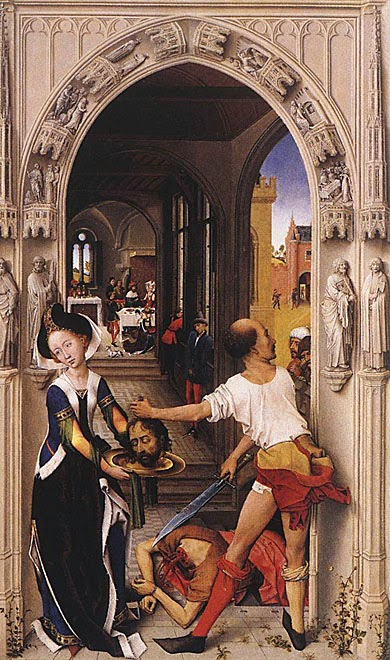
Feast Day — The Martyrdom of St. John the Baptist

Rogier van der Weyden, in his Beheading of John the Baptist,
transforms a horrific act into a scene of
elegance, subtle feeling and beauty-in-depth. (Paul Johnson)
For more about this painting, see this post.
 
Herod was the one who had John the Baptist arrested and bound in prison on account of Herodias, the wife of his brother Philip, whom he had married. John had said to Herod, “It is not lawful for you to have your brother’s wife.” Herodias harbored a grudge against him and wanted to kill him but was unable to do so. Herod feared John, knowing him to be a righteous and holy man, and kept him in custody. When he heard him speak he was very much perplexed, yet he liked to listen to him. She had an opportunity one day when Herod, on his birthday, gave a banquet for his courtiers, his military officers, and the leading men of Galilee. Herodias’ own daughter came in and performed a dance that delighted Herod and his guests. The king said to the girl, “Ask of me whatever you wish and I will grant it to you.” He even swore many things to her, “I will grant you whatever you ask of me, even to half of my kingdom.” She went out and said to her mother, “What shall I ask for?” She replied, “The head of John the Baptist.” The girl hurried back to the king’s presence and made her request, “I want you to give me at once on a platter the head of John the Baptist.” The king was deeply distressed, but because of his oaths and the guests he did not wish to break his word to her. So he promptly dispatched an executioner with orders to bring back his head. He went off and beheaded him in the prison. He brought in the head on a platter and gave it to the girl. The girl in turn gave it to her mother. When his disciples heard about it, they came and took his body and laid it in a tomb.
Mk 6:17-29

Today is the Martyrdom of St. John the Baptist who, as scripture makes abundantly clear, was killed for speaking the truth, shining God's light into the dark, hidden corners of powerful people's lives. I especially love that he was killed simply because he told the truth and wouldn't back down. These days that seems like a very precious commodity.

The first time I heard of this feast I was doing an online retreat which directed us to look at our lives to find our sins, the things that keep us from God ... and to do it while asking for God's grace. That's the perfect focus for this celebration of John's martyrdom. This makes it clear that we can't do it alone. We need God's help to look at ourselves straight, clearly, without hiding from the truth. We have to ask Jesus to shine his light on us to see what is true. I look at Herod, who doesn't know quite what to make of John but who is intrigued. Possibly if he had been able to stand up to Herodias, been less worried about his reputation, he would have become a disciple of John and eventually Jesus. 

I look at Herodias, who knows perfectly well that she has done wrong but is willing to kill, and involve any number of others, including her own daughter, in order to not face her wrongdoings. I look at Herodias' daughter, who is so unable to tell right from wrong that she has no problem asking for the death of someone at her mother's behest. 

Last, but surely not least, I look at John who cares not for the consequences but continues to do what is right even at the ultimate cost to himself. Can I be like John who is willing to let the light shine on and through him? Perhaps, with God's grace, I can ... surely, I must at least strive for it.

His persecutor had demanded not that he should deny Christ, but only that he should keep silent about the truth. Nevertheless, he died for Christ. Does Christ not say: I am the truth? Therefore, because John shed his blood for the truth, he surely died for Christ.

Through his birth, preaching and baptizing, he bore witness to the coming birth, preaching and baptism of Christ, and by his own suffering he showed that Christ also would suffer.

Such was the quality and strength of the man who accepted the end of this present life by shedding his blood after the long imprisonment. He preached the freedom of heavenly peace, yet was thrown into irons by ungodly men; he was locked away in the darkness of prison, though he came bearing witness to the Light of life and deserved to be called a bright and shining lamp by that Light itself, which is Christ. John was baptized in his own blood, though he had been privileged to baptize the Redeemer of the world, to hear the voice of the Father above him, and to see the grace of the Holy Spirit descending upon him. But to endure temporal agonies for the sake of the truth was not a heavy burden for such men as John; rather it was easily borne and even desirable, for he knew eternal joy would be his reward.
St. Bede the Venerable homily, Office of Readings, Liturgy of the Hours

Thursday, August 28, 2025

Feast Day for St. Augustine

This great saint's feast day is the day after his mother's. They always travel together, so to speak.

Saint Augustine by Philippe de Champaigne
People look upon [the Church] and say, "She is about to die. Soon her very name will disappear. there will be no more Christians; they have had their day." while they are thus speaking, I see these very people die themselves, day by day, but the Church lives on.

===========

Do you know how we should read Holy Scripture? As when a person reads letters that have come from his native country, to see what news we have of heaven.

===========

The turbulent have to be corrected, the faint-hearted cheered up, the weak supported; the Gospel's opponents need to be refuted, its insidious enemies guarded against; the unlearned need to be taught, the indolent stirred up, the argumentative checked; the proud must be put in their place, the desperate set on their feet, those engaged in quarrels reconciled; the needy have to be helped, the oppressed to be liberated, the good to be encouraged, the bad to be tolerated; all must be loved. (St. Augustine, describing his daily life)
Just a few tidbits of wisdom from my first saint friend and a great Doctor of the Church, St. Augustine. His writing has informed a lot of my practical daily Catholic life.

At times his writing has soared way above my head (he was brilliant, after all) and I have by no means read even a fraction of it. But even the tidbits, the crumbs, that fall at my feet are gratefully received and have made a huge difference in my life.

Thank you St. Augustine! Pray for us!

(Read about this great saint's life at Catholic Culture.)

The Conversion of St. Augustine by Fra Angelico

Wednesday, August 27, 2025

Prayers for the Shooting Victims at Annunciation Church

This breaks my heart, just as it does every time something like this happens. We pray for the victims and their families, we pray for everyone who witnessed it, and all those who are suffering because of this horrible act. We pray for the soul of the shooter who murdered himself. 

Lord have mercy, Christ have mercy, Lord have mercy. Be with us.

Feast of St. Monica, Housewife and Mother

Burial of Saint Monica and Saint Augustine
Departing from Africa Master of Osservanza
via Wikipedia
Widow; born of Christian parents at Tagaste, North Africa, in 333; died at Ostia, near Rome, in 387.

She was married early in life to Patritius who, a pagan, though like so many at that period, his religion was no more than a name. His temper was violent and he appears to have been of dissolute habits. Consequently Monica’s married life was far from being a happy one, more especially as Patritius’s mother seems to have been of a like disposition with himself. Monica’s almsgiving and her habits of prayer annoyed her husband, but it is said that he always held her in a sort of reverence and he converted to Christianity before he died.

Monica was not the only matron of Tagaste whose married life was unhappy, but, by her sweetness and patience, she was able to exercise a veritable apostolate amongst the wives and mothers of her native town; they knew that she suffered as they did, and her words and example had a proportionate effect.

Monica had three children but all her anxiety centred in her oldest son. He was wayward and, as he himself tells us, lazy. As he grew up, he kept seeking the truth but getting interested in heresies. It was at this time that she went to see a certain holy bishop, whose name is not given, but who consoled her with the now famous words, “the child of those tears shall never perish.”

There is no more pathetic story in the annals of the Saints than that of Monica pursuing her wayward son to Rome, wither he had gone by stealth; when she arrived he had already gone to Milan, but she followed him. Here she found St. Ambrose and through him she ultimately had the joy of seeing her yield, after seventeen years of resistance.

Mother and son had six months of true peace together after his baptism. Then Monica died and her son went on to become St. Augustine, one of the one of the most important figures in the development of Western Christianity

Patron:
  • difficult marriages
  • disappointing children
  • victims of adultery or unfaithfulness
  • victims of (verbal) abuse
  • conversion of relatives
I helped out with our parish's RCIA classes for a couple of years and would give a talk about St. Monica which included the above basics as well as my personal experience with her and St. Augustine. It made me realize that, without thinking about it, I'd grown very fond of St. Monica.

Augustine of Hippo and his mother Monica of Hippo,
Ary Scheffer, 1846, via Wikipedia

Tuesday, August 26, 2025

Julie and Scott went to Possum Trot and all they got was a t-shirt and this podcast.

 We talk about  Sound of Hope: The Story of Possum Trot in Episode 362 of A Good Story is Hard to Find.

"So often love means just showing up."

Recently I went to the annual meeting of parish office staff and volunteer group leaders since I'm the president of the St. Vincent de Paul conference at our parish. As I was at the mike, giving a brief summary of what we do, I said, "We don't go on a Home Visit to tell them about Jesus." I thought for a second and then said, "But of course we do go to tell them about Jesus, we just don't always say it."

Awkward, right? But accurate.

Listening the next morning to Father Mike Schmitz talk about what he learned from his parents, he put it the exact right way. "So often love means just showing up."

That's what everyone one of us in the society does. We show up — on the hotline, in the pantry, and at their homes. I see time and again how that makes a difference in our neighbors' lives.

I'm honored to be part of that expression of love as we "just show up."

Coast Guard

Coast Guard
by the talented Karin Jurick
This makes me smile even as I see the last days of summer slipping away.

Monday, August 25, 2025

Feast Day: St. Bartholomew, Apostle

This feast day is August 24 but that's a Sunday so Jesus takes precedence, as St. Bartholomew would agree is right and proper. I moved it to today so we can still reflect on this saint.

Statue of Bartholomew, Pierre Le Gros the Younger.
In St. John's Gospel, Bartholomew is known by the name Nathaniel (the liturgy does not always seem aware of this identity). He hailed from Cana in Galilee, was one of the first disciples called by the Lord. On that initial meeting Jesus uttered the glorious compliment: "Behold, an Israelite indeed in whom there is no guile!" After the Resurrection he was favored by becoming one of the few apostles who witnessed the appearance of the risen Savior on the sea of Galilee (John 21:2). Following the Ascension he is said to have preached in Greater Armenia and to have been martyred there. While still alive, his skin was torn from his body. The Armenians honor him as the apostle of their nation.
I just love Nathaniel who is so straight forward that when Philip tells him to come and see the Messiah, just up and says, "Can anything good come from Nazareth?" This is from someone who is from tiny Cana, so little that people argue to this day about where it really was. Just in case we didn't know how tiny and despised Nazareth was.

As Jesus says there truly is no guile in him, because when he mentions the fig tree, Nathaniel bursts out, "Rabbi, you are the Son of God; you are the King of Israel." This is the honest soul who is akin to St. Martha, to St. Teresa of Avila, to St. Thomas — speaking truth with a sharp tongue while simultaneously acknowledging God with whole-heartedness. They resonate with me. (Read the whole exchange here. It's good stuff.)

I remember reading a commentary speculating about that Nathaniel was praying something specific under the fig tree, whose branches go down to the ground and provide a nice private spot. This illuminates one of those moments when a simple statement is a piercing truth that speaks to the heart from God ... and yet means nothing to anyone else around.

Notice what he's holding in the sculpture above? That's right, his flayed skin, the source of his martyrdom. Truly he was without guile and where he gave his heart, he followed to the end. Makes the things I suffer and offer up seem very small.

Friday, August 22, 2025

Mary, Queen of Heaven

 
Coronation of Virgin, Giacomo di Mino, 1340-1350
From the earliest ages of the Catholic Church a Christian people, whether in time of triumph or more especially in time of crisis, has addressed prayers of petition and hymns of praise and veneration to the Queen of Heaven. And never has that hope wavered which they placed in the Mother of the Divine King, Jesus Christ; nor has that faith ever failed by which we are taught that Mary, the Virgin Mother of God, reigns with a mother's solicitude over the entire world, just as she is crowned in heavenly blessedness with the glory of a Queen.
I remember the thing that made this feast day come into focus for me was learning about King Solomon's Queen Mother who brought cases before him for special attention. I tell you, typology really helps you get a mental grip on things.

Thursday, August 21, 2025

A Saint for Today: St. Pius X

I never paid much attention to St. Pius X before but once you read about him it becomes blindingly obvious that he is a saint we should be asking for intercession in these modern times.

Pope Pius X working in the Vatican Gardens, 1913
He exercised holy intransigence in keeping the faith pure from doctrinal error. He reformed the Sacred Liturgy and promoted the custom of the frequent reception of Holy Communion. The motto of his Pontificate was Instaurare omnia in Christo [To restore all things in Christ]. He died on August 20, 1914. ...

St. Pius X made the motto of his Pontificate a reality -- to restore all things in Christ -- through his deep concern to stem the tide of the many evils that threatened the faithful. He frequently insisted on the damage ignorance of the Faith produces. He used to say: It is useless to expect a person without formation to fulfill his Christian duties. Time and again he pointed out the need to teach the catechism. From his uneasiness concerning the lack of Christian formation there was produced the Catechism of St. Pius X, which has done so much good in the church. His vehement desire to give doctrine in a world starving for the want of it, is reflected throughout his entire magisterium. ...

Many of the errors St. Pius X fought against are uncritically accepted in our own day. In countries evangelized almost twenty centuries ago great numbers of people are ignorant of the most elementary truths of the Faith. Many are defenseless and with the complicity of their own passions allow themselves to be taken by the erroneous opinions of a few. The call of St. Pius X to conserve and spread good doctrine is still a fully current and vital issue.

In whatever way possible, it is especially urgent to make known the teachings of the Church on the meaning of life, on the end of man and his eternal destiny, on marriage, on generosity in the number of children, on the right and duty of parents to choose the education their children receive, on the social doctrine of the Church, on love for the Pope and his teachings and on the evil of abortion. We should do all we can -- family catechism, the diffusion of good books, daily conversations concerning faith and morals ... Moreover, may we never forget as Pope John Paul II reminds us, that faith is strengthened by sharing it.
Also, I've gotta love a defender of the faith who can make quips.
The Pope was renowned for performing miracles. One day his former parishioners went to the Vatican to pay him a visit. With their customary simplicity and confidence, devoid of tact, they asked him: Father Beppo (as they used to call him when he was a parish priest), is it true you can work miracles? And the Pope with simplicity and good humor responded: Look, here in the Vatican, you have to turn your hand to a bit of everything. ...

Wednesday, August 20, 2025

Hi Nanna

Six-year-old Mahi, a spirited child with cystic fibrosis, shares a deep yet complex bond with her father, Viraj, a dedicated single parent and successful fashion photographer. Her curiosity about her absent mother leads to a journey of discovery when she runs away with her loyal dog, Pluto. A chance encounter with a kind woman named Yashna sparks unexpected revelations

Against all odds I really loved this movie.

This isn't the kind of movie that I usually love but the acting, direction, and pacing were so strong that they made up for the plot holes and how much I hated the snowflake of a wife. Also the second half was amazing. One twist after another and we didn't see any of them coming except for Dr. Aarvind.

The movie itself is probably 3 stars because of the script but my enjoyment earns it 4 stars.

Eiffel Tower

Taken by Paris Daily Photo - the link no longer works

This is from 2009 when Paris hosted the Rugby World Cup. It's so lovely and I love Paris so much - so let's enjoy it again all these years later.

Tuesday, August 19, 2025

Everyday Graces: Stories of Faith in the Ordinary by C.E. Albanese

A security guard wrestling with temptation. A teenage boy learning to serve. A lonely Christmas worker surprised by kindness. A family holding hands in prayer while carrying the weight of absence. These brief but powerful tales reveal how God's love manifests in the most ordinary circumstances. These aren't fairy tales or heavy-handed parables. They're glimpses of the sacred embedded in the real world, where small acts of generosity reveal the multiplication of grace.

You know if there's one thing I love it is seeing God's fingerprints just below the surface of everyday life. The author told me that these stories are the very thing I love to find and he was right. I was worried that they might be sentimental, fantasies of Christian life. But no, these are the real thing. They're presented as fiction but come from moments the author witnessed. I know that when I told my husband about the "Thanksgiving Texts" story, he said, "I know that story. I read it in the news." That's when I realized what treasures these little, 500 word tales are. I myself found them touching and inspirational.

This is a book worth keeping as a devotional or to give to someone who needs those glimpses of grace to unlock their vision for their own lives of faith. Highly recommended.