Projects undreamed of by past generations will absorb our immediate descendants; forces terrific and devastating will be in their hands; comforts, activities, amenities, pleasures will crowd upon them, but their hearts will ache, their lives will be barren, if they have not a vision above material things.
Winston Churchill
Thursday, May 11, 2017
Well Said: A vision above material things

My Year of "In Order" - TV, Novels, Movies
I just realized that I've fallen into a number of long series that it seemed logical to do "in order." That's not normally my style for things like the James Bond movies, where it is completely ok to see most of them without any reference to the others.
And, on the other side of that equation, I'm usually perfectly fine with not finishing series. I never read more than the first of the Dune series, was able to abandon Community after Season 3 (the last good season), and so forth.
But, for these seemed like it would be fun, somehow. They all seem specially suited for summer which is just around the corner.

This is actually Rose's project because she's never seen the tv shows although she knows the movies. At one point (the tragic period between the original series and The Next Generation), I'd watched these enough that I practically had them memorized. It's been decades since I've seen them, especially in order, and I'm really enjoying working our way through the first season.
We'll keep going until we're done with all the Trek series, making this possibly a lifetime project.


Our household has seen tons of James Bond movies but we realized there are big holes in our viewing. George Lazenby, Timothy Dalton, and even a few Sean Connery and Roger Moore movies are missing from our Bond experience. The movies we've individually missed overlapped so much that we decided to fill in the gaps in order. Which will be most of the movies by the time we get done. What says summer better than James Bond movies?
And, on the other side of that equation, I'm usually perfectly fine with not finishing series. I never read more than the first of the Dune series, was able to abandon Community after Season 3 (the last good season), and so forth.
But, for these seemed like it would be fun, somehow. They all seem specially suited for summer which is just around the corner.
STAR TREK

This is actually Rose's project because she's never seen the tv shows although she knows the movies. At one point (the tragic period between the original series and The Next Generation), I'd watched these enough that I practically had them memorized. It's been decades since I've seen them, especially in order, and I'm really enjoying working our way through the first season.
We'll keep going until we're done with all the Trek series, making this possibly a lifetime project.
DISCWORLD novels


I've loved some of Terry Pratchett's novels for a long time. Witches Abroad was the first book of his I read. I still remember how delighted I was by his skewering our dependence on the patterns of storytelling while at the same time telling a wonderfully funny and insightful story. I noticed Rose has been reading some of his older books and I realized they are the perfect books for summer and letting the world go hang. I'd read the first few long ago and so launched in with Guards! Guards! and got to know the Watch of Ankh Morpork who I'd only encountered before as comic side characters in the witches stories.
BOND, JAMES BOND

Wednesday, May 10, 2017
Well Said: Peasants Versus Philosophers
It wasn’t that they didn’t take an interest in the world around them. On the contrary, they had a deep, personal and passionate involvement in it, but instead of asking, "Why are we here?" they asked, "Is it going to rain before the harvest?"
A philosopher might have deplored this lack of mental ambition, but only if he was really certain about where his next meal was coming from.
Terry Pratchett, Carpe Jugulum
Worth a Thousand Words: El puente de Alcantara
 |
| El puente de Alcantara, Aureliano de Beruete y Moret - 1906 via The Athenaeum |
Genesis Notes: Sarah's Resume
One of the things I love about Genesis is that when it focuses on a story you get the sense of "real" people, not someone who's made up to make a point. Sarah's resume shows us a woman I can relate to in a lot of ways, both good and bad. She's a mass of contradictions, because that is how real people are. Genesis shows us these people, warts and all, and so carries their stories into our lives today.
 |
| Domenico Fiasella, Abraham and three angels [See Sarah? She's peeking out of the door. I like this view of her, keeping an eye on things and also curious about the visitors.] |
Strengths and accomplishments:All material quoted is from the Life Application Study Bible. This series first ran in 2004 and 2005. I'm refreshing it as I go. For links to the whole study, go to the Genesis Index. For more about the resources used, go here.
Weaknesses and mistakes:
- Was intensely loyal to her own child
- Became the mother of a nation and an ancestor of Jesus
- Was a woman of faith, the first woman listed in the Hall of Faith in Hebrews 11
Lessons from her life:
- Had trouble believing God's promises to her
- Attempted to work problems out on her own, without consulting God
- Tried to cover her faults by blaming others
Vital statistics:
- God responds to faith even in the midst of failure
- God is not bound by what usually happens; he can stretch the limits and cause unheard-of events to occur
Key verse:
- Where: Married Abram in Ur of the Chaldeans, then moved with him to Canaan
- Occupation: Wife, mother, household manager
- Relatives: Father - Terah. Husband - Abraham. Half brothers - Nahor and Haran. Nephew - Lot. Son - Isaac.
"By faith Abraham, even though he was past age -- and Sarah herself was barren -- was enabled to become a father because he considered him faithful who had made the promise" (Hebrews 11:11)
Sarah's story is told in Genesis 11-25. She also is mentioned in Isaiah 51:2, Romans 4:19; 9:9; Hebrews 11:11; 1 Peter 3:6.
Tuesday, May 9, 2017
Well Said: Tolerating only the right religions
"What is, um, your role, madam?"Sounds familiar, eh?
"I'm the godmother!"
"Which, um, god?" The young man was trembling slightly.
"It's from Old Lancre," said Agnes hurriedly. "It means something like 'goodmother." It's all right ... as witches we believe in religious toleration..."
"That's right," said Nanny Ogg, "But only for the right religions, so you watch your step!"
Terry Pratchett, Carpe Jugulum
Worth a Thousand Words: Carnation, Lily, Lily, Rose
 |
John Singer Sargent (1856–1925); Carnation, Lily, Lily, Rose via Wikipedia |
Vatican astronomer Brother Guy Consolmagno calls on scientests to "come out" and share their faith.
“God is not something we arrive at the end of our science, it’s what we assume at the beginning,” he said, adding emphatically: “I am afraid of a God who can be proved by science, because I know my science well enough to not trust it!”I've had the privilege of discussing books with Brother Guy (Episode 100, A Good Story is Hard to Find). Both that conversation and the book he co-authored, Would You Baptize an Extraterrestrial, made me admire his good sense and faith.
Read the whole "coming out" story here.
Monday, May 8, 2017

Farewell, My Lovely - SFFaudio Discussion

Jesse, Maissa, Paul and I discuss Farewell, My Lovely by Raymond Chandler on the SFFaudio podcast. We discuss missing dames, stolen jade necklaces, who sapped Philip Marlowe, and much more. Join us!
Friday, May 5, 2017

Stop what you're reading. Get this book: The Rosie Project by Graeme Simsion
I just finished rereading this for the third time, for an upcoming book club. I enjoyed it so much, even the third time around, that I thought I'd rerun the review in case you've missed this delightful book.
For those who'd like to hear more in-depth discussion, Scott Danielson and I discussed this on A Good Story is Hard to Find podcast (episode 84).
 THE ROSIE PROJECT
by Graeme Simsion
You know it's an unusual book when your mother forces you to read it by threatening you with guilt at her deathbed if you don't try it. (Ahem. Not that I've left any of my mother's book suggestions lingering too long on my "to read" list. No. Of course, I'd never do that.)
Guilt and mothers being what they are, plus the "after the 'goodbye'" reminder from her as I was hanging up the phone ... I looked around.
Heck, do people love this book or what? 21 copies at the library. All checked out. With 60 holds waiting for it to come in. Ok, Kindle make me love you. And I do love you, Kindle, I do! $1.99 and one click to download.
Where I literally laughed out loud by the beginning of the second chapter.
I guess Mom really does know best.
And it's a good thing because the description, while accurate, would never make me particularly want to pick it up. Hey, that's Don's problem. So accurate and we can't see what's really inside. Here's the blurb.
It is funny, it gives us insight into a completely different way of thinking, and it charms us while it does so.
I guess the test of a book one really enjoyed is that you don't want to start another book. You want to let the one you just read rattle around in your head and heart for a while. This, surprisingly, is such a book for me, thus forcing me to turn to nonfiction exclusively for a little while. Most unexpected.
NOTE: For quick explanation of what this book is, use Hannah's fast summing up to a pal: "It's an Abed situation." (Something for Community fans out there.)
For those who'd like to hear more in-depth discussion, Scott Danielson and I discussed this on A Good Story is Hard to Find podcast (episode 84).
THE ROSIE PROJECTby Graeme Simsion
You know it's an unusual book when your mother forces you to read it by threatening you with guilt at her deathbed if you don't try it. (Ahem. Not that I've left any of my mother's book suggestions lingering too long on my "to read" list. No. Of course, I'd never do that.)
Guilt and mothers being what they are, plus the "after the 'goodbye'" reminder from her as I was hanging up the phone ... I looked around.
Heck, do people love this book or what? 21 copies at the library. All checked out. With 60 holds waiting for it to come in. Ok, Kindle make me love you. And I do love you, Kindle, I do! $1.99 and one click to download.
Where I literally laughed out loud by the beginning of the second chapter.
I guess Mom really does know best.
And it's a good thing because the description, while accurate, would never make me particularly want to pick it up. Hey, that's Don's problem. So accurate and we can't see what's really inside. Here's the blurb.
Don Tillman, professor of genetics, has never been on a second date. He is a man who can count all his friends on the fingers of one hand, whose lifelong difficulty with social rituals has convinced him that he is simply not wired for romance. So when an acquaintance informs him that he would make a “wonderful” husband, his first reaction is shock. Yet he must concede to the statistical probability that there is someone for everyone, and he embarks upon The Wife Project. In the orderly, evidence-based manner with which he approaches all things, Don sets out to find the perfect partner.Don tells us the story himself and that is a great part of the charm.
It is funny, it gives us insight into a completely different way of thinking, and it charms us while it does so.
I guess the test of a book one really enjoyed is that you don't want to start another book. You want to let the one you just read rattle around in your head and heart for a while. This, surprisingly, is such a book for me, thus forcing me to turn to nonfiction exclusively for a little while. Most unexpected.
NOTE: For quick explanation of what this book is, use Hannah's fast summing up to a pal: "It's an Abed situation." (Something for Community fans out there.)
Thursday, May 4, 2017

Wednesday, May 3, 2017
Through Darkest Zymurgia! A Ripping Yarn by by William H. Duquette

Through Darkest Zymurgia! is what you'd get if you crossed P.G. Wodehouse with H. Rider Haggard and sprinkled a generous dose of Douglas Adams over the whole.
Professors Thintwhistle and Carbuncle go on a ripping yarn of exploration and adventure in a world almost — but not quite — entirely unlike our own. When a determined University donor wields his influence, the professors are forced to abandon their planned summer tour of taverns of exotic cities in the Known World. Instead they must go where no adventurers have gone before. Not, though, without a certain predictability to their new goal as we find when an admiral falls into conversation with Professor Thintwhistle about their destination of Zymurgia.
The admiral sat back in his chair. “What do you expect to find?” he asked.Most of the humor tends to build upon long setups and so, as in many Victorian books, takes a while to hit home. Suffice it to say that this Victorian-style tale of exploration retains genuine mystery and adventure while being infused with humorous whimsy.
“Beer,” I said.
“Beer?” asked Wyburn, in surprise.
“Beer,” I said. “That’s what Zymurgia means, you know…the land of brewing. They’ve been selling beer to the Serosans for thousands of years. The trade is only carried on in a small way these days; just with the folk at the base of the plateau.”
“It seems a long way to go to get a drink,” said Wyburn.
Full disclosure: I enjoyed it so much that I volunteered to do the layout. That's because I'll be rereading it in the years to come. This is a thoroughly enjoyable tale and I hope author William Duquette will favor us with many more featuring the famed Professors Thintwhistle and Carbuncle in the future.
Well Said: The Real Force
He felt helpless in the grip of this alien ritual, out of joint with his time. The confessional might have been a direct pipeline to the days when werewolves and incubi and witches were an accepted part of the outer darkness and the church the only beacon of light. For the first time in his life he felt the slow, terrible beat and swell of the ages and saw his life as a dim and glimmering spark in an edifice which, if seen clearly, might drive all men mad. Matt had not told them of Father Callahan’s conception of his church as a Force, but Ben would have understood that now. He could feel the Force in this fetid little box, beating in on him, leaving him naked and contemptible. He felt it as no Catholic, raised to confession since earliest childhood, could have.I don't know about "naked and contemptible." But I do know that I was struck by these words: "an edifice which, if seen clearly, might drive all men mad."
Stephen King, 'Salem’s Lot
It almost sounds Lovecraftian but if one considers how unprepared humans seem to be to see an angel (they always have to say "do not fear") and the angels are simply messengers ... well, then there is something to needing to go through Earthly boot camp and then the purification of Purgatory in order to even to be able to take in the Heavenly reality.
Not what you expect from a horror novel but this is one of King's best.
Genesis Notes: Abraham's Resume
As always, I love these resumes which give such a good overview of a person's life, often with unexpected insights. Believe it or not, I often look to his example, especially when I am struggling with obedience to God.
All material quoted is from the Life Application Study Bible. This series first ran in 2004 and 2005. I'm refreshing it as I go. For links to the whole study, go to the Genesis Index. For more about the resources used, go here.
 |
| Aert de Gelder, Abraham and the Angels |
Abraham could hardly have been expected to visualize how much of the future was resting on his decision of whether to go [follow God's direction] or stay, but his obedience affected the history of the world. His decision to follow God set into motion the development of the nation that God would eventually use as his own when he visited earth himself. When Jesus Christ came to earth, God's promise was fulfilled; through Abraham the entire world was blessed.
Strengths and accomplishments:
Weaknesses and mistakes:
- His faith pleased God
- Became the founder of the Jewish nation
- Was respected by others and was courageous in defending his family at any cost
- Was not only a caring father to his own family, but practiced hospitality to others
- Was a successful and wealthy rancher
- Usually avoided conflicts, but when they were unavoidable, he allowed his opponent to set the rules for settling the dispute
Lessons from his life:
- Under direct pressure, he distorted the truth
Vital statistics:
- God desires dependence, trust, and faith in him -- not faith in our ability to please him
- God's plan from the beginning has been to make himself known to all people
Key verse:
- Where: Born in Ur of the Chaldeans; spent most of his life in the land of Cannan
- Occupation: Wealthy livestock owner
- Relatives: Brothers - Nahor and Haran. Father - Terah. Wife - Sarah. Nephew - Lot. Sons - Ishmael and Isaac
- Contemporaries: Abimelech, Melchizedek
"Abram believed the Lord, and he credited it to him as righteousness" (Genesis 15:6)
Abraham's story is told in Genesis 11-25. He also is mentioned in Exodus 2:24; Acts 7:2-8; Romans 4; Galatians 3; Hebrews 2, 6, 7, 11.
All material quoted is from the Life Application Study Bible. This series first ran in 2004 and 2005. I'm refreshing it as I go. For links to the whole study, go to the Genesis Index. For more about the resources used, go here.
Seeking and Finding Jesus … Via Dracula?

Will Duquette interviewed me about Seeking Jesus in Everyday Life for Aleteia's Book Nook. It brought surprising things to light!
Dracula, by Bram Stoker, is a book I’ve read many times since my high school days. I’ve come to see what a master work it is in examining the difficulty modern man has in accepting the supernatural as real, in examining unselfish love and service to others as opposed to absolute selfishness, and in examining evil as a perversion of all that is good. Dracula isn’t the anti-Christ in the standard understanding of the term but he is definitely the anti-God. And, as in The Lord of the Rings, these messages are subtly communicated within the larger story. ... I reread Dracula when I was close to finishing Seeking Jesus in Everyday Life and never has it spoken more to my soul in terms of who Jesus is and why I am so grateful for his love and friendship.That's not nearly all I have to say on the topic ... and others. Read Seeking and Finding Jesus ... Via Dracula at Aleteia.
Thank you, Will, it was fun!
Tuesday, May 2, 2017
I've Been Blogging for 13 Years? How Did That Happen?
The sentiments below (from 2014) are still ones I feel when I think about the blog. Much has changed in my life due to this blog. For one thing I've written some books. That never would've happened.
For another, social media is now king and blogs seem old and passé. Yet, a fair number of people still come by every day. So rumors of our passing have been greatly exaggerated.
With that in mind, let's celebrate!

I remember so clearly that Sunday afternoon when I sat down, filled with nervous excitement, and figured out Blogger well enough to write my first post.
Fittingly enough it was a quote about St. Joseph and work as a spiritual act. I say fittingly enough because over the years I have leaned heavily on sharing quotes about living our faith in everyday life. St. Joseph, who guided Jesus through his first years of everyday life, is a perfect saint to have helped me launch such an endeavor.
I don't have any grand thoughts on this anniversary, perhaps because it just struck me a little while ago that I should see when it was in May that I began blogging. And it was 10 years ago today! What're the odds?
I can say that I have enjoyed it a lot. Blogging continues to bring me new friends, new insights, open doors for God to be present in my life. And what can be better than that? Not much, really!
Many thanks to those who take the time to drop by, and even more thanks to those who comment. I love you all! Now, let's all get some cake!
For another, social media is now king and blogs seem old and passé. Yet, a fair number of people still come by every day. So rumors of our passing have been greatly exaggerated.
With that in mind, let's celebrate!
I remember so clearly that Sunday afternoon when I sat down, filled with nervous excitement, and figured out Blogger well enough to write my first post.
Fittingly enough it was a quote about St. Joseph and work as a spiritual act. I say fittingly enough because over the years I have leaned heavily on sharing quotes about living our faith in everyday life. St. Joseph, who guided Jesus through his first years of everyday life, is a perfect saint to have helped me launch such an endeavor.
I don't have any grand thoughts on this anniversary, perhaps because it just struck me a little while ago that I should see when it was in May that I began blogging. And it was 10 years ago today! What're the odds?
I can say that I have enjoyed it a lot. Blogging continues to bring me new friends, new insights, open doors for God to be present in my life. And what can be better than that? Not much, really!
Many thanks to those who take the time to drop by, and even more thanks to those who comment. I love you all! Now, let's all get some cake!
CraftLit is giving away a copy of Seeking Jesus in Everyday Life!
A raffle for Seeking Jesus in Everyday Life ... done by Heather Ordover at the CraftLit podcast.
(She is the best - if you haven't listened to CraftLit then you are missing a real treat in literary enjoyment).
Giveaway ends May 5 so sign up!
Monday, May 1, 2017
Seeking Jesus review: Fall in love with Jesus all over again

This book is exactly what I needed at this point in my life! Each devotional tackles an area of Christian Living and surrounds the topic with Scripture, quotes from Saints and Scholars, and wisdom and reflection from the author's own experiences. It's a beautiful read that will make you fall in love with Jesus all over again. I cannot recommend this book enough!Don't you want to see what the fuss is about? Get a copy ... and maybe one for a friend!
Katherine Lyle, Amazon reviewer

Well Said: Perfect forms and lovely patterns
This is the age of science, of steel — of speed and the cement road. The age of hard faces and hard highways. Science and steel demand the medium of prose. Speed requires only the look — the gesture. What need then, for poetry?This was written in 1958. How much greater the need is now when we haven't stopped the speed, the noise, the barely-there communications. I'm beginning to reread this fine collection and this bit from the preface is as poetically beautiful as anything that follows.
Great need!
There are souls, in these noise-tired times, that turn aside into unfrequented lanes, where the deep woods have harbored the fragrances of many a blossoming season. Here the light, filtering through perfect forms, arranges itself in lovely patterns for those who perceive beauty.
Roy J. Cook, Editor, Preface to 101 Famous Poems
Friday, April 28, 2017
Well Said: Learning from Children
You can learn many things from children. How much patience you have, for instance.Just one more way families help us be better people!
Franklin P. Jones

Through Darkest Zymurgia!

Will Duquette has a new book out.
My latest book, Through Darkest Zymurgia!, is now available in print or as an e-book. It’s a Ripping Yarn of Exploration and Adventure in a faux-Victorian world with some surprising features and a good deal of understated humor. You’ll like it, I promise.How much do I love this humorous take on a Victorian tale of exploration and adventure? So much so that I volunteered to do the layout.
It’s cheaper as an e-book, but buy the print edition—it’s gorgeous.
I'll do a proper review soon but wanted to give y'all a heads up on this one. Check the link for a longer description. It's highly enjoyable.
Thursday, April 27, 2017

Wednesday, April 26, 2017
Pope Francis's TED Talk: "The future does have a name, and its name is Hope."
As I meet, or lend an ear to those who are sick, to the migrants who face terrible hardships in search of a brighter future, to prison inmates who carry a hell of pain inside their hearts, and to those, many of them young, who cannot find a job, I often find myself wondering: "Why them and not me?" I, myself, was born in a family of migrants; my father, my grandparents, like many other Italians, left for Argentina and met the fate of those who are left with nothing. I could have very well ended up among today's "discarded" people. And that's why I always ask myself, deep in my heart: "Why them and not me?"If you'd rather not watch the video, you can read the transcript of Pope Francis's TED Talk.
Well Said: Stories and Spiders
Stories are like spiders, with all they long legs, and stories are like spiderwebs, which man gets himself all tangled up in but which look pretty when you see them under a leaf in the morning dew, and in the elegant way that they connect to one another, each to each.
Neil Gaiman, Anansi Boys
Genesis Notes: What Abraham's Life Means to Us
GENESIS 22 & 23
Abraham's story with all the drama and events and lies and faulty humans is actually a story that shows us God's faithfulness and love. I never would have thought of it this way before going through this study but it is undeniable.
Abraham's story with all the drama and events and lies and faulty humans is actually a story that shows us God's faithfulness and love. I never would have thought of it this way before going through this study but it is undeniable.
 |
| The vision of the Lord directing Abraham to count the stars, Julius Schnorr von Carolsfeld, 1860 |
The story of Abraham's life is a story with almost limitless meaning. It includes examples of faith, prayer, and sacrifice. It contains many lessons for those who, like Abraham, live their lives by putting their faith in God. Yet perhaps the greatest significance of the story of Abraham is that it is the story of God in love with man.All quotes from Genesis, Part II: God and His Family. This series first ran in 2004 and 2005. I'm refreshing it as I go. For links to the whole study, go to the Genesis Index. For more about the resources used, go here.
From the earliest chapters of Genesis, we have traced out the evidence of God's profound love for the human creatures who bear His image and likeness. The rebellion of Adam and Eve not only did not conquer God's love, it actually became an occasion for Him to demonstrate its depth and breadth and height. For not only did God love humans when they behaved, but He even loved them when they sinned. How? He gave them promises to live by and punishments to purify them. Over and over again, God bent down to reorganize and restore the family life that was shattered in Eden. First, He promised to defeat His enemy through human beings. Then, in Genesis 12, He promised to create, from one man, a whole nation that would belong to Him; through that nation, He planned to reverse the curse of Eden into universal blessing.
The context for comprehending the significance of Abraham's story is the initiative and action of God in pursuit of humanity. His call to Abram in Genesis 12 begins a detailed, engaging account of how one ordinary human being, a creature of flesh and blood like us, is singled out by God to be transformed from sinner to saint. The story of his life is the first extended account we have of intimacy between God and man. It is a story of God's love from beginning to end.
Yes, even at the end, when God asks Abraham to give up, to put to death, that which gives his life its only true meaning, He is acting out of passionate love for him. How can that be? God knows that in losing our lives, we find them. He knew that in Eden. He knew that on Moriah. He knew it on Calvary. The source of perfect human happiness is perfect obedience to God, even if it costs us everything.
Tuesday, April 25, 2017
Worth a Thousand Words: Early Saturday Morning
 |
| Early Saturday Morning by Karin Jurick |
Well Said: The Value of Kneestem
"A lot of what you've been teaching me sometimes seems kind of useless. Like that kneestem you've got—I mean, it doesn't have anything to do with magic. It's just a weed. You said yourself it's worthless."Of course, I'm thinking of this in relation to a lot of issues that have nothing to do with the obvious application, such as our environment. It's a very Catholic way of looking at the world.
"It is worthless to us and to animals, having no value either as medicine or as food," Ingold agreed, turning the dry wisp in his mittened fingers. "But we ourselves are useless to other forms of life—except, I might point out, as sustenance to the Dark Ones. Kneestem, like you and me, exists for its own sake, and we must take that into account in all our dealings with the world that we hold in common with it.
Barbara Hambly, The Walls of Air
Books In the Pipeline
I just realized that between podcasts and my book club I've got a lot of varied reading coming up. I would say this interferes with my 2017 book goals but I tossed them out the window about a month ago.
I'd kind of forced the list this year just because I'd done a reading goals in previous years. Note to self - no need to force a reading list. The books will come to you anyway. And the reading will be both varied and wonderful.
This is my "assigned" reading for the next few months. (Title links go to my reviews.)
I'd kind of forced the list this year just because I'd done a reading goals in previous years. Note to self - no need to force a reading list. The books will come to you anyway. And the reading will be both varied and wonderful.
This is my "assigned" reading for the next few months. (Title links go to my reviews.)
- THE ROSIE PROJECT - rereading this for my Catholic women's book club. Proof that a book can be light and fun and still say something meaningful.
- THE HITCHHIKER'S GUIDE TO THE GALAXY - it's been years since I've read this one. It's Scott's selection for our next book on A Good Story is Hard to Find.
- DRACULA - rereading for SFFaudio podcast. I love this book so much. So. much.
- BURGLARS CAN'T BE CHOOSERS - also for SFFaudio. Never read it but Lawrence Block's "burglar" series is supposed to be good.
- NOSTRA AETATE (Vatican II doc: The Relation of the Church to Non-Christian Religions) - Catholic women's book club choice. The Vatican II documents are surprisingly easy reading.
- A TALE OF TWO CITIES - the book that introduced me to Dickens as an adult. This will be my next book choice for A Good Story is Hard to Find.
- THE MALTESE FALCON - the movie's good but the book is better. This one's also for SFFaudio.
Elements of Faith book club - live in Dallas? Join us!
A short interview about Seeking Jesus in Everyday Life

In this short Interview Extra, Scott sits down with Julie to discuss her new book Seeking Jesus in Everyday Life: Prayers and Reflections for Getting Closer.
Hear it at A Good Story is Hard to Find podcast.
Monday, April 24, 2017
Well Said: The Marvels of Rome and the Length of Human Memory
One of the marvels of Rome is that the traditional portraits of St. Peter and St. Paul have been preserved in the catacombs, and every artist who has painted the two Apostles owes something to this tradition. The portraits were engraved in gold leaf on the bases of the glasses or chalices which, as the Salesian Father had told me, were embedded in the plaster round the bodies. There are hundreds of these glasses to be seen in the Vatican Museum, and the type of portrait never varied. Both Apostles are shown as men of middle-age and both are bearded, but while St. Peter has a fine head of curly hair, St. Paul is almost bald. Those who have studied the portraits believe that they embody a tradition which goes back possibly to the days of Nero and to those who knew the Apostles by sight.This is lengthy but I love the vivid illustration of how few generations it takes to span a very long period of time when passing along memories.
I was reminded of a story which the late Monsignor Stapylton Barnes was fond of telling to illustrate the length of human memory. His mother, who died in 1927 at a great age, could clearly remember, as a small girl, hearing Victoria proclaimed queen in 1837. When a child she was often taken to see a very old lady who remembered the French Revolution and the execution of Marie Antoinette in 1793. This old lady had spent her childhood in Philadelphia and had known Benjamin Franklin, who was born in 1706. Thus it would have been possible for Franklin to have described some event of his early childhood--perhaps the great fire in Boston of 1711--to the little girl, who could have told it in her ld age to another little girl, Mrs. Barnes, who could have passed on the story to her son in the twentieth century.
In his book The Martyrdom of St. Peter and St. Paul, Monsignor Barnes refers to the great sweep of human events commanded by such lives, and says 'it would have been possible for a Christian child in rome in the year 67 to have been actually present at St. Peter's martyrdom and to have seen him nailed to the cross, and still to have been alive and able to tell the tale in 150. And the child to whom he told it then could have told the story again in his extreme old age to one who lived to see the peace of the Church in 312 under Constantine.'
H. V. Morton, A Traveller in Rome
Friday, April 21, 2017
Why You Should Go to Church (Even If You're Not Sure of Your Beliefs)
I'm not sure tho compelling this would've been before I became a believer. Now, though, having gone to church for a couple of decades, I can attest to the truth of this piece from The Art of Manliness. So I can assure you they're on point here.
These are just a few of the topics they touch upon:
These are just a few of the topics they touch upon:
- A Chance to Remember/Reorient/Reflect/Re-center
- Builds Discipline
- Rare Chance for Communal Singing
- Breaches Your Echo Chamber and Connects You With People From Different Walks of Life
- Contributes to Greater Free-Thinking and Your Diversity of Ideas
- Ample Opportunities (and More Motivation) for Service
Worth a Thousand Words: Noli Me Tangere
 |
| Noli Me Tangere, Lavinia Fontana, 1581 via Elizabeth Lev |
Fontana’s version emphasized accuracy: Mary Magdalene mistakes Jesus for a gardener, and so she paints him in a broad-brimmed hat holding a shovel. Yet once she has emphasized the literal sense, Lavinia also evokes a beautiful scene. The atmosphere is permeated with warm golden light as a new age is dawning. A little flashback scene in the distance shows the women who have left the city arriving at the tomb where an angel tells them Christ is gone. Mary’s pose in the further scene shows her with the slumped shoulders of dejection, but in the foreground her face becomes radiant with hope. Christ puts out his hand, ostensibly to tell her not to touch Him, but also in a gesture of affectionate blessing. Mary’s gaze is directed toward the wound on his hand made visible for her, but she seems to look beyond it, trying to gaze at his face under the shadowy brim. Proof of his resurrection is not her primary concern as she sinks to her usual place by his feet. The light, setting, and positions evoke a love story, a compelling language that the Counter-Reformation will employ in its time.There's more where that came from. I love being shown beneath the surface of paintings for deeper meaning. Elizabeth Lev's piece discusses the goals of Counter-Reformation art and opens another piece up for our edification. Be sure to check it out.
Genesis Notes: Jews, Christians, Muslims ... and Abraham
We know that all three religions have a basic connection through Abraham. A succinct summary in The Complete Bible Handbook shows where they agree and disagree about Abraham's example for us.
 |
| Abraham Serving the Three Angels by Rembrandt |
A common reverence for Abraham as a model of true human response to God and as ancestor of subsequent believers is one of the prime links between Jews, Christians, and Muslims.This series first ran in 2004 and 2005. I'm refreshing it as I go. For links to the whole study, go to the Genesis Index. For more about the resources used, go here.
Abraham's responsiveness to God is summed up in his epithet as "the friend of God." This title is first given in Hebrew scripture (Isa 41:8; 2 Chr. 20:7); it is taken up in the New Testament (Jas. 2:23); and in Islam, Abraham (Ibrahim) is known simply as "the friend" (Al Kahlil).
Each religion gives content to Abraham's friendship with God in terms of its own characteristic emphases, on the supposition that Abraham is best understood in terms of that to which he helped give rise. Thus for Jews (appealing to Gen. 26:5 as well as to more general considerations), Abraham is an example of one who was obedient to God's commandments, or Torah, even before Torah was given to Israel at Sinai. For Christians, following Paul's exposition (Rom. 4), Abraham is a model of one who has faith (pistis) in God. For Muslims, Abraham demonstrates islam, unconditional submission to the will of God, as in his willingness to sacrifice his son. Though Jews, Christians, and Muslims differ about the true human response to God as exemplified by Abraham, they agree that he provides a model of how human life should be lived.
Thursday, April 20, 2017
"Egyptian Christians are made of steel!"
Watch the news anchor's reaction to the forgiveness expressed by the widow of the gatekeeper who prevented a suicide bomber from entering an Alexandria church yard on Palm Sunday, thereby saving countless lives.
It is truly moving. This is why the blood of the martyrs [and the forgiveness of the faithful] is the seed of the church.
It is truly moving. This is why the blood of the martyrs [and the forgiveness of the faithful] is the seed of the church.
"Egyptian Christians are made of steel! These people have so much forgiveness!"Via The Deacon's Bench.

A "Fast Take" Interview on Aleteia

Elizabeth Scalia graciously offered me a "fast take" interview on Aleteia about Seeking Jesus in Everyday Life. Aleteia is a worldwide Catholic network with all sorts of fascinating articles.
Among other things, find out what person I identify with most in the book, what writing it taught me, and ... perhaps most importantly of all ... what the ideal beverage is that you should have in hand while reading your copy!
Challenging Opinions Interview: Sticking Up for the Faith

William has relaunched his podcast and I feel honored that my 2016 interview was one he carried over. So I'm reposting this in case you're interested.
===========
Always be ready to give an explanation to anyone who asks you for a reason for your hope.William Campbell invited me to chat with him at his podcast, Challenging Opinions. The podcast exists to "test all ideas, left and right, liberal and conservative, progressive and libertarian."
I Peter 3:15
That idea in itself is pretty challenging but when I listened to sample episodes William was a fair and impartial interviewer, which is a rare quality these days.
I thought we were going to discuss my post Obedience: The Dirtiest Word in America so I was prepared to talk about being an American Catholic during the political season. I think that post was only what drew me to William's attention. We never actually discussed that topic, but wound up covering everything from faith in God to Catholic misdeeds to the future of the Church.
I was going completely off the cuff, which I think shows sometimes, but that in itself was fair. Shouldn't we be able to shed some light on faith and the Church when we're asked about it? It was a like a particularly invigorating workout and I really enjoyed talking with William.
Listen at Challenging Opinions or iTunes.
===========
The Reason for My Hope and Why I'm a Happy Catholic
This didn't come up in our fast-paced conversation, but I wanted to share it anyway. This quote perfectly echoes my feeling.
I have looked for happiness everywhere: in the elegant life of the salons, in the deafening noise of balls and parties, in accumulating money, in the excitement of gambling, in artistic glory, in friendship with famous people, in the pleasure of the senses. Now I have found happiness, I have an overflowing heart and I want to share it with you. … You say, “But I don’t believe in Jesus Christ.” I say to you, “Neither did I and that is why I was unhappy.All my life I searched for Truth, wondering if there were such a thing. And I found it in Jesus.
Hermann Cohen, letter to a friend
===========
NOTE
On the documents I hadn't heard of, allegedly Vatican blueprints for methodically concealing sex crimes, the news articles had responses from both the Church and other experts which point out that they aren't a "smoking gun" and that "it's a church law that deals only with religious crimes and sins. And that the secrecy is meant to protect the faithful from scandal." All this proves is that there are two sides to any issue and that we can't make quick assumptions without very careful study.
A friend of mine is a canon lawyer. I've often heard him speak about how easy it is to misunderstand a law by only a looking at it through one frame, especially when it has been misused so that is the only lens we are using. Often these laws reflect long ago history and problems which were very different than the current issues.
Can such documents be misused? Absolutely. Was there a terrible sexual misconduct and a mistaken idea of protecting the Church implemented by moving predators around? No doubt. These are the sins we, the faithful, mourn and must keep from ever recurring.
But, it is equally a mistake to read our current mindset backwards into documents whose roots lie deep in the past. Jumping to conclusions about intention is as much of a mistake as ignoring victims to protect an institution.
Which is all a way of saying ... it's complicated.
Wednesday, April 19, 2017
Seeking Jesus in Everyday Life: "Are you ready to hit the reset button on your practice of the faith? Here it is."

A friend had a relative who’d just turned to God for the first time in the midst of a serious end-of-life crisis, but now what? How do you help someone who’s ignored God for a lifetime to even know how to pray? I recommended this book.Jen Fitz has a lovely review of Seeking Jesus in Everyday Life. Please do read the whole thing at the link.
Starting with “Beginning to Pray” as the zero point, Julie walks the reader from I’ve-got-nothing all the way into the depths of the Christian life.
Tuesday, April 18, 2017

Monday, April 17, 2017
Worth a Thousand Words: The Fantasy World
 |
| Column header from Stirring Science Stories, Feb. 1941 via SFFaudio |
Thursday, April 13, 2017
Coptic Priest: "To those who kill us. Thank you."
There is much more and it is worth reading and reflection, especially on Holy Thursday.A MESSAGE TO THOSE WHO KILL USFr. Boules George, St. Mark, Cleopatra (Cairo, Egypt)
What will we say to them?
THANK YOU
The first thing we will say is “Thank you very, very much,” and you won’t believe us when we say it.
You know why we thank you? I’ll tell you. You won’t get it, but please believe us.
You gave us to die the same death as Christ–and this is the biggest honor we could have. Christ was crucified–and this is our faith. He died and was slaughtered–and this is our faith. You gave us, and you gave them to die.
[...]
WE LOVE YOU
The second part of the message we want to send to you is that we love you. And this, unfortunately, you won’t understand at all. Maybe you won’t believe us when we say we’re grateful. But this–you won’t even understand. Why won’t you understand it? Because this too is a teaching of our Christ. I want to explain to you about our Christ. I want to tell you about how wonderful He is.
Via Eve Tushnet.
As an additional note on martyrdom, the cause for beatification of Fr. Jacques Hamel, priest and martyr, has been officially opened.
Wednesday, April 12, 2017
What I'm Reading: A Civil Contract by Georgette Heyer
When life gets serious, my reading gets light. As frequenters of these pages already know, for me that often means Georgette Heyer, the queen of the Regency romance novels. I've written about Heyer's novels in general so if you are rolling your eyes over romance novels, please do read it for a bit more explanation.
I've been struggling much more than usual this week over my Lenten penance. So many times I've stepped to the brink and then “So, could you not watch with me one hour?" comes to mind. And I turn away.
Between that and the Triduum beginning tomorrow, I think you could say I'm in a serious mood. Time for Heyer! Though, to be fair, this is a bit more serious Heyer than many.
 A Civil Contract
by Georgette Heyer
Georgette Heyer wrote two types of romance novels. One type was lighter, often verging on farce or containing large doses of adventure, such as Faro's Daughter or The Talisman Ring. The other type was more serious such as These Old Shades or this book, A Civil Contract.
We hear a lot in romances about couples who married for money but they tend to be couples on the periphery of the main action. In this book, Heyer took the bold action of making a distinctly unromantic match the main story. Adam Deveril must marry money or lose the family estate. Jenny Chawleigh's father is vulgar but rich and wants to boost his daughter into society. Complicating matters is the fact that Adam has been in love for some time with their one mutual acquaintance, Jenny's friend Julia who is everything that Jenny is not — cultured, sensitive, and beautiful. Jenny is painfully shy, direct, and plain.
Overall, this is a look at marriage and how one makes one's life work when our plans for the future are torn away from us. I remember when I was a college student, first discovering Heyer, this was one of my least favorite books. Now, with much time behind me and a 33-year marriage, it is one of my favorites.
I've been struggling much more than usual this week over my Lenten penance. So many times I've stepped to the brink and then “So, could you not watch with me one hour?" comes to mind. And I turn away.
Between that and the Triduum beginning tomorrow, I think you could say I'm in a serious mood. Time for Heyer! Though, to be fair, this is a bit more serious Heyer than many.
by Georgette Heyer
Georgette Heyer wrote two types of romance novels. One type was lighter, often verging on farce or containing large doses of adventure, such as Faro's Daughter or The Talisman Ring. The other type was more serious such as These Old Shades or this book, A Civil Contract.
We hear a lot in romances about couples who married for money but they tend to be couples on the periphery of the main action. In this book, Heyer took the bold action of making a distinctly unromantic match the main story. Adam Deveril must marry money or lose the family estate. Jenny Chawleigh's father is vulgar but rich and wants to boost his daughter into society. Complicating matters is the fact that Adam has been in love for some time with their one mutual acquaintance, Jenny's friend Julia who is everything that Jenny is not — cultured, sensitive, and beautiful. Jenny is painfully shy, direct, and plain.
Overall, this is a look at marriage and how one makes one's life work when our plans for the future are torn away from us. I remember when I was a college student, first discovering Heyer, this was one of my least favorite books. Now, with much time behind me and a 33-year marriage, it is one of my favorites.
Tuesday, April 11, 2017
Will Duquette's review of Seeking Jesus in Everyday Life
I'm here to tell you that there isn't any deadwood. If you're interested in learning to pray, or to pray "better", which is to say if you want to draw closer to Jesus Christ, this is an ideal book to spend time with.Will Duquette's very nice review - go read the whole thing! Thanks Will!
Monday, April 10, 2017
The Curt Jester's Review of Seeking Jesus in Everyday Life
She has a Chestertonian ability to see things afresh and to illustrate that freshness to you. There is gratitude and wonder in her reflections that inspire me to want to imitate that viewpoint more consistently.Jeff saw something in my book that I certainly wasn't aware of ... but am highly complimented to read in his review. I was especially pleased when Jeff told me he was using my book as intended, as a daily devotional. That makes his thoughtful remarks even more meaningful to me. Thank you Jeff!
Sunday, April 9, 2017
Praying for our Egyptian brothers and sisters
These Palm Sunday church bombings hit me hard. It's hard not to become inured to a lot of the violence that is epidemic these days. I can deplore it, and do, but not feel it.
Maybe it's because we went to Palm Sunday mass yesterday evening, beginning the holiest week of the year. I felt that ... and when I read about these attacks on these Christians it was as if my own family had been attacked. As indeed it has. We are all one body in Christ.
Let us pray for these victims, who are hated only because they follow our Lord Jesus. Let us pray for the attackers, that their hard hearts may soften and their blind eyes will be opened.
May God have mercy upon us all.
Maybe it's because we went to Palm Sunday mass yesterday evening, beginning the holiest week of the year. I felt that ... and when I read about these attacks on these Christians it was as if my own family had been attacked. As indeed it has. We are all one body in Christ.
Let us pray for these victims, who are hated only because they follow our Lord Jesus. Let us pray for the attackers, that their hard hearts may soften and their blind eyes will be opened.
May God have mercy upon us all.
Thursday, April 6, 2017
Seeking Jesus in Everyday Life - Now Available on Amazon!

Order it here!
This book is the fruit of my own personal search to grow closer to Jesus. It is perfect for launching into the Easter season or as a gift.Don't miss the book that made Elizabeth Scalia say, "I love this book. It’s like taking your Happy Catholic book and making all those quotes spiritually useful!"
To see an excerpt go to Niggle Publishing.
I'll be running samples here in the days to come.
What Lenten Penance Has Shown Me
When The Anchoress was failing at her Lenten penance, she shifted gears ... and found herself right back in the same place.
It's funny how it works when you give stuff up. Suddenly you understand just what it means in your life. I gave up listening to spoken word audio (podcasts, audiobooks) and discovered that they soothed me through my day. Without them I was twitchy, irritable, and I began eating more. Snacks, desserts, seconds. Hah! Welcome to panacea #2.
That realization has been hard but good. I am still fighting the good fight, now against both food and audio. I now know more about myself - things I wouldn't have without the fast. And I have been turning to Jesus more and more, asking for the grace I need. Leaning on him has been a great, good result of my internal struggle.
Getting my head in the game for the end of Lent, I've been reading through various meditations on the Way of the Cross at the Vatican website. Cardinal Ratzinger in 2005, Pope John Paul II in 2003. Great stuff is there. And it gets me back to the basics.
So when I read this reflection on when Jesus is nailed to the cross, it stuck with me in my internal struggles.
Slightly chagrined, I made an adjustment back to the most basic of basics: fasting. Without thinking much about it, I said, “Okay, no snacks. I won’t eat between meals.”Read it all here at Alateia.
If you had asked me before this how much snacking I did, I would tell you, “Nuthin’ much . . . I can’t understand why I am having so much trouble losing weight.” But since beginning this fast, I’ve learned how often I would, out of boredom or tension, not hunger, open the fridge and look inside or thoughtlessly grab a cookie. Confronting the difficulty of holding to this simple fast, I have been forced to think about motivation, and anxiety; tension vs. comfort, what it means to self-medicate, and why I feel the need to do so.
And that has caused me to think about what I am “treating” with the eating. The “eat” comes down to the same thing, actually, as my reluctance to “meet-and-greet”
It's funny how it works when you give stuff up. Suddenly you understand just what it means in your life. I gave up listening to spoken word audio (podcasts, audiobooks) and discovered that they soothed me through my day. Without them I was twitchy, irritable, and I began eating more. Snacks, desserts, seconds. Hah! Welcome to panacea #2.
That realization has been hard but good. I am still fighting the good fight, now against both food and audio. I now know more about myself - things I wouldn't have without the fast. And I have been turning to Jesus more and more, asking for the grace I need. Leaning on him has been a great, good result of my internal struggle.
Getting my head in the game for the end of Lent, I've been reading through various meditations on the Way of the Cross at the Vatican website. Cardinal Ratzinger in 2005, Pope John Paul II in 2003. Great stuff is there. And it gets me back to the basics.
So when I read this reflection on when Jesus is nailed to the cross, it stuck with me in my internal struggles.
Let us halt before this image of pain, before the suffering Son of God. Let us look upon him at times of presumptuousness and pleasure, in order to learn to respect limits and to see the superficiality of all merely material goods. Let us look upon him at times of trial and tribulation, and realize that it is then that we are closest to God. Let us try to see his face in the people we might look down upon. [W]e stand before the condemned Lord, who did not use his power to come down from the Cross, but endured its suffering to the end ...I begin struggling and then (with God's grace) I remember "may I never flee ... may I discover true freedom." And my struggles ease.
PRAYER
Lord Jesus Christ, you let yourself be nailed to the Cross, accepting the terrible cruelty of this suffering, the destruction of your body and your dignity. You allowed yourself to be nailed fast; you did not try to escape or to lessen your suffering. May we never flee from what we are called to do. Help us to remain faithful to you. Help us to unmask the false freedom which would distance us from you. Help us to accept your “binding” freedom, and, “bound” fast to you, to discover true freedom.
Wednesday, April 5, 2017
Genesis Notes: Burial and Bargaining
GENESIS 23
When Sarah dies we see Abraham arranging the funeral by buying her final resting place. This takes us back to customs of an earlier age and different culture as the Life Application Study Bible points out.
When Sarah dies we see Abraham arranging the funeral by buying her final resting place. This takes us back to customs of an earlier age and different culture as the Life Application Study Bible points out.
 |
| Burial of Sarah (engraving by Gustave Doré from the 1865 La Sainte Bible) |
BURIALAll quoted material is from Life Application Study Bible." This series first ran in 2004 and 2005. I'm refreshing it as I go. For links to the whole study, go to the Genesis Index. For more about the resources used, go here.
In Abraham's day, death and burial were steeped in ritual and traditions. Failing to honor a dead person demonstrated the greatest possible lack of respect. An improper burial was the equivalent of a curse. Mourning was an essential part of the death ritual. Friends and relatives let out loud cries for the whole neighborhood to hear. Because there were no funeral homes or undertakers, these same friends and relatives helped prepare the body for burial, which usually took place on the same day because of the warm climate.
BARGAINING
The polite interchange between Abraham and Ephron was typical of bargaining at that time. Ephron graciously offered to give his land to Abraham at no charge; Abraham insisted on paying for it; Ephron politely mentioned the price but said, in effect, that it wasn't important; Abraham paid the 400 shekels of silver. Both men knew what was going on as they went through the bargaining process. If Abraham had accepted the land as a gift when it was offered, he would have insulted Ephron, who then would have rescinded his offer. Many Middle Eastern shopkeepers still follow this ritual with customers.
Four hundred shekels of silver was a high price for the piece of property Abraham bought. The Hittites weren't thrilled about foreigners buying their property, so Abraham had little bargaining leverage ... The custom of the day was to ask double the fair market value of the land, fully expecting the buyer to offer half the stated price.
Tuesday, April 4, 2017
Worth a Thousand Words: Girl with a Book
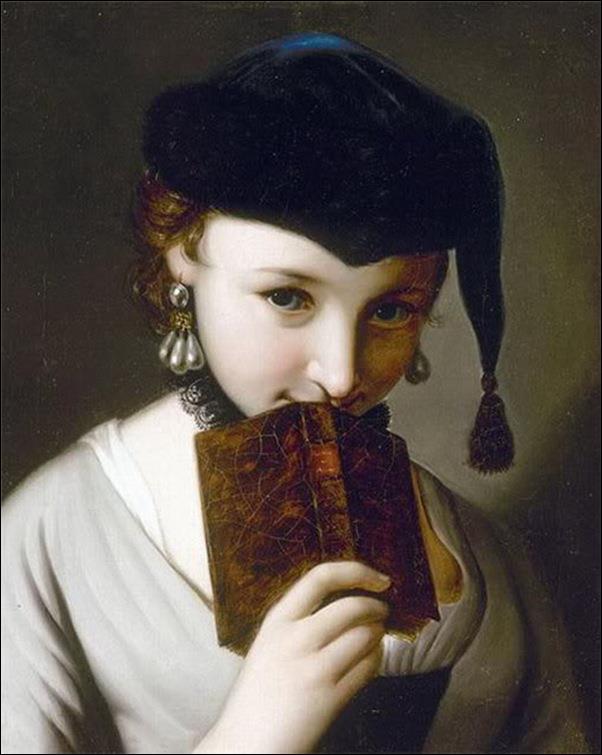 |
| Pietro Rotari, Girl with a Book via Arts and Everyday Living |
Lagniappe: The roaring wave of fear that swept through the greatest city in the world
So you understand the roaring wave of fear that swept through the greatest city in the world just as Monday was dawning--the stream of flight rising swiftly to a torrent, lashing in a foaming tumult round the railway stations, banked up into a horrible struggle about the shipping in the Thames, and hurrying by every available channel northward and eastward. By ten o'clock the police organisation, and by midday even the railway organisations, were losing coherency, losing shape and efficiency, guttering, softening, running at last in that swift liquefaction of the social body.One of the things that's hitting me this time through the book is just what a talented writer Wells was, not only in his plots but in his craft. Who among us having gotten caught up in a modern exodus from an oncoming disaster has not experienced just what he describes? Albeit without the thoughtful appreciation and imagery of the above.
H.G. Wells, The War of the Worlds
Monday, April 3, 2017

Well Said: Jesus is the "very imprint" of the Father
Healy here comments upon Hebrews 1:3 which tells us that "Christ is "the very imprint of [God's] being."
The word for "very imprint" in Greek is charakter, which refers to the impression that a stamp or seal makes on a soft surface. In the ancient world coins were made by stamping hot metal with a die on which a portrait had been engraved; the coin would bear the exact impression (charakter) of the die. The Son, then, is the exact representation of the Father. To see Jesus is to see exactly what God is like (see John 14:9; Col 1:15). In the fullest sense of the term, Jesus has the "character" of his Father.
Mary Healy, Hebrews (Catholic Commentary on Sacred Scripture)
Friday, March 31, 2017
Worth a Thousand Words: Portrait of a Woman
 |
| Portrait of a Woman (c.1520). Quentin Metsys via Books and Art |
Well Said: God speaking
The theme of God speaking will run like a thread through Hebrews. When introducing biblical quotations, instead of saying "it is written," Hebrews will invariably use phrases like "God says" or "he has promised." Scripture is not confined to the dusty pages of ancient manuscripts; it is a living and active word through which God continues to speak, addressing his people personally her and now (see 3:7, 4:12).
Mary Healy, Hebrews (Catholic Commentary on Sacred Scripture)
Thursday, March 30, 2017


_-_Google_Art_Project.jpg)


Well Said: Changed from within
Hebrews affirms that by Christ's passion those who share in him have been changed from within (10:22), radically and permanently. This means that the Christian life does not consist in acquiring a holiness we do not have, but rather in appropriating and more deeply living the holiness we have already been given (10:10). So we are invited to a relationship with God that is filled with confident hope and free from the burden of guilt and sin. Our whole life is qualified to be a priestly life, in which all our actions and sufferings are offered as "a sacrifice of praise" that is pleasing to God (13:15-16).
Mary Healy, Hebrews (Catholic Commentary on Sacred Scripture)
New Independent Bookstore for Dallas - Interabang Books
I've never forgotten Taylor Books, a full service independent bookstore chain in Dallas that predated Bookstop, Borders, and Barnes and Noble. Those big box stores killed Taylors and now that most of them are gone (with Barnes and Noble mostly selling games and other non-book items), I have longed for a decent bookstore in which to browse.
I was recently reading about several specialty independent bookstores, all of whom are quirky and none of whom cater to my quirks (mystery, science fiction, and so forth). Looking around I was thrilled to see that Interabang is supposed to open in May at Preston and Royal - run by someone who began his career at Taylor Books. Talk about coming full circle.
I can't wait!
I was recently reading about several specialty independent bookstores, all of whom are quirky and none of whom cater to my quirks (mystery, science fiction, and so forth). Looking around I was thrilled to see that Interabang is supposed to open in May at Preston and Royal - run by someone who began his career at Taylor Books. Talk about coming full circle.
I can't wait!
American the Last Best Hope: From a World at War to the Triumph of Freedom 1914-1989 by William J. Bennett
 America The Last Best Hope:
From a World at War to the Triumph of Freedom 1914-1989
by William J. Bennett
I've been reading this book very slowly, dipping in whenever current events makes the world seem chaotic and uncertain. So that's been a lot lately.
The great thing about history is that it reminds us there have always been chaotic, uncertain times and that we've endured, we've come out ok in the end. William Bennett's volumes on American history are even handed, easy to understand, and yet comprehensive. I came out understanding better those figures who I'd previously disliked, and in some cases even having a certain new respect for them. Those who I already liked were shown to me "warts and all" so I had a greater understanding of their complexity as people and leaders.
This history ends with Ronald Reagan and I was reminded that he was viewed in much the same way as Donald Trump is now. That is not to say Reagan and Trump are the same but our reactions as a people were surprisingly similar in their strength and alarm. That in itself was a good bit of context. The "olden days" are calm and easy to take only because we weren't the ones living then.
Highly recommended.
And yet we are a resilient people, caretakers of a blessed nation. It has become a commonplace that we always rise to the occasion in this country. That is still true. And we surprise ourselves, never knowing with exact certainty from whence our next leader or hero will come—good reason to respect and defend one another as Americans, as fellow countrymen dedicated to a great proposition.
Allow me a few simple illustrations. If you were sitting in a saloon in 1860, and someone told you that while he did not know who would win that year's presidential election, the next elected president after him was right then a little known leather tanner in Galena, Illinois, he would be laughed out of the saloon. But then came Ulysses S. Grant. If you were sitting at Franklin D. Roosevelt's inauguration, in 1933, and someone told you the next president was a little-known judge in Jackson County, Missouri, he would have been made to look the fool. But then came Harry S. Truman. If you were a political consultant in California in 1950 watching the bitter Senate race between Richard Nixon and Helen Gahagan Douglas (where Nixon labeled Douglas "the pink lady"), and you said that actor Ronald Reagan (who was then campaigning for Douglas) would someday be a Republican president and would crush the Soviet Union, your career would have been over.
Subscribe to:
Comments (Atom)