Stories are like spiders, with all they long legs, and stories are like spiderwebs, which man gets himself all tangled up in but which look pretty when you see them under a leaf in the morning dew, and in the elegant way that they connect to one another, each to each.
Neil Gaiman, Anansi Boys
Wednesday, April 26, 2017
Well Said: Stories and Spiders

Genesis Notes: What Abraham's Life Means to Us
GENESIS 22 & 23
Abraham's story with all the drama and events and lies and faulty humans is actually a story that shows us God's faithfulness and love. I never would have thought of it this way before going through this study but it is undeniable.
Abraham's story with all the drama and events and lies and faulty humans is actually a story that shows us God's faithfulness and love. I never would have thought of it this way before going through this study but it is undeniable.
 |
| The vision of the Lord directing Abraham to count the stars, Julius Schnorr von Carolsfeld, 1860 |
The story of Abraham's life is a story with almost limitless meaning. It includes examples of faith, prayer, and sacrifice. It contains many lessons for those who, like Abraham, live their lives by putting their faith in God. Yet perhaps the greatest significance of the story of Abraham is that it is the story of God in love with man.All quotes from Genesis, Part II: God and His Family. This series first ran in 2004 and 2005. I'm refreshing it as I go. For links to the whole study, go to the Genesis Index. For more about the resources used, go here.
From the earliest chapters of Genesis, we have traced out the evidence of God's profound love for the human creatures who bear His image and likeness. The rebellion of Adam and Eve not only did not conquer God's love, it actually became an occasion for Him to demonstrate its depth and breadth and height. For not only did God love humans when they behaved, but He even loved them when they sinned. How? He gave them promises to live by and punishments to purify them. Over and over again, God bent down to reorganize and restore the family life that was shattered in Eden. First, He promised to defeat His enemy through human beings. Then, in Genesis 12, He promised to create, from one man, a whole nation that would belong to Him; through that nation, He planned to reverse the curse of Eden into universal blessing.
The context for comprehending the significance of Abraham's story is the initiative and action of God in pursuit of humanity. His call to Abram in Genesis 12 begins a detailed, engaging account of how one ordinary human being, a creature of flesh and blood like us, is singled out by God to be transformed from sinner to saint. The story of his life is the first extended account we have of intimacy between God and man. It is a story of God's love from beginning to end.
Yes, even at the end, when God asks Abraham to give up, to put to death, that which gives his life its only true meaning, He is acting out of passionate love for him. How can that be? God knows that in losing our lives, we find them. He knew that in Eden. He knew that on Moriah. He knew it on Calvary. The source of perfect human happiness is perfect obedience to God, even if it costs us everything.
Tuesday, April 25, 2017
Well Said: The Value of Kneestem
"A lot of what you've been teaching me sometimes seems kind of useless. Like that kneestem you've got—I mean, it doesn't have anything to do with magic. It's just a weed. You said yourself it's worthless."Of course, I'm thinking of this in relation to a lot of issues that have nothing to do with the obvious application, such as our environment. It's a very Catholic way of looking at the world.
"It is worthless to us and to animals, having no value either as medicine or as food," Ingold agreed, turning the dry wisp in his mittened fingers. "But we ourselves are useless to other forms of life—except, I might point out, as sustenance to the Dark Ones. Kneestem, like you and me, exists for its own sake, and we must take that into account in all our dealings with the world that we hold in common with it.
Barbara Hambly, The Walls of Air
Books In the Pipeline
I just realized that between podcasts and my book club I've got a lot of varied reading coming up. I would say this interferes with my 2017 book goals but I tossed them out the window about a month ago.
I'd kind of forced the list this year just because I'd done a reading goals in previous years. Note to self - no need to force a reading list. The books will come to you anyway. And the reading will be both varied and wonderful.
This is my "assigned" reading for the next few months. (Title links go to my reviews.)
I'd kind of forced the list this year just because I'd done a reading goals in previous years. Note to self - no need to force a reading list. The books will come to you anyway. And the reading will be both varied and wonderful.
This is my "assigned" reading for the next few months. (Title links go to my reviews.)
- THE ROSIE PROJECT - rereading this for my Catholic women's book club. Proof that a book can be light and fun and still say something meaningful.
- THE HITCHHIKER'S GUIDE TO THE GALAXY - it's been years since I've read this one. It's Scott's selection for our next book on A Good Story is Hard to Find.
- DRACULA - rereading for SFFaudio podcast. I love this book so much. So. much.
- BURGLARS CAN'T BE CHOOSERS - also for SFFaudio. Never read it but Lawrence Block's "burglar" series is supposed to be good.
- NOSTRA AETATE (Vatican II doc: The Relation of the Church to Non-Christian Religions) - Catholic women's book club choice. The Vatican II documents are surprisingly easy reading.
- A TALE OF TWO CITIES - the book that introduced me to Dickens as an adult. This will be my next book choice for A Good Story is Hard to Find.
- THE MALTESE FALCON - the movie's good but the book is better. This one's also for SFFaudio.
Elements of Faith book club - live in Dallas? Join us!
A short interview about Seeking Jesus in Everyday Life

In this short Interview Extra, Scott sits down with Julie to discuss her new book Seeking Jesus in Everyday Life: Prayers and Reflections for Getting Closer.
Hear it at A Good Story is Hard to Find podcast.
Monday, April 24, 2017
Well Said: The Marvels of Rome and the Length of Human Memory
One of the marvels of Rome is that the traditional portraits of St. Peter and St. Paul have been preserved in the catacombs, and every artist who has painted the two Apostles owes something to this tradition. The portraits were engraved in gold leaf on the bases of the glasses or chalices which, as the Salesian Father had told me, were embedded in the plaster round the bodies. There are hundreds of these glasses to be seen in the Vatican Museum, and the type of portrait never varied. Both Apostles are shown as men of middle-age and both are bearded, but while St. Peter has a fine head of curly hair, St. Paul is almost bald. Those who have studied the portraits believe that they embody a tradition which goes back possibly to the days of Nero and to those who knew the Apostles by sight.This is lengthy but I love the vivid illustration of how few generations it takes to span a very long period of time when passing along memories.
I was reminded of a story which the late Monsignor Stapylton Barnes was fond of telling to illustrate the length of human memory. His mother, who died in 1927 at a great age, could clearly remember, as a small girl, hearing Victoria proclaimed queen in 1837. When a child she was often taken to see a very old lady who remembered the French Revolution and the execution of Marie Antoinette in 1793. This old lady had spent her childhood in Philadelphia and had known Benjamin Franklin, who was born in 1706. Thus it would have been possible for Franklin to have described some event of his early childhood--perhaps the great fire in Boston of 1711--to the little girl, who could have told it in her ld age to another little girl, Mrs. Barnes, who could have passed on the story to her son in the twentieth century.
In his book The Martyrdom of St. Peter and St. Paul, Monsignor Barnes refers to the great sweep of human events commanded by such lives, and says 'it would have been possible for a Christian child in rome in the year 67 to have been actually present at St. Peter's martyrdom and to have seen him nailed to the cross, and still to have been alive and able to tell the tale in 150. And the child to whom he told it then could have told the story again in his extreme old age to one who lived to see the peace of the Church in 312 under Constantine.'
H. V. Morton, A Traveller in Rome
Friday, April 21, 2017
Why You Should Go to Church (Even If You're Not Sure of Your Beliefs)
I'm not sure tho compelling this would've been before I became a believer. Now, though, having gone to church for a couple of decades, I can attest to the truth of this piece from The Art of Manliness. So I can assure you they're on point here.
These are just a few of the topics they touch upon:
These are just a few of the topics they touch upon:
- A Chance to Remember/Reorient/Reflect/Re-center
- Builds Discipline
- Rare Chance for Communal Singing
- Breaches Your Echo Chamber and Connects You With People From Different Walks of Life
- Contributes to Greater Free-Thinking and Your Diversity of Ideas
- Ample Opportunities (and More Motivation) for Service
Worth a Thousand Words: Noli Me Tangere
 |
| Noli Me Tangere, Lavinia Fontana, 1581 via Elizabeth Lev |
Fontana’s version emphasized accuracy: Mary Magdalene mistakes Jesus for a gardener, and so she paints him in a broad-brimmed hat holding a shovel. Yet once she has emphasized the literal sense, Lavinia also evokes a beautiful scene. The atmosphere is permeated with warm golden light as a new age is dawning. A little flashback scene in the distance shows the women who have left the city arriving at the tomb where an angel tells them Christ is gone. Mary’s pose in the further scene shows her with the slumped shoulders of dejection, but in the foreground her face becomes radiant with hope. Christ puts out his hand, ostensibly to tell her not to touch Him, but also in a gesture of affectionate blessing. Mary’s gaze is directed toward the wound on his hand made visible for her, but she seems to look beyond it, trying to gaze at his face under the shadowy brim. Proof of his resurrection is not her primary concern as she sinks to her usual place by his feet. The light, setting, and positions evoke a love story, a compelling language that the Counter-Reformation will employ in its time.There's more where that came from. I love being shown beneath the surface of paintings for deeper meaning. Elizabeth Lev's piece discusses the goals of Counter-Reformation art and opens another piece up for our edification. Be sure to check it out.
Genesis Notes: Jews, Christians, Muslims ... and Abraham
We know that all three religions have a basic connection through Abraham. A succinct summary in The Complete Bible Handbook shows where they agree and disagree about Abraham's example for us.
 |
| Abraham Serving the Three Angels by Rembrandt |
A common reverence for Abraham as a model of true human response to God and as ancestor of subsequent believers is one of the prime links between Jews, Christians, and Muslims.This series first ran in 2004 and 2005. I'm refreshing it as I go. For links to the whole study, go to the Genesis Index. For more about the resources used, go here.
Abraham's responsiveness to God is summed up in his epithet as "the friend of God." This title is first given in Hebrew scripture (Isa 41:8; 2 Chr. 20:7); it is taken up in the New Testament (Jas. 2:23); and in Islam, Abraham (Ibrahim) is known simply as "the friend" (Al Kahlil).
Each religion gives content to Abraham's friendship with God in terms of its own characteristic emphases, on the supposition that Abraham is best understood in terms of that to which he helped give rise. Thus for Jews (appealing to Gen. 26:5 as well as to more general considerations), Abraham is an example of one who was obedient to God's commandments, or Torah, even before Torah was given to Israel at Sinai. For Christians, following Paul's exposition (Rom. 4), Abraham is a model of one who has faith (pistis) in God. For Muslims, Abraham demonstrates islam, unconditional submission to the will of God, as in his willingness to sacrifice his son. Though Jews, Christians, and Muslims differ about the true human response to God as exemplified by Abraham, they agree that he provides a model of how human life should be lived.
Thursday, April 20, 2017
"Egyptian Christians are made of steel!"
Watch the news anchor's reaction to the forgiveness expressed by the widow of the gatekeeper who prevented a suicide bomber from entering an Alexandria church yard on Palm Sunday, thereby saving countless lives.
It is truly moving. This is why the blood of the martyrs [and the forgiveness of the faithful] is the seed of the church.
It is truly moving. This is why the blood of the martyrs [and the forgiveness of the faithful] is the seed of the church.
"Egyptian Christians are made of steel! These people have so much forgiveness!"Via The Deacon's Bench.

A "Fast Take" Interview on Aleteia

Elizabeth Scalia graciously offered me a "fast take" interview on Aleteia about Seeking Jesus in Everyday Life. Aleteia is a worldwide Catholic network with all sorts of fascinating articles.
Among other things, find out what person I identify with most in the book, what writing it taught me, and ... perhaps most importantly of all ... what the ideal beverage is that you should have in hand while reading your copy!
Challenging Opinions Interview: Sticking Up for the Faith

William has relaunched his podcast and I feel honored that my 2016 interview was one he carried over. So I'm reposting this in case you're interested.
===========
Always be ready to give an explanation to anyone who asks you for a reason for your hope.William Campbell invited me to chat with him at his podcast, Challenging Opinions. The podcast exists to "test all ideas, left and right, liberal and conservative, progressive and libertarian."
I Peter 3:15
That idea in itself is pretty challenging but when I listened to sample episodes William was a fair and impartial interviewer, which is a rare quality these days.
I thought we were going to discuss my post Obedience: The Dirtiest Word in America so I was prepared to talk about being an American Catholic during the political season. I think that post was only what drew me to William's attention. We never actually discussed that topic, but wound up covering everything from faith in God to Catholic misdeeds to the future of the Church.
I was going completely off the cuff, which I think shows sometimes, but that in itself was fair. Shouldn't we be able to shed some light on faith and the Church when we're asked about it? It was a like a particularly invigorating workout and I really enjoyed talking with William.
Listen at Challenging Opinions or iTunes.
===========
The Reason for My Hope and Why I'm a Happy Catholic
This didn't come up in our fast-paced conversation, but I wanted to share it anyway. This quote perfectly echoes my feeling.
I have looked for happiness everywhere: in the elegant life of the salons, in the deafening noise of balls and parties, in accumulating money, in the excitement of gambling, in artistic glory, in friendship with famous people, in the pleasure of the senses. Now I have found happiness, I have an overflowing heart and I want to share it with you. … You say, “But I don’t believe in Jesus Christ.” I say to you, “Neither did I and that is why I was unhappy.All my life I searched for Truth, wondering if there were such a thing. And I found it in Jesus.
Hermann Cohen, letter to a friend
===========
NOTE
On the documents I hadn't heard of, allegedly Vatican blueprints for methodically concealing sex crimes, the news articles had responses from both the Church and other experts which point out that they aren't a "smoking gun" and that "it's a church law that deals only with religious crimes and sins. And that the secrecy is meant to protect the faithful from scandal." All this proves is that there are two sides to any issue and that we can't make quick assumptions without very careful study.
A friend of mine is a canon lawyer. I've often heard him speak about how easy it is to misunderstand a law by only a looking at it through one frame, especially when it has been misused so that is the only lens we are using. Often these laws reflect long ago history and problems which were very different than the current issues.
Can such documents be misused? Absolutely. Was there a terrible sexual misconduct and a mistaken idea of protecting the Church implemented by moving predators around? No doubt. These are the sins we, the faithful, mourn and must keep from ever recurring.
But, it is equally a mistake to read our current mindset backwards into documents whose roots lie deep in the past. Jumping to conclusions about intention is as much of a mistake as ignoring victims to protect an institution.
Which is all a way of saying ... it's complicated.
Wednesday, April 19, 2017
Seeking Jesus in Everyday Life: "Are you ready to hit the reset button on your practice of the faith? Here it is."

A friend had a relative who’d just turned to God for the first time in the midst of a serious end-of-life crisis, but now what? How do you help someone who’s ignored God for a lifetime to even know how to pray? I recommended this book.Jen Fitz has a lovely review of Seeking Jesus in Everyday Life. Please do read the whole thing at the link.
Starting with “Beginning to Pray” as the zero point, Julie walks the reader from I’ve-got-nothing all the way into the depths of the Christian life.
Tuesday, April 18, 2017

Monday, April 17, 2017
Worth a Thousand Words: The Fantasy World
 |
| Column header from Stirring Science Stories, Feb. 1941 via SFFaudio |
Thursday, April 13, 2017
Coptic Priest: "To those who kill us. Thank you."
There is much more and it is worth reading and reflection, especially on Holy Thursday.A MESSAGE TO THOSE WHO KILL USFr. Boules George, St. Mark, Cleopatra (Cairo, Egypt)
What will we say to them?
THANK YOU
The first thing we will say is “Thank you very, very much,” and you won’t believe us when we say it.
You know why we thank you? I’ll tell you. You won’t get it, but please believe us.
You gave us to die the same death as Christ–and this is the biggest honor we could have. Christ was crucified–and this is our faith. He died and was slaughtered–and this is our faith. You gave us, and you gave them to die.
[...]
WE LOVE YOU
The second part of the message we want to send to you is that we love you. And this, unfortunately, you won’t understand at all. Maybe you won’t believe us when we say we’re grateful. But this–you won’t even understand. Why won’t you understand it? Because this too is a teaching of our Christ. I want to explain to you about our Christ. I want to tell you about how wonderful He is.
Via Eve Tushnet.
As an additional note on martyrdom, the cause for beatification of Fr. Jacques Hamel, priest and martyr, has been officially opened.
Wednesday, April 12, 2017
What I'm Reading: A Civil Contract by Georgette Heyer
When life gets serious, my reading gets light. As frequenters of these pages already know, for me that often means Georgette Heyer, the queen of the Regency romance novels. I've written about Heyer's novels in general so if you are rolling your eyes over romance novels, please do read it for a bit more explanation.
I've been struggling much more than usual this week over my Lenten penance. So many times I've stepped to the brink and then “So, could you not watch with me one hour?" comes to mind. And I turn away.
Between that and the Triduum beginning tomorrow, I think you could say I'm in a serious mood. Time for Heyer! Though, to be fair, this is a bit more serious Heyer than many.
 A Civil Contract
by Georgette Heyer
Georgette Heyer wrote two types of romance novels. One type was lighter, often verging on farce or containing large doses of adventure, such as Faro's Daughter or The Talisman Ring. The other type was more serious such as These Old Shades or this book, A Civil Contract.
We hear a lot in romances about couples who married for money but they tend to be couples on the periphery of the main action. In this book, Heyer took the bold action of making a distinctly unromantic match the main story. Adam Deveril must marry money or lose the family estate. Jenny Chawleigh's father is vulgar but rich and wants to boost his daughter into society. Complicating matters is the fact that Adam has been in love for some time with their one mutual acquaintance, Jenny's friend Julia who is everything that Jenny is not — cultured, sensitive, and beautiful. Jenny is painfully shy, direct, and plain.
Overall, this is a look at marriage and how one makes one's life work when our plans for the future are torn away from us. I remember when I was a college student, first discovering Heyer, this was one of my least favorite books. Now, with much time behind me and a 33-year marriage, it is one of my favorites.
I've been struggling much more than usual this week over my Lenten penance. So many times I've stepped to the brink and then “So, could you not watch with me one hour?" comes to mind. And I turn away.
Between that and the Triduum beginning tomorrow, I think you could say I'm in a serious mood. Time for Heyer! Though, to be fair, this is a bit more serious Heyer than many.
by Georgette Heyer
Georgette Heyer wrote two types of romance novels. One type was lighter, often verging on farce or containing large doses of adventure, such as Faro's Daughter or The Talisman Ring. The other type was more serious such as These Old Shades or this book, A Civil Contract.
We hear a lot in romances about couples who married for money but they tend to be couples on the periphery of the main action. In this book, Heyer took the bold action of making a distinctly unromantic match the main story. Adam Deveril must marry money or lose the family estate. Jenny Chawleigh's father is vulgar but rich and wants to boost his daughter into society. Complicating matters is the fact that Adam has been in love for some time with their one mutual acquaintance, Jenny's friend Julia who is everything that Jenny is not — cultured, sensitive, and beautiful. Jenny is painfully shy, direct, and plain.
Overall, this is a look at marriage and how one makes one's life work when our plans for the future are torn away from us. I remember when I was a college student, first discovering Heyer, this was one of my least favorite books. Now, with much time behind me and a 33-year marriage, it is one of my favorites.
Tuesday, April 11, 2017
Will Duquette's review of Seeking Jesus in Everyday Life
I'm here to tell you that there isn't any deadwood. If you're interested in learning to pray, or to pray "better", which is to say if you want to draw closer to Jesus Christ, this is an ideal book to spend time with.Will Duquette's very nice review - go read the whole thing! Thanks Will!
Monday, April 10, 2017
The Curt Jester's Review of Seeking Jesus in Everyday Life
She has a Chestertonian ability to see things afresh and to illustrate that freshness to you. There is gratitude and wonder in her reflections that inspire me to want to imitate that viewpoint more consistently.Jeff saw something in my book that I certainly wasn't aware of ... but am highly complimented to read in his review. I was especially pleased when Jeff told me he was using my book as intended, as a daily devotional. That makes his thoughtful remarks even more meaningful to me. Thank you Jeff!
Sunday, April 9, 2017
Praying for our Egyptian brothers and sisters
These Palm Sunday church bombings hit me hard. It's hard not to become inured to a lot of the violence that is epidemic these days. I can deplore it, and do, but not feel it.
Maybe it's because we went to Palm Sunday mass yesterday evening, beginning the holiest week of the year. I felt that ... and when I read about these attacks on these Christians it was as if my own family had been attacked. As indeed it has. We are all one body in Christ.
Let us pray for these victims, who are hated only because they follow our Lord Jesus. Let us pray for the attackers, that their hard hearts may soften and their blind eyes will be opened.
May God have mercy upon us all.
Maybe it's because we went to Palm Sunday mass yesterday evening, beginning the holiest week of the year. I felt that ... and when I read about these attacks on these Christians it was as if my own family had been attacked. As indeed it has. We are all one body in Christ.
Let us pray for these victims, who are hated only because they follow our Lord Jesus. Let us pray for the attackers, that their hard hearts may soften and their blind eyes will be opened.
May God have mercy upon us all.
Thursday, April 6, 2017
Seeking Jesus in Everyday Life - Now Available on Amazon!

Order it here!
This book is the fruit of my own personal search to grow closer to Jesus. It is perfect for launching into the Easter season or as a gift.Don't miss the book that made Elizabeth Scalia say, "I love this book. It’s like taking your Happy Catholic book and making all those quotes spiritually useful!"
To see an excerpt go to Niggle Publishing.
I'll be running samples here in the days to come.
What Lenten Penance Has Shown Me
When The Anchoress was failing at her Lenten penance, she shifted gears ... and found herself right back in the same place.
It's funny how it works when you give stuff up. Suddenly you understand just what it means in your life. I gave up listening to spoken word audio (podcasts, audiobooks) and discovered that they soothed me through my day. Without them I was twitchy, irritable, and I began eating more. Snacks, desserts, seconds. Hah! Welcome to panacea #2.
That realization has been hard but good. I am still fighting the good fight, now against both food and audio. I now know more about myself - things I wouldn't have without the fast. And I have been turning to Jesus more and more, asking for the grace I need. Leaning on him has been a great, good result of my internal struggle.
Getting my head in the game for the end of Lent, I've been reading through various meditations on the Way of the Cross at the Vatican website. Cardinal Ratzinger in 2005, Pope John Paul II in 2003. Great stuff is there. And it gets me back to the basics.
So when I read this reflection on when Jesus is nailed to the cross, it stuck with me in my internal struggles.
Slightly chagrined, I made an adjustment back to the most basic of basics: fasting. Without thinking much about it, I said, “Okay, no snacks. I won’t eat between meals.”Read it all here at Alateia.
If you had asked me before this how much snacking I did, I would tell you, “Nuthin’ much . . . I can’t understand why I am having so much trouble losing weight.” But since beginning this fast, I’ve learned how often I would, out of boredom or tension, not hunger, open the fridge and look inside or thoughtlessly grab a cookie. Confronting the difficulty of holding to this simple fast, I have been forced to think about motivation, and anxiety; tension vs. comfort, what it means to self-medicate, and why I feel the need to do so.
And that has caused me to think about what I am “treating” with the eating. The “eat” comes down to the same thing, actually, as my reluctance to “meet-and-greet”
It's funny how it works when you give stuff up. Suddenly you understand just what it means in your life. I gave up listening to spoken word audio (podcasts, audiobooks) and discovered that they soothed me through my day. Without them I was twitchy, irritable, and I began eating more. Snacks, desserts, seconds. Hah! Welcome to panacea #2.
That realization has been hard but good. I am still fighting the good fight, now against both food and audio. I now know more about myself - things I wouldn't have without the fast. And I have been turning to Jesus more and more, asking for the grace I need. Leaning on him has been a great, good result of my internal struggle.
Getting my head in the game for the end of Lent, I've been reading through various meditations on the Way of the Cross at the Vatican website. Cardinal Ratzinger in 2005, Pope John Paul II in 2003. Great stuff is there. And it gets me back to the basics.
So when I read this reflection on when Jesus is nailed to the cross, it stuck with me in my internal struggles.
Let us halt before this image of pain, before the suffering Son of God. Let us look upon him at times of presumptuousness and pleasure, in order to learn to respect limits and to see the superficiality of all merely material goods. Let us look upon him at times of trial and tribulation, and realize that it is then that we are closest to God. Let us try to see his face in the people we might look down upon. [W]e stand before the condemned Lord, who did not use his power to come down from the Cross, but endured its suffering to the end ...I begin struggling and then (with God's grace) I remember "may I never flee ... may I discover true freedom." And my struggles ease.
PRAYER
Lord Jesus Christ, you let yourself be nailed to the Cross, accepting the terrible cruelty of this suffering, the destruction of your body and your dignity. You allowed yourself to be nailed fast; you did not try to escape or to lessen your suffering. May we never flee from what we are called to do. Help us to remain faithful to you. Help us to unmask the false freedom which would distance us from you. Help us to accept your “binding” freedom, and, “bound” fast to you, to discover true freedom.
Wednesday, April 5, 2017
Genesis Notes: Burial and Bargaining
GENESIS 23
When Sarah dies we see Abraham arranging the funeral by buying her final resting place. This takes us back to customs of an earlier age and different culture as the Life Application Study Bible points out.
When Sarah dies we see Abraham arranging the funeral by buying her final resting place. This takes us back to customs of an earlier age and different culture as the Life Application Study Bible points out.
 |
| Burial of Sarah (engraving by Gustave Doré from the 1865 La Sainte Bible) |
BURIALAll quoted material is from Life Application Study Bible." This series first ran in 2004 and 2005. I'm refreshing it as I go. For links to the whole study, go to the Genesis Index. For more about the resources used, go here.
In Abraham's day, death and burial were steeped in ritual and traditions. Failing to honor a dead person demonstrated the greatest possible lack of respect. An improper burial was the equivalent of a curse. Mourning was an essential part of the death ritual. Friends and relatives let out loud cries for the whole neighborhood to hear. Because there were no funeral homes or undertakers, these same friends and relatives helped prepare the body for burial, which usually took place on the same day because of the warm climate.
BARGAINING
The polite interchange between Abraham and Ephron was typical of bargaining at that time. Ephron graciously offered to give his land to Abraham at no charge; Abraham insisted on paying for it; Ephron politely mentioned the price but said, in effect, that it wasn't important; Abraham paid the 400 shekels of silver. Both men knew what was going on as they went through the bargaining process. If Abraham had accepted the land as a gift when it was offered, he would have insulted Ephron, who then would have rescinded his offer. Many Middle Eastern shopkeepers still follow this ritual with customers.
Four hundred shekels of silver was a high price for the piece of property Abraham bought. The Hittites weren't thrilled about foreigners buying their property, so Abraham had little bargaining leverage ... The custom of the day was to ask double the fair market value of the land, fully expecting the buyer to offer half the stated price.
Tuesday, April 4, 2017
Worth a Thousand Words: Girl with a Book
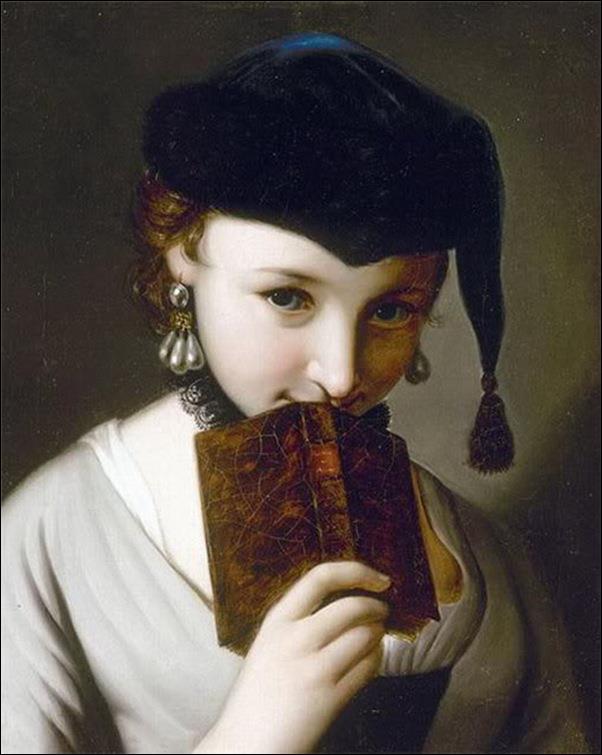 |
| Pietro Rotari, Girl with a Book via Arts and Everyday Living |
Lagniappe: The roaring wave of fear that swept through the greatest city in the world
So you understand the roaring wave of fear that swept through the greatest city in the world just as Monday was dawning--the stream of flight rising swiftly to a torrent, lashing in a foaming tumult round the railway stations, banked up into a horrible struggle about the shipping in the Thames, and hurrying by every available channel northward and eastward. By ten o'clock the police organisation, and by midday even the railway organisations, were losing coherency, losing shape and efficiency, guttering, softening, running at last in that swift liquefaction of the social body.One of the things that's hitting me this time through the book is just what a talented writer Wells was, not only in his plots but in his craft. Who among us having gotten caught up in a modern exodus from an oncoming disaster has not experienced just what he describes? Albeit without the thoughtful appreciation and imagery of the above.
H.G. Wells, The War of the Worlds
Monday, April 3, 2017

Well Said: Jesus is the "very imprint" of the Father
Healy here comments upon Hebrews 1:3 which tells us that "Christ is "the very imprint of [God's] being."
The word for "very imprint" in Greek is charakter, which refers to the impression that a stamp or seal makes on a soft surface. In the ancient world coins were made by stamping hot metal with a die on which a portrait had been engraved; the coin would bear the exact impression (charakter) of the die. The Son, then, is the exact representation of the Father. To see Jesus is to see exactly what God is like (see John 14:9; Col 1:15). In the fullest sense of the term, Jesus has the "character" of his Father.
Mary Healy, Hebrews (Catholic Commentary on Sacred Scripture)
Friday, March 31, 2017
Worth a Thousand Words: Portrait of a Woman
 |
| Portrait of a Woman (c.1520). Quentin Metsys via Books and Art |
Well Said: God speaking
The theme of God speaking will run like a thread through Hebrews. When introducing biblical quotations, instead of saying "it is written," Hebrews will invariably use phrases like "God says" or "he has promised." Scripture is not confined to the dusty pages of ancient manuscripts; it is a living and active word through which God continues to speak, addressing his people personally her and now (see 3:7, 4:12).
Mary Healy, Hebrews (Catholic Commentary on Sacred Scripture)
Thursday, March 30, 2017

Well Said: Changed from within
Hebrews affirms that by Christ's passion those who share in him have been changed from within (10:22), radically and permanently. This means that the Christian life does not consist in acquiring a holiness we do not have, but rather in appropriating and more deeply living the holiness we have already been given (10:10). So we are invited to a relationship with God that is filled with confident hope and free from the burden of guilt and sin. Our whole life is qualified to be a priestly life, in which all our actions and sufferings are offered as "a sacrifice of praise" that is pleasing to God (13:15-16).
Mary Healy, Hebrews (Catholic Commentary on Sacred Scripture)
New Independent Bookstore for Dallas - Interabang Books
I've never forgotten Taylor Books, a full service independent bookstore chain in Dallas that predated Bookstop, Borders, and Barnes and Noble. Those big box stores killed Taylors and now that most of them are gone (with Barnes and Noble mostly selling games and other non-book items), I have longed for a decent bookstore in which to browse.
I was recently reading about several specialty independent bookstores, all of whom are quirky and none of whom cater to my quirks (mystery, science fiction, and so forth). Looking around I was thrilled to see that Interabang is supposed to open in May at Preston and Royal - run by someone who began his career at Taylor Books. Talk about coming full circle.
I can't wait!
I was recently reading about several specialty independent bookstores, all of whom are quirky and none of whom cater to my quirks (mystery, science fiction, and so forth). Looking around I was thrilled to see that Interabang is supposed to open in May at Preston and Royal - run by someone who began his career at Taylor Books. Talk about coming full circle.
I can't wait!
American the Last Best Hope: From a World at War to the Triumph of Freedom 1914-1989 by William J. Bennett
 America The Last Best Hope:
From a World at War to the Triumph of Freedom 1914-1989
by William J. Bennett
I've been reading this book very slowly, dipping in whenever current events makes the world seem chaotic and uncertain. So that's been a lot lately.
The great thing about history is that it reminds us there have always been chaotic, uncertain times and that we've endured, we've come out ok in the end. William Bennett's volumes on American history are even handed, easy to understand, and yet comprehensive. I came out understanding better those figures who I'd previously disliked, and in some cases even having a certain new respect for them. Those who I already liked were shown to me "warts and all" so I had a greater understanding of their complexity as people and leaders.
This history ends with Ronald Reagan and I was reminded that he was viewed in much the same way as Donald Trump is now. That is not to say Reagan and Trump are the same but our reactions as a people were surprisingly similar in their strength and alarm. That in itself was a good bit of context. The "olden days" are calm and easy to take only because we weren't the ones living then.
Highly recommended.
And yet we are a resilient people, caretakers of a blessed nation. It has become a commonplace that we always rise to the occasion in this country. That is still true. And we surprise ourselves, never knowing with exact certainty from whence our next leader or hero will come—good reason to respect and defend one another as Americans, as fellow countrymen dedicated to a great proposition.
Allow me a few simple illustrations. If you were sitting in a saloon in 1860, and someone told you that while he did not know who would win that year's presidential election, the next elected president after him was right then a little known leather tanner in Galena, Illinois, he would be laughed out of the saloon. But then came Ulysses S. Grant. If you were sitting at Franklin D. Roosevelt's inauguration, in 1933, and someone told you the next president was a little-known judge in Jackson County, Missouri, he would have been made to look the fool. But then came Harry S. Truman. If you were a political consultant in California in 1950 watching the bitter Senate race between Richard Nixon and Helen Gahagan Douglas (where Nixon labeled Douglas "the pink lady"), and you said that actor Ronald Reagan (who was then campaigning for Douglas) would someday be a Republican president and would crush the Soviet Union, your career would have been over.
Wednesday, March 29, 2017
Genesis Notes: The Test
GENESIS 22
Now we come to the most famous incident in Abraham's story. God tells him to take his beloved only son, Isaac, and sacrifice him. No one ever really understands this until they become a parent but it is enough to strike horror into anyone's heart if they stop and visualize the scene. What really brought home the obedience required by all involved was when I realized that in order to carry the wood for his father, Isaac also knew exactly what was going on when he was told to lie on the altar. What a test of faith for everyone.
This whole scene was recently put into clearer context for me. At the time, child sacrifice was nothing new. Many "gods" demanded it and there is ample archaeological evidence for the fact that thousands of children were sacrificed, usually when they were at least 3 or 4 years old so that the gift was more valuable — they'd made it past infancy. This whole story adds a bit of perspective to Abraham and Isaac's seeming calm. It doesn't mean that they weren't feeling the horror, but it was an understandable demand.
The unbelievable part for them — the amazing blessing — was when God used it to show exactly who He was. How amazing and new this would have seemed to Abraham and Isaac. He is not a God who demands that sacrifice of us. He himself will provide the sacrifice, both of the ram and, later, of his own son.
An interesting bit of factual information about the place where Abraham offered Isaac.
Abraham's test brings up the question that we frequently ask and seem to find no answer for ... why are we tested at all?
Now we come to the most famous incident in Abraham's story. God tells him to take his beloved only son, Isaac, and sacrifice him. No one ever really understands this until they become a parent but it is enough to strike horror into anyone's heart if they stop and visualize the scene. What really brought home the obedience required by all involved was when I realized that in order to carry the wood for his father, Isaac also knew exactly what was going on when he was told to lie on the altar. What a test of faith for everyone.
This whole scene was recently put into clearer context for me. At the time, child sacrifice was nothing new. Many "gods" demanded it and there is ample archaeological evidence for the fact that thousands of children were sacrificed, usually when they were at least 3 or 4 years old so that the gift was more valuable — they'd made it past infancy. This whole story adds a bit of perspective to Abraham and Isaac's seeming calm. It doesn't mean that they weren't feeling the horror, but it was an understandable demand.
The unbelievable part for them — the amazing blessing — was when God used it to show exactly who He was. How amazing and new this would have seemed to Abraham and Isaac. He is not a God who demands that sacrifice of us. He himself will provide the sacrifice, both of the ram and, later, of his own son.
 |
| Abraham and Isaac, Rembrandt, 1634 |
An interesting bit of factual information about the place where Abraham offered Isaac.
[Note: " Mount Moriah is the place where Solomon (king of Israel in about 950 B.C.) set about building the house of the Lord, the temple that contained the Holy of Holies. Mount Moriah wasn't out in a remote desert; it was located where the city of Salem was situated in Abraham's day, which later became known as Jerusalem (see Ps. 76:1-3). Why the name change? An old rabbinic tradition attributes it to Abraham, based on what he said after sacrificing the ram: 'Abraham called the name of that place, 'The Lord will provide'; as it is said to this day, 'On the mount of the Lord it shall be provided (Gn 22:14). The Hebrew word for 'provide' is jira, which was then prefixed to Salem, thus making Jeru-salem." (A Father Who Keeps His Promises, by Scott Hahn; Ann Abor, MI: Servant Publications, 1998; p. 108)]
Abraham's test brings up the question that we frequently ask and seem to find no answer for ... why are we tested at all?
The test that God gives Abraham is so severe that it presumes an advanced level of knowledge and experience of Him. Compare it to the relatively simple test that God first put Abraham through, back in Gen. 12:1-4. There it was simply, "Pack up and go." Here, at least thirty years later, the test is staggeringly difficult. It builds on everything that has gone before in Abraham's life. For Abraham to endure the test, he will have to act on all that he knows about God, and he will have to be willing to mortify even the smallest weaknesses and imperfections yet remaining in his character.All quotes from Genesis, Part II: God and His Family. This series first ran in 2004 and 2005. I'm refreshing it as I go. For links to the whole study, go to the Genesis Index. For more about the resources used, go here.
This is what we call "purification." It is the final step in Abraham's life that establishes him as the Father of faith, both for Jews and Gentiles (Rom. 4:11-12). His obedience burned away the dross of even relatively minor imperfections. Interestingly, the test of Abraham gives us a dramatic demonstration of why God tests men in the first place. Men must freely choose to lay down their own wills in order to serve God. When they do this, they are conformed to the likeness of God. They participate in self-donation, which is the essence of the life of the Blessed Trinity. Abraham not only obeys God, but he becomes a living example of the character of God; he is a human being who reflects both the image and likeness of God. As the Catechism says, "As a final stage in the purification of his faith, Abraham, 'who had received the promises,' is asked to sacrifice the son God had given him...And so the father of believers is conformed to the likeness of the Father who will not spare his own Son, but will deliver him up for us all." (2572)
Tuesday, March 28, 2017
Lagnappe: Cup of Joe
[Secretary of the Navy Joesphus] Daniels's only enduring contribution to the U.S. Navy was to abolish the rum ration in favor of free coffee. FDR supported this reform. To this day, navy chief petty officers call their coffee "a cup of Joe" for Josephus.I had no idea. Now I'm going to enjoy that using that phrase even more. And I use it a lot.
William J. Bennett, America: The Last Best Hope, vol. II
I Join Jenny on the Reading Envy podcast to discuss: Slowing Down and Rereading

I join Jenny Colvin at the Reading Envy pub, where we talk about rereading, slowing down to appreciate an author's craft, and the best spy adventure the Vatican has ever seen! We also talk about good books we've read lately.
Check it out.
Monday, March 27, 2017

Friday, March 24, 2017

Lagniappe: A highly professional cat
Hamoudi explains soothingly that all will soon be well. The holes in the bedroom are being stopped up with plaster. More whitewash will be applied. Moreover, a cat is coming; it has been loaned out. It is a super-cat—a highly professional cat. ...
Our cat arrives at dinner-time. I shall never forget that at! It is, as Hamoudi has announced, a highly professional cat. It knows the job for which it has been engaged, and proceeds to get on with it in a truly specialized manner.
Whilst we dine, it crouches in ambush behind a packing case. When we talk, or move, or make too much noise, it gives us an impatient look.
"I must request of you," the look says, "to be quiet. How can I get on with the job without co-operation?"
So fierce is the cat's expression that we obey at once, speak in whispers, and eat with as little clinking of plates and glasses as possible.
Five times during the meal a mouse emerges and runs across the floor, and five times our cat springs. The sequel is immediate. There is no Western dallying, no playing with the victim. The cat simply bites off the mouse's head, crunches it up, and proceeds to the rest of the body! It is rather horrible and completely businesslike.
The cat stays with us five days. After those five days no mice appear. The cat then leaves us, and th emice never come back. I have never known before or since such a professional cat. It had no interest in us, it never demanded milk or a share of our food. It was cold, scientific, and impersonal. A very accomplished cat!
Agatha Christie, Come Tell Me How You Live
My New Book — Seeking Jesus in Everyday Life
COMING IN EARLY APRIL!

Seeking Jesus in Everyday Life
Prayers and Reflections for Getting Closer
This book is for the beginner and for those beginning again —
to bring us closer to Jesus, which is every Christian’s greatest desire.
to bring us closer to Jesus, which is every Christian’s greatest desire.
Each page gently leads the reader to open up and encounter Christ in their own way —
using scripture and inspirational quotes, reflection, brief commentary, and prayer.
using scripture and inspirational quotes, reflection, brief commentary, and prayer.
Foster a daily habit of prayer and reflection that will continue
long after you come to the end of this book.
long after you come to the end of this book.
Advance Praise
I’m getting a copy for every member of my RCIA class.
— William H. Duquette —
If you want to be a happy Catholic, you need to encounter Jesus.
And if you want to encounter Jesus, read this book.
And if you want to encounter Jesus, read this book.
— Brandon Vogt —
This book is a joyful pilgrimage to the Father,
made with the most amazing companions, from Ambrose of Milan
to Marshall McLuhan. Highly recommended.
made with the most amazing companions, from Ambrose of Milan
to Marshall McLuhan. Highly recommended.
— Mike Aquilina —
Thursday, March 23, 2017
Lagniappe: "A little extra money is always welcome"
Soundings must be made at all three mounds. We make a start with Tell Mozan. There is a village there, and with Hamoudi as ambassador we try and obtain workmen. The men are doubtful and suspicious.
"We do not need money," they say. "It has been a good harvest."
For this is a simple, and, I think, consequently a happy part of the world. Food is the only consideration. If the harvest is good, you are rich. For the rest of the year there is leisure and plenty, until the time comes to plough and sow once more.
"A little extra money," says Hamoudi, like the serpent of Eden, "is always welcome."
They answer simply: "But what can we buy with it? We have enough food until the harvest comes again."
And here, alas! the eternal Eve plays her part. Astute Hamoudi baits his hook. They can buy ornaments for their wives.
The wives nod their heads. This digging, they say, is a good thing!
Reluctantly the men consider the idea. ...
Agatha Christie, Come Tell Me How You Live

Wednesday, March 22, 2017
Well Said: There is no entering in ...
The next morning we reach the Cilician Gates, and look out over one of the most beautiful views I know. It is like standing on the rim of the world and looking down on the promised land, and one feels much as Moses must have felt. For here, too, there is no entering in. ... The soft, hazy dark blue loveliness is a land one will never reach; the actual towns and villages when one gets there will be only the ordinary everyday world—not this enchanted beauty that beckons you down. ...There is a lot of wisdom in that short observation. It's a lesson I always need to remember to apply to my own life. From far away, plans, dreams, desires, always look perfect. But it is close up, in the nitty gritty, where we live.
Agatha Christie, Come Tell Me How You Live
Tuesday, March 21, 2017
Genesis Notes: Hagar's Resume
I never thought of Hagar as a perpetual avoider, a run away, but there you go. And yet she also was thrust into a situation which most of us would find challenging, to say the least, when Sarah gave her to Abraham as a surrogate. We might also get in the habit of running away under those circumstances.
 |
| Matthias Stom, Sarah Leading Hagar to Abraham |
Escape of some kind is usually the most tempting solution to our problems. In fact, it can become a habit. Hagar was a person who used that approach. When the going got tough, she usually got going -- in the other direction.All quotes from Life Application Study Bible. This series first ran in 2004 and 2005. I'm refreshing it as I go. For links to the whole study, go to the Genesis Index. For more about the resources used, go here.
However, it is worthwhile to note that the biggest challenges Hagar faced were brought on by other people's choices.
Strengths and accomplishments:
Weaknesses and mistakes:
- Mother of Abraham's first child, Ishmael, who became the founder of the Arab nations
Lessons from her life:
- When faced with problems, she tended to run away
- Her pregnancy brought out strong feelings of pride and arrogance
Vital statistics:
- God is faithful to his plan and promises, even when humans complicate the process
- God shows himself as one who knows us and wants to be known by us
- The New Testament uses Hagar as a symbol of those who would pursue favor with God by their own efforts, rather than by trusting in his mercy and forgiveness
Key verse:
- Where: Canaan and Egypt
- Occupation: Servant, mother
- Relatives: Son - Ishmael
"Then the angel of the Lord told her, 'Go back to your mistress and submit to her.'" (Genesis 16:9)
Hagar's story is told in Genesis 16-21. She also is mentioned in Galatians 4:24, 25.
Monday, March 20, 2017


Well Said: One does not set a Force in motion lightly.
“... But if I go with the Host ... then I go as an agent of the Holy Catholic Church, prepared to execute what I would consider the most spiritual rites of my office. Then I go as Christ’s representative on earth.” He was now looking at Matt seriously, solemnly. “I may be a poor excuse for a priest—at times I’ve thought so—a bit jaded, a bit cynical, and just lately suffering a crisis of ... what? faith? identity? ... but I still believe enough in the awesome, mystical, and apotheotic power of the church which stands behind me to tremble a bit at the thought of accepting your request lightly. The church is more than a bunch of ideals, as these younger fellows seem to believe. It’s more than a spiritual Boy Scout troop. The church is a Force ... and one does not set a Force in motion lightly.”
Stephen King, Salem’s Lot
Friday, March 17, 2017
Well Said: The worst form of inequality
The worst form of inequality is to try to make unequal things equal.And thousands of years later, here we are ... still in the same place.
Aristotle
Worth a Thousand Words: Lady with a Bouquet
 |
| Lady with a Bouquet. The artist's wife with flowers from the Viburnum 'Snowball' bush, Charles Courtney Curran |
_-_Charles_Courtney_Curran_-_Google_Cultural_Institute.jpg)
Thursday, March 16, 2017
Well Said: God made the world beautiful because he loves us.
One July evening, cloudless, moonless, with just a hint of a humid breeze, her father took her out into the back yard in the dark and told her to look up at the sky.
From one horizon to the other, all across the black carpet of the night, were the stars — thousands of them, tens of thousands, in clusters and rivers of light. And in the quiet, her father said, “God made the world beautiful because he loves us.”
That was more than sixty years ago. … still, when she closes her eyes, she can see that carpet of stars and hear her father’s voice: God made the world beautiful because he loves us. Creation is more than an accident of dead matter. It’s a romance. It has purpose. It sings of the Living God. It bears his signature. And it's our home.
Charles J. Chaput, Strangers in a Strange Land
Worth a Thousand Words: Dance at Le Moulin de la Galette
 |
| Dance at Le Moulin de la Galette, 1876, Pierre-Auguste Renoir |
Strangers in a Strange Land by Charles J. Chaput

Living the Catholic Faith in a Post-Christian World
by Charles J. Chaput
We've spoken frankly so far about the American landscape as we now know it. Some of the words have been difficult. But candor is not an enemy of love. And real hope begins in honesty.As we might expect from the author of Render Unto Caesar, this is a book which focuses on how we can live both an authentically Catholic life and an American life in changing, chaotic times.
The current spirit of our country inclines us to be troubled. It's a sensible temptation. How can any one person or small group of people make a difference? How can we change and renew things so that our children grow up in a better world? We come back to a question suggested at the start of this book: How can we live in joy, and serve the common good as leaven, in a culture that no longer shares what we believe?
The first half of the book examines our nation's history, especially as it is tied to religion; how our society became "post Christian;" and why it will not return to the way it was. That last truth hit me hard. I'm not someone who thinks restoring a few laws is going to change the national psyche but I think I felt as if everything would settle back into old norms at some point. Absorbing Chaput's explanation was tough. But if we don't know the truth, then we aren't on firm ground for future decisions. So I'm grateful.
The second half looks at where we go from here, as Catholics, as Americans. I found it realistic and hope-filled and inspiring. What is hope and how do we maintain it? How do Jesus' promises in the Beatitudes apply to our lives and times? What does it mean to be the "people of God" in a distracted and unbelieving age?
Chaput's answer is one that I have always felt is a basic truth, perhaps because I myself came from a completely secular life before my conversion. We begin by reforming our own hearts, being authentic Christian witnesses by living our own lives with conviction. We have to be in love with our faith and with God. That is what spills over as we go into the world for work, school, and all the things that make up a normal life.
It may not always be easy, but, let's face it, we've been spoiled. All you have to do is look at the way Christians are persecuted around the world to see that.
In different ways, with varying directness, Chaput repeatedly points out that people living a fully Christian life make a difference in the world.
Jesus uses three images to describe using our gifts for God's kingdom: salt, light, and leaven, or yeast. ...Chaput directly addresses why withdrawing from the world won't work. I found his first reason the most compelling: "The world will come after us" because reminders of an abandoned past will be increasingly irritating. In his discussion of forming a Catholic identity, Chaput acknowledges the Benedict Option idea, albeit without naming it specifically, adding:
Note the logic at work here. Yeast mixes with flour and makes dough rise. We sprinkle salt on our food, and the meal tastes better. We turn on the lights of a dark room so we can see. The yeast, salt, and light aren't the focus of our attention. Rather, they impart their qualities to something else to make it better. And so it should be with the work of the Church in the world.
This is wisdom, so long as we don't give up on the good present in American society. We need to create places where Catholic culture can flourish and be handed down to the next generation. ...I'm not a fan of the Benedict Option, at least as I've read about it to date, but I do think it has begun a much needed discussion. Catholics and, indeed, all Christians need to be mindful of the uneasy ground beneath our feet as our society goes through a watershed moment. Strangers in a Strange Land is a clear-sighted road map to where we've been and where we need to head now.
Wednesday, March 15, 2017
Well Said: Our place of holiness
We, the ordinary people of the streets, believe with all our might that this street, this world, where God has placed us, is our place of holiness.
Madeleine Delbrêl
Saint Junipero Serra's Camino by Stephen J. Binz

Saint Junipero Serra's Camino
A Pilgrimage Guide to the California Missions
by Stephen J. Binz
For each of the 21 missions, this guide offers you the street address for your GPS, the mission’s website, a brief history of the place, the story of the mission’s patron or namesake, and information about the mission bells. You’ll be given a tour of the mission church, as well as a prayer service for your visit.I've always been drawn to the idea of walking the Camino de Santiago, that ancient pilgrimage which treks over mountains and takes weeks to complete. I've also always known in the depths of my sensible heart that time and money will never allow that pilgrimage.
But this book is much more than a simple travel guide. You’ll learn more about the life of Saint Junípero Serra, whose vision is responsible for this holy Camino. You’ll be enriched by two interwoven traditions: the Spanish Franciscan and the American Indian.
However, it never occurred to me that there is a camino of sorts in the United States. California has a well known string of twenty-one missions stretching from San Diego to San Francisco. On foot, on bike, or by car, that is within my reach. Stephen J. Binz has written an eminently usable guidebook which has all the usual practical travel guide info, ranging from GPS to area history to mission bell names.
I learned a lot about California's early history that I never knew before, including details about problems between native people, colonists, and soldiers. Binz also includes that the unintended consequences of Spanish evangelization which didn't always work out for either the missionaries or the natives. I really respected Binz's acknowledgement that history is never simple as we like to paint it, while he sorted through each mission's story.
What makes this more than a travel guide, however, is that Binz takes care to feed the traveler's spiritual side. He explores each mission's patron with the lessons they have for us in our times. Each entry includes a litany and spiritual readings from scripture or missionary letters. These are designed to make each mission visit into a visit with Our Lord.
The only thing I'd change would be to include more photos of each location and to print them in color. But if you want to make a camino pilgrimage, this is the most complete resource I can imagine.
Tuesday, March 14, 2017
Worth a Thousand Words: Embraced by the Raging Waves
 |
| Embraced by the raging waves taken by Remo Savisaar |
Well Said: Which path one chooses
As for me, I believe in a good God and in a life that is on the side of good, a life in which it is not a matter of indifference whether one takes one path or another.
Paul Claudel
Real Music by Anthony Esolen

Real Music
A Guide to the Timeless Hymns of the Churchby Anthony Esolen
I am writing this book to bring back the words of great Christian hymns, most of which are no longer heard anywhere. These hymns are not pious sentiments (or, worse, self-celebrating sentiments or social propaganda) set to a catchy tune. They are works of art. They are, at their best, profound meditations upon the meaning of Scripture, their artistry serving to help us to see truths we may have missed or to hear in our hearts, not only in our ears, the implications of the Word of God for our lives. they are verbal and melodic icons of Jesus Christ.I'm lucky enough to be part of a parish which offers a rich variety of music and our choice is the 11:00 Mass, where we often sing same great hymns that Anthony Esolen writes about in this stellar book.
Esolen's translation of Dante and his commentary on the missal, The Beauty of the Word, are favorites of mine. His adroit connecting of poetry and prayer with underlying meanings have often opened my eyes and inspired me. Naturally I was eager to see what he would show me in some of my favorite hymns. (Without the music, it's hard to have a complete experience so a CD of 18 beautifully sung hymns is included with the book, though that is far from the complete number that Esolen examines.)
He begins with the psalms and how many classic hymns have come from them. Then he looks at how the English poet would focus on a particular aspect of a psalm and develop it as a bit of theology for us to sing.
I've loved these hymns for their rich imagery and meaning but never made the sorts of connections that Esolen points out. That is why it is so good to have Anthony Esolen for a guide. He clearly loves the theology, poetry, and meaning of each hymn.
Here's an example, from the chapter "Who is Christ?"
We sing These Forty Days all the time during Lent but until I read Esolen's explanation, the hymn never came fully alive.The glory of these forty daysThe poetry is so straightforward that we might miss the artistry. Notice the word glory. That should surprise us. When Jesus went forth into the desert, what glory accompanied Him? No train of disciples, no fanfare, no parade, no earthquake. The glory, then, must subsist in the very absence of the manifestations of glory. It susbsists in loving humility—a glory the world misses.
We celebrate with songs of praise;
For Christ, by Whom all things were made,
Himself has fasted and has prayed.
Thus we can understand the first part of the stanza only in the context of the last part. This is what's glorious: Christ by Whom the world was brought into being (cf. Jn 1:3), Himself has fasted and has prayed. He Himself has done so. The pronoun is emphatic. The richness of the world's being—all things—is placed in contrast with Jesus' depriving Himself of food, and His attitude of complete openness, complete self-emptying, in prayer before the Father.
Chapters range from The Psalms to the Nativity, the Cross and the Resurrection to Our Love for Jesus to The Glory of God, and, of course, much more. Not only does this book help us to enter into each song, it gives us spiritual food in helping us understand and grow closer to God.
I can't recommend Real Music highly enough. Read it and then go ask your music director to slip some of these classics into his regular repertoire. They're good for the soul.
Monday, March 13, 2017
Worth a Thousand Words: Projet d'aménagement de la Grande Galerie du Louvre
.jpg) |
| Hubert Robert - Projet d'aménagement de la Grande Galerie du Louvre (1796) via Wikipedia |
.JPG)
Friday, March 10, 2017
Perils of the Home Office
Political analysis pales when the kids pop into the room during a live BBC interview. And I thought it was bad when the dogs bark during a phone call.
(Video via The Guardian)
Well Said: Cornbread and Time
Shamelessly, I often opt to buy the boxed, inferior version of everything for the sake of time. Why is it that I utilize the most modern time-saving technology known to humankind and yet I never have enough time? I can't even find the time to make homemade cornbread. It's tragic.This is the modern curse and once we recognize it, we have to take determined steps to fix it in our own lives. A good way to start is to make a great batch of cornbread. I can help with that.
Jacqueline Rhodes, The Soul of Soul Food
from The Spirit of Food
Subscribe to:
Comments (Atom)