Saturday, November 5, 2016
In which we meet Philip and Helen and build an amazing sounding city out of household items.
Chapter 1 of The Magic City by E. Nesbit ... at Forgotten Classics podcast!

Thursday, November 3, 2016
Genesis Notes: Noah's Resume
The Life Application Study Bible profile helps us see the key lessons from Noah's life. I like best the extreme patience, faithfulness, and obedience that Noah must have had to accomplish his task. Also, I love the lesson that God does not protect us from trouble, but takes care of us in spite of trouble.
This series first ran in 2004 and 2005. I'm refreshing it as I go. For links to the whole study, go to the Genesis Index. For more about the resources used, go here.
 |
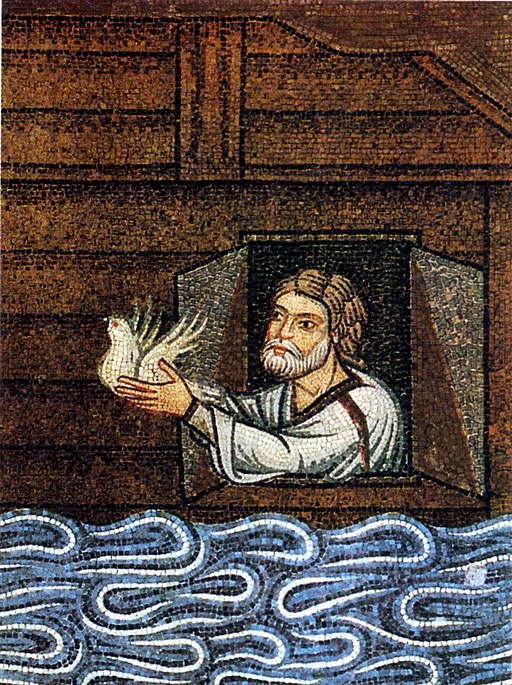
| Noah giving the gesture of orant as the dove returns |
Strengths and accomplishments:
Weaknesses and mistakes:
- Only follower of God left in his generation
- Second father of the human race
- Man of patience, consistency, and obedience
- First major shipbuilder
Lessons from his life:
- Got drunk and embarrassed himself in front of his sons
Vital statistics:
- God is faithful to those who obey him
- God does not always protect us from trouble, but cares for us in spite of trouble
- Obedience is a long-term commitment
- A man may be faithful, but his sinful nature always travels with him
Key verse:
- Where: We're not told how far from the Garden of Eden people had settled
- Occupation: Farmer, shipbuilder, preacher
- Relatives: Grandfather - Methuselah. Father - Lamech. Sons: Ham, Shem and Japheth
"Noah did everything just as God commanded him." (Genesis 6:22)
Noah's story is told in Genesis 5:29-10:32. He also is mentioned in 1 Chronicles 1:3, 4; Isaiah 54:9; Ezekiel 14:14, 20; Matthew 24:37, 38; Luke 3:36; 17:26; Hebrews 11:7; 1 Peter 3:20; 2 Peter 2:5..
This series first ran in 2004 and 2005. I'm refreshing it as I go. For links to the whole study, go to the Genesis Index. For more about the resources used, go here.
Wednesday, November 2, 2016
I'm with Chaput - Let's Punch the Devil in the Nose
 |
| The Blessed Virgin Mary punching the devil (13th century MS, British Library). Via Gregory Wolfe and Catholic News Agency |
For me this shows Mary as a powerful spiritual warrior, especially when I look at the expression on both faces. I'd like to think I could be like that.
I'll be fair. Mary could also be holding a seal of some sort with which she is marking the devil.
Looking around for a proper reference to prove it wasn't pop art I wound up at the Catholic News Agency. The bonus was this wonderful talk by Archbishop Chaput which used it as a springboard to exhort us to be like Mary.
“If we want to reclaim who we are as a Church, if we want to renew the Catholic imagination, we need to begin, in ourselves and in our local parishes, by unplugging our hearts from the assumptions of a culture that still seems familiar but is no longer really ‘ours,’” Archbishop Chaput said.I love that guy. Read the whole thing. It's good medicine.
“This is why Mary – the young Jewish virgin, the loving mother, and the woman who punches the devil in the nose – was, is, and always will be the great defender of the Church,” he added.
Archbishop Chaput addressed the 2016 Bishops’ Symposium at the University of Notre Dame on Wednesday. He spoke on “Remembering Who We Are and the Story We Belong To.”
He began his talk referencing an illustration, reportedly from the Middle Ages, of the Blessed Virgin Mary punching the devil in the nose. “She doesn’t rebuke him. She doesn’t enter into a dialogue with him. She punches the devil in the nose,” he said.
Tuesday, November 1, 2016
What We've Been Watching: The Good Place

At last, a new television show that is light, engaging, humorous, and makes you think. All while celebrating the virtues that lead to being good.
After a freak accident, Eleanor (Kristen Bell) wakes up to find that she died and wound up in The Good Place (as opposed to The Bad Place, of course). Hearing the long list of humanitarian behavior that led to her arrival is a surprise to Eleanor. Because the system, overseen by immortal Michael (Ted Danson) had a glitch that assigned her the completely wrong history. Eleanor was never very nice and always selfish which means she is in The Wrong Place.
Luckily, she's met her "soulmate" who was an expert in morality and ethics. He agrees to give her lessons to teach her how to be good. Naturally complications arise and we meet other Good Place neighbors who, though perfectly good, are dealing with their own dilemmas.
What all this leads to for the viewer is a refreshing change from the usual sitcoms. The show is being allowed to develop at its own pace and this lets us grow along with it.
One thing we especially enjoy is the mini-philosophy lesson which Eleanor learns and which is echoed in each episode's general plotline. You get a sense, albeit surface level, of different philosophical concepts of virtue and being good. Which is, in itself, refreshing.
It's not just high minded though. The humor is loopy, oddball and fun, in the best way possible. And the set design is deceptively simple but done with the sort of attention that makes me think of Pushing Daisies which was another favorite of ours.
The show was developed and is being run by Mike Schur who's known for his involvement in The Office, Parks and Recreation, and Brooklyn Nine Nine.
NBC has all the episodes available on their website. I think they're letting it grow through word of mouth, which is also refreshingly different these days. You need to watch them in order because it is one big story.
Rose pushed us to watch this because she wants it to keep going. It only took a few episodes for us to see why. So I'm pushing it too.
Take a look. I think you'll be pleasantly surprised.
(For a more indepth look, check out The AV Club's pilot review.
Sunday, October 30, 2016
Worth a Thousand Words: Halloween
 |
| Halloween, Grandma Moses via WikiArt |
Friday, October 28, 2016
"My marriage works and I'm going to tell you why."
This is a great reminder of the real priorities of our marriages. Thought I'd pass it along.
Lately, I’ve been thinking more and more about a term that’s become popular in reference to marriages. People are always asking, does (or will) this marriage “work.”He's got six reasons and each one was good. Read the whole thing here.
Everyone seems to speak like this, including couples themselves. But to think of marriage as something that does or does not “work” is to fall into the frenetic spiral of functionalism and utilitarianism that so characterizes our a materialistic world.
We don’t “make a marriage work.” We simply make a marriage. And, if I may, here is how it “works.”
- My marriage works because my wife and I are different. This seems obvious, but it’s actually quite difficult to accept all this statement implies. We are different because each of us is unique and unrepeatable, both of us made in the image of Christ. We are different because I am a man and she is a woman. We are different because our bodies are different, because we enjoy life differently, because we listen to others and to God differently. We caress with different styles. What we think and even what worries us and stresses us is … different.
Wednesday, October 26, 2016
Genesis Notes: Covenant Renewed
GENESIS 9-10
After all that Noah has endured and all that he has seen God do it is pretty disappointing to watch him get drunk and act just like a regular person. I always accepted it as part of Noah's human nature. However, there is a deeper lesson to be seen here.
I'll add that it took me watching the movie Noah to realize that wine wasn't invented until after the ark landed again — so we can soften our judgment of Noah. Though the commentary below still holds true in thinking of how we feel about flawed heroes.
I always loved the rainbow as a sign of God's promise to man. I never thought of it being a so called "risky" move on God's part until this reflection pointed out how man has a tendency to worship God's creation instead of the creator Himself. Certainly I never saw it as affirmation of the sacraments but that is pointed out as well.
All quoted material is from Genesis: God and His Creation. This series first ran in 2004 and 2005. I'm refreshing it as I go. For links to the whole study, go to the Genesis Index. For more about the resources used, go here.
After all that Noah has endured and all that he has seen God do it is pretty disappointing to watch him get drunk and act just like a regular person. I always accepted it as part of Noah's human nature. However, there is a deeper lesson to be seen here.
I'll add that it took me watching the movie Noah to realize that wine wasn't invented until after the ark landed again — so we can soften our judgment of Noah. Though the commentary below still holds true in thinking of how we feel about flawed heroes.
Did you feel disappointed when Noah, a man so bright in faith and obedience, succumbed to drunkenness, which led to something even darker? In the bleak wasteland of a world given over to evil, Noah seemed like a man we could trust. He looked like a hero.
Why is it so difficult to accept flawed heroes? Is it because all humans long for a perfect human, one who will not disappoint us and let our dreams die? Ever since Adam, we have been looking for one who won't botch things up. We want to see a human be all that God meant for us to be.
The characters of the Old Testament, like Adam and Abel and Noah, begin to prepare us for just such a Person. Even though humans in the story until His arrival disappoint us from time to time, we should never let their humanity sour us or tempt us to be contemptuous of them. We must never forget that God's promise in Gen. 3:15 to defeat His enemy through humans means that step by step in this battle, God's work will have a human face on it. This is the magnificent condescension of God to man. It is also God's resounding confirmation that He did not make a mistake in creating him. God knows very well what weaknesses beset humanity. Nevertheless, He works relentlessly to make sure that someday our dream of human perfection will be a reality, not a dream. To be a Christian means not being squeamish about human beings doing divine work. This is especially true for Catholics, because sometimes our Protestant brethren protest that we have too many "mere humans" in our understanding of redemption. We have Mary, "just a woman," as Queen of Heaven and Mother of the Church. We have a pope, "only a man," who sits in the line of Peter and holds the keys of the kingdom. We have saints, men and women who are "just like us," to serve as our examples and advocates in their lives as God's friends. When this charge is raised against us, we should bow our heads, give thanks to God, and smile deeply in our souls. A "human" Church? Exactly.
I always loved the rainbow as a sign of God's promise to man. I never thought of it being a so called "risky" move on God's part until this reflection pointed out how man has a tendency to worship God's creation instead of the creator Himself. Certainly I never saw it as affirmation of the sacraments but that is pointed out as well.
 |
| Dankgebet nach Verlassen der Arche Noah, Domenico Morelli |
Man, weakened by sin, has the potential to miss the messages God gives him. Was it possible that men would see the importance God attached to that beautiful rainbow and begin to worship it instead of God, Who created and used it? Certainly. We know for a fact that men regularly worshipped what God created instead of the Creator Himself. Nevertheless, God took that risk in order to communicate with man in a truly human way. As the Catechism says, "In human life, signs and symbols occupy an important place. As a being at once body and spirit, man expresses and perceives spiritual realities through physical signs and symbols. As a social being, man needs signs and symbols to communicate with others, through language, gestures, and actions. The same holds true for his relationship with God." (CCC 1146) In our human lives, we make use of natural and social symbols all the time. In fact, we can't imagine life without them. God, in the rainbow, joins Who He is and what He does to an element in nature that will have meaning to mortals. We call these actions "sacraments." Scripture is full of examples of God working this way among His people. The culmination, of course, is the Incarnation-God taking on the most profoundly human form of communication, flesh, to reveal to men Who He is. The sacramental nature of Catholic life is deeply rooted in this biblical truth about how God works among men, glimpsed first in the beautiful bow in Noah's sky. [emphasis added]
All quoted material is from Genesis: God and His Creation. This series first ran in 2004 and 2005. I'm refreshing it as I go. For links to the whole study, go to the Genesis Index. For more about the resources used, go here.
Tuesday, October 25, 2016

Monday, October 24, 2016
The Back from the Dead Cemetery Walk
Perhaps it goes without saying that it’s held in the dark. You must reserve tickets for the free event in advance and then groups of 8-15 people are let in at a time, greeted by a lantern-carrying grave digger who welcomes the participants and sets the stage for what they’ll encounter. During the approximately 40-minute walk, many familiar people show up, like St. Therese of Liseux, St. John de Brebeuf, St. Maximilian Kolbe, St. Elizabeth Ann Seton, St. John of the Cross, St. Gianna Molla, and St. Teresa Benedicta of the Cross (Edith Stein). There are souls in purgatory, two young children from heaven, and even a Screwtape devil. Sometimes these characters even know participants by name, which enhances the personal experience, and provides an extra surprise.I'm not into haunted houses but this? This I would do in a heartbeat.
This is in Maryland so if you're near there give it a try. Read more at Bringing Back the Dead ... Catholic Style.

In which we encounter deserted mansions, flying bullets, dancing, and arms about each other.
Chapter 5 of Oh, Murderer Mine by Norbert Davis is ready for your listening pleasure at Forgotten Classics!
Friday, October 21, 2016
Worth a Thousand Words: For president, Abram Lincoln
 |
| For president, Abram Lincoln. For vice president, Hannibal Hamlin via Library of Congress |
Print shows a large campaign banner for Republican presidential candidate Abraham Lincoln and running mate Hannibal Hamlin. Lincoln's first name is given here as "Abram." The banner consists of a thirty-three star American flag pattern printed on cloth. In the corner a bust portrait of Lincoln, encircled by stars, appears on a blue field.
Thursday, October 20, 2016
Worth a Thousand Words: The Green Parasol
 |
| Guy Rose, The Green Parasol, c. 1909-1911 via Arts Everyday Living |
Lagniappe: Valley of the Kings
The Valley of the Kings, where huge stone gods loomed above. Dust shifted in a strange downpour of tears from their eyes, tears made of sand and powdered rock.
The boys leaned into the shadows. Like a dry river bottom, the corridors led down to deep vaults where lay the linen-wrapped dead. Dust fountains echoed and played in strange courtyards a mile below. The boys ached, listening. The tombs breathed out a sick exhalation of paprika, cinnamon, and powdered camel dung. Somewhere, a mummy dreamed, coughed in its sleep, unraveled a bandage, twitched its dusty tongue and turned over for another thousand-year snooze ...
Wednesday, October 19, 2016
Genesis Notes: Symbolism in Noah's Story
GENESIS 6-8
In that glorious way that Scripture has, the story of Noah and the flood work on more than one level. There are worlds of symbolism therein as the early Church Fathers found. Genesis: God and His Creation elucidates for us.
In that glorious way that Scripture has, the story of Noah and the flood work on more than one level. There are worlds of symbolism therein as the early Church Fathers found. Genesis: God and His Creation elucidates for us.
 |
| Noah's Ark, Tecamachalco Church in Puebla, Mexico via SMU |
THE ARK AS THE CHURCH
The Fathers of the Early Church saw the ark as a figure of the Church. "God ordered Noah to build an ark in which he and his family would escape from the devastation of the flood. Undoubtedly the ark is a symbol of the City of God on pilgrimage in this world; that is, a symbol of the Church which was saved by the wood on which there hung the Mediator between God and men-Christ Jesus, Himself a man. Even the measurements of length, height, and breadth of the ark are a symbol of the human body in which He came ... The door open in the side of the ark surely symbolizes the open wound made by the lance in the side of the Crucified-the door by which those who come to him enter in the sense that believers enter the Church by means of the sacraments which issued from that wound." (St. Augustine, De civitate Dei, 15, 26; quoted in The Navarre Bible: Pentateuch, Princeton, NJ: Scepter Publishers, 1999; pg. 70)
THE NUMBER SEVEN AS REMINDER OF GOD'S COVENANT
The number seven should remind us of the hallowing of the seventh day of the first creation, which became a sign of the covenant God made with all creation. We are to comprehend that God is undertaking a re-creation of the earth and even of man himself, in a sense. He wants to renew the covenant. We should not mistake this for just another attempt to get things right. Rather, we are to absorb from all the details that evoke the creation that it is God Who desires to free man from his problems. God's unrelenting initiative in seeking to restore man to his original destiny is unequivocal proof of His love for us. The enormity of God's persistent love should rise up above all the details of man's early history as the sun rises in the morning sky. We dare not interpret any of it apart from the illumination of that bright light. Behind, above, beneath, before, and throughout everything is the glorious love of God for mere mortals. "O Lord, our Lord, how majestic is Thy Name in all the earth!" (Ps. 8:9)
MOVING OVER THE FACE OF THE WATERS AS RE-CREATION
"In the beginning," the earth was without form and void, and the Spirit of God was moving over the face of the waters (Gen. 1:2). To read in Genesis 8:7 that "the wind" of God, which is His breath, the Holy Spirit, is blowing over the earth helps us to recognize the beginning of the re-creation. The repetitive use of language from the original creation story teaches us that God's original plan for the universe and for man was a perfect plan. That is why the re-creation scenes in Scripture, wherever they appear, always use language from the original one. God doesn't keep trying out new ideas until something works. He is determined to make His original plan work, no matter what rises up to derail it. No fault can be found with the plan. Human history will reveal where the problem lies.
THE DOVE AS THE HOLY SPIRIT
The Church helps us to see the Holy Spirit as the dove that looks for habitable ground. In the days of Noah, it was dry earth that the dove sought and finally found. The appearance of the dove with the olive branch was a sign that a new life for man on the earth was about to begin. At the baptism of Jesus, the Holy Spirit descending on Him in the form of a dove is a powerful sign that finally the soil of the human soul will be fit for the presence of God's Spirit once again. Is there any thought more beautiful than this?
Tuesday, October 18, 2016

Monday, October 17, 2016
Well Said: The Church is something alive ...
The Church is something alive, a force at work; but many pious people seem to believe, or pretend to believe, that she is simply a shelter, a place of refuge, a sort of spiritual hotel by the roadside from which they can have the pleasure of watching the passers-by.
Georges Bernanos
via Flannery O'Connor and the Christ-Haunted South
by Ralph C. Wood
Worth a Thousand Words: Ceiling Fresco by Salvador Dali
 |
| Ceiling Frescoes by Salvador Dali at Palace of the Wind, Dali Museum taken by Barcelona Photoblog |
Friday, October 14, 2016

Lagniappe: Distressed Jeans
She wore the kind of distressed jeans they distress by rubbing money on them and a T-shirt that said HELLO, RUST BELT! in what looked like real rust and probably cost #300.
Timothy Hallinan, Crashed
Blogging Around: "Never Give Up, Never Surrender" Edition
Clinton's Campaign Team and a "Catholic Spring"
“There needs to be a Catholic Spring, in which Catholics themselves demand the end of a middle ages dictatorship and the beginning of a little democracy and respect for gender equality in the Catholic Church.” – Sandy Newman, president and founder of the Voices for Progress, in an email to John Podesta, chairman of the Hillary Clinton campaign for President.If you haven't heard of the email leaks about a disturbing exchange which shows an ignorance of Clinton campaign heads about both Catholicism and religious faith in general, you can read basics at The Washington Post. It also shows a sophomoric sense of humor. However.
In response, Podesta — a Catholic — tells Newman that structures have been put in place to work toward that end. A headline in the Washington Post would suggest that the line of thinking in these Wikileaks-obtained emails was mere joking, but the conversational back-and-forth appears to be in dead earnest.
It also seems shockingly ignorant.
For a thoughtful analysis and response, read Scalia's piece.
Interfaith Group Asks US Government to Reject Report that Stigmatizes Religious Americans
A letter to Barak Obama, Orrin Hatch and Paul Ryan was sent by a widely diverse group of religious leaders representing Catholicism, Judaism, Islam, the Church of Latter Day Saints, the African Methodist Church, Evangelicals, Krishna Consciousness, and many more. They were responding to troubling statements in a report from the U.S. Commission on Civil Rights.The Commission asserts in its Findings that religious organizations “use the pretext of religious doctrines to discriminate.”Read the whole letter. This is important.
What we find even more disturbing is that, in a statement included in the report, Commission Chairman Martin Castro writes:
“The phrases ‘religious liberty’ and ‘religious freedom’ will stand for nothing except hypocrisy so long as they remain code words for discrimination, intolerance, racism, sexism, homophobia, Islamophobia, Christian supremacy or any form of intolerance.”
Jesus told his disciples a parable about the necessity for them to pray always without becoming weary.
It's been a troubling last few days with a couple of stories about targeting Catholicism and freedom of religion. Luckily, this Sunday's readings are perfect for the situation. They're all geared to encourage and remind us to pray (while we do all we can) and to trust God.In fact, it includes one of my favorite parables, about the judge who delivered a just decision because he was afraid the widow would "poke him in the eye" (specific translation from the Greek which is often toned down in different translations). Makes me laugh and recall that we often forget Jesus' sense of humor.
I was greatly inspired and encouraged after hearing commentary from two different sources.
- Bishop Robert Barron's homily at Word on Fire: The Integrated and Variegated Body of Christ
- Lanky Guys: Our Help is in the Name of the Lord
Thursday, October 13, 2016
Well Said: Five Peas
There were five peas in one shell: they were green and the pod was green, and so they thought all the world was green; and that was just as it should be.Who knew? Hans Christian Anderson foresaw social media.
Hans Christian Anderson, Five Peas From a Pod
Tacos of Tomatillo Chicken with Wilted Greens and Fresh Cheese
It's what was for dinner a couple of nights ago. Delicious! Recipe is at Meanwhile, Back in the Kitchen.

Wednesday, October 12, 2016

Well Said: Who is the most holy?
It is not those who commit the least faults who are most holy, but those who have the greatest courage, the greatest generosity, the greatest love, who make the boldest efforts to overcome themselves, and are not immoderately apprehensive of tripping.
Francis de Sales
Genesis Notes: Noah and the Flood
GENESIS 6-8
The last study looked at how the people cleansed in the flood had a clear choice between right and wrong. This brings us to the other question my girls asked when little, "What about the poor animals? It isn't fair to them." True enough and a question that always tugged at my heart strings also. When I read why the animals had to be included the light bulb really went on. This explanation ties in with things I've read in other sources (notably Peter Kreeft's work) which talks about the universe being created for man.
The last study looked at how the people cleansed in the flood had a clear choice between right and wrong. This brings us to the other question my girls asked when little, "What about the poor animals? It isn't fair to them." True enough and a question that always tugged at my heart strings also. When I read why the animals had to be included the light bulb really went on. This explanation ties in with things I've read in other sources (notably Peter Kreeft's work) which talks about the universe being created for man.
 |
| Noah's Ark (1846), Edward Hicks. |
For animals to be included in the cleansing of the earth suggests the inseparable relationship between man and the rest of creation. The dominion God had given him has real meaning - when man goes down, so does all the rest of the earth. This helps us to see clearly how all the elements of creation led up to the creation of man. He was not just one player among many. Without man, the rest has no meaning. (Genesis: God and His Creation)The other question that comes up every time in this classic tale is just how the animals were collected in the first place.
Many have wondered how this animal kingdom roundup happened. Did Noah and his sons spend years collecting all the animals? In reality the creation, along with Noah, was doing just as God had commanded. There seemed to be no problem gathering the animals. God took care of the details of that job while Noah was doing his part by building the ark. Often we do just the opposite of Noah. We worry about details over which we have no control, while neglecting specific areas (such as attitudes, relationships, responsibilities) that are under our control. Like Noah, concentrate on what God has given you to do and leave the rest to God. (Life Application Study Bible)I also liked reading this description of the size of the ship, which boggles the mind. It's bad enough to build a regular boat with no visible hope of water to float it but what God asked Noah to do seemed preposterous if you didn't have faith.
... Picture yourself building a boat the length of one and a half football fields and as high as a four-story building. The ark was exactly six times longer than it was wide -- the same ratio used by modern shipbuilders. This huge boat was probably built miles from any body of water by only a few faithful men who believed God's promises and obeyed his commands. (Life Application Study Bible)This series first ran in 2004 and 2005. I'm refreshing it as I go. For links to the whole study, go to the Genesis Index. For more about the resources used, go here.
Tuesday, October 11, 2016

Saturday, October 8, 2016
In which we fix Carstairs breakfast. And find out more about Heloise and Handsome Lover Boy.

Chapter 3 of Oh, Murderer Mine at Forgotten Classics podcast.
Rated G for sassy girl teachers, Handsome Lover Boys, gigantic Great Danes, and deceptively pudgy detectives.
Friday, October 7, 2016
Worth a Thousand Words: Europa, Discover Life Under the Ice
 |
| Europa via my husband who recalled Will Duquette featuring these on Facebook |
Astonishing geology and the potential to host the conditions for simple life make Jupiter's moon Europa a fascinating destination for future exploration. Beneath its icy surface, Europa is believed to conceal a global ocean of salty liquid water twice the volume of Earth's oceans. Tugging and flexing from Jupiter's gravity generates enough heat to keep the ocean from freezing. On Earth, wherever we find water, we find life. What will NASA's Europa mission find when it heads for this intriguing moon in the 2020s.
Thursday, October 6, 2016
Lagniappe: Still like that.
"Lydia. You're still like that, huh?" He shook his head, smiling. "You're still like that."
I wasn't completely sure what it was I was still like, but I knew I was still like that.
S.J. Rozan, China Trade
Prayers for Family in Hurricane's Path
My mother, sister and BIL (haha, his name is Bill too) are in Melbourne, Florida, in the path of Hurricane Matthew.
They're hunkering down at Mom's place and hopefully will have the cheerful hurricane party experience that my husband recalls from his Houstonian childhood experiences.
Please keep them in your prayers.
As well as all of those in the storm's path, like Bridget!
St. Medard, patron saint for protection against bad storms, pray for them!
As well as all of those in the storm's path, like Bridget!
St. Medard, patron saint for protection against bad storms, pray for them!
Wednesday, October 5, 2016
Lagniappe: Trembling Inside
Mike's widow, to whom I'd said a few clumsy words, sat by the coffin. She was quiet, but she seemed to be trembling inside, like a teardrop.
S.J. Rozen, Concourse

Genesis Notes: Left Behind
GENESIS 6-8
Now Genesis brings us to a character who even the smallest child is familiar with, Noah and his ark of animals. When the girls were little and we would read picture books of this story they always were saddened by the animals and people left behind. Truth to tell, I was saddened by those pictures too. I never had a good reason as to why they got left behind. That's because I hadn't yet looked below the surface of Genesis. Get ready to look into Romans for some help with this subject in a way that relates directly to life today.
When they get to why the animals had to be included the light bulb really went on. This explanation ties in with things I've read in other sources (notably Peter Kreeft's work) which talks about the universe being created for man.
The other question that comes up every time in this classic tale is just how the animals were collected in the first place.
Now Genesis brings us to a character who even the smallest child is familiar with, Noah and his ark of animals. When the girls were little and we would read picture books of this story they always were saddened by the animals and people left behind. Truth to tell, I was saddened by those pictures too. I never had a good reason as to why they got left behind. That's because I hadn't yet looked below the surface of Genesis. Get ready to look into Romans for some help with this subject in a way that relates directly to life today.

When you read the account of the Flood, realizing that everyone except Noah's family died because of God's judgment, did you ever have a twinge of wondering if that was fair? After all, if some human civilizations developed away from the covenant-keepers, thus becoming intensely evil, perhaps we want to say that they didn't know any better. Maybe we think they never really had a chance to live their lives the way Noah did.
St. Paul, in his epistle to the Romans (1:19-25), helps us to understand better just exactly what was going on among men whose lives were given over to wickedness ...
Here we see that St. Paul says that anyone who lives on the planet Earth, whether he lives among covenant keeping people or not, knows enough about God to live in the right way. Why? Because God has revealed Himself in His works. Looking around at the world in which he lives, a man is capable of recognizing that (1) there is a God (2) He is powerful (3) He deserves to be honored and thanked (Rom. 1:20-21). When a man chooses not to act on what he knows to be true, he suppresses the truth. It isn't that he has been deprived of it-he simply refuses to live by it.
When that happens, things go downhill fast, as St. Paul tells us (Romans 1:28-32) ... This is a description of what happened in the early history of man and what continues to happen when men, like Cain, know what is right to do but refuse to do it. When that happens, the most merciful thing God can do is to punish man. It is often only when men are faced with suffering and death that their autonomy crumbles to ash, and they are willing to cry out to God, Whom they are finally ready to acknowledge as the only One who can help...
The people swept away in the Flood were not necessarily eternally lost. Their death was a temporal punishment until Christ preached to them the message of redemption they needed to hear. Those who were merely ignorant surely responded with great joy. But those who, like Cain, had hardened their hearts through sin, might well have had the same reaction to Christ as Cain had to God — "Thanks, but no thanks." We should never worry about the justice and fairness of God (see CCC 632-635).
When they get to why the animals had to be included the light bulb really went on. This explanation ties in with things I've read in other sources (notably Peter Kreeft's work) which talks about the universe being created for man.
For animals to be included in the cleansing of the earth suggests the inseparable relationship between man and the rest of creation. The dominion God had given him has real meaning — when man goes down, so does all the rest of the earth. This helps us to see clearly how all the elements of creation led up to the creation of man. He was not just one player among many. Without man, the rest has no meaning.
The other question that comes up every time in this classic tale is just how the animals were collected in the first place.
Many have wondered how this animal kingdom roundup happened. Did Noah and his sons spend years collecting all the animals? In reality the creation, along with Noah, was doing just as God had commanded. There seemed to be no problem gathering the animals. God took care of the details of that job while Noah was doing his part by building the ark. Often we do just the opposite of Noah. We worry about details over which we have no control, while neglecting specific areas (such as attitudes, relationships, responsibilities) that are under our control. Like Noah, concentrate on what God has given you to do and leave the rest to God.
Tuesday, October 4, 2016

Lagniappe: A dozen scientists and engineers
Confine a dozen scientists and engineers to a seemingly endless desert of hard-packed sand with no recreational diversions and, inevitably, they will design and build a golf course.
P.J. Tracy, The Sixth Idea
Friday, September 30, 2016

Thursday, September 29, 2016
Blogging Around
A Single Phrase Helped Save This Marriage
Finally, hoarse and broken, I sat down in the shower and began to cry. In the depths of my despair powerful inspiration came to me. You can’t change her, Rick. You can only change yourself. At that moment I began to pray. If I can’t change her, God, then change me. I prayed late into the night. I prayed the next day on the flight home. I prayed as I walked in the door to a cold wife who barely even acknowledged me. That night, as we lay in our bed, inches from each other yet miles apart, the inspiration came. I knew what I had to do.Read it all here.
Beware the (Online) Culture of Wrath
Stephen D. Greydanus on how to avoid poisoning your soul, or those of others, on social media. He's got good ways to do a self examination checking for unseen problems in your own participation. And some excellent common sense guidelines.What My Dying Friend is Teaching Everyone Around Her About Faith
Her luminous witness of a peaceful spirit despite real and ever present danger has directed the attention of everyone around her away from the cancer to the Divine Physician. She is embracing her cross like a lover, revealing thus the one she loves.Read it all here.
Why a Hawk is a Hummingbird
You know what they say about location and real estate. Hummingbird nests often appear in clusters, but for years researchers couldn’t figure out what attracted the birds to certain areas. Turned out the answer was, “good neighbors.”Fascinating. Read it all here.
Wednesday, September 28, 2016
Well Said: Tolkien's concern
The Ring is less morally ambiguous than the average realistic novel, but that's primarily because Tolkien wasn't especially interested in the problem of knowing right from wrong. His concern was to explore the psychology of the moment when you know right from wrong but aren't sure whether you have the courage and fortitude to do the right thing.Yep. And that is why The Lord of the Rings is endlessly fascinating.
Alan Jacobs
Tuesday, September 27, 2016
Well Said: What wonder you do not understand...
We are talking about God. What wonder is it that you do not understand? If you do understand, then it is not God.
St. Augustine

Genesis Notes: Adam's Descendents
GENESIS 5
Genesis 5 shows the descendents from Adam to Noah and is one of those endless seeming lists of names that make my eyes glaze over.
There's nothing for modern people in these lists. Right? Au contraire!

Genesis 5 shows the descendents from Adam to Noah and is one of those endless seeming lists of names that make my eyes glaze over.
There's nothing for modern people in these lists. Right? Au contraire!

The Bible contains several lists of ancestors, called genealogies. There are two basic views concerning these lists: (1) they are complete, recording the entire history of a family, tribe, or nation; or (2) they are not intended to be exhaustive and may include only famous people or the heads of families. "Became the father of" could also mean "was the ancestor of."This series first ran in 2004 and 2005. I'm refreshing it as I go. For links to the whole study, go to the Genesis Index. For more about the resources used, go here.
Why are genealogies included in the Bible? The Hebrews passed on their beliefs through oral tradition. For many years in many places, writing was primitive or nonexistent. Stories were told to children who passed them on to their children. Genealogies gave a skeletal outline that helped people remember the stories. For centuries these genealogies were added to and passed down from family to family. Even more important than preserving family tradition, genealogies were included to confirm the Bible's promise that the coming Messiah, Jesus Christ, would be born into the line of Abraham.
Genealogies point out an interesting characteristic of God. People are important to him as individuals, not just as races or nations. Therefore God refers to people by name, mentioning their life span an descendants.
Life Application Study Bible, emphasis added
Monday, September 26, 2016
Well Said: The most dangerous thing you can do ...
The most dangerous thing you can do is to take any one impulse of your own nature and set it up as the thing you ought to follow at all costs. There is not one of them which will not make us into devils if we set up as an absolute guide. You might think love of humanity in general was safe, but it is not. If you leave out justice you will find yourself breaking agreements and faking evidence in trials "for the sake of humanity," and become in the end a cruel and treacherous man.
C. S. Lewis, Mere Christianity

Friday, September 23, 2016
Well Said: Wherever there is love, there is a trinity
Wherever there is love, there is a trinity: a lover, a beloved, and a fountain of love.
St. Augustine

Thursday, September 22, 2016
Well Said: A Seven Year-Old’s Experimentation with a Life of Crime
I walked with purpose and carefully replaced Batman in the comic’s rack. I passed the shelf with the Life Savers. I glanced at the old woman behind the register. She was reading a magazine. I bent down quickly and pretended to tie my shoe. I reached up and grabbed a roll of Wint-O-Green and jammed it into my pocket.Stephen Tobolowsky is a master storyteller as I've mentioned before. Be sure to read the entire piece.
I was surprised by a revelation: I was already guilty. I never thought of that. I always thought that I wasn’t really a thief until I left the store. Not true. I was a thief now. I became one as soon as I demonstrated my intention to steal by putting the candy in my pocket.
Stephen Tobolowsky,
A Seven Year-Old’s Experimentation with a Life of Crime

Genesis Notes: Cain's Resume
We may feel that we know much more than we want to about Cain. He is the familiar character who doesn't do what he is supposed to, defies authority, and never sees the light. The Life Application Study Bible profile helps us see the key lessons from Cain's life.
 |
| Cain, Henri Vidal, Tuileries Gardens, Paris, 1896 |
Strengths and accomplishments:This series first ran in 2004 and 2005. I'm refreshing it as I go. For links to the whole study, go to the Genesis Index. For more about the resources used, go here.
Weaknesses and mistakes:
- First human child
- First to follow in father's profession, farming
Lessons from his life:
- When disappointed, reacted in anger
- Took the negative option even when a positive possibility was offered
- Was the first murderer
Vital statistics:
- Anger is not necessarily a sin, but actions motivated by anger can be sinful. Anger should be the energy behind good action, not evil action
- What we offer to God must be from the heart -- the best we are and have
- The consequences of sin may last a lifetime
Key verse:
- Where: Near Eden, which was probably located in present-day Iraq or Iran
- Occupation: Farmer, then wanderer
- Relatives: Parents - Adam and Eve, Brother - Abel, Seth and others not mentioned by name
"If you do what is right, will you not be accepted? But if you do not do what is right, sin is crouching at your door; it desires to have you, but you must master it." (Genesis 4:7)
Cain's story is told in Genesis 4:1-17. He also is mentioned in Hebrews 11:4; 1 John 3:12; Jude 11.
Wednesday, September 21, 2016
Well Said: Happy Enough
Miss Celia stares down into the pot like she's looking for her future. "Are you happy, Minny?"
"Why you ask me funny questions like that?"
"But are you?"
"Course I's happy. You happy too. Big house, big yard, husband looking after you." I frown at Miss Celia and I make sure she can see it. Because ain't that white people for you, wondering if they are happy enough.
Kathryn Stockett, The Help
Tuesday, September 20, 2016

Well Said: Jesus said love because ...
Jesus says love because hate destroys the hater as well as the hated.
Monday, September 19, 2016

Well Said: Who Knows What You Become
“Oh I know what people think. They think big, strong Minnie, she sure can stand up for herself. But they don’t know what a pathetic mess I turn into when Leroy’s beating on me. If afraid to hit back. I’m afraid he’ll leave me if I do. I know it makes no sense and I get so mad at myself for being so weak! How can I love a man who beats me raw? Why do I love a fool drinker? One time I asked him, “Why? Why are you hitting me?” He leaned down and looked me right in the face.
“If I didn’t hit you, Minny, who knows what you become.”
I was trapped in the corner of the bedroom, like a dog. He was beating me with his belt. It was the first time I’d ever really thought about it.
Who knows what I could become, if Leroy would stop goddamn hitting me.
Kathryn Stockett, The Help
Friday, September 16, 2016
What I've Been Reading: Earthrise, Stir, Kim, and Feeding Your Family's Soul

Rose Point
Laisrathera
by M. C. A. Hogarth
(The "Her Instruments" trilogy)
This is a really fun space opera series which is continually flirting with becoming romance novels.
I'll just review Earthrise because you need to read these in order. And if you like Earthrise you'll do as I did ... run off to get the next in the series as soon as you finish the book.
Earthrise is fun Firefly-esque space opera featuring a feisty, resourceful captain and her rag-tag multi-species crew. Struggling for funds to keep them going, Reece takes on a few jobs she probably should investigated more before accepting the pay up front. The book begins with the crew heading into slaver territory to rescue one of the mysterious Eldritch race who live only in legend (and in Reece's guilty pleasure, her romance novels).
From there things go from bad to worse ... and for us, of course, the story gets more fun all the time.
Recently I read a popular space opera, The Long Way to a Small Angry Planet, which kept coming to mind because it had so many similar elements to this book. The big difference is that this book avoids the flaws of the other which is that it was all talk and almost no action. In Hogarth's books action always has a point, the elements come together in the end, there is character development that the characters have to work for ... and everyone isn't always happy in the end because they don't always get what they want.
In fact, I'd say the flaw with Earthrise is that the captain has a hair trigger and is so consistently angry (the long way to a small angry captain could've been the title). However, it was a forgivable flaw because of how enjoyable the rest of the book was. One of the things I liked most was how many romance novel elements this story packed in without ever really quite turning into a romance novel. As I said — fun.

by Jessica Fechtor
On a day like any other, 28-year-old Jessica Fechtor had an aneurysm burst in her brain. She nearly died and lost her sense of smell, the sight in one eye, and suffered a long string of setbacks that continually interfered with her long fight back to normalcy. A key part of her recovery was working toward being able to cook again.
I was interested in this book from the moment I heard of it. It was inspiring in many ways and should I, God forbid, find myself in equally dire straits I hope that I remember her courage and spirit. The story is interesting and I appreciated the author's honesty as well as wanting to try a lot of the recipes. Yet I still felt fairly detached from the book. Eventually I really just wanted to see how the story came out. If there'd been a Wikipedia entry with enough of the details I'd have gone to that about halfway through.
Which is to say, I guess, that her writing wasn't gripping although her experience was. So not a book to savor but good enough to read.

by Rudyard Kipling
Most people know at least the basics about this novel. Kim, the orphaned son of an Irish trooper, grows up as a street urchin in Lahore, India, during British rule. Befriending a holy lama, Kim sets off to help him find the "River of the Arrow" which will cleanse him of his sins. Kim's been earning cash for some time by carrying coded intelligence messages and this when this him to the attention of the British his fate is changed.
I have tried this multiple times and never gotten past the first few chapters. A friend brought Kim up as necessary to fully appreciating Heinlein's Citizen of the Galaxy, which I love.
So I bit the bullet and plowed through those chapters and straight into India and the Great Game. I admit I really enjoyed the first 3/4 of the book and then lost interest toward the end. I think that's my problem, not the book's.
I can see why this is a classic. I really loved the descriptions of India and the people. The enduring love of the lama and Kim was endearing and what carried me through the book. I think I'll try it again sometime as an audio book. I kept wanting someone to read it to me.

by Donna-Marie Cooper O'Boyle
This is for every mother who ever wished they could transform dinner into a more spiritual experience. I feel as if many families will now have Sunday dinner with more purpose if they use the 52 lessons in this book.
Each lesson has a theme ranging from topics like one of the ten focusing on a commandments to how to live a Christian life (example: doing small things with love) to Catholic teachings (example: honoring Mary). There's a paragraph for contemplation, opening prayer, table teaching to read aloud, reflection questions, closing prayer, optional activities for later in the week, and usually a recipe.
This is the sort of guide that would be great for any Catholic family. It's practical, not sappy, grounded, and the recipes are family friendly (both for collaborative cooking and for turning out something a wide range of people would enjoy). Also, for those who might be trying to make cooking and dinner time more of a family focus, this would be a good place to begin.
There's a GoodReads giveaway you can sign up for through Sept. 23
Genesis Notes: Abel's Resume
All we really know about Abel is that he was a shepherd and his offering pleased God. As with Adam and Eve, I like the way that the Life Application Study Bible profile makes the key lessons from Abel's life stand out.
 |
| Icon of Abel by Theophanes the Greek |
The Bible doesn't tell us why God liked Abel's gift and disliked Cain's, but both Cain and Abel knew what God expected. Only Abel obeyed. Throughout history, Abel is remembered for his obedience and faith (Hebrews 11:4), and he is called "righteous" (Matthew 23:35).Here are a few extra tidbits of interesting information via Wikipedia. At least they interested me.
Strengths and accomplishments:
Lessons from his life:
- First member of the Hall of Faith in Hebrews 11
- First shepherd
- First martyr for truth (Matthew 23:35)
Vital statistics:
- God hears those who come to him
- God recognizes the innocent person and sooner or later punishes the guilty
Key verse:
- Where: Just outside of Eden
- Occupation: Shepherd
- Relatives: Parents - Adam and Eve, Brother - Cain
"By faith Abel offered God a better sacrifice than Cain did. By faith he was commended as a righteous man, when God spoke well of his offerings. And by faith he still speaks, even though he is dead" (Hebrews 11:4)
Abel's story is told in Genesis 4:1-8. He also is mentioned in Matthew 23:35; Luke 11:51; Hebrews 11:4 and 12:24
In Christianity, comparisons are sometimes made between the death of Abel and that of Jesus, the former thus seen as being the first martyr. In Matthew 23:35 Jesus speaks of Abel as "righteous", and the Epistle to the Hebrews states that "The blood of sprinkling ... [speaks] better things than that of Abel".(Hebrews 12:24) The blood of Jesus is interpreted as bringing mercy; but that of Abel as demanding vengeance (hence the curse and mark).This series first ran in 2004 and 2005. I'm refreshing it as I go. For links to the whole study, go to the Genesis Index. For more about the resources used, go here.
Abel is invoked in the litany for the dying in the Roman Catholic Church, and his sacrifice is mentioned in the Canon of the Mass along with those of Abraham and Melchizedek. The Alexandrian Rite commemorates him with a feast day on December 28.


Thursday, September 15, 2016
Blogging Around: 4 Movies and a Book Edition
What if a gun had a soul and didn't want to be a gun?

Stephen D. Greydanus has a wonderful look at a film which is a favorite in the HC household.
Two Takes on Florence Foster Jenkins
- DarwinCatholics: Three fine performances, and a deeply unstable moral core.
- Orson Scott Card: What could have been a cruel satire on a talentless old woman becomes a beautiful portrait of people who are trying to make the world a better place.
Mel Gibson — Hacksaw Ridge and Passion of Christ Sequel

- Mel Gibson’s ‘Hacksaw Ridge’ Gets a Standing Ovation at the Venice Film Fest — Not just a standing ovation. A ten-minute standing ovation. I can't wait to see this one.
- Mel Gibson Confirms Sequel to "The Passion of the Christ" — Called "The Resurrection." Of course. Also can't wait to see this one, though it's going to be years probably.
A Mighty Fortress by S. D. Thames
[Cue sound effect: Ringing bell.] We have a winner! From a quarter where I wouldn’t have expected to find one! A Mighty Fortress is a first (full-length) novel by an author I’d never heard of. It has so much going against it – it’s a Christian novel (which usually means low quality, let’s face it, especially when the authors are starting out). It’s a hard-boiled mystery into which the author injects supernatural and theological elements. There are even miracles. The miracle for me is how well this thing worked, and how much I loved it.Sign me up. Read the full review at Brandywine Books.
Well Said: When Hatred is a Pleasure
Suppose one reads a story of filthy atrocities in the paper. Then suppose that something turns up suggesting that the story might not be quite true, or not quite so bad as it was made out. Is one's first feeling, "Thank God, even they aren't quite so bad as that," or is it a feeling of disappointment, and even a determination to cling to the first story for the sheer pleasure of thinking your enemies are as bad as possible? If it is the second then it is, I am afraid, the first step in a process which, if followed to the end, will make us into devils. You see, one is beginning to wish that black was a little blacker. If we give that wish its head, later on we shall wish to see grey as black, and then to see white itself as black. Finally we shall insist on seeing everything — God and our friends and ourselves included — as bad, and not be able to stop doing it: we shall be fixed for ever in a universe of pure hatred.This is at the end of a chapter about loving one's neighbor, even in the eventuality that the person is a real enemy. Lewis, of course, had Nazis freshly to mind. We have ISIS and the like to consider. He gives very helpful examples about how to come to grips with loving the sinner while hating the sin.
C. S. Lewis, Mere Christianity
I hope, unlikely to come across a member of ISIS. I am, as we all are right now, very likely to come across someone who passionately supports a political candidate or opinion I despise. Keep that in mind and then reread the quote above.
Here is the key bit and one which I was shocked to realize I recognized in myself: "is it a feeling of disappointment, and even a determination to cling to the first story for the sheer pleasure of thinking your enemies are as bad as possible?"
It is then that we realize, as Lewis puts it later, that "hatred [is] such a pleasure that to give it up is like giving up beer or tobacco."
It is that we must fight.
Wednesday, September 14, 2016
Well Said: Gentlefolks' rock of idleness
Gentlefolks in general have a very awkward rock ahead in life — the rock ahead of their own idleness. Their lives being, for the most part, passed in looking about them for something to do, it is curious to see — especially when their tastes are of what is called the intellectual sort — how often they drift blindfold into some nasty pursuit. Nine times out of ten they take to torturing something, or to spoiling something — and they firmly believe they are improving their minds, when the plain truth is, they are only making a mess in the house. I have seen them (ladies, I am sorry to say, as well as gentlemen) go out, day after day, for example, with empty pill-boxes, and catch newts, and beetles, and spiders, and frogs, and come home and stick pins through the miserable wretches, or cut them up, without a pang of remorse, into little pieces. You see my young master, or my young mistress, poring over one of their spiders' insides with a magnifying-glass; or you meet one of their frogs walking downstairs without his head — and when you wonder what this cruel nastiness means, you are told that it means a taste in my young master or my young mistress for natural history. Sometimes, again, you see them occupied for hours together in spoiling a pretty flower with pointed instruments, out of a stupid curiosity to know what the flower is made of. Is its colour any prettier, or its scent any sweeter, when you DO know? But there! the poor souls must get through the time, you see — they must get through the time. You dabbled in nasty mud, and made pies, when you were a child; and you dabble in nasty science, and dissect spiders, and spoil flowers, when you grow up. In the one case and in the other, the secret of it is, that you have got nothing to think of in your poor empty head, and nothing to do with your poor idle hands. And so it ends in your spoiling canvas with paints, and making a smell in the house; or in keeping tadpoles in a glass box full of dirty water, and turning everybody's stomach in the house; or in chipping off bits of stone here, there, and everywhere, and dropping grit into all the victuals in the house; or in staining your fingers in the pursuit of photography, and doing justice without mercy on everybody's face in the house. It often falls heavy enough, no doubt, on people who are really obliged to get their living, to be forced to work for the clothes that cover them, the roof that shelters them, and the food that keeps them going. But compare the hardest day's work you ever did with the idleness that splits flowers and pokes its way into spiders' stomachs, and thank your stars that your head has got something it MUST think of, and your hands something that they MUST do.Yes, The Moonstone is a mystery but it is also hilarious, especially when Gabriel the steward is telling the story.
Wilkie Collins, The Moonstone
Subscribe to:
Comments (Atom)