Thursday, August 11, 2016

Seven Revolutions: How Christianity Changed the World and Can Change It Again

Seven Revolutions

How Christianity Changed the World and Can Change It Again
by Mike Aquilina and James L. Papandrea
As we present them here, the seven revolutions changed the world by changing human relationships, in ever widening concentric circles, beginning with the individual and extending outward to the world. A revolution of the individual affirmed that all people are created equal, in the image of God, and no one is expendable. A revolution of the home affirmed it as a place of safety and love, where women and children are not to be exploited. A revolution of the workplace affirmed that people are not property, that they must be free to choose their work, and that they must be given the free time for worship, for artistic expression, and to enjoy loved ones. A revolution of religion taught the world that God is love. A revolution of the community taught people to love their neighbor. A revolution of the way people thought about life and death rejected the culture of death and affirmed a culture of life and of hope, encouraging people to stand up for human rights. And finally, a revolution of government set up the ideal that rulers should serve those whom they rule (not the other way around), and that all people should enjoy freedom of religion. In short, the seven revolutions can be understood as cultural revolutions that gave the world a concern for human rights in two general categories: the protection of all human life, and the protection of each person's dignity and freedom.
I've been saying for a long time (with a singular lack of originality, I know) that we are living in times similar to those in which the first Christians lived.

Seven Revolutions spells out that truth in ways I hadn't even been aware of. Mike Aquilina and James L. Papandrea show what the pre-Christian world was really like and how everyday Christians, living out their faith, created a groundswell that gradually turned into a cultural revolution. Living in our post-Christian world, we too face a secular culture which doesn't understand our values and, therefore, misinterprets us and our faith.

The book not only covers past history but looks to the future with concrete ideas for converting our culture. It is a necessary read for anyone who isn't clear on the positive good Christianity has had and for those who aren't sure how to bring that good back into our world today. I found it heartening.
Maybe you've also heard that the Church is no longer relevant to the current generation. This is ridiculous. First of all, the mission of the Church is not relevance. Second, the definition of what is relevant changes by the moment and depending on the person, and the focus on relevance is in many ways a symptom of the very relativism that is part of the problem. Having said that, even if the Church is perceived as being out of touch with the current generation, the problem is with the generation, not with the Church. Was Jesus being irrelevant when he called his own generation adulterous and sinful? (Matthew 11:16-17; 12:39-45; 16:4; 17:17; Mark 8:12, 38; 9:19; Luke 9:41; 11:29-32). Jesus shows us that part of the Church's mission is to call each generation back to the Christian definition of relevance—which means the affirmation of life, in reverence to life's Creator.
This book isn't just for Catholics but for Christians of all sorts. Highly recommended.

And if you live in Dallas, it's at the library. Go borrow it!

Worth a Thousand Words: Flowers

Victoria Dubourg, Flowers
via Arts Everyday Living
I don't love still life paintings but I do love this.

Well Said: God said everything in his Word

In giving us his Son, his only Word (for he possesses no other), he spoke everything to us at once in this sole Word— and he has no more to say … because what he spoke before to the prophets in parts, he has now spoken all at once by giving us the All Who is His Son. Any person questioning God or desiring some vision or revelation would be guilty not only of foolish behavior but also of offending him, by not fixing his eyes entirely upon Christ and by living with the desire for some other novelty.
St. John of the Cross
I felt a distinct absence in the time I had been devoting to reading a canto a day of Dante's Divine Comedy. What better to fill it with than the Catechism? I have tried before to read through it and fallen far short of the mark. So far, very early on, I am finding it extremely rich, insightful, and rewarding.

Wednesday, August 10, 2016

Lagniappe: Champagne and Truth

Champagne, if you are seeking the truth, is better than a lie detector.
Graham Greene
It's funny because it's true.

Worth a Thousand Words: La Lettre

La Lettre (The Letter). Émile Munier (1840-1895).

Tuesday, August 9, 2016

Hard Sayings by Trent Horn

Hard Sayings: A Catholic Approach to Answering Bible DifficultiesHard Sayings
A Catholic Approach to Answering Bible Difficulties
by Trent Horn

Have you ever read something in the Bible and just scratched your head, or been challenged by a skeptic to explain a seemingly scandalous verse?

Trent Horn can help.

In Hard Sayings, Trent looks at dozens of the most confounding passages in Scripture and offers clear, reasonable, and Catholic keys to unlocking their true meaning.
Trent Horn addresses questions like the Bible being full of "bad" history, women being portrayed as less valuable than men, or that God is a murderous tyrant. Each chapter breaks down the reason for the questions and shows the Catholic explanations that help shed light on these objections. This  book would especially be good for someone who was teaching RCIA or who continually is having the Bible held up as a mass of contradictions.

Horn breaks down the confusing passages into three groups:

  • External Difficulties - when the Bible seems at odds with modern knowledge
  • Internal Difficulties - when there are contradictions between passages or 
  • Moral Difficulties - where evil actions seem endorsed by God's commands
As he works through the sections and objections, Horn is also methodically educating the reader about the Bible as literature. This culminates in his Bible-reading rules. These include things like reading passages in context of the larger work, checking your translation against the original language, and that the authors weren't divine stenographers.

I knew many of those concepts, but a few were new when thinking about discussing the Bible. For example, the Bible is allowed to be a sole witness to history, incomplete is not inaccurate, and the burden of proof is on the critic, not the believer.

Hard Answers is an accessible, balanced work that I'll be keeping as a reference. Definitely recommended.

Worth a Thousand Words: The Animals' Picnic

The Animals' Picnic, illustrated by G.H. Thompson, c. 1900
I'd love to have this book. What a treat it would be considering the wit and joy of this cover.

Monday, August 8, 2016

Genesis Notes: The Woman: "Seeing" Mary

GENESIS STUDY
The Annunciation - Luke 1:26-38
The Visitation - Luke 1:39-56
The Presentation in the Temple - Luke 2:22-35
The Wedding at Cana - John 2:1-11
The Crucifixion - John 19:25-27
A Vision of Heaven - Revelation 12:1-7

We are still breaking away from Genesis with Genesis: God and His Creation to look at the answer to the promise that the woman and her seed would defeat God's enemy.

This look at Revelation and the Catholic interpretation of it may challenge Protestants the most. Yet, it does answer the common protest that veneration of Mary isn't Scriptural. This shows the basis for Catholic belief in Mary's protection of the Church and of us individually.

Madonna on the Crescent Moon, Peter Paul Rubens

A Vision of Heaven - Revelation 12:1-7
The dragon aimed his earthly wrath at "the woman" first. She was protected from his fury by God. So, being angry with the woman, the dragon then went off to make war on the rest of her offspring, those "who keep the commandments of God and bear testimony to Jesus," which is the Church. Here we are able to see in dramatic detail just what God meant in Gen. 3:15 when He said He would put "enmity" between the serpent and the woman. In this scene from Revelation, she becomes the direct object of his assault, as he lashes out in anger as his time dwindles away. Who is this "woman"? Certainly she is a figure of Mary and the Church. Apocalyptic literature presents special interpretive challenges, but we can see why Christians throughout the ages have read this passage with Mary in mind. The point to note is how determined an enemy the dragon is of both the woman and her offspring. The woman is safe, but her offspring are terribly vulnerable while the dragon's time lasts. No wonder the Church has, down through the ages, given thanks for the special protection and advocacy which Mary gives to her children. This tender relationship is nurtured in the numerous Marian devotions that characterize Catholic life ...

Objections among Protestants to Marian dogma and devotion are usually rooted in their conviction that the Catholic Church teaches many things about Mary that simply aren't in the Bible. They are convinced that Mary has an exaggerated position in Catholic thought, either from over zealous pagan evangelism in the early centuries of the Church or from sentimentality over women in the Middle Ages or from a faulty understanding of redemption since the Council of Trent.

It was not always this way. At the time of the Protestant Reformation, in the 16th century, Protestants continued the 1500-year old tradition of reading the biblical references to Eve and Mary the way we have in this lesson. Even Martin Luther believed that Scripture accorded Mary a unique place in the human story. As time went by, however, a kind of Christian minimalism set into Protestant thought. Some of that was no doubt provoked by excesses and distortions practiced by some Catholics. Because of some abuses which seemed more like superstition than true Christian faith, Protestants gradually insisted on removing everything and everyone in Christian tradition that was not absolutely necessary to salvation. Jesus, of course, is necessary to salvation, so He is always at the center of the Protestant vision of redemption. Mary, we must remember, is a gift to the Church, as we saw in John 19:23-27. Gifts can be declined or left unopened or stored away and forgotten.

Modern Protestants, perhaps not knowing the history of the Church or even their own early history very well, have not been taught to "see" Mary in the Scripture as the New Eve. They are unaware of the fact that during all the years of Christian history before the Reformation, faithful Christians read the Bible this way. They do not realize that a Mary-less vision of redemption is a historical novelty. Mary appears to them to be an intrusion into an icon that has only Jesus in it.

Catholics can take confidence in the fact that, as we have seen in our lesson, there are strong scriptural reasons for retaining the icon of Mother and Son in our hearts and minds down through the ages. Being good students of Genesis, we would fully expect that when God conquers His enemy and restores man to a life of blessing, that life would be presided over by a New Adam and a New Eve, ordering everything as it was always meant to be.
This series first ran in 2004 and 2005. I'm refreshing it as I go. For links to the whole study, go to the Genesis Index. For more about the resources used, go here.

Friday, August 5, 2016

"It's not going to be easy, but it's going to be awesome!"

Gleason, the newly-released documentary that tells the story of former NFL player (and New Orleans Saints legend) Steve Gleason's battle with ALS, is a film filled with insightful and arresting moments. For me, however, none shone more brightly than the moment when Steve looks into the camera and tells his yet-unborn son (and us, the audience) that the journey he is about to undertake is "not going to be easy, but it's going to be awesome."

He's right. ...

The whole film is ... filled with amazingly powerful and wrenching moments, and amazingly beautiful ones. And with moments that are both at the same time. Because suffering as completely and as destructively as Steve does is (and will never be) easy, but the sacrifices and the love of his friends and family and the power of Steve's will in the face of such adversity are indeed "awesome" to behold.
Joseph Susanka's review does what I would have said was impossible. It makes me willing to watch a film that I already know is full of tough moments.

What We've Been Watching: Kind Hearts, Joy, Small Act, and Doris

KIND HEARTS AND CORONETS
(1949)
Louis Mazzini's mother belongs to the aristocratic family D'Ascoyne, but she ran away with an opera singer. Therefore, she and Louis were rejected by the D'Ascoynes. Once adult, Louis decides to avenges his mother and him, by becoming the next Duke of the family. Murdering every potential successor is clearly the safest way to achieve his goal.
We were both delighted way beyond expectation by this classic comedy. We knew that Alec Guiness played 8 parts but we didn't expect the wonderful script full of nuances which left us slightly shocked (in a happily funny way). We didn't expect the subplots which gave the film comic depth and kept us interested. We didn't expect the skill with which Dennis Price and Joan Greenwood smoothly played their parts. We certainly didn't expect the twist at the end.

This is definitely a movie that isn't watched enough these days.


JOY
(2015)
A story based on the life of a struggling Long Island single mom who became one of the country's most successful entrepreneurs.
Jennifer Lawrence stars as Joy Mangano, a self-made millionaire whose business empire was based on inventing the Miracle Mop. We were surprised at how much we enjoyed this.

Many film critics said they thought it was too chaotic but to us that was part of the point of the movie. Without the endurance tests that make up Joy's life could she have stuck with making her miracle mop a best seller?


A SMALL ACT
(2010 documentary)
A young Kenyan's life changes drastically when his education is sponsored by a Swedish stranger. Years later, he founds his own scholarship program to replicate the kindness he once received.
The good deeds we do, however small, can be important in a way we can't imagine. That is the overall message of this small but heartwarming documentary about Chris Mburu. He came from a tiny Kenyan village but, helped by a $15 monthly donation from a Swedish woman he never met, was able to go to secondary school. From there he won scholarships, began a successful career, and was able to begin his own educational foundation.

We see him tracking down his benefactor and finding they had unimagined connections. We also see three children striving to win a scholarship from Chris's foundation and the difference it would make in their lives.

It is unexpectedly riveting and may just inspire you to do your own small act of kindness to help an unknown child somewhere in the world. We ourselves went to Unbound (formerly CFCA) and began sponsoring an elderly Filipino lady who just needs $36 to make life better.


HELLO, MY NAME IS DORIS
(2015)
A self-help seminar inspires a sixty-something woman (Sally Fields) to romantically pursue her younger co-worker.
A charming little film which was a thousand times better than The Intern which had 70-year old Robert DeNiro as an intern imparting wisdom to entrepreneur Anne Hathaway.

Perhaps that is because this movie was shot incredibly quickly on a shoestring so they didn't worry about tying up every loose end. They also didn't make every person "consistent." The characters display all the blind spots and inconsistencies of real people.

It was refreshing and, as many have noted, Sally Fields is the engine that makes it work. She is wonderful in this. It's a simple little film without a lot of layers but it does offer an enjoyable peek into a thought provoking world.

Worth a Thousand Words: Sun Worshipper

Sun Worshipper
taken by the incomparable Remo Savisaar

Well Said: To try and then to fail ...

Joe said, "But to try and then to fail--"

"Is that so terrible?" Glimmung said. "I'll now tell you all something about yourselves, something that every one of you possesses: a quality in common. You have met failure so often that you have all become afraid to fail."

I thought so, Joe thought. Well, so it goes.

"What I am doing," Glimmung said, "is this. I am attempting to learn how much strength I have. There is no abstract way of determining the limits of one's force, one's ability to exert effort; it can only be measured in a way such as this, a task which brings into view the actual, real limitation to my admittedly finite--but great--strength. Failure will tell me as much about myself as will success. Do you see that? No, none of you can. You are paralyzed. That's why I brought you here. Self-knowledge; that is what I will achieve. And so will you: each about himself."

"Suppose we fail?" Mali asked.

"The self-knowledge will be there anyhow," Glimmung said...
Galactic Pot-Healer, Philip K. Dick

Thursday, August 4, 2016

What I've Been Reading: Pancakes, Espionage, and Burgers

Pancakes in Paris: Living the American Dream in FrancePANCAKES IN PARIS
Living the American Dream in France
by Craig Carlson


This was a really enjoyable memoir. Craig Carlson is living the dream with his Breakfast in America diner in Paris, but getting there required a heckuva lot of determination. First there was his dysfunctional family upbringing. Then there were the continual obstacles from acquiring backers to maneuvering the French legal system to overcoming the myriad headaches of running a restaurant in a foreign country. It is to Carlson's credit that he took a licking and kept on ticking ... and that he tells us about it in a sweet, humorous, wry style that never drags you into the doldrums. He made me think of Dory in Finding Nemo, "Just keep swimming." Surely that is the attitude he himself had to cultivate to overcome everything in his way.

I found his story greatly inspiring and gave it to my husband to read, knowing he'd be interested in the intricacies and insanity of French business. What is interesting is that as he reads, we have begun bringing up Pancakes in Paris to each other as a reminder that tenacity counts, that there is joy to be found in hard times, and that the connections in life can surprise you. And also that, if nothing else, even on our worst days at least we're not dealing with French business regulations.

Book provided by NetGalley. Opinions provided by me.


Etiquette & Espionage (Finishing School, #1)ETIQUETTE & ESPIONAGE
by Gail Carriger

It's one thing to learn to curtsy properly. It's quite another to learn to curtsy and throw a knife at the same time. Welcome to Finishing School.
What a delightful book, especially as read by Moira Quirk. I was put onto this series by Jenny and Rose's conversation at Reading Envy.

Steampunk, vampires and werewolves are all part of this world, although the focus is really on the adventurous and unladylike Sophronia's adventures at finishing school. That's where one learns deception, espionage, and "the other sort" of finishing. Combining that idea with true Victorian sensibilities leaves lots of room for humor and Gail Carriger is masterful at the understatement which leaves one snorting with laughter (however unladylike that is).

I really cracked up when Sophronia has to go on the lam, steeling herself to the fact that her ankles are visible to all the world. And I now know how to disarm a werewolf using my two best petticoats. So there is that.

A lot of fun and I can't wait for the second book to get to my local library branch.


The Bob's Burgers Burger Book: Real Recipes for Joke BurgersTHE BOB'S BURGERS BURGER BOOK
Real Recipes for Joke Burgers
by Loren Bouchard

One of the delights every week on Bob's Burgers is seeing what the Burger of the Day is. They are all wonderfully punny and also give you a little insight into Bob, that frustrated, creative gourmet. Leave it to a blogger to begin coming up with actual burger recipes and then to the Bob's Burgers team to turn them into a cookbook.

Granted, I haven't tried any of the recipes yet, but a surprising number of them made my mouth water. There is an extraordinary amount of care put into this book, which many might think is a throw away marketing effort.

There's new art adapted to the burgers. There are jokes worked into introductions and the recipes themselves, which make it sound as if you're in the kitchen with Bob or the family. There are the recipes themselves, overseen and reworked by two culinary folks to be sure all the kinks are worked out.

All in all it both entertains and promises delicious meals to come.

Well Said: Living without failing

It is impossible to live without failing at something unless you live so cautiously that you might as well not have lived at all — in which case you fail by default.
J.K. Rowling, Harvard commencement speech

Wednesday, August 3, 2016

Well Said: Making us Christians, not mathematicians.

One does not read in the Gospel that the Lord said: "I will send you the [Holy Spirit] who will teach you about the course of the sun and moon." For he willed to make them Christians, not mathematicians.
St. Augustine

GoodReads, you used to be cool!

I stuck with GoodReads through the Amazon buy, through the censorship of reviews, through several redesigns ... but this last redesign is the straw that breaks this camel's back. And it's practically making me cry to say that. (Probably a good thing I get less attached to social media sites, I guess.)

Anyway I'd appreciate tips on alternatives if anyone has a favorite. I'm familiar with LibraryThing but that's the only one.

Navigating the Tiber by Devin Rose

Navigating the Tiber
How to Help Your Friends and Family Journey Toward the Catholic Faith
by Devin Rose

Devin Rose draws from his own experience as a convert and shows you how to help your friends and family members make the "crossing" to Rome by journeying with them, offering the information, arguments, and most of all the prayerful support they'll need to reach their spiritual home.

I rarely, if ever, have Protestants coming to me for information about the Church. However, it did occur to me that I do know a fair number and if they ever do come knocking at my door then it would be really helpful to have this book for direction and insights.

Devin Rose lays down a sort of road map to help Protestants understand the theological issues that may obstruct or confuse as they journey toward Catholicism. Reading this also helped me to see just how very different beliefs can be between differing sorts of Christianity. Each chapter has personal examples which not only inform but lighten the tone as we meet Rose's different friends. I also liked that each chapter ended with a prayer and one or two reading suggestions.

I really liked the author's charitable tone, the insistence on being a friend, and the reminder that helping someone find the Catholic faith means that you too will have to grow.

I have to say that by the time I ended I was exhausted. It made me glad that most of the questions I receive have to do with the secular interpretation of Catholicism. However, this is a book I will definitely keep just in case I have a Protestant friend dipping a toe into the Tiber.

Tuesday, August 2, 2016

Genesis Notes — The Woman: From Jesus' Lips

GENESIS STUDY
The Annunciation - Luke 1:26-38
The Visitation - Luke 1:39-56
The Presentation in the Temple - Luke 2:22-35
The Wedding at Cana - John 2:1-11
The Crucifixion - John 19:25-27
A Vision of Heaven - Revelation 12:1-7

We are still breaking away from Genesis with Genesis: God and His Creation to look at the answer to the promise that the woman and her seed would defeat God's enemy.

I never really thought anything about how Jesus addressed His mother but the following two snippets of study make it crystal clear. The use of "woman" is a direct connection back to Genesis, the first woman Eve, and the "woman and her seed." For Him to deliberately us that word again when being crucified makes it even more powerful as to how important it was to make this connection.

The Wedding at Cana - John 2:1-11

Marriage at Cana, c. 1500, Gerard David, Musée du Louvre, Paris
For Jesus to address His own mother as "woman" in this context takes us right back to Gen. 3:15. We know He could not have meant any disrespect for her, so we must understand that it has special significance. For Him to ask her what she wants of Him is to heighten the dramatic power of the episode, and John doesn't want us to miss any of its meaning. It is clear that Jesus has every intention of granting Mary's request. What follows is a collaboration of the two of them that produces the very first sign of Jesus' Messianic mission in Israel. Mary acts as advocate ("they have no wine") and mediator ("do whatever He tells you"). Jesus changes water to wine, a miracle rich in Messianic overtones. What has John done in this episode? He has given us the grown-up icon of the Woman and her Seed. With language meant to call to mind the Garden of Eden, he has enabled us to see in Jesus and Mary the New Adam and the New Eve. The work of the Messiah has begun. [Note: According to The New Bible Dictionary (Wm. B. Eerdmans Publishing, 1965), one site in Israel thought to be that of ancient Cana is marked by springs of water and groves of fig trees, much like a Garden we know.]

The Crucifixion - John 19:25-27

The Crucifixion, seen from the Cross, by James Tissot, 19th century.
John's gospel is the only one to preserve this scene from the Crucifixion. Is the exchange prompted by sentiment or expediency? Is Jesus worried about what will happen to His mother when He is gone? Or is there deeper spiritual significance in this episode? Actually, the gift of a familial bond between Mary and John rockets us right back to the Garden of Eden. There we remember that the first Eve was called the "mother of all living," but before she had a chance to begin a family, she and Adam were expelled from Paradise. The original family plan for humanity was for Adam and Eve to preside over children who could enjoy the blessedness of the Garden and eat freely of the Tree of Life. Disobedience brought death into the human story, so Eve's motherhood was bittersweet. She became the human mother of the dying. That hope of blessed family life in the Garden was shattered.

Shattered but not lost. When Jesus, as He is dying, establishes this new family between Mary, the New Eve, and John, the only one of the Twelve at the foot of the Cross, He elevates Eve's motherhood to a supernatural fulfillment. Mary's motherhood will extend to all those who are in union with her Son, as John showed himself to be. Just as God becomes the Father of all who are born again into new life in Christ through baptism, Mary becomes their mother, by this gift from Jesus. This new "family," of course, is the Church-all those "who hear the word of God and do it," just as Jesus described it in Luke 8:19-21; see also Rev. 12:17). We can see that it was Jesus' intention to share Mary with His followers. Her motherhood in the Church is a powerful sign of God's plan to recover what was lost in the Garden (see CCC 964).
This series first ran in 2004 and 2005. I'm refreshing it as I go. For links to the whole study, go to the Genesis Index. For more about the resources used, go here.

Well Said: "Lor! Wasn't it prime!"

I have mentioned my liking for Mr. Pancks in Little Dorrit by Charles Dickens. Another favorite of mine is Maggy.
"Now, Little Mother, let's have a good 'un!"

"What shall it be about, Maggy?"

"Oh, let's have a Princess," said Maggy, "and let her be a reg'lar one. Beyond all belief, you know!"

Little Dorrit considered for a moment; and with a rather sad smile upon her face, which was flushed by the sunset, began:

"Maggy, there was once upon a time a fine King, and he had everything he could wish for, and a great deal more. He had gold and silver, diamonds and rubies, riches of every kind. He had palaces, and he had —"

"Hospitals," interposed Maggy, still nursing her knees. "Let him have hospitals, because they're so comfortable. Hospitals with lots of Chicking."

"Yes, he had plenty of them, and he had plenty of everything."

"Plenty of baked potatoes, for instance?" said Maggy.

"Plenty of everything."

"Lor!" chuckled Maggy, giving her knees a hug. "Wasn't it prime!"
I particularly love the way Maggy, her mind permenantly that of a 10-year-old, works hospitals into any conversation where comfort is concerned, that institution being the most comfortable place she has ever been in her poverty-stricken life.

The way this story continues makes me think of Charles Dickens' own experience with his numerous tribe of kiddos. He had to be drawing on experience because it is so natural sounding and, often, so funny because of Maggy's tenacity on the points she finds most interesting.

Monday, August 1, 2016

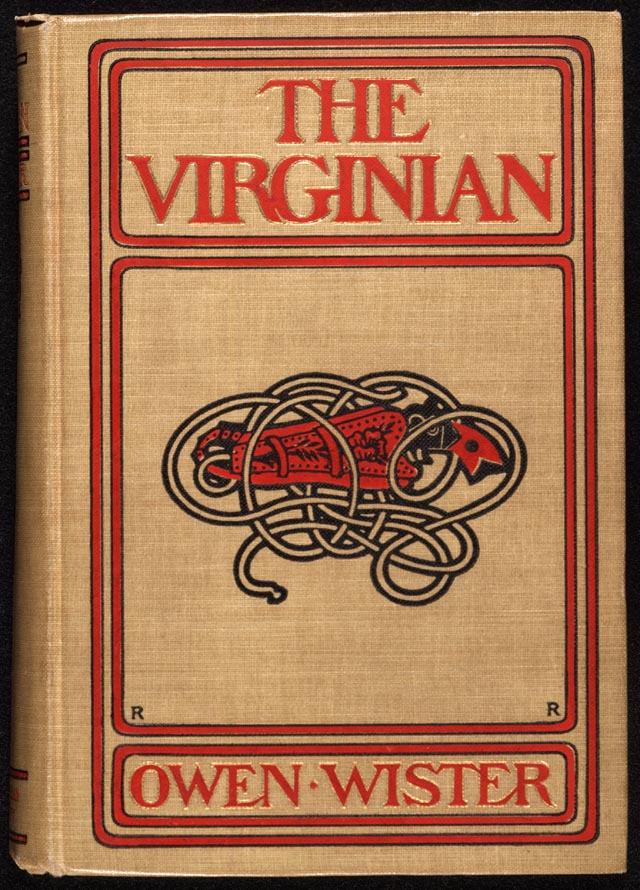
Worth a Thousand Words: The Virginian cover

Via mardecortésbaja.com's post about the novel

Faith Under Fire by Matthew Archbold

Faith Under Fire: Dramatic Stories of Christian CourageFaith Under Fire
Dramatic Stories of Christian Courage by Matthew Archbold

My rating: 5 of 5 stars

The stories in this book reveal a world that can seem increasingly dark, and I fear that things will grow darker still in the years to come. And yet these stories also reveal what happens when darkness encounters light: The light is not extinguished at all. It just appears brighter in the advancing darkness. ...

This is not a book about a gunman who attacked a schoolhouse; it's about the little girl who sacrificed herself for her classmates. This book isn't about abortion, but about the doctor who dedicated his life to helping women with crisis pregnancies. And this isn't about the radical terrorists who kill, but about those who choose love over life.

This is a book about hope and faith and light, and while it includes some terrible events, in the end it is, I believe, a hopeful book about love in a world that's often surprised and sometimes even opposed to those who show it.
Part of what attracted me to this book was the fact that these are modern people, not canonized saints but saints-in-training as we might say. It has not only the dramatic stories mentioned above but those about a man who prays the rosary, a baker who loves his work, and a basketball player getting to play her first NCAA game. Some stories made me cry and some seemed all too familiar, but all of them inspired me.

Matthew Archbold has a real talent for telling these stories with sincerity but without pathos. He helps us see how these stories connect with our own lives, whether through his introductions or the three discussion questions that close each chapter. And that makes us realize that we too are saints-in-training, called to stand up for our faith under fire, even if just in the very small ways that present themselves in everyday life.

Faith Under Fire is everything the author mentions in his introduction quoted above. Read it.

"Voting third party is the most effective way for you to bring about a change of regime."

If there were a morally acceptable candidate offered by either major party, of course you could vote for that person in clear conscience. There isn’t, and therefore many people are settling for choosing the least-bad candidate.

Don’t do this.

Vote third party.

Why?

Voting third party is the most effective way for you to bring about a change of regime.

...

When you vote third party, you send a clear, unequivocal message that is formally recorded and measured. You indicate to the major parties, and to the rest of the citizenry, which way the reform needs to go in order to field a winning candidate.
Yes.

Yes, yes, yes, yes, yes.

Read it all at Sticking the Corners. No one can lay out a well reasoned, reasonable, Catholic argument like Jen Fitz.

My husband, Tom, points out that when we voted for Ross Perot, Bill Clinton received a clear message. When he won the presidency he didn't do it with a majority. Tom feels that was a major factor contributing to Clinton's consensus building.

Plus, the more I read about my third party candidate of choice, the more he reminds me of Calvin Coolidge. I love me some Silent Cal.

It's nice to be excited about a candidate again ... even if I know he won't win.

Saturday, July 30, 2016

In which we meet Jules and Madame Verne ...

... avoid an international incident over a compliment,and take a risk to send a message. More of Around the World in Seventy-Two Days by that intrepid reporter, Nellie Bly, at Forgotten Classics podcast.

The Movie I Want to See: Hacksaw Ridge


“Hacksaw Ridge” tells the true story of Desmond Doss, a devout Seventh-day Adventist who became the first conscientious objector to win the Medal of Honor. See the cross in the smoke? Nice.

This movie is directed by Mel Gibson who isn't mentioned by name, such is Hollywood's memory (and possibly, I guess, that of the general public). They do say from the director of Braveheart and The Passion of the Christ.

Via Deacon Greg Kandra, read more about Desmond Doss here.

Here's the trailer, which will have to hold us until the movie comes out in November.

Friday, July 29, 2016

Blogging Around: Democrats and the Ideology of Death

The Week I Left the Democratic Party

A lifelong Democrat with a powerful story about what his child would have heard on TV from the Democratic convention. And why it made him quit the party.
But remember, politics are about stories. And this week, I watched as Ms. Ilyse Hogue, president of NARAL Pro-Choice America stood before the convention assembly describing her own decision to have an abortion. She wanted a family but the child came at the wrong time. So she sought out an abortion. And she acknowledged that now she is the mother of two beautiful children. ...

I was reading the story online next to my three-year old son, who is adopted. I couldn’t help but put myself in his very small shoes and begin to wonder what he would have heard from this speech. Children who come at the wrong time are best disposed of. Only children who come into our lives when we want should be kept. It’s the beautiful children who are planned. In the midst of a speech that talked about unplanned pregnancies, no mention was made of adoption. The Democratic Party’s pro-choice politics have blinded it from the dignity of this little creature of mine, who though “unplanned,” has also transformed the life of every adult he’s met. No suggestion was made that instead of funding abortion, let’s make adoption part and parcel of our social culture—where every human person, no matter his or her size, has the opportunity for human flourishing. If anyone can be president, as this convention has said again and again, shouldn’t it also be the case that unplanned children may also occupy this office?
Read the whole thing here.

Is There Such a Thing as Pro-Life Democrat?

Sure enough. Here's an interview with the Executive Director of Democrats for Life. Here's a sample.
Q: Hillary Clinton’s running mate is Tim Kaine, who describes himself as a “traditional Catholic” but a “strong supporter of abortion.” Isn’t that a contradiction?

While we cannot comment on Mr. Kaine’s belief system, we have seen others who regret accepting the Democratic “party line” on abortion.

John Kerry reflected on this after he lost the 2004 election. At a speech at Pepperdine University. He said,

How will we protect the weakest in our midst—innocent unborn children? How will our nation resist what Pope John Paul II calls a “culture of death”? How can we keep our nation from turning to violence to solve some of its most difficult problems—abortion to deal with difficult pregnancies; the death penalty to combat crime; euthanasia and assisted suicide to deal with the burdens of age, illness, and disability; and war to address international disputes?”

It was a few years after his presidential campaign that he understood the contradiction of failing to let your faith guide your decisions. If he had presented those thoughts during his run for office, the outcome might have been very different.

In addition, in an interview years after he served, Democratic President Jimmy Carter expressed regret that he had not embraced a pro-life position while in office. It was one of the few troubling positions he later felt remorse over.

Well Said: Choosing between two philosophies

Never forget that there are only two philosophies to rule your life: the one of the cross, which starts with the fast and ends with the feast. the other of Satan, which starts with the feast and ends with the headache.
Fulton Sheen

Worth a Thousand Words: Kim Novak Reads

Kim Novak reads
via Awesome People Reading

Thursday, July 28, 2016

Worth a Thousand Words: La Siesta

La Siesta, 1841, Franz Xaver Winterhalter

Well Said: What is serious to men ...

What is serious to men is often very trivial in the sight of God. What in God might appear to us as “play” is perhaps what he Himself takes most seriously. …

When we are alone on a starlit night; when by chance we see the migrating birds in autumn descending on a grove of junipers to rest and eat; when we see children in a moment when they are really children; when we know love in our own hearts; or when, like the Japanese poet Bashō we hear an old frog land in a quiet pond with a solitary splash – at such times the awakening, the turning inside out of all values, the “newness,” the emptiness and the purity of vision that make themselves evident, provide a glimpse of the cosmic dance.
Thomas Merton
A helpful antidote to the politics, terrorism, and whatever else is weighing us down at the moment.

Like Coloring Books? Like the Rosary? You're Gonna Love This!


This unique coloring book contains thirty illustrations—fifteen full-page drawings of the mysteries of the Rosary, each one beautifully bordered by traditional images of animals and flowers; twelve vignettes featuring prophets, evangelists, and Fathers of the Church; and three larger drawings with the artist’s commentary. It also contains descriptive copy written by the author for the three sets of Mysteries.
I've been a fan of Daniel Mitsui's art for a long time and I know he's got coloring pages at his website. The Mysteries of the Rosary book seems like the natural next step, what with the adult coloring trend.

Honestly, I don't think you need to be an adult to enjoy these. I recall in the 1970s there was a similar craze, with huge, intricate pictures to color. Everyone of all ages did them.

His The Saints coloring book will be out in November. Just in case you want to preorder a great Christmas gift.

Wednesday, July 27, 2016

The Virginian by Owen Wister

The Virginian: A Horseman of the PlainsThe Virginian: A Horseman of the Plains by Owen Wister

My rating: 5 of 5 stars


I read this when I was a teenager and recall liking it well enough. Having just watched High Noon and Rio Bravo , I wanted more Westerns. The Virginian is often mentioned in connection with High Noon, believe it or not, AND Gary Cooper starred in that movie also. So that impetus carried me into downloading the free Kindle version from Amazon.

What I was unprepared for is how marvelous this book is. It is, strictly speaking, a Western but it didn't feel like any Zane Gray or Louis L'Amour story I've read. There are cow-boys (love that spelling), guns, horses and the hauntingly beautiful isolation of the Wyoming range. But amidst those trappings is a wonderful character study told in surprisingly contemporary writing.

Initially told by a tenderfoot who reappears periodically, the story is held together by the Virginian's wooing of schoolteacher Molly Wood. Molly comes from Vermont, so between the two newcomers, we gradually learn the Virginian's character and life lessons which it does us all good to remember. All done in a whopping good tale. Highly recommended.

Worth a Thousand Words: Moonlight on the Water

Moonlight on the Waters, Frank Weston Benson
This makes me think of those glorious days when Tom's parents would rent a beach house at Galveston and hold open house for the family for a month. I was continually renewed by the sound of the waves, the glint of light on the water, the life in and around the ocean.

Tuesday, July 26, 2016

The blood of the martyrs is the seed of the church - Tertullian

Father Jacques Hamel (Photo: AFP)

Eternal rest grant unto him, O Lord, and let perpetual light shine upon him.

Jacques Hamel, pray for us.


--------------------------------------------


Sohrab Amari is an editorial writer for the Wall Street Journal. 

Welcome, brother.

Worth a Thousand Words: Proud Mother and Her Babies

Proud Mother and Her Babies
taken by Remo Savisaar

2016 Politics and Heaven on Earth

We can't control politicians, Facebook commenters, our friends, or our family. We can only control ourselves. And actions speak louder than words. Are we, as Christians, shedding light or heat, creating heaven or hell on earth?

Krassotkin
The thing to remember is he was your dad and your children’s grandpa before he was a Trump supporter. Politicians come and go but your dad will always be your dad. ...

You want peace? Initiate it. Call up your dad right now and tell him you love him and hate the tense situation between you two. Tell him you miss him and that his grandkids miss him and you want him over for dinner. Just dinner. No ulterior motives like trying to “change his mind about Trump.” Just dinner.
Really good advice from Katrina Fernandez in response to a letter from a divided family.  Be sure to read the whole thing.

If they can follow that advice it will be like a little bit of heaven on earth. There is so much that divides us, makes us angry, makes us fear, makes us treat each other as less than human. To celebrate what unites us is truly heavenly.

Here's how naive I am. I thought that posting this sensible advice on Facebook would be welcome. People would be happy for this little reminder of the important things in life.

Instead comments became a one-note judgment of people who support a "hate talker" like Donald Trump. If that meant cutting off family or friends, well, they earned it.

How can you say, 'Brother, let me take the speck out of your eye,' while you yourself fail to see the beam in your own eye?  (Luke 6:42)

I was truly stunned at this response. In vain did I quote Jesus on judging your brother. I'm just sayin' - we all have faults and there is no perfect candidate or party. The advice does say to eschew political talk so this was just about tolerating the presence of the person, not their political views.

Worst of all, to me, was watching people assume a candidate was supported only because of the lowest common denominator. Because this person saw Trump as promoting hate, she assumed that everyone supporting him is tolerant of hate speech. That assumption resulted in her endorsement of summary judgment and shunning of anyone who didn't agree.

That's equivalent to saying that the only reason women support Hillary is because they want to see a woman become president. Girl power, yeah! I've actually been told that.

And they'll all fight to the death to prove themselves right.

This is such a temptation that the author of that very good advice couldn't resist stopping by for a few  political statements. Which served to rile up everything again.

(Do we all remember that I am either not voting or voting for someone else entirely?)

Eventually I removed the post from Facebook.

Both sides want to make the world a better place, dare I say a "heaven on earth," but this is about as opposite as you can get. Welcome to hell, people. 

For all have sinned, and come short of the glory of God. (Romans 3:23)

None of us are immune. I discovered I'm just as bad thanks to the Democratic "taco bowl" email.


This looks incredibly racist and many have jumped on it as such.

To my great shame, I myself really enjoyed the idea of how the "no tolerance" for  Trump supporters person would react to this news.

However, it turns out we probably don't have the proper context. Donald Trump posed with a taco bowl on Cinco de Mayo — the day before that email was dated. So the "taco bowl" comment probably was about trying to get Latino votes through the Trump photo.

Context is everything. I sure am glad I didn't give into that literally unholy desire to one-up someone for a cheap victory. I don't want to add to the ugliness of the world or to my own soul.

And that is my point.

Few things are as simple as one thinks. People are complex. Their reasons for voting are likely based on something you don't have any notion about, especially if they are voting for someone you dislike.

Your actions speak so loudly, I can not hear what you are saying. (Ralph Waldo Emerson)

These days, we don't have a culture any more of keeping our mouths shut if we disagree with each other. And it's not enough to simply state one's view. We keep pounding away until everyone agrees with us. And the other side pounds back. That's a never ending cycle.

Let's look at this political season as a chance to relearn a little discipline.  And maybe create a little heaven on earth.

Silence is golden.

Politics are fleeting.

Family and friends are forever.

What are our actions saying to those around us? What does it say about us to advocate the rightness of a political party while casting off  family and friends? Especially what does it say about those of us who are Christians? Are we following in the footsteps of our Lord who ate with sinners?

There is no heaven on earth without human contact and connection.

What sort of place will we create with our actions?

Monday, July 25, 2016

I Will Fear No Evil

This was sent by a German friend after the attacks in Munich last week. It is almost getting to be a daily event to read about an atrocity committed on innocents, whether in Germany, Libya, France, Japan, or close to home.
THE SECOND COMING
William Butler Yeats (1865-1939)

Turning and turning in the widening gyre
The falcon cannot hear the falconer;
Things fall apart; the centre cannot hold;
Mere anarchy is loosed upon the world,
The blood-dimmed tide is loosed, and everywhere
The ceremony of innocence is drowned;
The best lack all conviction, while the worst
Are full of passionate intensity.

Surely some revelation is at hand;
Surely the Second Coming is at hand.
The Second Coming! Hardly are those words out
When a vast image out of Spiritus Mundi
Troubles my sight: a waste of desert sand;
A shape with lion body and the head of a man,
A gaze blank and pitiless as the sun,
Is moving its slow thighs, while all about it
Wind shadows of the indignant desert birds.

The darkness drops again but now I know
That twenty centuries of stony sleep
Were vexed to nightmare by a rocking cradle,
And what rough beast, its hour come round at last,
Slouches towards Bethlehem to be born?
No wonder he sent this poem. We all feel the despair it expresses.

I read it out loud to my husband. He responded with: "Yea, though I walk through the valley of the shadow of death, I will fear no evil: for thou art with me."

That surprised me because it isn't his way. It was what I needed to hear, so I share it with you.
The Lord is my shepherd; I shall not want.

He maketh me to lie down in green pastures: he leadeth me beside the still waters.

He restoreth my soul: he leadeth me in the paths of righteousness for his name's sake.

Yea, though I walk through the valley of the shadow of death, I will fear no evil: for thou art with me; thy rod and thy staff they comfort me.

Thou preparest a table before me in the presence of mine enemies: thou anointest my head with oil; my cup runneth over.

Surely goodness and mercy shall follow me all the days of my life: and I will dwell in the house of the Lord for ever.
It is what we cling to more and more these days. God with us, Christ-Emmanuel, hear our plea.

Genesis Notes — The Woman: Both Blessed and Suffering

GENESIS STUDY
The Annunciation - Luke 1:26-38
The Visitation - Luke 1:39-56
The Presentation in the Temple - Luke 2:22-35
The Wedding at Cana - John 2:1-11
The Crucifixion - John 19:25-27
A Vision of Heaven - Revelation 12:1-7

We are still breaking away from Genesis with Genesis: God and His Creation to look at the answer to the promise that the woman and her seed would defeat God's enemy. I strongly encourage anyone interested to get this study and read Lessons 6 and 7 for themselves. As if these scenes aren't powerful enough on their own, looking at their connection to Genesis adds such depth of meaning that it takes my breath away. This is the sort of thing where I see the "proof" that the Bible is divinely inspired.
Jan de Molder, The Visitation

The Visitation - Luke 1:39-56
Elizabeth "was filled with the Holy Spirit." Her utterance has the power of prophecy. In blessing Mary and the Child in her womb, Elizabeth gives voice to what all creation would want to sing out with "a loud cry" at the coming of the "woman" and her "seed" promised so long ago. Notice that Elizabeth does not separate the Child from His Mother. Her blessing is on both of them together. Her reverence is for both of them when she humbly asks why she should be the glad recipient of a visit from "the mother of my Lord." Even the child in her own womb, John the Baptist, leaps for joy when he hears Mary's voice. So closely are Mother and Child linked in this passage that the sound of Mary's voice is enough to produce rejoicing in the prophet-in-utero. John and his mother, Elizabeth, represent Israel, waiting for Messianic consolation. Jesus and His Mother, Mary, are God's comfort for His people. They are the flesh-and-blood icon of the Woman and her Seed from Genesis.

Menologion of Basil, Presentation of Jesus at the Temple

The Presentation in the Temple - Luke 2:22-35
And now in this passage we learn from Simeon that the Mother will also share in the suffering of the Son ("a sword will pierce through your own soul also"). Were we prepared in Gen. 3:15 for the possibility of suffering?

Yes, we were. We could anticipate a ferocious battle between the serpent and the seed of the woman, both inflicting wounds on the other. The suffering shouldn't surprise us. But how and why would Mary share in this suffering?

We must remember that Jesus opened up to all His followers the possibility of sharing in His suffering for sinners. His call to those who would follow Him to take up their crosses daily represented a call to obedience to God's will, no matter what, AND an invitation to suffer for sinners. That is what the Cross meant to Jesus. "While we were yet sinners, Christ died for us." (Rom. 5:8) He intended to make it possible for all who belong to Him to join Him in that redemptive suffering (see CCC 618) ...

Simeon's prophecy to Mary makes it clear that she was the very first Christian to share in His suffering for sinners. Her place in this is unique, of course, because of her unique relationship to Jesus and to God. It was not simply that His suffering would make her sad. Simeon's unusual words somehow place Mary there with Jesus on the Cross when the solider pierced Him through with a sword to make sure He was dead. She was the first one to be joined to Jesus in her suffering, but not the last. Down through the ages, the Church has called her children to join their human sufferings, in whatever form they experience them, to the perfect suffering of the Lamb of God on the Cross, Who takes away the sins of the world. Ever since the fall, suffering is inevitable. Remember that it is the lens that restores spiritual sight. The Cross teaches us not to shrink in fear from suffering but to actually rejoice-rejoice!!-in it. Why? Because through it we see God and ourselves in truth, through it we cry out to Him for mercy, and through it, the world is won back to Him.
This series first ran in 2004 and 2005. I'm refreshing it as I go. For links to the whole study, go to the Genesis Index. For more about the resources used, go here.

Worth a Thousand Words: Statue of Jean Althen

Statue of Jean Althen, Papal Palace Gardens, Avignon, Belinda Del Pesco

Well Said: Next of kin trouble

The young man was maybe in his close family. Nothing cold be worse than next-of-kin trouble. She'd heard that, though secretly she longed for kin of her own. Such trouble must be wonderful. Why did people not know their plights were lovely?
Jonathan Gash, The Year of the Woman

Thursday, July 21, 2016

Worth a Thousand Words: Putti in the Library of Congress

Library of Congress Great Hall. Detail of putti (gardener with a spade and a rake) on the Grand staircase

Voting FOR Someone — Updated

A vote for Hilary is a vote for Hilary. A vote for Trump is a vote for Trump. And a vote for Darrell Castle (WHO?) is a vote for Darrell Castle.

To say that my vote for Darrell Castle (WHO?) is a defacto vote for Hilary Clinton tries to deny me the right to vote for the best person running for president.
And a vote for Gary Johnson is a vote for Gary Johnson.

I've been honestly stuck between not voting at all and voting for one of two major candidates who do not reflect at all what I want to see from my beloved country's leadership.

Invariably, when I've said I was in a quandary about who to vote for, someone has always hissed in my ear, "Vote against [this person]."

I voted against in the last couple of elections and see where that got me? Supporting people I was less than crazy about while losing anyway.

Bethune Catholic's comment above realigned my priorities. Yes, vote for someone. They probably aren't perfect. After all, if you are Catholic there is no political party that is going to live up to your goals completely.

But it's a positive action that serves as a witness to the sort of leader I wish we had. And that's the best I can do.

UPDATE
I realized I need to clarify my position.

It's not about voting for either Trump or Johnson. I cannot stand Trump or Clinton and cannot in good conscience vote for either. So it comes down to no vote or voting for Gary Johnson.

Tuesday, July 19, 2016

James Beard's Favorite Meat Loaf

Super easy. Super good. Freezes well.

And ... bacon.

It's at Meanwhile, Back in the Kitchen.

Q: Why are Catholic bloggers such awful people?

Q: Why are Catholic bloggers such awful people?

Do you listen at Church on Sundays? We public Catholics are just as wretchedly in need of our Lord and Savior as anyone else. Some of us come across as very holy on the Internet, but really we aren’t, I promise you. Some of us splash our sins publicly, and in private are better people than you’d suspect. And there a few public Catholics who really are saints.

The willingness to speak about the faith in public is not a declaration that we are holy, it’s a declaration that God is holy. ...
Amen!

Jen Fitz's Behind the Scenes in Catholic Blogging is a great piece that answers many questions about writing and reading Catholic blogs. As always with Jen's posts, you get the unvarnished truth, charitably spoken, usually with a great deal of interwoven humor.

I am pleased to a ridiculous level to be included on Jen's short list of must read blogs ... and even more pleased to be the example for her caveat. (Yes, that's how I roll.)
The shortlist isn’t a canonization or a fullproof guarantee. Julie Davis engages the wider culture extensively, and you probably shouldn’t watch every movie she watches. One of the great things about Julie’s blog is that she sifts through the noise to bring you the true, beautiful, and good so that you don’t have to.
Anyway go read it. Good stuff there ...

Worth a Thousand Words: Uma Rua na Favela

Eliseu Visconti, Uma Rua na Favela, c. 1890

Lagniappe: Mr. F's Legacy and Mr. Pancks

A momentary silence that ensued was broken by Mr F.'s Aunt, who had been sitting upright in a cataleptic state since her last public remark. She now underwent a violent twitch, calculated to produce a startling effect on the nerves of the uninitiated, and with the deadliest animosity observed:

"You can't make a head and brains out of a brass knob with nothing in it. You couldn't do it when your Uncle George was living; much less when he's dead."

Mr Pancks was not slow to reply, with his usual calmness, "Indeed, ma'am! Bless my soul! I'm surprised to hear it."
Charles Dickens, Little Dorrit
Mr. Pancks is one of my favorite characters in Little Dorrit. The first notice we have of his well meaning nature is the way that he knows how to deal with Mr. F.'s Aunt, who clearly is suffering from some form of dementia.

Having known several similarly afflicted elderly people, I applaud his tactics.

Monday, July 18, 2016

Worth a Thousand Words: Herdsman with Resting Cattle

Herdsman With Resting Cattle, Jacob van Strij

Well Said: All is in Little

I am one of those who believe that all is in little. The child is small, and he includes the man; the brain is narrow, and it harbors thought; the eye is but a point, and it covers leagues.
Alexandre Dumas, Camille

Genesis Study — The Woman: Full of Grace

The Annunciation - Luke 1:26-38
The Visitation - Luke 1:39-56
The Presentation in the Temple - Luke 2:22-35
The Wedding at Cana - John 2:1-11
The Crucifixion - John 19:25-27
A Vision of Heaven - Revelation 12:1-7

This is where Genesis: God and His Creation breaks away from what would typically be considered a study of the book of Genesis. They take the time to examine the answer to the promise that the woman and her seed would defeat God's enemy.

This section concentrates on Mary as "the woman" and it is perfect timing when you consider that we also are in the count-down to the Feast of the Immaculate Conception. Veneration of Mary is one of the most Catholic of beliefs and is arguably the one most non-Catholics have problems with. Perhaps these snippets of the Catholic Scripture Study will aid in understanding. Certainly they opened my eyes even further to the fact that God had Mary in His plan from the beginning.

When Catholics study the Bible they recognize that the Old Testament holds truths that lead to the New Testament. This acknowledges that Scripture has many levels of meaning and often "types" of people shown early on are "types" that foreshadow the revelations of the New Testament. Two people who we see "types" of again and again are Mary and Jesus and never more than when studying "the woman and her seed." I found this whole concept really fascinating when I discovered it.

Henry Ossawa Tanner, The Annunciation, 1898
The Annunciation - Luke 1:26-38
"Hail, full of grace, the Lord is with you!" shows why Catholics venerate Mary. She gave herself entirely over to God and with her humble obedience made it possible for Our Savior to be born. I remember being astounded by the idea that Mary was the New Eve but the logic made impeccable sense.
Mary's humble obedience in her fiat made possible the Incarnation. No one has described it more beautifully than St. Iraenaeus (c. 140/160-202 A.D.), who was Bishop of Lyons:
Even though Eve had Adam for a husband, she was still a virgin... By disobeying, she became the cause of death for herself and for the whole human race. In the same way, Mary, though she also had a husband, was still a virgin, and by obeying, she became the cause of salvation for herself and for the whole human race... The knot of Eve's disobedience was untied by Mary's obedience. What Eve bound through her unbelief, Mary loosed by her faith. (from Adversus haereses, quoted in Mary and the Fathers of the Church by Luigi Gambero; Ignatius, 1999, pg. 52).
Just as Eve's participation in the fall of man was real, although the sin was charged to Adam, so Mary's participation in our redemption was quite real, although the victory was won by her Son.

It seems entirely logical and reasonable that if God created a male and a female to preside as the first parents over all creation, He would also place a male and female in special roles over re-created humanity. In addition, the very fact that God promised to defeat the serpent through a "woman" and her "seed" proves that He wants a male and female to begin the restoration. To see Mary as the New Eve was a very natural development in early Christianity. In fact, we have evidence of it in the writings of the very first great Christian apologist, Justin Martyr (c. 110-165 A.D.). In his defense of the faith in Dialogue with Trypho, he writes this way:
[The Son of God] became man through a Virgin, so that the disobedience caused by the serpent might be destroyed in the same way it had begun. For Eve, who was virgin and undefiled, gave birth to disobedience and death after listening to the serpent's words. But the Virgin Mary conceived faith and joy; for when the angel Gabriel brought her the glad tidings that the Holy Spirit would come upon her and that the power of the Most High would overshadow her, so that the Holy One born of her would be the Son of God, she answered, "Let it be done to me according to your word" (Lk 1:38). Thus was born of her the [Child] about whom so many Scriptures speak, as we have shown. Through him, God crushed the serpent, along with those angels and men who had become like serpents. (Quoted from Mary and the Fathers of the Church, by Luigi Gambero, Ignatius, p. 47)
It is important to understand that Justin Martyr was writing a defense of the Christian faith against attacks from the Jews and pagans. He was not developing new theological insight, since he was actually a layman. He was only defending what the Church believed and taught at that early time in her history. The development of Marian thought was as early as the development of the doctrine of the Trinity, which is another example of a truth which is only implicit in Scripture (since the word "Trinity" never appears) being made explicit over time. Time is not the enemy of truth. The question is not whether a doctrine took time to develop but whether the seed of that doctrine was contained in the gospel preached and taught by the apostles.
This series first ran in 2004 and 2005. I'm refreshing it as I go. For links to the whole study, go to the Genesis Index. For more about the resources used, go here.

Saturday, July 16, 2016

Aquilina and Tolkien on the Creation of the Universe

Two of my favorite authors ... together! Mike Aquilina looks at the answer to a question about J.R.R. Tolkien's Silmarillion.
I was a teenager when The Silmarillion appeared in print. I wasn’t much of a reader at the time, but a friend of mine, Ron, was fanatically invested in Middle-Earth. His copy of the book, not yet a week old, was already worn and its cover creased.

Ron was a big guy, and he’d already spent time in juvenile detention. So I complied when he insisted that I sit down, shut up, and listen as he read the entire creation account aloud. He read with more passion than I could muster for anything but food and baseball.

The moment stayed with me. The narrative stayed with me. I remembered my friend’s declamation when, just this year, a reader, deeply moved by the same passage, posted a question in an online forum for Tolkien fans. He asked if Tolkien’s work had been based on any “real creation myths.”
Of course the answer is yes. But it goes deeper than I'd realized. Read it all. Via Brandon Vogt.