Scott and I dive into the trilogy Kristin Lavransdatter with The Wreath (book 1) - episode 372 of A Good Story is Hard to Find. Join us!
Tuesday, February 10, 2026

Lenten Reading: The Big List of Nonfiction
Here's the big list of nonfiction for Lent. We'll begin with the one I'll be reading during Lent.

Meditations and Catechesis on Psalms and Canticles
 Fearfully and Wonderfully Made by Dr. Paul Brand and Philip Yancey
The Marvel of Bearing God's Image
Three in one — an inspiring science book, wide-ranging meditations on the body of Christ, and human stories that illuminate both. Ultimately a powerful experience of illuminating God's love and our role as part of his body.

 The Light of Christ: An Introduction to Catholicism by Thomas Joseph White
Do you want a good dose of philosophy with your Catholic faith? Here's the book for you. Looking for something lighter than Edward Feser, but that still had intellectual depth, I noticed this title continually popping up in my searches. So glad I did because it is exactly what I wanted ... though the discussion of the Trinity caused a bit of brain paralysis, but that's no different than my reaction to any other deep look at the Trinity. It's been a long time since I've had to think in such a different way. All this is without ignoring the questions that Catholicism raise in modern life. This isn't necessarily easy reading but it is really rewarding. Truly this is a great book. (My review here.)

 7 Men: And the Secret of Their Greatness
7 Women: And the Secret of Their Greatness
by Eric Metaxas
The stories of seven men who lived their lives in ways we can admire. Or women, depending on which book you read. Each contains short biographies of a diverse group of people that pack in a lot of information . Each story turns on the fact that they surrendered themselves to God and sacrificed themselves in some way for the greater good.
The men range from George Washington to Jackie Robinson to Chuck Colson. Women range from Joan of Arc to Rosa Parks to Mother Teresa. Plus some in each group that you probably haven't heard of.
Metaxas isn't heavy handed but he doesn't shy away from occasionally raising points that encourage the reader to look deeper within his (or her) own heart. I found each very inspirational. My review of 7 Men is here.
 A Song For Nagasaki by Fr. Paul Glynn
The biography of Takashi Nagai, a young Catholic Japanese doctor who lived through the bombing of Nagasaki and became an inspiration for spiritual healing for his people. Paul Glynn combines vivid descriptions, character insights, and just enough Japanese history so that we have context.
As a result I wound up admiring the Japanese people even more than I did already. I never realized how many of the Japanese ideals combine with saintly living, especially as seen through Takashi Nagai's eventful life.
My review here.
 The Bells of Nagasaki by Takashi Nagai
Among the wounded on the day they dropped the bomb on Nagasaki was a young doctor who, though sick himself cared for the sick and dying. Written when he too lay dying of leukemia, The Bells of Nagasaki is his account of the experience.
It is deeply moving story of faith under extraordinary conditions.
My review is here.
 The Smile of a Ragpicker by Fr. Paul Glynn
Satoko Kitahara came from a wealthy home and encountered the Catholic faith when she wandered into a church one day and saw a statue of Mary. As a convert, she lived her faith so completely that she is still a well known heroine for Japanese of all religious persuasions. Striving to follow Christ fully she wound up becoming the "Mary of Ants Town," living with with the destitute in a shanty town in a public park where subsistence living came from ragpicking.
On a personal level I cannot stress enough the effect this gentle saintly girl's story continues to have on me. I won't go into details here but her honesty in her spiritual journey, her complete faith and dedication, and her love of Mary affected me deeply. My review is here.
 To Whom Shall We Go? by Archbishop Timothy Dolan
In To Whom Shall We Go, we are reminded of all St. Peter's strengths, weaknesses, joys, and sorrows. In short, we are shown his humanity as he follows Jesus in the Gospels and Dolan points out how our own natures are reflected in therein as well.
This is a simply fantastic book and I say that as a person who has never been particularly interested in St. Peter.
My review here.
 Gospel of Mark, The (Catholic Commentary on Sacred Scripture) by Mary Healy
This is a really great commentary. Healy is excellent at putting the scripture in context, whether in reference to the context of people of the time, to other scripture, or for our own lives. Sometimes I was enlightened by the factual information which gave me new insights into the text. Sometimes it was from the material for reflection. However, it was a rare day that I failed coming away with an insight that I pondered the rest of the day. My review is here.
I've found a lot of the Catholic Commentary series book very rewarding, regardless of who the author is. So just dive in.
 Teresa of Avila: God Alone Suffices by Jean Jacques Antier
This book had both insights about Teresa and historical context. It was really a wonderful book. My review is here.
Toward the end of his life and pontificate, John Paul II began a series on of homilies on the psalms and canticles of morning prayer in the Liturgy of the Hours. He had begun working his way through those used in evening prayer when he died. His successor, Pope Benedict XVI, picked up the series for his Wednesday homilies.
I reviewed the collection of homilies for mornings because that's all that was published in this country at the time. This book has the complete collection of morning and evening. Each entry is a wonderful combination of brief, accessible, and rich. Perfect for Lenten reading. You can read my review here.
The Marvel of Bearing God's Image
Three in one — an inspiring science book, wide-ranging meditations on the body of Christ, and human stories that illuminate both. Ultimately a powerful experience of illuminating God's love and our role as part of his body.
This book connects strongly with the Gospels and Christ's admonition to love each other, especially in the needy. Society of St. Vincent de Paul members will find it especially meaningful but everyone can take inspiration from this example of living the Gospel. (My review here.) In Conversation with God: Meditations for Each Day of the Year by Francis Fernandez
Vol. 2: Lent Holy Week Eastertide
This is part of a series of seven devotionals, with entries for every day of the liturgical year as well as two volumes devoted to special feast days. I discovered these soon after I converted and reading them daily for at least four years was deeply formative. Over twenty years later, I still dip in and out of them, depending on what else I'm reading. I cannot recommend these books too highly. I know of no other books which do such a good job of showing how to live an authentic Christian life.
 Introduction to the Spiritual Life: Walking the Path of Prayer with Jesus by Brant Pitre
 Roman Pilgrimage by George Wiegel
From Ash Wednesday through Divine Mercy Sunday, Catholics go to the Roman "station church" assigned for that day's Mass as a pilgrimage.
This framework provides a wonderful daily devotional for Lent, complete with photos and a page of information on each church. It is much more than a simple set of devotional reflections, however. Mass readings and the Office of Readings from the Liturgy of the hours are interwoven in an insightful commentary. Weigel doesn't stop there. He includes papal comments, saints' stories and quotes, and much more. I have used this book for several years during Lent and it is extremely rewarding. (My review here.)
Vol. 2: Lent Holy Week Eastertide
This is part of a series of seven devotionals, with entries for every day of the liturgical year as well as two volumes devoted to special feast days. I discovered these soon after I converted and reading them daily for at least four years was deeply formative. Over twenty years later, I still dip in and out of them, depending on what else I'm reading. I cannot recommend these books too highly. I know of no other books which do such a good job of showing how to live an authentic Christian life.
The one most people have tried is the Lent/Easter book but the one I began with was for midsummer. I soon bought all the others. I probably will be dipping into this one throughout Lent and Easter. (My review here.)

This is a truly inspirational book. As he loves to do, Pitre is tracing the roots of practices and understanding from Judaism to Jesus to the Christian spiritual classics. This, of course, gives the reader depth and context which in itself is eye opening. However, as each section ends in the classics, we are given solid advice about how to apply ourselves to each particular step of the spiritual life.
That is what this book is all about, after all, the spiritual life. It ranges from forms of prayer to major temptations, from spiritual exercises to the seven capital sins, from how to meditate on scripture to how to hang on when nothing seems to be working (that's called the dark night of the soul). (My review here.)

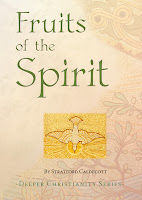
Fruits of the Spirit by Stratford Caldecott
Small but packs a powerful punch.
Book description, which I can't improve upon: This booklet explores the imagery of trees and fruitfulness in the Bible, and offers a sketch of Christian morality based on the relationship of spiritual fruits to the four cardinal virtues and the three theological virtues. The result is a kind of rough map, a guidebook of sorts to a life in the Spirit, inspired by teachings that we find in Holy Scripture and in the Catechism of the Catholic Church.
From Ash Wednesday through Divine Mercy Sunday, Catholics go to the Roman "station church" assigned for that day's Mass as a pilgrimage.
This framework provides a wonderful daily devotional for Lent, complete with photos and a page of information on each church. It is much more than a simple set of devotional reflections, however. Mass readings and the Office of Readings from the Liturgy of the hours are interwoven in an insightful commentary. Weigel doesn't stop there. He includes papal comments, saints' stories and quotes, and much more. I have used this book for several years during Lent and it is extremely rewarding. (My review here.)

For the Life of the World by Alexander Schmemann
The author was an Eastern Orthodox priest but any Christian can get a
great deal of insight and inspiration from this wonderful book. He looks
at the connection between daily life and the sacraments and liturgy of
the church. As a result, we are repeatedly drawn into fresh realizations
about how present God is in everyday life ... and how connected that is
with the liturgy.
One of the most inspirational books I've ever read. My full review is here.

Do you want a good dose of philosophy with your Catholic faith? Here's the book for you. Looking for something lighter than Edward Feser, but that still had intellectual depth, I noticed this title continually popping up in my searches. So glad I did because it is exactly what I wanted ... though the discussion of the Trinity caused a bit of brain paralysis, but that's no different than my reaction to any other deep look at the Trinity. It's been a long time since I've had to think in such a different way. All this is without ignoring the questions that Catholicism raise in modern life. This isn't necessarily easy reading but it is really rewarding. Truly this is a great book. (My review here.)


7 Women: And the Secret of Their Greatness
by Eric Metaxas
The stories of seven men who lived their lives in ways we can admire. Or women, depending on which book you read. Each contains short biographies of a diverse group of people that pack in a lot of information . Each story turns on the fact that they surrendered themselves to God and sacrificed themselves in some way for the greater good.
The men range from George Washington to Jackie Robinson to Chuck Colson. Women range from Joan of Arc to Rosa Parks to Mother Teresa. Plus some in each group that you probably haven't heard of.
Metaxas isn't heavy handed but he doesn't shy away from occasionally raising points that encourage the reader to look deeper within his (or her) own heart. I found each very inspirational. My review of 7 Men is here.
The biography of Takashi Nagai, a young Catholic Japanese doctor who lived through the bombing of Nagasaki and became an inspiration for spiritual healing for his people. Paul Glynn combines vivid descriptions, character insights, and just enough Japanese history so that we have context.
As a result I wound up admiring the Japanese people even more than I did already. I never realized how many of the Japanese ideals combine with saintly living, especially as seen through Takashi Nagai's eventful life.
My review here.

Among the wounded on the day they dropped the bomb on Nagasaki was a young doctor who, though sick himself cared for the sick and dying. Written when he too lay dying of leukemia, The Bells of Nagasaki is his account of the experience.
It is deeply moving story of faith under extraordinary conditions.
My review is here.
Satoko Kitahara came from a wealthy home and encountered the Catholic faith when she wandered into a church one day and saw a statue of Mary. As a convert, she lived her faith so completely that she is still a well known heroine for Japanese of all religious persuasions. Striving to follow Christ fully she wound up becoming the "Mary of Ants Town," living with with the destitute in a shanty town in a public park where subsistence living came from ragpicking.
On a personal level I cannot stress enough the effect this gentle saintly girl's story continues to have on me. I won't go into details here but her honesty in her spiritual journey, her complete faith and dedication, and her love of Mary affected me deeply. My review is here.
In To Whom Shall We Go, we are reminded of all St. Peter's strengths, weaknesses, joys, and sorrows. In short, we are shown his humanity as he follows Jesus in the Gospels and Dolan points out how our own natures are reflected in therein as well.
This is a simply fantastic book and I say that as a person who has never been particularly interested in St. Peter.
My review here.
This is a really great commentary. Healy is excellent at putting the scripture in context, whether in reference to the context of people of the time, to other scripture, or for our own lives. Sometimes I was enlightened by the factual information which gave me new insights into the text. Sometimes it was from the material for reflection. However, it was a rare day that I failed coming away with an insight that I pondered the rest of the day. My review is here.
I've found a lot of the Catholic Commentary series book very rewarding, regardless of who the author is. So just dive in.

This book had both insights about Teresa and historical context. It was really a wonderful book. My review is here.
Other books about saints that I highly recommend — Apostle in a Top Hat (about Frederic Ozanam), Catherine of Siena by Sigrid Undset, and The Porter of St. Bonaventure's (about Solanus Casey).
Monday, February 9, 2026
Happy Catholic for Lent
I'll have a couple of posts featuring good books for Lent, but want to mention my books also.
They are all devotionals except for Thus Sayeth the Lord which helps make the prophets more accessible to our own lives today.


Stay By Me, Dear Friend - how to keep Jesus close through the day. In paperback.
Thus Sayeth the Lord: A Fresh Take on the Prophets - a fresh take on the prophets. In Kindle or softcover.
Seeking Jesus in Everyday Life - when I didn't really "know" Jesus as a friend, I wrote this book to help. In paperback.
Happy Catholic - kind of like the blog where interesting quotes are commented on for reflecton. In either softcover or Kindle / Nook format.
Lent Begins Next Week. Let's Enter in the Right Spirit
What will convince the world, and - infinitely more importantly - what will convince us of the validity of our faith and all the truth she professes is not comfort, not the statement that "this will make me happy," but the witness of those being happy when they have nothing but their faith. The rich, old, country club preacher saying grace is not much to rally around. But what hope there is in finding out that there is tremendous grace after a day without eating! What affirmation it is to learn that no, we do not believe because we are comfortable, we believe because it is true! To have the grace to praise God in our suffering!Now that's what I call the spirit of a Christian soldier marching onward into Lent. Maybe even running headlong.
Plus it's badass. There's just no other way to put it. What else can you call a Church that specifically sets aside 40 days for it's followers to make their own lives difficult? It's as if the government mandated that, for the month of May, alarm clocks were to be replaced with getting punched in the face, for the sole purpose that it would make you stronger, and appreciate alarm clocks more. The Church looks at her children and does not say 'how cute' - she says 'shape up'. "Oh you're rich, happy and full? Well for no other reason than that it will make you stronger, be poor, in pain and hungry." Aaaaaw snap. Where there is no pain, the Church requires it. Run that one over to the humanists, see what they think.
Marc at Bad Catholic, 40 Days of Baddassery
"... the witness of those being happy when they have nothing but their faith."
That's just the inspiration I need to make me think seriously about my Lenten penance ... and embrace it!
Sunday, February 8, 2026
Saint Josephine Bakhita — Sor Moretta ("little brown sister") or Madre Moretta ("black mother")

St. Josephine Bakhita is the patron saint of the Sudan, human trafficking survivors and of our foundation. You can see from the quote above that she truly saw things from a different point of view than the average person, certainly that I myself would have. In this she puts me in mind of Joseph from Genesis, although we are given many more details of her sufferings as a slave.
Saint Josephine Margaret Bakhita was born around 1869 in the village of Olgossa in the Darfur region of Sudan. She was a member of the Daju people and her uncle was a tribal chief. Due to her family lineage, she grew up happy and relatively prosperous, saying that as a child, she did not know suffering.
Historians believe that sometime in February 1877, Josephine was kidnapped by Arab slave traders. Although she was just a child, she was forced to walk barefoot over 600 miles to a slave market in El Obeid. She was bought and sold at least twice during the grueling journey.
For the next 12 years she would be bought, sold and given away over a dozen times. She spent so much time in captivity that she forgot her original name.
... when her mistress decided to travel to Sudan without Josephine, she placed her in the custody of the Canossian Sisters in Venice.
While she was in the custody of the sisters, she came to learn about God. According to Josephine, she had always known about God, who created all things, but she did not know who He was. The sisters answered her questions. She was deeply moved by her time with the sisters and discerned a call to follow Christ.
I remember I heard this inspiring saint's story some time ago on a daily saint podcast that is now defunct. I was especially surprised to hear that she died as recently as 1947, making the story of her tortures under slavery even more vivid as they were in what I think of as modern times.
I was really taken by her story and can't believe that I haven't mentioned her here before. Her story has much more to it and there are a variety of sources to draw from. Here are a few:
- Pope Benedict tells her story and puts her witness in perspective of hope in paragraph 3 of his encyclical letter Spe Salvi. (This is just a bit so do click through and read the whole paragraph. In fact, this is a good inspiration to read the encyclical.)
She too was loved, and by none other than the supreme “Paron”, before whom all other masters are themselves no more than lowly servants. She was known and loved and she was awaited. What is more, this master had himself accepted the destiny of being flogged and now he was waiting for her “at the Father's right hand”. Now she had “hope” —no longer simply the modest hope of finding masters who would be less cruel, but the great hope: “I am definitively loved and whatever happens to me—I am awaited by this Love. And so my life is good.”
- A good short telling of her life is at the link above to Catholic.org.
- A more indepth life story is at Wikipedia.
Saint Josephine, pray for us!
Here's an easy way to celebrate St. Josephine Bakhita's day, Make a dish that is found all over Africa — Palaver Chicken. It is delicious, easy, and (as is often the case in African dishes) peanutty! Tell her story while you eat. It is one that too few people know, including some in our own household!
2nd Sunday of Saint Joseph
Reflecting on St. Joseph on the seven Sundays leading up to his solemnity is an old tradition.
 |
| Christ in the House of his Parents, John Everett Millais |
The Virtues of St. Joseph
The Humility of the Holy Patriarch
Joseph the honest man, seeks God. Joseph, the selfless man, finds God. Joseph, the hidden man, delights in God's presence. (Bossuet, Second panegyric on St. Joseph) We need to follow the Holy Patriarch's presence in the course of our ordinary work. ...
The life of the Holy Patriarch was full of work from his time in Nazareth and Bethlehem, in Egypt and then once again in Nazareth. Everyone knew of Joseph because he was such a hard worker. He probably gave great importance to the development of a manly character, the type of character that sines through the episodes of the Gospels. Saint Matthew repeatedly shows us how promptly Joseph responded to whatever God was asking of him.
During those times in Palestine the job of a "carpenter required dexterity and wide-ranging talents. This tradesman was therefore well-respected in the community. He was responsible for the most varied manufacturing projects, from constructing farming implements to making home furniture. He needed to be adept with any number of tools and implements. He also had to be familiar with the properties of the various materials, their strengths, their endurance, their proper uses. ...
Although the Gospels have not recorded anything Saint Joseph ever said, they do nevertheless give us a clear picture of his life and works. This record should serve as a point of reference for us in our efforts to achieve sanctity in ordinary life. What is crucially important here is the sanctification of daily life, a sanctification which each person must acquire according to his or her own state, and one which can be promoted according to a model accessible to all people. (John Paul II, Apostolic Exhortation, Redemptoris custos.In Conversation with God,
Volume Six: Special Feasts: January - June
Friday, February 6, 2026
Confession
 |
| "Confession" by Wlastimil Hofman, 1906 |
Lent's coming, although you don't need to wait until it begins. This is a great reminder that confession is about meeting Jesus to talk over the things that get in the way of our meeting him more fully.
Prepping for Lent: Prayer, Fasting, Almsgiving
Let's get serious about the three distinguishing marks of Lent.
If you ever wondered why we have to fast, how giving to the poor is prayer, or how to better incorporate prayer into your Lenten life, then this series is for you.
It will help you get in the mindset to let God in deeper and to have a more meaningful Lent.
How do you know it’s Lent?No one explains Catholicism more understandably than Mike Aquilina. So it's only natural that I turn every year to his wonderful pieces about the basics of Lent:
It’s not so much by the ash mark on your forehead or fish marks on the calendar. Tradition tells us that Lent has three distinguishing marks: prayer, fasting and almsgiving.
This three-part series will examine those practices. Prayer is surely the best place to begin, because it’s the one that unites them all. Fasting and almsgiving are themselves just forms of prayer.
Mike Aquilina
If you ever wondered why we have to fast, how giving to the poor is prayer, or how to better incorporate prayer into your Lenten life, then this series is for you.
It will help you get in the mindset to let God in deeper and to have a more meaningful Lent.
Memorial of St. Paul Miki and Companions

I was always fascinated by the Asian martyrs, specifically in China and Japan since those were the ones I usually could find info about. After becoming more interested in Takashi Nagai (here and here), I have even more of an attachment to St. Paul Miki and his companions since they formed the foundation of the Christian community that Nagai belonged to later in history.
The description below is from Bert Ghezzi's Voices of the Saints which I read from every day. It is followed by an eyewitness account which is very moving and inspirational.

Here is the reading from today's Office of Readings in the Liturgy of the Hours. I love the way that we are told the eyewitness account of all the martyrs' bravery, trust, and love.St. Paul Miki, SJ ((1564? - 1597)
Christianity spread like wildfire in sixteenth-century Japan. By the 1580s, less than forty years after Francis Xavier introduced the faith, the church counted two hundred thousand converts. The growth had proceeded despite the opposition of Buddhist priests and many petty rulers. However, in 1587, Emperor Hideyoshi ordered the banishment of all Catholics, forcing the Jesuit missionaries to operate from hiding. But outright persecution did not break out until late 1596, when Hideyoshi rounded up twenty-six Jesuits, Franciscans, and laypeople and prepared to martyr them.
Among the victims was St. Paul Miki, a Jesuit novice who had just completed eleven years of training. Paul’s noble family was converted when he was a child and at age five he was baptized. Educated by Jesuits, the gifted youth joined their novitiate at age twenty-two. He had studied intensively the teachings of the Buddhists so as to be able to debate their priests. He welcomed his chance at martyrdom, but may have wished just a little that it would be delayed long enough for him to be ordained a priest.
Hideyoshi had the left ears of the twenty-six martyrs severed as a sign of disrespect and paraded them through Kyoto. Dressed in his simple black cassock, Paul stood out among them. Most onlookers realized that this noble young man could have worn the samurai’s costume with two swords on his belt. The whole display had the unexpected effect of evoking compassion from the crowd, some of whom later became converts.
The martyrs were then taken to Nagasaki. They were tied to crosses with their necks held in place by iron rings. Beside each was an executioner with his spear ready to strike. ... As they awaited death the entire group sang the canticle of Zachary (see Luke 1:67–79). The executioners stood by respectfully until they had intoned the last verse. Then at a given signal they thrust their spears into the victims’ sides. On that day, February 5, 1597, the church of Japan welcomed its first martyrs.
From an account of the martyrdom of Saint Paul Miki and his companions, by a contemporary writer. (Cap. 14, 109-110: Acta Sanctorum Febr. 1, 769)
You shall be my witnesses
The crosses were set in place. Father Pasio and Father Rodriguez took turns encouraging the victims. Their steadfast behavior was wonderful to see. The Father Bursar stood motionless, his eyes turned heavenward. Brother Martin gave thanks to God’s goodness by singing psalms. Again and again he repeated: “Into your hands, Lord, I entrust my life.” Brother Francis Branco also thanked God in a loud voice. Brother Gonsalvo in a very loud voice kept saying the Our Father and Hail Mary.
Our brother, Paul Miki, saw himself standing now in the noblest pulpit he had ever filled. To his “congregation” he began by proclaiming himself a Japanese and a Jesuit. He was dying for the Gospel he preached. He gave thanks to God for this wonderful blessing and he ended his “sermon” with these words: “As I come to this supreme moment of my life, I am sure none of you would suppose I want to deceive you. And so I tell you plainly: there is no way to be saved except the Christian way. My religion teaches me to pardon my enemies and all who have offended me. I do gladly pardon the Emperor and all who have sought my death. I beg them to seek baptism and be Christians themselves.”
Then he looked at his comrades and began to encourage them in their final struggle. Joy glowed in all their faces, and in Louis’ most of all. When a Christian in the crowd cried out to him that he would soon be in heaven, his hands, his whole body strained upward with such joy that every eye was fixed on him.
Anthony, hanging at Louis’ side, looked toward heaven and called upon the holy names—“Jesus, Mary!” He began to sing a psalm: “Praise the Lord, you children!” (He learned it in catechism class in Nagasaki. They take care there to teach the children some psalms to help them learn their catechism.)
Others kept repeating “Jesus, Mary!” Their faces were serene. Some of them even took to urging the people standing by to live worthy Christian lives. In these and other ways they showed their readiness to die.
Then, according to Japanese custom, the four executioners began to unsheathe their spears. At this dreadful sight, all the Christians cried out, “Jesus, Mary!” And the storm of anguished weeping then rose to batter the very skies. The executioners killed them one by one. One thrust of the spear, then a second blow. It was over in a very short time.
RESPONSORY
See Galatians 6:14; Philippians 1:29
We must glory in the cross of our Lord Jesus Christ;
in him is our salvation, life and resurrection.
– Through him we are saved and set free.
This grace has been given to you,
not only to believe in Christ, but also to suffer for his sake.
– Through him we are saved and set free.
CONCLUDING PRAYER
Let us pray.
God our Father,
source of strength for all your saints,
you led Paul Miki and his companions
through the suffering of the cross
to the joy of eternal life.
May their prayers give us the courage
to be loyal until death in professing our faith.
We ask this through our Lord Jesus Christ, your Son,
who lives and reigns with you and the Holy Spirit,
God, for ever and ever.

St. Dorothy's Day
 |
| Saint Dorothy and the Infant Christ, Francesco di Giorgio |
Dorothy was born in Caesarea, where her Christian parents had fled to escape the persecutions taking place in Rome. The Roman emperor Diocletian stepped up his harassment of the Christian communities around the time that Dorothy was a young woman of marriageable age. When marriage to the roman prefect Fabricius was arranged for her, Dorothy refused, saying that she wanted to remain a virgin. To compound her insults to the Roman authorities, she also refused to take part in the ceremonies to the old gods. She was thrown into prison [where she was was tortured]...St. Dorothy is Rose's patron saint and after she moved out on her own we let the devotional practice drop. However, for anyone who is interested here's what we did.
Along the route to her place of execution, Dorothy met a young clerk in the legal network, named Theophilus, who made fun of her belief that when she was dead, she would be transported to a heavenly garden filled with flowers and fruit. "Send me fruit and flowers, then, when you are dead," he mocked. In one version, the young man watched Dorothy kneel down before she was executed, and while she was praying there, an angel appeared to him carrying three roses and three apples. In another version, after her death a strange boy appeared at Theophilus's door in the dead of winter, carring a basket with three red roses and three red apples.
Theophilus was converted and later martyred by being beheaded, after which his body was thrown to wild animals...
DEVOTIONAL PRACTICEDuring the winter months, place on your altar or in a special area in your home three apples and three roses., See them as reminders of the eternal garden that exists within you even in the dead of winter. Thank God for allowing you to have faith in this vision.
The Way of the Saints by Tom Cowan
We put the apples and roses on the "Mary" table. This is an end table in our living room where we have a cross, a statue of Mary, a statue of the holy family, and a little jar containing the dried rose petals from our "miraculous rose." Why? Because of those dried rose petals. They are our physical evidence of the miraculous and it is only right for this memorial to Dorothy to be placed there alongside them.
Thursday, February 5, 2026
Sholay — A Curry Western
We rewatched this and fell in love all over again. I thought I'd remind adventurous film watchers to see a different kind of Western.

A retired policeman in a small village summons a pair of small-time thieves that he had once arrested. He feels that the duo — Veeru and Jai — would be ideal to help him capture Gabbar Singh, a bandit wanted by the authorities dead or alive for a big reward. The policeman will pay an additional award if they surrender Gabbar to him alive.I've known about spaghetti Westerns for a long time, of course, but had never heard of a curry Western until I watched the most famous one ever made — Sholay (Embers).
Veeru and Jai grow fond of the villagers. Veeru is attracted to Basanti, a feisty, talkative young woman. Jai is drawn to Radha, the policeman's reclusive, widowed daughter-in-law.
Eventually, several skirmishes leads to big show-down comes with the bandits and the chance for Veeru and Jai to show what they're really made of.
This was set in the time in which it was made, 1975, but it still feels authentically Western. Rural India was fairly undeveloped technologically so there's the juxtaposition of a modern policeman, motorcycles, and denim caps with horse-mounted bandits, steam locomotives, and the simple village life. That setting totally works. You can identify elements of the source materials but the plot is still distinctively Indian and goes its own way, as is so often the case in these adaptations.
As an interpretation of The Seven Samurai, The Magnificent Seven, and Once Upon a Time in the West, this was perfect in so many ways. Yet being a meandering 3-1/2 hour film simultaneously makes it imperfect, at least by Western standards. It surely would have benefited from a tighter screenplay, but then it wouldn't have been a 1975 Indian film. So it is what it is.
I am now on the Amitabh Bachchan train and understand why so many people liked his acting. I'd only seen him in Amar Akbar Anthony which is a screwball comedy with a crazy plot that I wasn't a fan of, although I could see why it was an iconic film. In this, however, there was none of the over-the-top acting which is the Bollywood standard. He was very natural and totally cool. I could watch Jai all day.
I am sure that some of the other elements I loved are equally iconic:
- the coin flips
- the opening with a bandit gang mounted on horses trying to rob a Western-style steam train
- Basanti's dance to save Veeru
- the Holi celebration of colors
- the vicious villain Gabbar
- the first song with Jai and Veeru celebrating their bromance on a motorcycle with sidecar while one plays a harmonica. Good times.
Rating — for advanced viewers. (You've got to be willing to let this one wash over you, enjoying the ride for what it is ... and that means you've got to have seen enough other Indian movies to not worry about some dead space or romantic side trips. After all, how else are you going to see a musical Western with a Hindi celebration of colors?)
Wednesday, February 4, 2026
Embracing Obedience and Finding the Cross
We should not be surprised if, when we embrace obedience, we find the Cross. Obedience demands, for love of God, the renunciation of our self, of ourmost intimate will. However, Jesus helps and makes the way easier if we are humble. St. Teresa tells us: Once the Lord told me that I was not obeying, unless I was determined to suffer. I must fix my eyes on all that he had suffered and I should find everything easy.I've said it before and I'll say it again. I keep having to rediscover this truth, usually when I'm most annoyed by the personal cost of obedience. This is good medicine and helps set me straight.Francis Fernandez, In Conversation with God, vol. 1(St. Teresa of Avila, Life)
The Journal Readers
 |
| The Journal Readers (c.1660-1670). Jan Steen (Dutch, c.1625-1679). via Books and Art |
Tuesday, February 3, 2026
The Impossible Fortune by Richard Osman

This was a sheer delight, I am much relieved to say.
I've enjoyed this series a lot but really disliked the previous book for a variety of reasons, but mostly for the Elizabeth storyline — as did our whole family (what can I say? we're very Catholic) — I didn't rush out and buy this one as I did with the previous books. It was a long wait for my turn at a library copy but I enjoyed this one much as I did the rest of the series. The group dynamic is strong as ever and Osman's way of turning the expected on it's head in comedic fashion is truly amusing. The way that Connie mentored Tia cracked me up every time it arises. I especially enjoyed adding Joanna to the points of view.
It's clear that Osman is thinking about loneliness among the aged and society in general. We also see the club reassessing their current stage of life and relationships with each other, which has recently shifted for each of them. These were interesting themes to have running alongside the murder investigation.
Part of my relief at enjoying this book so much is that I was afraid the series was becoming stale in the way that happens to so many. Luckily that's not the case and I eagerly anticipate the next Thursday Murder Club book.
Double Trouble - Edward Gorey's letters and illustrated envelopes

When Tom Fitzharris met Edward "Ted" Gorey in 1974, the two quickly struck up a friendship. Over the next year Gorey sent a total of fifty letters to Fitzharris. Every envelope Fitzharris received was illustrated by Gorey, and filled with surprises: typewritten letters with news and opinions from Gorey's life, handwritten note cards with unexpected quotes, sketches, inside jokes, and a host of other joyous miscellany.
Assembled here for the first time, these envelopes and their contents deliver all the humor, imagination, gossip, and wonder that came with being Edward Gorey's pen pal.
This book is delightful. Here's a bit I especially enjoyed as I'm slowly reading through it little by little.
The weather seems to have improved. I have already made a meatloaf, boiled a lot of eggs hard prepatory to devilling them, and there is a loaf of walnut cheese bread hopefully baking in the oven. I say hopefully as the dough was very peculiar indeed.It's funny to think of Edward Gorey cooking up picnic foods before company comes to his family's home for a summer break. But there you have it — he was devilling eggs, as he says.
Monday, February 2, 2026
Natural History Series for Children
 |
| Prang's Natural History Series for Children, 1878 via Animalarium |
God's not "all business"
I'm sure God would have created the world very differently if he wanted us to be all business. Instead he generously sprinkles opportunities to laugh and play and adore and savor.Shemiah Gonzalez's friend Starlene,Undaunted Joy
We like to be efficient a lot of the time. God's just not that way.
Sunday, February 1, 2026
1st Sunday of Saint Joseph
There's something about St. Joseph ... I turn to him always for intercession with anything to do with family, work, or prayers for my husband. Reflecting on St. Joseph on the seven Sundays leading up to his solemnity is an old tradition.
 |
| Holy Family by Raphael, 1506. |
Devotion to Saint Joseph has developed spontaneously from the heart of Christian people. For many people the Holy Patriarch is an excellent model of humility, industriousness and fidelity to one's vocation.
One of the most popular devotions to this saint is the Seven Sundays of Saint Joseph. This is an extended opportunity to meditate about the Holy Patriarch and to pray for his intercession...
Saint Bernardine of Siena has taught, following the writings of Saint Thomas, that whenever God chooses someone to do some important work for him, God grants that person the necessary graces. The perfect example of this truth can be seen in the life of Saint Joseph, foster father of Our Lord Jesus Christ and spouse of Mary. Sanctity consists in fulfilling one's vocation. For Saint Joseph, that vocation entailed preserving Mary's commitment to virginity while living in authentic matrimony ... Joseph loved Mary with a love so pure and refined that it is beyond our imagination.Vocation and Sanctity
With respect to Jesus, Joseph watched over him, protected him, taught him a trade, helped in his education. Joseph is called "foster father" but words cannot express the intimate and mysterious relationship which he actually enjoyed with the Son of God. In normal circumstances a man becomes a foster father by accident. In the case of Joseph, however, this is no accidental relationship. Joseph was created so as to live out this transcendent responsibility. This was his predestination, the purpose of all the graces which he received. (R. Garrigou-Lagrange, The Mother of the Saviour)
Saint Joseph is a great saint because he corresponded in a heroic way to the graces given to him. We should contemplate about how well we are corresponding to the grace in our vocation in the middle of the world.
We can never forget the maxim that whenever God chooses someone to do some important work for him, God grants that person the necessary graces. How do we react to difficulties in our life of faith? Do we ever doubt God's support in our struggle to raise a family, to give ourselves generously to God's requests, to live a commitment of apostolic celibacy? Do we firmly believe that because I have a vocation, because I have the grace of God, I can overcome any obstacle? Do I put my trust in God so that difficulties only make me more faithful?
Friday, January 30, 2026
Joy does not nullify suffering.
Joy does not nullify suffering. On the contrary it transforms suffering. Joy shines bright, takes the power away from evil, and laughs in the face of deception and turmoil. "You will not take me!" joy says, shaking its fist. Because joy comes from outside oneself. It does not come from ourselves but from an act of surrender. Joy comes from surrendering oneself to God.Shemaiah Gonzalez, Undaunted Joy
This was my second favorite book of last year. This quote shows you why. Truth in joyfulness.


Subscribe to:
Comments (Atom)