 | |
|
Friday, May 10, 2024
Storm

Americans Are Waking Up to the Homelessness Crisis. Here’s How to Fix It.
Neither strict nor lenient laws will end homelessness. But a systematic and community-wide focus on homelessness prevention measures just might. ...This is an op-ed piece by John Berry (National St. Vincent de Paul Society President) that ran on Real Clear Policy. He discusses how becoming homeless is a contingent event, in other words, not one that’s inevitable or irreversible. It is very clear look at homelessness, the political arguments surrounding it, and how to help prevent it.
They save lives, dignity, and dollars, and more communities should invest in them. In our experience, these programs succeed because they are personal and flexible: personally administered and rooted in Christian charity; and flexible in the assistance they offer—whether it’s repairing a car, paying a utility bill, or working directly with a landlord to keep eviction at bay.
Precarious living situations don’t fit neatly into bureaucratic boxes. And administrative layers add complexity to application processes, deterring the very people who most need help. Flexible funding, personally administered ensures that households in crisis get help as quickly as possible. The simpler the process, the more quickly we can stabilize families and entire communities.
Simply great. Go read the whole thing.
Wednesday, May 8, 2024
Notes on Mark: The Scribes
 |
| Ephraim Moses Lilien (1874–1925) A scribe, wearing a traditional Middle Eastern costume of robe and turban, sews together pieces of parchment of a Torah scroll. |
Having seen how the Torah was viewed, we can now see why the scribes were so important. Someone had to tell everybody what was right and wrong for everyday living. After reading about how the scribes' systems worked it is clear why Jesus' teachings were so startling.
To give this study [of the Torah] ... a class of scholars arose. These were the Scribes, the experts in the law. The title of the greatest of them was Rabbi. The scribes had three duties.
(i) They set themselves, out of the great moral principles of the Torah, to extract rules and regulations for every possible situation in life. Obviously this was a task that was as endless...
(ii) It was the task of the scribes to transmit and to teach the law and its developments. These deduced and extracted rules and regulations were never written down; they are known as the Oral Law. Although never written down they were considered to be even more binding than the written law. From generation to generation of scribes they were taught and committed to memory...
(iii) The scribes had the duty of giving judgment in individual cases; and, in the nature of things, practically every individual case must have produced a new law.
Wherein did Jesus' teaching differ so much from the teaching of the Scribes? He taught with personal authority. No Scribe ever gave a decision on his own. He would always begin, "There is a teaching that ..." and would then quote all his authorities. If he made a statement he would buttress it with this, that, and the next quotation from the next great legal masters of the past. The last thing he ever gave was an independent judgment.
Reading about how the scribes gave the decisions made me flash on all the times that Jesus would say, "You have heard it said ... But I say to you..." and then give his own personal teaching with a definite air of authority. No wonder everyone was blown away!
All excerpts in this post are from: The Gospel of Mark (The Daily Bible Series, rev. ed.) by William Barclay
* Not a Catholic source and one which can have a wonky theology at times, but Barclay was renowned for his authority on life in ancient times and that information is sound.
=====
Tuesday, May 7, 2024
God does not ask all souls to show their love in the same way
God calls all the souls he has created to love him with their whole being, here and thereafter, which means that he calls all of them to holiness, to perfection, to a close following of him and obedience to his will. But he does not ask all souls to show their love by the same works, to climb to heaven by the same ladder, to achieve goodness in the same way. What sort of work must I then do? Which is my road to heaven? In what kind of life am I to sanctify myself? Apart from the universal calling of all of us to perfect love, to holiness, to the following of Jesus, and obedience to his will in everything, however small, a calling at the last to heaven, what is the particular and special vocation that he puts before me and you and each one of us? ...Well, that's the $64,000 question, isn't it? What am I being called to and am I obeying?
We do not "choose a vocation" but seek to find our vocation, to do all we can to hear the divine voice calling us, to make sure what he is saying — and then to obey him. Where vocation is concerned God speaks, calls, commands: man has not to choose but to listen and obey.Blessed Charles de Foucauld

Monday, May 6, 2024

The unforeseen consequence of the Lord as our shepherd
When you say, "The Lord is my shepherd, no proper grounds are left for you to trust in yourself.Thinking of Jesus as the good shepherd or the Lord in the psalm that we all know so well, we tend to forget to think of the logical consequence of this reality. That means we must trust him. And obey.St. Augustine, Sermon
Thursday, May 2, 2024
On the road again ...

My husband and I are taking a road trip through central Texas, to explore little towns and see what we can see. I love road trips together where we have so much time that our thoughts and conversation range much further afield than is ever possible during everyday life.
I'll be back online Monday!
Tuesday, April 30, 2024
Julie and Scott learned instruments for this episode. ...
Jon Batiste says he doesn't need either a kazoo or a tambourine in the movie, thank you very much.
We discuss the Pixar movie Soul in episode 330 of A Good Story is Hard to Find podcast. After all, it's darned hard to find a kid's movie featuring old fashioned astral transmigration displacement. That's gotta be talked about!


No Reason to be Unfair to God
I like that reminder that blaming God for everything we don't like means that we don't understand God or his creation."Just because you don't like the way things are," said Jean Valjean, "that's no reason to be unfair to God."
Victor Hugo, Les Miserables
Monday, April 29, 2024
The modern world is not evil; in some ways the modern world is far too good.
I am continually surprised by how this guy nails it ... from 100 years ago.The modern world is not evil; in some ways the modern world is far too good. It is full of wild and wasted virtues. When a religious scheme is shattered (as Christianity was shattered at the Reformation), it is not merely the vices that are let loose. The vices are, indeed, let loose, and they wander and do damage. But the virtues are let loose also; and the virtues wander more wildly, and the virtues do more terrible damage. The modern world is full of the old Christian virtues gone mad. The virtues have gone mad because they have been isolated from each other and are wandering alone. Thus some scientists care for truth; and their truth is pitiless. Thus some humanitarians only care for pity; and their pity (I am sorry to say) is often untruthful.
G.K. Chesterton, Orthodoxy
Portrait of Michelangelo
 |
| Portrait of Michelangelo by Daniele da Volterra |
.jpg)
I've seen so many pieces of art by Michelangelo but never thought about what he himself looked like.
Friday, April 26, 2024
Ghiberti
 |
| Lorenzo Ghiberti on the Paradise Gate ot the Baptisterio (Florence) self portrait |

Doesn't he look so modern? Just like someone you might run into today.
What today we term "the West" is less Christianity's heir than its continuation.
Already, by the time that Anselm died in 1109, Latin Christendom had been set upon a course so distinctive that what today we term "the West" is less its heir than its continuation. Certainly, to dream of a world transformed by a reformation, or an enlightenment, or a revolution is nothing exclusively modern. Rather, it is to dream as medieval visionaries dreamed: to dream in the manner of a Christian.I was given this several years ago and am just now getting around to it. I had been reading a philosophy series where I enjoyed the author's even handedness when it came to various religions. Then he got to the exploration of the New World, slavery, and colonialism and cracks began to show in his veneer — specifically about issues our modern world has ruled upon, without giving proper context to how it would have been viewed. It kind of broke my heart a little to hear how half-heartedly that context was being given.
[...]
This book explores what it was that made Christianity so subversive and disruptive; how completely it came to saturate the mindset of Latin Christendom; and why, in a West that is often doubtful of religion's claims, so many of its instincts remain—for good and ill— thoroughly Christian.
It is — to coin a phrase — the greatest story ever told.Tom Holland, Dominion: The Making of the Western Mind
So, I turned to Tom Holland who has turned out to be much more even-handed. When he talks about Catholic or Protestant events, he really isn't judging for better or worse. He is examining how their actions affected the Western world at large. He also is very good at showing how they thought about things without bringing any modern commentary.
This has been one of the fairest books toward Christianity that I've read. Having read a number of Catholic histories I know a lot of the saints and their contributions to church doctrine and historical developments in the West. However Holland comes at these from different angles that show me new things altogether.
For example, I know that the Church has respected women, marriage, and the family since the beginning. However, I didn't realize Catherine of Siena's strong influence on bringing it to public consciousness. I've always seen her lauded for her influence on the popes of the time. That does get mentioned but not as a main feature. This is a refreshingly different angle against which to view what I already know.
Holland turns this clear-eyed view on a number of unexpected topics as he works his way through history into modern times. It is welcome because he is so unwaveringly honest throughout. He continually stressed how revolutionary and unexpected the Christian values are. And he's right. I already had this viewpoint in that I knew that the values we cherish are a direct result of long-embedded Christianity. Many of the problems we have today come because in our modern culture those values have come unanchored from their Christian roots. We have a lot of mercy without justice and vice versa. The imbalance often leaves us floundering. The reminder of just how unexpected the Christian point of view is was a welcome reminder because I, too, tend to forget that part.
I was surprised, as I have mentioned, by some of the topics and their results that Holland examined. But it was a welcome surprise at meeting someone who valued truth and didn't care who knew it. Simply a fantastic book.
Wednesday, April 24, 2024
Notes on Mark: The Law
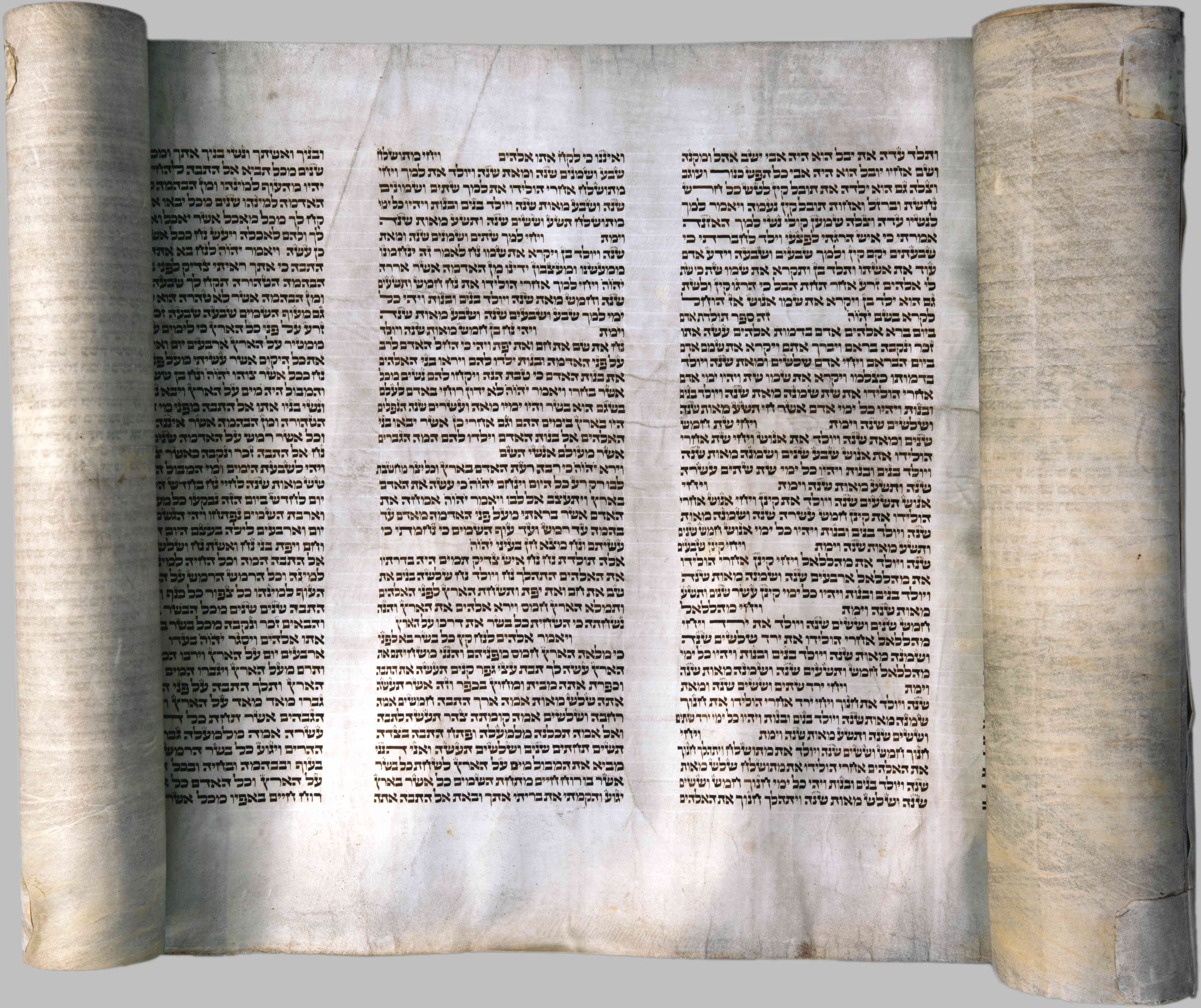 |
| An opened Torah scroll |
It is important to understand what perspective the Jews had that they heard Jesus' teachings as such a revelation ... and not like the scribes. First we must look at how they viewed the Torah (the Law).
To the Jews the most sacred thing in the world was the Torah, the Law. The core of the law is the Ten Commandments, but the Law was taken to mean the first five books of the Old Testament, the Pentateuch, as they are called. To the Jews this Law was completely divine. It had, so they believed been given direct by God to Moses. It was absolutely holy and absolutely binding. They said, "He who says that the Torah is not from God has not part in the future world." "He who says that Moses wrote even one verse of his own knowledge is a denier and despiser of the word of God."All excerpts in this post are from: The Gospel of Mark (The Daily Bible Series, rev. ed.) by William Barclay
If the Torah is so divine two things emerge. First, it must be the supreme rule of faith and life; and second, it must contain everything necessary to guide and to direct life. If that be so the Torah demands two things. First, it must obviously be given the most careful and meticulous study. Second, the Torah is expressed in great, wide principles; but, if it contains direction and guidance for all life, what is in it implicitly must be brought out. The great laws must become rules and regulations -- so their argument ran.
* Not a Catholic source and one which can have a wonky theology at times, but Barclay was renowned for his authority on life in ancient times and that information is sound.
=====
Alphonse Mucha, Self Portrait
 |
| Alphonse Mucha, Self Portrait via WikiPaintings |
I also love the fact that we know him for work that is very different than the portrait style above. As you can see below. If we hear Alphonse Mucha, it is likely that a style doesn't come to mind for most people like me. One look though, and we know his style very well.

Tuesday, April 23, 2024
Van Gogh: Self Portrait on the Way to Work
 |
| Vincent van Gogh, The Painter on the Road to Tarascon, 1888, reportedly destroyed during World War II |
Atonement Is Not Meant to Placate God
Paul wrote that "God put forward [Christ] as a sacrifice of atonement" 9Rom 3:25), but the atonement or expiation is not directed to God; it s not meant to satisfy or placate God. Instead, it is directed to sin, that in its being satisfied it will be eliminated. "it can be said that it is God himself, not man, who expiates sin. … The image is more like that or removing a corrosive stain or neutralizing a lethal virus than that of anger that is placated by punishment" (James Dunn, The Theology of Paul the Apostle).Raniero Cantalamessa, The Power of the Cross
I love this image! I've never had the problem of worrying about an "angry God" but this is the perfect clarification for those who do.
Monday, April 22, 2024
"I would like to insist on this idea ..."
I would like to insist on this idea. Refusing to let God enter into all aspects of human life amounts to condemning man to solitude. He is no longer anything but an isolated individual, without origin or destiny. He finds himself condemned to wander through the world like a nomadic barbarian, without knowing that he is the son and heir of a Father who created him through love and calls him to share his eternal happiness. It is a profound error to think that God came to limit and frustrate our freedom. On the contrary, God comes to free us from solitude and to give meaning to our freedom. Modern man has made himself the prisoner of reason that is so autonomous that it has become solitary and autistic.Again, here is a view of human freedom that would surprise many who mistakenly believe that God wants to keep us under his thumb. Not so. He gives meaning to our lives and opens them to true freedom.
Cardinal Robert Sarah, The Day is Now Far Spent
Subscribe to:
Comments (Atom)