Wednesday, March 29, 2023

On First Looking into Chapman's Homer

On First Looking into Chapman's Homer
By John Keats

Much have I travell'd in the realms of gold,
And many goodly states and kingdoms seen;
Round many western islands have I been
Which bards in fealty to Apollo hold.
Oft of one wide expanse had I been told
That deep-brow'd Homer ruled as his demesne;
Yet did I never breathe its pure serene
Till I heard Chapman speak out loud and bold.

Then felt I like some watcher of the skies
When a new planet swims into his ken;
Or like stout Cortez when with eagle eyes
He star'd at the Pacific—and all his men
Look'd at each other with a wild surmise—
Silent, upon a peak in Darien.

I never knew that the famous lines "Then felt I like some watcher of the skies when a new planet swims into his ken" came from a poem about reading a great translation of Homer. 

I know exactly how this feels, albeit minus the translation aspect. I've been reading 25 pages a day of The Lord of the Rings for my Lenten lectio divina and it has been transformative — both for my prayer life and for my feelings about the book itself. I am coming up on the Battle of the Pelennor Fields and am in the grip of just such a feeling.

Tuesday, March 28, 2023

St. Mark

Donatello, St. Mark (1411-13)
via Wikipedia
... it also remains true that Italian sculptors, like those north of the Alps, were moving relentlessly in the same direction: the discovery and representation of the individual human being, with truth and dignity. It was a move away from mere human symbols and archetypes toward actual flesh-and-blood men and women. For the Christian faith taught that humans were not types. Each had an immortal soul, and the carvers began to look for it in the faces and bodies they saw. But whereas the northern sculptor had no theory and worked by instinct—and his instinct for realism, as we have seen, was overwhelmingly strong—the Italian sculptors were beginning to learn about humanism, the knowledge from the past which directed fierce attention on the human body and psyche, created in God's image and the potential master of the universe and all it contained. The human being was all-important and sacrosanct, and to portray him accurately and vividly was a God-like act, worthy of the utmost pains and the highest genius.
Paul Johnson, Art: A New History
Amen.

I really, really like it when historians are not afraid to acknowledge all sorts of influences on people, including their faith. And to go to the trouble to understand the faith enough that they can see how it influences the people.

Monday, March 27, 2023

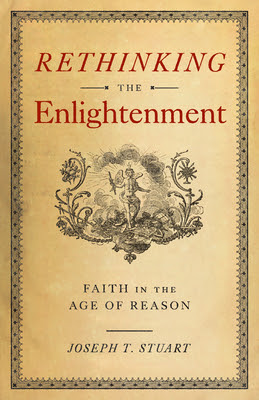
Rethinking the Enlightenment: Faith in the Age of Reason by Joseph T. Stuart

The Enlightenment is a fascinating example of the relationship between religion and culture. As common ways of life, Christian culture and Enlightenment culture both conflicted and overlapped with each other—or diverged altogether. Christians interacted with the Enlightenment thought conflict, engagement, and retreat. Each of these strategies possessed different emphases, strengths, and weaknesses.
I got interested in this after hearing the author on Catholic Answers Focus. I'd never heard of the Catholic Enlightenment or how many ways the Christian culture intentionally overlapped with the secular Enlightenment. The author did a great job of explaining the Enlightenment's origins and main players before going into the three Christian responses that led to the Conflictual Enlightenment, the Catholic Enlightenment, and the Practical Enlightenment.

Focusing on key people and events, he is able to tell this complex story so clearly that I was able to keep track of it the entire time. I grew very fond of some of the people involved. In fact, Pope Benedict XIV is now a new favorite of mine. And Edmund Burke — what a clear-headed thinker! I'd already read about some of these people, such as Susannah, Charles, and John Wesley. However, Stuart had more in-depth information than I'd seen. I really enjoyed seeing how they fit into the historical jigsaw puzzle, often bumping into others who I'd never have thought of connecting.

I also was fascinated by his examination of why the French didn't experience a religious revival as they eventually did in the English-speaking world. Comparing their situation to the American experience, which was that of Practical Enlightenment, was really eye opening. In fact, Practical Enlightenment is so key to the American psyche that, as I was reading, I felt right at home. That's still how we think, for the most part. Or has been until fairly recently, anyway.

This is just an excellent piece of history, explanation, and story telling. We are left with the message that our times are not lost or hopeless. We can regain what is being lost. It was done before and we can do it again.

Queen of Time, Selfridges

Gilbert Bayes, The Queen of Time, at Selfridges
Source 

 Isn't this magnificent? If ever I get to London again I will certainly be sure to go to see it and all the other wonderful art at Selfridges. I first came across the reference to this glorious piece of art in Art: A New History by Paul Johnson.

Be sure to go to the source link for more photos and information about the art of Selfridges. For more of this artist's work, check out the page at The Victorian Web.

Friday, March 24, 2023

Voting democracy and market democracy

The United States was the first to introduce voting democracy. Almost equally central to the ethos of the country was market democracy, in which ordinary people voted with their wallets and, in doing so, insured that they got what they wanted. Salesmanship, market research, advertising, the rapid response of production machinery to perceived customer requirements‚all these forms of materialism which, in their more raucous aspects, are identified as American failings or rather excrescences, are in fact central to its democratic strength. The story of Sears Roebuck, for instance, is a tale of how high-quality products, once the preserve of the rich, were humbled and distributed literally everywhere.

Paul Johnson,
A History of the American People

Iron Rolling Mill

Adolph Menzel (1815–1905), The Iron Rolling Mill
Source

 I originally came across this when reading Paul Johnson's Art: a New History. I love these big subjects with the humanity reflected in the little scenarios around the corners, like the fellows in the bottom right having a quick meal. Click through on the link so you can really look at the details closely.

Thursday, March 23, 2023

America as a great cultural nation

That the United States, lifted up by an extraordinary combination of self-created wealth and native talent, became a great cultural nation in the second half of the 19th century is a fact which the world, and even Americans themselves, have been slow to grasp.

Paul Johnson,
A History of the American People

Niagara Falls

Niagara Falls, 1857, Frederic Edwin Church
via Wikipedia

I love these sorts of pieces by painters who did such a splendid job of showing North America's natural beauty. They're often called the Hudson River School or the Luminous School but Paul Johnson in Art: A New History argues that that is limiting the artists too much.

This painting reminded me of the breathtaking paintings we saw at the Hudson River School show at the Amon Carter Museum years ago. There is simply nothing like seeing these (or any) paintings in real life.

The computer can't do it justice but do be sure to click through on the link above to see the painting in as large a size as possible.

Wednesday, March 22, 2023

What we lose track of in Exodus

The stories of the plague of Egypt, and the other wonders and miracles which preceded the Israelite break-out, have so dominated our reading of Exodus that we sometimes lose sight of the sheer physical fact of the successful revolt and escape of a slave-people, the only one recorded in antiquity.
Paul Johnson, A History of the Jews

Melk Staircase

Stift Melk, staircase near church, photographed by David Monniaux, Creative Commons licensing

 I first saw this gorgeous piece of architecture in Art: A New History by Paul Johnson. I could look at this all day.

Tuesday, March 21, 2023

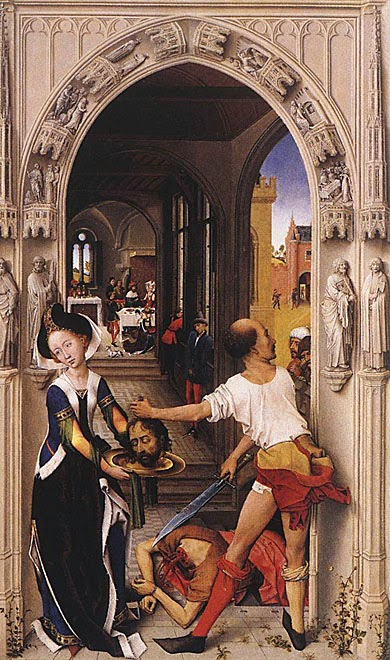
The Beheading of John the Baptist

Rogier van der Weyden, in his Beheading of John the Baptist (c. 1455-60),
transforms a horrific act into a scene of
elegance, subtle feeling and beauty-in-depth. (Paul Johnson)

This selection and the appreciation below are from Paul Johnson's Art: A New History which is an unusual window into history. This does not show us history as much as help to understand what the artist was trying to get across. It certainly helps me to understand why so many artists portrayed historical scenes with contemporary clothing and details.

If this seems like too much text to bother with, be sure at least to read the last couple of sentences. It is the essence of the thing and also may pique your interest for the rest.

... Rogier introduced many cunning innovations in presenting his work—shifting the angles, moving the main figures closer to the viewer, then pushing them back, framing them in architectural fantasies, windows and painted surrounds, devices which then become standard in northern art.

But in one respect, Rogier was faithful to his tradition. He loved detail, and it was always contemporary detail. Of his many large-scale works, the one which brings this out best is his Scenes from the Life of John the Baptist in Berlin. These three pictures convey an enormous amount of detail. Salome has certainly not been performing a dance. She is dressed in the height of Brussels fashion, c. 1450, and holds the dish to receive the severed head disdainfully, as though she was not accustomed to handling platters of any description. Every detail of her presentation is perfect. The executioner must have been done from life at a ceremonial chopping, of which there were many the artist could have witnessed. The way the man has stripped himself of most of his garments to get a perfect swing to his sword, itself rendered in fearsome detail, is unforgettable. Behind the pair and the ghoulish head, which glows with recently dead pallor, is a passageway, closely guarded, which opens in to the banquet scene itself, in the far distance but lovingly rendered so that we have a good idea of what was being eaten before the head made its entrance. The story of the head, which never failed to arouse interest anywhere in Europe for a thousand years—it was still going strong in the days of Oscar Wilde and Aubrey Beardsley—is here used as an excuse for a piece of dramatised genre painting. The details told the viewers two things. First, "All this is true," and secondly, "Take note of these events, they are part of your life also."

You are a temple, you are a great cathedral

Our culture has solved many of life's problems by its wonderful science and technology, and it has attained unprecedented power and comfort and freedom from pain. Yet it no longer loves life, no longer feels gratitude for life. Its suicide rate is far higher than it is in poor, primitive cultures. It lacks lasting joy. It is in the wilderness without a temple and without the manna from heaven, without the two temples that we know: our bodies in secual intercourse and Christ's Body in the Mass. They are the two holiest places in the universe and the two places where Goid literally performs a miracle millions of times every day around the world. Whenever we procreate mortal bodies, God creates new immortal souls, and whenever our priests echo his words of consecration, he transubstantiates our bread and wine into Christ's Body and Blood. ...

You are a temple; you are a great cathedral; you are God's masterpiece. Much more than that, you are God's children.
Peter Kreeft, Food for the Soul: Cycle A, Seventh Sunday in Ordinary Time

Thursday, March 16, 2023

The Sacrifice of Isaac

The Sacrifice of Isaac, The Tunesian Jews Synagogue, Akko
Taken by: Geagea

The whole purpose of sacrifice ...

Isaac was chosen as the offering not only because he was Abraham's most precious possession but because he was a special gift of God's under the covenant, and remained God's like all the rest of his gifts to man. This underlines the whole purpose of sacrifice, a symbolic reminder that everything man possesses comes from God and is returnable to him.
Paul Johnson, A History of the Jews

Monday, March 13, 2023

Double Boxer

In honor of the Dickens' excerpt today, here's a picture from our double Boxer days, which were crazy. Zoe and Wash, gone now but not forgotten.

Friday, March 10, 2023

The Bible is a work of history

The Bible is not a work of reason, it is a work of history, dealing with what are to us mysterious and even inexplicable events. It is concerned with the momentous choices which it pleased God to make. It is essential to the understanding of Jewish history to grasp the importance the Jews have always attached to God's unrestricted ownership of creation. Many Jewish beliefs are designed to dramatize this central fact. The notion of an elect people was part of God's purpose to stress his possession of all created things.
Paul Johnson, A History of the Jews

Dormant apostles in Gethsemane garden

Dionyz Stanetti, The carved relief of the dormant apostles
as the detail of prayer in Gethsemane garden (1744 - 1751) by

Tuesday, March 7, 2023

God made us creators

Creativity, I believe, is inherent in all of us. We are the progeny of almighty God. God is defined in many ways: all-powerful, all-wise, and all-seeing; everlasting; the lawgiver; the ultimate source of love, beauty, justice, and happiness. Most of all, he is the creator. He created the universe, and those who inhabit it; and, in creating us, he made us in his own image, so that his personality and capacities, however feebly, are reflected in our minds, bodies, and immortal spirits. So we are, by our nature, creators as well. All of us can, and most of us do, create in one way or another. We are undoubtedly at our happiest when creating, however humbly and inconspicuously. ...

... the only problem is how to bring it out. A farmer is creative—none more so—and so is a shoemaker. A ticket collector on a red double-decker once remarked to me: "I run the best bus route in London." His pride was proprietorial, and clearly he felt he was creating something, rather like Pascal, the moral philosopher, who in the mid-seventeenth century first conceived the idea of an omnibus service for big cities like Paris. I sometimes talk to a jovial sweeper, who does my street, and who comes from Isfahan, in Persia, wherein lies the grandest and most beautiful square in the world, the work of many architects and craftsmen over centuries, but chiefly of the sixteenth. I asked him if he felt himself creative, and he said: "Oh, yes. Each day they give me a dirty street, and I make it into a clean one, thanks be to God." People do not always discern the creative element in their lives and work. But those who do are more likely to be happy.
Paul Johnson, Creators
I was really stunned to read this in the introduction to Paul Johnson's book. As a personal witness it can't be beat. Plus, of course, being true.

Weepers

Philip the Bold, Duke of Burgundy, was the leading art patron of fourteenth-century France. His tomb, by Claus Sluter and Claus de Werve, is inhabited by alabaster hooded figures, known as "weepers." Description from Paul Johnson, image via Wikipedia

I really love these figures with their individual features and positions. Paul Johnson, Art: A New History, delights in this eloquently. Of course, I am going to share his comments!
Sluter was obliged to interrupt his work to attend to Philips tomb, a grand affair mainly in alabaster ... Sluter was bidden to attend the funeral and observe it, and his contract specified that he had to provide, in addition to the effigy of Philip, fifty-four angels and forty "Images pleurants." The angels are lost but the "weepers," as they were known--cowled figures common in late medieval art--were all done from life, and may have been actual participants in the obsequies. Slater was a master of the draped figure and its folds, in which he took exquisite delight, especially when working in a soft, luminous stone like alabaster. But he also put in wrinkles and beards, even the stubble, and all the details of costume under the drapes, down to buttonholes and laces. What strikes one most, however, is not such details as rosary beads, important though they are in creating verisimilitude, so much as the facial expressions, which though convey shamelessly the mixed emotions of a funeral: genuine and feigned grief, joy that one is still alive, sharp observation of how other people are behaving. Even funeral fashions are attended to, for each figure is clothed according to rank and personality, and each has a distinctive, often slyly observed,life of its own. After looking at these works, we feel we have a clear idea of what a grand early-fifteenth-century funeral was like. And that was Sluter's intention, for he did not want to change the world, merely to record it truthfully. If only all great artists were like him!

Monday, March 6, 2023

The excitement and inspiration of Job's prologue

[The Book of Job's] prologue with God's wager with Satan about Job's piety in the face of continual testing makes it one of the most exciting and inspirational books of the Old or New Testament.
Bob Dylan, The Philosophy of Modern Song
Well, that was unexpected. But it makes me want to go read the Book of Job!