 |
| A Girl Knitting, Shirataki Ikunosuke, 1895 via J.R.'s Art Place |
Wednesday, November 20, 2019

One day at a time
Let's try to live today as we should, according to the paths of the Kingdom, in trust and simplicity, seeking God and abandoning ourselves to him. And God will take care of the rest.
One day at a time. This is very important. Very often we exhaust ourselves going over the past again and again and also our fears about the future. But when we live in the present moment, we mysteriously find strength. We have the grace to live through what we encounter today. If tomorrow we must face more difficult situations, God will increase his grace. God's grace is given at the right time for it, day by day.
Jacques Phillipe, The Way of Trust and Love:A Retreat Guided by St. Therese of Lisieux
Monday, November 18, 2019

God's grace changes and re-orders the soul.
God's grace is not external; it actually changes and re-orders the soul and its loves, so that "God becomes the life of the soul as the soul is the life of the body." This begins now and is perfected in Heaven; in fact if it does not begin now, the soul could not endure Heaven.
Peter Kreeft, Socrates' ChildrenVol. II: Medieval Philosophy(chapter on Augustine)
Thursday, November 14, 2019

Lagniappe: Women and cats ...
Women and cats will do as they please, and men and dogs should relax and get used to the idea.
Robert A. Heinlein
Wednesday, November 13, 2019

Trusting in God Instead of Ourselves
Sometimes we manage to do what is right, lead a good and virtuous life, have great trust in God, without the slightest problem; and then a difficult time comes. For instance, we commit a fault that really humiliates us. Or we make a wrong decision, which is unpleasant, especially when other people notice it. We are brought face-to-face with our defects, and we become sad and discouraged. All our great trust in God melts away like snow in the sun.
This simply means that what we called trust in God was in fact trust in ourselves. If trust disappears when we do wrong, it shows that our trust was based on ourselves and our deeds. Discouragement is a clear sign that we've put our trust in ourselves and not at all in God.
... And it is vital that our trust should rest not on our personal achievements but only on God's love, his tenderness, his infinite mercy, on the fact that he is our Father and can never abandon us. Otherwise we will never be truly free but will always be afraid of failure, of our weaknesses and somewhat centered on ourselves instead of centered on God.
Jacques Phillipe,The Way of Trust and Love: A Retreat Guided by St. Therese of Lisieux
Tuesday, November 12, 2019

What God secretly sows in our hearts
We would like to feel that we're making progress, improving and advancing, and sometimes we do see it: we're aware that God has untied a knot, as he did for Therese that Christmas. But very often we don't feel anything. Yet God is still acting and one day we will see the fruits. Like the seed the Gospel speaks of, a tiny little gran of mustard seed, God has secretly sown something in our hearts; then, whether we wake or sleep, the seed grows, bears fruit and becomes like a tree in which the birds of the sky can find refuge.* These are the fruits of the secret working of grace for our benefit and our neighbors'; they grow by themselves, so to speak, and we end up seeing how the poor lost birds of today's world find consolation, hope, encouragement, acceptance, and tenderness with us.
So the underlying issue, in the human and spiritual life, is to discover (and practice) the inner attitudes, the dispositions of heart, that make us permeable to God's grace and attract it unfailingly: small and poor, yet attracting God's grace in an absolutely certain way. Not because anyone can manipulate God. If anyone can't be manipulated, it's God. But he is faithful and he loves us, and so we can find absolutely unfailing ways of attracting his grace.
Jacques Phillipe, The Way of Trust and Love: A Retreat Guided by St. Therese of Lisieux
* See the parables about the mysterious growth of the Kingdom, cf. Matthew 4:31-33 and Mark 4:26-29.
Monday, November 11, 2019
Veteran's Day Tribute

Photo credit: Kate Gardiner
It Is The Soldier
It is the Soldier, not the minister
Who has given us freedom of religion.
It is the Soldier, not the reporter
Who has given us freedom of the press.
It is the Soldier, not the poet
Who has given us freedom of speech.
It is the Soldier, not the campus organizer
Who has given us freedom to protest.
It is the Soldier, not the lawyer
Who has given us the right to a fair trial.
It is the Soldier, not the politician
Who has given us the right to vote.
It is the Soldier who salutes the flag,
Who serves beneath the flag,
And whose coffin is draped by the flag,
Who allows the protester to burn the flag.
by Charles M. Province, U.S. Army • November 1, 2004
- Recta Ratio has good comments on the day and how our lack of true celebration is a commentary in itself on our culture.
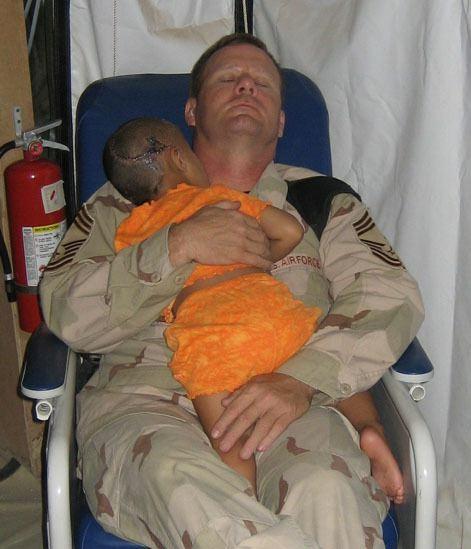
This moving photograph shows Chief Master Sgt. John Gebhardt, superintendent of the 22nd Wing Medical Group at McConnell Air Force Base in Kansas, holding an injured Iraqi girl. The picture was taken in October 2006, while Sgt. Gebhardt was deployed to Balad Air Base in Iraq. According to the Air Force Print News, the infant girl Sgt. Gebhardt held in his arms "received extensive gunshot injuries to her head when insurgents attacked her family killing both of her parents and many of her siblings."I haven't said it enough because none of us really can but to our veterans as well as those serving now ... thank you from the bottom of my heart.
Sgt. Gebhardt is now back home in Wichita, Kansas, with his wife and two children. An Air Force Link article about the sudden fame he gained as the subject of this photograph reported that:
The chief had a knack for comforting [the injured Iraqi girl] and they often would catch a cat nap together in a chair.
"I got as much enjoyment out of it as the baby did," he said. "I reflected on my own family and life and thought about how lucky I have been."
While deployed to Iraq, the chief tried to help out any way he could. He figured holding a baby that needed comforting that would free up one more set of arms that could be providing care to more critical patients.
"I pray for the best for the Iraqi children," he said. "I can't tell the difference between their kids and our kids. The Iraqi parents have the same care and compassion for their children as any American."
Source: Snopes
We notice a self-hatred in the Western world that is strange ...
Here we notice a self-hatred in the Western world that is strange and that can be considered pathological; yet, the West is making a praiseworthy attempt to be completely open to understanding foreign values, but it no longer loves itself; from now on it sees its own history only as a blameworthy and destructive, whereas it is no longer capable of perceiving what is great and pure. In order to survive, Europe needs a new ... acceptance of itself, that is, if it wants to survive.I am, of course, aware of this self-hatred which is flung at Americans. We're not allowed to honor or praise ourselves in a lot of ways without having fellow Americans tell us why we are terrible.
Joseph Ratzinger, Europe Today and Tomorrowquoted in The Day is Now Far Spent, Cardinal Robert Sarah
Reading this quote it struck me that if Ratzinger was describing a person instead of the Western world, we would worry about suicide or abuse. Certainly we'd think of depression accompanying such self loathing. We would build the person up, not tear them down every chance we got. And yet this is how we as Americans, as Westerners, are treated. No wonder we are suffering cultural crisis on so many levels.

Friday, November 8, 2019
The Star Lovers
 |
| Illustration for The Star Lovers by Grace James Illustrated by Warwick Goble Read the story at Childhood Reading |
God awaits us in our own nature.
We must rediscover the fact that our own nature is not an enemy or a prison. It extends a hand to us so that we might cultivate it.
Through our nature, ultimately the Creator himself is the one who extends his hand to us, who invites us to enter into his wise and loving plan for us. He respects our freedom and entrusts our nature to us as a talent that is to be made productive. In the gender ideology, there is a deep rejection of God the Creator. This ideology has real-life theological and spiritual consequences. In opposing it, the Church is not making herself the intransigent, inflexible guardian of a supposed moral order. She is fighting so that each human being may encounter God. The first place where he awaits us is precisely our nature, our profound being that he offers us as a gift.
Cardinal Robert Sarah, The Day is Now Far Spent
Thursday, November 7, 2019
Peanuts and Bananas
We've got two new recipes that are going to be making repeat appearances ... Whole-Grain Banana Bread (don't worry - it is not healthy tasting, just delicious) ... and Curried Peanut Sauce (suitable for simmering any combo you like of meat and vegetables). Both are also super simple!
All at Meanwhile, Back in the Kitchen.
All at Meanwhile, Back in the Kitchen.
Gospel of Matthew: Come to the desert to be baptized in the Jordan
Matthew 3:1-2
I'm going to back up for a second to look at just a little of the deep symbolism of John the Baptist's ministry. His garb screamed prophet to the Jewish people and that connection is easy to see if you look back over the different Old Testament prophets.
But I never thought about how the place he chose for baptism would have elevated the event. No wonder everyone is hurrying to see him.
I'm going to back up for a second to look at just a little of the deep symbolism of John the Baptist's ministry. His garb screamed prophet to the Jewish people and that connection is easy to see if you look back over the different Old Testament prophets.
But I never thought about how the place he chose for baptism would have elevated the event. No wonder everyone is hurrying to see him.
 |
| St. John the Baptist Preaching, c. 1665, by Mattia Preti |
John the Baptist's ministry was based at the Jordan river, probably on the southern stretch of the river that flows by the Judean desert, just before emptying into the Dead Sea. To get there, crowds from Jerusalem would travel about twenty miles through rugged terrain in a hot, barren wilderness. One might wonder why John would base his movement out there.Quote is from Catholic Commentary on Sacred Scripture. This series first ran in 2008. I'm refreshing it as I go.
To appreciate John's strategy in choosing this location we first must understand that the Jordan was more than a river for the Jews: it was a powerful symbol of hope and new life. God did great things at the Jordan. He healed Naaman the Syrian of his leprosy there (2 Kings 5:1-14), and he took the prophet Elijah up to heaven in a fiery chariot at the Jordan (2 Kings 2:1-11). Most of all God led the Israelites across the Jordan River at the end of their forty-year journey from Egypt to the promised land. Thus the Jordan represented the climax of the exodus story and the fulfillment of God's plan to bring Israel to the land of Canaan.
The Judean desert carried rich symbolism for the Jews. It too recalled the exodus story, for it was in a desert that Israel became established as God's covenant people as they journeyed to the promised land. ... The prophets foretold that God would lead his people back to the desert to renew his covenant with them. Hosea, for example, described how God would lovingly draw his sinful people back to him like a husband wooing an unfaithful wife. (Hosea 2:16, 20-21)
This background helps explain why John called the people to come out to the desert and be baptized in the Jordan. Such a summons would have signaled that everything the Jews had been longing for was about to be fulfilled. In this particular place, the ritual of baptism was a powerful symbolic action. In calling the people to journey into the wilderness to step into the Jordan River to be baptized, and to reenter the promised land, John was summoning them to reenact the exodus story. ...
Wednesday, November 6, 2019

Man's dignity consists of being fundamentally a debtor and an heir.
Man's dignity consists of being fundamentally a debtor and an heir. How beautiful and freeing it is to know that I exist because I have been loved! I am the product of a free decision by God, who, from all eternity, willed my existence. How sweet it is to know that one is the heir of a human lineage in which children are born as the most beautiful fruit of their parents' love. How productive it is to know that one is indebted to a history, to a country, to a civilization. I do not think that it is necessary to be born an orphan in order to be fully free. our freedom has meaning only if other persons give substance to it for us, gratuitously and through their love. What would we be if our parents did not teach us to walk and talk? To inherit is the condition for any true freedom.
Cardinal Robert Sarah, The Day is Now Far Spent
Tuesday, November 5, 2019


Subscribe to:
Comments (Atom)