We go to the most formal of our parish Masses with a full choir and the most likelihood of having older songs selected. As my husband puts it, "the good ones, written before 1900."
So some time ago when we began singing the "Lamb of God" bit of the liturgy in Latin (Agnus Dei) I though it was charming. Since it was short I was able to go through the mental translation into English while I was singing and still get something out of it.
Then, months ago, the Glory to God in the Highest went partially to Latin (Gloria in excelsis Deo). I likewise mentally translated that. It was getting painful (I ain't that good at it) but I was hanging on.
Recently we had the third Latin encroachment and the "Holy, holy, holy" turned completely into the Sanctus. This was too much for me to mentally translate and I took the tactic of lowering my head and murmuring the English words to the tune. Otherwise I was left in the cold for any meaning on this third section.
Unusually enough, I didn't mention it to anyone, not even my husband. I thought of Augustine asking Ambrose about different customs and receiving the advice, "When you are in Rome, live in the Roman style; When you are elsewhere, live as they live elsewhere." But I really saw the wisdom of the Novus Ordo being in a language we commoners could understand.
This Sunday the Sanctus went back into English. As I listened to the lector teaching the congregation and heard the "solemn modern" tune, I looked at Mary's statue and thought, "What would Mary do? She would do what the elders of the temple said." I inwardly laughed, thinking that I got the English I wished for, but at a cost.
So I resigned myself and forgot it until that moment broke upon us during the Mass. I sang and looked at the crucifix. I thought of the real suffering of Christ and my whining about a simple tune. In the middle of these thoughts I was startled at what shot abruptly and sharply into my mind, "Hey, I have to listen to it. Just sing."
So I sang. And laughed.
I love a mutual sense of humor.
Monday, October 13, 2014

Dallas - 30. Seattle - 23.
With 14 of the Seahawk's points were given to them by the Cowboys special teams.
In Seattle, one of the toughest locations for teams to visit.
I was honestly dreading this game, fearing a meltdown under pressure. But they turned in a solid performance such as I hardly dared hope for.
HOW 'BOUT THEM COWBOYS!
In Seattle, one of the toughest locations for teams to visit.
I was honestly dreading this game, fearing a meltdown under pressure. But they turned in a solid performance such as I hardly dared hope for.
HOW 'BOUT THEM COWBOYS!
Saturday, October 11, 2014

Friday, October 10, 2014
Blogging Around: Heavenly Spy, Casablanca, Big Weddings, Singing Nun, Gone Girl, and the Catholic No-Go
Heavenly Spy
A new blog ... Lebanese Catholic ... with some interesting things to say. Check it out and say hi!Gone Girl and Christian Engagement With Art
Jeffrey Overstreet on a subject dear to his (and my) heart. Be sure to read it all because this is just the tip of the iceberg.... there is a distressing delusion at the heart of so much Christian engagement with art: It's the delusion that says "The style and the substance are two different things. We should care much, much more about substance than we do about style.
Here's the thing: Style is substance.
Casablanca and the Four Main Types of Love
Ferdy on Films is not the place where I'd expect to find a discussion of how we see the four types of love as the Greeks defined it. What's more, Casablanca doesn't automatically spring to mind in this mix either. Definitely read this piece.Casablanca is much more than just a boy-meets-girl kind of romance, and to show that, I’m going to have to go all schoolmarm on you. The birthplace of most of the philosophies that guide Western societies is Greece, and the Greeks had four terms for the main types of love human beings experience: agape, eros, philia, and storge. Agape means love in a spiritual or humanitarian sense, wanting the good of another. Eros, the most common love in Hollywood romances, is the passionate love of longing and desire. Philia is more general and can extend to family, friends, or activities. Finally, storge is natural love, as by a parent for a child; importantly, Greek texts also use this term for situations people must tolerate, as in “loving” a dictator. Casablanca activates each of these forms of love, giving audiences a quadruple whammy of loves so powerful that the film has become the stuff of legend, with well-remembered quotes that distill the essence of these forms of love.
Singing Nun Sister Christina Releasing an Album for Christmas
I've seen just enough Sister Christina clips from Italy's "The Voice" tv show to know one thing. I want this album. Old news maybe but I thought you'd like to know ... read more at The Deacon's Bench.Mega-Weddings: Why You Should Say I Don't
Although this showed up in the WSJ's financial section it could easily have been an advice column. Financial strain isn't the only thing wrong with extravagant weddings. It may be an early indicator to underlying problems. It seems to me that if more couples were paying for their own weddings instead of relying on fond parents to cough up the cash, this might be less of a problem."The evidence suggests that the types of weddings associated with the lower likelihood of divorce are those that are relatively inexpensive but high in attendance," write Messrs. Francis and Mialon.(This is a subscriber only feature on the internet. But if you look it up on Google and click through there you should be able to read the whole thing.)
Why is Gay Marriage the Catholic No-Go?
This question comes up more and more, especially as the Synod on the Family is going on in Rome. Jen Fitz sets it out for us clearly and understandably.I’d like therefore to review some of the myths concerning Catholic teaching on same-sex attraction and Church participation, because the reality is both more extreme and not nearly as extreme as people guess, and that paradox is what bites.
Julie and Scott read a vampire novel by a horror writer they feel will be popular one day.
Keep writing Steve! Success is just around the corner! Yes, we've arrived at 'Salem's Lot ... launching our celebration of October at A Good Story is Hard to Find podcast.
Thursday, October 9, 2014
Well Said: Obsessed With Purpose
Would it not be strange if a universe without purpose accidentally created humans who are so obsessed with purpose?
Sir John Templeton
Wednesday, October 8, 2014
Pasta Sauce and a Little English Village
A couple of things I've got located elsewhere:
- Spicy Sausage Ragu, perfect for Fall weather, at Meanwhile, Back in the Kitchen
- Another Place, a little English village just like the kind you might find in The Twilight Zone, at Forgotten Classics.
- Spicy Sausage Ragu, perfect for Fall weather, at Meanwhile, Back in the Kitchen
- Another Place, a little English village just like the kind you might find in The Twilight Zone, at Forgotten Classics.
Worth a Thousand Words: Badger
 |
| Badger taken by Remo Savisaar |
Tuesday, October 7, 2014
What We're Watching: Person of Interest

Having watched the first two episodes I can say that it was a fascinating job of reorientation to "the same old thing" of working the numbers to save people and simultaneously adjusting to the fact that our heroes are the hunted.
Most interesting of all was the strong moral statement in the first episode from the most psychopathic character. Just as I've mentioned before, it is a pleasure to watch a show that affirms so many of the values I hold.
Finch: In the face of such a struggle what do one or two lives matter?
Root: Every life matters. You taught me that.
We often see the greater good for the greatest number being held up as an ideal but this show repeatedly points out that we can't ignore each person, no matter how easy it would make our lives.
The second episode ended by strongly affirming free will.
Finch is struggling with how to convince someone to make the right choice, wondering if The Machine would give him a plan for manipulation. Root points out that "she" (The Machine) would tell him just what he taught it ... that each person must make their own decisions. As happened in the last season, we were left longing for someone to make the right choice, knowing that force would not have served in the long run.
All that with Michael Emerson and Jim Caviezel too. What a pleasure!
Well Said: The Humble Man
The humble man receives praise the way a clean window takes the light of the sun. The truer and more intense the light is, the less you see of the glass.Yes. Am I letting Christ shine through me? Only if my best self is there to let Him do so. Looking at myself, looking at Christ, it makes me so grateful for His grace and the gift of confession.
Thomas Merton
Monday, October 6, 2014
Well Said: If a man dethrones God in his heart ...
If a man dethrones God in his heart, Satan must ascend to His position.Foreshadowing of The Stand! I've seen several things as I read which King later picked up on and developed in The Shining and The Stand. It is interesting to read this earlier work with those so firmly in mind.
Stephen King, 'Salem's Lot
Scott chose Salem's Lot to launch October's Halloween emphasis at A Good Story is Hard to Find and I've got to say I rarely have enjoyed disliking a story more. King really conveys with conviction the utter contempt that evil carries for anything good.
The American Catholic Almanac: A Daily Reader of Patriots, Saints, Rogues, and Ordinary People Who Changed the United States
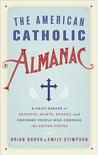 The American Catholic Almanac: A Daily Reader of Patriots, Saints, Rogues, and Ordinary People Who Changed the United States by Brian Burch
My rating: 4 of 5 stars
I'm a sucker for daily readers whether they are devotionals, writings of the saints, or historical almanacs. So if you combine American History with Catholicism naturally I'm going to be interested. I grew even more interested when a cursory glance revealed that General Longstreet, Buffalo Bill, and General Sherman were all Catholics. I did know that John Wayne became Catholic but not that famed director, and Wayne's longtime friend, John Ford was Catholic. Some of these famous men were more devout than others, some were late comers to the faith, but Catholicism helped define who each of them were.
The American Catholic Almanac by Brian Burch and Emily Stimpson looks not only at famous Catholics but at famous people who flirted with the faith in one way or another (Ronald Reagan and Mark Twain among them) although they never went all the way. It also tells us about people and events who are much less known but should be remembered by all of us today.
I was really interested to see how many "modern" hot button topics were a struggle for Catholics much earlier in our history. Separation of church and state became a Catholic issue in 1828 when schismatic priests appealed to President Andrew Jackson complaining the pope was acting like a "sovereign ruler." Nuns of today who shed their habits as a sign of "freedom" might be surprised to learn that in 1843 the Sisters of Mercy longed for the freedom to wear their habits but had to wear secular clothing because of the prevalent anti-Catholicism. The eugenics enthusiasts of 1927 would be openly approving of today's ability to test for such things as Down's Syndrome and would approve even more of the modern trend to abort any baby who the test shows might have it. We haven't really progressed as far as we'd like to think in that area. And those who lambast today's courts for not holding the high ideals of old times, might be surprised to learn that the Supreme Court supported Virginia's eugenics law with only one justice, a Catholic, dissenting. The authors don't make those comparisons for us, by the way. They leave us to draw our own conclusions and simply present the facts for our perusal.
It's not all serious, of course. In addition to tales of the famous people I mentioned above, there are stories of explorers, tales of churches, celebrations of faithful Catholics, and reminders of those who were not a credit to the faith. There is no telling when something will pop up to remind you how you are connected to the faith throughout our history and across our country. I was surprised to learn there is a cathedral in Dodge City, Kansas, where I lived for a year and a minor basilica in Victoria, Kansas. My husband and I were interested to read about the founding of St. Mary's in Galveston, Texas, because that is the church his grandmother fled to as a child during the devastating 1900 hurricane. It stood and she survived.
Speaking of my husband, I must praise the cover for this book which caught his attention and made him begin perusing it. He's not given to reading about Catholicism but this grounding of it in American history is right down his alley. Chalk one up for the value of having a printed book around to pique interest and keep him asking, "Who is it about today?" when he sees me pick it up for breakfast reading.
The one flaw is that it needs an index. There are a few appendices but if you want to find Sherman or Longstreet or Edgar Allen Poe then you've got to page through the book hoping they aren't too buried in the pages. Hopefully there will be a reprinting and this lack can be rectified.
Regardless of the lack of an index, this is a really great book and I highly recommend it.
NOTE
I received a review e-book and print copy of this work. My comments, as readers here know, are solely my own opinion.
Friday, October 3, 2014
The Joyful Beggar by Louis de Wohl
 The Joyful Beggar by Louis de Wohl
My rating: 4 of 5 stars
What is it with Louis de Wohl's books? They're like peanuts or popcorn. You just keep tossing back handfuls because they're so good and go down so tastily.
I received The Joyful Beggar on a Saturday at noon in the mail. Sunday at noon I was 75% done. It really grabbed me, obviously. I should've expected that since I've had that reaction to de Wohl's books before. They are consistently entertaining, historical fiction of saints and the times in which they lived.
I'm aware of the details of St. Francis's life but have never felt much connection with this saint. I wondered if sinking deeper into his life could help my life as a Christian. That's another of Louis de Wohl's talents, by the way. Whether or not you feel a personal affinity for someone, he brings to light aspects of their lives that illuminate your own.
Sharp as a blade, the Pope's mind put it all together. This beggar was a troubadour, a Minnesanger, as they called them in Germany, a "singer of love," but for once here was one who was singing in praise of the Love of God.What I felt after reading this book was Francis's joy in serving, his release from fear, his complete trust in God. I especially appreciated the way Francis connected Brother Sun and Sister Moon and all the other elements of his famous Canticle of the Sun with Jesus. It was that connection which made nature holy, the connection with our Lord in his Incarnation. Beautiful.
"I am the poor woman in the desert," Francis explained merrily. "And I trust my Lord, the King. he will look after my sons."
A jester and a dancer; a beggar and a troubadour; a preacher, a monk, a teller of parables, and perhaps a saint: there was no end to the man. If Satan could distort the minds of many to preach against the Church in the name of purity, here was one who could preach for the Church in the same name; here was, perhaps, the antidote against the poison in the veins of Europe, the man to give fresh life to a world grown cold. And therefore this man could be, nay, was the one who held up the falling walls of the Church. And that was all Innocent wanted to know.
As always, de Wohl shows us the saint's story through other imagined characters who have their own journeys to God. This is very useful for explaining the history and customs of the times. Quite often there is a contrast which layers meaning and context for the overall power of that particular saint. In this book there were both Clare of Assisi on her own journey to holiness and Roger of Vandria, continually striving to simply regain his ancestral lands. As they grow so do we.
"In that case, why not make a test?" Francis suggested. "Let a great fire be lighted before your tent, and these learned priests of yours and I will enter it. Then God may show which is the true faith."Did I wind up best friends with Francis of Assisi? No. But we can't be best friends with everyone. I did, however, wind up as more than a casual acquaintance with my own life enriched thanks to the story of the joyful beggar.
Roger gasped. If that was supposed to be a bluff, it was a very dangerous one. There were fanatics enough among Moslem priests, and at least some of them might accept the challenge.
The sultan glanced at his imams and mullahs. they looked a little vague, as if they had not understood the little dervish's words, and one of them, standing at the back, began to move with great dignity toward the exit of the tent.
"I don't think my priests are very likely to consent to this test of yours, little dervish," Al Kamil said, smiling.
He's got out of it, Roger thought, half relieved, half angry.
"Then I will enter the fire alone," Francis said quietly, "If you promise for yourself and for your people that you will worship Christ if I come out of the fire unhurt." After a little pause he added, "If I should be burned to death, it will be due only to my sins. But if God protects me, it is a clear sign of his holy will, and you must all accept Christ.
Now he has killed himself, Roger thought. This is too good a spectacle for the sultan to miss. The man is mad. He is a fanatic. He is magnificent. By all the angels and devils, he is the only crusader in the army. What a pity he is done for. Those priests will take him at his word, even if the sultan doesn't.
NOTE:
This is a review book from Ignatius Press. This opinion is my own, uninfluenced by anything as paltry as a free book. As anyone is well aware who reads this blog regularly.
For a good overview of the novels, take a look at Rose Trabbic's piece Discovering the Novels of Louis de Wohl. Also well worth reading is Will Duquette's review of The Citadel of God where he gives a concise commentary on de Wohl as an author, with which I completely agree.
Wednesday, October 1, 2014
Worth a Thousand Words: Pepsi 12 Oz.
 |
| Pepsi 12 Oz. painted by James Neil Hollingsworth |
Tuesday, September 30, 2014
The Sacred Year by Michael Yankoski
 The Sacred Year: Mapping the Soulscape of Spiritual Practice -- How Contemplating Apples, Living in a Cave, and Befriending a Dying Woman Revived My Life by Michael Yankoski
My rating: 4 of 5 stars
Father Solomon spoke again, and the shaking of my foundation continued. "The God who called you into existence ex nihilio—out of nothing—is the same God who holds you in existence this moment and every moment. Were he to withdraw his hand, you would vanish wihtout memory. All things would. No, you can't make God love you. You can't make God like you. But nor do you need to; he already does. Never forget that is why he made you—because he wants you to exist. He wants you to live life in all its fullness."Now this is interesting. What happens when a Protestant motivational speaker realizes he is in perpetual inner turmoil, goes to a monastery to rest for a week, and takes a monk's advice to explore spiritual practices for a more authentic encounter with God? Is there a way to live intentionally that shapes us so we can better catch God's wind in our sails and "allow Him to move us?"
Catholicism has a long tradition of various disciplines designed to help believers do this. Not every Catholic practices such disciplines. It just depends on the person. Yankoski's dive into different spiritual practices is a bit more extreme than the average Catholic, I'd say, because he's meeting every few weeks with a spiritual director and their conversations lead him from one discipline into another.
This is interesting me both as a Catholic and as someone who too often skirts the shallow end of the pool. Which is probably why the Patheos book club began soliciting Catholics to read this book.
Right from the beginning this book is compelling. I'm more or less familiar with most of the practices that Yankoski engages with. Some are part of me, like lectio divina, and keeping the Sabbath. Others I dance around, trying and leaving, then returning to again occasionally. Yet others I have sampled and found not to be helpful.
Every chapter in the book had at least one moment that made me more aware. I've practiced keeping the Sabbath for several years now. And so while I was nodding my head at some of Yankoski's realizations on that topic, he also had some wonderful moments like this one which opened my eyes.
One thing this Sacred Year is beginning to show me is how each of these spiritual practices can work like an antidote to some of the more poisonous aspects of our culture today. Tey are refreshing and life giving, whereas so often the habits and methods I've developed in my frenzied, stressed-out life are deadly poisons. The spiritual practices work like balm on wounds,healing even if painful at first.I have to say there are some practices that I had a hard time accepting that the author was coming to completely unawares, such as being aware of how our lives often affect those who are less fortunate (think Chinese children working in shoe factories sort of situations). That is, after all, one of the cries of conscience of our secular society, to be aware of how privilege comes at such a cost. However, perhaps it had never occurred to him to connect it with faith somehow. However, even these chapters had moments that were valuable for me.
Thus silence counteracts noise. And contemplation counteracts commodification.
Might Sabbath counteract the idol of the self-made man?
No wonder I mocked Sabbath at first: idols always die hard.
This book is inspirational for any Christian who struggles with how to be "in the world" and yet not "of the world." That is a line that both Catholic and Protestant struggle with. If we read enough history, we know that it is also something that not only modern people have struggled with. Michael Yankoski discovered that turning to these spiritual traditions eases the way to help us "live life in all its fullness" ... and he shares that discovery with us.
I really enjoyed this book and will be rereading it.
Note: I wish they'd have included an appendix briefly explaining how to do some of the traditional practices (like the Examen).
REVIEW COPY PROVIDED FREE
The review copy was provided by the Patheos Book Club. Publishers pay for Patheos to feature their books. My review is my own based solely on the book's merits.
Well Said: Pope Benedict is like the "grandfather of all grandfathers"
Retired pontiff Benedict XVI joined some 50,000 pilgrims in Saint Peter’s Square on Sunday, Sept. 28 for a meeting between Pope Francis and elderly people from around the world.I love the idea of Pope Francis bumping into Benedict XVI in the garden in the evenings and the two of them exchanging a few words about whatever is on the Pope's mind at the time. For some reason that possibility just never occurred to me. It sounds very companionable and comfortable.
Welcoming his predecessor, the Holy Father described Pope Benedict as the “grandfather of all grandfathers.”
“I have said many times that it gives me great pleasure that he lives here in the Vatican, because it is like having a wise grandfather at home. Thank you!”
Catholic News Agency, via The Deacon's Bench
Saturday, September 27, 2014
Weekend Joke: Atheists

This is from xkcd (Randall Munroe) who graciously allows me to share his humor here.
He's got a new book out which has me drooling just having looked through the Amazon sample: What If? Serious Scientific Answers to Absurd Hypothetical Questions. It isn't cartoons, other than those which illustrate the answers. Orson Scott Card's review gives a good idea of what it's like.
Friday, September 26, 2014
Herbed Pita Crisps
You want to make these. Heck, you definitely want to eat these! Get 'em at Meanwhile, Back in the Kitchen.
In which a vacation turns into an encounter with gods older than recorded history ...
... in our latest sampling of "tall tales told in taverns" at Forgotten Classics podcast.
Great Expectations Time After Time
One of my GoodReads friends said that watching me try to force myself to finish Great Expectations was better than the book itself. I feel rather proud actually as my usual practice is to just toss a book when it's not working for me. Even the classics (especially Russian classics).
But this is Charles Dickens who I learned to love with A Tale of Two Cities, and who left me awestruck after reading Bleak House and Little Dorrit. And I am now quite glad I did. If you're interested, a tale of my trek through Great Expectations follows.
 Great Expectations by Charles Dickens
My rating: 4 of 5 stars
A kind friend gave me the Blackstone Audio read by Simon Prebble, a narrator whose shoes other readers are not fit to touch.
I've never really been interested in reading Great Expectations. However, it's been too long since I've had any Dickens in my life. At least a month or two. And that's too long.
Oh Dickens, Dickens. I'm still in the very early pages but already his little observations are making me laugh.
UPDATE
I really hate Pip. Really, really. However, I had a great breakthrough when I went and read G.K.Chesterton's introduction to this novel. It made me realize Dickens' boldness in writing a novel with an antihero. I realize he is far from the first to do so, but I really hadn't expected it since his other books that I've read have all had at least one likable heroic protagonist. This accounts for my difficulty in connecting with the book, which I'm a third of the way through. And it helps me to reorient mentally on the story.
Secondly, something Chesterton said made me go look at GE's chronology. I hadn't realized it was the next to the last finished novel Dickens wrote, thus making it more a more mature work. I realized that I needed to trust this author to show me something new, to sit back and let the story sink in, rather than to rush to judgment because I would like to give Pip a good smack.
Chastened ... I continue ...
UPDATE THE SECOND
Just can't make myself go back to this book after I stopped to read something else. Even fantastic narration can't make up for the fact that I'm just not into the story. If I pick this up, and anything is possible (!), it will be in print because that will go much faster than audio.
BEGINNING AGAIN and ENDING
Having finished all the Jane Austen books and casting around for a classic for "background" reading ... I thought I'd give this book yet another try. My method was to skim the second half of the book from my Kindle as fast as I could (a couple of hours ... I'm a topnotch skimmer). Naturally as the plot twisted and turned I found myself slowing down in many spots to enjoy the story's development. Oh Dickens ... you did it again. This is not Bleak House or Little Dorrit (or even A Tale of Two Cities) but the second half definitely redeemed the first half.
... AND ONCE MORE FROM THE MIDDLE
I am now listening to the second half in audio so I pick up the details I missed in my breakneck race through the print version. I picked up the library's audiobook which is by Michael Page and I like this narration much better, though I couldn't tell you why as Simon Prebble is a longtime favorite of mine. But, once again, it is making all the difference. Audio got me through Jonathan Strange and Mr. Norrell. It got me through The Lord of the Rings. It got me through C. S. Lewis's space trilogy. And now, it is redeeming Great Expectations for me.
I am really enjoying all the funny bits that Dickens includes in the midst of the drama, such as Pip and Bentley Drummle standing shoulder to shoulder refusing to give up the fire, or the Aged's reading of the newspaper aloud.
I still feel all the mooning after Estella to be quite boring but am willing to put up with it based on the rest of what is happing.
I was interested to see that this book has two endings. The original and the one that Dicken's good friend Edward Bulwer-Lytton asked for. I love that Dickens was so obliging as to write a second ending for him. My copy had both. I'm not sure which I preferred as both work well.
But this is Charles Dickens who I learned to love with A Tale of Two Cities, and who left me awestruck after reading Bleak House and Little Dorrit. And I am now quite glad I did. If you're interested, a tale of my trek through Great Expectations follows.
Great Expectations by Charles DickensMy rating: 4 of 5 stars
A kind friend gave me the Blackstone Audio read by Simon Prebble, a narrator whose shoes other readers are not fit to touch.
I've never really been interested in reading Great Expectations. However, it's been too long since I've had any Dickens in my life. At least a month or two. And that's too long.
Oh Dickens, Dickens. I'm still in the very early pages but already his little observations are making me laugh.
UPDATE
I really hate Pip. Really, really. However, I had a great breakthrough when I went and read G.K.Chesterton's introduction to this novel. It made me realize Dickens' boldness in writing a novel with an antihero. I realize he is far from the first to do so, but I really hadn't expected it since his other books that I've read have all had at least one likable heroic protagonist. This accounts for my difficulty in connecting with the book, which I'm a third of the way through. And it helps me to reorient mentally on the story.
Secondly, something Chesterton said made me go look at GE's chronology. I hadn't realized it was the next to the last finished novel Dickens wrote, thus making it more a more mature work. I realized that I needed to trust this author to show me something new, to sit back and let the story sink in, rather than to rush to judgment because I would like to give Pip a good smack.
Chastened ... I continue ...
UPDATE THE SECOND
Just can't make myself go back to this book after I stopped to read something else. Even fantastic narration can't make up for the fact that I'm just not into the story. If I pick this up, and anything is possible (!), it will be in print because that will go much faster than audio.
BEGINNING AGAIN and ENDING
Having finished all the Jane Austen books and casting around for a classic for "background" reading ... I thought I'd give this book yet another try. My method was to skim the second half of the book from my Kindle as fast as I could (a couple of hours ... I'm a topnotch skimmer). Naturally as the plot twisted and turned I found myself slowing down in many spots to enjoy the story's development. Oh Dickens ... you did it again. This is not Bleak House or Little Dorrit (or even A Tale of Two Cities) but the second half definitely redeemed the first half.
... AND ONCE MORE FROM THE MIDDLE
I am now listening to the second half in audio so I pick up the details I missed in my breakneck race through the print version. I picked up the library's audiobook which is by Michael Page and I like this narration much better, though I couldn't tell you why as Simon Prebble is a longtime favorite of mine. But, once again, it is making all the difference. Audio got me through Jonathan Strange and Mr. Norrell. It got me through The Lord of the Rings. It got me through C. S. Lewis's space trilogy. And now, it is redeeming Great Expectations for me.
I am really enjoying all the funny bits that Dickens includes in the midst of the drama, such as Pip and Bentley Drummle standing shoulder to shoulder refusing to give up the fire, or the Aged's reading of the newspaper aloud.
I still feel all the mooning after Estella to be quite boring but am willing to put up with it based on the rest of what is happing.
I was interested to see that this book has two endings. The original and the one that Dicken's good friend Edward Bulwer-Lytton asked for. I love that Dickens was so obliging as to write a second ending for him. My copy had both. I'm not sure which I preferred as both work well.
Subscribe to:
Comments (Atom)