 |
| Wrought Iron Door taken by Barcelona Photoblog |
Tuesday, June 10, 2014
Worth a Thousand Words: Wrought Iron Door

At the Movies and Related News: Philomena

★★★
I'm not a fan of movies where the theme is "bash the bad guys" especially when the "bad guys" have been bashed by many a moviemaker already. You know what I mean: Slavetraders, Nazis, heartless mine owners, and so forth. I don't deny the bad guys need bashing much of the time, I just don't care to get my "facts" via a one-sided, often manipulative film. And I often find the subject matter too sad to want to watch. I can read articles or a book if need be, where I will often find more nuanced, complete information.
Therefore, I'd managed to avoid Philomena until forced to watch it for a movie discussion group. If you have to watch a "bash the bad Irish Catholic nuns" film, this is probably the one you want. In this case they preach shame to unwed mothers while allowing rich American Catholics to adopt the babies without the mothers' permission. The mothers have to work in a horrible, prison-like laundry. It's definitely not Christian by any stretch of the imagination. So - very bad nuns.
Philomena (Judi Dench) is a woman who alongside reporter Martin Sixsmith (Steve Coogan) journeys to America to find the illegitimate son who was adopted 50 years ago. Philomena is still a Catholic, something that atheist Sixsmith just can't fathom after what was done to her.
So far, all is according to what we'd expect. The nuns are bad, the reporter is angry, and the film is fairly predictable and manipulative. So why do I say it is worth watching?
Judi Dench, as we'd expect, turns in a stellar performance as a little, old Irish lady who loves romances and salad bars. She also shows the fruit of fortitude in living with life's hard knocks, deep empathy, and keen insight. In some ways it made me think of my mother-in-law who had a gift for delivering simple but penetrating insights while we were doing something mundane like making potato salad. You never expected it but you always remembered it.
Philomena's, set between the two judgmental, unyielding, self-righteous forces of Mother Hildegarde and Martin Sixsmith, who delivers the takeaway message of the movie. This is reinforced by the view of her son's life, which points up the fact that life is often not easy no matter what one's circumstances. Viewers are left to ponder what actions they themselves take when life delivers a brutal blow.
RELATED NEWS
It hadn't escaped my attention that this movie was in my life at just the time to make me pay attention to more terrible news about the Irish Catholic Church. We were specifically watching the movie as a contrast piece to I Confess featuring Montgomery Clift as a very holy priest from around the same time period. Obviously I needed to do my homework.
And I'm glad I did. It solidified one thing I already knew.
It doesn't matter who is committing evil, under what "trustworthy" banner whether religious, teacher, coach, or friend. Evil is evil. Vision is skewed.
Woe to you, scribes and Pharisees, hypocrites! For you are like whitewashed tombs which on the outside appear beautiful, but inside they are full of dead men's bones and all uncleanness. So you, too, outwardly appear righteous to men, but inwardly you are full of hypocrisy and lawlessness... — Matthew 23:27-28Jennifer Fitz has an excellent piece on the Irish news, Evil is Easy, which only served to cement the reading I above, which I'd heard on a podcast while mulling this over. Jennifer pointed out that we need not only point fingers at the past. (Don't stop at this bit ... go read it all.)
What you and I need to fear, then, is not our tolerance of cruelty towards Irish unwed mothers of the mid-20th century, but our tolerance of some other horror that perhaps we can’t even see.This formed an excellent talking point for the movie group, as a matter of fact. We also wound up discussing Irish culture as a whole which led to some of the points I read in Pia de Solenni's excellent coverage. I'll let you discover them for yourself in these pieces:
The best overall media analysis, as is so often the case in anything about religion, comes from GetReligion. Read In Irish children's deaths, clarity doesn't thrive in a septic tank to see who is reporting honestly and who is spinning without complete information.
For me the best commentary was that of Irish Independent columnist David Quinn. It is a thoughtful and thorough piece which leaves us with a truth that cannot be denied.
Why didn't the children and adults encounter a proper Christian witness, real love, when they walked through their doors? Why was it impersonal rules and regulations on a good day and cruelty of a sometimes very extreme kind on other days?With all that said, these are the sorts of things I read to get a real grip on a situation. You can't turn to a movie like Philomena expecting more than one view. We're just lucky that Philomena herself had the one view we really needed.
I think it was because Christianity in Ireland had by then hardened into something that was all too often more about punishment than mercy and forgiveness. To that extent Christianity in Ireland had become, in the strict meaning of the term, anti-Christ, and the church is still living this down.
Monday, June 9, 2014
Worth a Thousand Words: Sir Ian Reads
 |
| via Awesome People Reading |
Right now, front runners are my paperbacks of the Lord of the Rings trilogy. I have resigned myself to the fact that the big, one-volume book would be too heavy.
What books would you take on a long journey? Kindle or real?
(Want to know more about my Holy Land journey? Or come along? Check it out.)
What We've Been Watching: Encounters at the End of the World

★★★
I know I'll never make it to Antarctica and when a friend recommended this documentary it seemed like a good way to see what it is like. I had no idea so many different kinds of research were underway in that icy environment.
And there is Warner Herzog too. I admit it took me several visits to the video store, weighing the Herzog-factor, before I gave in and rented this. His involvement was much as I recall it from Cave of Forgotten Dreams. The dreamy German voiceover, with the (evidently) requisite 10 minutes of insane pondering over some very strange question (in this case about what aliens 1,000 years in the future would think of some of the goofy things people have sitting around). Oh Werner, you dreamer!
Other than that, though it was interesting. Not ground breaking but good enough.
Tuesday, June 3, 2014
Well Said: More to life than living ...
"There's got to be more to life than just living," Foyle said to the robot.We all like to think that we are the center of everything (and, indeed, to ourselves we are). Not only did I like the inherent truth of this passage but it made me laugh that it took a robot to focus the question properly.
"Then find it for yourself, sir. Don't ask the world to stop moving just because you have doubts."
Alfred Bester, The Stars My Destination
Saints and Social Justice: A Guide to Changing the World by Brandon Vogt
 Saints and Social Justice: A Guide to Changing the World by Brandon Vogt
My rating: 5 of 5 stars
The phrases "social justice" and "solidarity" could hardly have been more unwisely coined or adapted by the Catholic Church in my opinion. From the moment I heard them, they turned me off. I always thought they sounded like some lame department name you'd read about in a spy novel set in communist Russia. I mean really - solidarity? What does that even mean to the average person? Nothing.
However, if one digs deeper beneath the stiff, offputting phrases, one finds the heart of Christianity. They mean treating each person as if they belong, going out of one's way to find Christ in each individual, and following God's will (with Christ's help) to help each person one encounters. In other words, fully living your Christian life, whether as an individual or as part of the larger community.
“It’s good that you exist” — carries great power. To someone struggling with alcohol, who drinks away his loneliness, we say, “It’s good that you exist.” To someone who loathes her body and thinks she’s too fat, too skinny, too short, or not good enough, we say, “It’s good that you exist.” To the addict, the slave, the homeless man, even the murderer, we say, “It’s good that you exist.”This is ably illustrated by Brandon Vogt's book, which highlights 14 different saints whose lives were spent giving dignity and aid to the less fortunate. Ranging from housewives to priests, in all sorts of different life situations, these people were open enough to God's wishes to do extraordinary things. Vogt also does a great job of helping us relate by contrasting each saint with another one or two who lived out similar "missions" in different ways. He ends each section by relating these saints' larger missions to our own lives, so we can see where we might do more or act in ways that hadn't occurred to us previously.
This phrase reminds people that they have intrinsic value, regardless of what they produce, or how they look, or if they have it all together. It echoes what God said immediately after creating the first man: “[He] looked at everything he had made, and found it very good” (Gn 1:31).
Next time you want to uplift someone’s dignity, remind them of that wonderful truth: “It’s good that you exist.”
He ends each section by relating these saints' larger missions to our own lives, so we can see where we might do more or act in ways that hadn't occurred to us previously. This is important because these saints achieved so much that we might feel any small drops of help we can achieve are not going to make a difference. Vogt's gentle questions and examples helps us see that our drops matter because all of them together add up to a large ocean.
And this, no matter what stupid phrase is used to describe it, is something dear to my heart, a lesson I've been learning a little better every day in my 14 years as a Catholic. Each time I've followed that internal prompting, despite my fears of not knowing enough or being rejected or looking stupid, I have been rewarded. My efforts have had effects, in their own small way, which I never could have imagined. And I have grown and changed for the better myself along the way.
I found this book really inspiring. I especially enjoyed the amount of detail Vogt gave for each saint. Even the ones I knew about, like Peter Claver, Frances of Rome, or Dorothy Day, took on unexpected meaning for me because I hadn't realized there was so much I didn't know about them. Of course, there were some who were brand new to me and I really enjoyed learning about their lives.
This is a well written and inspiring book and one that should help us understand that "social justice" and "solidarity" mean "living as a Christian" no matter what your condition in life.
Please Mr. Vogt, may I have another? Perhaps one about the martyrs? You pick the subject. I'll read it.
Monday, June 2, 2014
Angels and Saints Blog Tour: St. Monica and St. Augustine

I chose to take my day of the blog tour to look at St. Monica and St. Augustine. (Which, to be fair, was what I thought my assignment was, so maybe my review jumped the gun. No matter. This is just icing on the cake, right?)
So after you've read Scott Hahn's fine Angels and Saints book, what difference will it really make in your life? If you feel drawn to one of the saints or angels you read about, consider striking up a relationship. It will change your life, deepen your faith, and give you a new friend.
Allow me to illustrate.
St. Augustine was my first saint friend. Thanks to a book of daily reflections based on excerpts of his writing, I got to know him before I really invested much thought in my patron saint, Martha.
I could relate to St. Augustine. Stubborn, searching for truth, understanding the reason for living the clean life but not wanting to commit to it fully. He's the poster boy not only for his age but for the ages since then.
Not only that, but he was able to put words to feelings and thoughts that I, a new convert, hadn't really even been able to articulate until I read them and knew how right they were.
Late have I loved you, O Beauty ever ancient, ever new, late have I loved you! You were within me, but I was outside, and it was there that I searched for you. In my unloveliness I plunged into the lovely things which you created. You were with me, but I was not with you. Created things kept me from you; yet if they had not been in you they would not have been at all. You called, you shouted, and you broke through my deafness. You flashed, you shone, and you dispelled my blindness. You breathed your fragrance on me; I drew in breath and now I pant for you. I have tasted you, now I hunger and thirst for more. You touched me, and I burned for your peace.I appreciated his mother, St. Monica, who followed her wayward son from city to city, reasoning with him and crying for his conversion and, most importantly, never ceasing her prayers. For 17 years.
[Side note about St. Monica. This is all most books ever tell you. I recently read St. Augustine's Confessions. Oh, yes, did I mention he wrote the first autobiography? Yep. Anyway, he gives full tribute to his mother's role as a role model and in saving his soul. He also gives a lot of her own personal story which shows she was a woman who fought her own personal demons and won, while serving as a splendid example to the women in her town. Definitely read it. I recommend the middle third if, like me, you have trouble getting into it.]
Soon after I learned all this about St. Augustine and St. Monica, I thought of my parents. Atheists, not probably going to listen to me talking about religion, and it troubled me greatly. I felt a greater and greater yearning for them to come to know the happiness and freedom I felt now that I knew Christ.
So I lit a votive candle and enlisted St. Augustine and St. Monica in praying with me for my parents' souls. I vowed that even if it took ten years I'd match Monica's faithfulness in prayer. (Boy oh boy, am I glad that I thought she'd prayed for 10 years and didn't know then that it was 17 years!) I joked to myself that I had visions of sitting by their deathbeds, rosary in hand, not giving up. Little could I foresee that was exactly where I found myself 10 years later as my father was dying. Or how richly God would answer our prayers. It stretched me, it changed me, and I grew during the entire process.
Scott Hahn's book gives a succinct overview of Augustine's life and Monica's influence. However, he doesn't stop there but points out how God used both Monica and Augustine to enrich the lives of each other, those around them, and those who have followed. I especially appreciated the point that St. Augustine wouldn't have been as effective when he was a bishop who was bringing congregations of heretics back to the Catholic faith, if he hadn't had firsthand experience of being a heretic himself.
That's an aspect of Augustine's life I hadn't realized and showed me yet another way I relate to him. As someone raised without any faith, with completely secular values, I am often able to explain to atheists and agnostics what the Catholic point of view might be on a particular issue. I can do it with an understanding of what they believe and where the differences are. Not as well as St. Augustine, but I'm working on getting better at it.
Friday, May 30, 2014
Well Said: Finding Inspiration
From my quote journal.
You can’t wait for inspiration. You have to go after it with a club.
Jack London
Thursday, May 29, 2014
Worth a Thousand Words: Pope Francis at the West Bank Wall
 |
| Pope Francis praying at the West Bank wall dividing Palestine and Israel. |
In which Juana and Otter are venerated as gods and see what it means to worship The Snake.
Adventure ratchets up a notch for our band of adventurers in the land of The People of the Mist by H. Rider Haggard, read for you at Forgotten Classics!
Julie thinks Father Logan has dreamy eyes and Scott is judging Inspector Larrue for his pointed investigation.
They both confess they love this little known Alfred Hitchcock movie while discussing I Confess at A Good Story is Hard to Find podcast.
Wednesday, May 28, 2014


The Last Monk of Tibhirine by Freddy Derwahl
 The Last Monk of Tibhirine: A True Story of Martyrdom, Faith, and Survival by Freddy Derwahl
My rating: 4 of 5 stars
When Jean-Pierre appeared at the gate in the late afternoon of my arrival, we immediately embraced each other. He knew what I expected of him—namely, that I hoped he would relate the whole story to me. I found the slightly bent-over eighty-seven-year-old Trappist monk in good spirits. His blue-green eyes accentuated an impish smile that concealed great kindness. Deep wrinkles on his forehead and chin did not bear the signs of worry but of wisdom. He wore a sand-colored habit typical for this climate, with a leather belt, and on his head a knit tarbush bearing Islamic motifs. ... The next morning at 10:30, we sat down together for the first time. Our only topic was his life. The massacre of his seven brothers lay fifteen years in the past. He, however, had been spared from the attack, so where had his fate led him since then?This is the story of Jean-Pierre Schumacher, the last surviving member of a Cistercian monastic community in Algeria, whose members were was kidnapped and killed in 1996. Like many people, I became aware of that event when I saw the movie Of Gods and Men, which Scott Danielson and I discussed on A Good Story is Hard to Find podcast.
This book alternates between Jean-Pierre's life story and author Freddy Derwahl's experience while on retreat at the monastery. It includes the lives of the martyred monks as their lives intertwined with Jean-Pierre's, with special emphasis on the prior, Christian, and his writing. Once the timeline gets to the point where the movie was made, it is included in the discussion which is interesting for anyone who has seen it.
I did not expect the book to grab me from the first page as the author told the story, not only of Jean-Pierre, but also of his own experience staying at the new monastery. His diary entries not only drew me into his own experience, but also invited me to deeper reflection.
2:00 pm:One of the most impressive things to me about this book is the way that the monks' offer their faith to others by embracing all that they can of Islam. That may sound overly ecumenical but the way that Christian approached it was to include all the Islamic symbolism and patterns possible in different parts of the monastery. This at least added a familiar feel to visiting Muslims and added a context for showing where there were common points of worship and faith.
A siesta with open eyes. The text about the exciting life of P. André Louf that I read during the night continues to resonate with me. I need the example of strong men. That is the reason why I had also taken along the books by Pope Benedict and Ernst Junger. They tested their limits—one of them in a gentle manner, the other defying death. By the way, both of them feel the mocking criticism of their time breathing down their necks.
9:30 pm:
I sit outside on my little wooden bench. Rarely was the star-filled sky so comforting. We are surrounded by magnificence that is unreachable and yet a promise that is quite close.
It worked so well that twice a year there were a group of Muslim devout who would come for a day of common prayer and worship, at the Muslims' request. They quickly discovered that discussing theological points led to disagreement and so learned to focus on the God alone. This made it possible to connect as people of faith based on the core idea of searching for God and personally connecting with Him.
A deep bond developed between the prior and the Muslim friend after the latter had asked him to teach him how to pray, and for many years there was a lively spiritual exchange between the two. After they had not seen each other for a while due to various other obligations, the Muslim friend said to him, "I think it is time to dig in our common well again." It was an allusion to the depth that characterized their encounters.The Last Monk of Tibhirine was originally written in German and the English translation occasionally betrays awkwardness. The most obvious place was when Derwahl's July 26 diary said, "Mass in celebration of the Apostle Jacob." I was stopped in my tracks as I pondered who the Apostle Jacob might be. Finally going to a liturgical calendar I realized that it was a mistranslation. July 26 is the Apostle James' feast day.
Christian responded, "And what will we find at the bottom of the well? Muslim or Christian water?"
Then he looked at him with a mixture of smiling and sorrow: "Do you still ask yourself this question? Don't you know that on the bottom of this fountain we will find the water of God?"
There were a few other awkward phrasings in sentences which seemed as if they should connect to transitional commentary or new thoughts, but which never materialized.These were not egregious enough to make reading problematic but did cause the occasional hiccup.
Overall The Last Monk of Tibhirine is suitable for either slow, meditative reading or simply to learn more about the story of Jean-Pierre and Our Lady of Atlas monastery. I enjoyed it on both levels. Suffice it to say that this book is a gem whether one has seen Of Gods and Men or not. Highly recommended.
Tuesday, May 27, 2014
Faces of Christ by Jane Williams
 Faces of Christ by Jane Williams
My rating: 5 of 5 stars
Jesus is one of the most commonly portrayed figures of all time in the artistic community. But what can all of his varying faces—coming from so many different ages and diverse countries around the world—tell us about him as a person? In this beautiful book, images of Jesus are used to explore his life and legacy, including Jesus as shepherd, Jesus as victor, Jesus as broken, and many more. With illuminating text and arresting images, this book is visually stunning and textually inspiring.This was a birthday gift and I'm so glad I had it on my wish list. I'm continually trying to find books that use art for Christian reflection and meditation. They open up faith in a way that plain words alone don't. Thus far, Sister Wendy Beckett's books have been the only ones I've found, so Jane Williams comes as a welcome addition.
Williams chooses diverse artists that reveal strikingly different ways to think about different aspects of Christ's life and our own. Her text is spare but illuminating. I'm about a third of the way into the book (it is small) and have already had three "aha" moments. This book will become part of my regular rotation of meditation books and I can foresee that it will shed light in different areas when I need it most.
Worth a Thousand Words: Victorian Clock Tower
 |
| Victorian Clock Tower, Ripon, England taken by Joseph of Zombie Parent's Guide |
On the other side of town is the Victorian Clock Tower. Two sisters had this built to commemorate Queen Victoria's Diamond Jubilee in 1897.He's got more of the town at the link.
Well Said: The Door of Bread and Wine
...the door comes to us, and it looks like bread and wine. But it is God. God coming to live in us, here, until we can go to live with Him, there.
It’s a hard, crazy kind of faith we have to have, because we were not made for it. We were made to live with God, to see Him face to face, to walk with Him every evening in the garden. We weren’t made to live so separate. It hurts. We want to see the door, we want to be sure it’s the door, we want to peek around the other side and know for certain what lies behind the door.
Well, original sin destroyed that door. And that door came back to us, God made flesh, and re-opened the way.
I like that point, that we weren't made to live separate from God. I know it but I forget in the mishmash of daily life. I need to be reminded. This is the heart of it, but there's a bit more if you go to the link.
Friday, May 23, 2014
Trailer - Life Itself (documentary about Roger Ebert)
I've been curious about this for some time. The gang at RogerEbert.com has been following progress of every showing at various festivals, including Cannes.
I was impressed it was directed by the Hoop Dreams director and so was excited to see the trailer.
Which just made me want more. The way a good trailer should. See for yourself.
(P.S. It also made me miss Gene Siskel all over again.)
I was impressed it was directed by the Hoop Dreams director and so was excited to see the trailer.
Which just made me want more. The way a good trailer should. See for yourself.
(P.S. It also made me miss Gene Siskel all over again.)
Well Said: Being Honest With God
For when you say only the things that you believe you should say, rather than being honest, any relationship grows cold, including one with God.
Father James Martin, Jesus: A Pilgrimage
I remembered this just yesterday and it was of immense help.
Instead of just putting up with something, I needed to be completely honest with God about the fact that I was afraid, distrustful in fact, that He wasn't going to come through for me in a certain situation.
Wow, did that help with everything. Including connecting with God.
And then I could prepare for the fact that I might just have to put up with it. (I didn't have to, but that's a different story.)
Thursday, May 22, 2014
Angels and Saints by Scott Hahn (with Book Giveaway)
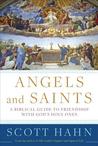 Angels and Saints: A Biblical Guide to Friendship with God's Holy Ones by Scott Hahn
My rating: 4 of 5 stars
This is a solid, understandable book that explains the concept and theology of angels and saints. The last half of the book contains the stories of specific saints and angels, along with an excerpt from a writing about them (usually from a Church Father). It would definitely be a good book to give to someone wondering about the topic.
Angels and saints have been a special interest of mine since my conversion in 2000 so I've read a lot of books on the subject. Therefore, a lot of the information was not new to me. Even so, almost every section had some tidbit which was a surprise or gave me a new perspective. A few samples of the sort of things that knocked my socks off:
My favorite part was the introduction where Scott Hahn shares his personal experience, which is both moving and inspiring. I think the book could have done with a few more personal touches throughout and then I might have given it another star.
- Humans are the minority in the Church. Oh, right. Angels outnumber us, which makes sense when you realize that each of us has a guardian angel. (I also was blown away by the connection of guardian angels to Jesus' agony in the Garden of Gethsemane where he was comforted and assisted by ... yep ... an angel.)
- Hahn draws on rabbinical teachings to point out: It was Moses' special intimacy with God that made it possible for him to compose the Torah. He could describe the earliest days of creation not because he was there, but because God was; through prayerful intimacy, Moses had come to see as God saw. Oh snap!
- There was not a bishop alive who could speak the language of the Old Testament, but Jerome was teaching it to Roman widows and teenagers. They pushed him to the point where he lamented that they had surpassed him in their ability to speak Hebrew with no accent.
Hahn's been writing more of these "Catholic basics" books lately but this is the first I've read. If it is any indication, he's giving the Church a fine resource. He's certainly giving regular readers a great chance to dig deeper into their faith.
BLOG TOUR
I'll be participating in the blog tour for this book along with 11 other bloggers. Scott Hahn chose 12 favorite saints to highlight and we'll each be reflecting on his chapter about a saint close to our hearts as well.
My day is June 2.
My choice? I get two for one! Saint Monica and Saint Augustine.
Here's the schedule.
- May 27: St. Michael and the Angels - Catholic Katie
- May 28: Moses - Abigail’s Alcove
- May 29: St. Paul - Catholic Bibles
- May 30: St. Ignatius of Antioch - The Orant
- May 31: St. Irenaeus of Lyons - Seasons of Grace
- June 1: St. Jerome - Stuart’s Study
- June 2: St. Monica and St. Augustine - Happy Catholic
- June 3: St. Thomas Aquinas - Blog of the Courtier
- June 4: St. Therese of Lisieux - Single Catholic Girl
- June 5: St. Maximilian Kolbe - Random Acts of Momness
- June 6: St. Josemaria Escriva - Catholic Mom
- June 7: Queen of All Saints, Mother of the Church - This Cross I Embrace
And I'll be doing a book giveaway on the day of the blog tour! Woohoo! Leave a comment here to enter in the random drawing that I'll hold that day. If you comment anonymously, that is fine, but leave your name in the comment so I can alert you if you win!
Subscribe to:
Comments (Atom)