Wednesday, March 28, 2007

Have You Got Motu-Mania?

I don't but I recognize the signs well enough to just die laughing over Aliens in This World's Top Ten List of Signs You've Succumbed to Motu-Mania. My favorites:
3. You have a nasty ailment, and decide to wait and apply a printout of the motu proprio instead of trying your aunt’s Lourdes water.

2. Rocco calls to warn you that the Vatican’s webmistress has sent over the Swiss Ninja Death Guard to pull out your modem.

This, of course, spurred The Curt Jester on to similar brilliance with his own Top Ten List.
8. You have already budgeted in the fact that you are going to be saving a lot of money on gas by not having to drive to that one parish over an hour away that has the Indult Mass.

7. You have an “I “heart” Motu Proprio” bumper sticker on your car.


Prayer Request

My father has been ailing for some time but, talking to my mother this morning, I realized that I didn't know quite the extent of his illness. It is increasingly debilitating and the doctors cannot find any reason for it. Evidently this has been going on since last October. My mother is becoming increasingly upset and worried, naturally.

I so appreciate having y'all to call on in interceding for my parents. Thank you so much.

A Bleg

Anyone know of an orthodox Catholic parish in Pittsburgh? Any help is much appreciated!

The Waiting is the Hardest Part

The waiting is the hardest part
Every day you see one more card
You take it on faith, you take it to the heart
The waiting is the hardest part

The Waiting by Tom Petty
I am impatient by nature. This is not helped any by the fact that our national psyche is one of wasting no time in doing something about what we want. Whether it is solving a problem, getting something we want, or trying to make an unpleasant situation better, we are conditioned to fix, to solve, to heal ... to control. And we want to do all these things now.

I am getting better at waiting. Some of it has to do with age and learning over time that everything can't come at once. Most of it has to do with God. I waited a year to realize that he was there after making my bet with Him. I waited six months to even begin RCIA classes after realizing that I needed to become Catholic. I waited four months to attend the Christ Renews His Parish retreat after realizing I needed something more that I could get from reading books by myself. I waited 6 weeks after realizing that I was being told through private discernment I might become the leader of my CRHP team for the actual discernment to make it from a possibility to a reality.

The waiting seemed long but in every case the payoff was huge. In fact, it was life changing.

In all of these cases, once I realized the steps to be taken, my job was to keep myself open to God's will and wait. In essence, I was to be passive and not attempt to control or affect anything. The keeping open was never the problem that the waiting was. Can't we just get on with things?

This morning's devotional reading highlighted waiting and being passive in such a good way that I couldn't cut any of it. Hence we have a very long passage below . Perhaps you will find it as fruitful as I have.
From Action to Passion
Henri Nouwen

I was invited to visit a friend who was very sick. He was a man about fifty-three years old who had lived a very active, useful, faithful, creative life. Actually, he was a social activist who had cared deeply for people. When he was fifty he found out he had cancer, and the cancer became more and more severe.

When I came to him, he said to me, "Henri, here I am lying in this bed, and I don't even know how to think about being sick. My whole way of thinking about myself is in terms of action, in terms of doing things for people. My life is valuable because I've been able to do many things for many people. And suddenly, here I am, passive, and I can't do anything anymore."

And he said to me, "Help me to think about this situation in a new way. Help me to think about my not being able to do anything anymore so I won't be driven to despair. Help me to understand what it means that now all sorts of people are doing things to me over which I have no control."

As we talked I realized that he and many others were constantly thinking, "How much can I still do?" Somehow this man had learned to think about himself as a man who was worth only what he was doing. And so when he got sick, his hope seemed to rest on the idea that he might get better and return to what he had been doing. If the spirit of this man was dependent on how much he would still be able to do, what did I have to say to him? ...

The central word in the story of Jesus' arrest is one I never thought much about. It is "to be handed over." That is what happened in Gethsemane. Jesus was handed over. Some translations say that Jesus was "betrayed," but the Greek says he was "handed over." Judas handed Jesus over (see Mark 14:10). But the remarkable thing is that the same word is used not only for Judas but also for God. God did not spare Jesus, but handed him over to benefit us all (see Romans 8:32).

So this word, "to be handed over," plays a central role in the life of Jesus. Indeed, this drama of being handed over divides the life of Jesus radically in two. The first part of Jesus' life is filled with activity. Jesus takes all sorts of initiatives. He speaks; he preaches; he heals; he travels. But immediately after Jesus is handed over, he becomes the one to whom things are being done. He's being arrested; he's being led to the high priest' he's being taken before Pilate; he's being crowned with thorns; he's being nailed on a cross. things are being done to him over which he has no control. That is the meaning of passion -- being the recipient of other people's initiatives.

It is important for us to realize that when Jesus says, "It is accomplished," he does not simply mean, "I have done all the things I wanted to so." He also means, "I have allowed things to be done to me that needed to be done to me in order for me to fulfill my vocation." Jesus does not fulfill his vocation in action only but also in passion. He doesn't just fulfill his vocation by doing the things the Father sent him to do, but also by letting things be done to him that the Father allows to be done to him, by receiving other people's initiatives.

Passion is a kind of waiting -- waiting for what other people are going to do. Jesus went to Jerusalem to announce the good news to the people of that city. And Jesus knew that he was going to put a choice before them: Will you be my disciple, or will yoube my executioner? There is no middle ground here. Jesus went to Jerusalem to put people in a situation where they had to say "Yes " or "No." That is the great drama of Jesus' passion: he had to wait upon how people were going to respond. How would they come? To betray him or to follow him? In a way, his agony is not simply the agony of approaching death. It is also the agony of having to wait.

All action ends in passion because the response to our action is our of our hands. That is the mystery of work, the mystery of love, the mystery of friendship, the mystery of community -- they always involve waiting. And that is the mystery of Jesus' love. God reveals himself in Jesus as the one who waits for our response. Precisely in that waiting the intensity of God's love is revealed to us. If God forced us to love, we would not really be lovers.

All these insights into Jesus' passion were very important in the discussions with my friend. He realized that after much hard work he had to wait. He came to see that his vocation as a human being would be fulfilled not just in his actions but also in his passion. And together we began to understand that precisely in this waiting the glory of God and our new life both become visible.

Precisely when Jesus is being handed over into his passion, he manifests his glory. "Whom do you seek? ... I am he" are words that echo all the way back to Moses and the burning bush: "I am the one. I am who I am" (see Exodus 3:1-6). In Gethsemane, the glory of God manifested itself again, and they fell flat on the ground. Then Jesus was handed over. But already in the handing over we see the glory of God who hands himself over to us. God's glory revealed in Jesus embraces passion as well as resurrection.

"The Son of Man," Jesus says, "must be lifted up as Moses lifted up the serpent in the desert, so that everyone who believes may have eternal life in him" (John 3:14-15). He is lifted up as a passive victim, so the cross is a sign of desolation. And he is lifted up in glory, so the cross becomes at the same time a sign of hope. Suddenly we realize that the glory of God, the divinity of God, bursts through in Jesus' passion precisely when he is most victimized. So new life becomes visible not only in the resurrection on the third day, but already in the passion, in the being handed over. Why? Because it is in the passion that the fullness of God's love shines through. It is supremely a waiting love, a love that does not seek control.

When we allow ourselves to feel fully how we are being acted upon, we can come in touch with a new life that we were not even aware was there. This was the question my sick friend and I talked about constantly. Could he taste the new life in the midst of his passion? Could he see that in his being acted upon by the hospital staff he was already being prepared for a deeper love? It was a love that had been underneath all the action, but he had not tasted it fully. So together we began to see that in the midst of our suffering and passion, in the midst of our waiting, we can already experience the resurrection.

Imagine how important that message is for people in our world. If it is true that God in Jesus Christ is waiting for our response to divine love, then we can discover a whole new perspective on how to wait in life. We can learn to be obedient people who do not always try to go back to the action but who recognize the fulfillment of our deepest humanity in passion, in waiting. If we can do this, I am convinced that we will come in touch with the glory of God and our own new life. Then our service to others will include our helping them see the glory breaking through, not only where they are active but also where they are being acted upon.
Last night I realized that the waiting may be beginning again. After our scripture study I was quite surprised and flattered when a fellow attendee who I respect immensely approached me and tentatively said that she wanted to "plant a seed." Actually she wanted to plant a couple of seeds in sharing ways she had served the parish that had furthered her relationship with God. One suggestion is just not for me. The other suggestion though ... the other is one that a friend recently had been telling me about in the same way. However, where my friend's words hadn't particularly moved me, this acquaintance's words did break through in such a way that I was envisioning it all the way home.

I don't want to plunge in without a little more than a sudden surge of imagination. I am quite good at imagining things. This needs to be based on a bit more, especially as I already am involved up to my elbows in various parish activities. Last night and again this morning I told God that I'd wait until I had more than just a glimmer. I'd let Him guide me in this.

This waiting is a familiar feeling. It took me back to those previous times. And I am not impatient either for the "yes" or "no." I am content to wait in this instance and see what, if anything, unfolds.

I realize that, unlike the excerpt above, my waiting is all about whether I should "do" something. However, all this waiting for God's word about His will is excellent practice in not doing anything at all but being passive. I hope and pray that when the days come that I am "handed over," as those days will inevitably come to us all in our lives, that I may benefit from all this practice ... and thus do God's will by not doing.

Monday, March 26, 2007

Prayer and Bible Reading: Listening to God

Reading the Bible should be a form of prayer. The Bible should be read in God's presence and as the unfolding of His mind. It is not just a book, but God's love letter to you. It is God's revelation, God's mind, operating through your mind and your reading, so your reading is your response to His mind and will. Reading it is aligning your mind and will with God's; therefore it is a fulfillment of the prayer "Thy will be done," which is the most basic and essential key to achieving our whole purpose on earth: holiness and happiness. I challenge every reader to give a good excuse (to God, not to me, or even just to yourself) for not putting aside fifteen minutes a day to use this fundamental aid to fulfilling the meaning of your life.

Both prayer and Bible reading are ways of listening to God. They should blend: our prayer should be biblical and our Bible reading prayerful.

In Catholic theology, the Bible is sacramental: it is a sign that is an occasion for grace. The Bible fits the two classic definitions of a sacrament: (1) a visible sign instituted by Christ to give grace and (2) a sign that effects what it signifies. However, unlike the seven sacraments, it does not work ex opere operato; it does not give grace by itself, but is dependent on our use of it. ...

Though it is not a sacrament, it has power. Its power comes from two wills, God's and ours. It is the Spirit's sword (Eph 6:17) that cuts our very being apart (Heb 4:12), though we must give it an opening by exposing our minds and hearts and wills to its cutting edge. When we do that, God's Kingdom comes to earth. For it first comes to that tiny but crucially important bit of earth that is your mind and will. Then it transforms your life, which your mind and will control. Then, through your life, your world.
You Can Understand the Bible
A Practical And Illuminating Guide To Each Book In The Bible
by Peter Kreeft
I think this is why I always have identified with St. Augustine a lot (we will put aside any other reasons ... ahem). St. Augustine was converted to Catholicism by reading the Bible. Although I was not converted through reading, in fact had no idea at the time that there were books about that sort of thing, I always had my "best results" in prayer when I was reading the Bible. In fact, that is the reason I also always identified with St. Teresa of Avila, who said that she could not pray without a book.

Kreeft's commentary about prayer, reading, and aligning the mind and will with God resonate on that same level. And give me impetus to return to that prayer style which always worked so well for me. (Magnificat is good but I think I need the whole book in my case.)

Chock Full of Kreeft-y Goodness

YOU CAN UNDERSTAND THE BIBLE
A Practical And Illuminating Guide To Each Book In The Bible
by Peter Kreeft

I realize with surprise that it has been some time since I have mentioned Peter Kreeft around here. I say "with surprise" since Peter Kreeft is probably the modern Catholic writer that has influenced me most since I became a Catholic. He states things with a logic and clarity that hits me right between the eyes and sticks with me when I need to remember them most. These three books
  • Prayer for Beginners
    I am not positive but I think this book was where I first came along Kreeft. I was a new Catholic and suddenly bethought myself to wonder how I should pray. I don't know why I thought there was a proper way to pray but evidently enough others have asked the question that this book was written. A great book to give new Christians by the way. On a side note, Kreeft really endeared himself to me when I heard him in an interview somewhere confessing that he was a pretty good professor of philosophy but not a very good "pray-er." He then proceeded to give an example right out of my playbook as to continuing to read instead of using that extra fifteen minutes in prayer even when knowing it would make his day go better, etc.

  • Angels And Demons
    This I picked up because the subject matter was irresistable. Who doesn't want to read about angels and demons? Based on the questions in his class on the subject, this is solidly based on scripture and Church teachings. If you have questions, this is the place to go for your angel and demon answers. Most of all, this showed me just how much information is contained in reputable sources if we are willing to mine it for the details. Which led me to Bible studies and, thus, I am in Peter Kreeft's debt again.

  • Catholic Christianity
    This is the book that made me into a faithful Catholic. When I converted I had many mental reservations about the big issues that the secular world raises. They weren't answered by my RCIA class in a way that convinced me of their rightness and I wound up having problems with the idea that I had, so to speak, joined a club that I couldn't endorse wholeheartedly. When this book was published and I saw that it was putting the "muscle" on the the "skeleton" of the Catechism (so to speak) I couldn't get it fast enough. Although it is a thick book I read it in a week, straight through. Kreeft's logic showed how the Church's stands on abortion, homosexuality, and other such issues flowed naturally out of that core belief in Christ. What a relief it was to have it all laid out in front of me in such an understandable way.
When I began this blog I was posting Kreeft excerpts right and left as some may recall. The reason I haven't mentioned him for some time is simple. I've been on a fast from actually buying books. Thanks to the review books I receive I am amply supplied with theological reading for the forseeable future (I still can't believe my luck at hitting the lists of those who send out review copies ... talk about manna from heaven!). Our library is well supplied with most of the books I crave, right up to and including three of the four versions of Dante I wanted to check out before embarking upon The Divine Comedia. Now that is a well supplied library, I think that you'll agree.

However, recently I was looking for a gift to give a friend upon his confirmation this Easter and thought it would be good to give him a basic guide to reading the Bible. That's something we all can use some help with, I always think. That is not to say that just diving in isn't recommended, but I know that I always benefit from a little explanation and guidance along the way as well.

I thought of Kreeft's You Can Understand the Bible (yes, we're finally getting to the book mentioned at the beginning of this post...) which I have been drooling over since I first heard of it. Now, naturally I wouldn't want to give anyone a book unless I had read it first. What if Peter Kreeft suddenly slid off of that Catholic pedestal upon which I have placed him? (As if.) To be sure I ordered two copies so I could really mark up mine. (Rationalization is my friend, y'all.)

Oh boy, oh boy! This is good stuff. Originally a long running series of articles, each chapter is short enough to read in one sitting without any trouble. However, each still is packed with fascinating information and background about the different books of the Bible. It didn't take long before I had read the first 40 pages and had marked seven excellent excerpts that must be shared. Tom quickly tired of me clearing my throat significantly and waiting for him to glance my way so I could read him just one more really good bit. I am going to be sharing these with y'all in the days to come so that you too can experience some of that Kreeft-y goodness.

For those who would like to sample some Peter Kreeft without having to buy a book first, he has a good variety of writing and yet more writing. The selection featured under "Pillars of Unbelief" (about various modern philosophers) and "Other Religions" were especially helpful to me. There is also a section of featured audio which has speeches on key subjects. These can be downloaded from the site or found through iTunes (look for them under "www.peterkreeft.com").

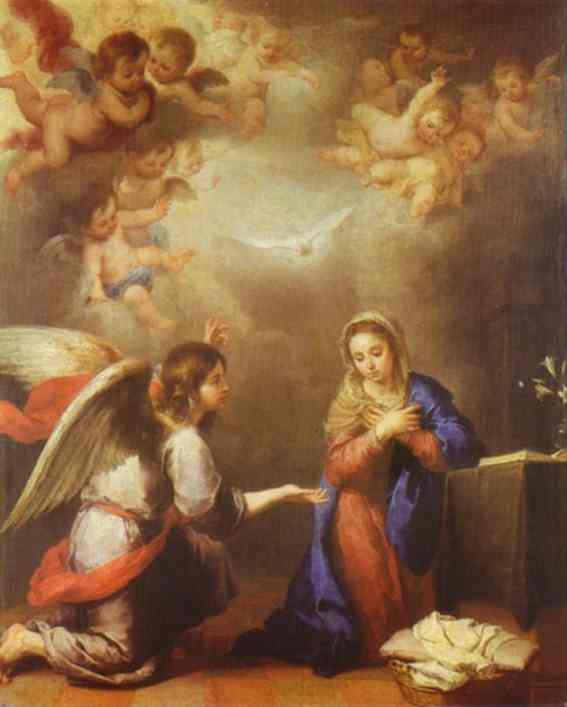
Solemnity of the Annunciation of the Lord

Bartolomo Esteban Murillo. Annunciation.
c.1660-65. Oil on canvas. Museo del Prado, Madrid, Spain. (Source)

On today's feast the Church celebrates the mystery of the Incarnation and, at the same time, the vocation of Our Lady. It was her faithful response to the angel's message, her fiat, that began the work of redemption...

The setting of this feast day, March 25th, corresponds to Christmas. In addition, there is ancient tradition that the creation of the world and the commencement and conclusion of the Redemption all happened to coincide at the vernal equinox.


The Incarnation should have a pronounced and dramatic on our life. This event is the central moment of human history. Without Christ, life has no meaning. Christ the Redeemer "fully reveals man to himself" (Encyclical, Redemptor Hominis). It is only through Christ that we will come to comprehend our inner self and everything that matters most to us: the hidden value of pain and of work well done, the authentic peace and joy which surpass natural feelings and life's uncertainties, the delightful prospect of our supernatural reward in our eternal homeland...

The human testimony of the Son of God teaches us that all earthly realities ought to be loved and offered up to Heaven. Christ has transformed the human condition into a pathway to God. Consequently, the Christian's struggle for perfection takes on a profoundly positive character. This struggle has nothing to do with snuffing out one's humanity so that the divine might shine out instead. Sanctity does not necessitate total separation from worldly affairs. For it is not human nature that opposes God's will, but sin and the effects of original sin which have so badly damaged our souls. Our struggle to become like Christ brings with it a life-long battle against whatsoever degrades our humanity -- egoism, envy, sensuality, a critical spirit ...

In the same way as the humanity of Christ is not effaced by his dignity, so it is that through the Incarnation the human condition preserves its integrity and finds its final end.

Friday, March 23, 2007

A New Blog

A Catholic, a knitter and an avid book lover since 1983.

And the lady understands what makes being a Catholic so great ...

Wherever the Catholic sun doth shine,
There's always laughter and good red wine.
At least I've always found it so.

Benedicamus Domino

What's not to like? Go check it out these musings of a wine country Catholic and welcome her to St. Blog's Parish!

Thursday, March 22, 2007

Poetry Thursday

I like to have a martini,
Two at the very most.
After three I'm under the table,
after four I'm under my host.

Dorothy Parker

Wednesday, March 21, 2007

Thanks Be to God for Miracles, Little Girls ...

... and this Catholic hospital.
"By that point," remembers Taylor, "our prayer was more, initially, or first reaction was to pray to God to help us make it through it. To comfort us. Shortly after that our mind changed and we said God we know you have the power to change this, and we're putting this in Your hands.

Regular sonograms for the next six months still showed no amniotic fluid. An inducement was scheduled six weeks before the due date. One last sonogram indicated something had changed. The Whites headed straight to their specialist in Dallas...
Read it all. Via Alicia.

Unity of Life: Daily Life and Prayer

Personal practices of piety cannot be isolated from the rest of our daily concerns. Rather they should be moments when our constant turning to God is made more intense and more profound; the whole tone of our daily activity is then raised. It is clear that to seek sanctity in the middle of this world does not simply consist in simply doing or in multiplying devotions or pious practices. It lies in an effective union with the Lord with such actions promote and to which they are ordained. And when there is an effective union with the lord, this affects the whole of one's activity. These practices will lead you, almost without your realizing it, to contemplative prayer. Your soul will pour forth more acts of love, aspirations, acts of thanksgiving, acts of atonement, spiritual communions and this will happen while you go about your ordinary duties, when you answer the telephone, get on a bus, open or close a door, pass in front of a church, when you begin a new task, during it and when you have finished it ... (J. Escriva, Friends of God)

Thus we will try to live, with Christ and in Christ, at each and every moment of our existence at work, in the family, among friends. This is unity of life. It is then that personal piety is directed to action, giving it both encouragement and content, converting every task into another act of love for God. And in their turn, work and the tasks of each day make it easier to relate to God; they are the field where all the virtues are exercised. If we try to work well and to give our actions the transcendental dimension of the love of God, our deeds will be of use for the salvation of men and we will make the world more human. for it is not possible for man to be respected -- and even less to be loved -- if God is neglected or opposed, for man is only man when he is the true image of God. ...
I have been finding this to be very true as I have been more vigilant about forcing myself to take time for prayer before beginning the day. It all comes together in a flow back and forth with God's presence wound through everything ...

Tuesday, March 20, 2007

It Was the Lord Who Turned

This reflection on Peter's denial of Christ three times before cock crow resonates all the more after last Sunday's reading of the parable of the prodigal son. I especially like the commentary on the two kinds of sorrow for sin.
... But the real lesson in Peter's life is one of repentance. his fall is a lesson in sin that requires no teacher, but his repentance is a great lesson in salvation. And it is this great lesson that contains the only true spiritual meaning to those who have personally made Peter's discovery -- that they have betrayed our God.

What then can we learn from Peter's turning around? First, it was not Peter who turned. It was the Lord who turned and looked at Pater. When the cock crew, that might have kept Peter from falling further. But he was just in the very act of sin. And when a person is in the thick of his sin his last thought is to throw down his arms and repent. So Peter never thought of turning, but the Lord turned. And when Peter would rather have looked anywhere else than at the Lord, the Lord looked at Peter. This scarce-noticed fact is the only sermon needed to anyone who sins -- that the Lord turns first.

For this reason it is important to distinguish between two kinds of sorrow for sin. The one has to do with feeling sorry over some wrong or sin we have committed. This feeling seems to provide a sort of guarantee that we are not disposed to do the same wrong again, and that our better self is still alive enough to enter its protest against the sin our lower self has done. And we count this feeling of reproach which treads so closely upon the act, as a sort of compensation or atonement for the wrong.

In this kind of sorrow, however, there is no real repentance, no true sorrow for sin. It is merely wounded self-love. It is a sorrow over weakness,over the fact that when we were put to the test we found to our chagrin we had failed. But this chagrin is what we are apt to mistake for repentance. This is nothing but wounded price -- sorrow that we did not do better, that we were not so good as we and others thought. It is just as if Peter turned and looked upon Peter. ...

All this is to say that there is a vast difference between divine and human sorrow. Human sorrow is us turning and looking upon ourselves. True, there is nothing wrong in turning and looking at oneself -- only there is a danger. We can miss the most authentic experience of life in the imitation. For genuine repentance consists of feeling deeply our human helplessness, of knowing how God comes to us when we are completely broken.

In the end, it is God looking into the sinner's face that matters. ...

Monday, March 19, 2007

Good Humored, Spiritual and Packed with Common Sense

Mom to Mom, Day to Day by Danielle Bean

The subtitle of this book is "Advice & Support for Catholic Living" but I think that I'd call it "Down to Earth Advice for Mothers." This is a collection of short essays grouped under such subjects as How Can I Survive the Preschool Years Without Losing My Mind?, How Can I Fill My Marriage with More of "The Better" and Less of "The Worse?", and How Can I Get on Top of the Housework When It Feels Like I'm Smothering Under It?

I am long past the point of having little ones around the house but this is the sort of book that I certainly could have used back in those days. Bean combines practical advice with humorous anecdotes so that we know she's been there (in fact is there as her family is still young) with us on those days when just one more little detail is going to send a usually rational and loving mother screaming out into the yard. (Yes, I've been there too.)

She also puts the spiritual aspect into her advice so that a mother can remember the higher purpose behind the chaos of everyday life with small children. This is a book that not only a Catholic mother can use but one that any mother will find useful. True, in my days with toddlers, I was agnostic, but Bean's deft touch with proffering advice on any subject is that which most young mothers these days can use ... and I would have been no exception to that. In fact, as I was searching for the Truth, it might have made me think twice about Christianity in general.

Regardless, this is an excellent book. I am going to give my copy to a good friend and am planning on buying another for another young mother I know. It would make a wonderful gift for a baby shower if it comes to that. Bean's reassuring advice is just what any young wife and mother can use to make their life a little lighter, easier, and more loving on the days when nothing seems to go right.

Rosetta Stone's review is one that prospective buyers may find more informative than mine. Check it out.

The Weekend

I MISS HANNAH
Spring break is over.

ST. PATRICK'S DAY
In honor of the day, Rose mentioned that she had learned in U.S. History that the Irish were dreaded as immigrants because of the quantity of their drinking. "Oh, dear God, not more Irish!" is how she reported the town fathers reacting when the boats would come in. The only immigrants worse were the Scots because they enjoyed nothing more than a good fight to go along with their drinking, although they tended to live in the back country so that kept involvement with the towns to a minimum. Did I mention that Tom and I have a lot of Irish ancestry? We are a sad tribute to our hard drinking forebears.

Also, when at the grocery store the next day (note to self, avoid any contact with Greenville avenue for the entire length of St. Patrick's day), a Sudanese checker asked with a wide smile if I had been at "the celebration" yesterday. (The store is on Greenville where the parade goes.) I told him that although we had a lot of Irish in our backgrounds, we tended to avoid the parade. He then said with evident delight, "Oh, I was here at work but I enjoyed so much seeing all the happy people at their celebration. It was so much fun to watch! Why is it for the Irish?" Whereupon I gave him the quick story of St. Patrick and his day. He then said again, "It is a good day. I love to see everyone so happy and cheerful." I liked to get this completely neutral take on the "celebration."

LENTEN WATCHING AND READING
Rose began watching The Lord of the Rings trilogy (extended version, of course!) on Saturday. As soon as I saw it I couldn't pull away. It has been a long time since I've seen it and I had forgotten how much Peter Jackson had retained of the original themes. Good and evil, free will and choices, temptations, what constitutes a heroic effort ... what fantastic contemplation this has provided me for the weekend. We progressed through the second movie yesterday and halfway through the last one. I also began rereading the trilogy and am about halfway through the first book. Again, I am amazed at Tolkien's masterpiece. (Note to self: use this for future Lenten reading and watching. Note to others: see the sidebar for any links.)

HOLY TOAST

A late Christmas gift given to me by one of Hannah's friends ... Holy Toast. We were cracking up.

Friday, March 16, 2007

Owl and Shrew

Today's photos by this talented Estonian are so amazing that I called Hannah to make sure she saw them.

Thursday, March 15, 2007

Poetry Thursday

A wonderful bird is the pelican,
His mouth can hold more than his belly can,
He can hold in his beak,
Enough food for a week!
I'm damned if I know how the hell he can!

Dixon Lanier Merritt

I Keep Telling Y'all, Georgette Heyer is the Best!

This is no bodice-ripper, but it is wonderfully romantic in a madcap sort of way. In fact, Heyer wrote it in 1934, and it’s a Georgian, not Regency period, if that matters (I believe it does, to some) but reading this thing was like watching one of my favorite screwball comedies of that era. The heroine is a humorous scamp, the hero - Gad, I fell in love with him! He only shows up in about a third of the book, but he is so well drawn, so clever and funny and wry, that he steals every chapter he’s in. The rest of the book is dominated by secondary characters who kept me in stitches, particularly the overindulging brother, Pel and his drinking/gambling buddy, Pom.

I picked it up yesterday and couldn’t put it down - read it right through the night...

I said, “no, it’s not sexy at all - but it IS romantic, but just tantalizingly so. What it is, is freaking hilarious.”

Now you don't just have to take my word for it (or even Mama T's word), you can see what The Anchoress has to say. And then get thee to a library or bookstore and pick up a Georgette Heyer book!

Conversion Stories Alert

HISTORICAL CHRISTIAN
At the end of the second day, in a Protestant store, I came across a book written by a Protestant pastor on the Holy Spirit, and how the Holy Spirit had worked in his life. As I read it, I got this eerie feeling. I recognized what he was saying, because I had already experienced it. What he was describing was the same thing that I had been experiencing all those years, beginning with my experience of the moon, which had led me on this journey to the very point where I was right then, reading that book.

My mind was in a jumble. He was talking about the Holy Spirit. The HOLY SPIRIT. Of GOD. Of the TRINITY, that thing I had heard about as a child in the Episcopalian church, the BIG Holy Spirit that was one of the three Persons of God, Father, Son, and HOLY SPIRIT.

Wait a minute. You mean, that thing, that “interior guidance system,” that little “spirit” that had been guiding me all those years, was no less than the real HOLY SPIRIT OF GOD, of which Jesus was also a part, that distant figure from my childhood that had meant so little to me before that I had abandoned and rejected it?

I felt like I was being electrified. I looked at my arm, and the hairs were standing straight out.

I bought the book, took it home, and read the whole thing cover-to-cover that night, my mind reeling the whole time: could it be true? Is this the real Holy Spirit that’s been guiding me all this time? Is Jesus the one I’ve been looking for all these years?
The short version of why Aimee became Catholic is good but for the really indepth stuff follow the links contained in that post, as I did, and read her dual series of "how I first came to encounter Christ" (where the excerpt above is found) and "how my experience of Christ has changed during my journey from Evangelicalism to Catholicism." Very good testimony and it personally touched me ... I wasn't exactly electrified as she describes but it definitely was being used by Jesus to get a specific point across to me.

JOHN C. WRIGHT
One of my favorite bloggers, whose books I am just beginning to explore, John C. Wright was interviewed by SCI FI Weekly. As fascinating as his thoughts from an author's perspective are, I was much more taken with his conversion story which is contained about halfway through the interview. For those who don't want to have to hunt down the story, I have taken the liberty of excerpting it in entirety below, although I encourage any sci-fi fans to read the whole interview. I thoroughly enjoyed it.
At some point after your first three epics were completed, you converted to Christianity, having been a resolute humanist before. How did this come about?

Wright: Now, this is a difficult question to answer, because to talk of these deep matters automatically provokes half the audience, and bores the other half. I will try to be as brief and delicate as I can.

Humanist is too weak a word. I was an atheist, zealous and absolute, one who held that the nonexistence of God was a fact as easily proved as the inequality of five and twice two.

However, my disbelief began to erode as fatherhood and war pressed upon me the realities of the world. I was a Stoic, a disciple of Epictetus and Marcus Aurelius, Cicero and Seneca, who say the ground of morality is duty; but I was also a liberal of the classical Enlightenment, which says toleration is the ground of morals. Both these strands in my philosophy were naïve: Humans cannot live by the strictness of the Stoics; humans ought not live by the laxness of the liberals, libertarians or libertines. The two strands did not match. Modern philosophy, which is based on self-interest or utilitarianism, is unsuited both for war and for fatherhood. Growing aware of the defects in my system, I sought something with more experience and wisdom.

Where is wisdom found? I read the deep thoughts of the most highly regarded thinkers of the modern age, and found them vain and shallow. The insights of Nietzsche, Freud, Sartre, Marx, Wittgenstein and other luminaries of the modern world contained simple errors in logic a schoolboy can dismiss with a laugh. Each in his own way asserted that man was irrational, and the truth unknowable: But if so, how did they prove this unreason? Using reason, or otherwise? And how exactly did they come to know the truth that truth was unknowable?

In popular culture, the books influencing the morals and values of the current age, such as Stranger in a Strange Land or Zen and the Art of Motorcycle Maintenance, read like they were written by a Man from Mars, or a mental patient. They know nothing of real life.

The salient characteristic of modern philosophy is a speculative disconnection from reality. Michael the Martian and Karl Marx expect the super-humans to live together without jealousy or scarcity of resources. Money will simply overflow the collection plate, and anyone can take as much or as little as he likes. But what if someone is dishonest or selfish, comrade? Ah, but the theory does not allow for that.

In contrast, the writings of C.S. Lewis, J.R.R. Tolkien, G.K. Chesterton, Evelyn Waugh, all read like things written by mature men. The ancients, Aristotle, Plato, Epictetus, Marcus Aurelius, Seneca, Cicero, Aquinas and even Augustine, solidly prepared the ground from which a sane, mighty and just civilization could be grown.

I reached a point in my life where on all divisive questions of morals and manners, I agreed with no one other than my hated enemies, the Christians. I knew in my cool atheist heart they must be wrong in theory; I could not explain how they were correct in practice.

I began to read history. The modernists are right to fear it. Once a man knows the context and origins of the ideas of modern times, it becomes increasingly difficult to maintain faith in them. It becomes impossible to condemn Western civilization for shortcomings that fall short only of ideals unique to Western civilization. It becomes impossible not to notice Western civilization is nothing other than Christendom.

The conclusion pressed on me was that modern thought is a parasite on Christianity, and has no intellectual life outside her. The basic motif of the modern intellectual, one endlessly repeated, is of a man sawing off the branch on which he sits. The moderns delight in assertions that, if taken seriously, would disprove the axiom used to make the assertion.

The profoundly unserious nature of modern thought astonished me, and still does. I stump my secular friends by asking them to explain to me why cannibalism is wrong. Their humanist doctrines are insufficient to give a reason for humane humanity.

History told me that everything I admired about the noble and great-souled pagans still survived in Christianity: Aristotle was still alive in Aquinas, and nowhere else. The cool rationality of Athens had been preserved by Rome. Everything in paganism from which the civilized mind recoils, as slavery, infanticide, polygamy, sodomy, had been defeated by Christianity, and made a recurrence only when and where Christianity retreats.

I reached a point in my studies of history where I was forced to grit my teeth and conclude that the progress and enlightenment of Europe was due to Christianity, not despite it; and that when Europe departed from Christian roots, barbarism and darkness unique to the ideologies of the modern age descended. The crowning achievement of the rejection of Christian norms in modern times was communism: Its crowning achievement was death in such large numbers that only astronomers can grasp them.

I knew the Christians were evil in theory; I could not explain how so much unique good came from them.

Greatly daring, I attempted an experiment in prayer, addressing a Supreme Being I knew with deep certainty did not and could not exist. My prayer was quickly and awfully answered.

A miracle occurred. I suffered a supernatural experience and found all the foundations of my carefully examined and rigidly logical philosophy swept away as if by a tidal wave of blazing and supernal light. A great and powerful spirit visited me.

The whole thing was as simple and astonishing, as easy to explain and as hard to explain, as falling in love.

I am one of those rare creatures whose belief in the supernatural is due to empirical considerations. My mysticism is entirely scientific. Alas, the second step in the experiment, when the miracle occurs, cannot be reproduced before the eyes of skeptics.

Worse yet, the experiment was like toying with radium: I was mutated and changed by the exposure.

Being still a creature of pure logic, logic requires me to conclude either that I am mad as a March Hare or that my memory and perceptions were veridical.

There is insufficient evidence for the first theory, and Occam's razor cuts against it: Assuming everything was actually coincidence or an act of the subconscious mind, would be merely to assume that these things, coincidences and the subconscious, act with more power and foresight than empiricism can confirm. It is what Karl Popper called a non-disprovable assumption. Not science: an article of faith.

I am left with the second explanation, a simpler one, postulating fewer entities: I saw whom I saw and He is that He is. My integrity as a philosopher, not to mention my pride as a man, will not allow me the evasion of a return to my former beliefs, much as I might respect them. The world is far odder than I would have believed. The oddest thing of all is joy.

Sharing the Mirth

Too, too funny. Find more at Inherit the Mirth.

Trinitarian Beauty

In the Trinity God loves himself without any shadow of egotism and admires himself without any shadow of narcissism.

Trinitarian beauty is a wide area to explore. It is, like the Persons themselves, a beauty of relationship. It consists in beautiful relationships; it is the synthesis between unity and diversity. The least inadequate images of this beauty are from music and dance. In musical harmony, every note derives from its beauty from its relationship to the other notes. When a man and woman dance together, every movement derives its beauty through each partner's coordination with the movement of the other. Beauty is the three divine Persons facing each other from the beginning with a joyful and silent gaze.
Something for us to meditate upon.