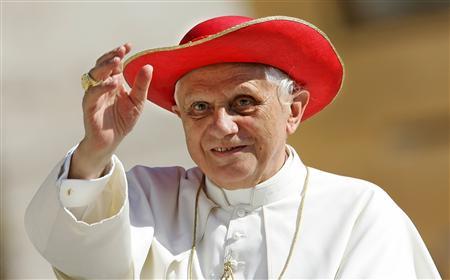
Oy veh! Talk about funny ... and insightful. Via The Anchoress.
Tags: Catholicism, Christianity
St. Augustine, the fifth-century African who was the church's seminal teacher, penned a striking phrase to describe the example of Jesus: Caro quasi vox ("Christ's flesh is like a voice"). What he meant is that at every state of Jesus' earthy life -- his life in the flesh -- he is calling to us, inviting us personally to live in the mystery of divine love that he reveals...Catholic Passion by David Scott
Nightmare
Faded picture in my mind
Of nightmares from the past
Of the present, I am blind
Twenty monsters of a kind
As my heart beats fast
Faded pictures in my mind
I open doors I cannot find
The traps have all been cast
Of the present, I am blind
The roads, the walls, the trees wind
I stumble off the path
Faded picture in my mind
My arms, my legs, my tongue, they bind
I fall, the abyss is vast
Of the present, I am blind
My face is now old and lined
Many years have past
Faded picture in my mind
Of the present, I am blind
Why can't Farmer Johnson solve his own problems? Every time he needs to know how many acres of soy beans, corn and wheat to plant with 80,000 dollars and 600 hours of labor to spare if the cost of seeds is $4 for soy and $6 for wheat or corn and labor is 6 hours per acre for soy, 2 for wheat, and 7 for corn, I have to calculate this bumpkin's assets and tell him how to run a farm.There's pretty much no denying that logic. Obviously the answer is that Farmer Johnson shouldn't have a farm ... or won't for much longer if he can't start figuring these things out for himself.


Our Deliverer and God came by the quietest of signs, in the everyday miracle of a baby being born -- the same way that you and I came into the world. He was born amid tears of joy, swaddled in a blanket, and held in the gentle arms of his father. On the first night of his life, he likely fell asleep nursing, his head nestled against his mother's warm breast -- like countless babies before him and countless babies since.The thing I like about reading this book is that David Scott takes something that I already know, such as the idea that Jesus came to show us what God is like, and then twists it. Adds that phrase or two that makes me rethink what I "already knew" and realize that I do not know it as well as I thought. In this case, talking about God's "autobiographical statement," "full disclosure," and "confession" made me take a fresh look.
Why this way? Why not in power and glory, in fire that swept down from the mountaintops, in the upheaval of nations, or in the blood red stars falling from the sky? Because in coming to us as a child, God was making what amounts to an "autobiographical" statement. The Incarnation was God's confession, his full disclosure. In the baby conceived at Nazareth and later born in a stable in Bethlehem, God revealed himself as a God of love and mercy -- a Father who seeks us in the wilderness of our fallen world. ...Catholic Passion by David Scott
... Christianity has too often been in what appeared at the time to be fatal danger for us now to be frightened by yet another such test. The ways by which Providence ransoms and saves its elect are unforeseeable. At times, our enemy becomes a friend; at times he is despoiled of the capacity for evil that made him fearsome; at times he auto-destructs, or, without desiring it, produces beneficial effects and simply vanishes without leaving a trace. Generally, the Church does not have to do anything but persevere with peace and confidence in the fulfillment of its tasks, remain serene, and await salvation from God. (Cardinal J.H. Newman)I especially like the point that Cardinal Newman made about how many times Christianity has seemed to be in danger and how it always has been saved. It seems that too often we hear Christians bemoaning the fate of the faith's existence in the modern world without remembering that point.
The moments in which we encounter opposition and difficulties without exaggerating them are particularly propitious for exercising a whole range of virtues: we should pray for those who do evil to us even without our knowing it, so that they may leave off offending God; we can strive to make amends to the Lord, to be even more apostolic, and to protect with exquisite charity those weaker brothers in the faith who on account of their age, their lack of formation, or the special situations they find themselves in, could sustain a greater harm to their souls.

WASHINGTON, DC—Over 87 percent of Americans are unprepared to protect themselves from even the most basic world-ending scenarios, according to a study released Monday by the nonpartisan doomsday think-tank The Malthusian Institute....Oh, The Onion ... how do they manage to be so funny? Read the whole hilarious story.
... The study found that many apocalypse-preparedness measures are cost-prohibitive. With virtually no tax incentives in place, many Americans share the "dangerous perception" that only the richest few can afford to survive the extinction of humanity.
"I just renovated my house with cantilevered leaden cofferdams for increased earthquake and radiation protection, and I'm working on a pantheistic altar to appease the god or gods most likely to return to this world with an insatiable wrath," said Seattle resident Tim Hanson, whose actions were praised in the study as a "highly rare display of prescience and vigilance."
"I installed solar panels and a generator so I could live off the grid for a while," Hanson added. "But it cost so much that now I might not be able to have the altar properly gilded. At least not in time." ...
... Life involves so many challenges; by paying attention to the ways that God has gifted us, we can begin to appreciate the ways our gifts enable us to live more fully.I have to admit that I am not in the habit of loving challenges. I hear the word "challenge" and my mind substitutes "problem" or "difficulty" or "hardship." Yep, corporate speak has done a number on me and I know what they mean when they say "challenge."
Great athletes love challenges. While watching the Olympics recently, I was struck by how many athletes talked about wanting to break a world record or beat a particular opponent. Instead of seeing these challenges as roadblocks to their own comfort and ease, they saw them as opportunities to let their gifts manifest themselves. Often, these athletes had to face great hurdles; many did not accomplish what they had hoped. But they were grateful for the chance. I often wish that I could bring a similar drive into ordinary life, with the ability to see challenges as ways to manifest the gifts God has given me. But the truth is that, more often, I see them as unnecessary hassles and often blame God for that.
Notice that the risen Jesus still bears his wounds. How can it be otherwise? In our own lives, times of suffering may lead to times of peace and joy, but we cannot escape the lingering effects of suffering. It permanently changes us -- we cannot pretend that it never happened. That the risen Jesus still bears his wounds is good news, for it tells us that there is a continuity between the lives we have now and the lives that we will enjoy in the Resurrection. Jesus is the same person. His wounds, though, are different: they are not a source of suffering but a source of recognition. It is only through seeing Jesus' wounds that Thomas recognizes him. In the Resurrection, we will still bear the effects of the hurts that have been done to us, but they will no longer cause us pain.
 From my mouth to Apple's ears.
... Through the lens of the Resurrection, life is not bounded by death -- and thus we achieve our freedom in no longer being afraid of it. For while all of us will die one day, our understanding of death changes because of the Resurrection: death becomes little more than the closing of one chapter of our lives and the beginning of another. The resurrected Jesus was almost nonchalant about his own death -- extraordinary, since we might expect that someone in his situation could come back to wreak havoc on the political establishment that executed him. Why didn't he hunt down his enemies? Why didn't he use his return from the dead as a platform to call attention to his own power?And isn't that really the most attractive thing about the real Christians that we know? Their joy, their love of life and wanting to share that joy with others? I know it is for me.
Perhaps the reason is because Jesus was truly free. He was not concerned about the pettiness of so much social and political action; he was alive and wanted to bring good news to his friends. Perhaps too he was more concerned with inviting his friends to share that joy.

CONSTABLEI'd never have guessed ... fascinating!
Now used as on official term for law enforcement officers, this word began in the horse stables. In ancient Rome, the official version was comes stabuli, literally meaning "count of the stable," or the head groom. By the 1200s, the Old French version, conestable, was used to refer to the head officer of a king's household and by the 1500s, the current use had arisen.
The point of reading these stories is not to experience some tabloid thrill, but to understand how grace works in the world. Every day, all day long, God pours out his grace upon us, urging us, coaxing us, to turn away from everything that is base and cheap and unsatisfying, and to turn toward the only thing that is eternal, perfect, and true -- that is, himself.I must admit that I came to this slender book with a lot of preconceptions.