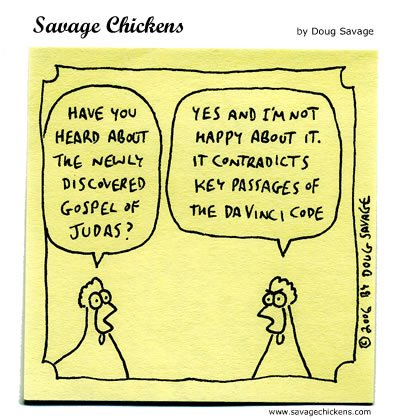
If not then you are missing a great comic pleasure every day. Reproduced with permission.
The miraculous changing of what was bread and wine into the body and blood of Christ that occurs during the Consecration at each and every Mass is called transubstantiation. It refers to the changing of substances, in this case, the substances of bread and wine into the substances of the Body and Blood of Jesus. Catholicism bases this belief in the transubstantiation on two points:
- In the Gospels of Matthew, Mark, and Luke, each writer uses the same phrase to describe the Last Supper on Holy Thursday, the day before Jesus was crucified. Jesus took the bread, blessed it, broke it, and gave it to his disciples and said, "This is My Body" (touto estin to soma mou in Greek; hoc est corpus meum in Latin). The verb to be is used such that an equality exists between This (which refers to the bread) and My Body. So the bread becomes the body of Christ. Because all three Gospels (Matthew 26:26, Mark 14:22, and Luke 22:19) meticulously repeat the exact same phrase, as does St. Paul (1 Corinthians 11:24), these sacred words must be taken literally.
- The words of the Last Supper spoken by Christ over the bread and wine are consistent with the New Testament: Jesus explicitly and graphically commanded, "Eat My flesh and drink My Blood," more than a few times. He also said, "My flesh is real food and my blood real drink." Some in the crowd said, "How can this man give us his flesh to eat?" (John 6:52), and he responded, "Unless you eat the flesh of the Son of man and drink his blood, you have no life in you" (John 6:53). "After this, many of his disciples drew back and no longer went about with him," (John 6:66). The Church reasons that if Jesus had meant this to be symbolic, why would he allow so many of his followers to leave with a serious misunderstanding?
Catholicism For Dummies by John Trigilio


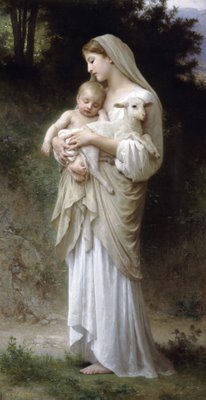 William Bouguereau (1825-1905)
The May MagnificatGerard Manley Hopkins
- May is Mary's month, and I
Muse at that and wonder why:- Her feasts follow reason,
Dated due to season --- Candlemas, Lady Day;
But the Lady Month, May,- Why fasten that upon her,
With a feasting in her honour- Is it only its being brighter
Than the most are must delight her?- Is it opportunest
And flowers finds soonest?- Ask of her, the mighty mother;
Her reply puts this other- Question: What is Spring? --
Growth in everything --- Flesh and fleece, fur and feather
Grass and green world all together;- Star-eyed strawberry breasted
Throstle above her nested- Cluster of bugle blue eggs thin
Forms and warms the life within;- And bird and blossom swell
In sod or sheath or shell.- All things rising, all things sizing
Mary sees, sympathising- With that world of good
Nature's motherhood.- Their magnifying of each its kind
With delight calls to mind- How she did in her stored
Magnify the Lord- Well but there was more than this:
Spring's universal bliss- Much, had much to say
To offering Mary May.- When drop-of-blood-and-foam-dapple
Bloom lights the orchard-apple- And thicket and thorp are merry
With silver-surféd cherry- And azuring-over greybell makes
Wood banks and brakes wash wet like lakes- And magic cuckoo call
Caps, clears, and clinches all --- This ecstasy all through mothering earth
Tells Mary her mirth till Christ's birth- To remember and exultation
In God who was her salvation.
I wanted to wait until I saw Flight 93 to weigh in on this discussion. I have just seen it, and it is one of the finest efforts I have seen in years of moviegoing. I am ready to say that this one will be a classic, along with Tora Tora Tora and films of that general type.
I want to say that the key to this film is the unquenchable courage of the human spirit. This is about a battle in the sky - a truly significant battle fought by ordinary American citizens. And of all the documentaries, re-enactments, narrations, etc., that I have seen dealing with that day, this is superior to and unlike any of them. It is gripping and spellbinding, and you will be proud of these people, and also get a good look at "the fog of war" and what the people in the FAA and military were dealing with.
The movie starts so very slowly, capturing the ordinary, familiar, even boring atmosphere perfectly. What we then are treated to is the story of how the ordinary people (just like me, just like you, just like our friends and neighbors) came to grips with a situation that became clearer and more perilous with each bit of gleaned information. I am so proud of those people words can't express it.
Please don't dismiss this movie expecting blood (very little), scenes of slaughter, etc. You won't find them. What you will find is an exceptional group of heroes. And if heroism makes you cry, then yes, you might want to tuck a Kleenex in your pocket. Sorry for the long comment and "mini-review", but as you can tell, I was very impressed. And I still haven't seen Saving Private Ryan, because I can't take violent movies.
Catholicism professes that during the Consecration, a miracle occurs — the priest consecrates the bread and wine: Just as Jesus did at the Last Supper, the priest takes the bread in the form of a Host and says, "This is My body." Then he elevates the Host for the congregation to see, bells are rung, and he genuflects. Then he takes the chalice (cup) of wine, saying "This is the cup of My blood," elevates the chalice, and genuflects. Now it's the body and blood of Christ — it still looks, feels and tastes like bread and wine, but it's not. This change of bread and wine into the real Body and Blood of Christ is called transubstantiation.
The Bible says that God created merely by speaking: "God said, 'Let there be light' and there was light" (Genesis 1:3). Likewise, by merely speaking the words of Christ over the bread and wine during Holy Communion, the priest changes them into the body and blood, soul and divinity of Christ through the authority given to him by the Sacrament of Holy Orders. Only an ordained priest has the authority to say Mass and consecrate the bread and wine.
Catholics kneel before the consecrated Host — the Eucharist — because it's not a piece of bread anymore — it truly is Christ. If the Holy Eucharist were just a symbol — such as bread and wine — then kneeling down and adoring it would be considered idolatry, but the Catholic Church has staunchly asserted for 2,000 years that the Holy Eucharist isn't a symbol. The Holy Eucharist is his body and blood. Therefore, the Holy Eucharist is Christ himself present in the consecrated Host...Catholicism for Dummies by John Trigilio
The Confessions of St. Augustine
By St. Augustine
St. Augustine
I was a bad boy. Damn, was I a bad boy. Not anymore, though.
THE END
Traditionally, Catholicism has four kinds of prayer.The Church believes that the Mass is the highest and supreme form of prayer, so it has all four elements in it. The Gloria is the adoration part of prayer, whereas the Confiteor and Penitential Rite are the contrition part. Later in the Mass, after the homily (sermon) and the Nicene Creed, comes the Prayer of the Faithful, also known as the General intercessions, which is a prayer of petition. The thanksgiving part comes after Holy Communion, when gratitude is shown for all the graces given at Mass.
- Adoration: Praising God.
- Contrition: Asking for God's forgiveness.
- Petition: Asking God for a favor.
- Thanksgiving: Showing God gratitude.
Catholicism for Dummies by John Trigilio
Love for God does not consist in sensible feelings, although these too may be given to us by Our Lord so as to help us to be more generous. It consists essentially in the full identification of our will with that of God ...
Love is repaid with love, but it must be genuine love, which is seen in specific ways in the fulfillment of our duties toward God and towards others, even when our feelings do not incline us in this direction, and it may be for us an uphill struggle. The highest perfection consists not in interior favors or in great raptures, wrote St. Teresa, but in the Will of God that, as soon as we realize that he wills anything, we desire it ourselves with all our might.
In the service of God, a Christian should be guided by faith an in this way overcome the ups and downs of moods. To guide myself by mere sentiment would be like putting a servant in charge of the household and causing the master to relinquish his position. Sentiment is not what is bad, but the importance that is given to it ... In certain souls the emotions constitute all their piety, to such an extent that they are convinced that they have lost it whenever the feeling goes away ... If only these souls could understand that this is precisely the moment in which to begin to have it (J. Tissot, The Interior Life).
Matthew and John and Peter (whose Gospel Mark wrote) were among the six pairs of apostles sent out on that first mission (Mt 10). No one of them gives us a single detail. Yet it may well have been the most nerve-racking experience any of them had yet had. To begin with, they had been ordered to take the road with no money and no food, wearing nothing but what they stood up in — they went out as mendicant friars would later go. They were to live on what they were given, and for men not rich indeed but respectably brought up, this could have been trying.
Yet it was as nothing to what they had been told they must do. We can imagine the cold pain in the back and the gulp as they steeled themselves to their first miracle — would the disease obey them? Would the devils? Their first sermon might have meant a chiller pain, a more sickening gulp — anyone who remembers his own first speech will know about that. And preaching was such a long way away from fishing, or even tax collecting. Fishermen had no training as prophets, tax collectors still less.
Their instructions were so very exacting (some indeed envisioned a wider apostolate than this first one). They were to be wise as serpents — considering the part that the serpent's cunning had played in the Fall of man, it is interesting that our Lord mentions its wisdom. It is faintly surprising that he offers is apostles the serpent for their imitation at all.
The dove also is held up for their imitation. Yet there is nothing dovelike in what they must do is any house or city will not receive them or hear their words: "Going forth out of that house or city, shake off the dust from your feet" (Mt 10:14). This shaking the dust from the feet was an exclusively Jewish gesture — Jews used it, for instance, when returning to the Holy Land from the lands of the Gentiles. The apostles must have been startled to be instructed to use it against their fellow Jews.To Know Christ Jesus by Frank Sheed