 |
| The Bookworm, 1857, Carl Spitzweg |
Featured Post
On the road again — back July 6!
Back July 6! My husband and I are taking a road trip through Utah. We're going to Zion National Park, Brice Canyon and eventually we...

Friday, August 9, 2024
Mine is a simple system
Mine is a simple system. I read from morning till bedtime, with breaks for my job, my family, meetings with friends, exercise, household chores and periodic reviews of my life's greatest blunders.I don't read for a living, but I am often asked how I read so many books. My system is identical to Dirda's.Michael Dirda, 10 Rules for Reading from Someone Who Does It for a Living

Thursday, August 8, 2024
The Release from Deception
 |
| The Release from Deception, Francesco Queirolo |
Release from Deception (Il Disinganno), produced in 1752–1759,[2] shows a fisherman being released from a net by an angel. The masterpiece was carved from a single piece of marble and can be seen in Cappella Sansevero, Naples.
The inscription on the book at the bottom of the sculpture depicts in Latin the words of the angel to the fisherman, made up of three different quotations from the Vulgate Holy Bible put together:
VINCULA TUA DISRUMPAM (Nahum i. 13)
VINCULA TENEBRARUM ET LONGÆ NOCTIS (QUIBUS ES) COMPEDITUS (Sapientiæ xvii. 2)
UT NON CUM HOC MUNDO DAMNEBIS (St. Paul 1 Corinthians. xi. 32)
“I will burst thy bonds asunder, / being fettered with the bonds of darkness, and a long night, / that you will not be condemned with this world.”
Surrender is not giving up.
Surrender is not giving up. Surrender is giving God access – and then getting to work.Amen, amen.Father Mike Schmitz
Wednesday, August 7, 2024

Notes on Mark: Choosing The Twelve
 |
| Vocation of the Apostles, a fresco in the Sistine Chapel by Domenico Ghirlandaio |
MARK 3:13-19
I like the way the Standard Revised Version says it ... "He called to them those whom he desired." That rings true for my life, much less for anyone who is called to a vocation. Some interesting observations about the choosing of The Twelve. I especially like the point that the Apostles were a group because I always am mystified by people who say that they don't need church. I know that if left to myself I tend to lose perspective. I definitely need the church even if I don't always feel warm and fuzzy toward the people in it all the time.
It is significant that Christianity began with a group. The Christian faith is something which from the beginning had to be discovered and lived out in a fellowship. The whole essence of the way of the Pharisees was that it separated men from their fellows; the very name Pharisee means the separated one; the whole essence of Christianity was that it bound men to their fellows, and presented them with the task of living with each other and for each other.
Further, Christianity began with a very mixed group. In it the two extremes met. Matthew was a tax-collector and, therefore, an outcast; he was a renegade and a traitor to his fellow countrymen. Simon the Cananaean is correctly called by Luke, Simon the Zealot; and the Zealots were a band of fiery, violent nationalists who were pledged even to murder and assassination to clear their country of the foreign yoke. The man who was lost to patriotism and the fanatical patriot came together in that group, and no doubt between them there were all kinds of backgrounds and opinions. Christianity began by insisting that the most diverse people should live together and by enabling them to do so, because they were all living with Jesus.
The Gospel of Mark (The Daily Bible Series, rev. ed.)
We also can't forget the significance of numbers, as is always the case when studying Scripture.
The Twelve chosen by Jesus receive a specific vocation to be "people sent out," which is what the word "apostles" means. Jesus chooses them for a mission which he will give them later (6:6-13) and to enable to perform this mission he gives them part of his power. The fact that he chooses twelve is very significant. This is the same number as the twelve Patriarchs of Israel, and the Apostles represent the new people of God, the Church founded by Christ. Jesus sought in this way to emphasize the continuity that exists between the Old and New Testaments. The Twelve are the pillars on which Christ builds his Church (Gal 2:9); their mission to make disciples of the Lord (to teach) all nations, sanctifying and governing the believers (Mt 28:16-20; Mk 16:15; Lk 24:45-48; Jn 20:21-23)
The Navarre Bible: St. Mark
=====
Tuesday, August 6, 2024
Julie and Scott are not surprised to learn that Ramon's favorite song is Me and My Shadow.
In Episode 337 of A Good Story is Hard to Find, we discuss The Charwoman's Shadow by Lord Dunsany. Fantasy the way it should be done.
Monday, August 5, 2024
We gave him the power to die
Who is Christ if not the Word of God: "in the beginning was the Word, and the Word was with God, and the Word was God?' This Word of God was "made flesh and dwelt among us." He had no power of himself to die for us: he had to take from us our mortal flesh. This was the way in which, though immortal, he was able to die, the way in which he chose to give life to mortal men: he would first share with us, and then enable us to ashare with him. Of ourselves we had no power to live, nor did he himself have the power to die.Once again, Saint Augustine teases out a fact that never would have occurred to me. But it is so obvious once it is pointed out.
Accordingly, he effected a wonderful exchange with us, through mutual sharing: we gave him the power to die, he will give us the power to live.Saint Augustine
Travelers
 |
| Travelers painted by Karin Jurick |
Friday, August 2, 2024
"It's hard to get clos'r to a chicken goin' at him head on..."
A chicken lived every situation, every moment, like it was brand-new, and so lived in a constant state of wonder and surprise. "It's hard to get closr to a chicken goin' at him head-on," the old man said, because, though chickens had tiny brains, most of these brains seemed devoted to suspicion.We kept chickens for a while when I was young. My mother found them frustrating, but also relaxing with their clucking, scratching, and general gossip sessions amongst themselves.Rick Bragg, The Best Cook in the World
It's her 90th birthday today. It's the excuse for a family reunion so it will be full of good food and laughter and talk. We will not, however, be eating chicken. We're having TexMex for this celebration.
This quote and today's chicken picture are a little blog gift for her. Happy birthday, Mom!
Red Junglefowl
 |
| Illustration of male and female Red Junglefowl |
A main ancestor of our modern chickens which is still found in India and Southeast Asia.
Thursday, August 1, 2024
She does not own a measuring cup.
She does not own a measuring cup. She does not own a measuring spoon. She cooks in dabs, and smidgens, and tads, and a measurement she mysteriously refers to as, "you know, hon, just some." In her lexicon there is "part of a handful" and "a handful" and "a real good handful," which I have come to understand is roughly a handful, part of another handful, and "some.Rick Bragg, The Best Cook in the World
Laundresses before the Wasserturm
 |
Samuel Prout, 1783 - 1852, Laundresses before the Wasserturm, Nuremberg via National Gallery of Art |
I was drawn into the Wikipedia piece on him which begins:
Samuel Prout (/praʊt/; September 17, 1783 – February 10, 1852) was one of the masters of British watercolour architectural painting. Prout secured the position of Painter in Water-Colours in Ordinary to King George IV in 1829 and afterwards to Queen Victoria. John Ruskin, whose work often emulated Prout's, wrote in 1844, "Sometimes I tire of Turner, but never of Prout". Prout is often compared to his contemporaries; Turner, Gainsborough, Constable and Ruskin, whom he taught.It is all worth reading and the art samples are lovely.
Wednesday, July 31, 2024
Ocean Waves
 |
| Ocean waves, Katsushika Hokusai via Wikipaintings |
"Tell us of that man.”
In 1908, in a wild and remote area of the North Caucasus, Leo Tolstoy, the greatest writer of the age, was the guest of a tribal chief “living far away from civilized life in the mountains.” Gathering his family and neighbors, the chief asked Tolstoy to tell stories about the famous men of history. Tolstoy told how he entertained the eager crowd for hours with tales of Alexander, Caesar, Frederick the Great, and Napoleon. When he was winding to a close, the chief stood and said, “But you have not told us a syllable about the greatest general and greatest ruler of the world. We want to know something about him. He was a hero. He spoke with a voice of thunder; he laughed like the sunrise and his deeds were strong as the rock….His name was Lincoln and the country in which he lived is called America, which is so far away that if a youth should journey to reach it he would be an old man when he arrived. Tell us of that man.”I loved this book and this story is the cherry on the sundae.
“I looked at them,” Tolstoy recalled, “and saw their faces all aglow, while their eyes were burning. I saw that those rude barbarians were really interested in a man whose name and deeds had already become a legend.” He told them everything he knew about Lincoln’s “home life and youth…his habits, his influence upon the people and his physical strength.” When he finished, they were so grateful for the story that they presented him with “a wonderful Arabian horse.” The next morning, as Tolstoy prepared to leave, they asked if he could possibly acquire for them a picture of Lincoln. Thinking that he might find one at a friend’s house in the neighboring town, Tolstoy asked one of the riders to accompany him. “I was successful in getting a large photograph from my friend,” recalled Tolstoy. As he handed it to the rider, he noted that the man’s hand trembled as he took it. “He gazed for several minutes silently, like one in a reverent prayer, his eyes filled with tears.”
Tolstoy went on to observe, “This little incident proves how largely the name of Lincoln is worshipped throughout the world and how legendary his personality has become. Now, why was Lincoln so great that he overshadows all other national heroes? He really was not a great general like Napoleon or Washington; he was not such a skilful statesman as Gladstone or Frederick the Great; but his supremacy expresses itself altogether in his peculiar moral power and in the greatness of his character.
“Washington was a typical American. Napoleon was a typical Frenchman, but Lincoln was a humanitarian as broad as the world. He was bigger than his country—bigger than all the Presidents together.
“We are still too near to his greatness,” Tolstoy concluded, “but after a few centuries more our posterity will find him considerably bigger than we do. His genius is still too strong and too powerful for the common understanding, just as the sun is too hot when its light beams directly on us.Doris Kearns Goodwin, Team of Rivals
Tuesday, July 30, 2024

Team of Rivals by Doris Kearns Goodwin

Acclaimed historian Doris Kearns Goodwin illuminates Lincoln's political genius in this highly original work, as the one-term congressman and prairie lawyer rises from obscurity to prevail over three gifted rivals of national reputation to become president. Goodwin demonstrates that Lincoln's political ability was the result of a character that had been forged by experiences that raised him above his more privileged and accomplished rivals. He possessed an extraordinary ability to put himself in the place of other men, to experience what they were feeling, to understand their motives and desires.
It was this capacity that enabled Lincoln as president to bring his disgruntled opponents together, create the most unusual cabinet in history, and marshal their talents to the task of preserving the Union and winning the war.
I'd never have read this if not for The Big Read. I am truly grateful. What a magnificent book.
Abraham Lincoln was already at the top of my admired people list. However, I found a lot in this book that gave me a fuller picture of the man himself. Some things were just interesting such as his very strong passions for women so that he could hardly keep his hands off of them. (My goodness!) And his strong passion for Mary Todd. She's been portrayed (justly) as crazy so consistently that most Americans have a distaste for her. However, she and Abe were crazy for each other, even when she was just plain crazy.
Most of what I learned, however, was simply admirable. He was a shrewd judge of character and dealt magnanimously with even his enemies, which often resulted in their becoming his loyal supporters. He was also a shrewd judge of how and when to push measures to achieve his political goals. This applied both to his personal career and to the laws governing the country. I was impressed by how he would often wait to propose measures until the nation's emotional state had been brought along in understanding so that it would be supported.
In many ways this book inspired me personally because of all the warm, personal examples of Lincoln's forgiving nature.
The author was excellent at unfolding the progress of political measures and the people involved so that I really understood everything going on. Considering how much of the book consisted of that sort of thing, it is a real accomplishment. Plus I was riveted, often not waiting for the next week's "assigned reading" but charging ahead. I can't think of another book of this sort where that has happened.
Highly, highly recommended.
Friday, July 26, 2024
The Gold Railway
 |
| Die Goldbahn (The Gold Railway), Edward B. Gordon |
I just love Edward B. Gordon's paintings and especially those from urban life.
Thursday, July 25, 2024
Preparation
 |
| Die Vorbereitung (Preparation), Edward B. Gordon |
Since today's quote was about food, let's keep that theme going!
Lagniappe
It is the food of the high places, of the foothills, pine barrens, and slow brown rivers. It is not something done by the great chefs of Atlanta or Birmingham for people who spend more on a table for four than a working class family spends on groceries for a month. It was never intended for everyone, but for people who once set a trotline, or slung a wrench, or rose from a seat in the ciety auditorium to testify during an all-night gospel singing.As I've mentioned before, this is one of my favorite comfort books.Rick Bragg, The Best Cook in the World
Wednesday, July 24, 2024
Notes on Mark: Healing on the Sabbath
 |
| Christ healing the man with a withered hand, Byzantine mosaic. |
Jesus enters the synagogue and heals a man's withered hand while the Pharisees move toward final judgment. (Read it here.) Once again it comes down to the nitpicking details the Pharisees labeled holiness. Somehow "healing" just doesn't fall under the "work" label for me (although if I were a doctor or nurse that would be a whole other kettle of beans.) The Pharisees had no such qualms. This is easy to see when you know how stringent the rules were about medical care on the Sabbath.
That also makes it all the easier to see why Jesus' pulling that man to the front, asking that question, and then healing him was such an in-your-face challenge. Gotta love it, don't you? He just never backed down from the good fight. He never quit trying to get them to understand what they were doing that was wrong.
Jesus' opponents take for granted that he is able to cure and they guess, rightly, that the sight of the disabled man will move him to do so. But their only interest is in whether he will again violate their interpretation of sabbath law.Jewish rules about healing and the Sabbath.
[...]
Far from being intimidated by their scrutiny, Jesus ensures that what he is about to do will be in full public view. The verb for come up, egeiro, can also be translated "rise up," and is the same word used for Jesus' resurrection in 16:6. Mark often uses it in healing stories (1:31; 2:9-12; 5:41; 10:49) to indicate that Jesus is bringing about not only physical cures but a restoration to fullness of life.
[...]
Unlike Matthew and Luke, Mark gives us a glimpse of Jesus'' interior reaction: he is angry and deeply grieved at their hardness of heart. "Hardness of heart" signifies a stubborn refusal to be open to God (Jer 11:8; Ezek 3:7; Eph 4:18) ...
At Jesus' word, the man stretches out his crippled hand, and in this very act it is restored. The Pharisees' response to this deed of mercy is swift. Ironically, they answer Jesus' question by their actions: rather than choosing to do good on the sabbath, they choose to do evil and destroy life by conspiring to put him to death. ...
George Montague, Catholic Commentary on Sacred Scripture: Gospel of Mark
It was the Sabbath day; all work was forbidden and to heal was work. The Jewish law was definite and detailed about this. Medical attention could be given only if a life was in danger. To take some examples -- a woman in childbirth might be helped on the Sabbath; an infection of the throat might be treated; if a wall fell on anyone, enough might be cleared away to see whether he was dead or alive; if he was alive he might be helped, if he was dead the body must be left until the next day. A fracture could not be attended to. Cold water might no be poured on a sprained hand or foot. A cut finger might be bandaged with a plain bandage but not with ointment. That is to say, at the most an injury could be kept from getting worse; it must not be made better...Possible historical precedents cited by Jesus.
Jesus knew that. This man's life was not in the least danger. Physically he would be no worse off if he were left until tomorrow. For Jesus this was a test case, and he met it fairly and squarely. He told the man to rise and to come out of his place and stand where everyone could see him. There were probably two reasons for that. Very likely Jesus wished to make one last effort to waken sympathy for the stricken man by showing everyone his wretchedness. Quite certainly Jesus wished to take the step he was going to take in such a way that no one could possibly fail to see it.
The Gospel of Mark (The Daily Bible Series, rev. ed.)
Jesus may allude to the precedent of 1 Macc 2:41, where the Jews temporarily suspended Sabbath observance to permit defensive warfare. This was necessary in order to save life from military attacks on their sacred day of rest. If Israel could sidestep the Sabbath to preserve life, then surely Jesus can heal a man's hand on the same day.
The Gospel of Mark (The Ignatius Catholic Study Bible)
=====
“Brothers don’t shake hands … brothers gotta hug!”
 |
| Bruno and Gus, Fort Worth Zoo |
The Fort Worth Zoo has a great Facebook feed as you can see from this photo of Bruno and Gus sharing some brotherly love. I love this so much!
Tuesday, July 23, 2024
Julie and Scott learn that ice cream is good for you, that clutches are optional on Volkswagens, and that Nietzche was not very cheerful.
We're on a heckuva road trip in episode 336, discussing Little Miss Sunshine on A Good Story is Hard to Find.
We must certainly be in a novel
We must certainly be in a novel; What I like about this novelist is that he takes such trouble about his minor characters.As a minor character, I like that too!G.K. Chesterton
Poster for Victorien Sardou`s Gismonda
 |
| Poster for Victorien Sardou`s Gismonda starring Sarah Bernhardt at the Théâtre de la Renaissance in Paris Alphonse Mucha, 1894 Via WikiArt |
Friday, July 19, 2024
The Last Lesson of Life
[My father's] den or study was piled high with the stratified layers of about ten or twelve creative amusements; water-colour painting and modelling and photography and stained glass and fretwork and magic langerns and mediaevel illumination. ... He never dreamed of turning any of these plastic talents to any mercentary account, or of using them for anything but his own private pleasure and ours. ... All this time he was known to the world, and even the next-door neighbours, as a very reliable and capatable though rather unambitious business man. It was a very good lession in what is also the last lesson of life; that in everything that matters, the inside is much larger than the outside.Autobiography of G.K. Chesterton
What a wonderful way to live and one that we seem largely to have forgotten.
Also - the inside is much larger than the outside - did Dr. Who meet G.K. Chesterton and steal this line? Or vice versa?

Thursday, July 18, 2024
What is wonderful about childhood
What was wonderful about childhood is that anything in it was a wonder. It was not merely a world full of miracles; it was a miraculous world.Autobiography of G.K. Chesterton
Absolutely. You see this illustrated as an adult when you have children or grandchildren. It's a wonderful time machine to your own realization about everything being a wonder.
The Water Garden
 |
| Childe Hassam, The Water Garden Metropolitan Museum of Art |
Wednesday, July 17, 2024
Sunlight and Shadow
 |
| Sunlight and Shadow, Albert Bierstadt, 1862 via WikiPaintings |
Psalm 42 — Thirsting for God
If in your intense longing for God, you hear the reviling of your enemies, do not give way to fear but know that such a longing bears an immortal fruit, and comfort your soul with hope in God. When you are uplifted by this, and earthly sorrow has been assuaged a little, say Psalm 42.
Athanasius, On the Interpretation of the Psalms
This begins Book 2 of the psalms. Psalm 42 and 43 used to be a single hymn until they were separated to be used in the prayer book. They express a longing for restoration by God which is combined by confident trust.
 |
| Relief of Psalm 42 Tympanum above the northern side entrance of St. Thomas Church, taken by Siehe Jotquadrat |
The most famous image from Psalm 42 is of the thirsting deer and also of deep calling to deep. The first is of an intense longing for God's life-giving waters. The second is the opposite of life-giving waters, being indicative of all the troubles cascading over the psalmist, tumbling him around. But in the midst of this tumbling, the psalmist notes that God still "sends" or "directs" his love. In the midst of this trouble there is a strong sign of God's presence.
Both images call on the nature imagery that I love and which convey truths about God's love and our trust that strike deep at the soul. Here St. Augustine ponders the idea of pouring out one's soul.
Both images call on the nature imagery that I love and which convey truths about God's love and our trust that strike deep at the soul. Here St. Augustine ponders the idea of pouring out one's soul.
42:4 Pouring Out One's SoulTranscends All Things. Augustine: I look for my God in every bodily creature, whether on earth or in the sky, but I do not find him. I look for his substance in my own soul but do not find him there. Yet still I have pondered on this search for my God and, longing to gaze on the invisible realities of God by understanding them through created things, "I poured out my soul above myself," and now there is nothing left for me to touch, except my God. For there, above my soul, is the home of my God: there he dwells, from there he looks down on me, from there he created me, from there he governs me and takes thought for me, from there he arouses me, calls me, guides me and leads me on, and from there he will lead me to journey's end. (Expositions on the Psalms 42.)Psalms 1-50 (Ancient Christian Commentary on Scripture)
An index of psalm posts is here.
Tuesday, July 16, 2024
Stewed Cabbage and Perfect Validation
My uncle Jimbo is not a gourmet, or an unbiased and veracious critic; he once ate a bologna sandwich sitting on a dead mule, to win a bet, and can out-lie any man I have ever known. But he would tell her, hot tears rolling down his cheeks, that he has not eaten stewed cabbage that fine since his momma was alive. My mother never needed much validation beyond that, no grander praise.From one of my favorite books which is family memoir, light-hearted history of family cooking, and a loving memory of his mother.Rick Bragg, The Best Cook in the World
Evoking Summer: Boaters Rowing on the Yerres
 |
| Gustave Caillebotte, Boaters Rowing on the Yerres |
Monday, July 15, 2024

Linnets & Valerians by Elizabeth Goudge

Four endearing but rather naughty siblings–Robert, Nan, Timothy, and Betsy– are left to stay with their grandmother while their father is in Egypt with his regiment. “Grandmother said they were insubordinate; Father only thought them high-spirited.” Since the children’s first acts in the book are to run away from grandmother’s house and to “borrow” a pony and cart full of someone’s else’s groceries, I tend to agree with Grandmother. But the children turn out to be charming, nevertheless.
And they don’t stay with Grandmother very long. It’s not much of a spoiler, since the change happens in the second chapter of the book, to tell that the four incorrigible children end up living with their Uncle Ambrose, a Church of England clergyman, former educator, and inveterate bachelor. Uncle Ambrose also claims to dislike children, but he takes his nephews and nieces into his home anyway. And so the adventure begins.
This description is from the review that piqued my interest in the first place, over at Semicolon blog. Definitely go read that review for a top-notch overview.
My brief take is that in many ways it makes me think of E. Nesbit's tales such as The Magic City, The House of Arden, and The Treasure Seekers. Like those, this book takes recognizable fantasy beats and weaves an entirely new and enchanting pattern.
Don't go by the cover which is appalling. Do read it.
Friday, July 12, 2024
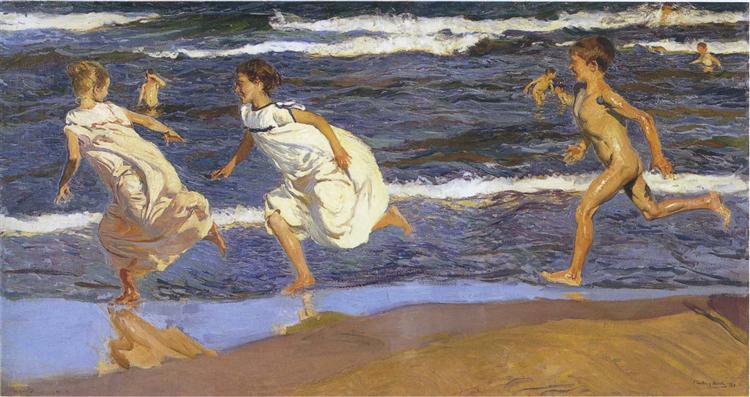
Running Along the Beach
 |
| Running along the beach, Joaquín Sorolla, 1908 Via WikiPaintings |
Great First Line — 1984
It was a bright cold day in April, and the clocks were striking thirteen.It seems funny when you first read it. Upon rereading, you realize just how much it says about how wrong things are and how they are codified into common culture.George Orwell, 1984
Thursday, July 11, 2024
Fishing Boats on the Beach at Saintes-Maries
 |
| Vincent van Gogh, Fishing Boats on the Beach at Saintes-Maries, 1888 |
TV You Might Have Missed #10 — Pokerface

Poker Face is a murder mystery "case-of-the-week" series with each episode adapting the inverted detective story format popularized by Columbo.
Charlie Cale, a former casino worker with an innate ability to detect lies, is on the run from a casino owner following a suspicious death. Along the way, she encounters colorful characters and solves homicides in a variety of settings.
We really love procedural murder mysteries and this one is really entertaining. In each episode, we see the crime being committed, then we back up in time to see how Charlie was involved on the fringes of the victim's life, and the final section has the crime solved and justice served. The justice is sometimes unorthodox but always satisfying. I was always fascinated by how ingeniously Charlie has been included off-screen in the murder we've seen happening.
We were drawn to it because Rian Johnson developed it. Just as he did with Knives Out and The Glass Onion, this show is an homage to classic mystery TV series.
The series was inspired by Columbo, being referred as a "howcatchem". Johnson also used Magnum, P.I., The Rockford Files, Quantum Leap, Highway to Heaven and The Incredible Hulk as influences for the tone of the series. Johnson was interested in "doing that Columbo or even Quantum Leap thing of having every episode be an anthropological deep dive into a little corner of America that you might not otherwise see." — WikipediaAs with most Rian Johnson work it is a creative, superfun throwback to TV the way it used to be.
Season One is streaming on Peacock and Season Two is in the works.
Wednesday, July 10, 2024
Notes on Mark: About the Sabbath
 |
| Jesus and his disciples walk through the corn. |
We looked at this section last time, but this adds more nuance to the whole thing. Recall that Jesus is passing through a field of grain on the Sabbath and the hungry disciples pick and eat grains. The Pharisees are all over this like white on rice. (You can read it here.)
Here are a few notes that add to our understanding of the nuances of this passage.
The fourth controversy, like the second, involves a meal—but this time it is a meal on the go, the ancient equivalent of fast food. Mark notes several occasions when Jesus and his disciples are so busy ministering to the throngs of people that they have no time even to eat (3:20; 6:31; 8:1).
[...]
In drawing this comparison [between himself and David], Jesus is declaring that the requirements of his messianic mission (here, his disciples' need for nourishment on the road) take precedence over the prescriptions of the law. But he is also saying more than this. Jesus is likening himself to David, and his disciples to David's loyal band of soldiers. David was the "anointed one" who had been chosen by god to lead Israel (1 Sam 16:13), but who spent years being hunted down by Saul before finally taking up his royal throng. Like David, Jesus is the Lord's anointed one, his Messiah, pursued and persecuted by the leaders of Israel until the day when he will take up his throne. ...
George Montague, Catholic Commentary on Sacred Scripture: Gospel of Mark
===========
"Son of man": the origin of the messianic meaning of this expression is to be found particularly in the prophecy in Dan 7:13, where Daniel, in a prophetic vision, contemplates 'one like a son of man' coming down on the clouds of heaven, who even goes right up to God's throne and is given dominion and glory and royal power over all peoples and nations. This expression appears 69 times in the Synoptic Gospels; Jesus prefers it to other ways of describing the Messiah -- such as Son of David, Messiah, etc. -- thereby avoiding the nationalistic overtones those expressions had in Jewish minds at the time.
===========
when Abiathar was high priest: The priest who provided David with bread was actually Ahimelech, Abiathar's father (1 Sam 21:1). This apparent discrepancy causes some modern scholars to accuse Jesus of misquoting Scripture, although this conclusion is unnecessary.
Jesus probably mentioned Abiathar instead of Ahimelech to post a warning for the Pharisees. Abiathar is infamous in OT history as the last high priest of his line, who was banished from Jerusalem and the priesthood for opposing Solomon, the son of David and the heir of his kingdom (1 Kings 2:26-27). He thus represents the end of an old order that passes away with the coming of David's royal successor. As Jesus compares himself and the disciples with David and his men, he likewise draws the Pharisees into the story by casting them as figures like Abiathar. The Pharisees, then, represent an old order of covenant leadership that is about to expire, and if they persist in their opposition to Jesus, the new heir of the Davidic kingdom, they will meet the same disastrous fate that befell Abiathar. Jesus' allusion to this OT tradition was a subtle yet strategic way to caution the Pharisees against their antagonism to his ministry.
The Gospel of Mark, The Ignatius Catholic Study Bible
=====
Three Sisters on the Beach
 |
| Joaquín Sorolla, Las tres hermanas en la playa |
Tuesday, July 9, 2024
When Julie and Scott agreed to do this podcast from the hills of Appalachia in the 1910's, some people called them crazy.
We discuss Christy by Catherine Marshall in episode 335 of A Good Story is Hard to Find podcast. Join us!
Mark's Noble Quest by Katharine Campbell

This novelette (longer than a short story and shorter than a novella) follows Mark as he tries to prove to Rosaline that he's just as brave as the guys back in the 1200s. That's not easy in 2024 but luckily a friendly fairy sends him on a quest to climb a volcano and recover a beautiful ring. While undergoing three trials.
So it is a classic adventure set up. Except that this story is being told by Katharine Campbell which means it is charming, funny, and resonates with modern readers' lives. That's all while following the rules of such a fairytale.
This is highly satisfying and I only wish it were longer.
The Last Supper - Korean Art
 |
| The Last Supper, part of a series on the life of Christ by Korean artist Kim Ki-chang, 1950-53. via J.R.'s Art Place |
I really love art from foreign cultures depicting scriptural events. It makes me realize how universal they are and opens my eyes to the way other cultures see Christianity.
Monday, July 8, 2024
Great First Line: Twelve Fair Kingdoms
I should have known something was very wrong when the Mules started flying erratically.You've got to want to read this after that line, just to find out what it's talking about!
Twelve Fair Kingdoms by Suzette Haden Elgin
The Rose
 |
| The Rose, Thomas Anshutz, via Arts Everyday Living |
Friday, July 5, 2024
Spectacled Caiman and a False Coral Snake
 |
| Spectacled Caiman (Caiman crocodilus) and a False Coral Snake (Anilius scytale), Maria Sibylla Merian |
Anyone who has seen Killing It's first season has to admit that this is the perfect art to consider.
TV You Might've Missed 9 — Killing It

Florida underdog Craig Foster (Craig Robinson) and perky Aussie Uber driver Jillian Glopp (Claudia O’Doherty) enter the Florida Python Challenge to win $20,000 so he can pursue his dreams of owning a saw palmetto berry farm.
Like most people, one of my favorite characters from The Office was Darryl who ran the warehouse. I'm not alone. Mention Darryl and the universal response is, "I love that guy!" That's what made us try his series Killing It, about Florida security guard Craig Foster whose dream is to own a saw palmetto berry farm. He and Aussie Uber driver Jillian enter the Florida Python Challenge which we discovered is a real thing) to win $20,000 seed money.
Craig is trying to show that he can provide for his daughter and maybe win back his ex-wife. He's a good guy faced a lot of the time with choosing the lesser of two evils. Jillian becomes a good friend as well as snake hunting partner. She is the moral compass of the show. She always knows the right thing to do and will push for it even if if hurts personally.
Killing It feels like it really belongs in the Floridian setting thanks to the irreverence and shock humor, especially in the first season which takes us on a tour of snake oil salesmen in society. The second season is all about how Craig and Jillian weather the many ethical trials that they encounter in running their business.
All this is while never forgetting to tie up the smallest threads in each episode to finish the story, drive the point home, and make the joke bigger than it was in the beginning.
Tuesday, July 2, 2024
Great First Line: Equal Rites
This is a story about magic and where it goes and perhaps more importantly where it comes from and why, although it doesn't pretend to answer all or any of these questions.I don't love the book, but I do love that line.
Equal Rites by Terry Pratchett
Boy by the Water
 |
| Boy by the Water, Paul Gauguin, 1885 via WikiArt |
Monday, July 1, 2024

Great First Line: Take My Camel
"Take my camel, dear," said my Aunt Dot, as she climbed down from this animal on her return from High Mass.This first line has made me try several times to read the book but, alas, I've just never been able to stick with it. That line though is so evocative. I can just see Aunt Dot and that camel! I believe she has a parasol.
Rose Macaulay, The Towers of Trebizond
Friday, June 28, 2024
Great First Line: Hogfather
Everything starts somewhere, although many physicists disagree.Pratchett can comment on so many levels with just one funny line of text.
Hogfather by Terry Pratchett

Thursday, June 27, 2024
Bashi-Bazouk
 |
| Jean-Leon Gerome, Bashi-Bazouk, 1868-1869 |
Notes on Mark: Fasting
 |
| The Disciples Eat Wheat on the Sabbath, James Tissot |
There are good reasons for fasting but I never understood the Pharisees' question to Jesus, as it always seemed to ask why he wasn't copying the "holy crowd." Surely that would be the last reason for doing it ... which is just what Jesus points out. This is especially true when we know more about fasting in those times.
* Not a Catholic source and one which can have a wonky theology at times, but Barclay was renowned for his authority on life in ancient times and that information is sound, as are many of his general reflections.
With the stricter Jews fasting was a regular practice. In the Jewish religion there was only one day in all the year that was a compulsory fast, and that was the Day of Atonement. The day when the nation confessed and was forgiven its sin was The Fast... But the stricter Jews fasted on two days every week, on Mondays and Thursdays. It is to be noted that fasting was not as serious as it sounds, for the fast lasted from 6 a.m. to 6 p.m. and after that normal food could be eaten...You may recall that I brought up the Pharisees questioning the disciples about Jesus' hanging out with sinners. Now, let's take another quick look at how the question about fasting is handled.
... The trouble about the Pharisees was that in far too many cases their fasting was for self-display. It was to call the attention of men to their goodness. They actually whitened their faces and went about with disheveled garments on their fast days so that no one could miss the fact that they were fasting and so that everyone would see and admire their devotion. It was to call the attention of God to their piety. They felt that this special act of extra piety would bring them to the notice of God. Their fasting was a ritual and a self-displaying ritual at that...
The Gospel of Mark (The Daily Bible Series*, rev. ed.) by William Barclay
Once again, those voicing criticism aim it indirectly, as if seeking to drive a wedge between Jesus and his followers. Where as the previous question about Jesus had been addressed to his disciples (Mark 2:16), now a question about his disciples is addressed to Jesus.Interesting isn't it? What I always saw as fairly straight forward questions, albeit angry ones with ulterior motives, now become something much more planned and sly. The Gospel of Mark has a subtlety that it often isn't credited with and which Healy's commentary helps me to appreciate.
The Gospel of Mark: Catholic Commentary on Sacred Scripture by Mary Healy
* Not a Catholic source and one which can have a wonky theology at times, but Barclay was renowned for his authority on life in ancient times and that information is sound, as are many of his general reflections.
=====
Wednesday, June 26, 2024
Mother Feeding Her Twins in a Cornfield
 |
| Mother feeding her twins in a cornfield by Bertha Wegmann, c. 1900 Via J.R.'s Art Place |
I love the sweet looks on the mother's and baby's face. Bertha Wegmann captured that perfectly.
More Praise for Stay by Me, Dear Friend

Joseph Reninger at Zombie Parent's Guide wrote this very nice review at Goodreads.
One of the great challenges of being a Christian is developing your personal relationship with Christ. Like most other relationships, it takes time, commitment, and interest to make progress. The goal is not simply to know the other but to love the other. When people fall in love, they think about each other all the time and want to be together all the time. It's a crazy and wonderful time. That's the way we Christians should be with Jesus, though it is much more tricky because it is so different from a romantic relationship. And it is so much more important.I have long enjoyed Zombie Parent's Guide which has a lot of good book and movie reviews. Be sure to swing by see what's going on.
Julie Davis provides a lot of devotional material to get the reader into that state of intimate friendship with Jesus. This book has, on each page, one or two related quotes, a reflection, and a short prayer. Facing pages have related materials with a shared title over the two-page spread. The reader can read one page if time is short or both pages to get some more depth or different perspectives on the same idea. The format works very well and is not tied down to days of the week or of the year. In the introduction, Davis even encourages readers to jump around. Find something useful or eye-catching or inspiring. The book is divided loosely into sections for different times of day, showing how to be aware of Jesus throughout the day, being present to Him and talking with Him like a good friend. It reminds me of Fiddler on the Roof, where the main character Tevye has a very frank and familiar way of talking with the Lord, which he does throughout his day, asking for help with a problem or complaining about a misfortune or offering advice on how to handle a situation (yes, Tevye gives advice to God!). We could all be more like Tevye and this book helps.
Highly recommended--I read through it quickly to write the review but will use it as a devotional and go through it at the proper pace.
In the meantime, pick up a copy of the Stay by Me, Dear Friend!
Tuesday, June 25, 2024
Julie and Scott would love to record a podcast this week, but there's a bridge that needs building.
This week we're deep in the jungle talking in Episode 334 about The Bridge on the River Kwai.
Palm Trees Under Glass
 |
| Palm Trees Under Glass photographed by Will Duquette (All rights reserved) |
Great First Line — Huckleberry Finn
You don't know about me without you have read a book by the name of The Adventures of Tom Sawyer; but that ain't no matter.He's right on both counts. But what a great, economical way to say "sequel" and also "this is completely different."
Mark Twain, Adventures of Huckleberry Finn
Friday, June 21, 2024
Great First Line — Blood Rites
The building was on fire and it wasn't my fault.Do you think he makes those sorts of huge mistakes? Or gets blamed for them a lot?
Blood Rites by Jim Butcher

Thursday, June 20, 2024
Great First Line: Johnny and the Dead
Johnny never knew for certain why he started seeing the dead.A great first line from the Johnny Maxwell trilogy that almost no one has heard of or read. Except for me. Everyone go look for them and get reading!
Johnny and the Dead by Terry Pratchett


Wednesday, June 19, 2024
Notes on Mark: Matthew, the Tax Collector
 |
| Saint Matthew writing the Gospel with an angel holding the volume, an Islamic miniature c. 1530 |
Thinking of how we feel about the IRS, we can understand why Matthew was not well liked. Then add on the facts we see below, which is that tax collectors could line their own pockets with whatever they could get away with ... well, I feel the crowd's astonishment when Jesus calls Matthew to follow him.
Matthew was a well-hated man. Tax-gatherers can never be a popular section of the community, but in the ancient world they were hated. People never knew just how much they had to pay; the tax-collectors extracted from them as much as they could possibly get and lined their own pockets with the surplus that remained after the demands of the law had been met. Even a Greek writer like Lucian ranks tax-gatherers with "adulterers, panderers, flatterers and sycophants." Jesus wanted the man no one else wanted. He offered his friendship to the man whom all others would have scorned to call friend...I'd like to note one other thing here. Mary Healy in The Gospel of Mark: Catholic Commentary on Sacred Scripture points out that although the Pharisees disapproved of Jesus, they questioned his disciples. Jesus answers because he overhears. Is this because they lack the courage to confront Jesus or because they are trying to shake the disciples' faith? An interesting point and one to consider when we ourselves are questioned similarly, as is all too common these days.
Of all the disciples Matthew gave up most. He literally left all to follow Jesus. Peter and Andrew, James and John could go back to the boats. There were always fish to catch and always the old trade to which to return; but Matthew burned his bridges completely...
The odd thing is that Matthew's reckless decision brought him the one thing he can least have been looking for -- it brought him immortal and world-wide fame. All men know the name of Matthew as one forever connected with the transmission of the story of Jesus.
The Gospel of Mark (The Daily Bible Series*, rev. ed.) by William Barclay
* Not a Catholic source and one which can have a wonky theology at times, but Barclay was renowned for his authority on life in ancient times and that information is sound, as are many of his general reflections.
=====
Tuesday, June 18, 2024
Godzilla Minus One

POSTWAR JAPAN. FROM ZERO TO MINUS.
In postwar Japan, a new terror rises. Will the devastated people be able to survive… let alone fight back?
We loved this for a lot of reasons. It manages to combine the monster movie action thrills of a Hollywood-style movie with the introspection of the first Japanese Godzilla movie. The result is simply fantastic, something that keeps you on the edge of your seat with adventure and also looks at surviving the ultimate catastrophe of having your society, family and life collapse.
This was especially interesting since it is set in post-WWII Japan so you are also getting the Japanese commentary on that whole situation. Along with the biggest monster to stomp a city.
Godzilla Minus One was unavailable since the first short theater run in America due to some Godzilla licensing agreement with the Hollywood movie makers. I was thrilled to hear it is now on Netflix since we'd figured it wouldn't be allowed here until 2025. Being suspicious of streaming agreements based on something so flimsy and stupid, we wasted no time in watching it. Do thou likewise!
Mom and Babies

From Traces of Texas, where we are told:
Baby possums have a gestation period of only 12-13 days. That's the shortest gestation period of any mammal in North America.There's barely enough room for them to hang on!
Great First Line - Sky Coyote
You'll understand this story better if I tell you a lie.That tells you right there what the main character is like and the way the story is going to work. Of course, Coyote is a trickster character in Native American folklore so this works perfect.y
Sky Coyote by Kage Baker
Subscribe to:
Posts (Atom)