One cannot help noting God's own admiration for the beauty of the craftsman, the farmer, the fisherman, because in a most fitting way those occupations reflect God's own being and manner of acting. After all, Jesus himself, by this call and election of Peter and Andrew, exhibits himself to be the primordial "Fisher of Men." This act of Christ's, like all his acts, manifests something essential of the being of God. God is fisherman by nature, we might say, and entrapping fish out of a lake is a visible reflection of the manner in which God eternally attracts beings to himself...
... The strategy of "entrapment" is given to us where we least expect it: we may be looking at the fish in the lake, but Jesus is looking at Peter and Andrew by the lake. The immediacy with which they are "caught" reveals the simplicity and awesomeness of the ruse. Beaming from the face of Christ, the voice and the glance of God have made themselves perceptible to human eyes and ears. Just as surely as these can see and hear the splashing of the water on the shore can they behold the glory of God in the man addressing them. And they are magnetized. Their own strategy in "catching" man will simply be an extension through the person of their own encounter with Jesus.
Erasmo Leiva-Merikakis, Fire of Mercy, Heart of the Word, vol. 1
Thursday, July 3, 2014
God's own admiration
From my quote journal.

Wednesday, July 2, 2014
Worth a Thousand Words: A Freshly "Hatched" Cicada
 |
| Via Hannah |
Beautiful isn't it?
The 13 Clocks by James Thurber
 The 13 Clocks by James Thurber
My rating: 5 of 5 stars
Once upon a time, in a gloomy castle on a lonely hill, where there were thirteen clocks that wouldn’t go, there lived a cold, aggressive Duke, and his niece, the Princess Saralinda. She was warm in every wind and weather, but he was always cold. His hands were as cold as his smile, and almost as cold as his heart. He wore gloves when he was asleep, and he wore gloves when he was awake, which made it difficult for him to pick up pins or coins or the kernels of nuts, or to tear the wings from nightingales.I never heard of this until Neil Gaiman chose it for his Wall Street Journal book club selection. He has called it possibly the best book in the world and said that he grew up loving this book and thinking it was as well known in the U.S. as Alice in Wonderland.
Naturally I raced online to the library and requested it. Anyone who reads Neil Gaiman, especially his children's books, will instantly see that he and Thurber are kindred souls.
Naturally a prince comes to rescue the princess from the land where time lies frozen so "It's always Then. It's never Now." Replete with the wordplay and humor one would expect from James Thurber, this is a charming and slightly insane book with large dark elements. Like Alice in Wonderland it has a lot of bits that are just wonderful for their own sakes without having any deeper meaning. And yet, everything comes together to move the story along in a most satisfactory way.
Here's a bit that went into my quote journal.
"The task is hard," said Zorn, "and can't be done."
"I can do a score of things that can't be done," the Golux said. "I can find a thing I cannot see and see a thing I cannot find. The first is time, the second is a spot before my eyes. I can feel a thing I cannot touch and touch a thing I cannot feel. The first is sad and sorry, the second is your heart. What would you do without me? Say 'nothing.'"
"Nothing," said the Prince.
"Good. Then you're helpless and I'll help you."
Tuesday, July 1, 2014
From the In-Box: Rugged Rosaries
Hey these Rugged Rosaries look interesting!
I make military inspired paracord rosaries for men, and I have been in this business for 2 years. Although I give away about half the rosaries I make, the other half which I sell keeps me funded for the supplies of making all the rosaries.
We're Back!
 |
| Brown Pelican via Wikipedia |
A wonderful bird is the pelican,
His bill will hold more than his belican,
He can take in his beak
Enough food for a week
But I'm damned if I see how the helican!
Dixon Lanier Merrit
(as quoted by both Tom and Mom)
The pelicans marked our entry to Melbourne Beach and it was really terrific sitting on our 15th floor balcony to see them flying by at eye level sometimes. The Radisson was quite clever and built the hotel one-suite deep so that every suite has a beach view. (And for $95 per night! A steal!)
We saw a heron begging bait from a fisherman, dolphins rolling and fishing, and many pelicans diving and then bobbing on waves while swallowing. Best of all, we brought my mother back to the hotel one afternoon and sat under an umbrella outside enjoying the ocean, the wildlife, and the parade of bathers coming and going.
I'll try to get more photos up later with a bit more travel talk, but this is my first day back at work so I'm a bit crazy. Just a bit!
Friday, June 20, 2014
The Narnia Code by Michael Ward
 The Narnia Code: C. S. Lewis and the Secret of the Seven Heavens by Michael Ward
My rating: 4 of 5 stars
In "The Narnia Code," Michael Ward takes the reader through each of the seven Narnia books and reveals how each story embodies and expresses the characteristics of one of the seven planets of medieval cosmology--Jupiter, Mars, Sol, Luna, Mercury, Venus and Saturn--planets which Lewis described as "spiritual symbols of permanent value." How does medieval cosmology relate to the Christian underpinnings of the series? How did it impact Lewis's depiction of Aslan, the Christlike character at the heart of the books?This was free to borrow on my Kindle, so I gave it a shot.
And I was really intrigued with the idea that Lewis was using medieval cosmology as themes for each of the Narnia books. After reading That Hideous Strength in which eldils from different planets are significant, Ward's idea made sense.
The whole explanation of medieval cosmology as seen in the Narnia books is riveting and, if for no other reason, I am very glad to be introduced to the subject.
I am 50% done and am really enthralled by this idea. I actually will pick up the Narnia series with book 4 after I'm done with this one.
I've requested Ward's earlier, more scholarly, book on this subject and also C.S. Lewis's "The Discarded Image" for his explanation of medieval mindsets (it's supposed to be pretty amazing).
Thursday, June 19, 2014
In which there is a father-daughter reunion. And things go from bad to worse. Again.
More H. Rider Haggard adventure in The People of the Mist at Forgotten Classics.
Well Said: Pilgrimage and willingness to be profoundly changed
Although the taking of pilgrimages to holy shrines and sacred places has played a major role in most world religions (especially medieval Catholicism), today only Islam maintains a strong and visible commitment to this ancient discipline. True, many modern Americans will take secular, consumer-driven pilgrimages to such places as Disney world or Graceland or Manhattan, while others will take more intellectual and aesthetic pilgrimages to Rome or to Athens or to Stratford-upon-Avon. A number of Jews and Christians will even make their way to the Holy Land. Still something, I fear, has been lost. Perhaps it is that sense of messianic anticipation that coverts the journey into a longing for higher purpose. Perhaps it is that willingness to be profoundly changed that transforms it into a voyage of self-discovery. Perhaps we simply insulate ourselves too much.First off, this is an excellent book and I will be reviewing it very soon.
Now then, I have been musing on this idea of pilgrimage. And I've been doing it for long before this Holy Land Pilgrimage came up.
I'm perfectly open to change and self-discovery if they happen to find me where I am. I don't have to be at home. I can be on vacation.
However, the idea of traveling with that as a goal is not one I have ever cared about. To be perfectly honest, I was actively disinterested in visiting the Holy Land, until a few years ago when a friend brought me an undeniable "message from God." He wants me to go to the Holy Land.
Not a message I was dying to hear, actually.
It has taken several years to get myself used to the idea. I've always been of a mind that the wide world is one of the reasons we were sent the Holy Spirit. We don't have to go to one place to get holy, God does it within us where we are. I am willing to be profoundly changed (obviously or we wouldn't have this blog as evidence). However, given the opportunity, I do like to dictate terms while we do it. And evidently location.
That said, the years of wrestling with this idea, while trying to figure out how to afford it, have given me a peace about pilgrimage. In fact, I've come to identify with Abraham's journey to Canaan more and more.
Musing about Abraham and this book and also some of Diana's comments have made me also consider a pilgrimage as a tribute, a sacrifice, an acknowledgement to the physical ... to Christ's Incarnation. There are things we experience physically that affect us in ways we can't predict. Pilgrimage may indeed be one of the most profound ways to pay tribute and give thanks for Christ's Incarnation.
And I like thinking about it that way. As an offering of thanks and of myself.

Wednesday, June 18, 2014
Worth a Thousand Words: Poppies
 |
| Poppies by Edward B. Gordon |
Lagniappe: Harold's watch
In fact, Harold had never once paid attention to his watch other than to find out the time. And, honestly, it drove his watch crazy.
Stranger Than Fiction movie
Live in Dallas? Want to Make Your Good Marriage Better?

I can't begin to say how many ways our involvement has made my own marriage better except by recommending it to you. It isn't sappy. It is practical. And yet you come away more in love than ever.
No one will observe or interfere in any way with each couple's time alone. Nor will you be required to share any of your discussions. (Just wanted to address those with the same qualms I had before attending!)
If you are Catholic married couple and live in the DFW area, you might want to consider spending a weekend (July 25-27) making your good marriage better. Details are here.
Tuesday, June 17, 2014
Worth a Thousand Words: Waiting
 |
| Waiting (c.1879-1882). Edgar Degas via Books and Art |
Fortunately, not lately. They don't look as if they were merely waiting but tired, beat-down, worn out. Of course, this is simply my interpretation which is the great thing about art. It can speak to us all differently. You may not see that same feeling there. Maybe I get it from the leaning forward. It could just be a very uncomfortable bench.
I also wonder what they are thinking. These days both of them would be very busy with cell phones, music, and whatnot. I myself would probably be reading a book instead of tracing lines with the end of my umbrella. (Hey, that's what she's doing. If you don't see it, then ... well, I said it above. Degas put something else there for you. Isn't it great?)
Monday, June 16, 2014
Well Said: What Influences You
It is always hard to tell what your influences are. Everything you've seen, experienced, read, or heard gets broken down like compost in your head and then your own ideas grow out of that compost.Of course, she was speaking about writing but I think that applies to life in a lot of ways too.
J.K. Rowling, 1999 interview
Friday, June 13, 2014
Echoes of heaven: It's really hard to have a better day than this

This morning I realized my thoughts had wandered and I firmly applied myself to the line I'd just read unthinkingly:
9) Only for today, I will firmly believe, despite appearances, that the good Providence of God cares for me as no one else who exists in this world.And as it penetrated, I was suddenly seized with the joy of an ineffable moment of knowing just how well God knows me, really knows me, and loves me and ... well, it's ineffable.
I'll just say that I had, at that moment, a capacity to receive and what I received was joy.

I can’t help but think that if you can only read five blogs, these are among the best.Happy Catholic was listed among a lot of luminaries and international spots (like the Vatican or Cardinal Dolan - I'm getting giddy just thinking of it). I knew something was coming because I'd supplied a photo, but I'd completely forgotten all about it. By the way, this piece has tons of good places for you to find solid Catholic info online, so go read it.
That was like a bouquet of flowers to begin the day.

His review included not one but four excerpts. So I know he wasn't kidding around when he said he liked it. Prefacing all this was the nicest set of compliments for this blog that I've ever read. (I mean, Manny and I are pals, but I had no idea ... Manny, you sweetheart!)
It’s hip, fresh, and on contemporary culture from a Roman Catholic perspective. Her motto which is right at the top of the blog and reflects her upbeat personality is, “Not always happy, but always happy to be Catholic.”It was like closing the door with one set of flowers only to have the doorbell instantly ring to find another set waiting for me.

As today's "well said" points out:
And we must remember that all these things, the nuances, the anomalies, the subtleties, which we assume only accessorize our days, are effective for a much larger and nobler cause. They are here to save our lives. I know the idea seems strange, but I also know that it just so happens to be true.And brings joy.
Thursday, June 12, 2014
Well Said: Of course, in a novel people's hearts break ...
Of course, in a novel, people's hearts break, and they die, and that is the end of it; and in a story this is very convenient. But in real life we do not die when all that makes life bright dies to us. There is a most busy and important round of eating, drinking, dressing, walking, visiting, buying, selling, talking, reading, and all that makes up what is commonly called living, yet to be gone through; and this yet remained to Augustine. Had his wife been a whole woman, she might yet have done something—as woman can—to mend the broken threads of life, and weave again into a tissue of brightness. But Marie St. Clare could not even see that they had been broken. As before stated, she consisted of a fine figure, a pair of splendid eyes, and a hundred thousand dollars; and none of these items were precisely the ones to minister to a mind diseased.I am reading this for the third time, which allows me to pursue it at a very leisurely pace and simply enjoy it. Stowe was such a great writer in the Dickensian style I love. I like even more that she and Charles Dickens were great admirers of each others' writing. This book does contain a great deal of heartbreak, suffering, and hypocrisy. However, it is interwoven with a great deal of humor and insight that leavens the whole, makes it timeless, and a real pleasure to read.
Harriet Beecher Stowe, Uncle Tom's Cabin
Marie St. Clare was spoiled in the true sense of the word through complete indulgence. Stowe's comments and examples find vivid echoes in the behavior of heedless parents and spoiled children today. Entitlement is no new thing and it is shown in all possible ways here, including those which make the reader laugh. I mean to say, the mind that conceived of putting Marie St. Clare up against Miss Ophelia, a no-nonsense Vermonter, is a mind that understands humor.
Also, I think of the conversation about books to take on a long trip (yes, for a Holy Land Pilgrimage ... it's on my mind!) and I look at this little, light version and smile. It is a Collector's Library edition. I love little books and this series fills the bill. They are generally inexpensive, between $5-$10, hardback with a ribbon marker and gilt edges, and 4" x 6". This 644 page book weights only around 11 ounces, making it a perfect bedtime book and easy to slip into my bag during the day in case I am stuck in line somewhere.
Wednesday, June 11, 2014
Well Said: Critics who treat adult as a term of approval
Critics who treat adult as a term of approval, instead of as a merely descriptive term, cannot be adult themselves. To be concerned about being grown up, to admire the grown up because it is grown up, to blush at the suspicion of being childish; these things are the marks of childhood and adolescence. And in childhood and adolescence they are, in moderation, healthy symptoms. Young things ought to want to grow. But to carry on into middle life or even into early manhood this concern about being adult is a mark of really arrested development. When I was ten, I read fairy tales in secret and would have been ashamed if I had been found doing so. Now that I am fifty I read them openly. When I became a man I put away childish things, including the fear of childishness and the desire to be very grown up.Some self important ninny wrote a piece over at Slate advising everyone that we should read what we like but if we're reading books written for children then we should be embarrassed. I can just see her now, looking over her glasses at us in severe, professorial mode.
C.S. Lewis, On Three Ways of Writing for Children
Two actual professors, J.R.R. Tolkien and C.S. Lewis, loved children's literature and I thank heavens they did since they wrote for us what they themselves enjoyed reading.
A life without The Hobbit. Or even without The Little Princess or Little House on the Prairie, which I occasionally reread. What sort of life is that anyway? It sounds pretty joyless to me.
Or do you think she secretly reads The Hobbit under her bedcovers with a flashlight so no one sees her?
Either way, I feel sorry for her. What a lot she's cutting out of her life by putting such broad restrictions on what she allows into her reading pile.
I've seen this mentioned all over but the most recent place is Redecorating Middle-earth in Early Lovecraft, where Amy H. Sturgis has a link to a wicked, tongue-in-cheek response.
Pray for the Inhabitants of Mosul
First Things has a post Father Najeeb's request for prayers.
As you will have read by now, Sunni militants have driven the Iraqi government from the city of Mosul in a sudden and violent offensive. The non-combatant civilian population has been imperiled as a result, among whom are some Dominican friars. One friar living in Mosul, Fr. Najeeb Michaeel, O.P. composed the following request, which I pass along as relayed and translated for me by a confrere:There is more to the post and I encourage you to go read. But first pray. Above all pray for these victims of terrorism.
Bad news. I write you in a situation of violence in Mosul that is very critical and even apocalyptic. Most of the inhabitants of the city have already abandoned their houses and fled into the villages and are sleeping in the open without anything to eat or drink. Many thousands of armed men from the Islamic Groups of Da’ash have attacked the city of Mosul for the last two days. They have assassinated adults and children. The bodies have been left in the streets and in the houses by the hundreds, without pity. The regular forces and the army have also fled the city, along with the governor. In the mosques, they cry “Allah Akbar, long live the Islamic State.” Qaraqosh is overflowing with refugees of all kinds, without food or lodging. The check points and the Kurdish forces are blocking innumerable refugees from entering Kurdistan. What we are living and what we have seen over the last two days is horrible and catastrophic. The priory of Mar Behnam and other churches fell into the hands of the rebels this morning. . . . and now they have come here and entered Qaraqosh five minutes ago, and we are now surrounded and threatened with death. . . . pray for us. I’m sorry that I can’t continue . . . They are not far from our convent. . . . Don’t reply. . . .Dominicans have been ministering in Iraq (sponsored by the French Provinces) since 1750. The Order’s presence includes both Dominican friars and sisters (Sisters of St. Catherine of Siena).
In which the People of the Mist do not embrace a religion of love. And things go from bad to worse.
More of The People of the Mist by H. Rider Haggard at Forgotten Classics podcast. Enjoy!
Tuscany Prize for Catholic Fiction — Deadline June 30
Are you the next great writer of Catholic fiction? The Tuscany Prize is your chance to find out.
If you want to see the 2013 winners, What World Is This? And Other Stories is available on Kindle today for just 99 cents. The collection of 2013 Tuscany Prize winners features National Book Award Winner Gloria Whelan.
Click through the link to find where to submit manuscripts.The Tuscany Prize for Catholic Fiction is a literary prize to promote writers and great undiscovered stories of Catholic fiction.
What is Catholic fiction? Stories that capture the imagination of the reader and are infused with the presence of God and faith — subtly, symbolically or deliberately.
Think of Flannery O’Connor, Graham Greene, J.R.R. Tolkien and G.K. Chesterton and many others whose writings reflected the thoughts of the great writer Gerard Manley Hopkins: “The world is charged with the grandeur of God.”
This is the “stuff” of literature that wins the Tuscany Prize.
Do you have a manuscript? A Novel? A Young Adult Novel? A short story?
Would you like it published?
Does your story have themes of faith and struggle, of grace and nature, atonement, courage, redemption and hope? Whether it is fiction, historical fiction, mystery, fantasy or humor, the Tuscany Press is open to all genres.
We seek original great stories of unpublished/self-published works of fiction.
Are you the next great writer of Catholic fiction? We invite you to send in your manuscript.
Submission Deadline: June 30, 2014

If you want to see the 2013 winners, What World Is This? And Other Stories is available on Kindle today for just 99 cents. The collection of 2013 Tuscany Prize winners features National Book Award Winner Gloria Whelan.
Tuesday, June 10, 2014
Well Said: Being a Christian...
Being a Christian is less about cautiously avoiding sin than about courageously and actively doing God’s will.
Eric Metaxas, Bonhoeffervia Brandywine Books
Yes. Yes. Yes.
Worth a Thousand Words: Wrought Iron Door
 |
| Wrought Iron Door taken by Barcelona Photoblog |
At the Movies and Related News: Philomena

★★★
I'm not a fan of movies where the theme is "bash the bad guys" especially when the "bad guys" have been bashed by many a moviemaker already. You know what I mean: Slavetraders, Nazis, heartless mine owners, and so forth. I don't deny the bad guys need bashing much of the time, I just don't care to get my "facts" via a one-sided, often manipulative film. And I often find the subject matter too sad to want to watch. I can read articles or a book if need be, where I will often find more nuanced, complete information.
Therefore, I'd managed to avoid Philomena until forced to watch it for a movie discussion group. If you have to watch a "bash the bad Irish Catholic nuns" film, this is probably the one you want. In this case they preach shame to unwed mothers while allowing rich American Catholics to adopt the babies without the mothers' permission. The mothers have to work in a horrible, prison-like laundry. It's definitely not Christian by any stretch of the imagination. So - very bad nuns.
Philomena (Judi Dench) is a woman who alongside reporter Martin Sixsmith (Steve Coogan) journeys to America to find the illegitimate son who was adopted 50 years ago. Philomena is still a Catholic, something that atheist Sixsmith just can't fathom after what was done to her.
So far, all is according to what we'd expect. The nuns are bad, the reporter is angry, and the film is fairly predictable and manipulative. So why do I say it is worth watching?
Judi Dench, as we'd expect, turns in a stellar performance as a little, old Irish lady who loves romances and salad bars. She also shows the fruit of fortitude in living with life's hard knocks, deep empathy, and keen insight. In some ways it made me think of my mother-in-law who had a gift for delivering simple but penetrating insights while we were doing something mundane like making potato salad. You never expected it but you always remembered it.
Philomena's, set between the two judgmental, unyielding, self-righteous forces of Mother Hildegarde and Martin Sixsmith, who delivers the takeaway message of the movie. This is reinforced by the view of her son's life, which points up the fact that life is often not easy no matter what one's circumstances. Viewers are left to ponder what actions they themselves take when life delivers a brutal blow.
RELATED NEWS
It hadn't escaped my attention that this movie was in my life at just the time to make me pay attention to more terrible news about the Irish Catholic Church. We were specifically watching the movie as a contrast piece to I Confess featuring Montgomery Clift as a very holy priest from around the same time period. Obviously I needed to do my homework.
And I'm glad I did. It solidified one thing I already knew.
It doesn't matter who is committing evil, under what "trustworthy" banner whether religious, teacher, coach, or friend. Evil is evil. Vision is skewed.
Woe to you, scribes and Pharisees, hypocrites! For you are like whitewashed tombs which on the outside appear beautiful, but inside they are full of dead men's bones and all uncleanness. So you, too, outwardly appear righteous to men, but inwardly you are full of hypocrisy and lawlessness... — Matthew 23:27-28Jennifer Fitz has an excellent piece on the Irish news, Evil is Easy, which only served to cement the reading I above, which I'd heard on a podcast while mulling this over. Jennifer pointed out that we need not only point fingers at the past. (Don't stop at this bit ... go read it all.)
What you and I need to fear, then, is not our tolerance of cruelty towards Irish unwed mothers of the mid-20th century, but our tolerance of some other horror that perhaps we can’t even see.This formed an excellent talking point for the movie group, as a matter of fact. We also wound up discussing Irish culture as a whole which led to some of the points I read in Pia de Solenni's excellent coverage. I'll let you discover them for yourself in these pieces:
The best overall media analysis, as is so often the case in anything about religion, comes from GetReligion. Read In Irish children's deaths, clarity doesn't thrive in a septic tank to see who is reporting honestly and who is spinning without complete information.
For me the best commentary was that of Irish Independent columnist David Quinn. It is a thoughtful and thorough piece which leaves us with a truth that cannot be denied.
Why didn't the children and adults encounter a proper Christian witness, real love, when they walked through their doors? Why was it impersonal rules and regulations on a good day and cruelty of a sometimes very extreme kind on other days?With all that said, these are the sorts of things I read to get a real grip on a situation. You can't turn to a movie like Philomena expecting more than one view. We're just lucky that Philomena herself had the one view we really needed.
I think it was because Christianity in Ireland had by then hardened into something that was all too often more about punishment than mercy and forgiveness. To that extent Christianity in Ireland had become, in the strict meaning of the term, anti-Christ, and the church is still living this down.
Monday, June 9, 2014
Worth a Thousand Words: Sir Ian Reads
 |
| via Awesome People Reading |
Right now, front runners are my paperbacks of the Lord of the Rings trilogy. I have resigned myself to the fact that the big, one-volume book would be too heavy.
What books would you take on a long journey? Kindle or real?
(Want to know more about my Holy Land journey? Or come along? Check it out.)
What We've Been Watching: Encounters at the End of the World

★★★
I know I'll never make it to Antarctica and when a friend recommended this documentary it seemed like a good way to see what it is like. I had no idea so many different kinds of research were underway in that icy environment.
And there is Warner Herzog too. I admit it took me several visits to the video store, weighing the Herzog-factor, before I gave in and rented this. His involvement was much as I recall it from Cave of Forgotten Dreams. The dreamy German voiceover, with the (evidently) requisite 10 minutes of insane pondering over some very strange question (in this case about what aliens 1,000 years in the future would think of some of the goofy things people have sitting around). Oh Werner, you dreamer!
Other than that, though it was interesting. Not ground breaking but good enough.
Tuesday, June 3, 2014
Well Said: More to life than living ...
"There's got to be more to life than just living," Foyle said to the robot.We all like to think that we are the center of everything (and, indeed, to ourselves we are). Not only did I like the inherent truth of this passage but it made me laugh that it took a robot to focus the question properly.
"Then find it for yourself, sir. Don't ask the world to stop moving just because you have doubts."
Alfred Bester, The Stars My Destination
Saints and Social Justice: A Guide to Changing the World by Brandon Vogt
 Saints and Social Justice: A Guide to Changing the World by Brandon Vogt
My rating: 5 of 5 stars
The phrases "social justice" and "solidarity" could hardly have been more unwisely coined or adapted by the Catholic Church in my opinion. From the moment I heard them, they turned me off. I always thought they sounded like some lame department name you'd read about in a spy novel set in communist Russia. I mean really - solidarity? What does that even mean to the average person? Nothing.
However, if one digs deeper beneath the stiff, offputting phrases, one finds the heart of Christianity. They mean treating each person as if they belong, going out of one's way to find Christ in each individual, and following God's will (with Christ's help) to help each person one encounters. In other words, fully living your Christian life, whether as an individual or as part of the larger community.
“It’s good that you exist” — carries great power. To someone struggling with alcohol, who drinks away his loneliness, we say, “It’s good that you exist.” To someone who loathes her body and thinks she’s too fat, too skinny, too short, or not good enough, we say, “It’s good that you exist.” To the addict, the slave, the homeless man, even the murderer, we say, “It’s good that you exist.”This is ably illustrated by Brandon Vogt's book, which highlights 14 different saints whose lives were spent giving dignity and aid to the less fortunate. Ranging from housewives to priests, in all sorts of different life situations, these people were open enough to God's wishes to do extraordinary things. Vogt also does a great job of helping us relate by contrasting each saint with another one or two who lived out similar "missions" in different ways. He ends each section by relating these saints' larger missions to our own lives, so we can see where we might do more or act in ways that hadn't occurred to us previously.
This phrase reminds people that they have intrinsic value, regardless of what they produce, or how they look, or if they have it all together. It echoes what God said immediately after creating the first man: “[He] looked at everything he had made, and found it very good” (Gn 1:31).
Next time you want to uplift someone’s dignity, remind them of that wonderful truth: “It’s good that you exist.”
He ends each section by relating these saints' larger missions to our own lives, so we can see where we might do more or act in ways that hadn't occurred to us previously. This is important because these saints achieved so much that we might feel any small drops of help we can achieve are not going to make a difference. Vogt's gentle questions and examples helps us see that our drops matter because all of them together add up to a large ocean.
And this, no matter what stupid phrase is used to describe it, is something dear to my heart, a lesson I've been learning a little better every day in my 14 years as a Catholic. Each time I've followed that internal prompting, despite my fears of not knowing enough or being rejected or looking stupid, I have been rewarded. My efforts have had effects, in their own small way, which I never could have imagined. And I have grown and changed for the better myself along the way.
I found this book really inspiring. I especially enjoyed the amount of detail Vogt gave for each saint. Even the ones I knew about, like Peter Claver, Frances of Rome, or Dorothy Day, took on unexpected meaning for me because I hadn't realized there was so much I didn't know about them. Of course, there were some who were brand new to me and I really enjoyed learning about their lives.
This is a well written and inspiring book and one that should help us understand that "social justice" and "solidarity" mean "living as a Christian" no matter what your condition in life.
Please Mr. Vogt, may I have another? Perhaps one about the martyrs? You pick the subject. I'll read it.
Monday, June 2, 2014
Angels and Saints Blog Tour: St. Monica and St. Augustine

I chose to take my day of the blog tour to look at St. Monica and St. Augustine. (Which, to be fair, was what I thought my assignment was, so maybe my review jumped the gun. No matter. This is just icing on the cake, right?)
So after you've read Scott Hahn's fine Angels and Saints book, what difference will it really make in your life? If you feel drawn to one of the saints or angels you read about, consider striking up a relationship. It will change your life, deepen your faith, and give you a new friend.
Allow me to illustrate.
St. Augustine was my first saint friend. Thanks to a book of daily reflections based on excerpts of his writing, I got to know him before I really invested much thought in my patron saint, Martha.
I could relate to St. Augustine. Stubborn, searching for truth, understanding the reason for living the clean life but not wanting to commit to it fully. He's the poster boy not only for his age but for the ages since then.
Not only that, but he was able to put words to feelings and thoughts that I, a new convert, hadn't really even been able to articulate until I read them and knew how right they were.
Late have I loved you, O Beauty ever ancient, ever new, late have I loved you! You were within me, but I was outside, and it was there that I searched for you. In my unloveliness I plunged into the lovely things which you created. You were with me, but I was not with you. Created things kept me from you; yet if they had not been in you they would not have been at all. You called, you shouted, and you broke through my deafness. You flashed, you shone, and you dispelled my blindness. You breathed your fragrance on me; I drew in breath and now I pant for you. I have tasted you, now I hunger and thirst for more. You touched me, and I burned for your peace.I appreciated his mother, St. Monica, who followed her wayward son from city to city, reasoning with him and crying for his conversion and, most importantly, never ceasing her prayers. For 17 years.
[Side note about St. Monica. This is all most books ever tell you. I recently read St. Augustine's Confessions. Oh, yes, did I mention he wrote the first autobiography? Yep. Anyway, he gives full tribute to his mother's role as a role model and in saving his soul. He also gives a lot of her own personal story which shows she was a woman who fought her own personal demons and won, while serving as a splendid example to the women in her town. Definitely read it. I recommend the middle third if, like me, you have trouble getting into it.]
Soon after I learned all this about St. Augustine and St. Monica, I thought of my parents. Atheists, not probably going to listen to me talking about religion, and it troubled me greatly. I felt a greater and greater yearning for them to come to know the happiness and freedom I felt now that I knew Christ.
So I lit a votive candle and enlisted St. Augustine and St. Monica in praying with me for my parents' souls. I vowed that even if it took ten years I'd match Monica's faithfulness in prayer. (Boy oh boy, am I glad that I thought she'd prayed for 10 years and didn't know then that it was 17 years!) I joked to myself that I had visions of sitting by their deathbeds, rosary in hand, not giving up. Little could I foresee that was exactly where I found myself 10 years later as my father was dying. Or how richly God would answer our prayers. It stretched me, it changed me, and I grew during the entire process.
Scott Hahn's book gives a succinct overview of Augustine's life and Monica's influence. However, he doesn't stop there but points out how God used both Monica and Augustine to enrich the lives of each other, those around them, and those who have followed. I especially appreciated the point that St. Augustine wouldn't have been as effective when he was a bishop who was bringing congregations of heretics back to the Catholic faith, if he hadn't had firsthand experience of being a heretic himself.
That's an aspect of Augustine's life I hadn't realized and showed me yet another way I relate to him. As someone raised without any faith, with completely secular values, I am often able to explain to atheists and agnostics what the Catholic point of view might be on a particular issue. I can do it with an understanding of what they believe and where the differences are. Not as well as St. Augustine, but I'm working on getting better at it.
Friday, May 30, 2014
Well Said: Finding Inspiration
From my quote journal.
You can’t wait for inspiration. You have to go after it with a club.
Jack London
Thursday, May 29, 2014
Worth a Thousand Words: Pope Francis at the West Bank Wall
 |
| Pope Francis praying at the West Bank wall dividing Palestine and Israel. |
In which Juana and Otter are venerated as gods and see what it means to worship The Snake.
Adventure ratchets up a notch for our band of adventurers in the land of The People of the Mist by H. Rider Haggard, read for you at Forgotten Classics!
Wednesday, May 28, 2014


The Last Monk of Tibhirine by Freddy Derwahl
 The Last Monk of Tibhirine: A True Story of Martyrdom, Faith, and Survival by Freddy Derwahl
My rating: 4 of 5 stars
When Jean-Pierre appeared at the gate in the late afternoon of my arrival, we immediately embraced each other. He knew what I expected of him—namely, that I hoped he would relate the whole story to me. I found the slightly bent-over eighty-seven-year-old Trappist monk in good spirits. His blue-green eyes accentuated an impish smile that concealed great kindness. Deep wrinkles on his forehead and chin did not bear the signs of worry but of wisdom. He wore a sand-colored habit typical for this climate, with a leather belt, and on his head a knit tarbush bearing Islamic motifs. ... The next morning at 10:30, we sat down together for the first time. Our only topic was his life. The massacre of his seven brothers lay fifteen years in the past. He, however, had been spared from the attack, so where had his fate led him since then?This is the story of Jean-Pierre Schumacher, the last surviving member of a Cistercian monastic community in Algeria, whose members were was kidnapped and killed in 1996. Like many people, I became aware of that event when I saw the movie Of Gods and Men, which Scott Danielson and I discussed on A Good Story is Hard to Find podcast.
This book alternates between Jean-Pierre's life story and author Freddy Derwahl's experience while on retreat at the monastery. It includes the lives of the martyred monks as their lives intertwined with Jean-Pierre's, with special emphasis on the prior, Christian, and his writing. Once the timeline gets to the point where the movie was made, it is included in the discussion which is interesting for anyone who has seen it.
I did not expect the book to grab me from the first page as the author told the story, not only of Jean-Pierre, but also of his own experience staying at the new monastery. His diary entries not only drew me into his own experience, but also invited me to deeper reflection.
2:00 pm:One of the most impressive things to me about this book is the way that the monks' offer their faith to others by embracing all that they can of Islam. That may sound overly ecumenical but the way that Christian approached it was to include all the Islamic symbolism and patterns possible in different parts of the monastery. This at least added a familiar feel to visiting Muslims and added a context for showing where there were common points of worship and faith.
A siesta with open eyes. The text about the exciting life of P. André Louf that I read during the night continues to resonate with me. I need the example of strong men. That is the reason why I had also taken along the books by Pope Benedict and Ernst Junger. They tested their limits—one of them in a gentle manner, the other defying death. By the way, both of them feel the mocking criticism of their time breathing down their necks.
9:30 pm:
I sit outside on my little wooden bench. Rarely was the star-filled sky so comforting. We are surrounded by magnificence that is unreachable and yet a promise that is quite close.
It worked so well that twice a year there were a group of Muslim devout who would come for a day of common prayer and worship, at the Muslims' request. They quickly discovered that discussing theological points led to disagreement and so learned to focus on the God alone. This made it possible to connect as people of faith based on the core idea of searching for God and personally connecting with Him.
A deep bond developed between the prior and the Muslim friend after the latter had asked him to teach him how to pray, and for many years there was a lively spiritual exchange between the two. After they had not seen each other for a while due to various other obligations, the Muslim friend said to him, "I think it is time to dig in our common well again." It was an allusion to the depth that characterized their encounters.The Last Monk of Tibhirine was originally written in German and the English translation occasionally betrays awkwardness. The most obvious place was when Derwahl's July 26 diary said, "Mass in celebration of the Apostle Jacob." I was stopped in my tracks as I pondered who the Apostle Jacob might be. Finally going to a liturgical calendar I realized that it was a mistranslation. July 26 is the Apostle James' feast day.
Christian responded, "And what will we find at the bottom of the well? Muslim or Christian water?"
Then he looked at him with a mixture of smiling and sorrow: "Do you still ask yourself this question? Don't you know that on the bottom of this fountain we will find the water of God?"
There were a few other awkward phrasings in sentences which seemed as if they should connect to transitional commentary or new thoughts, but which never materialized.These were not egregious enough to make reading problematic but did cause the occasional hiccup.
Overall The Last Monk of Tibhirine is suitable for either slow, meditative reading or simply to learn more about the story of Jean-Pierre and Our Lady of Atlas monastery. I enjoyed it on both levels. Suffice it to say that this book is a gem whether one has seen Of Gods and Men or not. Highly recommended.
Tuesday, May 27, 2014
Faces of Christ by Jane Williams
 Faces of Christ by Jane Williams
My rating: 5 of 5 stars
Jesus is one of the most commonly portrayed figures of all time in the artistic community. But what can all of his varying faces—coming from so many different ages and diverse countries around the world—tell us about him as a person? In this beautiful book, images of Jesus are used to explore his life and legacy, including Jesus as shepherd, Jesus as victor, Jesus as broken, and many more. With illuminating text and arresting images, this book is visually stunning and textually inspiring.This was a birthday gift and I'm so glad I had it on my wish list. I'm continually trying to find books that use art for Christian reflection and meditation. They open up faith in a way that plain words alone don't. Thus far, Sister Wendy Beckett's books have been the only ones I've found, so Jane Williams comes as a welcome addition.
Williams chooses diverse artists that reveal strikingly different ways to think about different aspects of Christ's life and our own. Her text is spare but illuminating. I'm about a third of the way into the book (it is small) and have already had three "aha" moments. This book will become part of my regular rotation of meditation books and I can foresee that it will shed light in different areas when I need it most.
Worth a Thousand Words: Victorian Clock Tower
 |
| Victorian Clock Tower, Ripon, England taken by Joseph of Zombie Parent's Guide |
On the other side of town is the Victorian Clock Tower. Two sisters had this built to commemorate Queen Victoria's Diamond Jubilee in 1897.He's got more of the town at the link.
Well Said: The Door of Bread and Wine
...the door comes to us, and it looks like bread and wine. But it is God. God coming to live in us, here, until we can go to live with Him, there.
It’s a hard, crazy kind of faith we have to have, because we were not made for it. We were made to live with God, to see Him face to face, to walk with Him every evening in the garden. We weren’t made to live so separate. It hurts. We want to see the door, we want to be sure it’s the door, we want to peek around the other side and know for certain what lies behind the door.
Well, original sin destroyed that door. And that door came back to us, God made flesh, and re-opened the way.
I like that point, that we weren't made to live separate from God. I know it but I forget in the mishmash of daily life. I need to be reminded. This is the heart of it, but there's a bit more if you go to the link.
Friday, May 23, 2014
Trailer - Life Itself (documentary about Roger Ebert)
I've been curious about this for some time. The gang at RogerEbert.com has been following progress of every showing at various festivals, including Cannes.
I was impressed it was directed by the Hoop Dreams director and so was excited to see the trailer.
Which just made me want more. The way a good trailer should. See for yourself.
(P.S. It also made me miss Gene Siskel all over again.)
I was impressed it was directed by the Hoop Dreams director and so was excited to see the trailer.
Which just made me want more. The way a good trailer should. See for yourself.
(P.S. It also made me miss Gene Siskel all over again.)
Well Said: Being Honest With God
For when you say only the things that you believe you should say, rather than being honest, any relationship grows cold, including one with God.
Father James Martin, Jesus: A Pilgrimage
I remembered this just yesterday and it was of immense help.
Instead of just putting up with something, I needed to be completely honest with God about the fact that I was afraid, distrustful in fact, that He wasn't going to come through for me in a certain situation.
Wow, did that help with everything. Including connecting with God.
And then I could prepare for the fact that I might just have to put up with it. (I didn't have to, but that's a different story.)
Thursday, May 22, 2014
Angels and Saints by Scott Hahn (with Book Giveaway)
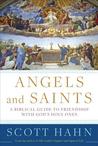 Angels and Saints: A Biblical Guide to Friendship with God's Holy Ones by Scott Hahn
My rating: 4 of 5 stars
This is a solid, understandable book that explains the concept and theology of angels and saints. The last half of the book contains the stories of specific saints and angels, along with an excerpt from a writing about them (usually from a Church Father). It would definitely be a good book to give to someone wondering about the topic.
Angels and saints have been a special interest of mine since my conversion in 2000 so I've read a lot of books on the subject. Therefore, a lot of the information was not new to me. Even so, almost every section had some tidbit which was a surprise or gave me a new perspective. A few samples of the sort of things that knocked my socks off:
My favorite part was the introduction where Scott Hahn shares his personal experience, which is both moving and inspiring. I think the book could have done with a few more personal touches throughout and then I might have given it another star.
- Humans are the minority in the Church. Oh, right. Angels outnumber us, which makes sense when you realize that each of us has a guardian angel. (I also was blown away by the connection of guardian angels to Jesus' agony in the Garden of Gethsemane where he was comforted and assisted by ... yep ... an angel.)
- Hahn draws on rabbinical teachings to point out: It was Moses' special intimacy with God that made it possible for him to compose the Torah. He could describe the earliest days of creation not because he was there, but because God was; through prayerful intimacy, Moses had come to see as God saw. Oh snap!
- There was not a bishop alive who could speak the language of the Old Testament, but Jerome was teaching it to Roman widows and teenagers. They pushed him to the point where he lamented that they had surpassed him in their ability to speak Hebrew with no accent.
Hahn's been writing more of these "Catholic basics" books lately but this is the first I've read. If it is any indication, he's giving the Church a fine resource. He's certainly giving regular readers a great chance to dig deeper into their faith.
BLOG TOUR
I'll be participating in the blog tour for this book along with 11 other bloggers. Scott Hahn chose 12 favorite saints to highlight and we'll each be reflecting on his chapter about a saint close to our hearts as well.
My day is June 2.
My choice? I get two for one! Saint Monica and Saint Augustine.
Here's the schedule.
- May 27: St. Michael and the Angels - Catholic Katie
- May 28: Moses - Abigail’s Alcove
- May 29: St. Paul - Catholic Bibles
- May 30: St. Ignatius of Antioch - The Orant
- May 31: St. Irenaeus of Lyons - Seasons of Grace
- June 1: St. Jerome - Stuart’s Study
- June 2: St. Monica and St. Augustine - Happy Catholic
- June 3: St. Thomas Aquinas - Blog of the Courtier
- June 4: St. Therese of Lisieux - Single Catholic Girl
- June 5: St. Maximilian Kolbe - Random Acts of Momness
- June 6: St. Josemaria Escriva - Catholic Mom
- June 7: Queen of All Saints, Mother of the Church - This Cross I Embrace
And I'll be doing a book giveaway on the day of the blog tour! Woohoo! Leave a comment here to enter in the random drawing that I'll hold that day. If you comment anonymously, that is fine, but leave your name in the comment so I can alert you if you win!
Wednesday, May 21, 2014
Movie Group in a Nutshell

I actually have been meaning to do a blog to serve as a resource with lists and tips in case anyone else was interested in such a venture. I began one and then got distracted. I'll get busy with it again.
In a nutshell, it is providing activity for small groups, rather than large ones. I've been working with the facility's management but providing a way that those within the small group can help nurture it if they are interested.
The facility had most activities organized around large groups attending and this was their first view of how successfully a small group could turn into a vibrant community. And when I say small, let's be clear. I was thrilled Monday to hear that about 15 people watched the movie and to have 9 people come to lunch.
It has been hit and miss to get to where we are. I wanted to do something to volunteer and was asked to set up my own idea. All I really could think of was the sort of conversations Scott and I have at A Good Story is Hard to Find.
I began over a year ago with a book and movie club, which met in the afternoons. It turns out that very few wanted to read books or even listen to audiobooks, which the facility happily provided free.
So movies are the focus.
Afternoons were also a problem as people had other activities or wanted to nap after lunch.
So a couple of group members were inspired to move the meeting to lunch time. Because who doesn't want to have a good conversation with a meal? We all know the key to getting attendance is to provide food, no matter what time of day.
The current formula, which has been working well for some time, is that we meet twice a month. The movie is shown on Sunday evening by a group member, though the management is going to begin also showing it on Fridays (as we continue to tweak). On Monday there is a lunch for anyone who saw it to come and join a group discussion. I have trivia from Wikipedia/IMDB and insights just from reading various reviews, to try to foster conversation.
Well Said: What we are promised.
I happen to love our latest pope (and, really, who doesn’t?), but we were never promised loveable popes. We have plenty of saints to keep us company and give us heart, thank God, but we were never promised that the Church would be administered by them, nor even that the Church would be administered by minimally decent and reasonably competent people. We are not promised that Jesus will never again be denied, deserted and betrayed, nor are we promised that trusted teachers, priests, bishops and popes won’t do the denying, deserting and betraying. We are not promised that they (and we) won’t sin again and again and again, only that He will always forgive.Yep. Wherever we go, there we are. All the more reason we need Christ and His Church ... and to remember His promises.
What we are promised is not that we possess the Truth but that He has a Church and that He will always be there, however we may deny, desert and betray Him. What we are promised is that the One who told Moses so frightfully “no one can look upon Me and live” now offers Himself to us as food. What we are promised is his presence in the Eucharist, his mercy in our sorrow, his welcome as we lie dying. What we are promised is that He loves us, and that, if we will only bring ourselves to ask, He will bless us with a ravenous hunger for intimacy with Himself. That He will save us, in other words.
Michael Garvey, Still Catholic
Tuesday, May 20, 2014
Well Said: Our Efforts and Jesus
We also may feel our efforts are inadequate. ... But Jesus accepts what we give, blesses it, breaks it open, and magnifies it. Often in ways that we don't see or cannot see.This seems facile to say but I actually saw that in action just this morning. The director of the assisted living facility where I do my bimonthly movie group said that it was one of the most successful programs they have. And that they are having more programs "follow your model."
Father James Martin, Jesus: A Pilgrimage
My model?
I was slightly stunned. Mostly because I know the inspiration to try the group was due to a strange coming together of "pushes": Bilbo picking a troll's pocket, me reading to my mother-in-law, and stepping way out in faith (and fear) to try a new idea when it occurred to me. So, evidently a divine inspiration. (Nice to have that confirmed.)
A classic for our times: reviewing Something Other Than God by Jennifer Fulwiler
 Something Other Than God: How I Passionately Sought Happiness and Accidentally Found It by Jennifer Fulwiler
My rating: 5 of 5 stars
SHORT VERSION:
I can think of an awful lot of people who I'd give this book to:
Christians trying to understand atheists (like a pal of mine who said, "I just don't know how those people don't believe in God." I almost shoved my copy into her hands. Almost. Hey, I wasn't finished with it yet.)
Atheists trying to understand Christians.
Protestants trying to understand Catholic teachings.
Catholics trying to understand Church teachings.
Catholics who understand but struggle with following Church teachings.
Anyone wanting an inspirational story of change and redemption.
Yes, that really is an awful lot of people ...
LONG VERSION
Jennifer Fulwiler was raised by loving parents who didn't push their atheism on her or do more than tell her to think for herself. However, that in itself was enough to produce a dedicated atheist, especially when told to an intelligent youngster who applied herself with the passion that only youth can muster to facts and logical conclusions.
I looked at the ammonite settled in between my soggy sneakers and I understood for the first time that my fate was no different than its own.Her only encounters with Christians were, frankly, off-putting and tended to be with friends who were not at all equipped to discuss faith versus scientific truth and logic. So Fulwiler spent many years losing herself in fun to distract herself from the awareness of mortality.
I had always thought of these creatures as being fundamentally different from me. They were the dead things, I was the alive thing, and that's how it would be forever. Now I wondered what had kept me from understanding that to look at these long-dead life-forms was to look at a crystal ball of what lay in store for me—except that, unless I happened to die by falling into some soft mud, I wouldn't end up a fossil. Ten million years from now, there would be nothing left of me.
[...]
There was no solution to my problem, because it wasn't even a problem; it was just a new awareness of reality. But as I took one last glance at the pickup before it disappeared from view. I felt like there was some answer in that brief flash of happiness I'd experienced while driving the truck. The grim truth I'd uncovered hadn't gone away, but it was somehow rendered less significant when I'd been immersed in the distraction of having fun.
When Fulwiler became a wife and mother, the life-altering love she experienced defied logic. It defied scientific explanations. It tipped the scales against atheism. With this realization, she began searching for the truth. That truth led her to a place she'd never have expected, conversion to Catholicism.
On the surface, this is Fulwiler's story of her conversion. However, because she required so much reflection, connection, and research before relinquishing her old beliefs, it is also a primer on logical investigation and thought. Finally, it is a exploration of Catholic teachings and how they apply to modern life. It was key for Fulwiler to fully understand all the implications of what she was accepting so she takes care to make sure the reader also understands.
This isn't done in a dry or preachy way. Au contraire, I often found myself laughing, especially at the time she sat in a bathroom stall for hours, reading a Bible furiously searching for answers and just as furiously spinning the toilet paper roll to send away people who knocked on the door. And there are moving and insightful moments such as when she is reading C. S. Lewis, listening to Tupac Shakur, and melding her thoughts about both into realizations about hell, heaven, and purgatory.
I recently read St. Augustine's Confessions, the first autobiography ever written. It is a moving and completely honest book about one man's search for ultimate truth. On many levels Fulwiler conveys the same passionate desire to know what is true, what can be trusted, as that young African seeker did 1,600 years ago.
Augustine's book is a classic because it spoke so directly to the people of his time and yet sounds its message through the ages. Other Christian classics do the same. Francis de Sales with his Introduction to the Devout Life, Teresa of Avila with her Interior Castle, and Thérèse of Lisieux with The Story of a Soul all addressed problems of their time with advice that is still applicable and invaluable today. They reach us now because the human soul always struggles with the same problems and they speak in a way that transcends their own particular eras.
Why do I bring them up? Only time will tell if this book is a classic that reaches beyond our time. I think it is nuanced, well written, and relatable enough that it could.
What I do know is that, as with those classics, this book was written to address a dire need in the author's own time. Right here, right now, our country and the Western world are crying out for a way to make the world make sense. Jennifer Fulwiler's book spells it out in a way that cannot be ignored by any honest truth seeker. She tells of the truth that transcends mere facts while speaking the language that our modern, science loving, atheistic world understands.
It is truly a classic for our times.
Monday, May 19, 2014
Happy Birthday, Lisa!
 |
| Irises, Vincent van Gogh, 1889 via WikiPaintings |
This brings me to my sister whose super-curly blonde hair, bright blue eyes, and light, fluttery personality must have made her like a vivid, exotic butterfly in our household. She's a bright, vivid spot in my life. An iris of unusual perfume and difference who makes me glad. Happy birthday, Lisa!
 |
| Vase With Irises, Vincent van Gogh, 1890 also via WikiPaintings |
Friday, May 16, 2014
"I am a Christian and I will remain a Christian"
The judge sentenced her to hang.
The Deacon's Bench has a good roundup of stories about this 26-year-old pregnant Christian doctor who has been sentenced to 100 lashes and death after refusing to deny her faith.
John Allen wrote The Global War on Christians for this very reason. We may face low-level cultural bias here, but there is real, horrible persecution going on around the world. Which the media usually ignores. This story is just the tip of the iceberg and unusual because it is getting coverage.
I can't deny that I've been a bit afraid of tackling that book. It sits on my review stack now. But this news story means I've got to read it soon.
These are our brothers and sisters, suffering for their faith in a way that we can't imagine coming to us personally. We must pray for them and not be silent about their persecution.
The Deacon's Bench has a good roundup of stories about this 26-year-old pregnant Christian doctor who has been sentenced to 100 lashes and death after refusing to deny her faith.
John Allen wrote The Global War on Christians for this very reason. We may face low-level cultural bias here, but there is real, horrible persecution going on around the world. Which the media usually ignores. This story is just the tip of the iceberg and unusual because it is getting coverage.
I can't deny that I've been a bit afraid of tackling that book. It sits on my review stack now. But this news story means I've got to read it soon.
These are our brothers and sisters, suffering for their faith in a way that we can't imagine coming to us personally. We must pray for them and not be silent about their persecution.
Subscribe to:
Posts (Atom)