Tuesday, April 11, 2006

I Confess ... to Knowing Too Many Monty Python Routines

Our entire family went to confession last night and headed straight for where our favorite confessor was always stationed. There was no line so I popped in first.

When I came out, Rose said, "We could hear both of you laughing in there."

Father O. had said, "Ok, here's what I want you to do. This is a two step process. The first step is for you to put this issue on the back burner in your mind. Just let it sit there and don't worry about it. Then, the second step is ... wait, there are three steps to this process."

I said, "Amongst the many steps in this process ..."

And we both just broke up guffawing.

(Actually, I realized later on ... it is a four-step process ... which made the whole thing even funnier when I was telling the story.)
Peasant: I didn't expect a kind of Spanish Inquisition.

Cardinal Ximinez: Nobody expects the Spanish Inquisition! Our chief weapon is surprise...surprise and fear...fear and surprise.... Our two weapons are fear and surprise...and ruthless efficiency.... Our *three* weapons are fear, surprise, and ruthless efficiency...and an almost fanatical devotion to the Pope.... Our *four*...no... *Amongst* our weapons.... Amongst our weaponry...are such elements as fear, surprise.... I'll come in again.

Holy Week - Tuesday

Pilate
Nikolay Gay. "Quod Est Veritas?" Christ and Pilate. 1890.
(CowPi Journal has a very good reflection about light and dark inspired by this painting.)
The Passion of Our Lord
BEFORE PILATE: JESUS CHRIST, THE KING
Thinking that in this way he might placate the hatred of the Jews, Pilate, took Jesus and scourged him (John 19:1). This is the scene we contemplate in the second sorrowful mystery of the Rosary, Bound to the pillar. Covered with wounds.

The blows of the lash sound on his torn flesh, upon his undefiled flesh, which suffers for your sinful flesh. More blows. More fury. Still more ... It is the last extreme of human cruelty.

Finally, exhausted, they untie Jesus. And the body of Christ yields to pain and falls, limp, broken and half-dead.

You and I cannot speak. Words are not needed. Look at him, look at him ... slowly.

After this ... can you ever fear penance? (J. Escriva, Holy Rosary, Second Sorrowful Mystery)


When this has happened, the soldiers plaited a crown of thorns, and put it on his head, and arrayed him in a purple robe; they came up to him, saying, "Hail King of the Jews!" and struck him with their hands (John 19:4-5). Today as we contemplate Jesus proclaiming his kingship before Pilate, we should also meditate upon that scene contained in the third sorrowful mystery of the Rosary.

The crown of thorns, driven in by blows, makes him a mock king ... And with their blows they wound his head. And they strike him ... and spit on him ...

You and I ... haven't we crowned him anew with thorns and struck him and spat on him?

Never again, Jesus, never again ... (J. Escriva, Holy Rosary, Third Sorrowful Mystery)

In Conversation with God: Lent and Eastertide

Scourging

Caravaggio. The Flagellation of Christ. 1607.

Monday, April 10, 2006

Holy Week - Monday

Trial

Duccio di Buoninsegna. Maestà (back, central panel): Jesus Accused by the Pharisees. 1308-11.

The Passion of Our Lord
PETER'S DENIALS

Jesus having been much ill-used, is led into one of the courtyards. He then turned and looked at Peter (Luke 22:61). Their looks meet. Peter would like to bow his head, but he cannot tear his eyes from Him, Whom he has just denied. He knows the Saviour's looks well; that look that had determined his vocation, he had not been able to resist either its authority or its charm; and that tender look of the Master's on the day He had affirmed, looking at His disciples, "Here are my brethren, my sisters, my mother!" And that look that had made him tremble when he, Simon, had wanted to banish the Cross from Jesus' path! And the affectionately pitying look with which he had invited the too-rich young man to follow him! And His look, clouded with tears, before Lazarus' tomb ... He knows them well, the Saviour's looks.

And yet never, never had he seen on the Saviour's face the expression he sees there at this moment, the eyes marked with sadness but without any severity. A look of reproach without a doubt, but which becomes suppliant at the same time and seems to repeat to him, "Simon, I have prayed for thee!"

This look only rests on him for an instant; Jesus is violently dragged away by the soldiers, but Peter sees Him all the time (G. Chevrot, Simon Peter).
He sees that compassionate look of Jesus fixed upon the deep wound of his guilt. He now understands the enormity of his sin, and the fulfillment of Our Lord's prophecy about his betrayal ...

Contrition gives special strength to the soul; it restores hope, makes the Christian forget himself and draw close to God once more with a deeper act of love. Contrition proves the quality of interior life and always attracts God's mercy; ... this is the man to whom I will look, he that is humble and contrite in spirit ... (Isaiah 66:2)

Christ found no difficulty in building his Church upon a man who was able to fall and who did fall. God also counts on weak instruments, provided they repent, to carry out his big project: the salvation of mankind.
In Conversation with God: Lent and Eastertide

I will never forget when I first read the Gospel where Jesus turns and looks at Peter. I don't know why I never noticed that part before but it is one of the most meaningful to me. What a terrible moment of sudden knowledge that must have been. I know that feeling in the pit of your stomach when you are "found out" and the remorse and shame that flooded Peter on that instant. How many times have I given Jesus reason to look at me like that?

Beginning Easter Sunday


Catholic catechism dialogue blog, a new group blog, is being launched with the hope of inspiring people to become consistent, daily readers of the Catechism of the Catholic Church. You can read all about it here.

I really am honored to be included in the writers of the blog. This will be especially good for me as reading the entire Catechism is something that I've always meant to do. Of course, I never have though I have a great copy of the Catechism sitting on my bookshelves as a reference.

I am so looking forward to printing out that schedule Owen mentions and getting into a daily routine of the CCC to supplement the Bible. Also, there is a crack team of diverse writers assembled. I can't wait to see what insights they have to share. This is definitely gonna keep me on my toes!

Sunday, April 9, 2006

It Really Happened

Mk 11:1-10

When Jesus and his disciples drew near to Jerusalem
to Bethphage and Bethany at the Mount of Olives,
he sent two of his disciples and said to them,
“Go into the village opposite you,
and immediately on entering it,
you will find a colt tethered on which no one has ever sat.
Untie it and bring it here.
If anyone should say to you,
‘Why are you doing this?’ reply,
‘The Master has need of it
and will send it back here at once.’”
So they went off
and found a colt tethered at a gate outside on the street,
and they untied it.
Some of the bystanders said to them,
“What are you doing, untying the colt?”
They answered them just as Jesus had told them to,
and they permitted them to do it.
So they brought the colt to Jesus
and put their cloaks over it.
And he sat on it.
Many people spread their cloaks on the road,
and others spread leafy branches
that they had cut from the fields.
Those preceding him as well as those following kept crying out:
“Hosanna!
Blessed is he who comes in the name of the Lord!
Blessed is the kingdom of our father David that is to come!
Hosanna in the highest!”
This was the opening Gospel, read when we were all facing the cross in the center of the church.

Our pastor made a brief commentary after it was read before processing behind the cross throughout the rest of the church. He said, "Why is this in the Gospel?" and read this part again.
If anyone should say to you,
‘Why are you doing this?’ reply,
‘The Master has need of it
and will send it back here at once.’”
So they went off
and found a colt tethered at a gate outside on the street,
and they untied it.
Some of the bystanders said to them,
“What are you doing, untying the colt?”
They answered them just as Jesus had told them to,
and they permitted them to do it.
He said that no scholars have puzzled over the hidden meanings of those simple words. Why were they even included? Because they are the little details that are remembered and told by someone who was there. An eyewitness.

He said, "This really happened. It is not some ancient mythology with which we fool ourselves. It is not made up. It really happened. Jesus really died for our sins to bring us salvation. He is real. It really happened."

That was the first time I cried at today's Mass. The second was when I had to read aloud, "Crucify him!"

Because it really happened.

Saturday, April 8, 2006

My Crush on Cardinal Arinze Continues

Y'all may remember my full-fledged crush.

I see no sign of it abating. In fact, it might be getting worse.
The Mass is the supreme act of adoration, praise and thanksgiving which humanity can offer to God. We owe everything to God: life, family, talents, work, country. Moreover God has sent us his only-begotten Son for our salvation. At Mass we offer God this supreme acknowledgment of his transcendent majesty and thanksgiving for his magnificent goodness towards us. Moreover, at Mass we associate ourselves with all creation in acknowledging the greatness of God. God is not our equal. He is not our colleague. He is our Creator. Without him we would not exist at all. He is the only necessary being. It is normal that we acknowledge this fact. Those who refuse to adore God must not decorate themselves with the apparently nice title of liberal intellectuals.

If we are to call a spade a spade, we shall inform such people that they are unreasonable, ignorant and blind to most obvious facts. A child who refuses to recognise his parents is not a liberal. He is a brat. Would it be wrong to call him stupid, and unaware of common sense, and even of his own best interest? And God is to us much more than parents are to their children. On the other hand, God is not a rival to us human beings. He is not a threat. He is not a killjoy.

God is our loving Father. He is Providence. He takes care of every detail regarding our life. When we adore him, praise him and thank him, we not only do not demean ourselves. Rather we begin to realise our greatness. Our acknowledgment of God's transcendent reality elevates us. The shepherds in Bethlehem and the Magi were all the better because they adore the Child Jesus. St Anselm, St Augustine, St Thomas Aquinas, St Teresa of Avila, St Therese of the Holy Child Jesus, St Benedicta of the Cross (Edith Stein) and Albert Einstein were all the greater because they offered the sacrifice of t eir intelligence to God the Creator. Christians must not allow themselves to be misled by the errors of a secularistic mentality which lives as if God did not exist. Man is not the centre of reality. God is. By adoring God through the Holy Eucharist, we pay this due tribute to God's transcendence.
Read the full text of his speech here. Thanks to Fr. Stephanos for the scoop and link.

Friday, April 7, 2006

You HAVE to See This

Watch this all the way through.

And make sure you have the sound on.

Thanks to SC&A for the heads up. How does Siggy always know what I'll like?

Eaking-Spay Ussian-Ray

Disputations mentions Pig Latin which reminds me of this funny story about my brother.

Once upon a time, he and some other Americans were learning Russian on the U.S. Army's dime (he later went into Military Intelligence, but that's another story). The other students at the language school were all German. The instructors were Russian.

The instructors would not allow the Americans to speak anything except Russian. However, they would allow the Germans to also speak German.

Naturally, this unfair discrimination angered the Americans. With native ingenuity, they came upon the answer. They spoke Russian ... in Pig Latin.

This confused and enraged the instructors. They could tell it was some sort of Russian but couldn't figure it out. They also never could understand how all the Americans instantly knew this new language.

Who knew that the "talent" every American schoolchild picks up with so little trouble would be used to such good effect?

My brother. He's a clever one all right!

APB on John B.

Anyone seen The Catholic Packer Fan lately?

Or have did I just miss something?

Bryan and I are wondering where he is.

A Trend in the Making


I found the street sign generator on my own
(ok, so the link was at the bottom of the other generator...)
.


hcposter

I found this poster generator so long ago that I forgot it until Jules reminded me.

Thursday, April 6, 2006

The Miraculous Haul

To me this addresses so perfectly that feeling of astonishment and directness we feel when God suddenly addresses us ... in a way that means more to us than anyone else around, because it is a message tailored for us specifically. And, then, suddenly we can see.
He told Peter to row out into the deep and lower the nets again. And now for the first time we hear Peter speak: he must have said a good deal before this, for he was almost too ready a talker; but this is the first utterance of his that the Holy Spirit thought worth recording. "Master," he said, "we have labored all the night, and have taken nothing; but at thy word I will let down the net." All Peter's discipleship was in that answer — "It seems impossible, but if you say so —!"

We know what followed — a haul of fish that burst the net. Peter and Andrew called to James and John, their partners, who were in another boat near by, and both boats were loaded with fish to the gunwales, nearly sinking under the weight. What was the exact nature of the miracle? Either Jesus knew that the fish would be there — if so, it was by no natural knowledge that a carpenter would read signs that the fishermen missed; or he willed them to be there.

Peter's reaction is fascinating: "Depart from me, for I am a sinful man, O Lord." After all, this was not the first miracle Peter has seen Jesus work. He had been there when his new Master spoke to Nathanael of an incident that his bodily eyes had not seen — Peter may well have thought that he was reading the other's mind. He had been at the wedding feast in Cana when the water was changed into wine, he had been there all through the week of miracles following Passover in Jerusalem. Only recently his mother-in-law had been cured of fever at a touch of Christ's hand and a word from his lips. But reading minds and healing bodies, even making wine — such things lay outside his experience: even without miracle, these were mysteries to Peter. But fish were different: he knew all about fish. This miracle hit home to him as the others had not.

So we understand the special intensity of his astonishment. But why the fear? Why was his first reaction to a vast haul of fish an overpowering sense of his own sinfulness?He had see the money-changers scourged from the Temple — and probably was delighted to see it, feeling that they were getting what they deserved. Evidently it had not occurred to him that he was a sinner himself. This time, precisely because the miracle hit home to him in all the reality of its miraculousness, he suddenly saw Christ for the first time. Seeing Christ, he at last saw himself.
To Know Christ Jesus by Frank Sheed

Wednesday, April 5, 2006

Thanks Be to God

Ron Rolling's latest update. God is good and so are y'all for answering the call.

Water Into Wine

This excerpt is talking about when Jesus turned water into wine at the wedding at Cana.
But how could he work a miracle immediately after he had said, "My hour is not yet come"? In those words is the mystery of Cana. What did he mean by his hour? Once he has begun his public teaching, it always means the time when he should die and be glorified by his Father. That meaning would not fit here. Evidently he means that the moment has not yet come to show his power to the eyes of men. Then two surprises: Mary knows that he will show it all the same. One minute his hour had not come, the next it had.

Surely the Holy Spirit was at work. We know that Jesus went into the desert to be tempted by the devil because the Holy Spirit sent him there. His certainty that his hour had not yet come would have meant that the Holy Spirit had not yet told him that he was to show his power publicly. And now, suddenly, his Mother asks for a miracle. As we have seen, the life of the family at Nazareth had not been strewn with miracles ... Nazareth did not believe in him, was indeed the only town that wanted to kill him.

Mary could have asked him to work a miracle thus publicly, only at the command of the Holy Spirit: it was not in her nature to thrust bright ideas of her own on her Son. She asked him as she was bid, and the Holy Spirit moved him to do what she asked. Thus Mary, who by her obedience had brought her Son into life, now by his obedience brought him into public life.
To Know Christ Jesus by Frank Sheed

Tim Burton Terry Gilliam Would Be Proud

MIRRORMASK

We all found ourselves at a strange loss for words after watching this movie. On one hand it is a typical adventure teenage quest story of the sort found in fantasy novels. A girl must find the Mirrormask to restore her world and a parallel one to balance in order to save her mother from dying.

The way the story is illustrated with extremely odd special effects at first brought Tim Burton to mind. We soon saw that Tim Burton just wasn't odd enough (and how often do you hear that said?) and had to revise our opinion to the WeirdMeister ... Terry Gilliam.

We watched with a strange fascination to see what would happen next, not because we were caught up the story which at the base was fairly straight forward. The fascination was in the way the story moved along its predictable lines but made so very, very odd by the effects. It was like the time we watched Time Bandits (except Mirrormask's plot was more normal) ... unable to look away because we were wondering what would happen next in the weirdness.

In the end, neither Tom, Rose, or me could say that we liked or disliked this movie. That in itself probably is the strangest thing about the movie for we are an opinionated crowd. If you like this sort of movie, then this is the sort of movie you will like (to misquote The Car Guys).

HC RATING: Undefinable

Tuesday, April 4, 2006

Encounter at the Grocery Store

Picking up some things on the way to work yesterday, I overheard the guy checking my groceries talking to another checker about making sure they had Easter Sunday off. Then they were comparing times for their respective churches' sunrise services.

Memories of a chilly, windy, gray, wet outdoor Easter morning at 6 a.m. filled my head as I suddenly thought of attending an Easter service with my best friend from high school who attended the Church of the Nazarene. I asked the checker if his service was outside or inside.

That's all it took. We were off on a whirlwind conversation that covered why Easter is timed when it is, how many people only come to Easter and Christmas services, how hard it is to get up for a sunrise service ("You know you're a soldier when you're doing that," he said). It ended with a surprisingly personal moment of sharing as he reflectively said, "You know, I like to go somewhere by myself on Easter. I think about Jesus and what he did for us. I mean, I know he came to do it but ... still. Think of it. If it wasn't for him, none of us would be here. There'd be no Christians at all. No salvation."

We both were silent for a second. Then he handed me my driver's license and returned to his usual brisk manner. I turned away to see the bag boy grinning at both of us ... a couple of softies talking about Jesus at the grocery store.

That's ok. I'm used to it. Somehow I get caught up in those sorts of conversations fairly regularly. I like it. I like knowing so many people love their Savior and their faith and aren't afraid to talk about it with someone they don't know. Jesus is what connects us, makes us one.

Body of Christ ... it pops up all over the place. Even at the grocery store.

Back to Basics: Three Forms of Baptism

I am so used to Baptism by water that I tend to forget the other two forms.
Baptizing with Water
The most common form of Baptism is by water. The Gospels say that one must be born again of water and the Holy Spirit (John 1:33). The early Christians and their successors have been baptizing with water for almost two millennia but with some slight differences:
  • Immersion: Some Christian denominations fully immerse a person in water three times while saying the invocation of the Holy Trinity, also known as the Trinitarian formula, "I baptize you in the name of the Father and of the Son and of the Holy Spirit."
  • Aspersion: Other Christians sprinkle water on the forehead of the one being baptized and then invoke the Trinitarian formula.
  • Infusion: Catholics (mostly Latin) baptize by pouring water over the head of the one being baptized while the Trinitarian formula is pronounced.
All three methods use water and the invocation of the Holy Trinity. Only water can be used — no other substance. But immersion or infusion are preferred.

Baptism of Blood
The notion of being baptized by shedding your own blood for Christ and/or his Church grew up during the Roman persecutions. And the Catholic Church has always revered these unbaptized martyrs — people who die for their faith — maintaining that the divine mercy of God wouldn't penalize them or ignore their sacrifice merely because they died before their Baptism by water.

In addition, Herod killed many infants (Matthew 2:16) in an failed effort to kill the newborn Christ. These infants, known as the Holy Innocents, are martyrs, too, because they shed their blood, so Christ could live. So Baptism by blood is as valid as Baptism by water. The following quote from the Catechism of the Catholic Church shows what the Church has to say about Baptism by blood:
The Church has always held the firm conviction that those who suffer death for the sake of the faith without having received Baptism are baptized by their death for and with Christ. This Baptism of blood, like the desire for Baptism, brings about the fruits of Baptism without like being a sacrament (1258).
Baptism by Desire
Part of Catholic theology is the Universal Salvific Will of God, which is just a fancy way of saying that God basically would like for everyone, all men and women, to join him in heaven. Men and women have free will, though, so he offers the gift of grace, but men and women must freely accept and then cooperate with it...

People who lack any knowledge of Christ and his teachings are sometimes called anonymous Christians, and they don't consciously, deliberately, and willingly reject Christ and his Catholic Church, so they aren't responsible for not knowing the whole truth. Therefore, the Church believes in Baptism by desire, which allows salvation for non-Christians who, through no fault of their own, haven't yet accepted Christ explicitly but nonetheless live good, moral lives as if already Christian. Only those who consciously, deliberately, and willingly reject Christ are considered liable.

If people in their heart of hearts are sincerely disposed to God's will but, through no fault of their own, don't know about Jesus Christ — or they've never been shown by word and good example — then the Church presumes that they possess an implicit desire to be baptized. If someone had told them and given good example, they would've freely and willingly embraced Christianity and asked for Baptism by water.

The Catechism of the Catholic Church has this to say about Baptism by desire:
Since Christ died for all ... we must hold that the Holy Spirit offers to all the possibility ... Every man who is ignorant of the Gospel of Christ and of his Church, but seeks the truth and does the will of God ... can be saved. It may be supposed that such persons would have desired Baptism explicitly if they had known its necessity. (1260)
Catholicism for Dummies by John Trigilio

Monday, April 3, 2006

Mensa By the Numbers

Jake is one-fourth of Molly's age. Two years ago, he was one-seventh her age.

How old are they now?

You Know, Jesus Did Take It With Him

His body, that is.

I did a double-take when this author attempted to explain details of Roman Catholicism as a key to grasping Bosch's paintings.
The ceremony takes place at an altar that contains precious relics, which are real pieces either of the body of Christ or of a saint, or of something they have touched.
Ok, that's not Christian theology at all. No editor caught this one? Luckily, the author seems to be much better at writing about art than theology.

Duel in the Desert

This excerpt is talking about when Jesus was driving into the desert by the Holy Spirit and was tempted by the Satan
We should follow the duel closely — three thrusts by Satan, three times parried by Christ. What lay behind the three thrusts? I think what principally lay behind them was Christ's sinlessness. From your past sins and mine, the devil knows where the weaknesses are, the cracks and fissures in our natures half-healed or still gaping wide open. With us, he has plenty to go on: with Christ he had nothing at all. He could only improvise. We cannot read his mind ... but we can look at what he did.

He made three propositions. All of them were sketched in advance — rather sketchily sketched perhaps — by the behavior of the children of Israel in the desert. Christ answered with three wholly appropriate texts, all from Deuteronomy, all dealing with the time when Israel was beginning its new life... Or he may simply have taken three current views of the Messiah and tried them out in turn — that he would bring the earth wholly into the service of men's needs; that the very heavens would serve his splendor; that all the kingdoms of the world would be subject to him and to the Jewish nation whose glory he would be.

The first two temptations open with the words: "If you are the son of God." I think it was of the first urgency for Satan to find out what "son of God" meant. It had been used in the Old Testament as a name for the Messiah (Ps 2:7). But did he know what it meant?

"Son of God" had variously been used in the Old Testament — of the chosen people, for instance (Ex 4:22), and, in the plural, of the Jewish judges (Ps 81[82]:6). Satan knew his Old Testament, but the Book of Job he must have scrutinized with special closeness, for so much of it was about a certain Satan and the high carnival he had at Job's expense. In that book (1:6, 2:1, 38:7) "sons of God" meant the unfallen angels...
To Know Christ Jesus by Frank Sheed

Saturday, April 1, 2006

Pin All Your Romantic Hopes on Google

User A: "Finally I've found my Soulmate!
Thanks, Google Romance!"

User B: "I never thought I'd be writing
an online dating testimonial.
Until I met User A..."


Google has a new beta program for online dating with contextual advertising ... make sure you take the tour.

And while we're at it ... of course ... April Fool's!

Google is the master of the day I love to hate. (For the past three years of their practical jokes check here.) I always get caught by practical jokes. Just not clever enough.

As a born afficianado of others' work (just think about all those quotes, people), I do love the way that computer nerds have taken over April Fool's Day as a way to show their chops. So any cleverness will be linked to below as I come across it.

Around the House

Just a few random things ...
  • Last weekend we watched a couple of favorite movies that few have heard of but many should watch ... Infernal Affairs (scroll down for my review) and Payback.

  • Perhaps to compensate for the trouble with each word having definite tones, there is no verb conjugation. Catch that? No verb conjugation! For example, to make a statement past tense, add "le" to the end of the sentence. (Or that's how simple it is as of lesson 17 at ChinesePod.) Whew!

  • Ballad of Mulan (courtesy of Rose who is taking East Asian studies ... yes as a sophomore in high school ... it really is a college prep school isn't it?) the first poem found in calligraphy. For fans of the Disney movie (and I am one) read it and see how it corresponds. Click on "English translation."

  • Monk parakeets are a relatively common sight around here as a colony of them lives near White Rock Lake. A great story yesterday about these "bunny rabbits of the sky" (who doesn't love a parakeet in their back yard, after all?) and how the local electric utility "is earning notice for a planned construction of a 40-foot platform near White Rock Lake designed exclusively for the monks' sanctuary."

The Holy Mass and Personal Self-Surrender

In every true sacrifice there are four essential elements: and all of them are present in the sacrifice of the Cross: priest, victim, internal offering and external manifestation of the sacrifice. The external manifestation must be an expression of one's interior attitude. Jesus dies on the Cross, externally manifesting (through his words and his deeds) his loving internal surrender. Father, into thy hands I commend my spirit! (Luke 23:46) I have finished the task you committed to me, I have fulfilled your Will. He is, both then and now, at once Priest and Victim. Since, then, we have a great high priest who has passed through the heavens, Jesus, the Son of God, let us hold fast our confession. For we have not a high priest who is unable to sympathize with our weaknesses, but one who in every respect has been tempered as we are, yet without sinning. (Heb 4:14-15)

This internal offering of Jesus gives full meaning to all the external elements of his voluntary sacrifice — the insults, the stripping of his garments, the crucifixion.

The Sacrifice of the Cross is a single sacrifice. Priest and Victim are one and the same divine person: the Son of God made man. Jesus was not offered up to the Father by Pilate or by Caiphas, or by the crowds surging at his feet. It was He who surrendered himself. At every moment of his life on earth Jesus lived a perfect identification with his Father's will but it is on Calvary that the Son's self-surrender reaches its supreme expression.

We who want to imitate Jesus, who want only that our life should be a reflection of his, must ask ourselves today in our prayer: do we know how to unite ourselves to Jesus' offering to the Father and accept God's will at every moment? Do we unite ourselves to him in our joys and our sorrows and in all the activities that make up each one of our days? Do we unite ourselves to him at the more difficult times, such as moments of failure, pain or illness, at at the easy times, when we feel our souls filled with joy?

My Mother and Lady, teach me how to pronounce a "yes" which, like yours, will identify with the cry Jesus made before his Father: non mea voluntas ... (Luke 22:42) — not my will but God's be done. (J. Escriva, The Way of the Cross, Fourth Station)

Friday, March 31, 2006

One Year Ago Today, Terri Schaivo Died

I have seen various tributes all over but will direct you to the first one I saw today (and still my favorite thus far), at Jay's place.

My thoughts about Terri, euthanasia, and the culture of death from around that time can be found here.

Proceed Patiently With Confidence in God

Well, as of this posting, 41 people have donated (and someone asked me via my personal e-mail for my postal address to send a check). The net amount takes care of rent for March and April as well as the court costs mentioned in the summons, plus a very good start to May (or perhaps some luxuries like food and utilities)...

(UPDATE: The donor roll has increased to 59, as of a few minutes before the new day begins. The job interview that was scheduled for the past afternoon is postponed until noon tomorrow.)
Much thanks to all who have gotten the word out and to those who followed prayers with deeds in supporting Ron in his time of need.

I encourage you to read his "accounting," especially the comments which he has featured in the post.

Please keep praying for Ron's successful interview, for the Catholic guy who commented, and all those who are seeking employment, that God help their efforts and show them great good out of these trying times.

Jesus: Thirty, and Not Married

There is one thing that must have struck the townspeople as singular about him [Jesus]: he was thirty and he was not married. Remember the rarity of virginity among the Jews — not one woman in the Old Testament, among men only the prophet Jeremiah, and he had accepted celibacy for no spiritual reason. There were eccentrics, Essenes and perhaps the sect at Qumran, withdrawn in communities of their own and remaining celibate (again for no profoundly spiritual reason — Josephus says it was because wives "give the handle to domestic quarrels"). Anyhow the carpenter was no eccentric, and he plied his trade in his own town. In Palestine men usually married round twenty. The fathers of marriageable daughters must have weighed him up and found him eligible. Those opinionated cousins of his must have asked him what he thought he was up to, still celibate when he should have been married these ten years. Mary knew why, but it was not her secret to tell.

But this was the only peculiarity (and it was not in his favor). For the rest, the town took him for granted. Even when all Palestine was ringing with his miracles and the power of his utterance, Nazareth would have none of him — they had known him all his life, been to school with him, some of them, had him do their big and small carpentry jobs — plows, doorframes, wooden boxes.

Their reaction to his fame was a "What, him?" — amused smiles perhaps to begin with, such rage when he at last came to speak in their synagogue that they tried to kill him. Imagine your own plumber suddenly turning preacher and miracle-worker after many blameless years of mending leaks in your water pipes. You would not the be the first to believe, I think. Neither was Nazareth. They simply could not take all the high talk about him seriously. They knew him too well. He might fool others, but not Nazareth, never Nazareth. Not one of his apostles, apart from his own cousins, came from his own town...

Let us look steadily at him. He was a carpenter in a town, which even in insignificant Galilee, was despised as insignificant. He was not playing at being a carpenter, as Marie Antoinette and her ladies played at being shepherdesses at Versailles. He was a carpenter; the household depended on what he made; if trade was bad his Mother had to go without. The locals hired him to make and mend in wood. He would name a price and it would be a just price. They would haggle as is the way of the East, beating him down, asking doubtless if he thought they were made of money. In a better mood (having got the price down, perhaps) they might offer him a drink.

And he was omnipotent God, the second Person of the blessed Trinity, by whom all things were made, including the wood of his carpentry, and the drink, and the customer who was arguing with him about the price: including his own human body and human soul — that human soul which had to sustain the wonder of his divine self and not be blinded by it.
To Know Christ Jesus by Frank Sheed

Thursday, March 30, 2006

Prayers Needed

For Ron Rolling. My heart goes out to him. Let our prayers storm heaven.

Backing Up Prayers With Deeds
For anyone who feels called to help Ron out in addition to prayers, he has been talked into accepting donations. There is now a PayPal button in his sidebar for any blogging buddies or readers who are interested.

Prayers Requested

Theocoid tells us of a tragic accident that left only the father alive. Prayers are requested for him and for the souls of his family.

Growing in Virtue

St. John Chrysostom urges us to struggle in our interior life like little children at school. First, says the saint, they learn the shape of the letters. Then they begin to distinguish the strokes; and thus, step by step, they learn to read. If we divide up the virtues into different parts, we can learn first, for example, not to speak badly of people. Then, passing to another letter, we can learn not to envy anybody: we can learn never under any circumstances to be a slave to the body: we can learn not to give way to gluttony. Passing on from there to the spiritual letters, we shall study continence, mortification of the senses, chastity, justice, and scorn for vainglory. We should try to be modest and of contrite heart. Let us link virtues together and write them on our souls. We have to do all this in our own home, with our friends, with our wives, with our children.

What is important is that we should make a definite and loving decision to strive after virtue in our everyday affairs. The more we practice performing these good acts, the easier we will find them to do next time. In this way we will identify ourselves more and more with Christ.

Wednesday, March 29, 2006

It's About Time!

I've been waiting and waiting for these folks to get an RSS feed ... and now I have my hands on it. Yes, I'm connected.

Now y'all can be too. Here ya go: http://www.eppc.org/rss/publications.xml

What ... Nothing Was Available in Advertising?

You Should Get a PhD in Liberal Arts (like political science, literature, or philosophy)

You're a great thinker and a true philosopher.
You'd make a talented professor or writer.


Via Doctor Laura

You Know You're a Catholic Nerd When ...

The biggest fight you've had with your boyfriend is about which one of you was praying the Apostles' creed wrong.
Guilty as charged ... if you consider some of the arguments that happen in the comments boxes here.

Venial Sin

It is so easy to slip into the way of thinking that venial sin isn't that bad. True, it is not mortal sin, but it still is quite destructive and will erode our union with God in that "drip of water on rock" way.
Our Lord has called us to holiness for us to love with deeds. And on the approach we adopt towards deliberate venial sin will depend the progress we make in our interior life. For when we do not struggle to avoid venial sins or when there is not enough contrition for them, they damage the soul grievously. These venial sins make the soul insensitive to the inspirations and motions of the Holy Spirit. They weaken the life of grace and make the virtues more difficult to practice, and incline one towards mortal sin.

Many pious souls, says a present-day author [B. Baur, In Silence with God], are in an unfaithful state almost continuously as regards "little things;" they are impatient, hardly charitable in their thoughts, judgments and words, false in their conversations and attitudes, slow and lax in their piety; they don't control themselves and are excessively frivolous in their language, or treat the good name of their neighbor lightly. They know their own defects and infidelities, and perhaps even accuse themselves in confession; but they do not seriously repent of them, nor do they make use of the means to avoid them in the future. They do not realize that each one of these "imperfections" is like a leaden weight that drags them down. They do not realize that they are beginning to think in a purely human way and to work only for human reasons, or that they habitually resist the inspirations of grace and misuse them. The soul thus loses the splendor of its true beauty, and God is increasingly distanced from it. Little by little the soul loses contact with God: in him it does not see a loving and lovable Father to whom it should give itself with filial affection; something has been allowed to place itself between the two. This is the beginning of the road to lukewarmness.

Tuesday, March 28, 2006

Just as I Feared ... 50% Weird

(and it rhymes ... cool!)

You Are 50% Weird

Normal enough to know that you're weird...
But too damn weird to do anything about it!

Via "Not Nearly As Weird" Karen Hall.

I Won!


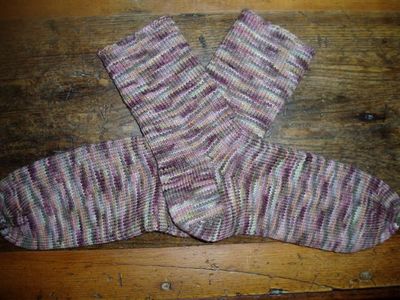
And I didn't even know there was a contest. I will finally get to find out if a pair of hand-knitted socks is like a hug for your feet.

Perhaps this will inspire me to get going on trying to knit a pair myself. I have the instructions but just have been too scattered to get it together to collect needles and yarn to get started.

Back to Basics: Vaccination Against Original Sin

This is probably the simplest explanation I've ever seen of how baptism fights original sin.
Catholicism sees original sin differently from actual sin, which is what a rational person does when she consciously, deliberately, and willingly disobeys God. Original sin is the natural inclination to sin.

For example, nobody is born with polio, measles, or chicken pox, but folds aren't born with any immunity to these diseases, either. A baby needs to be vaccinated, so the human body can produce its own antibodies and fight these diseases when it's exposed to them. Likewise, you can think of original sin as being born without any immunity or ability to internally fight sin. On the spiritual level, human beings, born without any resistance to sin, need a spiritual vaccination.

Baptism is to original sin what the polio vaccination is to the poliovirus. Baptism restores what should have been -- a spiritual resistance or immunity to sin and temptation. The first sin of the first parents, Adam and Eve, wounded human nature, and every one inherited that wounded nature from them. Baptism washes it away.

... And just as vaccinations are but a first step for a healthy physical life, Baptism is but a first step for a healthy spiritual life. Cultivating a good, healthy spiritual life means avoiding what's bad for your soul, such as sin and evil, and doing what's good for your soul -- prayer and works of mercy motivated by divine grace.

In addition to getting rid of original sin, Baptism also imparts or infuses sanctifying grace, a special free gift from God. Sanctifying grace makes the new Christian a child of God and applies the merits of Jesus Christ, his suffering and death for sins, to the new Christian personally, because the person being baptized is mentioned by name ...
Catholicism for Dummies by John Trigilio

Monday, March 27, 2006

66% Genuine!

Bass

(66% dark & bitter, 33% working class, 66% genuine)


It's a testament to Bass Ale, and therefore to YOU, that when I went to look for ads for Bass, all I found was this. An ad from 1937. Bass is legit, and if your scores are true, so are you. I tip my glass to that.

Personality-wise, you have refined tastes (after all, Bass is kind of expensive), but you know how to savor what you get. Your personality isn't exactly bubbly, but you're well-liked by your close circle of friends. Your sense of humor is rather dark, but that's just another way to say sophisticated, right? Cheers.
Link: The If You Were A Beer Test.

Via that half pint o' Guiness, The Anchoress.

Mensa for the Numbers People

Find the six-digit number in which the first digit is one more than the second, the third and fourth digits are the sum of the first and second, the fifth digit is two less than the fourth, the sixth digit is two less than the fifth, and the sum of the fifth and sixth digits equals the second. The sum of all the digits is 33.
I don't know about y'all but my brain melted just typing this monster.

UPDATE: we have a winner (I am amazed by her mental powers ... "math brained" doesn't begin to describe it) so don't go into the comments box if you're still figuring it out.

You'll Be a Man, My Son

If

If you can keep your head when all about you
Are losing theirs and blaming it on you;
If you can trust yourself when all men doubt you,
But make allowance for their doubting too;
If you can wait and not be tired by waiting,
Or, being lied about, don't deal in lies,
Or, being hated, don't give way to hating,
And yet don't look too good, nor talk too wise;

If you can dream - and not make dreams your master;
If you can think - and not make thoughts your aim;
If you can meet with triumph and disaster
And treat those two imposters just the same;
If you can bear to hear the truth you've spoken
Twisted by knaves to make a trap for fools,
Or watch the things you gave your life to broken,
And stoop and build 'em up with wornout tools;

If you can make one heap of all your winnings
And risk it on one turn of pitch-and-toss,
And lose, and start again at your beginnings
And never breath a word about your loss;
If you can force your heart and nerve and sinew
To serve your turn long after they are gone,
And so hold on when there is nothing in you
Except the Will which says to them: "Hold on";

If you can talk with crowds and keep your virtue,
Or walk with kings - nor lose the common touch;
If neither foes nor loving friends can hurt you;
If all men count with you, but none too much;
If you can fill the unforgiving minute
With sixty seconds' worth of distance run -
Yours is the Earth and everything that's in it,
And - which is more - you'll be a Man my son!
Rudyard Kipling
In a society all too eager to point out any masculine gender differences as something bad, to be blamed on men, just who will teach our boys to be men?

That is the question posed by Mary Jacobs in her Dallas Morning News editorial. Ms. Jacobs who loves the qualities that makes her son different from her daughter is reading The Minds of Boys by Michael Gurian. It sounds like a book that I would read also if I had a son to raise.
Women have always attempted to rein in boys' reckless impulses, Mr. Gurian says, but feminism made maleness inherently defective. Think of two fictional icons of American boyhood, Huck Finn and Tom Sawyer. The Widow Douglas may have attempted to civilize them with starched collars and good table manners, but Mr. Gurian says, "If Huck and Tom were alive today, they'd probably be diagnosed with a conduct disorder and put on Ritalin."
The answer to that question is that real men are quietly teaching their sons in spite of society's message. In a post that dovetails nicely with this editorial, Joel at On the Other Foot had his sons in mind when he wrote this wonderful piece about what a man is and what a man does. Here's a bit but do go read the entire thing. It is not to be missed.
As a man, you are stronger physically than women. You are also bigger than they are and hence intimidating to them, if only on a subconscious level. Never loom over them, never yell at them, never treat them as though they were men. (On the other side of the coin, don't condescend to them either. They're small, not dumb.) Bear in mind that you have all the equipment and strength necessary at any moment to overpower and violate any woman. It's therefore vital that you conduct yourself in a way that makes obvious that you not only wouldn't do something like that, but you'd step in front of a bullet or a grizzly bear to keep her safe. This isn't something you say out loud, but an attitude that stays in the back of your mind.
Lucky sons to have such a wise father. And, Joel's wife, Christina, at Confessions of a Hot Carmel Sundae, shows what a difference it makes to be married to such a man.

My lessons in the qualities that make a man came from Tom's mother who never forgot that her husband and her five sons were men, different from women, and rightfully so. Her small asides here and there about these men in her life were touchstones for me, who really had soaked up all the propaganda that was handed out by society when I went to college. My often surprised rejoinders to her insightful comments would lead to a five or ten minute conversation about what men were like and how to support them in being themselves. I am lucky to have had that input from a wise woman who loved her men and helped me to appreciate the innate manliness in my husband.

Many are not so lucky. We can only hope that the pendulum is beginning to swing back to the middle and that once again manliness will be appreciated in our society.

UPDATE
This also can be found at Spero News.

Back to Basics: Original Sin and Our Original Parents

I love it when science corroborates Scripture.
More than make connections and relationships, Baptism also washes away original sin, the sin of the original parents of the whole human race: Adam and Eve. The Book of Genesis (1:26-27) says that God created man in his own image and likeness, male and female. The first man was called Adam, and the first women, the wife of Adam, was called Eve. They were the prototype man and woman, and their sin affected all men and women after them. And the Bible says that their sin was disobedience.

Even secular science today uses the name Eve to refer to the first human woman -- the first homo sapien. We want to mention that avowed atheist scientists from Oxford University in England have identified seven ancestral matriarchal groups from which all Europeans appear to have descended. Every European, according to the study, can trace his evolutionary history back to the seven ancestral mother groups, also referred to as the Seven Daughters of Eve. This corroborates the discovery of biochemists Allan Wilson and Vincent Sarich of the University of California at Berkley who've shown that every man and woman on earth, past, present, and future, can be traced genetically to one human woman.
Catholicism for Dummies by John Trigilio

Saturday, March 25, 2006

Celebrating the Basic Catholic: My Husband

I think the truest value of various debates I have become involved in within St. Blog's Parish (wearing scapulars, whether Jesus went to school, where does that comma go in what St. Thomas Aquinas wrote, and many more such issues) ... has been to make me appreciate my husband even more.

He is what I suppose many people would call the most basic sort of Catholic ... loves the Church because of the truth (though he says that most people would not call his trust in the Church "love"), follows the rules because they are there for his good, and simply lives his faith better than any other person I have ever known. (He says that he always thought he was a "Catholic Neanderthal." Wrong.)

It might bother many people because Tom doesn't say novenas, say the rosary, wear a scapular or do any other overt signs of devotion. He has a quiet, basic faith that expresses itself every so often but mostly stays hidden.

And he doesn't talk, talk, talk about it. Hardly ever. He just lives it.

I mention this to him. He looks at me and says, "Isn't that what we are supposed to do?"

What a testimony that is to me time and again. When we are asked to give for some worthy cause and I am ready to cheap out, Tom will look at me and remind me of how much we have been given and that we should pass it on. Then he will name an amount that makes me gasp. Sometimes, very rarely, he will say something like, "Isn't this what that story about burying the talents is all about?"

Tom applies thoroughly practical thinking and a dispassionate view of "the big picture" in answering questions like the ones that people in the blogosphere will argue over for days. In one or two sentences he can bring things into a perspective that has been totally lost by people who spill tons of ink (or bytes) on issues. And then ... wait for it ... he lets people make up their own minds.

This is hugely important, and in my view, is one of the key ways that he "lives his faith" to the greatest degree. He trusts the person to think for themselves and make their own decisions. This, largely, is how we also deal with each other in our marriage. One or the other of us will bring something up (oh, let's say what we already know ... I usually am bringing the things up) and we will discuss it and then we will let it drop for each to consider in their own way. He doesn't push me to do things his way and (believe it or not) I don't push him to do things my way. We trust each other to be honest in our considerations and our responses.

It is amazingly effective. And after a day in the blogosphere what a relief it is.

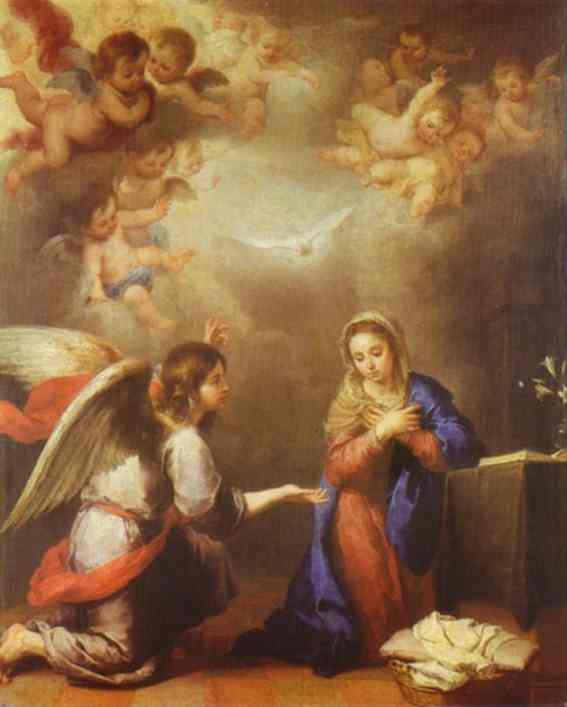
Solemnity of the Annunciation of the Lord

Bartolomo Esteban Murillo. Annunciation.
c.1660-65. Oil on canvas. Museo del Prado, Madrid, Spain. (Source)

On today's feast the Church celebrates the mystery of the Incarnation and, at the same time, the vocation of Our Lady. It was her faithful response to the angel's message, her fiat, that began the work of redemption...

The setting of this feast day, March 25th, corresponds to Christmas. In addition, there is ancient tradition that the creation of the world and the commencement and conclusion of the Redemption all happened to coincide at the vernal equinox.


The Incarnation should have a pronounced and dramatic on our life. This event is the central moment of human history. Without Christ, life has no meaning. Christ the Redeemer "fully reveals man to himself" (Encyclical, Redemptor Hominis). It is only through Christ that we will come to comprehend our inner self and everything that matters most to us: the hidden value of pain and of work well done, the authentic peace and joy which surpass natural feelings and life's uncertainties, the delightful prospect of our supernatural reward in our eternal homeland...

The human testimony of the Son of God teaches us that all earthly realities ought to be loved and offered up to Heaven. Christ has transformed the human condition into a pathway to God. Consequently, the Christian's struggle for perfection takes on a profoundly positive character. This struggle has nothing to do with snuffing out one's humanity so that the divine might shine out instead. Sanctity does not necessitate total separation from worldly affairs. For it is not human nature that opposes God's will, but sin and the effects of original sin which have so badly damaged our souls. Our struggle to become like Christ brings with it a life-long battle against whatsoever degrades our humanity -- egoism, envy, sensuality, a critical spirit ...

In the same way as the humanity of Christ is not effaced by his dignity, so it is that through the Incarnation the human condition preserves its integrity and finds its final end.

The Vocation of Our Lady

Vittore Carpaccio. Annunciation.
1504. Canvas. 127 x 139 cm. Galleria Franchetti in the Ca d'Oro, Venice. (Source)

In the oldest Christian calendars, this Solemnity [The Annunciation of the Lord] is referred to as a feast of the Lord. Nevertheless, the texts do make special reference to Our Lady. For many centuries this has been considered a Marian feast. The Church has traditionally held that there is a close connection between Eve, the mother of mankind, and Mary, the new Eve, Mother of redeemed humanity.

The messenger greets Mary as "full of grace;" he calls her this as if it were her real name. He does not call her by her proper earthly name "Myriam" (Mary), but by this new name: "Full of grace." What does this name mean? Why does the archangel address the Virgin of Nazareth in this way?

In the language of the Bible "grace" means a special gift, which according to the New Testament has its source precisely in the Trinitarian life of God himself, of God who is love (cf I John 4:8) [John Paul II, Redemptoris Mater]
. Mary is called "full of grace" because this name expresses her true being. Whenever God changes a person's name or gives him or her an extra one, He destines him or her to something new, or reveals to that person his or her true mission in the history of salvation. Mary is called "full of grace," most highly favored, because of her divine Motherhood.

The angel's announcement revealed to Mary her task in the world, the key to her whole existence. The Annunciation was for her a most perfect light that filled the whole of her life and made her fully aware of her exceptional role in the history of mankind. Mary is definitively introduced into the mystery of Christ through this event. (John Paul II, loc cit) ...

Mary's reply fiat, is rather more final than a simple "yes." It is the complete surrender of her will to what God wanted of her at that moment, and for the whole of her life. This fiat will reach its culmination on Calvary, when standing beside the Cross, she offers herself up with her son.

The "yes" that God asks of each one of us, whatever our path in life may be, lasts for the whole of our lives. Sometimes it will be our reply to small occurrences, at other times to larger, more important events. It will be our reply to each call that God makes and which leads successively to the next. Our "yes" to Jesus leads us not to think too much about ourselves. It should lead us to keep our hearts alert so that we may be attentive to the voice of God, who tells us who belong to him which is the path He has traced out for us. As we lovingly respond to his call we should see how our freedom and God's Will mingle in perfect harmony.

Friday, March 24, 2006

Are Mormons Christian?

Twice within the last couple of days I have come read posts by Mormons (or members of The Church of Jesus Christ of Latter-day Saints, aka LDS) angrily declaring that they are Christians because of their belief in Jesus and that they do not appreciate being told otherwise.

I know that one of the main reasons for this conflict is that both groups are using one word "Christian" to define two radically different beliefs about Jesus. For example, LDS believe God the Father and God the Son have physical bodies and that the Holy Ghost is a spirit who as yet does not have a body. When one considers how different just this nugget of information is from the theology of the Trinity, it is easy to see where problems in understanding one another begin.

I wrote asking for the scoop to several ex-LDS who are either Catholic now or quite close to being confirmed at Easter.

All wrote back with good links and saying basically the same thing in different ways. However, Defensor Veritatis has just posted a piece about that very subject so I will send anyone interested to Brad's place.

UPDATE
My friend (and devout LDS) Garry has a good and comprehensive comment about all this for any who are interested.

Luscious!

I don't read the blog being parodied but this is funny anyway. Thanks to Jay for the heads up!

AND the B Team has a wanted poster out for that Lisper ...

Want the Scoop on the Consistory?

American Papist has more links than anyone knew existed about it. I meant to post this earlier but forgot. So there's no time like the present for going over there to catch up.

Some Favorite Podcasts

Chris tells me that he's getting ready to dip his toes in the podcast ocean. I told him that I'd pass along a few of my favorites to help him get started.

These can all be found at iTunes. (Nothing Catholic as that isn't his interest ... check my sidebar under "They Like to Talk - Podcasts" for those.)

MOVIE REVIEWS
Mark Kermode Film Reviews
He's British, witty, irreverent, brilliant and overall great fun. It's nice to hear a viewpoint from outside America as well. An ongoing, amusing game is played with real-time listeners in which they email or phone in a cryptic one-liner movie description which Kermode guesses. Weekly.

Cinecast
Two Chicago movie lovers review current releases as well as have a top five list on different themes. They also usually have an ongoing series which continues for several weeks and allows them to cover great classic movies. Past series have included westerns and overlooked auteurs. The current series is musicals. This show has added a lot of titles to my "must rent" list. I tend to skip listening to readers' responses on this one. Twice weekly.

TELEVISION
Lost
Normally I wouldn't give two hoots about a podcast covering a television show. However, the executive producers are so hilarious when recapping the previous show and the answering questions that it is worth it just to hear them joke around (if you are a diehard Lost fan ... otherwise probably not). Weekly when a new show is airing.

TRAVEL
iPod Traveller
Cheeky Opal and travel guru Nick have great chemistry, wit, and style in this show highlighting European budget travel. Rather than just give basic info about a place, they usually also have interesting travel experiences which is what makes this interesting even if you have no immediate prospects to get to Europe (such as is the case for many of us in America). Weekly.

DRINK
Wine for Newbies
This is a really good basic primer for those who don't know much about wine. Bill Wilson's style is quite formal but don't let that put you off. He has a winning enthusiasm and desire to help newbies really understand wine. No set time for new podcasts.

SCIENCE
This Week in Science -- The Kickass Science Podcast
First of all, this has the best theme song of any podcast I've heard. Kirsten and Justin cover the latest in science news. Occasionally they may interview an author or scientist which I may or may not listen to depending on my interest. Kirsten is a PhD candidate in neuroscience and is very good at giving practical explanations of why stories matter. Justin is laid back and irreverent ("rather like a game show host" as Sigorney Weaver said to Bill Murray in Ghostbusters). It all comes together to make ... well, "kickass science." Weekly.

ANIMATION
The Animation Podcast
Animator Clay Kaytis airs interviews with some of the major animation talent of our time. So far he has had only animators who have worked with Disney one way or another but they have all been fascinating. I advise beginning with the oldest podcasts as it is interesting to see how these animators' paths have crossed at one time or another. No set time for new podcasts.

The Battle of the Reviews

Scott at Nehring the Edge and I have been battling some time over the movie "Millions." He felt it was a commercial laden, banal film. I absolutely loved it.

He has posted my review, which appeared originally at Spero News, and provided a link for his.

Who is right? You be the judge.

As an aside, if you haven't been reading his blog please do give it a try. I agree with Scott much more often than not and find his sharp wit words delightful.

Back to Basics: The Seven Sacraments

You know, I never thought of this correspondence, but it does make sense.
Why do Catholics have seven sacraments? Why not more or less? The easy answer is that Jesus instituted all seven. In the 13th century, however, philosopher St. Thomas Aquinas pointed out that seven stages of human development occur in the realm of nature, so it makes sense that God created the sacraments to correspond with each of those events. It's not that God had to make seven sacraments, Aquinas said, but it's reasonable to have seven:
  • We are born: Baptism

  • We are fed: Holy Eucharist

  • We grow: Confirmation

  • We need healing: Penance

  • We recover: Anointing of the Sick

  • We need family: Matrimony

  • We need leaders: Holy Orders
Catholicism for Dummies by John Trigilio

Thursday, March 23, 2006

Jesus, Mary and Joseph in Nazareth

At school he [Jesus] was taught Scripture, first the books of Moses, then the rest of the Old Testament, and some of the great commentaries of Israel's scholars. In this matter, as always when we try to picture to ourselves what was actually happening, we are almost giddy at the thought of the boy Jesus reading the Old Testament, learning what it had to tell of the Messiah, of himself in fact. It is hard to think that he did not discuss it with his Mother: children do, naturally. And Joseph, the man of the house, would have been listening to such Scripture commentary from those two as man has never heard, listening and making his own contribution.

As the boy grew older, the talk would be freer. A time would come when he must be told that Joseph was not his father in the way of nature. Is it fanciful to think that his Mother told him not only of her own virginal conceiving but of God's message about the child herself? They were a living family, not a set piece. They were not three figures in a ritual, cataleptically rigid in their muteness about the things that matters most, elaborately pretending that they were just like anybody else, each wondering how much the others knew! A loving family shares everything -- shares knowledge, shares thoughts and wondering. In the beginning Mary pondered in her heart: she would have discussed her pondering first with her husband, then with the boy, as he grew toward manhood.

If family life means anything at all, the story of God's message would have been gone over again and again: "The Holy Spirit shall come upon thee, and the power of the Most High shall overshadow thee. And therefore the Holy which shall be born of thee shall be called Son of God." Did those words lead sooner or later into discussion of the Trinity? I cannot pretend to know. I can only record my own feeling that it would have been strange if they did not. Mary was not just a convenience, to get him born, Joseph not just a convenience to keep the neighbors from talking. They were the two people closest to God-made-man. If they come to talk of the Trinity or of Jesus' Godhead, we need not assume that they used the terminology the Church has slowly hammered out -- Jesus had his own luminous experience of these truths and may have conveyed their reality more luminously than the Fathers of Chalcedon could have dreamed -- or even comprehended! If only one knew --!
To Know Christ Jesus by Frank Sheed

Wednesday, March 22, 2006

Possible Eucharistic Miracle in Dallas? UPDATED

It was quite odd to see this along with the fact that they are waiting on Bishop Grahmann to make a ruling. Isn't this sort of thing really supposed to just happen in Italy? Via The Crescat.

UPDATE
It isn't a miracle ... get the scoop at Spero News. No shock there as the circumstances alone were fairly strange.

Well, I Know I Like to Watch ...

You Should Be a Film Writer

You don't just create compelling stories, you see them as clearly as a movie in your mind.
You have a knack for details and dialogue. You can really make a character come to life.
Chances are, you enjoy creating all types of stories. The joy is in the storytelling.
And nothing would please you more than millions of people seeing your story on the big screen!


Via a favorite screenwriter of mine, Karen Hall, who is tantalizing us with the tale of being galvanized into action on her newest book. Hurry up, Karen, I wanna read it!

More About That Episode in the Temple

As to the scene in the Temple [when young Jesus was found with the teachers], the amazement probably did not spread much beyond the group actually present: it would have been a nine days' wonder for a handful of people. Nazareth, one imagines, never heard of it. The boy's schoolteacher would have been mildly surprised if some such account as Luke gives had reached him, and would certainly have dismissed it as exaggerated.

Of one thing we can be fairly sure -- the boy never staged a repetition of the incident in school. If he had, the master would probably have decided that it was high time to flog some humility into him, a masters have done to brilliant boys in all ages. But Jesus did nothing so spectacular, in school or out of it. We cannot remind ourselves too often how startled his townspeople were when his public mission began. It is clear that the thirty years in Nazareth contained nothing to prepare them either for his miracles or for the incomparable power of his mind.
To Know Christ Jesus by Frank Sheed

Tuesday, March 21, 2006

Episode in the Temple

We have got into the way, some of us, of thinking that the twelve-year-old Jesus was teaching some of the most learned men of Israel. But that is not what Saint Luke says. What was happening was an example of a daily custom in the Temple. Groups would gather round a rabbi, and ask him questions, on theology or morals or ritual. He would give them the benefit of his learning, which would usually be very considerable learning. As part of his teaching, he would put questions to them. It was in one such group that his parents found Jesus.

He was not teaching the doctors, he was "hearing them and asking them questions." It is clear that he was answering the questions put by the learned men who conducted the group: but we must realize that they were not searchers after truth asking him to enlighten them, but teachers using questions as part of their teaching method. His replies must have been brilliant, at any rate for a boy: because Luke tells us that all who heard him "were astonished at his wisdom and his answers" -- and the Greek verb used is a great deal stronger than our word "astonished," they were quite "taken out of themselves!" ...

Mary and Joseph wondered too, and once again the Greek verb is stronger than the English: it was if they had a sort of electric shock. Why? Not, one imagines, because his answers were brilliant. Most probably what startled, almost stunned them,was to see him showing his brilliance.
To Know Christ Jesus by Frank Sheed

A Couple of Literary Notes

NOTE THE FIRST
On Rose's recommendation, I began Uncle Tom's Cabin yesterday and have been surprised to find myself riveted ... to the point where I was propping it open to read while making lunch or washing dishes. I'm in the early stages, needless to say, but let me just say this. All this talk about Uncle Tom and not one person has ever mentioned Aunt Chloe? Well, knock me over with a feather! I only had time to read that she is the cook at the big house and that may be all there is to her information, but still ... it never occurred to me that Uncle Tom might be married.

NOTE THE SECOND
I really love it when Rose sums up these classics for me. She has just begun Madame Bovary. Having read only about 20 pages she told me, "So far the book is only about Charles Bovary."

I said, "That's Madame Bovary's husband?"

She waggled her eyebrows, "He's the loser she runs away from later."

Short. Sweet. To the point.

Hilarious.

Monday, March 20, 2006

Public Service Announcement

ASSISTED LIVING

This movie is the newest recipient of The Coma Award, replacing Schultze Gets the Blues, which while an amazing waste of our time, did not depress us to the point of tears ... and partway through this dreary indie movie I was actually at that point.

The movie distributors obviously knew that this view of a slacker working in a nursing home was a problem as the trailer lied to us by putting together the only two minutes worth of humorous, upbeat footage in the entire piece. The acting is so bad that Tom actually thought it was a documentary for much of the movie, the plot is miniscule, the pace that of a snail, and the only reason we could think that it got any awards was so that the award givers could fool themselves into not feeling shallow.

No wonder everyone loved The Station Agent so much. They'd been watching movies like this one.

Two good things about this movie:
  1. It is only 73 minutes long.
  2. I now appreciate Deacon Tom and all those who give loving care in a nursing home even more than I did before.
HC rating: * Worse than Godfather III.

More Mensa

To give us "wordies" another chance after most of us failed so spectacularly at the last Mensa word puzzle, here's a little something to get our brains revved up for Monday.
What three words, formed from different arrangements of the same six letters, can be used to complete the sentences below?

The posters were all on one theme: protect our ______. The campaign was meant to ______ an awareness and be somewhat ____ than scare tactics.
UPDATE
Go ahead and put answers in the comments box. If you are still thinking and don't want to know the answers ... stay out until you're ready to know all. You have been warned!

Saturday, March 18, 2006

Remembering Terri

Today is the one-year anniversary of when Terri Schaivo's feeding tube was removed. She was not the first and, sadly, not the last to be murdered with the assistance of the courts. Let us keep her in our minds and hearts as we pray and work against this evil.

Blogs for Terri requests:
Bloggers, please join with us over the next 13-days and write about Terri's life and death, honoring her memory by making the argument for why lives like hers should be protected, respected, and loved.

Friday, March 17, 2006

Kiss Me, I'm 45% Irish ...

... actually, that might be just about accurate.

You're 45% Irish

You're probably less Irish than you think you are...
But you're still more Irish than most.


Via Alabama Improper.

When German Eyes Are Smiling...

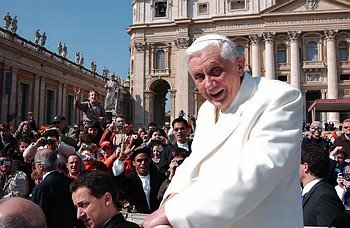
We now interupt the Irish festivities to show this endearing photo of Papa,
shamelessly ripped off from American Papist.


Ok, as you were ... back to all things Irish.

On Seeking Out Mortification and Penance, Part II

As I promised yesterday, here is a follow up reading about the opportunities mortification in our ordinary daily routines.
... It has to mean serving the person one does not get on well with, expecting nothing in return. This is the best way of giving one's life for others, in an effective and hidden way which is hardly noticed, and which enables us to tackle that egoism of ours which deprives us of joy...

To serve others requires mortification, a continuing realisation of the presence of God, and a forgetting of self. On occasion, this spirit of sacrifice will clash with the mentality of those who think only of themselves. For us Christians it is our pride and our dignity. For in this way we are imitating Christ, and in thus serving willingly, out of love, many human and supernatural virtues are brought into play. This dignity is expressed in readiness to serve, in keeping with the example of Christ, who "came not to be served but to serve." If in the light of this attitude of Christ, "being a king" is truly possible only by "being a servant," then "being a servant" also demands so much spiritual maturity that it must really be described as "being a king." In order to be able to serve others worthily and effectively, we must be able to master ourselves, in order to be able to possess the virtues that make this mastery possible (John Paul II, Redemptor hominis, 21).