|
| Die Goldbahn (The Gold Railway), Edward B. Gordon |
I just love Edward B. Gordon's paintings and especially those from urban life.
|
| Die Goldbahn (The Gold Railway), Edward B. Gordon |
I just love Edward B. Gordon's paintings and especially those from urban life.
 |
| Die Vorbereitung (Preparation), Edward B. Gordon |
It is the food of the high places, of the foothills, pine barrens, and slow brown rivers. It is not something done by the great chefs of Atlanta or Birmingham for people who spend more on a table for four than a working class family spends on groceries for a month. It was never intended for everyone, but for people who once set a trotline, or slung a wrench, or rose from a seat in the ciety auditorium to testify during an all-night gospel singing.As I've mentioned before, this is one of my favorite comfort books.Rick Bragg, The Best Cook in the World
 |
| Christ healing the man with a withered hand, Byzantine mosaic. |
Jesus' opponents take for granted that he is able to cure and they guess, rightly, that the sight of the disabled man will move him to do so. But their only interest is in whether he will again violate their interpretation of sabbath law.Jewish rules about healing and the Sabbath.
[...]
Far from being intimidated by their scrutiny, Jesus ensures that what he is about to do will be in full public view. The verb for come up, egeiro, can also be translated "rise up," and is the same word used for Jesus' resurrection in 16:6. Mark often uses it in healing stories (1:31; 2:9-12; 5:41; 10:49) to indicate that Jesus is bringing about not only physical cures but a restoration to fullness of life.
[...]
Unlike Matthew and Luke, Mark gives us a glimpse of Jesus'' interior reaction: he is angry and deeply grieved at their hardness of heart. "Hardness of heart" signifies a stubborn refusal to be open to God (Jer 11:8; Ezek 3:7; Eph 4:18) ...
At Jesus' word, the man stretches out his crippled hand, and in this very act it is restored. The Pharisees' response to this deed of mercy is swift. Ironically, they answer Jesus' question by their actions: rather than choosing to do good on the sabbath, they choose to do evil and destroy life by conspiring to put him to death. ...
George Montague, Catholic Commentary on Sacred Scripture: Gospel of Mark
It was the Sabbath day; all work was forbidden and to heal was work. The Jewish law was definite and detailed about this. Medical attention could be given only if a life was in danger. To take some examples -- a woman in childbirth might be helped on the Sabbath; an infection of the throat might be treated; if a wall fell on anyone, enough might be cleared away to see whether he was dead or alive; if he was alive he might be helped, if he was dead the body must be left until the next day. A fracture could not be attended to. Cold water might no be poured on a sprained hand or foot. A cut finger might be bandaged with a plain bandage but not with ointment. That is to say, at the most an injury could be kept from getting worse; it must not be made better...Possible historical precedents cited by Jesus.
Jesus knew that. This man's life was not in the least danger. Physically he would be no worse off if he were left until tomorrow. For Jesus this was a test case, and he met it fairly and squarely. He told the man to rise and to come out of his place and stand where everyone could see him. There were probably two reasons for that. Very likely Jesus wished to make one last effort to waken sympathy for the stricken man by showing everyone his wretchedness. Quite certainly Jesus wished to take the step he was going to take in such a way that no one could possibly fail to see it.
The Gospel of Mark (The Daily Bible Series, rev. ed.)
Jesus may allude to the precedent of 1 Macc 2:41, where the Jews temporarily suspended Sabbath observance to permit defensive warfare. This was necessary in order to save life from military attacks on their sacred day of rest. If Israel could sidestep the Sabbath to preserve life, then surely Jesus can heal a man's hand on the same day.
The Gospel of Mark (The Ignatius Catholic Study Bible)
 |
| Bruno and Gus, Fort Worth Zoo |
The Fort Worth Zoo has a great Facebook feed as you can see from this photo of Bruno and Gus sharing some brotherly love. I love this so much!
We're on a heckuva road trip in episode 336, discussing Little Miss Sunshine on A Good Story is Hard to Find.
We must certainly be in a novel; What I like about this novelist is that he takes such trouble about his minor characters.As a minor character, I like that too!G.K. Chesterton
 |
| Poster for Victorien Sardou`s Gismonda starring Sarah Bernhardt at the Théâtre de la Renaissance in Paris Alphonse Mucha, 1894 Via WikiArt |
[My father's] den or study was piled high with the stratified layers of about ten or twelve creative amusements; water-colour painting and modelling and photography and stained glass and fretwork and magic langerns and mediaevel illumination. ... He never dreamed of turning any of these plastic talents to any mercentary account, or of using them for anything but his own private pleasure and ours. ... All this time he was known to the world, and even the next-door neighbours, as a very reliable and capatable though rather unambitious business man. It was a very good lession in what is also the last lesson of life; that in everything that matters, the inside is much larger than the outside.Autobiography of G.K. Chesterton
What a wonderful way to live and one that we seem largely to have forgotten.
Also - the inside is much larger than the outside - did Dr. Who meet G.K. Chesterton and steal this line? Or vice versa?
What was wonderful about childhood is that anything in it was a wonder. It was not merely a world full of miracles; it was a miraculous world.Autobiography of G.K. Chesterton
Absolutely. You see this illustrated as an adult when you have children or grandchildren. It's a wonderful time machine to your own realization about everything being a wonder.
 |
| Childe Hassam, The Water Garden Metropolitan Museum of Art |
 |
| Sunlight and Shadow, Albert Bierstadt, 1862 via WikiPaintings |
If in your intense longing for God, you hear the reviling of your enemies, do not give way to fear but know that such a longing bears an immortal fruit, and comfort your soul with hope in God. When you are uplifted by this, and earthly sorrow has been assuaged a little, say Psalm 42.
Athanasius, On the Interpretation of the Psalms
This begins Book 2 of the psalms. Psalm 42 and 43 used to be a single hymn until they were separated to be used in the prayer book. They express a longing for restoration by God which is combined by confident trust.
 |
| Relief of Psalm 42 Tympanum above the northern side entrance of St. Thomas Church, taken by Siehe Jotquadrat |
42:4 Pouring Out One's SoulTranscends All Things. Augustine: I look for my God in every bodily creature, whether on earth or in the sky, but I do not find him. I look for his substance in my own soul but do not find him there. Yet still I have pondered on this search for my God and, longing to gaze on the invisible realities of God by understanding them through created things, "I poured out my soul above myself," and now there is nothing left for me to touch, except my God. For there, above my soul, is the home of my God: there he dwells, from there he looks down on me, from there he created me, from there he governs me and takes thought for me, from there he arouses me, calls me, guides me and leads me on, and from there he will lead me to journey's end. (Expositions on the Psalms 42.)Psalms 1-50 (Ancient Christian Commentary on Scripture)
An index of psalm posts is here.
My uncle Jimbo is not a gourmet, or an unbiased and veracious critic; he once ate a bologna sandwich sitting on a dead mule, to win a bet, and can out-lie any man I have ever known. But he would tell her, hot tears rolling down his cheeks, that he has not eaten stewed cabbage that fine since his momma was alive. My mother never needed much validation beyond that, no grander praise.From one of my favorite books which is family memoir, light-hearted history of family cooking, and a loving memory of his mother.Rick Bragg, The Best Cook in the World
 |
| Gustave Caillebotte, Boaters Rowing on the Yerres |

Four endearing but rather naughty siblings–Robert, Nan, Timothy, and Betsy– are left to stay with their grandmother while their father is in Egypt with his regiment. “Grandmother said they were insubordinate; Father only thought them high-spirited.” Since the children’s first acts in the book are to run away from grandmother’s house and to “borrow” a pony and cart full of someone’s else’s groceries, I tend to agree with Grandmother. But the children turn out to be charming, nevertheless.
And they don’t stay with Grandmother very long. It’s not much of a spoiler, since the change happens in the second chapter of the book, to tell that the four incorrigible children end up living with their Uncle Ambrose, a Church of England clergyman, former educator, and inveterate bachelor. Uncle Ambrose also claims to dislike children, but he takes his nephews and nieces into his home anyway. And so the adventure begins.
This description is from the review that piqued my interest in the first place, over at Semicolon blog. Definitely go read that review for a top-notch overview.
My brief take is that in many ways it makes me think of E. Nesbit's tales such as The Magic City, The House of Arden, and The Treasure Seekers. Like those, this book takes recognizable fantasy beats and weaves an entirely new and enchanting pattern.
Don't go by the cover which is appalling. Do read it.
 |
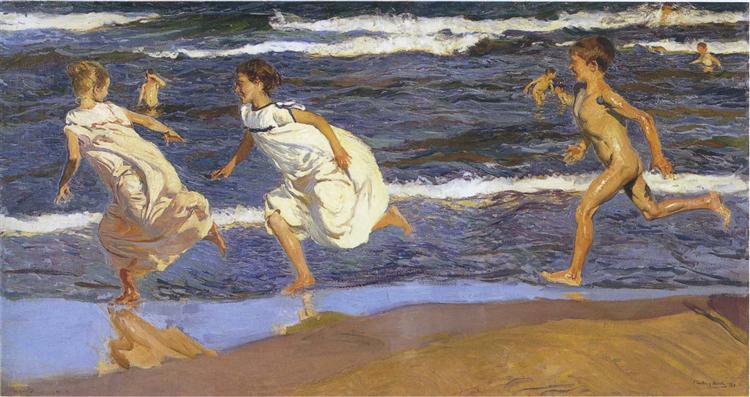
| Running along the beach, Joaquín Sorolla, 1908 Via WikiPaintings |
It was a bright cold day in April, and the clocks were striking thirteen.It seems funny when you first read it. Upon rereading, you realize just how much it says about how wrong things are and how they are codified into common culture.George Orwell, 1984