Wednesday, April 5, 2017

Genesis Notes: Burial and Bargaining

GENESIS 23
When Sarah dies we see Abraham arranging the funeral by buying her final resting place. This takes us back to customs of an earlier age and different culture as the Life Application Study Bible points out.

Burial of Sarah (engraving by Gustave Doré from the 1865 La Sainte Bible)
BURIAL
In Abraham's day, death and burial were steeped in ritual and traditions. Failing to honor a dead person demonstrated the greatest possible lack of respect. An improper burial was the equivalent of a curse. Mourning was an essential part of the death ritual. Friends and relatives let out loud cries for the whole neighborhood to hear. Because there were no funeral homes or undertakers, these same friends and relatives helped prepare the body for burial, which usually took place on the same day because of the warm climate.

BARGAINING
The polite interchange between Abraham and Ephron was typical of bargaining at that time. Ephron graciously offered to give his land to Abraham at no charge; Abraham insisted on paying for it; Ephron politely mentioned the price but said, in effect, that it wasn't important; Abraham paid the 400 shekels of silver. Both men knew what was going on as they went through the bargaining process. If Abraham had accepted the land as a gift when it was offered, he would have insulted Ephron, who then would have rescinded his offer. Many Middle Eastern shopkeepers still follow this ritual with customers.

Four hundred shekels of silver was a high price for the piece of property Abraham bought. The Hittites weren't thrilled about foreigners buying their property, so Abraham had little bargaining leverage ... The custom of the day was to ask double the fair market value of the land, fully expecting the buyer to offer half the stated price.
All quoted material is from Life Application Study Bible." This series first ran in 2004 and 2005. I'm refreshing it as I go. For links to the whole study, go to the Genesis Index. For more about the resources used, go here.

Tuesday, April 4, 2017

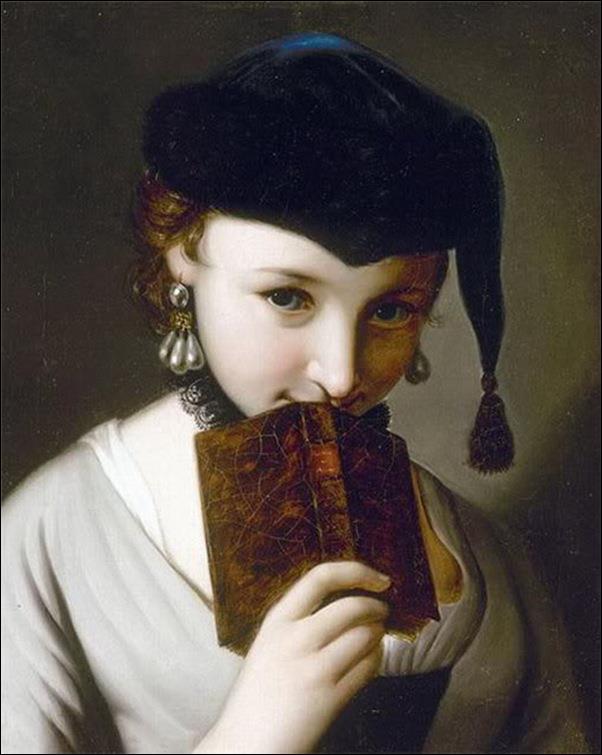
Worth a Thousand Words: Girl with a Book

Pietro Rotari, Girl with a Book
via Arts and Everyday Living

Lagniappe: The roaring wave of fear that swept through the greatest city in the world

So you understand the roaring wave of fear that swept through the greatest city in the world just as Monday was dawning--the stream of flight rising swiftly to a torrent, lashing in a foaming tumult round the railway stations, banked up into a horrible struggle about the shipping in the Thames, and hurrying by every available channel northward and eastward. By ten o'clock the police organisation, and by midday even the railway organisations, were losing coherency, losing shape and efficiency, guttering, softening, running at last in that swift liquefaction of the social body.
H.G. Wells, The War of the Worlds
One of the things that's hitting me this time through the book is just what a talented writer Wells was, not only in his plots but in his craft. Who among us having gotten caught up in a modern exodus from an oncoming disaster has not experienced just what he describes? Albeit without the thoughtful appreciation and imagery of the above.

Monday, April 3, 2017

Worth a Thousand Words: Mute Swan

Mute Swan
taken by Remo Savisaar

Well Said: Jesus is the "very imprint" of the Father

Healy here comments upon Hebrews 1:3 which tells us that "Christ is "the very imprint of [God's] being."
The word for "very imprint" in Greek is charakter, which refers to the impression that a stamp or seal makes on a soft surface. In the ancient world coins were made by stamping hot metal with a die on which a portrait had been engraved; the coin would bear the exact impression (charakter) of the die. The Son, then, is the exact representation of the Father. To see Jesus is to see exactly what God is like (see John 14:9; Col 1:15). In the fullest sense of the term, Jesus has the "character" of his Father.
Mary Healy, Hebrews (Catholic Commentary on Sacred Scripture)

Friday, March 31, 2017

Worth a Thousand Words: Portrait of a Woman

Portrait of a Woman (c.1520). Quentin Metsys
via Books and Art
What I like about this is that she's looking out of the portrait at something in our world. That amuses me. And that she stopped reading her devotional to do it. That is just like me. Easily distracted.

Well Said: God speaking

The theme of God speaking will run like a thread through Hebrews. When introducing biblical quotations, instead of saying "it is written," Hebrews will invariably use phrases like "God says" or "he has promised." Scripture is not confined to the dusty pages of ancient manuscripts; it is a living and active word through which God continues to speak, addressing his people personally her and now (see 3:7, 4:12).
Mary Healy, Hebrews (Catholic Commentary on Sacred Scripture)

Thursday, March 30, 2017

Worth a Thousand Words: Sink at the Old Mill Inn

Sink at the Old Mill Inn
by Belinda Del Pesco

Well Said: Changed from within

Hebrews affirms that by Christ's passion those who share in him have been changed from within (10:22), radically and permanently. This means that the Christian life does not consist in acquiring a holiness we do not have, but rather in appropriating and more deeply living the holiness we have already been given (10:10). So we are invited to a relationship with God that is filled with confident hope and free from the burden of guilt and sin. Our whole life is qualified to be a priestly life, in which all our actions and sufferings are offered as "a sacrifice of praise" that is pleasing to God (13:15-16).
Mary Healy, Hebrews (Catholic Commentary on Sacred Scripture)

New Independent Bookstore for Dallas - Interabang Books

I've never forgotten Taylor Books, a full service independent bookstore chain in Dallas that predated Bookstop, Borders, and Barnes and Noble. Those big box stores killed Taylors and now that most of them are gone (with Barnes and Noble mostly selling games and other non-book items), I have longed for a decent bookstore in which to browse.

I was recently reading about several specialty independent bookstores, all of whom are quirky and none of whom cater to my quirks (mystery, science fiction, and so forth). Looking around I was thrilled to see that Interabang is supposed to open in May at Preston and Royal - run by someone who  began his career at Taylor Books. Talk about coming full circle.

I can't wait!

American the Last Best Hope: From a World at War to the Triumph of Freedom 1914-1989 by William J. Bennett

From a World at War to the Triumph of Freedom 1914-1989 (America: The Last Best Hope #2)America The Last Best Hope:
From a World at War to the Triumph of Freedom 1914-1989
by William J. Bennett

I've been reading this book very slowly, dipping in whenever current events makes the world seem chaotic and uncertain. So that's been a lot lately.

The great thing about history is that it reminds us there have always been chaotic, uncertain times and that we've endured, we've come out ok in the end. William Bennett's volumes on American history are even handed, easy to understand, and yet comprehensive. I came out understanding better those figures who I'd previously disliked, and in some cases even having a certain new respect for them. Those who I already liked were shown to me "warts and all" so I had a greater understanding of their complexity as people and leaders.

This history ends with Ronald Reagan and I was reminded that he was viewed in much the same way as Donald Trump is now. That is not to say Reagan and Trump are the same but our reactions as a people were surprisingly similar in their strength and alarm. That in itself was a good bit of context. The "olden days" are calm and easy to take only because we weren't the ones living then.

Highly recommended.
And yet we are a resilient people, caretakers of a blessed nation. It has become a commonplace that we always rise to the occasion in this country. That is still true. And we surprise ourselves, never knowing with exact certainty from whence our next leader or hero will come—good reason to respect and defend one another as Americans, as fellow countrymen dedicated to a great proposition.

Allow me a few simple illustrations. If you were sitting in a saloon in 1860, and someone told you that while he did not know who would win that year's presidential election, the next elected president after him was right then a little known leather tanner in Galena, Illinois, he would be laughed out of the saloon. But then came Ulysses S. Grant. If you were sitting at Franklin D. Roosevelt's inauguration, in 1933, and someone told you the next president was a little-known judge in Jackson County, Missouri, he would have been made to look the fool. But then came Harry S. Truman. If you were a political consultant in California in 1950 watching the bitter Senate race between Richard Nixon and Helen Gahagan Douglas (where Nixon labeled Douglas "the pink lady"), and you said that actor Ronald Reagan (who was then campaigning for Douglas) would someday be a Republican president and would crush the Soviet Union, your career would have been over.

Wednesday, March 29, 2017

Genesis Notes: The Test

GENESIS 22
Now we come to the most famous incident in Abraham's story. God tells him to take his beloved only son, Isaac, and sacrifice him. No one ever really understands this until they become a parent but it is enough to strike horror into anyone's heart if they stop and visualize the scene. What really brought home the obedience required by all involved was when I realized that in order to carry the wood for his father, Isaac also knew exactly what was going on when he was told to lie on the altar. What a test of faith for everyone.

This whole scene was recently put into clearer context for me. At the time, child sacrifice was nothing new. Many "gods" demanded it and there is ample archaeological evidence for the fact that thousands of children were sacrificed, usually when they were at least 3 or 4 years old so that the gift was more valuable — they'd made it past infancy. This whole story adds a bit of perspective to Abraham and Isaac's seeming calm. It doesn't mean that they weren't feeling the horror, but it was an understandable demand.

The unbelievable part for them — the amazing blessing — was when God used it to show exactly who He was. How amazing and new this would have seemed to Abraham and Isaac. He is not a God who demands that sacrifice of us. He himself will provide the sacrifice, both of the ram and, later, of his own son.

Abraham and Isaac, Rembrandt, 1634


An interesting bit of factual information about the place where Abraham offered Isaac.
[Note: " Mount Moriah is the place where Solomon (king of Israel in about 950 B.C.) set about building the house of the Lord, the temple that contained the Holy of Holies. Mount Moriah wasn't out in a remote desert; it was located where the city of Salem was situated in Abraham's day, which later became known as Jerusalem (see Ps. 76:1-3). Why the name change? An old rabbinic tradition attributes it to Abraham, based on what he said after sacrificing the ram: 'Abraham called the name of that place, 'The Lord will provide'; as it is said to this day, 'On the mount of the Lord it shall be provided (Gn 22:14). The Hebrew word for 'provide' is jira, which was then prefixed to Salem, thus making Jeru-salem." (A Father Who Keeps His Promises, by Scott Hahn; Ann Abor, MI: Servant Publications, 1998; p. 108)]

Abraham's test brings up the question that we frequently ask and seem to find no answer for ... why are we tested at all?
The test that God gives Abraham is so severe that it presumes an advanced level of knowledge and experience of Him. Compare it to the relatively simple test that God first put Abraham through, back in Gen. 12:1-4. There it was simply, "Pack up and go." Here, at least thirty years later, the test is staggeringly difficult. It builds on everything that has gone before in Abraham's life. For Abraham to endure the test, he will have to act on all that he knows about God, and he will have to be willing to mortify even the smallest weaknesses and imperfections yet remaining in his character.

This is what we call "purification." It is the final step in Abraham's life that establishes him as the Father of faith, both for Jews and Gentiles (Rom. 4:11-12). His obedience burned away the dross of even relatively minor imperfections. Interestingly, the test of Abraham gives us a dramatic demonstration of why God tests men in the first place. Men must freely choose to lay down their own wills in order to serve God. When they do this, they are conformed to the likeness of God. They participate in self-donation, which is the essence of the life of the Blessed Trinity. Abraham not only obeys God, but he becomes a living example of the character of God; he is a human being who reflects both the image and likeness of God. As the Catechism says, "As a final stage in the purification of his faith, Abraham, 'who had received the promises,' is asked to sacrifice the son God had given him...And so the father of believers is conformed to the likeness of the Father who will not spare his own Son, but will deliver him up for us all." (2572)
All quotes from Genesis, Part II: God and His Family. This series first ran in 2004 and 2005. I'm refreshing it as I go. For links to the whole study, go to the Genesis Index. For more about the resources used, go here.

Tuesday, March 28, 2017

Lagnappe: Cup of Joe

[Secretary of the Navy Joesphus] Daniels's only enduring contribution to the U.S. Navy was to abolish the rum ration in favor of free coffee. FDR supported this reform. To this day, navy chief petty officers call their coffee "a cup of Joe" for Josephus.
William J. Bennett, America: The Last Best Hope, vol. II
I had no idea. Now I'm going to enjoy that using that phrase even more. And I use it a lot.

I Join Jenny on the Reading Envy podcast to discuss: Slowing Down and Rereading


I join Jenny Colvin at the Reading Envy pub, where we talk about rereading, slowing down to appreciate an author's craft, and the best spy adventure the Vatican has ever seen! We also talk about good books we've read lately.

Check it out.

Friday, March 24, 2017

Worth a Thousand Words: Summertime

Summertime, Edward Hopper
via WikiArt, Fair Use

Lagniappe: A highly professional cat

Hamoudi explains soothingly that all will soon be well. The holes in the bedroom are being stopped up with plaster. More whitewash will be applied. Moreover, a cat is coming; it has been loaned out. It is a super-cat—a highly professional cat. ...

Our cat arrives at dinner-time. I shall never forget that at! It is, as Hamoudi has announced, a highly professional cat. It knows the job for which it has been engaged, and proceeds to get on with it in a truly specialized manner.

Whilst we dine, it crouches in ambush behind a packing case. When we talk, or move, or make too much noise, it gives us an impatient look.

"I must request of you," the look says, "to be quiet. How can I get on with the job without co-operation?"

So fierce is the cat's expression that we obey at once, speak in whispers, and eat with as little clinking of plates and glasses as possible.

Five times during the meal a mouse emerges and runs across the floor, and five times our cat springs. The sequel is immediate. There is no Western dallying, no playing with the victim. The cat simply bites off the mouse's head, crunches it up, and proceeds to the rest of the body! It is rather horrible and completely businesslike.

The cat stays with us five days. After those five days no mice appear. The cat then leaves us, and th emice never come back. I have never known before or since such a professional cat. It had no interest in us, it never demanded milk or a share of our food. It was cold, scientific, and impersonal. A very accomplished cat!
Agatha Christie, Come Tell Me How You Live

My New Book — Seeking Jesus in Everyday Life

COMING IN EARLY APRIL!


Seeking Jesus in Everyday Life

Prayers and Reflections for Getting Closer

This book is for the beginner and for those beginning again —
to bring us closer to Jesus, which is every Christian’s greatest desire.
Each page gently leads the reader to open up and encounter Christ in their own way —
using scripture and inspirational quotes, reflection, brief commentary, and prayer.
Foster a daily habit of prayer and reflection that will continue
long after you come to the end of this book.

Advance Praise
I’m getting a copy for every member of my RCIA class. 
— William H. Duquette —
If you want to be a happy Catholic, you need to encounter Jesus.
And if you want to encounter Jesus, read this book.
— Brandon Vogt —
This book is a joyful pilgrimage to the Father,
made with the most amazing companions, from Ambrose of Milan
to Marshall McLuhan. Highly recommended.
— Mike Aquilina —

Thursday, March 23, 2017

Lagniappe: "A little extra money is always welcome"

Soundings must be made at all three mounds. We make a start with Tell Mozan. There is a village there, and with Hamoudi as ambassador we try and obtain workmen. The men are doubtful and suspicious.

"We do not need money," they say. "It has been a good harvest."

For this is a simple, and, I think, consequently a happy part of the world. Food is the only consideration. If the harvest is good, you are rich. For the rest of the year there is leisure and plenty, until the time comes to plough and sow once more.

"A little extra money," says Hamoudi, like the serpent of Eden, "is always welcome."

They answer simply: "But what can we buy with it? We have enough food until the harvest comes again."

And here, alas! the eternal Eve plays her part. Astute Hamoudi baits his hook. They can buy ornaments for their wives.

The wives nod their heads. This digging, they say, is a good thing!

Reluctantly the men consider the idea. ...
Agatha Christie, Come Tell Me How You Live

Worth a Thousand Words: Satan of the Sea

Via Pulp Covers