It has been said that each generation must rewrite history in order to understand it. The opposite is true. Moderns rewrite history to make it palatable, not to understand it. Those who edit "history" to popular taste each decade will never understand the past — neither the horrors nor glories of which the human race is equally capable — and for that reason, they will fail to understand themselves.
T.R. Fehrenbach, Lone Star
Monday, April 18, 2016
Well Said: Rewriting History

Worth a Thousand Words: Bluebonnets in the Sunset
 |
| Bluebonnets in the Sunset, San Sabe County, Texas taken by Jason Merlo, Jason Merlo Photography |
There's nothing like ending the day in silence surrounded by the fragrance of bluebonnets as the warm sunset light slowly fades away.
Friday, April 15, 2016

Well Said: In His Great Love, God Challenges All of Us
Maybe some of you will say to me, Saint Paul is often severe in his writings. How can I say he was spreading a message of love? My answer is this. God loves every one of us with a depth and intensity that we can hardly begin to imagine. And he knows us intimately, he knows all our strengths and our faults. Because he loves us so much, he wants to purify us of our faults and build up our virtues so that we can have life in abundance. When he challenges us because something in our lives is displeasing to him, he is not rejecting us, but he is asking us to change and become more perfect. That is what he asked of St. Paul on the road to Damascus. God rejects no one. And the Church rejects no one. Yet in his great love, God challenges all of us to change and become more perfect.
Pope Benedict XVI
Thursday, April 14, 2016

Well Said: True Community is a Fellowship of the Weak
When we dismiss people out of hand because of their apparent woundedness, we stunt their lives by ignoring their gifts, which are often buried in their wounds.Ain't that the truth!
We all are bruised reeds, whether our bruises are visible or not. The compassionate life is the life in which we believe that strength is hidden in weakness and that true community is a fellowship of the weak.
Henri Nouwen
Wednesday, April 13, 2016
Must See TV: Papal Pilgrimage in the Holy Land

My friend Diana von Glahn, The Faithful Traveler, needs no introduction to the many who have enjoyed her DVDs and series: The Faithful Traveler in the Holy Land. For those who haven't seen her videos on U.S. shrines or the Holy Land, you're missing a real treat. Diana is personable, joyful, and devout (without being corny ... ok, sometimes she's corny but it works!). You get a full dose of the faith in the actual place it happened plus a way to relate to it wherever you are.
(Some day I am going to get to meet her in person and that is going to be a very joyful day. We almost got to go the Holy Land together and I rue the day I discovered that little dream was not going to happen. However, I have talked to her on the phone and she is just as genuine in person as on TV.)
Now we've got a real treat in store during May. The Faithful Traveler looks at Papal Pilgrimage in the Holy Land, in a 3-part series.
It will show on CatholicTV, EWTN, Salt + Light, and a few other networks. Check the schedule here.This 3-episode special explores the important history behind Papal pilgrimages to the Holy Land, including the background behind Pope Paul VI’s meeting with Patriarch Athenagoras in 1964, and the significance of the meeting of Pope Francis and Patriarch Bartholomew in 2014.

Well Said: After reading a new book ...
It is a good rule, after reading a new book, never to allow yourself another new one till you have read an old one in between. If that is too much for you, you should at least read one old one to every three new ones. Every age has its own outlook. It is especially good at seeing certain truths and specially liable to make certain mistakes. We all, therefore, need the books that will correct the characteristic mistakes of our own period. And that means the old books ... Not, of course, that there is any magic about the past. People were no cleverer then than they are now; they made as many mistakes as we. But not the same mistakes. They will not flatter us in the errors we are already committing; and their own errors, being now open and palpable, will not endanger us.
C.S. Lewis, “On the reading of old books,” God in the Dock
via Semicolon
Reading the Bible in Chronological Order
How sweet are your words to my taste! Yes, sweeter than honey to my mouth!
Psalm 119:103

However, what I did begin thinking about was the idea of reading the Bible chronologically. I'd like to read salvation history as it unrolls through time — not in the order it was written, but in the order it happened. And it would definitely be interesting to read Isaiah, Jeremiah and the other prophets within the historical timeline.
There are a variety of plans out there, but the one that fit the bill for me was from the Catholic Commentary on Sacred Scripture. You may recall I love their commentaries and when I saw how their plan interspersed parts of Isaiah throughout the historical books, I could see we were on the same page.
They have a 3-column, 365-day Bible reading plan formatted in legal and letter sized pdfs. Perfect! Here's a bit of their thinking, but they lay out all their rationale at the reading plan link.
For the most part, the Old Testament narrative and prophecy readings present the biblical books in the order of the story they tell (not the same as the order in which they were written). This chronological order is particularly helpful in understanding where the prophets and various narrative works fit in the history of Israel. A significant exception to this chronological presentation is the placement of 1-2 Chronicles (which cover the same period as the books of Samuel and Kings) near to when they were written near the end of the OT period, in order to lessen the experience of repetition.I'm going to read from beginning to end, as I said, placing the gospels in their chronological order for when they were written. (Hey it wouldn't be me if I didn't inject my own thinking, would it?)
A similar approach is taken to the third column that contains the books of the NT. These readings begin with the Gospel of Luke and Acts to provide a narrative framework for the whole. The other three Gospels are interspersed among the remaining New Testament books to allow readers to return to reflect on the life of Christ throughout the year. Then come the letters of Paul arranged in approximate chronological order, Hebrews, the epistles of James, Peter, John, and Jude, concluding with the book of Revelation.
I'm interested to read the New Testament, when I get to it, in the order that the first Christians did, as letters circulating through churches with gospels popping up later on. Anyway, I have the Church's daily Mass readings for a daily dose of gospel.
So I've begun with Genesis and the Psalms. A couple of chapters of Genesis start my day, while I'm feeding the dogs, and a psalm is the midday punctuation.
I like the idea of the wisdom books accompanying the historical books. In my particular case, Genesis is one of my all-time favorite books and I've always struggled with the Psalms, though wanting to read them has been a goal for a long time. So this is the perfect pairing to begin.
Tuesday, April 12, 2016
If the moon were replaced with some of our planets ...
Here's the thing I never thought about — rotation. How many science fiction movie directors have missed a big visual by having interesting moons hang in alien skies, but not having them rotate?
(via Cat Hodge's Facebook page)

Poetry: Old Books
OLD BOOKSby Margaret Widdemer(via Semicolon)
The people up and down the world that talk and laugh and cry,
They’re pleasant when you’re young and gay, and life is all to try,
But when your heart is tired and dumb, your soul has need of ease,
There’s none like the quiet folk who wait in libraries–
The counselors who never change, the friends who never go,
The old books, the dear books that understand and know!
‘Why, this thing was over, child, and that deed was done,’
They say, ‘When Cleopatra died, two thousand years agone,
And this tale was spun for men and that jest was told
When Sappho was a singing-lass and Greece was very old,
And this thought you hide so close was sung along the wind
The day that young Orlando came a-courting Rosalind!’
The foolish thing that hurt you so your lips could never tell,
Your sister out of Babylon she knows its secret well,
The merriment you could not share with any on the earth
Your brother from King Francis’ court he leans to share your mirth,
For all the ways your feet must fare, the roads your heart must go,
The old books, the dear books, they understand and know!
You read your lover’s hid heart plain beneath some dead lad’s lace,
And in a glass from some Greek tomb you see your own wet face,
For they have stripped from out their souls the thing they could not speak
And strung it to a written song that you might come to seek,
And they have lifted out their hearts when they were beating new
And pinned them on a printed page and given them to you.
The people close behind you, all their hearts are dumb and young,
The kindest word they try to say it stumbles on the tongue,
Their hearts are only questing hearts, and though they strive and try,
Their softest touch may hurt you sore, their best word make you cry.
But still through all the years that come and all the dreams that go
The old books, the dear books, they understand and know!
In which we see how to fight like a space pirate.
And how a Talent gets you where you want to go — faster. Episode 300 of Forgotten Classics: Talents Incorporated, chapters 7-8
Monday, April 11, 2016
Lagniappe: Everyone She Didn't Trust
She started drawing up a mental list of everyone she didn't trust, and had to stop immediately. She didn't have all day.
Mick Herron, Dead Lions
Friday, April 8, 2016
Worth a Thousand Words: St. Christopher
 |
| St. Christopher by Daniel Mitsui |
I wanted the image to convey this weight bearing down upon the saint, and this determined much of the surrounding imagery, which represents all of Creation, according to day.Each piece of art is like a visual feast.
I have for some time been fascinated by the account of the six days of Creation given in Genesis, especially the way that God on successive days distinguished and then populated different dimensions. On the first day, by separating day from night, He created a difference of time. On the second, by placing the sky between heaven and earth, He created a vertical order. On the third, by moving the land and the water apart, He created a horizontal order. Over the next three days, this succession (temporal, vertical, horizontal) was repeated, as each dimension was filled with moving things: first, the celestial bodies that mark the days and seasons and years; second, the animals that move vertically (by flying or diving); third, the animals that mover horizontally upon the earth, including Man.
I made sure to include in the picture both day and night, sky and earth, water and land. The sun, moon and stars appear in the sky. Three small birds in the background and three aquatic creatures in the foreground (two eels and one frog) represent the fifth-day animals. The sixth day is represented by Christopher himself, and the seventh (that of God’s rest) by the Christ Child resting on the saint’s shoulders.
Well Said: Why Such Fury Against Religion?
Why is there such a fury against religion now? Because religion is the one reliable force that stands in the way of the power of the strong over the weak.
Peter Hitchins
Pope Francis on Love in the Family
[Cardinal Francis George] said that it is insufficient simply to drop the truth on people and then smugly walk away. Rather, he insisted, you must accompany those you have instructed, committing yourself to helping them integrate the truth that you have shared. I thought of this ... often as I was reading Pope Francis’s apostolic exhortation Amoris Laetitia. If I might make bold to summarize a complex 264-page document, I would say that Pope Francis wants the truths regarding marriage, sexuality, and family to be unambiguously declared, but that he also wants the Church’s ministers to reach out in mercy and compassion to those who struggle to incarnate those truths in their lives.Bishop Robert Barron has a great overview of the Pope's exhortation "The Joy of Love" about love in the family ... which brings together the results of the two Synods on the family convoked by Pope Francis in 2014 and 2015.
Quicker summary, based on reading Bishop Barron's piece — the Pope is Catholic and the Truth, it ain't a-changin'. However, being Pope Francis, which is to say a good Catholic, he also counsels gentle methods to help people come to a knowledge of that truth in a disordered world or relationship.
Will I be reading this? Yes, indeed. Though it's long so it may be a bit before I do.
Here's where you can read or download the pdf.
If you don't want to wade through the pdf, Crux has the document chapter by chapter.
Thursday, April 7, 2016
My Last Dickens' Novel: The Mystery of Edwin Drood
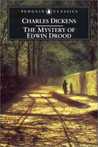 The Mystery of Edwin Drood by Charles Dickens
My rating: 4 of 5 stars
In pursuing my goal of reading all of Dickens' novels, I saved his last book for the very end, mostly because I knew he died when it was half finished. I was afraid it would break my heart not to know what happens. I combined actual reading with listening to the fantastic David Timson narration.
It was interesting that Dickens was telling a single-strand tale. This was probably because he planned to make it half the length of his usual novels. So it was much more like A Christmas Carol than Bleak House.
It was also interesting that we can see who the murderer is but we are left uncertain as to whether the murder was really committed. Is Edwin missing because he's dead or because the murderer was suffering from an opium dream and incompletely carried out the crime? Perhaps Edwin was left unconscious and something else happened.
The one thing we could tell was that the engagement ring would be a key identifier whenever Edwin turned up, whether dead or alive.
Having read the book I then turned to Wikipedia where I found John Foster's account of what Dickens had told him in two letters. Foster was Dickens' lifelong friend and his biographer after he died. I won't spoil it for anyone wanting to read the book fresh but it did make sense and it also made me bitterly regret not having that second half of the book which was to be "a very curious and new idea for my new story. Not a communicable idea (or the interest of the book would be gone), but a very strong one, though difficult to work."
You can also read an account there of the mock trial that was put on to solve the mystery by G.K. Chesterton, George Bernard Shaw and similar literary luminaries. It sounds as if t'was all good fun.
The jury returned a verdict of manslaughter, Shaw stating that it was a compromise on the grounds that there was not enough evidence to convict Jasper but that they did not want to run the risk of being murdered in their beds. Both sides protested and demanded that the jury be discharged. Shaw claimed that the jury would be only too pleased to be discharged. Chesterton ruled that the mystery of Edwin Drood was insoluble and fined everyone, except himself, for contempt of court.
Tuesday, April 5, 2016
Well Said: Crushing Someone
If you do not understand a man you cannot crush him. And if you do understand him, very probably you will not.
G.K. Chesterton
Subscribe to:
Comments (Atom)