Wednesday, July 16, 2014

Children's Books: Angels for Kids by Donna-Marie O'Boyle

Angels for KidsAngels for Kids by Donna-Marie Cooper O'Boyle

My rating: 5 of 5 stars

Artists have painted, drawn, and sculpted Angels in a variety of styles. Angels are many times portrayed as children. This is most likely to convey innocence.

Beginning in about the fourth century, Angels were usually illustrated with wings. That's how we usually see them in books, paintings, on the walls of churches, in icons, or in the art of stained-glass windows. The wings might even be the artist's interpretation of their swiftness. An Angel is able to quickly come to our aid. However, this also has roots in Holy Scripture, since some of the people in both the Old and New Testaments of the Bible describe the angels who appeared to them as having wings.

For instance, we know that Isaiah saw a winged Angel. Ezekiel, too, saw visions of winged Angels. Most times when Angels appear, they look like normal people, always men. Sometimes Angels appear all aglow in awesome splendor. Warrior Angels—like the Archangels—are tremendously tall and powerful.
As you can see from the excerpt, this is a book for older children and might even be good as a quick primer for adults. Donna-Marie O'Boyle has a true talent for explaining the basics about angels, which are a more complex subject than most people might think.

She includes scriptural references, real life stories such as the children at Fatima, and has ways to relate personally to the fact that angels are all around us. The book cover angels in the Bible, their work, what they look like, archangels, fallen angels, a variety of prayers and much more. I also really liked the book design which was simple but beautiful.

I have a special interest in angels myself and consequently have read a number of books about them. This is a really great book that I'm not sure I'll be able to make myself give to the children I know. I might have to buy them their own copy.

Tuesday, July 15, 2014

Well Said: Folk call the road lonely

For myself, the Creek satisfies a thing that had gone hungry and unfed since childhood days. I am often lonely. Who is not? But I should be lonelier in the heart of a city. ... I walk at sunset, east along the road. There are no houses in that direction, except the abandoned one where the wild plums grow, white with bloom in springtime. ...

Folk call the road lonely, because there is not human traffic and human stirring. Because I have walked it so many times and seen such a tumult of life there, it seems to me one of the most populous highways of my acquaintance. I have walked it in ecstasy, and in joy it is beloved. Every pint tree, every gallberry bush, every passion vine, every joree rustling in the underbrush, is vibrant. I have walked it in trouble, and the wind in the trees beside me is easing. I have walked it in despair, and the red of sunset is my own blood dissolving into the night's darkness. For all such things were on earth before us, and will survive after us, and it is given to us to join ourselves with them and to be comforted.
Marjorie Kinnan Rawlings, Cross Creek
Amen.

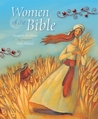
Children's Books: Women of the Bible by Margaret McAllister

Women of the BibleWomen of the Bible by Margaret McAllister

My rating: 5 of 5 stars

"Rescuing animals is only the start of it," said Mother Noah. She scooped up a handful of seeds and placed them carefully in her pocket. "If God wants to send a flood, it's very good of him to ask Noah to put the animals in a boat. But then what do you do with them?"

[...]

But however hard it [work] was, every day brought something good. On day ten the tigers realized that she was a friend and stopped trying to eat her. On day eleven the parrots learned to say, "Move over!" which saved Mother Noah a lot of shouting. On day fifteen the chimpanzees had a very silly half hour with Ham's hat and Mr. Noah's whistle. ...
I have a real antipathy toward things that are yanked out of perspective and told from some "special" point of view, usually to empower some group. I encounter this a lot in feminist perspectives where predictable and myopic points of view bore me to tears.

So you can imagine the shiver that ran down my spine when I saw the title Women of the Bible. I read the first story, Mother Noah, to see how it fit into that feminist construct. And was pleased to see it did no such thing. Furthermore I was delighted to find it humorous, relatable, true to Genesis, and opened up my mental image of life aboard the ark. I continued, enchanted, through stories of Rachel's worry about Jacob's meeting with Esau, Miriam's following her baby brother Moses floating in the river, Mary's four special things kept in a box to sink in her mind the great turning points in her life, and many more.

Each story is told in a different way and from a different perspective. Each is accompanied by truly enchanting illustrations by Alida Massari which made me go looking for other books she's worked on.

Most importantly, each story would make a wonderful story time with your favorite little ones, whether girls or boys. They encourage questions and wonder and "entering into" familiar Bible stories from an imaginative point of view.

Highly recommended.

Monday, July 14, 2014

Well Said: A Star

"In our world," said Eustace, "a star is a huge ball of flaming gas."

"Even in your world, my son, that is not what a star is but only what it is made of."
C.S. Lewis, The Voyage of the Dawn Treader
Yes. There are facts and there is truth.

A Couple of Movies on My Radar: Calvary and Exodus

CALVARY

CALVARY’s Father James (Brendan Gleeson from In Bruges) is a good priest who is faced with sinister and troubling circumstances brought about by a mysterious member of his parish. Although he continues to comfort his own fragile daughter (Kelly Reilly ) and reach out to help members of his church with their various scurrilous moral - and often comic - problems, he feels sinister and troubling forces closing in, and begins to wonder if he will have the courage to face his own personal Calvary. CALVARY opens in select theaters on FRIDAY, AUGUST 1, 2014 (Rated: R; Running Time: 104)
I have a few questions going into Calvary. The priest has a daughter? That can be a legit thing, but my antennae are up.

On the other hand, I'm a sucker for Brendan Gleeson ever since seeing him in In Bruges, hence my agreeing to go to the movie screening where he will be doing the Q&A. Yep, I'm excited!

I also became interested in seeing this after reading that the director said, "There are probably films in development about priests which involve abuse. My remit is to do the opposite of what other people do, and I wanted to make a film about a good priest." I've gotta love that!

More after the screening in a couple of weeks. The trailer is here though I don't think it is that great. I feel as if the description above works just fine.

EXODUS: GODS AND KINGS

It's been a long time since the Ten Commandments, which was made in 1956. I myself really loved The Prince of Egypt from Dreamworks but that was animated.

And then came Ridley Scott with Exodus: Gods and Kings.

Ooo, and Christian Bale as Moses! Now I'm really interested!

Jeffrey Overstreet has some excellent observations and links if you are interested in this upcoming movie. I was vaguely interested. And then I saw the trailer. Wow.

I'm having a hard time dealing with a Pharaoh who isn't Yul Brynner, but other than that it really looks good.

Also, word is that Ridley Scott is interested in doing a movie about King David. About time. Talk about a story that's got everything in it: faith, devotion, insanity, war, love, betrayal, a no-nonsense prophet and more. Real Old Testament stuff, if you know what I mean.

I think I'll get to see a screening of this also when it is closer to release, which should be around Christmas.

Friday, July 11, 2014

Children's Books: "The gospel according to... dog" by Peter D. Ward

The gospel according to... dog: 'the greatest story ever told'... by a dogThe gospel according to... dog: 'the greatest story ever told'... by a dog by Peter D. Ward

My rating: 4 of 5 stars
'Come Lazarus!' I have never heard the Wisest One shout so loudly.

'Come, Lazarus... come out to me!' again he shouted.

The Great Ones [men] all looked at each other uneasily, the smell of fear coming off them as sharp as any skunk. But my ears were pinched back, and I heard what they could not hear: a wondrous thing, a little sigh as gentle as the breeze, and then a scratching, scruffling noise and something being put to one side — the leftover spices, perhaps in a jar being moved? ...

I watched in wonder and could barely keep myself from shouting and dancing and chasing my tail — for in all my days I have never seen anything like this. Suddenly the woman — I realized at once she was the mother of Lazarus — came rushing up and ran straight into the resting-place. There was a shriek of joy and then such weeping it would tear your heart in two if you didn't know it was tears of you that were being wept. ...
Kal is Peter the Fisherman's dog, rescued when he was just a puppy from a group of tormenting boys. He tells us the Gospel story from a canine point of view, including all the senses the we don't notice! Did you know that lepers are delicious to lick and even have a convenient bell to let Kal know they are coming? When Jesus (the Wisest One) heals them it is is a great disappointment because they taste just like regular men again.

Any kid from about the age of 8 who has a basic understanding of the gospel story would enjoy this different view of it. In fact, I enjoyed it quite a bit myself. Kal's different viewpoint will not only open up the gospel but might prompt children to wonder how their pets understand them and the family events unfolding in daily life.

I really loved the way the book graphically conveyed Kal's sense of smell with "Smellavision" dots of different colors strategically scattered on pages to give an extra layer of information. I wasn't crazy about the illustrations which were done in a very child-like style but, again, that is a matter of personal taste and they don't detract from enjoyment of the story itself.

The story has humor, pathos, drama, and many interesting smells! I can definitely recommend this to imaginative readers, whether young or old.

Thursday, July 10, 2014

In which our band of adventurers face their accusers in a public trial.

Will Juanna, Leonard, Otter, and Francisco escape The People of the Mist? Find out at Forgotten Classics podcast where chapters 28-29 are ready for your enjoyment.

Well Said: Expressing Christ in Our Own Stories

Gandalf and Frodo are not allegorical masks for Christ, as in a strict allegory, nor symbols for some aspect of human condition, as in a loose allegory. They are people in their own right. But because they are almost real people they can, as real people can, express Christ in their own way.

It is part of the Roman Catholic idea of the saints that each mirrors Christ in an individual way, expressing facets of the infinite Personality, which could not all be expressed in one finite life, no matter how great. The historical Christ, for example, was not a philosopher nor a King; but St. Thomas Aquinas and St. Louis of France show us something of what He might have been like if He had been. Thus Gandalf and Frodo, while being very real and very individual, also have something to tell us about Christ.
Richard L. Purtill, Lord of the Elves and Eldils
I like thinking of expressing Christ in my own story. It's a phrase that appeals to me since all our lives are stories. Of course, from our own points of view, each of us is the star of our story. How am I doing at expressing Christ? And how often? All the time or just a little? My answers are my own but they push me for a fuller and better expression.

Wednesday, July 9, 2014

The Caves of Steel by Isaac Asimov

The Caves of Steel (Robot, #1)The Caves of Steel by Isaac Asimov

My rating: 5 of 5 stars

Like most people on the over-populated Earth, New York City police detective Elijah Baley has little love for either the arrogant Spacers or their robotic companions. But when a prominent Spacer is murdered under mysterious circumstances, Baley is ordered to help track down the killer. Then he learned that they had assigned him a partner: R. Daneel Olivaw. Worst of all was that the " R" stood for robot.
I snagged a review audiobook of this from SFFaudio.

I originally read this book when I was a teenager and loved it from the beginning. Isaac Asimov's descriptions of an overpopulated future Earth were de rigueur for science fiction of the time. What gave this story a fresh spin was that it was a bona fide mystery.

Many years later, listening to William Dufris' splendid narration, it still holds up. I still remembered the main points of the mystery and detective Lige Bailey's personality. This left me free to fully appreciate the details of Asimov's imagined future society, complete with spacemen and robots to provide tension and interest.

I'm not sure if I completely forgot or just never registered the points Asimov was making in this book about technology, adaptation, and the human soul. I was quite surprised to see that Lige Bailey knew his Bible so well that he could quote it in either the King James version or the modern version. And that he used religion as a main point of differentiation (along with art, beauty, and other intangibles) between humans and robots. Atheist Isaac Asimov didn't deny that faith can lift people higher and that is something one rarely, if ever, sees these days in science fiction.

I also was really interested in watching the way the germ of an idea took hold and was spread from person to person. It was fascinating to see how many things that idea applied to once it had wormed its way into the person's consciousness.

All in all, this short but satisfying mystery is much richer than I recalled. It was greatly enhanced by the audio where William Dufris became a one man theater company in the way he voiced different characters. There was never any fear of my mistaking who was talking in straight exchanges of dialogue. He was simply masterful whether it was world-weary detective Bailey, slightly robotic Daneel Olivaw, jumpy Jessie, or the nervous Commissioner.

Highly recommended.

INTERESTING SIDE NOTE
Wikipedia notes:
It is a detective story and illustrates an idea Asimov advocated, that science fiction is a flavor that can be applied to any literary genre, rather than a limited genre itself. Specifically, in the book Asimov's Mysteries, he states that he wrote the novel in response to the assertion by editor John W. Campbell that mystery and science fiction were incompatible genres. Campbell had said that the science fiction writer could invent "facts" in his imaginary future that the reader would not know. Asimov countered that there were rules implicit in the art of writing mysteries, and that the clues could be in the plot, even if they were not obvious, or were deliberately obfuscated.
All hail opinionated John Campbell and Isaac Asimov's determination to prove him wrong. Today there are a lot of different mash-ups included in the science fiction genre and Asimov led the way with this book.

Tuesday, July 8, 2014

On the Shoulders of Hobbits: The Road to Virtue with Tolkien and Lewis by Louis Markos

On the Shoulders of Hobbits: The Road to Virtue with Tolkien and LewisOn the Shoulders of Hobbits: The Road to Virtue with Tolkien and Lewis by Louis Markos

My rating: 5 of 5 stars


We need the truth, but we also need to know how to live in and through and by that truth.

What we need, in short, are stories.
Louis Markos begins with the idea that in the past stories weren't only told for children's entertainment and instruction, but for that of adults as well. We've lost not only that idea but a lot of the time-honored values that we used to teach and cherish in such stories. The author "mines" two of the most honored stories in modern times, the Lord of the Rings and, to a lesser extent, The Chronicles of Narnia, to show how they can help us return to classic virtues these days.

Ancient literature, modern culture, and scripture are all woven into Markos' book. The main emphasis is on Tolkien and Lewis, but the depth of material means that it hits you where you live.  Before delving into the virtues, Markos begins with the idea of the hero's journey and the road. These are the heart of good story telling, after all, and so are themes that are returned to repeatedly throughout the book.
In the greater tales, the ones that matter—the ones that change both us and our world—the heroes do not so much choose the Road, as the Road chooses them. For our part, we must be ready, prepared in season and out, to answer the call, whenever and however it comes. And we must be prepared to press on, trusting to an end that we often do not, perhaps cannot, see. It is easy to claim that we would have done what Abraham did, but that is only because we stand outside the story. We see the good end, the fulfillment that Abraham could not see from within the story.
Markos is not detached with his subject at arm's length. He loves these stories and the themes they embrace and his enthusiasm comes through to make a warm, lively reading experience.

I've read several other books looking deeper into The Lord of the Rings, in particular, and this book still managed to provide new ideas for reflection. Markos really does a fantastic job of revealing the characteristics of various characters in Middle-Earth and Narnia and the virtues we can see in them. This is a thoughtful and thought provoking book which I can't recommend highly enough.

I'll be looking for more of Markos' books in the future.

NOTE
I received this review copy from Aquinas and More, the largest on-line Catholic bookstore. They've got a lot more than books. Check them out for all your Catholic needs ... rosaries, communion gifts, and so forth.

I originally wrote this review of On the Shoulders of Hobbits for the free Catholic Book review program, created by Aquinas and More Catholic Goods. I receive free product samples as compensation for writing reviews for Tiber River.

Well Said: Two views about everything

"I suppose there are two views about everything," said Mark.

"Eh? Two views? There are a dozen views about everything until you know the answer. Then there's never ore than one. But it's no affair of mine. Good night."
C.S. Lewis, That Hideous Strength
Ain't that the truth!

What makes this all the more poignant is that this book clearly shows us just how well the enemy is keeping everyone distracted from clear thought, whether by turning them against each other or putting their focus solely on themselves. A tactic that is still used today, from what I observe and what I struggle with myself.

Monday, July 7, 2014

Worth a Thousand Words: Peach-leaved Bellflowers

Peach-leaved Bellflowers
taken by Remo Savisaar
Is this not simply gorgeous? Click through to see it fill the screen in glorious purple.

The Last Policeman at SFFaudio

You may recall that I really loved The Last Policeman by Ben H. Winters. Here I discuss it with the others from the SFFaudio podcast gang.

Yes. I annoy everyone until they read the books I love. Not just you guys. Everyone.

Bibliotheca


You know that I care, very much, about book design.

This project to rethink Bible design in terms of typeface, binding, proportions, and more so that the Bible is an enjoyable reading experience is very exciting.

Well Said: Mostly true

Both the stolen apple [The Magician's Nephew, C.S. Lewis] and the Ring [Lord of the Rings, J.R.R. Tolkien] work: they do give the immortality and power that they promise, just as the forbidden fruit in Genesis 3 does open the eyes of Adam and Eve to the knowledge of good and evil. The lie does not lurk in the primary promise of life-strength-wisdom, but in the accompanying, deceptive promise that these things, once achieved, will make one into a god: eternal, omnipotent, omniscient. The lie rests in the false promise that the life it gives will be a life worth living, the strength a strength worth wielding, the wisdom a wisdom worth possessing.
Louis Markos
On the Shoulders of Hobbits
It's always just that little twist when evil tells us lies. Mostly true is the key to a good lie, after all. Unfortunately that "mostly" is a long way to fall from real truth. And we are always sorry.

Pilgrimage Reading: Grandma's on the Camino by Mary Wyman

Grandma's on the Camino: Reflections on a 48-Day Walking Pilgrimage to SantiagoGrandma's on the Camino: Reflections on a 48-Day Walking Pilgrimage to Santiago by Mary O'Hara Wyman

My rating: 3 of 5 stars

Mary Wyman has an entry for each day of her solo walk to Santiago. Each includes the daily postcard she sent to 4-year-old granddaughter Elena, a journal entry from that day, and a longer reflection from after the pilgrimage was completed. I really enjoyed the format, especially the ways that Wyman connected with her granddaughter in the cards by asking questions or suggesting little activities like "count to 36 out loud with Mama to see how many days Grandma has left to walk the Camino (paraphrased)."

I found a lot of the book fascinating and almost feel as if I'd been along for the trip. Certainly I was just about as concerned as Mary that she get to lodgings in time for a lower bunk and that her feet would hold out. Mary's vivid descriptions of the people and nature all around her, as well as her inclusion of insights and spiritual experiences all combined to make this a very good book.

It isn't a perfect book though. As a 70-year old woman from San Francisco, Mary has all the stereotypical attitudes of that demographic. Push the right button and the standard liberal attitude comes popping right up. Luckily it was rare enough to avoid ruining the book for those of us who don't share those attitudes. In fact, it often provided humorous moments such as one day's reflections on the huge list of women who have influenced her life, when contrasted with a later day when she struggled to make a list of 15 influential men in her life because it never occurred to her to think of such a thing. She later added to that list but with so many qualifications that she may as well not have bothered. I actually laughed out loud.

More problematic were the two or three times she recorded long conversations about topics dear to her heart and went into so much detail that the book essentially ground to a halt. I realize that this book is to provide a legacy for Wyman's granddaughter, so it made sense from her point of view to write so many pages about such things as Centering Prayer and the Jobs Corps. However, the tone completely changed to a preachy-teachy style that is deadly unless one also is passionate about those topics. I ain't.

I mention the imperfections to explain my 3-star rating. As a whole, they are relatively slight as witnessed by the fact that I read this book in a couple of days, riveted to the pilgrimage.

Thursday, July 3, 2014

Worth a Thousand Words: At the Bar

At the Bar
by Edward B. Gordon
Another wonderful slice of life from one of my favorite artists.

Julie loves 1920's Paris, especially at midnight. But she's not sure she can give up air conditioning. Scott wonders if Hemingway will still read his rough draft if he refuses to fight him.

It's midnight and we're in Paris at A Good Story is Hard to Find podcast. I'm really surprised that it has taken us this long to discuss a Woody Allen movie. Join us for Midnight in Paris.

Respecting Conscience: The Right to Be Wrong by Kevin Seamus Hasson

I'm rereading this as a palliative to the brouhaha over the Supreme Court's decision to uphold religious conscience for the Hobby Lobby case. Pilgrims. Park Rangers. Both drive me nuts. This book is a good reminder that there is another way than always screaming at each other about extreme opposites.

Speaking of the Hobby Lobby case, you can get the straight scoop on what's true and what's false in news coverage from GetReligion. I hadn't realized they were represented by The Becket Fund for Religious Liberty but that makes this book even more appropriate since the author founded that organization.

This review originally ran in 2005 at Spero News.


It seems as if our country is caught up in an endless religious war that is being fought with grim determination. No, this isn’t about the war on terror. It is about the annual battle over public nativity scenes at Christmas, the skirmishes over allowing school Halloween parties, whether Jews for Jesus are allowed to preach at the Los Angeles Airport, and much more. In short, it is about how much and what sort of religious freedom is granted in this country.

One side (dubbed “Pilgrims” in the book) wants to legally coerce any religious conscience with which they disagree while the other side (called “Park Rangers”) thinks that all religion must be purely private. Both seem prepared to battle to the death over these issues. The rest of us, that vast majority in the middle, duck and cover as best we can while wondering why we must always fight every detail of anything to do with religion. After all, it didn’t used to be this way. Did it?

Actually, it used to be much worse, as Kevin Hasson tells us in The Right to Be Wrong. He is a constitutional lawyer who now heads up a non-partisan, public-interest law firm that specializes in defending free religious expression for all faiths. Hasson asserts, “We defend all faiths but we are not relativists. On any given day, I think most of my clients are wrong. But I firmly believe that, in an important sense, they have the right to be wrong.” This is not a very long book and it is written in a conversational and easy style, but it packs a heavy punch.

Hasson cuts to the heart of the issue by turning our focus to conscience, that interior voice that won’t be still until we do the right thing. The core of any discussion about religion, according to Hasson, is that we recognize the inherent right of each person to follow his or her conscience just as we would wish them to allow us to follow ours.
Conscience won’t let us be satisfied with resting on the truth we already know, the good we already embrace. There is an unease we experience, an unease that pushes us on to seek ever-deeper truths and choose ever-better goods. Sometimes we ignore it; sometimes we try to suppress it. Conscience, however, demands that we attend to it and miss no opportunity to try to satisfy it. Conscience is forever insisting that we look here, or search there, or try this or that in our quest for the true and the good.

And then conscience still isn’t content. It won’t stand for the argument that searching alone should suffice. Conscience demands not only that we seek but that we embrace the truth we believe we’ve found. It insists that, at whatever cost, our convictions follow through into action. And it’s famously stubborn about this, sending generation after generation of dissidents to all sorts of deprivations in the name of integrity...
In the process of proving this point, Hasson takes the reader on a journey through the history of American religious liberty. We soon discover that there was precious little to be had before modern times. The Pilgrims, whose vaunted quest for tolerance landed them on American shores, quite knowingly practiced a double standard and forcefully suppressed any opposing opinions. We are shown why Roger Williams founded Maryland in order to practice true religious tolerance only to have the laws changed after he died. Similarly William Penn’s vision of religious liberty was soon practiced in quite a different way after his influence waned. James Madison emerges as a man who had a surprisingly accurate vision of religious liberty and, possibly, the influence to get the proper laws passed. It is all the more disappointing, then, to learn that he let Thomas Jefferson influence him to weaken them. As a result, Quakers, Catholics, and Jews were routinely discriminated against by one state after another. It is safe to say that for most of American history, you were free to practice any religion you liked, as long as you wanted to be Protestant.

This is the legacy that has put us in the position in which we find ourselves today. Without that history of intolerance, there would not be the backlash that insists there is no place at all for religion in public life. One could hardly blame the Park Rangers for insisting on suppressing public displays of religion except that, in their turn, they are so very extreme. Under the guise of religious freedom the Park Rangers have exercised their own form of oppression so effectively that ludicrous displays of celebration can be found everywhere: a public school system in Michigan offers “Breakfast with a Special Bunny” to avoid using the word Easter, another school system requires that the children exchange “special person cards” in lieu of valentines, and an Ohio bureaucrat explained a decorated tree in December by saying it was to celebrate Pearl Harbor Day. This in turn alarms the Pilgrims who push back even harder. Although it is clear to all bystanders that this is really about one side or the other getting their own way, both sides insist they are advocating universal religious freedom. No one on either side is practicing any true tolerance at all, just like the good old days, in fact.
... Ask either faction whether it believes religious liberty is a human right and you’ll get a passionate, tub-thumping — mostly hypocritical — speech in favor of the idea. That’s because religious freedom is so familiar, so American a concept that nobody can really admit to opposing it. That would be like opposing apple pie. So even those who are at each other’s throats over religious liberty have to insist they all absolutely love the stuff. Instead of confessing that they’re actually opposed to religious freedom for all, the Pilgrims and the Park Rangers among us equivocate. When they say they support “religious freedom,” the Pilgrims mean the freedom of their religion, while the Park Rangers mean freedom from others’ religions. That way, they can all sound so very American — they can say they’re in favor of something called religious freedom — and still be as oppressive as they want to be.
However, that is where Hasson’s insistence on the value of conscience is so valuable. By reminding us that conscience is the core of religious conviction, he takes us to the true turning point of religious liberty. This in turn frees us to totally disagree with another’s religious convictions while, with complete integrity, conceding that they do, indeed, have the right to be wrong. It is this attitude that allows Hasson to be in the position of being both invited to Hasidic Jewish weddings and also to be a guest speaker on the Arab network Al-Jazeera. His respect of the integrity of others’ consciences has earned him their respect in turn. That is the attitude that will help dig America out of our internal religious wars and just possibly bring us, at long last, true religious liberty.

God's own admiration

From my quote journal.
One cannot help noting God's own admiration for the beauty of the craftsman, the farmer, the fisherman, because in a most fitting way those occupations reflect God's own being and manner of acting. After all, Jesus himself, by this call and election of Peter and Andrew, exhibits himself to be the primordial "Fisher of Men." This act of Christ's, like all his acts, manifests something essential of the being of God. God is fisherman by nature, we might say, and entrapping fish out of a lake is a visible reflection of the manner in which God eternally attracts beings to himself...

... The strategy of "entrapment" is given to us where we least expect it: we may be looking at the fish in the lake, but Jesus is looking at Peter and Andrew by the lake. The immediacy with which they are "caught" reveals the simplicity and awesomeness of the ruse. Beaming from the face of Christ, the voice and the glance of God have made themselves perceptible to human eyes and ears. Just as surely as these can see and hear the splashing of the water on the shore can they behold the glory of God in the man addressing them. And they are magnetized. Their own strategy in "catching" man will simply be an extension through the person of their own encounter with Jesus.
Erasmo Leiva-Merikakis, Fire of Mercy, Heart of the Word, vol. 1