Somehow it slipped right by me that Jeff Vehige was now podcasting. I really like reading him and am looking forward to listening ... just the thing for my early morning "prayer walks." Hey, I can't pray the entire time ...
The blog posts evidently support the podcast information though you need not have listened to get plenty from the posts.
You can subscribe here
Via Scott Danielson at Rivets and Trees who I bet was the person asking for subscription methods. If so, well done, sir!
Tuesday, October 7, 2008

Why is the Pope Reading the Bible in Italian on TV?
Because if he read from the New American Bible in English the American bishops would sue him.
Ok, that's at least partially a joke.
Not that I'm annoyed about the way the bishops treat well-meaning Bible-podcasters or anything. (Yes, they'll actually sic the law on you ... )
But it is pretty cool that they are actually going to read the entire Bible in a marathon on Italian television.
Ok, that's at least partially a joke.
Not that I'm annoyed about the way the bishops treat well-meaning Bible-podcasters or anything. (Yes, they'll actually sic the law on you ... )
But it is pretty cool that they are actually going to read the entire Bible in a marathon on Italian television.
Pope Benedict XVI will kick off a week-long reading of the Bible on Italian television starting Sunday, with readers to include three former presidents and Oscar-winning actor Roberto Benigni.For a more indepth look at why the Bible reading is happening, check out the always reliable Get Religion.
Some 2,000 people will take turns reading the Bible's 73 books, from the Old Testament's Genesis to the New Testament's Book of Revelations, at Rome's Holy Cross in Jerusalem basilica.
The pope will record the first reading at the Vatican.
Teach Your Children Well ... Reviewing "The Fathers" by Pope Benedict XVI
Finally, [St.] Basil was of course also concerned with that chosen portion of the People of God, the youth, society's future. He addressed a Discourse to them on how to benefit from the pagan culture of that time.One of the things that may surprise the reader of this series of homilies given by Pope Benedict XVI is just how much pertinent information can be packed into a short piece. As one flows into the next we are treated to a history of the growing understanding of the revelation of Jesus Christ. We also watch the struggles taken on for the truth, not simply against pagans, but with those who have developed heretical doctrines.
He recognized with great balance and openness that examples of virtue can be found in classical Greek and Latin literature. Such examples of upright living can be helpful to young Christians in search of the truth and the correct way of living.
Therefore, one must take from the texts by classical authors what is suitable and conforms with the truth: thus, with a critical and open approach--it is a question of true and proper "discernment"--young people grow in freedom.
With the famous image of bees that gather from flowers only what they need to make honey, Basil recommends: "Just as bees can take nectar from flowers, unlike other animals which limit themselves to enjoying their scent and color, so also from these writings...once can draw some benefit for the spirit. We must use these books, following in all things the examples of bees. They do not visit every flower without distinction, nor seek to remove all the nectar from the flowers on which they alight, but only draw from them what they need to make honey, and leave the rest. And if we are wise, we will take from those writings what is appropriate for us, and conform to the truth, ignoring the rest."
... Dear brothers and sisters, I think one can say that this Father from long ago also speaks to us and tells us important things.
In the first place, attentive, critical, and creative participation in today's culture.
Then, social responsibility: this is an age in which, in a globalized world, even people who are physically distant are really our neighbors; therefore, friendship with Christ, the God with the human face. ...
Each homily, nicely edited to read as an essay, encapsulates the Father's life history, influences, and career. Pope Benedict then focuses on a key area of influence which that particular Father has had on the faith. Most importantly, he shows just how significant this influence can be to modern society and to each of us personally if we reflect upon it. I was reminded of just how little human nature has changed over time as I repeatedly felt the applicability of these teachings to our lives today.
As wall, we are reminded that none of us is perfect and these Church Fathers are noting if not human. Pope Benedict is not shy about pointing out a person's failings, though he always does so with charity and in order to emphasize a topic for our personal reflection.
An interesting item to note is that every single Father strongly emphasizes prayer. Each has his own particular focus or style, but the constant refrain from person to person serves as a strong reminder to us that this is a vital area where we must persevere in order to come into a good and loving relationship with God.
Notwithstanding all the theological richness of his [Origen's] thought, his is never a purely academic approach; it is always founded on the experience of prayer, of contact with God. Indeed, to his mind, knowledge of the Scriptures requires prayer and intimacy with Christ even more than study.It is a pleasure to see that Pope Benedict doesn't just include the better known Fathers, although he does go into extra depth for some of them such as St. Basil, St. John Chrysostom, and St. Augustine. He takes care to highlight the richness of the Eastern Church by including such lesser known Fathers as Aphraates "The Sage" and St. Ephrem, the Syrian.
He was convinced that the best way to become acquainted with God is through love, and that there is no authentic scientia Christi without falling in love with him.
In his Letter to Gregory, Origen recommends: "Study first of all the lectio of the divine Scriptures. Study them, I say. for we need to study the divine writings deeply... and while you study these divine works with a believing and God-pleasing intention, knock at that which is closed in them and it shall be opened to you by the porter of whom Jesus says, 'To him the gatekeeper opens.'
"While you attend to this lectio divina, seek aright and with unwavering faith in God the hidden sense which is present in most passages of the divine Scriptures. And do not be content with knocking and seeking, for what is absolutely necessary for understanding divine things is oratio, and in urging us to this the Savior says not only 'knock and it will be opened to you,' and 'seek and you will find,' but also 'ask and it will be given you.'"
The "primordial role" played by Origen in the history of lectio divina instantly flashes before one's eyes. Bishop Ambrose of Milan, who learned from Origen's works to interpret the Scriptures, later introduced them into the West to hand them on to Augustine and to the monastic tradition that followed.
It says much for Pope Benedict's abilities that he was able to synthesize such a vast amount of information about the Fathers the history of the Church, and the application of their teachings to modern life in general and our own lives in particular. What a gift this collection is for those who read it thoughtfully. Each of the essays is fairly short so that they could easily be made part of a daily devotional reading if desired. As well, this book is a nice companion volume to The Apostles, a previous collection of Pope Benedict's homilies.
Highly recommended.
This review was written as part of The Catholic Company product reviewer program. Visit The Catholic Company to find more information on The Fathers by Pope Benedict XVI.

Monday, October 6, 2008
Worth a Thousand Words
 Alchemist's Laboratory IN: 'Amphitheatrum Sapientiae Aeternae' by Heinrich Khunrath, 1595.
From BibliOdyssey where there is a whole gaggle of Alchemy Laboratories on display.
Personally, this just screams steampunk to my mind. But it's the real thing ... from way before the steam, much less the punk!
Saturday, October 4, 2008
Weekend Joke
Via Coffee Klatch.
New Dog Breeds
The following breeds are now recognized by the AKC:
Collie + Lhasa Apso = Collapso, a dog that folds up easy for transporting
Spitz + Chow Chow = Spitz-Chow, a dog that throws up a lot
Pointer + Setter = Poinsetter, a traditional Christmas pet
Great Pyrenees + Dachshund = Pyradachs, a puzzling breed
Pekingnese + Lhasa Apso = Peekasso, an abstract dog
Irish Water Spaniel + English Springer Spaniel = Irish Springer, a dog fresh and clean as a whistle
Newfoundland + Basset Hound = Newfound Asset Hound, a dog for financial advisers
Terrier + Bulldog = Terribull, a dog that makes awful mistakes
Bloodhound + Labrador = Blabador, not a popular dog with CIA agents
Malamute + Pointer = Moot Point, owned by… oh, well, it doesn’t matter anyway
Collie + Malamute = Commute, a dog that travels to work
Deerhound + Terrier = Derriere, a dog that’s true to the end
Friday, October 3, 2008
Worth a Thousand Words
 Red Barn on a Mountain Farm taken by D.L. Ennis at Visual Thoughts
I know he is in Virginia but this really reminds me of driving the back roads in the Ozarks.
Thursday, October 2, 2008
Looking Both Ways

You Know You're a Republican If ...
You want to increase the U.S. military budget,
especially for the base in your congressional district.
You Know You're a Democrat If ...
You want to slash the U.S. military budget,
as long as they don't touch the base in your congressional district.
You want to increase the U.S. military budget,
especially for the base in your congressional district.
You Know You're a Democrat If ...
You want to slash the U.S. military budget,
as long as they don't touch the base in your congressional district.
Wednesday, October 1, 2008
Goodbye Dallas Morning News.
Make Room for the Wall Street Journal.
I remember the good old days. The days when we had two newspapers in Dallas. Our choice was The Dallas Times Herald.
The one that went under.
Naturally.
Now, this was over twenty years ago. We adapted. We have read The Dallas Morning News every single morning for that entire time.
However, in the last year or so there have been more troubling changes than the usual ones that we see complained about by everyone in general when griping about media.
Correct me if I'm wrong, but the reason to take a local newspaper is for the local coverage by professionals that we can trust.
For the last few months I'd begun wondering about canceling the newspaper. But what would we read when we got up in the morning? A book wasn't going to cut it. So I didn't say anything.
Then, a couple of days ago, Tom's blood boiled. In a size and starkness that would do a terrorist attack proud, the headline read, "$1 Trillion Lost!"
He said, "If I can't get some reasonable reporting from the newspaper then why am I reading it? I can get this kind of alarmism without any real facts from any television station in town."
Over dinner last night we began talking about what rag that the DMN has become. Tom put it down to the fact that newspapers felt the pressure to compete with blogs. My point, which I'd made in writing to the newspaper over a year ago, was that the way to compete is to become better. Not to put your most interesting coverage on the blog and just reference it in print. (Another gripe, can you tell?)
We began pondering alternatives. National newspapers? I'd rather die than take the NY Times. If my news came ladled out with their giant doses of opinion I could count on having a heart attack some morning.
Then we thought of the Wall Street Journal.
Yes.
Business and national ... and, as far as we could tell ... less opinion than most news sources.
The true shocker was that when I looked it up, the WSJ was $89 per year. The DMN has been on a credit card draw for some time. They talked of the low, low price of ... $3.29 per week? Wait a minute ... why that's ... that's ... that's $171.08 per YEAR.
Just serve up my heart attack now.
What a sap I've been for not catching that astronomical price.
On the other hand, I'm so excited about getting a new newspaper. 3-5 days to begin delivery ... c'mon, c'mon ... I can't wait to fire the DMN!
The ironic thing is that when The Dallas Morning News guys sit around analyzing sales figures at the end of the year, they are going to blame a bad economy, blogs, the internet, and everything else except the real reason. Their lack of passion and pride in their own product.
UPDATE
Got a letter from the Dallas Morning News yesterday. Silly me, I thought that perhaps they had noticed we canceled our paper and were asking us back. Pffft! No way.
The essence of the thing, which not only shows the depth of their self-delusion in their references to "quality you expect" but also took many paragraphs to get to:
No decision ever looked better.
The one that went under.
Naturally.
Now, this was over twenty years ago. We adapted. We have read The Dallas Morning News every single morning for that entire time.
However, in the last year or so there have been more troubling changes than the usual ones that we see complained about by everyone in general when griping about media.
- Saturday's religion section was abruptly replaced with a story on the front of the Metro section that led to a couple of token listings near the back pages. I woke up every Saturday looking forward to that religion section. That was like a punch in the gut. (Result: Less local coverage.)
- The television reporter was fired. Y'all know how very important my tv is to me! I needed that reporter! He was reliable and a good judge of shows! Luckily, he moved to the internet and I can get my dose of Ed Bark anyway. (Result: Less local coverage.)
- Local movie reporters were cut. We were left with maybe one for the main movie each week. The rest is picked up from syndications around the country. If I wanted to know what someone in LA thought of a movie, I'd read their paper. (Result: Less local coverage.)
- Tom began pointing out to me business stories where very precise terminology was misused. To the point where two words meaning different things were used interchangeably in the same stories. I don't know if the editors and reporters are overworked or simply incompetent. Those aren't stories we can trust. (Result: Untrustworthy local coverage.)
- We started seeing articles from people we knew. These were largely neighborhood event coverage and often the reporters were local mothers we knew through our children's schools. There's nothing wrong with that as long as they can write well. But when the newspaper has fired a lot of the trained reporters and now seems to be filling in with local freelancers ... who can't necessary write the way a reporter would? (Result: Local coverage we don't care about.)
Correct me if I'm wrong, but the reason to take a local newspaper is for the local coverage by professionals that we can trust.
For the last few months I'd begun wondering about canceling the newspaper. But what would we read when we got up in the morning? A book wasn't going to cut it. So I didn't say anything.
Then, a couple of days ago, Tom's blood boiled. In a size and starkness that would do a terrorist attack proud, the headline read, "$1 Trillion Lost!"
He said, "If I can't get some reasonable reporting from the newspaper then why am I reading it? I can get this kind of alarmism without any real facts from any television station in town."
Over dinner last night we began talking about what rag that the DMN has become. Tom put it down to the fact that newspapers felt the pressure to compete with blogs. My point, which I'd made in writing to the newspaper over a year ago, was that the way to compete is to become better. Not to put your most interesting coverage on the blog and just reference it in print. (Another gripe, can you tell?)
We began pondering alternatives. National newspapers? I'd rather die than take the NY Times. If my news came ladled out with their giant doses of opinion I could count on having a heart attack some morning.
Then we thought of the Wall Street Journal.
Yes.
Business and national ... and, as far as we could tell ... less opinion than most news sources.
The true shocker was that when I looked it up, the WSJ was $89 per year. The DMN has been on a credit card draw for some time. They talked of the low, low price of ... $3.29 per week? Wait a minute ... why that's ... that's ... that's $171.08 per YEAR.
Just serve up my heart attack now.
What a sap I've been for not catching that astronomical price.
On the other hand, I'm so excited about getting a new newspaper. 3-5 days to begin delivery ... c'mon, c'mon ... I can't wait to fire the DMN!
The ironic thing is that when The Dallas Morning News guys sit around analyzing sales figures at the end of the year, they are going to blame a bad economy, blogs, the internet, and everything else except the real reason. Their lack of passion and pride in their own product.
UPDATE
Got a letter from the Dallas Morning News yesterday. Silly me, I thought that perhaps they had noticed we canceled our paper and were asking us back. Pffft! No way.
The essence of the thing, which not only shows the depth of their self-delusion in their references to "quality you expect" but also took many paragraphs to get to:
We have taken aggressive steps to offset rising costs and reduce expenses while preserving the quality you expect from The Dallas Morning News and the convenience of home delivery. ...That makes the annual rate for the paper $252.
It is necessary that we increase 7-day subscription prices by $2.00 per month ... from $19.00 to $21.00 per month.
No decision ever looked better.
If You Only See HC Through an RSS Feed ...
... you might want to click through today to see the quote in the sidebar from Pinky and the Brain. It's one of my favorites and certainly speaks to the way that most people feel today, what with upcoming elections and economic crises and all.
Good for Wednesday only ... tomorrow it will change!
Good for Wednesday only ... tomorrow it will change!
A Little Useless Information
It is a very sad thing that nowadays there is so little useless information. -- Oscar Wilde
VERMIN • Although this term now refers to offensive animals of all sizes and kinds, it originally referred to only a single kind of creature, a worm. In Latin, the root was vermis, meaning "worm."The Word Origin Calendar


Tuesday, September 30, 2008
Aye Carumba! That's A Lot of Hits!
Taking a look at the stats from yesterday's angel-fest, I did a double take. The number of hits doubled my all-time high.
Welcome to anybody who comes back by today for a follow-up ... not so many angels, but hopefully there's still a little something interesting going on.
Welcome to anybody who comes back by today for a follow-up ... not so many angels, but hopefully there's still a little something interesting going on.
The Economic Crisis, St. Basil, Aliens, and Greg Farrell's Prediction
Reading The Fathers, a collection of Pope Benedict's homilies about the Church Fathers, I have consistently been struck by how much these of these men's wisdom relates to modern life.
For instance, reading about St. Basil yesterday, this instantly made me think of the economic crisis and the greedy, selfish, thoughtless people whose desire for gain has hurt so many.
Finally, I listened to the Monday morning memo yesterday and it has a fascinating revelation that goes to the point I made when talking about that economic crisis explanation video. This is everybody in Congress's fault. Everybody.
For instance, reading about St. Basil yesterday, this instantly made me think of the economic crisis and the greedy, selfish, thoughtless people whose desire for gain has hurt so many.
In times of famine and disaster, the holy bishop exhorted the faithful with passionate words "not to be more cruel than beasts ... by taking over what people possess in common or by grabbing what belongs to all."Or as Ellen Ripley paraphrases pithily in Aliens (you didn't know that St. Basil was in there, did you?):
I don't know which species is worse. You don't see them f*****g each other over for a goddamn percentage!Ah yes. That about sums it up.
Finally, I listened to the Monday morning memo yesterday and it has a fascinating revelation that goes to the point I made when talking about that economic crisis explanation video. This is everybody in Congress's fault. Everybody.
Greg was America’s only reporter in the courtroom for every minute of the trials of Enron, Worldcom, Tyco and Martha Stewart. As an investigative reporter Greg dug deep, full time, year after year. “Roy, the SEC is being set up to take the fall for a series of financial disasters,” he said. “This whole Enron thing is just the tip of the iceberg.”Go read it all and check out the links.
“What do you mean?”
“The number of publicly traded companies has grown exponentially in recent years, yet the budget for the SEC had been increased by only a small amount. Think of it this way,” Greg said, "Andy and Barney did a pretty good job patrolling Mayberry, but now they’re being told they have to patrol Los Angeles without any additional help, and without any bullets for their guns.”
Worth a Thousand Words
 TOMB OF PTAHOTEP 5TH DYNASTY
Ptahotep sits before a table to receive offerings. He is dressed in an animal skin.
(Found via Your Daily Art)
Monday, September 29, 2008
Thank You, Joan!
Much heartfelt thanks goes to Joan Wester Anderson who not only devoted the time to answering questions (and in a very gentle and loving way, I was impressed to see) but who also had to learn from the ground up about Haloscan and comments boxes. She leapt over many technological hurdles to be with us!
Also, much thanks to those who commented. I read some really wonderful stories and some very thoughtful questions. Check the comments on our introductory post as well as those linked to in the very bottom of that post to see them all.
RAFFLE WINNER
And, the winner, based on a random drawing ... is Victoria. Victoria, please send your contact information to me (julie at glyphnet dot com) so we can get that autographed book headed your way!
Also, much thanks to those who commented. I read some really wonderful stories and some very thoughtful questions. Check the comments on our introductory post as well as those linked to in the very bottom of that post to see them all.
RAFFLE WINNER
And, the winner, based on a random drawing ... is Victoria. Victoria, please send your contact information to me (julie at glyphnet dot com) so we can get that autographed book headed your way!
Saturday, September 27, 2008
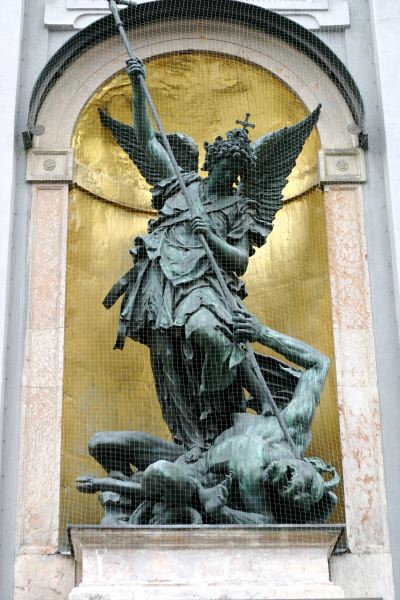
Angels and Wonders: Warriors
My favorite angel stories tend to be those that remind us of what warriors they are. Yes, they are constant spiritual warriors. However, sometimes we hear stories that remind us they also can do it "up close and personal."
Here is the last of our series of pre-posts to get us in the right spirit for Joan Wester Anderson's blog tour which will begin here on Monday. This story is from her newest book.

The God Squad
As a “street kid,” Mike DiSanza learned early that life was full of dangers. He was small and slight, with a shaky self-esteem, and he soon developed a strong fear of any kind of physical violence. There was no use praying about his physical safety either; to Mike, God was an aloof deity, interested in rules and punishment, not concerned with an ordinary kid from the Bronx.
By the time Mike graduated from high school, the Vietnam War was under way. “There was no money for college,” he explains, “and since many of my cousins and my brothers had been drafted into the army, I followed.” Perhaps as a soldier he would overcome his fear of violence.
Mike came through Vietnam unscathed—but still anxious. Almost on a lark—and because few job opportunities loomed—he then took the test for the New York City police force along with fifty thousand other applicants. Mike was astonished when he was one of the four hundred hired. Now he would have to get over his fears. But he didn’t. Mike worked as a patrol officer, first in Harlem, later in Manhattan. Due to antiwar sentiment, police officers were under attack by many, and morale was low. This increased Mike’s on-the-job stress. “We were the cops on the front line, the ones who went into situations all alone,” he points out. “I got seasoned real quick, but I continued to be afraid.”
One evening on street patrol, Mike experienced such a deep anxiety attack that he thought he was dying. “My body literally shook as if it would explode,” he says. What was it all about? he asked himself. What was he doing out here in this high-risk environment, where fear tore him apart every night? Just then a young black woman stopped in front of him and grabbed his hand. “Is anything the matter, Officer?” she asked.
Mike didn’t answer, but he held on. “I didn’t want to let go,” he explains. “I felt something wonderful coming from her. I didn’t know it then, but it was the love of Jesus, a love I had never experienced.”
The woman led Mike to a storefront Pentecostal church, where people were singing, dancing, and praising the Lord. Mike thought it wasn’t at all like the “flickering candles in those huge, formal New York cathedrals I’d been used to.” A nameless hunger came over him, and a few nights later, he read the Bible at home for the first time.
He came upon the words of John 3:17: “For God did not send his Son into the world to condemn the world, but that the world might be saved through him.” Mike closed the book. “Jesus, whoever you are, help me,” he prayed.
A few weeks later, Mike answered a call for assistance from a fellow officer making an arrest in the subway at Seventy-second and Broadway. Mike ran past one officer still in the parked squad car and continued down the stairs. “The cop was attempting to handcuff the suspect, but he was resisting,” Mike says. “A crowd was growing, and people were trying to rescue the suspect. I worked my way through and helped the cop get him cuffed. But we were surrounded. How were we going to get upstairs?”
The crowd was furious at the arrest. Hands shoved Mike toward the edge of the platform. “Throw him onto the tracks!” someone yelled. Mike felt a blow against the side of his head and heard, with dread, the sound of an approaching train.
“Jesus,” he murmured. “Help.”
Suddenly two large African American men loomed in front of him. “Follow us, Officer,” one said. The other, somehow, made a little opening in the densely packed crowd. Relieved, Mike pushed the prisoner directly behind these two unexpected guardians. The crowd moved back, and with the other officer behind him, Mike and his prisoner followed the two men across the platform and up the stairs.
On the street, however, there was more danger. “Another gang had formed around the patrol car, and the driver was getting nervous,” Mike says. “The black guys had been right ahead of us, running interference all the way.” But now as Mike shoved the prisoner in the car and turned to thank his rescuers, they were nowhere in sight. How could he have missed them?
As the squad car pulled away, everyone sighed in relief. “Thanks, Mike,” the subway officer said. “You did a great job getting us through that crowd.”
“Yeah, thanks to those two big black guys,” Mike answered.
“What guys?”
“The ones that said ‘follow us.’ You saw them. They muscled everyone aside.”
The officer looked puzzled. “I didn’t see anyone but you.”
Mike stopped. He was getting a strange feeling. Just last night, in his ongoing quest to understand the Bible, he had read from Hebrews about “ministering spirits, sent from heaven to help in times of distress.” Could the black men have been angels?
No. Police officers didn’t see angels. Not unless they were having mental breakdowns. But although Mike’s heart had raced during the subway episode, he realized suddenly that he was not as afraid as he ordinarily was. Something was definitely different.
A few weeks later, he was assisting another officer making an arrest. “The suspect broke free and ran,” Mike says. “I tackled him, and we fell into a hole in the street, where the Con Edison crews had been digging. The suspect landed first, and I fell on top of him, making it easy to handcuff him. But the hole was too deep for us to get out. We had to wait for backup.”
When extra officers arrived, they hauled the prisoner out of the hole. Then they grabbed Mike’s hands and pulled him up. “Lucky that you landed on him-—you could have been hurt,” one officer remarked.
“Yeah,” Mike murmured. Again he was filled with anxiety. Would he never be free of it? And then, near the side of the excavation, he saw two large black men wearing Con Edison helmets, smiling at him as he passed. They were the same two—he knew it! But when he looked back, they had vanished.
Over the next few months, Mike spent a lot of time thinking. He was in a unique position, he knew. He had already begun to witness to other police officers, even to people on the street, about how knowing Jesus was changing his life. Maybe God was building his confidence, so he would have both the physical and mental courage to do whatever he was asked to do. But how would he know for sure?
One afternoon Mike went into a restaurant for lunch. He had passed two diners at a table before he realized . . . He turned in amazement. There were the same two black men, both looking directly at him.
Joy flooded his spirit. “I couldn’t help it,” he says. “I winked at them.”
Each man winked back. Mike could hardly keep from laughing out loud. He seated himself, then looked back. The table was empty.
It was the sign he had needed. From that point on, although Mike continued to have occasional anxious moments on the job, he never felt alone. Sometimes he’d sense that he was being prepared for an upcoming dangerous moment. Occasionally he would walk into angry crowds, disarm gunmen, or display sudden strength, all without being injured.
It wasn’t the sort of thing one could put in a police report. But Mike understood. “I knew now that Jesus was right beside me, and would never leave me,” he says. Jesus, and two very heavenly bodyguards.
Here is the last of our series of pre-posts to get us in the right spirit for Joan Wester Anderson's blog tour which will begin here on Monday. This story is from her newest book.
The God Squad
By the time Mike graduated from high school, the Vietnam War was under way. “There was no money for college,” he explains, “and since many of my cousins and my brothers had been drafted into the army, I followed.” Perhaps as a soldier he would overcome his fear of violence.
Mike came through Vietnam unscathed—but still anxious. Almost on a lark—and because few job opportunities loomed—he then took the test for the New York City police force along with fifty thousand other applicants. Mike was astonished when he was one of the four hundred hired. Now he would have to get over his fears. But he didn’t. Mike worked as a patrol officer, first in Harlem, later in Manhattan. Due to antiwar sentiment, police officers were under attack by many, and morale was low. This increased Mike’s on-the-job stress. “We were the cops on the front line, the ones who went into situations all alone,” he points out. “I got seasoned real quick, but I continued to be afraid.”
One evening on street patrol, Mike experienced such a deep anxiety attack that he thought he was dying. “My body literally shook as if it would explode,” he says. What was it all about? he asked himself. What was he doing out here in this high-risk environment, where fear tore him apart every night? Just then a young black woman stopped in front of him and grabbed his hand. “Is anything the matter, Officer?” she asked.
Mike didn’t answer, but he held on. “I didn’t want to let go,” he explains. “I felt something wonderful coming from her. I didn’t know it then, but it was the love of Jesus, a love I had never experienced.”
The woman led Mike to a storefront Pentecostal church, where people were singing, dancing, and praising the Lord. Mike thought it wasn’t at all like the “flickering candles in those huge, formal New York cathedrals I’d been used to.” A nameless hunger came over him, and a few nights later, he read the Bible at home for the first time.
He came upon the words of John 3:17: “For God did not send his Son into the world to condemn the world, but that the world might be saved through him.” Mike closed the book. “Jesus, whoever you are, help me,” he prayed.
A few weeks later, Mike answered a call for assistance from a fellow officer making an arrest in the subway at Seventy-second and Broadway. Mike ran past one officer still in the parked squad car and continued down the stairs. “The cop was attempting to handcuff the suspect, but he was resisting,” Mike says. “A crowd was growing, and people were trying to rescue the suspect. I worked my way through and helped the cop get him cuffed. But we were surrounded. How were we going to get upstairs?”
The crowd was furious at the arrest. Hands shoved Mike toward the edge of the platform. “Throw him onto the tracks!” someone yelled. Mike felt a blow against the side of his head and heard, with dread, the sound of an approaching train.
“Jesus,” he murmured. “Help.”
Suddenly two large African American men loomed in front of him. “Follow us, Officer,” one said. The other, somehow, made a little opening in the densely packed crowd. Relieved, Mike pushed the prisoner directly behind these two unexpected guardians. The crowd moved back, and with the other officer behind him, Mike and his prisoner followed the two men across the platform and up the stairs.
On the street, however, there was more danger. “Another gang had formed around the patrol car, and the driver was getting nervous,” Mike says. “The black guys had been right ahead of us, running interference all the way.” But now as Mike shoved the prisoner in the car and turned to thank his rescuers, they were nowhere in sight. How could he have missed them?
As the squad car pulled away, everyone sighed in relief. “Thanks, Mike,” the subway officer said. “You did a great job getting us through that crowd.”
“Yeah, thanks to those two big black guys,” Mike answered.
“What guys?”
“The ones that said ‘follow us.’ You saw them. They muscled everyone aside.”
The officer looked puzzled. “I didn’t see anyone but you.”
Mike stopped. He was getting a strange feeling. Just last night, in his ongoing quest to understand the Bible, he had read from Hebrews about “ministering spirits, sent from heaven to help in times of distress.” Could the black men have been angels?
No. Police officers didn’t see angels. Not unless they were having mental breakdowns. But although Mike’s heart had raced during the subway episode, he realized suddenly that he was not as afraid as he ordinarily was. Something was definitely different.
A few weeks later, he was assisting another officer making an arrest. “The suspect broke free and ran,” Mike says. “I tackled him, and we fell into a hole in the street, where the Con Edison crews had been digging. The suspect landed first, and I fell on top of him, making it easy to handcuff him. But the hole was too deep for us to get out. We had to wait for backup.”
When extra officers arrived, they hauled the prisoner out of the hole. Then they grabbed Mike’s hands and pulled him up. “Lucky that you landed on him-—you could have been hurt,” one officer remarked.
“Yeah,” Mike murmured. Again he was filled with anxiety. Would he never be free of it? And then, near the side of the excavation, he saw two large black men wearing Con Edison helmets, smiling at him as he passed. They were the same two—he knew it! But when he looked back, they had vanished.
Over the next few months, Mike spent a lot of time thinking. He was in a unique position, he knew. He had already begun to witness to other police officers, even to people on the street, about how knowing Jesus was changing his life. Maybe God was building his confidence, so he would have both the physical and mental courage to do whatever he was asked to do. But how would he know for sure?
One afternoon Mike went into a restaurant for lunch. He had passed two diners at a table before he realized . . . He turned in amazement. There were the same two black men, both looking directly at him.
Joy flooded his spirit. “I couldn’t help it,” he says. “I winked at them.”
Each man winked back. Mike could hardly keep from laughing out loud. He seated himself, then looked back. The table was empty.
It was the sign he had needed. From that point on, although Mike continued to have occasional anxious moments on the job, he never felt alone. Sometimes he’d sense that he was being prepared for an upcoming dangerous moment. Occasionally he would walk into angry crowds, disarm gunmen, or display sudden strength, all without being injured.
It wasn’t the sort of thing one could put in a police report. But Mike understood. “I knew now that Jesus was right beside me, and would never leave me,” he says. Jesus, and two very heavenly bodyguards.
Worth a Thousand Words
 Starry Night Over the Rhone, Vincent Van Gogh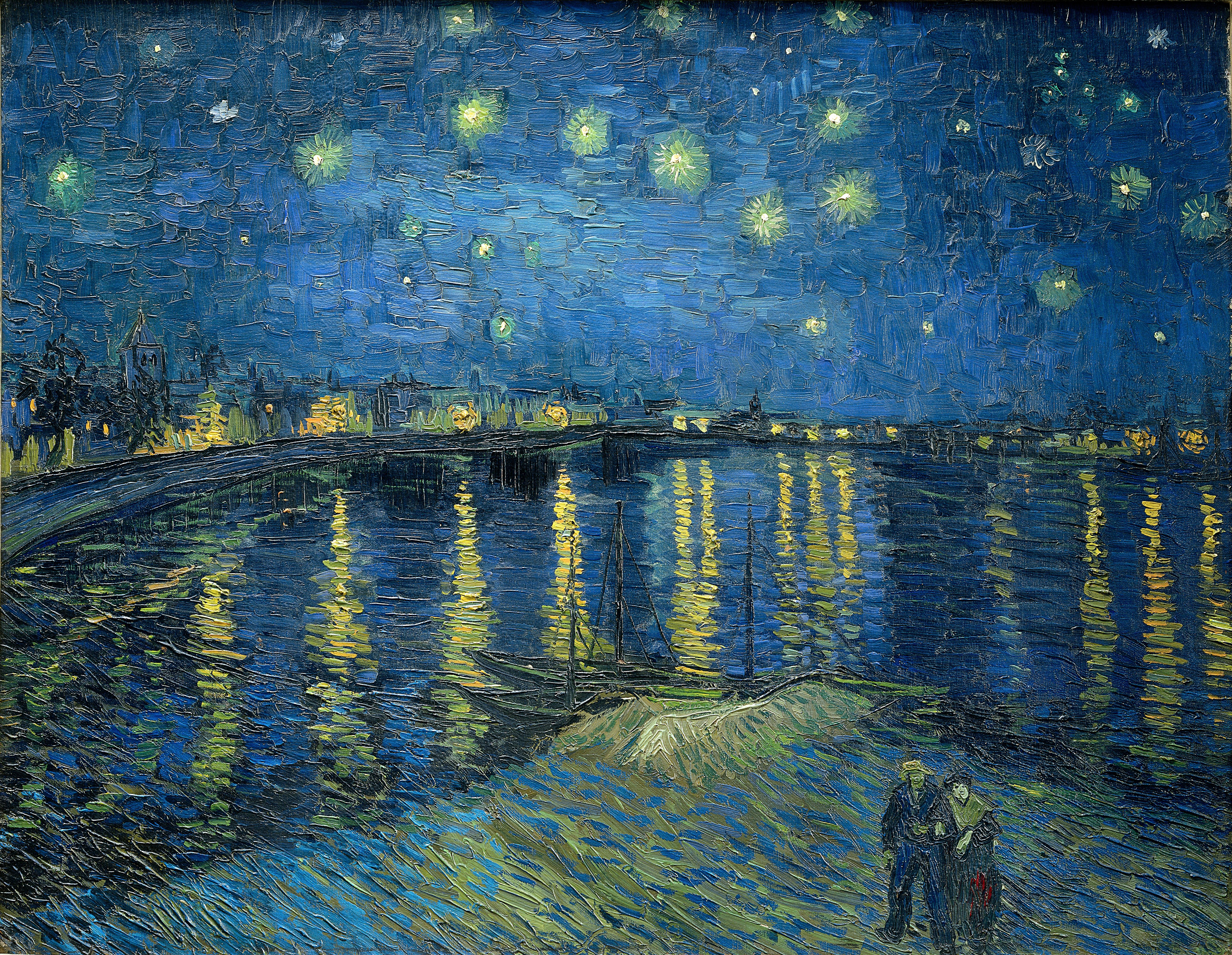
(via Lines and Colors who has a very nice essay about seeing the Van Gogh connections in Arles.)
Friday, September 26, 2008
Miracles ... In Our Time
The parting of the Red Sea, the feeding of the five thousand, the turning of water into wine - miracles. Miracles? Yet miracles have been part of human culture for thousands of years. From beliefs about the shin bone of a saint to ideas about the nature of creation and the laws of nature, miracles have been a measure of disputes within religion and between religion and rationality from St Augustine in the 4th century to David Hume in the 18th. They have also been used by the corrupt and the powerful to gain their perverse ends. Miracles have been derided and proved to be fraudulent and yet, for many, the miraculous maintain a grip on our imagination, our language and our belief to this day.BBC's In Our Time is back from their break with a look at miracles. Anne is a Man reviews this episode and says, among other things:
... A lot of fascinating aspects were touched upon, but the subject flows like fine sand between your fingers; it is so difficult to get a grasp.Read his whole review here.
... this is a weakness that is unlike In Our Time: it was too fragmented. There are glimpses of intelligent and provocative thoughts, but they fleet a bit too easily. Still, this is In Our Time, one of the best podcasts around. But be prepared.
Angels and Wonders: Mary's Mantle
Now to get us all in the mood for angelic conversation on Monday, here is a feature story from Joan Wester Anderson's newest book, chosen for us by the author herself.
When bombs fell out of the sky on Sunday morning, December 7, 1941, Pearl Harbor, Hawaii, was not the only city to suffer. Many areas in the Philippine Islands were also hit, including the city of Baguio. Baguio was a place of pine trees and mountains, surrounded by fields and gold mines, where Lolo Joaquin worked as an engineer. Lolo’s family, all devout Catholics, had spent the weekend visiting him at the mining site, and everyone was driving home to Baguio for Mass when they heard the bombs exploding. Terrified, the family turned the car around and sped back to the relative safety of the camp. For the next several months, they and many others, stayed near Itogon at a mission run by Father Alfonso, a Belgian priest and longtime friend.
Lolo had graduated from the Colorado School of Mining and had American friends, so as the Japanese army invaded city after city, he became involved in the resistance movement. He refused to work in the copper mines, knowing the metal would be turned into bullets used against his friends. His wife, Lola, smuggled messages inside loaves of freshly baked bread to American prisoners in concentration camps. But both knew it was just a matter of time before the Japanese made inroads into more distant areas, and discovered their activities.
Early in October 1942, as monsoon season began, word spread that Japanese soldiers were heading in their direction. “We’ll go deeper into the mountains, to Dalupiri,” Father Alfonso told the families that had been staying with him. They could hide among the Benguet tribe, whose kings were sympathetic to their plight.
The journey began early in the day, but Lolo soon realized that, for his family, passage was going to be difficult. Not only were the Joaquins traveling with four young children, but Lola had recently had a miscarriage and was still very weak. As miles passed and the trails became rockier, she often stumbled and fell. Other families tried to help, and Lolo knew that his was holding the rest of them back. With the Japanese on their heels, this could be disastrous for everyone.
“Go on ahead,” he finally told Father Alfonso. “We’ll catch up.”
Father nodded reluctantly. “We’ll send people back to help carry Lola as soon as we can,” he promised. “God go with you.”
“And you.”
Soon their friends were gone. Frightened, everyone looked at one another. “Daddy, it’s starting to rain.” Nine-year-old Patricia glanced anxiously at the sky.
Lolo followed her gaze. Clouds were gathering, and the sun had dropped, leaving a chill in the air. “Come,” he said, lifting baby Sonny into his piggyback sling. “Everything will be all right.”
But it wasn’t long before the wind picked up and rain pelted the little group. Soon everyone was soaked. The baby whimpered, and seven-year-old Teresita jumped as the trees swayed, whispering ominously. Lola grew increasingly exhausted. The monsoons had begun. How could they go on?
Soon the trail became so narrow that it could only accommodate one person at a time. To the right rose the cliff-side, straight up, stony and forbidding. To the left a precipitous chasm dropped to the overflowing river. The rain continued, pounding them as they struggled to stay upright on the slippery bluff. Finally Lolo stopped. “We’ll sit now,” he said calmly, although Patricia had seen the worry on his face before the last of the light faded. “Your mother needs to rest.”
Slowly the family put down their packs and sat against the rocks. It was dark now, Lolo realized. Even worse, somewhere in the last mile or two, he had lost his way. What should he do? His little ones were exhausted—how could they continue across those treacherous cliffs, especially as night fell? But they couldn’t sleep on the mountainside either, not with these heavy rains and soldiers trying to ambush them.
The wind grew wilder, and soon Lolo stood up again. “Perhaps we should crawl,” he suggested. “One hand on the ground and the other on the wall of the mountain for guidance.”
“Why don’t we light a torch, Daddy?” Buddy asked.
“We can’t, son,” Lolo explained. “The enemy might see it and shoot us.”
Teresita began to cry. “I’m scared, Daddy,” she sobbed as thunder rolled across the mountains. “I want to go home!”
“Hush,” he soothed her, patting her with one hand as he held the sobbing baby in the sling. “Stop crying, my little ones. This is not a good place to be caught by darkness and rain, but we must make the best of it. This situation calls for courage, not fear!”
“What can we do?” Lola asked, drawing four-year-old Buddy close to her.
Lolo paused. “We can pray,” he said. “Haven’t we always turned to heaven when things got bad?”
The children nodded. They had all read prayers from books, or recited those they had been taught. Of course they could pray. But now their father threw out his hands and lifted his voice in a way they had never heard before. “Cover us with thy mantle, oh Blessed Mother of God,” he pleaded, “that we may be saved from all evil and temptation, and from all dangers of body and soul!”
It was a wonderful petition. It had power and hope, and their terror seemed to recede, just a little. Lolo felt it, too. “I have an idea,” he said slowly. “It is too dark now to see ahead, but if we go in single file, each taking the hand of the person in front, we will all feel safer.”
Teresita wanted to be brave. But she trembled as the river beneath them roared. “I’m afraid, Daddy.”
Her father grasped her wet hand. “We will say the rosary as we walk, loud, so God can hear it over the storm! Buddy, you lead the way because you are the smallest and closest to the ground. Is everyone ready?”
“Ready.” Slowly the little group moved forward, water streaming into their eyes, clothes plastered to their shivering bodies. They would not make it. One child would trip, and all would lose their balance, plunging to the canyon below. “Hail Mary, full of grace.” Shakily they clung to the familiar biblical phrases, the reassuring cadence, the memory of their father’s impassioned plea. They would not make it. And yet . . .
The journey seemed to last forever. But as they approached a sharp turn in the path, Buddy was the first to see. “Mama! Daddy!” he shouted. “Look!”
The rain had abruptly stopped, the air seemed sweetly fragrant. And before them, as far as they could see, stretched a long line of luminous candles winding around the curve of the mountain and on to a wide plain. But no—not candles. For these lights were bouncing, dancing, twinkling like stars illuminating the heavens.
They were fireflies! Thousands, millions of them, all hovering about three feet from the ground. In their combined greenish glow, Lolo could see the path as bright as day, even the footprints of the refugees who had gone ahead of them.
Awed, Lola dropped to her knees in thanksgiving. The children laughed, catching some of the little insects and wrapping them in their handkerchiefs. “We can use them for lanterns!” Patricia cried, delighted.
Clutching the baby, Lolo stared at the scene, incredulous. In all his life he had never seen such a huge collection of fireflies in the same place, or massed in a precise pattern like this. Fireflies didn’t come during monsoon season. Nor did they hover close to the ground, preferring
instead the tops of trees. Yet here, hip-high, were an incredible number, waiting for his family, enclosing them—like a mantle of protection, he realized suddenly. A queen’s mantle, edged with gold.
There were more miles to go, but now the path seemed enchanted as the blessed fireflies lighted their way to the little village. Finally! They ran the last muddy yards and pounded on Father Alfonso’s door.
“We had given you up for lost!” the astonished priest cried, coming out to embrace them. “How did you do it? How did you cross the mountains in the dark, in this raging storm?” Patricia and Teresita looked up. The deluge had started again.
“Father, we can’t explain it,” Lolo said. “Look behind us and see this miracle for yourself.”
Father looked past Lolo. But there was nothing at all to see. No fireflies, no softened sky—nothing but darkness and streaming water. Lolo understood. “Has it been raining like this all evening, Father?” he asked quietly.
“It has not stopped at all, Mr. Joaquin,” Father Alfonso answered.
The following day, Father Alfonso called a meeting of the tribal elders, some of them over one hundred years old, and showed them the fireflies left in Teresita’s handkerchief. “Have any of you heard of this?” he asked. “Fireflies coming in a storm to light a traveler’s path?”
The elders conferred. They were experts on the ways of nature, and fireflies. There was no possibility of such a thing, they all agreed.
Such a verdict did not matter to the Joaquins. For they had seen, not only with physical eyes but the eyes of faith. Life would be difficult as they struggled to survive in their war-torn land. But they would not be alone. How wonderful were the ways of God!
Mary’s Mantle
All things bright and beautiful,
All creatures great and small,
All things wise and wonderful,
The Lord God made them all.
—Cecil Frances Alexander, “All Things Bright and Beautiful”
All creatures great and small,
All things wise and wonderful,
The Lord God made them all.
—Cecil Frances Alexander, “All Things Bright and Beautiful”
When bombs fell out of the sky on Sunday morning, December 7, 1941, Pearl Harbor, Hawaii, was not the only city to suffer. Many areas in the Philippine Islands were also hit, including the city of Baguio. Baguio was a place of pine trees and mountains, surrounded by fields and gold mines, where Lolo Joaquin worked as an engineer. Lolo’s family, all devout Catholics, had spent the weekend visiting him at the mining site, and everyone was driving home to Baguio for Mass when they heard the bombs exploding. Terrified, the family turned the car around and sped back to the relative safety of the camp. For the next several months, they and many others, stayed near Itogon at a mission run by Father Alfonso, a Belgian priest and longtime friend.
Lolo had graduated from the Colorado School of Mining and had American friends, so as the Japanese army invaded city after city, he became involved in the resistance movement. He refused to work in the copper mines, knowing the metal would be turned into bullets used against his friends. His wife, Lola, smuggled messages inside loaves of freshly baked bread to American prisoners in concentration camps. But both knew it was just a matter of time before the Japanese made inroads into more distant areas, and discovered their activities.
Early in October 1942, as monsoon season began, word spread that Japanese soldiers were heading in their direction. “We’ll go deeper into the mountains, to Dalupiri,” Father Alfonso told the families that had been staying with him. They could hide among the Benguet tribe, whose kings were sympathetic to their plight.
The journey began early in the day, but Lolo soon realized that, for his family, passage was going to be difficult. Not only were the Joaquins traveling with four young children, but Lola had recently had a miscarriage and was still very weak. As miles passed and the trails became rockier, she often stumbled and fell. Other families tried to help, and Lolo knew that his was holding the rest of them back. With the Japanese on their heels, this could be disastrous for everyone.
“Go on ahead,” he finally told Father Alfonso. “We’ll catch up.”
Father nodded reluctantly. “We’ll send people back to help carry Lola as soon as we can,” he promised. “God go with you.”
“And you.”
Soon their friends were gone. Frightened, everyone looked at one another. “Daddy, it’s starting to rain.” Nine-year-old Patricia glanced anxiously at the sky.
Lolo followed her gaze. Clouds were gathering, and the sun had dropped, leaving a chill in the air. “Come,” he said, lifting baby Sonny into his piggyback sling. “Everything will be all right.”
But it wasn’t long before the wind picked up and rain pelted the little group. Soon everyone was soaked. The baby whimpered, and seven-year-old Teresita jumped as the trees swayed, whispering ominously. Lola grew increasingly exhausted. The monsoons had begun. How could they go on?
Soon the trail became so narrow that it could only accommodate one person at a time. To the right rose the cliff-side, straight up, stony and forbidding. To the left a precipitous chasm dropped to the overflowing river. The rain continued, pounding them as they struggled to stay upright on the slippery bluff. Finally Lolo stopped. “We’ll sit now,” he said calmly, although Patricia had seen the worry on his face before the last of the light faded. “Your mother needs to rest.”
Slowly the family put down their packs and sat against the rocks. It was dark now, Lolo realized. Even worse, somewhere in the last mile or two, he had lost his way. What should he do? His little ones were exhausted—how could they continue across those treacherous cliffs, especially as night fell? But they couldn’t sleep on the mountainside either, not with these heavy rains and soldiers trying to ambush them.
The wind grew wilder, and soon Lolo stood up again. “Perhaps we should crawl,” he suggested. “One hand on the ground and the other on the wall of the mountain for guidance.”
“Why don’t we light a torch, Daddy?” Buddy asked.
“We can’t, son,” Lolo explained. “The enemy might see it and shoot us.”
Teresita began to cry. “I’m scared, Daddy,” she sobbed as thunder rolled across the mountains. “I want to go home!”
“Hush,” he soothed her, patting her with one hand as he held the sobbing baby in the sling. “Stop crying, my little ones. This is not a good place to be caught by darkness and rain, but we must make the best of it. This situation calls for courage, not fear!”
“What can we do?” Lola asked, drawing four-year-old Buddy close to her.
Lolo paused. “We can pray,” he said. “Haven’t we always turned to heaven when things got bad?”
The children nodded. They had all read prayers from books, or recited those they had been taught. Of course they could pray. But now their father threw out his hands and lifted his voice in a way they had never heard before. “Cover us with thy mantle, oh Blessed Mother of God,” he pleaded, “that we may be saved from all evil and temptation, and from all dangers of body and soul!”
It was a wonderful petition. It had power and hope, and their terror seemed to recede, just a little. Lolo felt it, too. “I have an idea,” he said slowly. “It is too dark now to see ahead, but if we go in single file, each taking the hand of the person in front, we will all feel safer.”
Teresita wanted to be brave. But she trembled as the river beneath them roared. “I’m afraid, Daddy.”
Her father grasped her wet hand. “We will say the rosary as we walk, loud, so God can hear it over the storm! Buddy, you lead the way because you are the smallest and closest to the ground. Is everyone ready?”
“Ready.” Slowly the little group moved forward, water streaming into their eyes, clothes plastered to their shivering bodies. They would not make it. One child would trip, and all would lose their balance, plunging to the canyon below. “Hail Mary, full of grace.” Shakily they clung to the familiar biblical phrases, the reassuring cadence, the memory of their father’s impassioned plea. They would not make it. And yet . . .
The journey seemed to last forever. But as they approached a sharp turn in the path, Buddy was the first to see. “Mama! Daddy!” he shouted. “Look!”
The rain had abruptly stopped, the air seemed sweetly fragrant. And before them, as far as they could see, stretched a long line of luminous candles winding around the curve of the mountain and on to a wide plain. But no—not candles. For these lights were bouncing, dancing, twinkling like stars illuminating the heavens.
They were fireflies! Thousands, millions of them, all hovering about three feet from the ground. In their combined greenish glow, Lolo could see the path as bright as day, even the footprints of the refugees who had gone ahead of them.
Awed, Lola dropped to her knees in thanksgiving. The children laughed, catching some of the little insects and wrapping them in their handkerchiefs. “We can use them for lanterns!” Patricia cried, delighted.
Clutching the baby, Lolo stared at the scene, incredulous. In all his life he had never seen such a huge collection of fireflies in the same place, or massed in a precise pattern like this. Fireflies didn’t come during monsoon season. Nor did they hover close to the ground, preferring
instead the tops of trees. Yet here, hip-high, were an incredible number, waiting for his family, enclosing them—like a mantle of protection, he realized suddenly. A queen’s mantle, edged with gold.
There were more miles to go, but now the path seemed enchanted as the blessed fireflies lighted their way to the little village. Finally! They ran the last muddy yards and pounded on Father Alfonso’s door.
“We had given you up for lost!” the astonished priest cried, coming out to embrace them. “How did you do it? How did you cross the mountains in the dark, in this raging storm?” Patricia and Teresita looked up. The deluge had started again.
“Father, we can’t explain it,” Lolo said. “Look behind us and see this miracle for yourself.”
Father looked past Lolo. But there was nothing at all to see. No fireflies, no softened sky—nothing but darkness and streaming water. Lolo understood. “Has it been raining like this all evening, Father?” he asked quietly.
“It has not stopped at all, Mr. Joaquin,” Father Alfonso answered.
The following day, Father Alfonso called a meeting of the tribal elders, some of them over one hundred years old, and showed them the fireflies left in Teresita’s handkerchief. “Have any of you heard of this?” he asked. “Fireflies coming in a storm to light a traveler’s path?”
The elders conferred. They were experts on the ways of nature, and fireflies. There was no possibility of such a thing, they all agreed.
Such a verdict did not matter to the Joaquins. For they had seen, not only with physical eyes but the eyes of faith. Life would be difficult as they struggled to survive in their war-torn land. But they would not be alone. How wonderful were the ways of God!
"Rapunzel! Why aren't you at the fair?"
The book went on to spin the tale of a charmed girl named Rapunzel, who spent her days in the tower sewing dresses with a friend. She loved when the witch came to visit and teach songs, including one that made Rapunzel's hair grow longer. But tension arrived: One day, Rapunzel looked out the window and saw a fair in the village nearby. She wanted to go, but the witch was off tending to her garden and couldn't let her out. Fortunately, a prince riding by in his carriage called up to her, "Rapunzel! Why aren't you at the fair?"Joanna Weiss talks about the evolution of fairy tales from dark and frightening to whitewash, sanitized "feel good" tales.
This was not the fairy tale I vaguely recalled from my childhood - the one with the mother who gives up her child, the vindictive witch, the powerless girl trapped high above the ground. This new version was sanitary and safe in a way that modern parents will easily recognize. In an age when some families ban the word "killed" or come up with creative euphemisms to mask the death of goldfish, it's not hard to see why a toy company would reduce Rapunzel's story to its prettiest parts. Real life, presumably, packs enough trauma for children to think about later.
Saint Superman, whence I found the link originally (are y'all reading him because he's really great, by the way), talks about what Tom and I often wonder ... has everyone forgotten what it was like to be a kid and experience deliciously scary stories?
When I was ten, I lived in Pan’s Labyrinth, a place filled to the brim with demons and witches, monsters and swords. I hoped my house was haunted, and I prayed for some supernatural thing to happen to me. I wandered in the woods between housing properties at night and at day, looking for some monster, king, or sage, or looking in the dark sky for some flash of alien light. It wasn’t something fearful; I’d read Herschel and the Hanukkah Goblins, and I knew that monsters could be fooled, even if they were not to be trifled with or ignored. It was people that scared me.I know just what he means. I think, too, that people forget another valuable aspect to the dark side of fairy tales. Not only do children not process them as adults do, but the stories provide valuable lessons for children in dealing with problems later in life. When they are being picked on in the school yard, the last one chosen for baseball, or pointed out as a bad example to the whole class, these stories provide a cultural background that life often is not fair, bad things happen to good people, and that the little guy can win if they keep on trying. Do they think of these things consciously? Nope. But those stories are lurking in the back of their minds nonetheless with valuable lessons for life.
Subscribe to:
Comments (Atom)