Don't forget the nominations begin Sunday and are open through Friday.
This is a great way to recognize your favorite blogs. I know I have a long list that I'll be nominating. The categories are much more to the point this year, so take a look and see who you think fits them best.
Saturday, February 3, 2007

Friday, February 2, 2007
The A&M Report
Hannah is up to all kinds of things these days. Her classes are easier than last semester (thank Heavens!) and so she's able to plan a trip to Austin to see a concert, start thinking about how many hours of work she needs to log on a summer job to earn the money for a 4-week trip to do field research with bats next year, get in lots of rock climbing at the MSC ... and all kinds of other interesting things.
Dearest to my heart is the fact that she was chosen Chaplain of the Christian sorority she joined last semester. I'm not sure what else the position entails but it includes running a Bible study. She didn't have anything available to specifically study the Bible but she did have that old reliable Mere Christianity to hand.
Who better than C.S. Lewis to start a discussion of the cardinal virtues? She was really surprised because no one had ever heard of cardinal virtues. "I didn't remember what they were," she said, "but I did know that they existed!"
Inevitably, after she read the excerpt containing this unknown concept to the girls, the question arose, "Is this a Catholic book?"
She was thankful to be able to assure them that C.S. Lewis wasn't Catholic.
Subsequently a good and interesting discussion was had by all.
Dearest to my heart is the fact that she was chosen Chaplain of the Christian sorority she joined last semester. I'm not sure what else the position entails but it includes running a Bible study. She didn't have anything available to specifically study the Bible but she did have that old reliable Mere Christianity to hand.
Who better than C.S. Lewis to start a discussion of the cardinal virtues? She was really surprised because no one had ever heard of cardinal virtues. "I didn't remember what they were," she said, "but I did know that they existed!"
Inevitably, after she read the excerpt containing this unknown concept to the girls, the question arose, "Is this a Catholic book?"
She was thankful to be able to assure them that C.S. Lewis wasn't Catholic.
Subsequently a good and interesting discussion was had by all.
Why Did You Revert or Convert?
That's the question that Open Book asked and the comments are worth the time taken to read them. I am printing these out to read at my leisure but answers range from "my iPod!" to John Paul II (yes I saw you in there Bender!) to the Eucharist (which is my personal reason). I love getting to see all the ways that God reaches out to pull people to the Church.
And I see that Baptists asking questions have a lot of Catholic converts/reverts to their credit also. Interesting.
Via A Quiet Catholic.
And I see that Baptists asking questions have a lot of Catholic converts/reverts to their credit also. Interesting.
Via A Quiet Catholic.
Resting in God
"In meditating," he [St. Francis de Sales] says, "we as it were count the divine perfections which we find in a mystery, but in contemplating, we sum up their total." The contemplative gaze is a holistic one, and one steeped in love. We are in the presence of God, and like human lovers who "are content, sometimes, with being near or within sight of the person they love without speaking to her, and without even distinctly thinking of her," we simply rest in God's nearness.I agree that this is quite a challenge in modern times where, as a people, we tend to analyze everything up to and including ourselves. However, it is a part of "letting go" in general to just push those inclinations aside when it comes to prayer.
This contemplative repose is easily disrupted if we become overly aware of ourselves, a special temptation in modern times. People who "voluntarily forsake [the state of contemplative repose] to note their own behaviour within, and to examine whether they are really in content, disquieting themselves to discern whether their tranquility is really tranquil, and their quietude quiet," soon become distracted.
Rather than maintaining their focus on God, they "employ their understanding in reasoning upon the feelings they have; as a bride who should keep her attention on her wedding ring without looking upon the bridegroom who gave it to her. There is a great difference ... between being occupied with God who gives us the contentment, and being busied with the contentment which God gives us." We must stop studying our emotional reactions as though we were involved in a scientific experiment if we are ever to meet God as he is. Though honest self-awareness is critically important to the spiritual life, contemplation only happens when we learn to set aside self-study in order to lose ourselves in God.By Way of Grace: Moving from Faithfulness to Holiness
by Paula Huston
Thursday, February 1, 2007
Around the House
Rose and Kill Hannah
She came belting in from Kung Fu last Tuesday with her eyes alight and aquiver with excitement. "Kill Hannah is having a concert on Friday and there are 11 tickets left!"
Ah, Kill Hannah, every girl's androgynous dream band!
Her good friend Anna got two of those last 11 tickets and also managed to sweet talk her parents into letting her attend. The only thing they were worried about was the same thing that we were ... the trip downtown and back. Tom will be driving them down and picking them up later. And I might just go along to keep him company. It will mean a late night. But it's worth it to see Rose all revved up like that.
To Ruin that Voice in Your Head ...
... at least if you're like me and have mental "voices" to go with the bloggers you read.
I'm going to be interviewed on "The Catholic Guy," hosted by Lino Rulli, to discuss Happy Catholic live around 5:00 ET (which is 4:00 to me). It airs on The Catholic Channel on Sirius Satellite Radio, 159.
For those of us who don't have Sirius or know anyone who does I am trying to find out if they have a download or some such thing.
Felting Question
Every time I see felting mentioned, a top-loading washer is always specified. What about us poor schmoes who have front-loading washers? Are we doomed to live felt-less forever? Or is there a technique that works as an alternative?
Craft 'N Pray
For those who were interested in that Craft 'N Pray time I mentioned long ago, it is finally time to get it going. We'll be meeting on the second Saturday of the February, from 2-4 in the afternoon at my house. If you live in Dallas and are interested email me and I'll give you the details (julie @ glyphnet . com). [If you don't get a response in a day or so, it is safe to assume that my spam filter ate your email. In that case, leave me a comment with your email and I'll contact you.]
Perpetua & Felicity Book Club
As long as I have the Craft 'N Pray notice above I might as well throw in our little Catholic women's book club too ... we meet on the third Monday of each month from 8-10 p.m. at my house. We're beginning Triumph: The Power and Glory of the Catholic Church by H.W. Crocker III. Nothing like reading a history of the Catholic Church during Lent, eh?
I see that I didn't actually review this book but piggybacked on a review of Mama T's and that link is dead for some reason. Suffice it to say that this was one of my favorite books of 2004. Crocker is hilarious (or snarky as Mama T says) and I liked the fact that he made no attempt to hide his partisanship ... especially obvious when talking about Martin Luther ... maybe because I agreed with him. It was refreshing to find a history that didn't stop and back up every few steps to apologize for the non-correctness of our forebears. I remember that I was so caught up in it that I read this in about a week. I'm looking forward to rereading it.
Again, if you're interested email me for information.
She came belting in from Kung Fu last Tuesday with her eyes alight and aquiver with excitement. "Kill Hannah is having a concert on Friday and there are 11 tickets left!"
Ah, Kill Hannah, every girl's androgynous dream band!
Her good friend Anna got two of those last 11 tickets and also managed to sweet talk her parents into letting her attend. The only thing they were worried about was the same thing that we were ... the trip downtown and back. Tom will be driving them down and picking them up later. And I might just go along to keep him company. It will mean a late night. But it's worth it to see Rose all revved up like that.
To Ruin that Voice in Your Head ...
... at least if you're like me and have mental "voices" to go with the bloggers you read.
I'm going to be interviewed on "The Catholic Guy," hosted by Lino Rulli, to discuss Happy Catholic live around 5:00 ET (which is 4:00 to me). It airs on The Catholic Channel on Sirius Satellite Radio, 159.
For those of us who don't have Sirius or know anyone who does I am trying to find out if they have a download or some such thing.
Felting Question
Every time I see felting mentioned, a top-loading washer is always specified. What about us poor schmoes who have front-loading washers? Are we doomed to live felt-less forever? Or is there a technique that works as an alternative?
Craft 'N Pray
For those who were interested in that Craft 'N Pray time I mentioned long ago, it is finally time to get it going. We'll be meeting on the second Saturday of the February, from 2-4 in the afternoon at my house. If you live in Dallas and are interested email me and I'll give you the details (julie @ glyphnet . com). [If you don't get a response in a day or so, it is safe to assume that my spam filter ate your email. In that case, leave me a comment with your email and I'll contact you.]
Perpetua & Felicity Book Club
As long as I have the Craft 'N Pray notice above I might as well throw in our little Catholic women's book club too ... we meet on the third Monday of each month from 8-10 p.m. at my house. We're beginning Triumph: The Power and Glory of the Catholic Church by H.W. Crocker III. Nothing like reading a history of the Catholic Church during Lent, eh?
I see that I didn't actually review this book but piggybacked on a review of Mama T's and that link is dead for some reason. Suffice it to say that this was one of my favorite books of 2004. Crocker is hilarious (or snarky as Mama T says) and I liked the fact that he made no attempt to hide his partisanship ... especially obvious when talking about Martin Luther ... maybe because I agreed with him. It was refreshing to find a history that didn't stop and back up every few steps to apologize for the non-correctness of our forebears. I remember that I was so caught up in it that I read this in about a week. I'm looking forward to rereading it.
Again, if you're interested email me for information.
Wednesday, January 31, 2007
Questions About Catholicism?
What you think you know about Catholicism may not be the reality of Catholicism.I can't remember if I've referred y'all to Rafting the Tiber before or not.
Mark Windsor has a good, solid base of posts written about some of the questions that come up when people are looking into the Catholic Church ... whether they are contemplating swimming the Tiber (a.k.a. converting) or just taking a look inside the door to get the real scoop. He has some great information about Mary, the papacy, and more.
Even better, as his blog is fairly new, he is answering questions when they arise as in his most recent post which responds to a bevy of questions from a commenter about what the Church teaches. Mark is taking great care to be accurate, even going to the trouble of applying to the bishop for a Nihil Obstat on a particular post (don't know what that is? go read his latest post).
If you have a question I can't think of a better person in St. Blog's to ask.
Tuesday, January 30, 2007
Tuesday's Classic Book in a Minute
The Collected Work of Jane Austen
By Jane Austen
Ultra-Condensed by Christina Carlson and Peter da Silva
Female Lead
I secretly love Male Lead. He must never know.
Male Lead
I secretly love Female Lead. She must never know.
(They find out.)
THE END
Savage Chickens
 It is Savage Chickens' second anniversary. If you're not reading this then you're missing one of the funniest cartoons around. Check it out.
Mirror, Mirror, On the Wall ...
Funk says, "The practice of humility is to be neither too high nor too low" in this self-estimation. If we see ourselves as more important than we really are, we are guilty of vainglory; if we see ourselves, who have been created in the image of God, as utterly worthless, we are guilty of dejection. The trick is to gaze in the mirror and name with is truly there. In a sense, we are to look at ourselves contemplatively, for as Aquinas reminds us, "Contemplation refers to the actual, simple, looking at the truth." Humility allows us to see ourselves clearly and realistically so that we are not tricked into either self-inflation or self-hatred.I like that definition of humility: our estimation of ourselves according to truth. I have seen similar comments before but what opened this one up a little further for me was adding "striving for excellence" into the equation. It is only natural to want to be the best we can be ... as long as we have it balanced by a healthy sense of humility and remember that we are doing all in order to glorify God and not ourselves.
Only when we are humble can we safely follow out our natural urge toward excellence. The two--humility and excellence--are in a sense joined. "Nothing lights the way to a proper understanding of humility more tellingly than this: humility and high-mindedness not only are not mutually exclusive, but actually are neighbors and akin." High-mindedness or excellence is "the striving of the mind toward great things." (Pieper, Four Cardinal Virtues) My urge to be the best I could be was not inherently wrong or sinful--quite the contrary. God made us for himself, and buried deep within this natural longing of ours for higher, better things is thelonging for God. Our striving for great things can be easily derailed by vainglory or even pride, however, if humility--our estimation of ourselves according to truth--is not there to safeguard us.By Way of Grace: Moving from Faithfulness to Holiness
by Paula Huston
What a Nerve!
If you think that you got the whole story of Frank Abagnale, Jr.'s, escapades watching the movie then think again.
I am about two-thirds of the way through reading Abagnale's book, Catch Me If You Can: The True Story of a Real Fake, and am amazed at what he got away with. For instance, he taught sociology classes at a college one summer. During the classes he'd illustrate the lessons with stories about criminal behavior ... his own if only anyone else had known it. Or then there is the time that he decided having a real "flight crew" (read that a bevy of beautiful stewardesses) around him would add to his believability. I was stunned at the audacity with which he brought that one off. The most incredible so far is the time he talked his way out of jail and then went and robbed a bank. I'm not telling you any of the details that would ruin the book but please believe me when I tell you that I'm running out of adjectives for Abagnale's escapades.
The movie brought off the feel of Abagnale's life of crime but when you pile story upon story it just becomes even more amazing.
I am about two-thirds of the way through reading Abagnale's book, Catch Me If You Can: The True Story of a Real Fake, and am amazed at what he got away with. For instance, he taught sociology classes at a college one summer. During the classes he'd illustrate the lessons with stories about criminal behavior ... his own if only anyone else had known it. Or then there is the time that he decided having a real "flight crew" (read that a bevy of beautiful stewardesses) around him would add to his believability. I was stunned at the audacity with which he brought that one off. The most incredible so far is the time he talked his way out of jail and then went and robbed a bank. I'm not telling you any of the details that would ruin the book but please believe me when I tell you that I'm running out of adjectives for Abagnale's escapades.
The movie brought off the feel of Abagnale's life of crime but when you pile story upon story it just becomes even more amazing.
Sunday, January 28, 2007
Notice

Blogger finally let me change to the new Blogger. (Think maybe I could have been held up by the fact that I have almost 5,000 posts here?)
I am going to be using the labels feature to help categorize things, such as quotes, excerpts, Bible studies, and more. However, that will require updating the template and I'll be in various stages of disarray for a bit.
Thanks for your patience!
Saturday, January 27, 2007
"Star Wars" Wars
Not really "wars" but definitely there is an interesting conversation going on about Star Wars, origins, and redemption going on in the comments here. Everyone seems to be responding to the excerpt. I do encourage all to go read the linked article. More fodder for discussion surely is there as Mike Resnick takes apart sci-fi movies for their lack of logic and science.
Friday, January 26, 2007
In This House of Brede: Anglican or Catholic?
I started looking into this after some response to the Rumer Godden post raised the question.
My impression was that they were Catholic, no question about it. After all, they were very interested in the papal conclave that happens in the book, going so far as to bring a television in to watch the doings. Also, I see from the Loyola notes that Godden converted to Catholicism partway through living near the abbey and doing the research. That also indicated a Catholic setting.
However, it was brought up that High Anglicans also might be quite interested in the papal election.
So I went to other sources. My fellow Brede-addict, The Anchoress points out:
My impression was that they were Catholic, no question about it. After all, they were very interested in the papal conclave that happens in the book, going so far as to bring a television in to watch the doings. Also, I see from the Loyola notes that Godden converted to Catholicism partway through living near the abbey and doing the research. That also indicated a Catholic setting.
However, it was brought up that High Anglicans also might be quite interested in the papal election.
So I went to other sources. My fellow Brede-addict, The Anchoress points out:
The Brede nuns are undoubtedly Roman Catholic, which is why they were so interested in the election of the new pope and were so keyed up over the post Vat II changes, masses facing the congregation, etc.From Loyola press comes the reminder:
... also, remember the Brede nuns were chased out of England during the reformation, had to go to France and then slowly came back to England. Definitely Roman Catholic. Also, anglicans don't do rosaries.
Godden's model for Brede was Stanbrook Abbey, a Catholic Benedictine convent which is in the process of being sold.Unless something very definitive comes to light, I'm going with Catholic.
Thursday, January 25, 2007
This Displeases Me ...
... yet, dutifully, I will report the findings.
Thanks to Jo March (a.k.a. Recovering Dissident Catholic) for this one!Which Classic Heroine are You?
Wendy Darling
Wendy loves to tell her brothers stories about Peter Pan, the boy who never grows up, and magical Neverland. One night, Peter Pan comes and the three children fly away with him to adventures of Indians, pirates and fairies. But Wendy knows that she cannot stay in Neverland forever, and eventually she must leave Peter and grow up.
Poetry Thursday
A repeat offering from Rose ... just because I like it.
Kipling
Because Rudyard Kipling grew up in the Far East
That is what he wrote about until he was deceased
For the smog of London never did look quite so fine
When he thought back to the jungles of Indian design.
But his poetry would speak about whatever he could see
And what he would say never left a mystery
For what he said, he said quite plainly, stating all in black and white
Which is why some critics said that he never got it right.
Not Seeing God
... these experiences of darkness had opened me up to a new way of seeing -- or, more accurately, not seeing God. Benedictine prioress Mary Margaret Funk writes about the three traditional renunciations required of monks: "First, we must renounce our former way of life and move closer to our heart's desire, toward the interior life. Second, we must do the inner work (of asceticism) by renouncing our mindless thoughts ... Third, and finally, we must renounce our own images of God so that we can enter into contemplation of God as God." In other words, we must give up our natural human longing to understand what is beyond our capacity to do so. If we do not, we risk worshiping an idol.This idea of renouncing our own ideas of God is one that stays with me. We try to understand things, to puzzle out where they fit, how they work, what they look like (even if only in our mental landscape). That is how we are made, of course, part of our essence to think like that.By Way of Grace: Moving from Faithfulness to Holiness
by Paula Huston
But God is beyond our comprehension. After reading St. Theresa of Avila's thoughts about the soul's beauty in The Interior Castle, our book club discussion centered a lot on how we don't know our soul's intrinsic beauty and so we ignore it in ignorance. That is why we must work so hard to clear the way to see things and especially our souls clearly.
Thinking of the above quote, which is also similar to something that St. Theresa says in the book, we basically came to the same conclusion as Paula Huston. We will let God show us what of Himself that He will. Our job lies elsewhere.
Tags: Catholicism, Christianity
Tuesday, January 23, 2007
Charles Dickens, Master Storyteller
A Tale of Two Cities by Charles Dickens (a Librivox free audio book)
I know this is news to nobody except me but I just finished listening to this tale of love and hate, evil and redemption, and noble sacrifice in the midst of the French revolution. I mean to say I was literally riveted by the last two chapters and brought to sudden, unexpected tears by the last sentences of the book.
I think I have been overexposed to Oliver Twist and Great Expectations, both through being forced to read them in school and watching seemingly endless movie adaptations. In the midst of all that overexposure I never realized Dickens' ability to slyly imply humor, twist a plot like a pretzel in delightful ways, and, in short, tell a heck of a thumping good story.
I was totally intrigued by the fact that Dickens was giving us a series of contrasts in that way ... nobility versus selfishness, love versus hate, abuse of power over those who are powerless ... and then FLIPS it completely (almost) in the second part of the book. The hated noblemen become the powerless victims, the poor peasants become a bloodthirsty, mindless mob ... Characters who seem so kindly and reasonable and then filled with blood lust and hatred ... someone who was presented as a buffoon who I blew off and then shows unexpected depths. All the contrasts of human nature, the heights and depths to which we can rise or fall ... and he shows that many of us are capable of all of it. Not all of his characters are so changeable but it is a fascinating look at human nature. AND he did it while concocting cliffhangers for the newspaper serials! I have to take my hat off to him. Wow!
What a delightful discovery. I will definitely be reading more Dickens.
I know this is news to nobody except me but I just finished listening to this tale of love and hate, evil and redemption, and noble sacrifice in the midst of the French revolution. I mean to say I was literally riveted by the last two chapters and brought to sudden, unexpected tears by the last sentences of the book.
I think I have been overexposed to Oliver Twist and Great Expectations, both through being forced to read them in school and watching seemingly endless movie adaptations. In the midst of all that overexposure I never realized Dickens' ability to slyly imply humor, twist a plot like a pretzel in delightful ways, and, in short, tell a heck of a thumping good story.
I was totally intrigued by the fact that Dickens was giving us a series of contrasts in that way ... nobility versus selfishness, love versus hate, abuse of power over those who are powerless ... and then FLIPS it completely (almost) in the second part of the book. The hated noblemen become the powerless victims, the poor peasants become a bloodthirsty, mindless mob ... Characters who seem so kindly and reasonable and then filled with blood lust and hatred ... someone who was presented as a buffoon who I blew off and then shows unexpected depths. All the contrasts of human nature, the heights and depths to which we can rise or fall ... and he shows that many of us are capable of all of it. Not all of his characters are so changeable but it is a fascinating look at human nature. AND he did it while concocting cliffhangers for the newspaper serials! I have to take my hat off to him. Wow!
What a delightful discovery. I will definitely be reading more Dickens.
What the Hell: Dante Lite, Hell, and Acquiring Virtue
Gregory was convinced, as were his desert-dwelling predecessors, that the Christian life is a life of spiritual warfare on an invisible battlefield. The stakes here are the highest: eternity in the kingdom of heaven or everlasting perdition. Those who can see clearly owe help to those who cannot; souls are at stake, and lack of spiritual vision can be deadly. For Gregory, this meant that the saint and the holy man are absolutely essential to the Christian community: "To lesser mortals blinded by the Fall, they reveal the invisible world which is always very much present." It is the role of these mediators between carnal and the spiritual realms to reveal what they see, no matter how dire the vision and unwelcome the message.Dante is one of those guides who has been sent to reveal the invisible world. In fact, the power of Dante's Inferno is such that even a prosaic retelling such as Inferno by Larry Niven and Jerry Pournelle has a sobering effect.By Way of Grace: Moving from Faithfulness to Holiness by Paula Huston
I only wish I could say that it's scaring the sin out of me. Alas, I am all too human so my sins are none so easy to banish. However, reading this book definitely is making me consider my own life in a light I hadn't before. Specifically, I recognized something that heretofore I had not considered to be a big deal. Not having read the original book (which I plan on doing), I have to give Niven and Pournelle credit for applying larger sins to specific, modern traits. Here is a vivid example.
"Fortune tellers," Benito said before I could ask. "They tried to see the future by magic." ...Please note that the authors were pointing out that this teacher deliberately used the "dyslexic" label for any child she had trouble teaching to read, without actually bothering to find out if they had any learning disabilities.
Then I recognized one of the damned.
A little elderly lady, very prim and proper. She'd been a teacher in my nephew's school. Now she walked with her head turned backward, and tears ran down her spine and between her buttocks. I screamed. The damned looked up at me.
"Mrs. Herrnstein! Why?" I shouted.
She looked away. Then she stopped and looked up. Face and back turned toward us. She's always been thin, and I'd never thought of her as particularly feminine. Certainly she wasn't feminine now. "I belong here, Mr. Carpentier," she called. "Please leave. I don't want to be watched."
"You belong here?" I could not see Mrs. Herrnstein with a crystal ball.
"Yes. Whenever I had a pupil who had difficulty learning to read, I used -- I was a bad teacher, Mr. Carpentier."
"You were a good teacher! You taught Hal more in a year than he learned in five!"
"I was a good teacher with good pupils. But I could not be bothered with the ones who weren't so bright. If they had trouble learning to read, I said they had dyslexia."
"Are you here because of bad diagnoses?" This was monstrous!
"Dyslexia is not a diagnosis, Mr. Carpentier. It is a prediction. It is a prediction that says that this child can never learn to read. And with that prediction on his record --- why, strangely enough, none of them ever do. Unless they happen on a teacher who doesn't believe in educationese witchcraft."
"But--"
"It was witchcraft, Mr. Carpentier. Please go now." She walked on, crying uncontrollably, her face toward us as she walked away. I watched until she was out of sight.
Considering my own life in light of the circle after circle of sins after sins has left me with a much better understanding of those holy saints who constantly referred to themselves as weak and pitiful sinners. It is not a false humility they were applying but their vivid understanding of what sins do to our souls and what the punishment is likely to be if we do not repent and try to correct our faults.
During this consideration, it was quite fortunate that Steven Riddle's ruminations led me to also reflect on how to try to change destructive patterns of recurring sin.
It is these recurrent sins that give me the clues to the particular virtues I need to cultivate to combat them. ...That "one-time by one-time" really resonated with me. It makes me remember something that I read (and now don't remember where) that I believe a saint said about it being all very well to think about changing our ways but that we must make the effort to forcibly apply our will to the problem. That is our cooperation with Jesus. Sometimes it is all too easy to dismiss sins as small and nonconsequential and, when we continue in our patterns, to say, "Jesus please help me!" while we sit back and wait for ourselves to automatically change.
Self-denial then, is one step, one positive thing that we can assent to, that leads us away from the predominant fault. We can recognize the pattern, recognize the root, make use of the sacraments and pray for the strength to stay away from that fault. Moreover, we would do well in addition to praying against to pray in the presence of what we seek. Looking at Jesus is probably more efficacious in the fight against sin than putting up arms against a sea of troubles. Because no matter what we think, it is not our own opposition that ends them.
... God will give the grace, Jesus will supply the strength and the moment. However, none of this will be efficacious if we do not first seek guidance and understanding about what is tempting us and then (with the strength of the sacraments and Grace) resolutely decide not to give in just this one time. When we do this one-time by one-time, God gradually gives us victory over the sin--often allowing us to go our own way to show just how weak we are on our own. But nevertheless, it is the repeated pattern that will give us the focus and the spirit of clinging to God that will gradually lead us away from our sins.
No.
We must apply the effort. Then if we fail on that particular issue we have at least been fighting instead of sitting back and waiting for change to be dropped in our laps. Yes, I am so very guilty of this.
It is also a matter of keeping in mind that if we keep "glancing at God" to see if we are on the right track we will then be able to apply it to our lives in general. And it is along that path that we will find positive change and growth.
The practice of the virtue of faith in our daily lives adds up to what is commonly known as supernatural outlook. This consists in a way of seeing things, even the most ordinary, apparently quite commonplace things, in relation to God's plan for each person as regards his own salvation and the salvation of many others. It leads us to accustom ourselves to undertake our daily activities as though we were constantly glancing at God to see whether what we are doing is really his Will whether ours is the way He wants us to do things. It leads us to get used to discovering God in people, to recognize him behind what the world calls chance or coincidence, in fact, to see his mark everywhere. (F. Suarez, On being a Priest)I originally intended this to be a book review and it turned into a quite different reflection. (See here for a partial review.) However, I think that you can see Dante's vision peering through the lens used by these two science fiction writers. It is still a very good read just from a sci-fi point of view. I disagree with their lack of a "hard stance" on souls having earned damnation. They shied away from this and turned it into Purgatory's front steps. However, in the sci-fi realm that is quite acceptable.In Conversation With God Vol 3: Ordinary Time, Weeks 1-12
I hear that the authors are working on Inferno II which I assume will be about Purgatory. Not only do I eagerly await that book but I hope that perhaps it will make the publishers consider republishing Inferno. It is something that I can quite easily see our book club tackling ... reading "Dante lite" to interest people in the real thing.
RELATED LINKS
- The Divine Comedy, translated by Longfellow, was just published a few days ago by Librivox as a free audiobook. How's that for timing?
- One of the other effects of this book was to make me quite annoyed with the fact that no one "on the watchtower" (this would be homilists) do enough to remind us of the reality of Hell. Yeah, maybe Hell and Purgatory are painful just because of our separation from God but maybe, just maybe, all those stories about flames and torments are true. I don't seem to remember Jesus saying, "Oh by the way y'all, this is just symbolic" when he talked about Hell time after time after time. All that is to say, here is a link to the Pertinacious Papist's reflections about Hell, using an essay by Tom Bethell as a springboard.
- Fascinating reading, after I finished the book, was found in this essay which compares Inferno to Dante's original work. I do not necessarily agree with every conclusion the author draws about the Niven's and Pournelle's modernization of the story (again, for example, I disapprove of their softening of the finality of Hell) but these are very slight differences of opinion between us and I highly recommend it. Note: spoilers necessarily are included, especially about Inferno.
- Into the Deep has a series about Spiritual Combat which has just begun. It ties in quite nicely with this overall theme.
Tags: Catholicism, Christianity
Monday, January 22, 2007
The New Self-Evident Truths
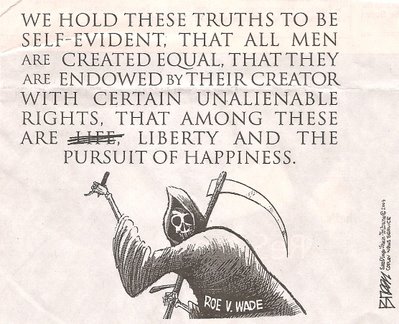
Shamelessly ripped off from Into the Deep.
Also go read Mark's thoughtful View from Ground Zero.
Tags: Catholicism, Christianity
A Little Useless Information
It is a very sad thing that nowadays there is so little useless information. -- Oscar Wilde
"Knitting for Britain" became quite competitive [at school]. Who could knit the fastest or make the longest scarf or make the most noise with his needles? A good many of us took up knitting seriously and made socks, sweaters and woolen hats. We would knit in bed after lights out and, some of us, even more surreptitiously, in chapel. Finally, the headmaster had to take steps to limit the activity.Clinton Trowbridge, "When Knitting Was a Manly Art"
Subscribe to:
Comments (Atom)