Very. I still haven't stopped laughing over this.
At least I'm in good company. Check out the new additions to Amateur Catholic.
There are many Christian circles in which even to admit belief that there is a devil makes one an object of curiosity. In such circles Christ's casting out of devils is never mentioned voluntarily at all; if some amused unbeliever raises the matter, the answer is that Jesus himself knew better, but found it saved trouble to use the language of the people of his own day, who, to a man, were confirmed believers in the devil.
But this view can arise only out of a prolonged abstention from Gospel reading. Jesus was not that sort of person. On a matter of no importance he might have used ordinary ways of speech. But he would never have used a way of speech, however ordinary, that was based on a religious error. When his disciples assumed that a man was born blind either because of sins he would one day commit or sins his parents had already committed (Jn 9:2), he told them plainly that neither of them was the cause.
Further, when we come to read some of the accounts of expulsions of demons, we should feel that he would have been carrying the use of popular ideas and popular language rather far, if he did not believe that there were any demons there. For he spoke to them, commanded them, questioned them, granted a request made by them, ordered them to be silent about himself. Further still, when he sent the Twelve out on their first mission without him, he expressly gave them the power to cast out devils (Mt 10:8)...
... there can be similarity between diabolic possession and nervous disease: the Catholic Church makes strenuous efforts to be sure that demons are actually present before she resorts to exorcism: it is possible even for the very skilled to be deceived — to the amusement, perhaps, of such demons as happen to be watching from the sideline. But Jesus could not be mistaken. At times we find him treating deafness, dumbness (Mk 7:32-35), blindness (Mk 8:22-26), with no mention of demons, his commands being addressed only to the afflicted body or the bodily affliction.
I have said that he orders demons out. It is fascinating to compare the speed and almost casualness of his exorcisms with the form prescribed in the Church — which occupies thirty pages of the Rituale Romanum...
He [Jesus] simply ordered the demons out, exactly as he had ordered their leader away after the third temptation. And they had to go. They might plead, they might abuse, but they went. Their inability to resist his word must have convinced them, as no miracle could, that he was something new in the world.To Know Christ Jesus by Frank Sheed
When believers receive Holy Communion, they're intimately united with their Lord and Savior, Jesus Christ. However, Communion isn't limited to the communicant (the one receiving Holy Communion) and Jesus Christ. By taking Holy Communion, the Catholic is also expressing union with all Catholics around the world and at all times who believe the same doctrines, obey the same laws, and follow the same leaders. This is why Catholics (and Eastern Orthodox Christians) have a strict law that only people who are in communion with the Church can receive Holy Communion. In other words, only those who are united in the same beliefs — the seven sacraments, the authority of the pope, and the teachings in the Catechism of the Catholic Church — are allowed to receive Holy Communion.
In Protestant tradition, Communion is often seen as a means of building unity among various denominations, and many have open Communion, meaning that any baptized Christian can take Communion in their services. Catholics and Eastern Orthodox Christians, on the other hand, see communion not as the means but as the final fruit of unity. So only those in communion can receive Holy Communion. It has nothing to do with who's worthy...
Similarly, Catholics who don't follow the Church's laws on divorce and remarriage, or who obstinately reject Church teaching, such as the inherent evil of abortions shouldn't go to Communion, because they're no longer in communion. It's not a judgment on their moral or spiritual state, because only God can know that. But receiving Holy Communion is a public act, and therefore, it's an ecclesiastical action requiring those who do it to be united with all that the Church teaches and commands and with all the ways that the Church prays.Catholicism for Dummies by John Trigilio
What happened in Fairmont, West Virginia, on July 5, 1908?Aren't y'all glad that we all got these trivia style daily calendars for Christmas?
A special church service memorialized the fathers among some 350 West Virginia coal miners who had died in an accident the previous December; many consider the observance to have been the first formal celebration of Father's Day. The holiday was not officially established until 1972, when President Richard Nixon signed it into law. (It is observed on the third Sunday in June, however, not in July.)
Of all seven sacraments, the Holy Eucharist is the most central and important to Catholicism, because of the staunch belief that the consecrated bread and wine are actually, really, truly, and substantially the body and blood, soul and divinity of Christ. For Catholics, the presence of Christ in the Holy Eucharist is not just symbolic, allegorical, metaphorical, or merely spiritual. It's real. That's why it's also called the Real Presence —because Christ really is present.Catholicism for Dummies by John Trigilio

RAISED FROM THE DEADThis is the great truth which fills our faith with meaning. Jesus, who died on the cross, has risen. He has triumphed over death; he has overcome sorrow, anguish and the power of darkness ... In him we find everything. Outside of him our life is empty (J. Escriva, Christ is passing by).In Conversation With God: Lent and Eastertide

THE SEPULCHRE OF JESUS' BODY
The Body of Christ lay in the tomb. The world was in darkness. Mary was the only light still burning on earth. The Mother of Our Lord -- my Mother -- and the women who have followed the Master from Galilee, after taking careful note of everything, also take their leave. Night falls.
Now it is all over. The work of our Redemption has been accomplished. We are now children of God, because Jesus has died for us and his death has ransomed us. "Empti enim estis pretio magno (1 Cor 6:20), you and I have been bought at a great price.
We must bring into our own life, to make them our own, the life and death of Christ. We must die through mortification and penance, so that Christ may live in us through love. And then follow in the footsteps of Christ, with a zeal to co-redeem all mankind. We must give our life for others. That is the only way to live the life of Jesus Christ, and to become one and the same with him (J. Escriva, The Way of the Cross, Fourteenth Station).In Conversation with God: Lent and Eastertide

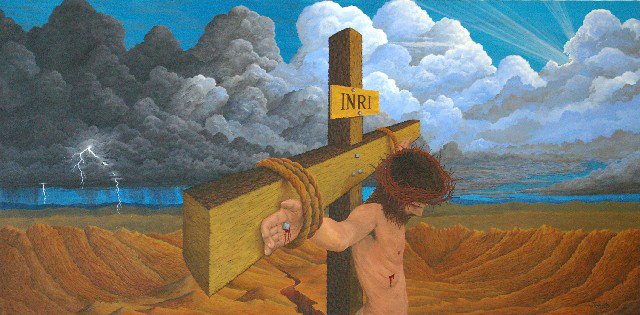
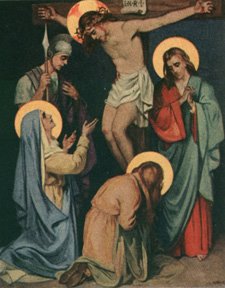
JESUS DIES ON THE CROSSThe Lord is firmly nailed to the cross. He has waited for this for many years, and this day He is to fulfill his desire to redeem all men ... What until now has been an instrument of infamy and dishonor, has been converted into the tree of life and the stairway of glory. A deep joy fills him as he extends his arms on the cross, for all those sinners who will approach him will now know that he will welcome them with open arms...
He saw -- and this filled him with joy -- how the cross was to be loved and to be adores, because he was going to die on it. He saw the witnessing saints who for love and in defence of the truth were to suffer a similar martyrdom. He saw the love ofhis friends; he saw their tears at the foot of the cross. He saw the triumph and the victories Christians would achieve under the standard of the cross. He saw the great miracles which, with the sign of the cross, would be performed throughout the world. He saw so very many men who, with their lives, were going to be saints, because they would know how to die like him, overcoming sin (L. de la Palma, the Passion of the Lord) ...
It was not necessary for him to undergo so much torment. He could have avoided those trials, those humiliations, that ill-usage, that iniquitous judgement, and the shame of the gallows, and the nails and thelance ... But he wanted to suffer all this for you and for me. And we, are we not going to respond?
Very likely there will be times when, alone in front of a crucifix, you find tears coming to your eyes. Don't try to hold them back ... But try to ensure that those tears give rise to a resolution. (J. Escriva, The Way of the Cross, Eleventh Station).In Conversation with God: Lent and Eastertide
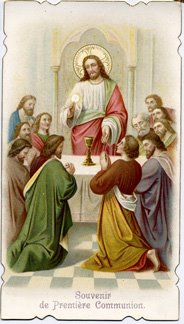
Singular events took place in that period, which the evangelists have recorded for us; take, for instance, the rivalry between the apostles, who began to discuss who was the greatest; think of Jesus' surprising example of humility and of service when he carried out the menial task of the lowest of the servants -- he began to wash their feet; consider, too, how Jesus went out of his way to show his disciples his love and affection. My little ones, he actually calls them. Christ himself wished to give that gathering such a fullness of significance, so rich in memories, scene of such moving words and sentiments, such new actions and precepts, that we will never come to an end of meditating on them and exploring them. It was, you might say, a testimonial dinner: it was an affectionate and yet a somber occasion, a time mysteriously revealing divine promises and far-reaching visions. On top of that was the sad presentiment of death, with unprecedented omens of treason, of abandonment, of immolation; the conversation dies away, while Jesus' words flow continuously in his gentle and winning voice, though there is an unwonted tension in his grave allusion to profound revelations, the matter of which hovers between life and death (Paul VI, Homily, Holy Thursday).THE LORD'S LAST SUPPER
What Christ did for his own may be summarized in a few words from St. John: he loved them to the end (John 13:1). Today is a particularly appropriate day for mediating on the love Jesus has for each one of us, and how we respond to it; in regular dealings with him, in love for the Church, in acts of atonement and reparation, in charity towards others, in preparation and in thanksgiving for Holy Communion, in our desire to co-redeem with him, in our hunger and thirst for justice ...In Conversation With God: Lent and Eastertide

THE WAY TO CALVARYForming part of the procession, their presence making his impending death yet more shameful, are two convicted criminals, described as two thieves. A recently-arrived spectator to the scene would see three men, each laden with a cross, walking towards death. But only one is the Saviour of the world. Only one of the crosses is the redeeming Cross.
Today, too, the cross can be carried in different ways. There is the cross carried furiously or sullenly, in a rage; man writhes and squirms, filled with hate, or at least, with a deep and burning resentment. It is a cross without meaning and without any explanation, useless; such a cross may even separate one from God. It is the cross of those in this world who seek comfort and material well-being, who will put up with neither suffering nor setbacks, for they have no wish to understand the supernatural meaning of pain. It is a cross which does not redeem. It is the cross carried by one of the thieves.
On the road to Calvary is a second cross, carried this time with resignation, perhaps even with some dignity, with an acceptance of the situation simply because there is no alternative to it. This is the one carried by the other thief. Little by little he realizes that close by him is the sovereign figure of Christ, who will radically change the final moments of his life on earth, and for eternity; he will be the one converted into the good thief.
There is a third way of carrying the cross. Jesus embraces the saving wood and teaches us how we ought to carry our own cross: with love, co-redeeming all souls with him, making reparation at the same time for our own sins. Our Lord has conferred on human suffering a deep meaning. Being able, as he was, to redeem us in a multitude of ways, he chose to do so through suffering, for greater love has no man than this, that a man lay down his life for his friends (John 15:13).In Conversation with God: Lent and Eastertide
Peasant: I didn't expect a kind of Spanish Inquisition.
Cardinal Ximinez: Nobody expects the Spanish Inquisition! Our chief weapon is surprise...surprise and fear...fear and surprise.... Our two weapons are fear and surprise...and ruthless efficiency.... Our *three* weapons are fear, surprise, and ruthless efficiency...and an almost fanatical devotion to the Pope.... Our *four*...no... *Amongst* our weapons.... Amongst our weaponry...are such elements as fear, surprise.... I'll come in again.

The Passion of Our LordThinking that in this way he might placate the hatred of the Jews, Pilate, took Jesus and scourged him (John 19:1). This is the scene we contemplate in the second sorrowful mystery of the Rosary, Bound to the pillar. Covered with wounds.
BEFORE PILATE: JESUS CHRIST, THE KING
The blows of the lash sound on his torn flesh, upon his undefiled flesh, which suffers for your sinful flesh. More blows. More fury. Still more ... It is the last extreme of human cruelty.
Finally, exhausted, they untie Jesus. And the body of Christ yields to pain and falls, limp, broken and half-dead.
You and I cannot speak. Words are not needed. Look at him, look at him ... slowly.
After this ... can you ever fear penance? (J. Escriva, Holy Rosary, Second Sorrowful Mystery)
When this has happened, the soldiers plaited a crown of thorns, and put it on his head, and arrayed him in a purple robe; they came up to him, saying, "Hail King of the Jews!" and struck him with their hands (John 19:4-5). Today as we contemplate Jesus proclaiming his kingship before Pilate, we should also meditate upon that scene contained in the third sorrowful mystery of the Rosary.
The crown of thorns, driven in by blows, makes him a mock king ... And with their blows they wound his head. And they strike him ... and spit on him ...
You and I ... haven't we crowned him anew with thorns and struck him and spat on him?
Never again, Jesus, never again ... (J. Escriva, Holy Rosary, Third Sorrowful Mystery)In Conversation with God: Lent and Eastertide


The Passion of Our Lord
PETER'S DENIALS
Jesus having been much ill-used, is led into one of the courtyards. He then turned and looked at Peter (Luke 22:61). Their looks meet. Peter would like to bow his head, but he cannot tear his eyes from Him, Whom he has just denied. He knows the Saviour's looks well; that look that had determined his vocation, he had not been able to resist either its authority or its charm; and that tender look of the Master's on the day He had affirmed, looking at His disciples, "Here are my brethren, my sisters, my mother!" And that look that had made him tremble when he, Simon, had wanted to banish the Cross from Jesus' path! And the affectionately pitying look with which he had invited the too-rich young man to follow him! And His look, clouded with tears, before Lazarus' tomb ... He knows them well, the Saviour's looks.
And yet never, never had he seen on the Saviour's face the expression he sees there at this moment, the eyes marked with sadness but without any severity. A look of reproach without a doubt, but which becomes suppliant at the same time and seems to repeat to him, "Simon, I have prayed for thee!"
This look only rests on him for an instant; Jesus is violently dragged away by the soldiers, but Peter sees Him all the time (G. Chevrot, Simon Peter). He sees that compassionate look of Jesus fixed upon the deep wound of his guilt. He now understands the enormity of his sin, and the fulfillment of Our Lord's prophecy about his betrayal ...
Contrition gives special strength to the soul; it restores hope, makes the Christian forget himself and draw close to God once more with a deeper act of love. Contrition proves the quality of interior life and always attracts God's mercy; ... this is the man to whom I will look, he that is humble and contrite in spirit ... (Isaiah 66:2)
Christ found no difficulty in building his Church upon a man who was able to fall and who did fall. God also counts on weak instruments, provided they repent, to carry out his big project: the salvation of mankind.In Conversation with God: Lent and Eastertide