Friday, December 16, 2005

It Ain't Necessarily So: Stem Cells

SEOUL (Reuters) - Key parts of a landmark paper from South Korea's most renowned stem cell scientist were fabricated and the researcher is seeking to have the work withdrawn, a close collaborator told South Korean media on Thursday...

Roh told media nine of the 11 stem cell lines that were part of the tailored stem study paper were fabricated and the authenticity of the other two was questionable.

According to recent reports in South Korean media, some of the photographic images of the stem cells lines may have been manipulated to make it appear as if there were 11 separate lines.
Skipping ahead a bit in the The Politically Incorrect Guide to Science, this quote seems prescient when taken into account with the happenings above.
For years it was not stem cells but gene therapy -- the idea of fixing a disease by mending broken DNA -- that seemed to be the ultimate expression of molecular medicine. Cures, we were told, lay just around the corner. Unfortunately, success turned out to be much harder to achieve in people than to diagram on a chalkboard ... Realization that the promised cures were years away finally burst the bubble. Today, a disappointingly small number of hardy investigators remain in what was once medicine's most highly anticipated new area of research.

Is this going to be the fate of embryonic stem cell science in five or ten years? I hope not, and yet it's also not very difficult to imagine this happening. Already newspapers are filled with extravagant claims of progress and cures. These reports belie the very slow rate of true scientific advancement. Add to this the explicit expectation of rapid clinical progress ... and you have a recipe for trouble.
David A. Shaywitz,
Harvard stem cell researcher,
Washington Post, April 29, 2005
UPDATE: Get Religion has a good story with links about the cloning superstar's "feet of clay."

Dialogue

For all these years I had thought of doubt and faith as mutually exclusive opposites. Also faith and reason, faith and despair, faith and fear. I had thought that as long as I still had doubt, I could not have faith. For all these years, I had assumed that god did not want to hear from me until I had resolved my doubts and vanquished my uncertainty.

But that Thursday night in April with the Virgin Mary sleeping in the room next door, it suddenly occurred to me that I was wrong. Maybe this endless internal monologue need not be a monologue at all. Maybe it was meant to be a dialogue. Perhaps, for all these years, I had not needed to be talking to myself. Perhaps, for all these years, I could have been talking to God. Perhaps that night, when I thought I was thinking, really I was praying.

Perhaps it was more important to ask these questions than to have all the answers. Perhaps God was just as interested in hearing about my doubts as anything else. I finally understood that just as, according to Heisenberg's uncertainty principle, a system is changed by the observer, so I, too, was being changed forever by asking the questions in the first place. I finally understood that my uncertainty and my doubt were gifts that made me the perfect candidate for faith.
Our Lady of the Lost and Found
by Diane Schoemperlen
Because the person who keeps questioning and looking will be answered in the end. Seek and ye shall find, knock and the door shall be opened. People who think that God expects certainty and perfect faith and therefore turn away don't understand that doubt and questions are the human condition. Good thing for us that God knows it. And He never gives up on us. Never.

Thursday, December 15, 2005

Peddling Fear

Stanford climatologist Stephen Schneider, winner of a MacArthur Fellow "genius" award in 1992, was quoted as saying: "We have to offer up scary scenarios, make simplified, dramatic statements, and make little mention of any doubts we might have. This 'double ethical bind' we frequently find ourselves in cannot be solved by any formula. Each of us has to decide what the right balance is between being effective and being honest. I hope that means both."
Discover, October 1989, quoted in
The Politically Incorrect Guide to Science
This seems to me to be a rare moment of unguarded honesty in how much of science operates today. Perhaps something we should all keep in mind?

I Just Can't Put This Book Down

Garlic and Sapphires : The Secret Life of a Critic in Disguise by Ruth Reichl

I tried Reichl's first two memoirs attracted by the food writing connection but, let's face it, I just don't like the grittiness that comes with some memoirs and Reichl's were of that sort to me. This book, however, is nothing like that as Reichl is telling about her struggles to stay "under cover" as when it is announced she will be the next NY Times food critic her photo is plastered all over restaurant kitchens throughout the city. She also tells about her struggles to change the sorts of restaurants that the Times covers, including a hilarious recounting of her interview where she tried her hardest to be so outrageous that they wouldn't offer her the job. I am only partway through but this book is a great read for anyone interested in food writing ... or any writing.

Defending the Faith and Contentiousness, IV

Previously on Happy Catholic ... part I.
You may ask, "What do you do when your opponent utters nonsense against Christ or the Church?" It is easier to say what you should not do. The general rule the Catholic Evidence Guild followed was never to make a joke at the expense of someone who offers a question or comment, even a hostile or foolish one. The best advice in that regard I ever personally received came from Karl Keating, who said, "Let your opponent's foolishness speak for itself. Your job is to present the truth as winsomely as possible." After all, what do you really accomplish in a battle of wits with a food. If you belittle or make jokes about him, it probably will reflect badly on your and your message...

... When Catholic apologists become contentious, their good sense sometimes disappears and too often with it, any consideration the non-Catholic might have given to the faith. Here the apologist would do well to remember 1 Peter 3:15 and 16. "Always be prepared to make a defense to anyone who calls you to account for the hope that is in you," Peter writes, adding, perhaps with the contentious apologist in mind, "yet do it with gentleness and reverence; and keep your conscience clear, so that, when you are abused, those who revile your good behavior in Christ may be put to shame."

Wednesday, December 14, 2005

Global Warming and Volatility

Yesterday's post, which was an excerpt of three bullet points about global warming from the Politically Incorrect Guide to Science, certainly set off some interesting comments. I appreciate everyone's civility in that exchange of ... I can't say ideas ... science beliefs might be the better term.

I think what I find more fascinating than anything else is how three little bullet points with no other details set off negative commentary that spoke as if they knew what the author's support for those points was ... without ever asking questions for further information or reading the book themselves to see if there was, perhaps, evidence that these people hadn't considered.

That, more than anything, showed me what ingrained beliefs we hold about these scientific theories. As I mentioned in my mini-review I know that stunned feeling at seeing "what everybody knows" challenged and I can empathize with the desire to do the best thing that motivates people on both sides.

Previously I was just going to post the provocative bullet points that lead each chapter (yes, I was "poking" to see what happened). However, I believe I will give a few more excerpts than I intended just to give a sample of where the author is coming from. I am not taking any of these theories up as causes to promote, although I do find the author's information to make sense in many cases. This is just because I found the information interesting and thought provoking. I am hoping that people will ask a few more questions and be a little inclined to consider the possibility that "what everybody knows" ain't necessarily so.

Think of health information and how often it changes. For example, I recently saw a study where scientists are now saying that the "glass a day" of wine may not be a good idea after all. This is after we have been told with surety that a glass a day is the way to good health and long life. And before that concept was promoted that we were told the sure way to health and long life was no alcohol at all. So I do not find it mind boggling that scientific theories about other disciplines could easily have led both scientists and the public astray.

If nothing else I certainly now appreciate the scientists who have gone on the record as having a different theory. It shows me how sure they must be of their theories to risk such ridicule from their peers. They are putting their professional reputations on the line. I am doing nothing more than risking becoming known as the "Flat Earth Catholic" or some other clever name.

The question is, are we open minded enough to explore the possibilities ... whether they turn up as dead ends or as valid theories?

Ordinary People in History

... Imagine all the chronologists making their lists and checking them twice. Imagine every single thing that has ever happened falling into place and staying there.

When I began to read about Mary after she left, I turned naturally enough to these chronologies. I already knew that she was reported to have made more than twenty thousand appearances in the past two hundred years. But I found that in these books she made few or no appearances at all. In a chronology of women's history, she was listed only five times, as having given birth to Jesus in 1 A.D., as having given rise to a cult-following by 1100, as having appeared to Juan Diego in Mexico in 1531, to Catherine Laboure in Paris in 1830, and to Bernadette Soubirous at Lourdes in 1858. She was not mentioned at all in any of the other books.

How can this omission be explained in light of the fact that Marian veneration has flourished around the world ever since her death in the first century? How is it that the most influential, inspirational, and significant woman in the history of the world is not accorded a single mention in most standard history books?

Despite having been thus rendered virtually invisible by most secular historians, Mary has not become a quaint and feeble anachronism. She has remained an important and ongoing part of history. Like most people, she has continued to exist as both a part or and apart from history.
Our Lady of the Lost and Found
by Diane Schoemperlen
Maybe that is why Catholics love Mary so much. In spite of being the Mother of God, the Immaculate Conception (which means that she was born without sin not that she didn't have a human father, by the way) ... in spite of her pure holiness, she was an ordinary woman in an ordinary time in history. She has been largely ignored by the historians just the way we all will be (no doubt). But she shows us how to live a holy life and she shows us her son. The historians don't care about that. It is hard to measure. But we care and that is a big part of why we love her.

Tuesday, December 13, 2005

Guess What: Global Warming

  • Environmentalists not so long ago believed the earth was cooling.
  • The earth surface temperature suggests that manmade greenhouse emissions have not been sufficient to increase global temperatures.
  • The Kyoto Treaty, which bound signatories to reducing greenhouse emissions, would have caused a depression in the United States.

Monday, December 12, 2005

It Ain't Necessarily So

1,500 years ago, everybody "knew" that the earth was the center of the universe. 500 years ago, everybody "knew" that the earth was flat. And 15 minutes ago, you "knew" that humans were alone on this planet. Imagine what you'll "know" tomorrow.
THE POLITICALLY INCORRECT GUIDE TO SCIENCE
This interesting book looks at the effects of scientists becoming more politicized and how it has affected what "everybody knows."

I still remember a few years ago when I read the evolution had a few holes in it (for example that chart with the little horses becoming big horses is conjecture not based on fossil findings) ... it truly rocked my world's foundation because I thought it was rock solid, proven, and settled. The same thing happened a year or so later when reading about global warming. By the time I read an article disputing "common knowledge" about overpopulation I was more prepared.

However, this book takes on more than these subjects. For instance, the chapter about DDT rocked my world again. As well as the chapter about AIDS in Africa. The amount of conjecture that takes place with studies then done to support those findings is staggering. Also, the role of media in refusing to publicize conflicting studies is appalling. Often this happens even when the new studies are done by the original scientists as a follow up and published to refute or clarify earlier findings.

This sounds like a crank book, I admit. However, one of its strengths is that it is written by a journalist, not a scientist with a specific point to prove. It also serves more as an overview of these subjects, leading the reader to more indepth works on the various subjects if they are interested.

I encourage y'all to check this book out, if only to make us more aware that the government and general scientific consensus aren't always based on solid studies. The days when we can blindly accept scientific findings are gone thanks to the way science has abused our trust to get government funding. A healthy skepticism is called for and, if nothing else, this book helps remind us of that fact.

Naturally, I'll be posting interesting bits every so often.

Our Lady of Guadalupe


MEMORIAL
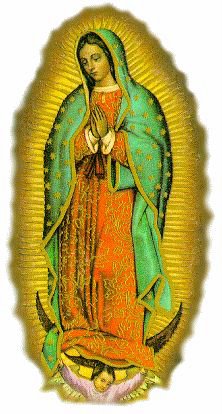
The Blessed Virgin Mary appeared to Juan Diego on Tepayac hill near Mexico City on the 9th of December 1531 to ask for the construction of a church there in her honour. After the miraculous cure of his uncle, Bernardo, this Indian peasant brought to his Bishop some roses that he received from Our Lady as a sign of her request. As the flowers fell from his cloak to the ground before the astonished Prelate, the image of the blessed virgin, which is venerated in the Basilica of Guadalupe to this day, was miraculously impressed on the simple garment before their eyes.

What has always fascinated me is the symbolism of the image that was on the cloak. TSO says:
One of the interesting things about the image of Our Lady of Guadalupe is its teaching potential. Though she looks glorified, with stars and rays of sun coming from her as was predicted in Rev. 12, she is no goddess. Her hands are folded in supplication, her posture indicating that she is interceding for us at the throne of the God.
Indeed, he is right. There is so much in that image that speaks to Catholic hearts through symbolism.

However, there is much more to Our Lady of Guadalupe's image than that. As with all good Catholic images there is abundant symbolism that was specifically designed to speak to the hearts of the people to whom she brought her message ... the Aztecs. I remember when our priest put out a flyer about this and I was just knocked out at how meaningful every single thing in the image is. I really like this explanation.
The miraculous image produced on the apron or tilma of Blessed Juan Diego is rich in symbolism. The aureole or luminous light surrounding the Lady is reminiscent of the "woman clothed with the sun" of Rev. 12:1. The light is also a sign of the power of God who has sanctified and blessed the one who appears. The rays of the sun would also be recognized by the native people as a symbol of their highest god, Huitzilopochtli. Thus, the lady comes forth hiding but not extinguishing the power of the sun. She is now going to announce the God who is greater than their sun god.

The Lady is standing upon the moon. Again, the symbolism is that of the woman of Rev. 12:1 who has the "moon under her feet". The moon for the Meso-Americans was the god of the night. By standing on the moon, she shows that she is more powerful than the god of darkness. However, in Christian iconography the crescent moon under the Madonna's feet is usually a symbol of her perpetual virginity, and sometimes it can refer to her Immaculate Conception or Assumption.

The eyes of Our lady of Guadalupe are looking down with humility and compassion. This was a sign to the native people that she was not a god since in their iconography the gods stare straight ahead with their eyes wide open. We can only imagine how tenderly her eyes looked upon Blessed Juan Diego when she said: " Do not be troubled or weighed down with grief -- Am I not here who am your Mother?"

The angel supporting the Lady testifies to her royalty. To the Meso-American Indians only kings, queens and other dignitaries would be carried on the shoulders of someone. The angel is transporting the Lady to the people as a sign that a new age has come.

The mantle of the Lady is blue-green or turquoise. To the native people, this was the color of the gods and of royalty. It was also the color of the natural forces of life and fecundity. In Christian art, blue is symbolic of eternity and immortality. In Judaism, it was the color of the robe of the high priest. The limbus or gold border of her mantle is another sign of nobility.

The stars on the Lady's mantle shows that she comes from heaven. She comes as the Queen of Heaven but with the eyes of a humble and loving mother. The stars also are a sign of the supernatural character of the image. The research of Fr. Mario Rojas Sanchez and Dr. Juan Homero Hernandez Illescas of Mexico (published in 1983) shows that the stars on the Lady's mantle in the image are exactly as the stars of the winter solstice appeared before dawn on the morning of December 12, 1531.

The color of the Madonna's dress is rose or pale-red. Some have interpreted this as the color of dawn symbolizing the beginning of a new era. Others point to the red as a sign of martyrdom for the faith and divine love.

The gold-encircled cross brooch under the neck of the Lady's robe is a symbol of sanctity.

The girdle or bow around her waist is a sign of her virginity, but it also has several other meanings. The bow appears as a four-petaled flower. To the native Indians this was the nahui ollin, the flower of the sun, a symbol of plenitude. The cross-shaped flower was also connected with the cross-sticks which produce fire. For them, this was the symbol of fecundity and new life. The high position of the bow and the slight swelling of the abdomen show that the Lady is "with child". According to Dr. Carlos Fernandez Del Castillo, a leading Mexican obstetrician, the Lady appears almost ready to give birth with the infant head down resting vertically. This would further solidify her identification with the woman of Rev. 12 who is about to give birth.
You can read about this apparition of Our Lady in more depth here.

UPDATE
Some more about conditions in Mexico at the time Our Lady appeared as well as a prayer for abortion victims from Jean at her new blog, Ave Maria. She also provides a link to further symbolic information.

God or the Lottery?

"The funny thing about lottery tickets," Mary mused as we waited in line at the cash register, "is that people keep buying them even if they never win. Week after week, month after month, year after year, still they never give up hope. But if they pray for something two or three times, they expect immediate results, and if it doesn't happen, then they say that God is unfair, disinterested, or dead. Why is it easier to keep believing in the lottery than in God?"
Our Lady of the Lost and Found
by Diane Schoemperlen

Sunday, December 11, 2005

See Ya Soon, Raccoon!

I'm going to stay off the computer until Monday. Comments and e-mails will be returned then. Enjoy sunday, y'all!

Saturday, December 10, 2005

A Little Useless Information

Words with all the vowels in alphabetical order:
  • Abstemious
  • Abstentious
  • Arsenious
  • Caesious
  • Facetious
  • Fracedinous

Friday, December 9, 2005

Want to See One of the Winners in the Great Cookie Swap?

Yes, you're lookin' at her.

Well, you would be if you were over at Meanwhile, Back in the Kitchen. Go check it out. And they have a real prize for winning. I must say the food blogs know how to have a good time.

I Don't Care Enough

Steven Riddle has been writing about prayer. Go read this.

Bottom line. In my heart of hearts, I know this. Every time I choose something else over "prayer time" (which is all too short as it is), I am telling God that I don't care enough.

This flows perfectly into Fr. O's homily from yesterday when he talked about God walking in the Garden of Eden calling Adam. "Where are you?"

He then went on to say that God is always calling us to him the same way.

It made me think that God has been calling us to him always. God knows where we are. God calls us so that we will think about Him, think about where we are and how to get to Him.

Fr. O. went on to say that we have to get our hearts to a place where we hear Him, where we answer Him, where there is nothing keeping us from Him.

Which, for any good Christian, leads to examination of conscience. And, for any good Catholic, very often leads to the confessional.

God already knows everything we have done, good and bad. For us to take the steps to examine our consciences and see what is keeping us from answering is not telling Him anything He doesn't already know. We aren't telling the priest anything he hasn't heard before. We are the ones who need to say it, who need to hear it.

To do otherwise, is to turn our backs to Him, to refuse to come when He calls us. To not care enough.

Here is what I will be using ... an Advent examination of conscience from Word Among Us.
The following examination of conscience is meant to help you prepare for Confession. Take your time as you answer these questions. Let the Spirit’s still, small voice speak to you words of hope and mercy.

Believe that Jesus didn’t come to condemn but to forgive. So let him wash you clean. Then, you too will be able to say, “We have seen his glory” (John 1:14).

“ ‘Come,’ my heart says, ‘seek his face!’ Your face, Lord, do I seek.” (Psalm 27:8)
  • Does God hold first place in my life, or have I become the servant of something or someone else?
  • Have I given priority to God on Sundays and holy days by attending Mass and making a special effort to seek him?
  • Do I safeguard my time of prayer and Scripture reading so that I can open myself to God’s love and direction every day?

“The glory that you have given me I have given them, so that they may be one, as we are one . . . so that the world may know that you have sent me.” (John 17:22-23)
  • Have I pursued unity in my relationships with others, or have I eroded it by my words, attitudes, and actions?
  • Have I lied or gossiped about other people in a way that tarnished their reputation?
  • Do I give appropriate honor and respect to my parents and all legitimate authority?
  • Is there anyone I need to forgive? Is there anyone whose forgiveness I need to ask?
  • Do I treat my body with respect, or have I abused it through the willful misuse of drugs, alcohol, or food?
  • Am I following Jesus’ teachings on sexual morality? Do I indulge in lustful thoughts and sexual fantasies? Have I committed sins of impurity?

“Let your light shine before others, so that they may see your good works and give glory to your Father in heaven.” (Matthew 5:16)
  • How have I shown compassion and concern for the poor, less fortunate, sick, and suffering?
  • Am I helping to build a culture of life?
  • Have I resisted the Spirit’s invitations to speak the truth or spread the gospel out of fear of what others might think?

What other areas of my life does the Holy Spirit want to cleanse so that I can be transformed into the image of Jesus, “from one degree of glory to another” ?(2 Corinthians 3:18)?

Lord, let your glory be revealed—in the world, in your church, in me!

Heroes, Anti-Heroes, and Underdogs

So, about that school assignment that had Rose watching Payback ...

I thought this was an intriguing way to get the kids to actually think about the role of heroes in movies and in our society today. Rose's English class has just finished reading and discussing The Odyssey. To take it a step further the teacher had them write a paper about one of three categories, each containing five movies, how they are targeted to their audience, and how they handle heroes. They discussed the major themes of the categories in class. The categories were:

Children's Movies
(Rose says that the class never came to a definite conclusion in their discussions of this category but it seems pretty clear that it looks at the underdog who rises above adversity to become heroic ... which would make perfect sense for appealing to children.)

Lady and the Tramp
The Sword in the Stone
Lion King
Hercules
Robin Hood

Teenage Movies
(Examines the anti-hero whose main feature is that they are extremely loyal to their group, not nearly as bad as the people they are overcoming, and there is a high level of coolness.)

Die Another Day
The Italian Job
Payback
The Matrix
Ocean's Eleven

Oscar Winners
(This category focuses on the epic hero.)

Gladiator
Braveheart
The Last Samurai
Crouching Tiger, Hidden Dragon
Saving Private Ryan
Interesting assignment eh? The only problem with the whole thing is that I think the teacher missed two of the picks for the Teenage category.

Payback is rated "R." That in itself is a disqualification for being aimed at a teenage audience who couldn't get in to see it. Also, although Porter fits the anti-hero category (just squeaking in with one or two good traits), there is very little to admire. Neither he nor the movie exudes the element of style needed to be cool enough for mere looks to attract a teen audience either. The teacher admits this is one of his favorite movies (and I can see why) but I think he forced it into that category.

The Matrix does try to paint Neo with a touch of anti-hero at the very beginning of the movie. But that is so little touched upon and so quickly abandoned in favor of the young hero-in-training that it is soon forgotten. Throughout most of the movie Neo is a Christ-figure and a hero. Period. It's totally cool enough but that alone doesn't justify it's inclusion in this category (rewatching this with Rose I realized I had forgotten just how freakin' cool it was).

Hannah maintains that a better choice than The Matrix would have been Equilibrium and I agree that it's a better movie, though I liked The Matrix better on this second viewing than I did the first time around. However, I am pretty sure few of the kids have watched Equilibrium and Preston also is not an anti-hero because as soon as he realizes the truth he starts righting wrongs.

So what would have been better choices?

Instead of Payback, how about Matchstick Men a similar "flavor?" You don't get much more of an anti-hero than Nicholas Cage's character. As for style, granted it is that of the 60's more than today but that is more than compensated for by the sheer attraction of watching the con go on. Another choice that seems to fit would be O Brother Where Art Thou. Anti-hero and old-time charm carried by wit and ... wait for it ... a story inspired by The Odyssey itself.

Replacing The Matrix is even easier. Going for the sci-fi angle we can see that either X-Men or X-2 has Wolverine who barely even fits into his own group because he is such a rebel. Even better, but not out until Dec. 23 on DVD, would be if the teacher considers Serenity ... the ultimate cool anti-hero sci-fi story. The captain plays by his own set of rules and often is hardly sure what they are. Indeed, he is taken to task by his own first mate at one point for his inhumanity. His loyalty is to his group and that alone. Throw in the action, adventure, and humor and it's a tale of anti-hero triumph that any teen loves ... and all that I know did (ok, I did too but what can I say? Y'all know I'm a little backwards a lot of the time!)

More Holiday Baking

Check it out at Meanwhile, Back in the Kitchen.

Defending the Faith and Contentiousness, III

Previously on Happy Catholic ... part I.
The core of Catholicism is an affirmation, not a denial. It is the Triune God and God's self-donating love and mercy toward us. It is communion with the Father, through the Son, in the Holy Spirit. That, ultimately, is what being a Catholic is all about. We Catholics should defend the Church, because we believe that the Catholic Church is the divinely established sacrament of communion with the Father, through the Son, in the Spirit. But we should not be defensive. We must earnestly contend for the faith (Jude 3) without being contentious (cf. Titus 3:9, 1 Pet. 3:15). ...

Defending the faith is not supposed to be about us but about God and his truth. We should not defend Catholicism because our Church is being attacked; that is the attitude of the nationalist or sectarian. Still less should we be defensive because our personal beliefs are challenged -- as if the Catholic faith were merely a matter of our private philosophy of life or personal theology. No, we should defend the Church because we love God and the Church belongs to him, and because we love our neighbors, and the Church -- on the Catholic view -- is the God-given means of bringing people into full communion with Christ, the only Savior. If we truly belief that, then charity compels us to share the truth of the Catholic faith with others.
To be continued ...

Thursday, December 8, 2005

Immaculate Conception: In the News

The Holy Father's Immaculate Conception homily. Thanks to Bender for bringing this to my attention. Here's a bit but go read it all.
Yes, we can say Mary is closer to us than any other human being, because Christ is man for mankind and all his being is a “being for us”. Christ, said the Fathers, as Head is inseparable from his Body that is the Church, making a sole living subject together with it, so to speak. The Mother of the Head is also the Mother of all the Church; she is, so to speak, totally expropriated from herself; she gave herself entirely to Christ and with Him she is given as a gift to all of us. In fact, the more a human being gives of himself, the more he finds himself. <>The Council intended to say this: Mary is so interwoven in the great mystery of the Church, that she and the Church are inseparable just as she and Christ are.

The Feast of the Imaculate Conception at Mary's House. I never thought about this but how cool would that be to celebrate this feast day at Mary's house? Wow! Read it here. Thanks to The Anchoress, who has a great post up about this feast day, for calling this to my attention.
IZMIR, Turkey -- Not many pilgrims will be clambering up the slopes of Bulbul Dag (hill of the nightingale) where the "House of the Blessed Virgin Mary" is found. It could be because now summer is over, winter has crept in and groups of foreign tourists have melted away; or it may be because Dec. 8 is just another working day in Turkey; then again, perhaps it is because Orthodox Christians and Protestants do not recognize the dogma of the Immaculate Conception.

Yet, Dec. 8, precisely because there will be no vast crowd of people, is sure to be a privileged day for the handful of Catholics who will go there to celebrate Mass with the community of Capuchins and sisters who are custodians of the house.


What Is Your Life Worth?

PAYBACK
Porter knows his worth. $70,000. That is the amount that his erstwhile partner, who now works for the syndicate, stole after double crossing and leaving him for dead. And that is the amount Porter wants back. No more, no less. He will do whatever it takes to get it.

So begins the grittiest movie I have ever seen Mel Gibson in. The director said that he wanted to make a movie in which the protagonist was a bad guy who didn't make excuses. He certainly achieved that. Porter is the anti-heroes "hero" so to speak, a guy who has only one goal and only one redeeming quality, which is his love for Rosie, the requisite hooker with a heart of gold. I suppose he actually could have two redeeming qualities, the second being his stubborn determination to take only the money that was stolen from him. One of the elements that becomes a comic refrain is as he works his way up the chain of command at the syndicate people repeatedly say, "You're doing all this for $140,000?" Porter disgustedly corrects them, "$70,000." And the other bad guys have even less to redeem them.

One of the interesting elements of this movie is that the "bad guys" (which would be everyone) all assume that Porter must have a fairly sophisticated approach hidden behind his tough-guy front. No. What you see is what you get. And when they get used to the idea that Porter is very direct then they assume that he isn't smart. Wrong again. Part of the fun is watching them react to those realizations.

This normally is the sort of movie that we never would enjoy. Tom started watching after happening upon Rose watching it for a school assignment (more in a different post about why Rose was watching an extremely violent, "R"-rated movie for school) and got hooked by the old-style detective narration and film noir atmosphere. We watched the whole thing that evening and by the end were amazed that we watched it ... and loved it. The only conclusion that we could come to is that Mel Gibson pulled it off. He somehow invests his character with a touch of lightness without ever breaking out of character.

HC Rating: **** 9 Thumbs Up!