Red Barn on a Mountain Farm taken by D.L. Ennis at Visual Thoughts
I know he is in Virginia but this really reminds me of driving the back roads in the Ozarks.
Red Barn on a Mountain Farm taken by D.L. Ennis at Visual Thoughts
We have taken aggressive steps to offset rising costs and reduce expenses while preserving the quality you expect from The Dallas Morning News and the convenience of home delivery. ...That makes the annual rate for the paper $252.
It is necessary that we increase 7-day subscription prices by $2.00 per month ... from $19.00 to $21.00 per month.
VERMIN • Although this term now refers to offensive animals of all sizes and kinds, it originally referred to only a single kind of creature, a worm. In Latin, the root was vermis, meaning "worm."The Word Origin Calendar
In times of famine and disaster, the holy bishop exhorted the faithful with passionate words "not to be more cruel than beasts ... by taking over what people possess in common or by grabbing what belongs to all."Or as Ellen Ripley paraphrases pithily in Aliens (you didn't know that St. Basil was in there, did you?):
I don't know which species is worse. You don't see them f*****g each other over for a goddamn percentage!Ah yes. That about sums it up.
Greg was America’s only reporter in the courtroom for every minute of the trials of Enron, Worldcom, Tyco and Martha Stewart. As an investigative reporter Greg dug deep, full time, year after year. “Roy, the SEC is being set up to take the fall for a series of financial disasters,” he said. “This whole Enron thing is just the tip of the iceberg.”Go read it all and check out the links.
“What do you mean?”
“The number of publicly traded companies has grown exponentially in recent years, yet the budget for the SEC had been increased by only a small amount. Think of it this way,” Greg said, "Andy and Barney did a pretty good job patrolling Mayberry, but now they’re being told they have to patrol Los Angeles without any additional help, and without any bullets for their guns.”
 TOMB OF PTAHOTEP 5TH DYNASTY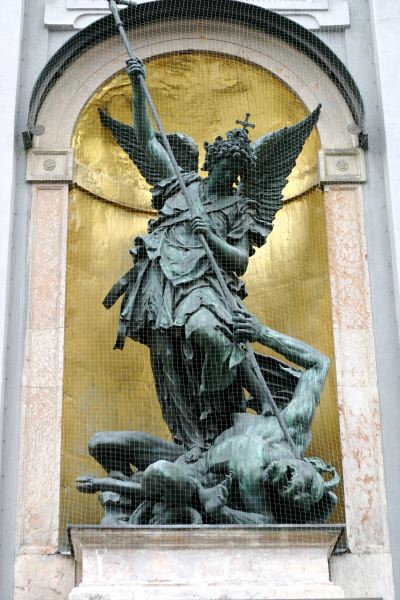
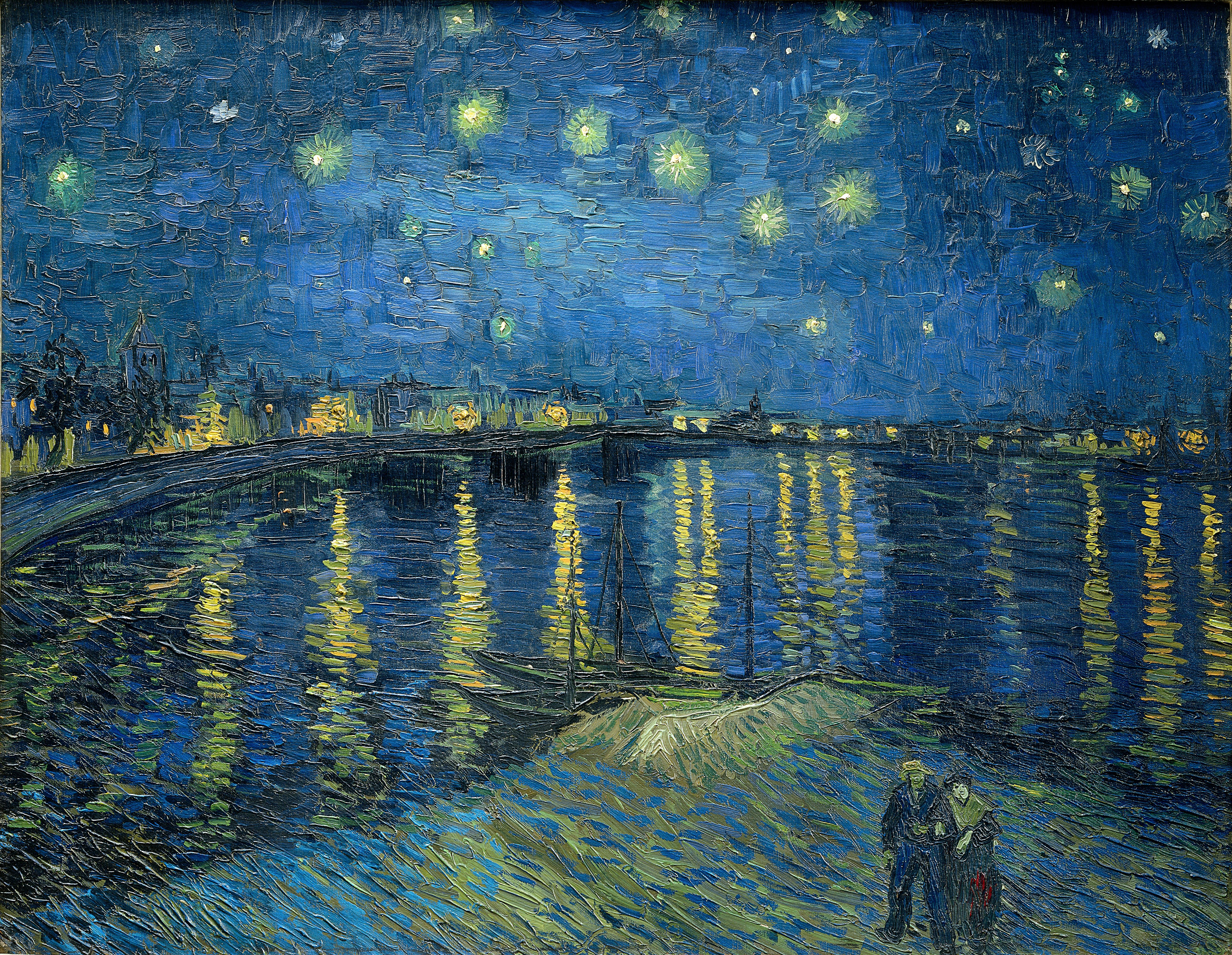
 Starry Night Over the Rhone, Vincent Van Gogh
The parting of the Red Sea, the feeding of the five thousand, the turning of water into wine - miracles. Miracles? Yet miracles have been part of human culture for thousands of years. From beliefs about the shin bone of a saint to ideas about the nature of creation and the laws of nature, miracles have been a measure of disputes within religion and between religion and rationality from St Augustine in the 4th century to David Hume in the 18th. They have also been used by the corrupt and the powerful to gain their perverse ends. Miracles have been derided and proved to be fraudulent and yet, for many, the miraculous maintain a grip on our imagination, our language and our belief to this day.BBC's In Our Time is back from their break with a look at miracles. Anne is a Man reviews this episode and says, among other things:
... A lot of fascinating aspects were touched upon, but the subject flows like fine sand between your fingers; it is so difficult to get a grasp.Read his whole review here.
... this is a weakness that is unlike In Our Time: it was too fragmented. There are glimpses of intelligent and provocative thoughts, but they fleet a bit too easily. Still, this is In Our Time, one of the best podcasts around. But be prepared.
The book went on to spin the tale of a charmed girl named Rapunzel, who spent her days in the tower sewing dresses with a friend. She loved when the witch came to visit and teach songs, including one that made Rapunzel's hair grow longer. But tension arrived: One day, Rapunzel looked out the window and saw a fair in the village nearby. She wanted to go, but the witch was off tending to her garden and couldn't let her out. Fortunately, a prince riding by in his carriage called up to her, "Rapunzel! Why aren't you at the fair?"Joanna Weiss talks about the evolution of fairy tales from dark and frightening to whitewash, sanitized "feel good" tales.
This was not the fairy tale I vaguely recalled from my childhood - the one with the mother who gives up her child, the vindictive witch, the powerless girl trapped high above the ground. This new version was sanitary and safe in a way that modern parents will easily recognize. In an age when some families ban the word "killed" or come up with creative euphemisms to mask the death of goldfish, it's not hard to see why a toy company would reduce Rapunzel's story to its prettiest parts. Real life, presumably, packs enough trauma for children to think about later.
When I was ten, I lived in Pan’s Labyrinth, a place filled to the brim with demons and witches, monsters and swords. I hoped my house was haunted, and I prayed for some supernatural thing to happen to me. I wandered in the woods between housing properties at night and at day, looking for some monster, king, or sage, or looking in the dark sky for some flash of alien light. It wasn’t something fearful; I’d read Herschel and the Hanukkah Goblins, and I knew that monsters could be fooled, even if they were not to be trifled with or ignored. It was people that scared me.I know just what he means. I think, too, that people forget another valuable aspect to the dark side of fairy tales. Not only do children not process them as adults do, but the stories provide valuable lessons for children in dealing with problems later in life. When they are being picked on in the school yard, the last one chosen for baseball, or pointed out as a bad example to the whole class, these stories provide a cultural background that life often is not fair, bad things happen to good people, and that the little guy can win if they keep on trying. Do they think of these things consciously? Nope. But those stories are lurking in the back of their minds nonetheless with valuable lessons for life.
 Rose Window, Santa Maria del Pi Church, Barcelona
 Something happened this week that reminded me of you and one of your posts awhile ago. I had a business lunch date at a restaurant in Silver Spring, MD. I had gone to confession on my way to the restaurant, and I took a new way across the MD ‘burbs to the place. The drive was lovely—Sligo Creek Parkway. I had driven past it often, and I was always curious about just how much the parkway lived up to the name. As it turned out, it was beautiful. It follows the creek up into Montgomery County; the parklands were thickly forested w/ trails and picnic areas. Just beautiful. We were also enjoying temps in the 70s with no humidity. So the sun roof was open, and old Lyle Lovett was playing in the CD player. I arrived in a fine mood.On the related subject of angels, A. Alve left this comment yesterday on one of my angel posts. It was too good to leave buried there.
My lunch date was late, so I hung around outside. As I waited, a very scruffy older man shuffled up to me. He had bad teeth. His remaining hair was uncombed. He wore an old t-shirt and torn jeans. When he got close, I smiled, and he said, “Your light is shining.” I wasn’t expecting an exchange, and I was kind of distracted. I had no idea what he was talking about—my car’s headlights? I smiled again, and said “Excuse me?” He smiled and repeated, “Your light is shining.” I realized that he was talking about me. I thanked him profusely, and he grinned and wandered off. I was touched, and he efforts seriously brightened a day that was already wonderful. ...
I thought immediately of your posts regarding angels, especially the one about the homeless man on the median. A wonderful lesson: God sends his messages to us in humble vessels. You could go on forever from there.
A few years ago, I took a one-week vacation in Geneve, Switzerland. I was flying from Lisbon with a stop in Italy. When I planned my return to Lisbon, I booked an early flight from Geneve to Rome and a late flight from Rome to Lisbon. My idea was to spend some hours in Rome to pray at Saint Josemaria's tomb, where I had been 15 years earlier. I had to arrive in Geneve's airport really early and therefore I had to leave the place where I was staying and catch a bus to the airport before sunrise, when it was still really dark. I was travelling alone and I was concerned about my safety. I had to be at the bus-stop, with all my luggage when it was still dark, and that prospect frightened me. The night before I prayed and asked for a safe journey to the airport.To make a trilogy of humble vessels, Penni tells the story of how a 3-year-old boy inspired her to make a "Bible flip" that gives her God's answer to her innermost thoughts.
When I arrived at the bus stop, I was relieved to see that there other people there as well, in particular a woman with a long blond hair who had a reassuring and peaceful smile. When my bus arrived, I was happy to see that she took it too. She left the bus before I did, and when she did it, she nodded at me, she smiled and I heard her saying "Bonne prière", which means "Good pray". How could she know what the purpose of my trip was? I had never seen her before, nor had talked to anyone about I was going to do in Rome. Up to now, I have the clear feeling that she was my guardian angel, to whom I had prayed asking for protection. This is one of the happiest memories I have and I wish I could go back in time and experience that moment again. Now I know the face of my guardian angel.
Needless to say that I arrived sound and safe in Rome, where I prayed as I had planned, and in Lisbon.
How can this be? This is one of my favorite places to be. I sigh inwardly and make my way out, pushing on the heavy wooden door to go back into the light. Quiet, silent. Disappointing. But even as I leave, I thank God for being with me, even if I can't feel Him. I thank Him for the steadfastness in being with me, even though I can feel no indication He is paying attention.
"At least I hope so," I thought to myself and returned to the clinic for the balance of the afternoon.
In Rediscovering Catholicism, Kelly has taken the complicated language out without dumbing anything down. He’s given me a resource that can be easily passed along to anyone - and most especially other Catholics.And it's free!
He gives tips for the tough things - living an authentic life, say - that make sense AND can be put into practice easily, even as he explains other difficult concepts - like mortifications - in a way that made me see, immediately, how to apply them.
He talks of witnessing and salvation with an enthusiasm that’s hard not to catch. This book burns with a fire that comes straight from the Holy Spirit, and the practical advice Kelly gives is perfect for us normal folk. He writes it as a real person, not as someone who assumes that their canonization will take place five minutes after their death.
Above all, the common outcry, which is justly made on behalf of human rights—for example, the right to health, to home, to work, to family, to culture—is false and illusory if the right to life, the most basic and fundamental right and the condition for all other personal rights, is not defended with maximum determination.”There are numerous places out there to help Catholic voters inform their consciences for the upcoming election.Christifideles Laici, no. 38
But we have not yet touched on the original and the deepest meaning of the fish. The fish is the primal symbol of the Holy Eucharist. One need not be Catholic to recognize this fact. Erwin Goodenough, an agnostic scholar at Yale University, wrote that the Gospel According to John — which he called “the primitive Gospel” — gives us “the earliest explicit acceptance of the fish as a eucharistic symbol and as a symbol of the Savior who was eaten in the Eucharist.” John does this, in his sixth chapter, by moving immediately from Jesus’ multiplication of the loaves and fishes to the Bread of Life discourse, His most famous eucharistic sermon. Jesus is the bread come down from heaven, multiplied for the multitude. At the end of John’s Gospel, we see the figures of fish and bread return as Jesus prepares a lakeside meal for the disciples (Jn 21:9). For the early Christians, all of these events prefigured the life-giving blessing that Jesus bestowed upon the Church. The Protestant scholar of archeology Graydon Snyder concluded: “the fish was, with the bread, the primary symbol for the Eucharist, the meal that developed, maintained, and celebrated the new community of faith.”
No text could make the association as clearly as one particular depiction in Rome’s Catacomb of St. Callistus. There we see two fish on a gravestone, one fish bearing bread, the other bearing a cluster of grapes: the eucharistic bread, the eucharistic wine . . . and the symbolic eucharistic fish.Signs and Mysteries: Revealing Ancient Christian Symbols
by Mike Aquilina
 From Dark Fun by Mercer's Daughter
On the ninth day, she came home, and I began to realize that my feelings of fear and anxiety had changed in a way that no prenatal screening could ever have predicted.When Gregg Rogers heard that their baby would have Down syndrome, he was terrified. Until she was born. A life-affirming story that reminds us that what we often fear turns out to be a great blessing. Read or listen to this short essay here at This I Believe.
I now believe Genevieve is here for everyone. I believe Genevieve is taking over the world, one heart at a time — beginning with mine. I believe that what was once our perceived damnation has now become our unexpected salvation.
Christian sailors likened Jesus Christ to the dolphin. Pastoral images of the lamb were remote from their experience. But they knew countless stories of dolphins as rescuers, guides, and friends. As the dolphins appeared in the ancient legends, so Jesus served in life: rescuer, guide, and friend.
Dolphins appear frequently on the walls of the catacombs. As symbols of Christ, they bear the souls of the saints to glory. Sometimes they appear crushing the head of a sea monster or an octopus, representing Satan. Often, they are shown twisted around a trident or an anchor, suggesting Christ on the Cross. In underground Rome there is even an image of a dolphin with an exposed heart.
The dolphin usually symbolizes Jesus Christ. In some instances, however, the dolphin seems to represent not Christ, but Christians. Thus the dolphin, like the lamb, holds an ambiguous position for the ancients: the lamb can represent Christ as “Lamb of God” — or the Christian as member of the Good Shepherd’s “little flock.” These dolphin-Christians appear sometimes in pairs, both swimming toward a monogram or other symbol of Christ.Signs and Mysteries: Revealing Ancient Christian Symbols
by Mike Aquilina
On June 23, all three men, accompanied by their families, made a pilgrimage to San Giovanni Rotondo, the chief national shrine to Padre Pio, in order to give thanks to the Capuchin saint ... The three told reporters they had prayed to Padre Pio during their captivity and promised to make this pilgrimage if they survived.
"I'm very devoted to Padre Pio and I prayed often during our imprisonment," Cupertino said. "They too," pointing to Agliana and Stefio, "were united with me in prayer because they know Padre Pio."
In another twist, Cupertino's 10-year-old cousin Carmelina, after going with her parents to San Giovanni Rotondo on May 31, apparently returned home and wrote "freed" on a calendar hanging above the family telephone on the date of June 8 - exactly the day the Italians were liberated. She says the date came to her in a dream.
"Eat locally, eat seasonally." A simple slogan that is backed up by science and by taste. The farther away from the market something is grown, the longer it must spend getting to us, and what eventually arrives will be less than satisfying. Although we can enjoy a bounty of produce year-round -- apples in June, tomatoes in December, peaches in January -- most of it is lacking in flavor. In order to select wisely, we need to know more. Where and how was the head of lettuce grown? When was it picked and how was it stored? How do you tell if a melon is really ripe? Which corn is sweeter, white or yellow?This description may make the book sound clinical but Parsons infuses it with details and personality that make us relate to what he writes about. The argument about whether fat or skinny asparagus are better? Been there. Argued that. To reduce the heat of a pepper remove the ... no, not the seeds ... the ribs, which is where the capsicum is stored. Aha!
Russ Parsons provides the answers to these questions and many others in this indispensable guide to common fruits and vegetables, from asparagus to zucchini. He offers valuable tips on selecting, storing, and preparing produce, along with one hundred delicious recipes. Parsons delivers an entertaining and informative reading experience that is guaranteed to help put better food on the table.
A cocktail is more than a segue to dinner when it's a Sazerac, an anise-laced drink of rye whiskey and bitters indigenous to New Orleans. For Wisconsin native Sara Roahen, a Sazerac is also a fine accompaniment to raw oysters, a looking glass into the cocktail culture of her own family—and one more way to gain a foothold in her beloved adopted city.What this description perhaps fails to get across is that this is more about falling in love with New Orleans as a place than being a cookbook. In fact, there are no recipes included, although you may find yourself reading it with a pen and paper nearby for note taking on the numerous cookbooks and websites that Roahen mentions. That's what I did. Roahen communicates fully just how intertwined food and place are in this unique US city. I fell in love with New Orleans (doesn't everyone?) during the course of many visits and, to my limited knowledge, this book rings very true. It is a wonderful way to answer the question that Louis Armstrong put, "Do you know what it means to miss New Orleans?" For a more complete review, go to Homesick Texan, which is where I came across this book in the first place. Grade: **** 9 thumbs up.
Roahen's stories of personal discovery introduce readers to New Orleans' well-known signatures—gumbo, po-boys, red beans and rice—and its lesser-known gems: the pho of its Vietnamese immigrants, the braciolone of its Sicilians, and the ya-ka-mein of its street culture. By eating and cooking her way through a place as unique and unexpected as its infamous turducken, Roahen finds a home. And then Katrina. With humor, poignancy, and hope, she conjures up a city that reveled in its food traditions before the storm—and in many ways has been saved by them since.
“Geneva, even if the girl isn’t making up all this stuff, even if she’s in real danger, you can’t take the law into your hands.”UFOs, aliens, an empathetic dog, a crippled girl, and a host of supporting characters overcoming past traumas to reach out to others all are combined by Dean Koontz in a book that is the most compelling statement I have ever seen made about the right to life, no matter what one's condition. As always with his novels, few things are what they seem.Two basic plots run parallel before their heroes find themselves coming together to fight off a very evil villain. "What is one door away from heaven," is a question that one character has asked another since her childhood. The answer, along with the overall theme of the book, is enough to make us all examine our lives more carefully ... and be thankful that Koontz's writing reflects his beliefs so honestly. Grade: **** 9 thumbs up ... way up!
“There’s lots of law these days,” she interrupted, “but not much justice. Celebrities murder their wives and go free. A mother kills her children, and the news people on TV say she’s the victim and want you to send money to her lawyers. When everything’s upside down like this, what fool just sits back and thinks justice will prevail?”
This was a different woman from the one with whom he had been speaking a moment ago. Her green eyes were flinty now. Her sweet face hardened as he wouldn’t have thought possible.
“If Micky doesn’t do this,” she continued, “that sick b*****d will kill Leilani, and it’ll be as if she never existed, and no one but me and Micky will care what the world lost. You better believe it’ll be a loss, too, because this girl is the right stuff, she’s a shining soul. These days people make heroes out of actors, singers, power-mad politicians. How screwed up are things when that’s what hero has come to mean? I’d trade the whole self-important lot of ‘em for this girl. She’s got more steel in her spine and more true heart than a thousand of those so-called heroes. Have another cookie?"
"Some people think the Crucifixion only took place on Calvary. Well, they better wise up!"No one in Hollywood today has the guts to write a priestly role like the one Karl Malden played. Also Marlon Brando give us a fantastic look at someone who was raised without very little moral guidance and now has to find his own way amid much conflicting advice. I got this from the library and then was cooling off on it until Tom and I read the description on the back, which I share with you here:
Marlon Brando gives one of the screen's most electrifying performances as Best Actor in this 1954 Academy Award® winner for Best Film. Ex-fighter Terry Malloy (Brando) could have been a contender but now toils for boss Johnny Friendly on the gang-ridden waterfront. Terry is guilt-stricken however when he lures a rebellious worker to his death. But it takes the love of Edie Doyle, the dead man's sister, to show Terry how low he has fallen. When his crooked brother, Charley the Gent, is brutally murdered for refusing to kill him Terry battles to crush Friendly's underworld empire.I was glad that I had recently read Good News Film Reviews' tip about spotting crosses and crucifixes right before watching this. You wouldn't think so unless you keep an eye out but there is symbolism all over the place. Truly an excellent drama about redemption. Personally speaking, I'm not sure I'll want to watch it again but am glad I watched it overall. Grade - *** Liked it despite the absence of flubber..."
"The poor dope. He always wanted a pool."This movie starts off watching a dead man floating in a pool, with a voice over from the man himself. You then hear this quote and you remember that Billy Wilder's dialogue crackles with verve and multiple layers of meaning. We then flash back to see the story of Joe who is an aspiring screenwriter but on the run from repo men when he dodges into a driveway to throw them off the track. He finds a dilapidated house from the 1920's and Gloria Swanson as the equally dilapidated former silent screen star who lives in the past and is planning her comeback. Joe finds himself lured into becoming her rewrite man and gigolo.
The truth is that he voted against Illinois' Born Alive Infant Protection Act four times and the last time he voted against a bill identical in wording to the Federal version. What is out of context? His ad quotes a Chicago Tribune article saying "None of those who voted against SB1082 favored infanticide." Well all of those who voted against the bill allowed infanticide and thought a dead baby is a better conclusion than challenging abortion in any way. They made a political calculation that a dead baby was better than any chance no matter how slim that it would affect abortion even if the bill specifically excluded that. For Obama infanticide is alright and truth is "sleazy." Of course Obama also called the NRLC liars for proving that he did vote against the bill identical to the Federal version which was passed 98-0.If Obama doesn't think that is what those bills are about, he'd better get educated fast.
... In addition to an ivory-colored telephone that served the private apartments and secretary's office, there was a gray telephone the Pope could use to call the Holy See's departments, and a black one with an outside line. Up until the era of Paul VI, the idea of making a direct telephone call to the Supreme Pontiff was inconceivable. John Paul II, however, sometimes took callas, but only after a three-way filter comprising the general switchboard, Sister Eufrosyna and Msgr. Dziwisz. Poor John Paul I, who to begin with had no idea how the filter worked, always answered everyone who called in the early days. One morning, journalist Bruno Bartoloni from the AFP (Agence France-Presse), who also contributed to Gazette de Venise, wanted to contact his secretary, but got the Pope himself on the line! He was so stupefied that he started off apologizing profusely and offering all sorts of good wishes before taking advantage of the opportunity to conduct a short interview, which naturally enough was a great scoop.
A prehistorical science fiction novel that does everything but invent the wheel. The “wonder-stick” of the title, is a real invention which provided an unparalleled quantum leap in human technology.Jesse points out that The Wonder Stick is the original revenge of the nerds and then provides a nice musical video accompaniment to set the tone for the book ... you can see it here as well as read his complete review.
"A decline in courage may be the most striking feature which an outside observer notices in the West in our days. The Western world has lost its civil courage, both as a whole and separately, in each country, each government, each political party and of course in the United Nations.Read the Orson Scott Card's entire column, Nobody Was Listening.
"Such a decline in courage is particularly noticeable among the ruling groups and the intellectual elite, causing an impression of loss of courage by the entire society. Of course there are many courageous individuals but they have no determining influence on public life."
He saw this in 1978. It is so clear today that he was right -- but how many of us saw it then?
Our intellectual elite today has only the courage of bullies. They can jump on individuals who dare to depart from their absurd and contradictory dogmas, calling them vicious names and doing all they can to silence them. But they haven't the courage of their own convictions.
According to 12-century ritual, white clothes symbolize innocence and charity, whereas red clothes, which the Pope only wore outdoors, recall the blood of the martyrs, authority and compassion. It was naturally unthinkable for the Holy Father to have the slightest mark on his various white habits, despite the numerous activities that made up his day. As one of his former colleagues confided to me, "At working lunches or official meals, he never ate salad, spaghetti or tagliatelli so as to avert the risk of a fatal drop of vinaigrette or sauce falling on his immaculate capelet. In private, however, he did not hesitate to tie a large napkin around his neck."
It is difficult to understand calumny or persecution -- either open or veiled -- in an era in which one hears so much about tolerance, understanding, fellowship and peace. But the attacks are more difficult to understand when they come from good men, when Christian persecutes, no matter how, another Christian, or a brother his brother. Our Lord prepared his own for the inevitable times when those who would defame, calumniate, or undermine their apostolic work would not be pagans or enemies of Christ, but brothers in the Faith who would think that with these actions they would be doing a service to God. (cf John 16:2). ... It is particularly painful for the Christian to whom it happens. The motives of the calumniators are usually due to human passions that can distort good judgment and complicate the clear intention of men who profess the same faith as those they attack, and who make up the same People of God. There are at times jealousies that supervene, rather than zeal for souls, rash allegations that appear to derive from envy, and make it possible to consider as evil the good being done by others. There can also be a kind of blinkered dogmatism that refuses to recognize for others the right to think in a different way in matters left by God to the free judgment of men. The opposition from the good usually shows itself in antipathy towards some brothers in the Faith, in a more or less masked opposition to their work, and a criticism that is as destructive as it is ill-informed. ...
The moments in which we encounter opposition and difficulties without exaggerating them are particularly propitious for exercising a whole range of virtues: we should pray for those who do evil to us, even without our knowing it, so that they may leave off offending God; we can strive to make amends to the Lord, to be even more apostolic, and to protect with exquisite charity those weaker brothers in the faith who on account of their age, their lack of formation, or the special situations they find themselves in, could sustain a greater harm to their souls. ...In Conversation with God - Vol. 4 - Ordinary Time, Weeks 13-23


He set out to find buried treasure all over the world so he could mail it out to moviegoers, inspiring questions and conversation. "We don't want our movies to be available only in the big cities," he says. "Our movies are available theatrically in cities like New York and L.A., but there are a lot of people who don't have an arthouse theater near them."Along the way I saw names of several movies in the article that I am going to look for. Read the article and check out the links. Sounds as if we can look forward to some modern forgotten classics being pointed out.
An Alternative to Ecstasy
In my final chapter I offer an alternative to unusual and extraordinary ways of knowing the things of God. There is a normal, everyday opportunity open to those who seek God, called religious experience. This is the action of grace operating in the context of a human life. If we allow it, grace will elicit deeply-moving responses and become a powerful source of virtue. this is the meaning of the words of Saint Therese of Lisieux:"To ecstasy, I prefer the monotony of sacrifice."Notice she does not use the passive verb "accept." She prefers the plain fulfillment of one's duties. the active reception of the innumerable signs of grace that surround us, the faithful carrying out of responsibilities, and the willingness to work on daily repentance make a symphony of religious experience, which is appreciated by those who are willing to take the time and make the effort. Perhaps many who are clinging to or seeking the reassurances given by extraordinary experience might be much better off if they knew how to grow and be enriched by the ordinary experience of God and the Holy which are available to all. Saint John of the Cross, the mystical Doctor of the Church, who warned people to assume that extraordinary experiences came from the forces of evil unless the opposite could be proved, would enthusiastically agree.
An appreciation of and sensitivity to ordinary religious experiences frees a person from the possibility of serious error and spiritual price. Therese of Lisieux hardly ever had extraordinary experiences, and yet her life was filled with a profound awareness of the presence of Divine Love. She even regarded falling asleep at her prayers as religious experience. The monotony of sacrifice, fidelity, and generosity may be the safest and most productive of all religious experience, and it is there waiting for us all.A Still, Small Voice:
A Practical Guide On Reported Revelations
by Father Benedict J. Groeschel, C.F.R.