Showing posts with label Lent. Show all posts

Wednesday, April 1, 2026

Holy Week: Wednesday - The Way to Calvary

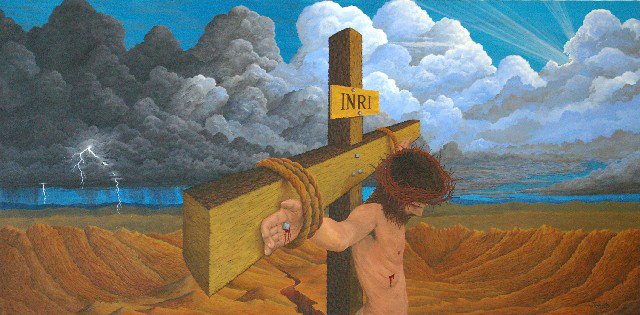
How do we carry the Cross? With resentment? With resignation? Or with love?

Maurice Denis. The Road to Calvary/
Montace au calvaire ou Le Calvaire. 1889
THE WAY TO CALVARY
Forming part of the procession, their presence making his impending death yet more shameful, are two convicted criminals, described as two thieves. A recently-arrived spectator to the scene would see three men, each laden with a cross, walking towards death. But only one is the Saviour of the world. Only one of the crosses is the redeeming Cross.

Today, too, the cross can be carried in different ways. There is the cross carried furiously or sullenly, in a rage; man writhes and squirms, filled with hate, or at least, with a deep and burning resentment. It is a cross without meaning and without any explanation, useless; such a cross may even separate one from God. It is the cross of those in this world who seek comfort and material well-being, who will put up with neither suffering nor setbacks, for they have no wish to understand the supernatural meaning of pain. It is a cross which does not redeem. It is the cross carried by one of the thieves.

On the road to Calvary is a second cross, carried this time with resignation, perhaps even with some dignity, with an acceptance of the situation simply because there is no alternative to it. This is the one carried by the other thief. Little by little he realizes that close by him is the sovereign figure of Christ, who will radically change the final moments of his life on earth, and for eternity; he will be the one converted into the good thief.

There is a third way of carrying the cross. Jesus embraces the saving wood and teaches us how we ought to carry our own cross: with love, co-redeeming all souls with him, making reparation at the same time for our own sins. Our Lord has conferred on human suffering a deep meaning. Being able, as he was, to redeem us in a multitude of ways, he chose to do so through suffering, for greater love has no man than this, that a man lay down his life for his friends (John 15:13).
In Conversation With God Vol 2: Lent and Eastertide

Tuesday, March 31, 2026

Holy Week: Tuesday - Before Pilate

Nikolay Gay. "Quod Est Veritas?" Christ and Pilate. 1890.
The Passion of Our Lord
BEFORE PILATE: JESUS CHRIST, THE KING
Thinking that in this way he might placate the hatred of the Jews, Pilate, took Jesus and scourged him (John 19:1). This is the scene we contemplate in the second sorrowful mystery of the Rosary, Bound to the pillar. Covered with wounds.

The blows of the lash sound on his torn flesh, upon his undefiled flesh, which suffers for your sinful flesh. More blows. More fury. Still more ... It is the last extreme of human cruelty.

Finally, exhausted, they untie Jesus. And the body of Christ yields to pain and falls, limp, broken and half-dead.

You and I cannot speak. Words are not needed. Look at him, look at him ... slowly.

After this ... can you ever fear penance? (J. Escriva, Holy Rosary, Second Sorrowful Mystery)


When this has happened, the soldiers plaited a crown of thorns, and put it on his head, and arrayed him in a purple robe; they came up to him, saying, "Hail King of the Jews!" and struck him with their hands (John 19:4-5). Today as we contemplate Jesus proclaiming his kingship before Pilate, we should also meditate upon that scene contained in the third sorrowful mystery of the Rosary.

The crown of thorns, driven in by blows, makes him a mock king ... And with their blows they wound his head. And they strike him ... and spit on him ...

You and I ... haven't we crowned him anew with thorns and struck him and spat on him?

Never again, Jesus, never again ... (J. Escriva, Holy Rosary, Third Sorrowful Mystery)

In Conversation With God Vol 2: Lent and Eastertide
Caravaggio. The Flagellation of Christ. 1607.

Monday, March 30, 2026

Holy Week: Monday - Peter's Denials

Duccio di Buoninsegna. Maestà (back, central panel): 
Jesus Accused by the Pharisees. 1308-11.
The Passion of Our Lord
PETER'S DENIALS
Jesus having been much ill-used, is led into one of the courtyards. He then turned and looked at Peter (Luke 22:61). Their looks meet. Peter would like to bow his head, but he cannot tear his eyes from Him, Whom he has just denied. He knows the Saviour's looks well; that look that had determined his vocation, he had not been able to resist either its authority or its charm; and that tender look of the Master's on the day He had affirmed, looking at His disciples, "Here are my brethren, my sisters, my mother!" And that look that had made him tremble when he, Simon, had wanted to banish the Cross from Jesus' path! And the affectionately pitying look with which he had invited the too-rich young man to follow him! And His look, clouded with tears, before Lazarus' tomb ... He knows them well, the Saviour's looks.

And yet never, never had he seen on the Saviour's face the expression he sees there at this moment, the eyes marked with sadness but without any severity. A look of reproach without a doubt, but which becomes suppliant at the same time and seems to repeat to him, "Simon, I have prayed for thee!"

This look only rests on him for an instant; Jesus is violently dragged away by the soldiers, but Peter sees Him all the time (G. Chevrot, Simon Peter).
He sees that compassionate look of Jesus fixed upon the deep wound of his guilt. He now understands the enormity of his sin, and the fulfillment of Our Lord's prophecy about his betrayal ...

Contrition gives special strength to the soul; it restores hope, makes the Christian forget himself and draw close to God once more with a deeper act of love. Contrition proves the quality of interior life and always attracts God's mercy; ... this is the man to whom I will look, he that is humble and contrite in spirit ... (Isaiah 66:2)

Christ found no difficulty in building his Church upon a man who was able to fall and who did fall. God also counts on weak instruments, provided they repent, to carry out his big project: the salvation of mankind.
In Conversation With God Vol 2: Lent and Eastertide
I will never forget when I first read the Gospel where Jesus turns and looks at Peter. What a terrible moment of sudden knowledge that must have been. I know that feeling in the pit of your stomach when you are "found out" and the remorse and shame that flooded Peter on that instant. How many times have I given Jesus reason to look at me like that?

On the other hand, I also read a commentary mentioning that Jesus turned and looked at Peter first ... indicating that God always looks first (echoes of the parable of The Prodigal Son to meditate upon there). Which is a comforting thought especially when we, like Peter, have fallen so far and need to get up again.

Sunday, March 29, 2026

The Beginning of the Celebration of Our Lord's Paschal Mystery

This post is from years ago but it hits me where I live even now. Some of the liturgy quoted may not relate to this year because it is older, but it is all close enough.
... we gather together to herald with the whole Church
the beginning of the celebration
of our Lord's Paschal Mystery,
that is to say, of his Passion and Resurrection.
Palm Sunday, Commemoration of the Lord's Entrance Into Jerusalem
In his commentary on this portion of the Mass last year, our priest pointed out that the Triduum is one extended liturgy.

For the first time I understood why we read the entire passion and crucifixion during Palm Sunday's liturgy. It is to give us a preview of what we are to be meditating on during this week. It is to give us a chance to enter fully into that journey Jesus is taking which culminates with his Passion, Crucifixion, and Resurrection. It is to give us the chance to accompany him not just as a spectator, but as a friend.

Let us put aside our differences. It changes nothing. It is fruitless self preoccupation. It distracts and divides us at a time when we should be focusing on Jesus. I thought of those squabbles when I heard this part of the gospel:
His disciples realized what was about to happen, and they asked,
“Lord, shall we strike with a sword?”
And one of them struck the high priest’s servant
and cut off his right ear.
But Jesus said in reply,
“Stop, no more of this!”
Then he touched the servant’s ear and healed him.
Let us "Stop, no more of this" as we concentrate on what matters most now.
Christ Jesus, though he was in the form of God,
did not regard equality with God
something to be grasped.
Rather, he emptied himself,
taking the form of a slave,
coming in human likeness;
and found human in appearance,
he humbled himself,
becoming obedient to the point of death,
even death on a cross.
Because of this, God greatly exalted him
and bestowed on him the name
which is above every name,
that at the name of Jesus
every knee should bend,
of those in heaven and on earth and under the earth,
and every tongue confess that
Jesus Christ is Lord,
to the glory of God the Father.
This year, our priest had a three sentence homily and it hit the nail on the head. When talking to his spiritual advisor about troubles and trials, he was told, "You are having these problems because you are avoiding the Cross."

Aren't we all? For my own part, I faced a severe internal struggle last week. Then God in his goodness made me understand that I was causing my own turmoil because I was trying to squirm out of the Cross.

Ah yes.

At that point I gave up wanting my way. And I was able, with St. Josemaria Escriva, to say, "Is that what you want? Then I want it too." that I regained peace and calm. I still had to face the Cross, but it was not so big a cross as the one I was creating for myself.

This is why I need Lent every year. I forget this lesson so easily. And life is so much simpler when I live without avoiding the Cross. Let's face it ... I'd face that Cross anyway. But when I do it squirming and turning away it is so much more difficult than when I slip my hand in God's and follow my Savior's example.

Let us walk with him this week.


Les Très Riches Heures du duc de Berry,
Folio 173v - The Entry into Jerusalem the Musée Condé, Chantilly.

Friday, March 27, 2026

Part 5 - The Wedding at Cana and The Passion of Christ

Duccio di Buoninsegna. Maestà (back, predella): The Wedding at Cana. 1308-11.

In preparation for holy week, here is the final part of Fulton Sheen's reflections on the wedding at Cana and Christ's Passion, death and resurrection.
The Cross is everywhere. When a man stretches out his arms in relaxation, he unconsciously forms the image of the reason for the Son of Man's coming. So too at Cana, the shadow of the Cross was thrown across a "woman," and the first stroke of the "Hour" was sounded like a bell of execution. In all the other incidents of His life, the Cross came first, then the joy. But at Cana, it was the joy of the nuptials that came first--the nuptials of the Bridegroom and the Bride of redeemed humanity; only after that are we reminded that the Cross is the condition of that ecstasy.

Thus He did at a marriage feast what He would not do in a desert; He worked in the full gaze of men what He had refused to do before Satan. Satan asked Him to turn stones into bread in order that He might become an economic Messiah; His mother asked Him to change water into wine that He might become a Savior. Satan tempted Him from death; Mary "tempted" Him to death and Resurrection. Satan tried to lead Him from the Cross; Mary sent Him toward it. Later on, He would take hold of the bread that Satan had said men needed, and tee wine that His mother had said the wedding guests needed, and He would change them both into the memorial of His Passion and His death. Then He would ask that men renew that memorial, even "unto the consummation of the world." The antiphon of His life continues to ring: Everyone else came into the world to live; He came into the world to die.
Life of Christ by Fulton Sheen

Thursday, March 26, 2026

Part 4 - The Wedding at Cana and The Passion of Christ

Gerard David. The Marriage at Cana. c. 1503.

In preparation for holy week, here are more of Fulton Sheen's observations about the wedding at Cana and Christ's Passion, death and resurrection.
The six water pots were filled, making about one hundred and twenty gallons, and in the beautiful language of Richard Crashaw, "the conscious water saw its God and blushed." The first miracle was something like creation itself; it was done by the power of "the Word." The wine He created was so good that the bridegroom was reproached by the steward with the words:
Everyone serves the best wine first, and waits until the guests have drunk freely before serving the poorer sort; but you have kept the best wine till now. John 2:10
Truly the best wine was kept. Up until then in the unfolding of revelation, the poor wine had been the prophets, judges, and kings, Abraham, Isaac, Jacob, Moses, Josue -- all were like the water awaiting the miracle of the Expected of the Nations. The world generally gives its best pleasures first; afterward come the dregs and the bitterness. But Christ reversed the order and gave us the feast after the fast, the Resurrection after the Crucifixion, the joy of Easter Sunday after the sorrow of Good Friday.
This deed at Cana-in-Galilee is the first of the signs by which Jesus revealed his glory and led his disciples to believe in him. John 2:11
Life of Christ by Fulton Sheen
Part 5 will be tomorrow.

Wednesday, March 25, 2026

Part 3: The Wedding at Cana and The Passion of Christ


Giotto. The Wedding Feast at Cana. 1304-1306.

In preparation for holy week, we're continuing with Fulton Sheen's insights connecting the wedding at Cana and Christ's Passion, death and resurrection.
At the Resurrection He gave Himself back to her, to show that while she had gained new children, she had not lost Him. At Cana the prophecy that Simeon had made to her in the temple was confirmed: henceforth, whatever involved her Son would involve her, too; whatever happened to Him would happen to her. If He was destined to go to the Cross, so was she; and if He was now beginning His Public Life, then she would begin a new life too, no longer as just the mother of Jesus, but as the mother of all whom Jesus the Savior would redeem. He called Himself "Son of Man," a title embracing all humanity; she would be henceforth the "Mother of Men." Just as she was at His side as He began His Hour, so would she be at His side at its climactic finish. When she took Him away from the temple as a boy of twelve, it was because she sensed that His Hour had not yet come; He obeyed her then and returned to Nazareth with her. Now, He told her that His Hour had not yet come, but she bade Him begin it, and He obeyed. At Cana she gave Him as a Savior to sinners; on the Cross He gave her as a refuge to sinners.

When He suggested that His first miracle would lead unerringly to His Cross and death, and that she would become henceforth a Mother of Sorrows, she turned at once to the wine steward and said:
Do whatever he tells you. John 2:5
What a magnificent valedictory! She never speaks again in Scripture. Seven times she had spoken in the Scriptures, but now that Christ had shown Himself, like the sun in the full brilliance of His Divinity, Our Lady was willingly overshadowed like the moon, as John later on described her.
Life of Christ by Fulton Sheen
Part 4 will come tomorrow.

Tuesday, March 24, 2026

Part 2 - The Wedding at Cana and The Passion of Christ

Hieronymus Bosch. Marriage Feast at Cana.

In preparation for holy week, we're continuing the connections Fulton Sheen makes between the wedding at Cana and Christ's Passion, death and resurrection.
As soon as He has consented to begin His "Hour," He proceeded immediately to tell her that her relations with Him would be henceforth changed. Until then, during His hidden life, she had been known as the mother of Jesus. But now that He was launched on the work of Redemption, she would no longer be just His mother, but also the mother of all His human brethren whom He would redeem. To indicate this new relationship, He now addressed her, not as "Mother" but as the "Universal Mother" or "Woman." What a ring those words had to people who lived in the light of the Old Testament. When Adam fell, God spoke to Satan and foretold that He would put enmity between his seed and "the Woman," for goodness would have a progeny as well as evil. the world would have not only the City of Man which Satan claimed as his own, but also the City of God. The "Woman" did have a seed, and it was her Seed that was standing now at the marriage feast, the Seed that would fall to the ground and die and then spring forth into new life.

The moment the "Hour" began, she became "the Woman"; she would have other children too, not according to the flesh, but according to the spirit. If He was to be the new Adam, the founder of a redeemed humanity, she would be the new Eve and the mother of that new humanity. As Our Lord was a man, she was His mother; and as He was a Savior, she was also the mother of all whom He would save. John, who was present at that wedding, was also present at the climax of the "Hour " on Calvary. He heard Our Lord calling her "Woman" from the Cross and then saying to her, "Behold thy son." When Our Lord raised the son of the widow of Naim from the dead, He said, "Give him back to his mother." On the Cross, He consoled His mother by giving her another son, John, and with him the whole of redeemed humanity.
Life of Christ by Fulton Sheen
Part 3 will come tomorrow.

Monday, March 23, 2026

Part 1 - The Wedding At Cana and the Passion of Christ


Jan Steen. The Marriage Feast at Cana. c. 1665/70.

Fulton Sheen makes some wonderful connections between the wedding at Cana and Christ's Passion, death, and resurrection in his excellent Life of Christ. Next week is holy week so I'm posting these for our contemplation ahead of time.
There were, in His life, two occasions when His human nature seemed to show an unwillingness to take on His burden of suffering. In the Garden, He asked His Father if it be possible to take away His chalice of woe. But He immediately afterward acquiesced in His Father's will: "Not My will, but Thine be done." The same apparent reluctance was also manifested in the face of the will of His mother. Cana was a rehearsal for Golgotha. He was not questioning the wisdom of beginning His Public Life and going to death at this particular point in time; it was rather a question of submitting His reluctant human nature to obedience to the Cross. There is a striking parallel between His Father's bidding Him to His public death and His mother's bidding Him to His public life. Obedience triumphed in both cases; at Cana, the water was changed into wine; at Calvary, the wine was changed into blood.

He was telling His mother that she was virtually pronouncing a sentence of death over Him. Few are the mothers who send their sons to battlefields; but here was one who was actually hastening the hour of her Son's mortal conflict with the forces of evil. If He agreed to her request, He would be beginning His hour of death and glorification. To the Cross He would go with double commission, one from His Father in heaven, the other from His mother on earth.
Life of Christ by Fulton Sheen
Part 2 will be tomorrow.

Friday, March 6, 2026

A Lenten Litany - Fasting and Feasting

During Lent, let us…

Fast from judging others; feast on the Christ within them.
Fast from emphasis on difference; feast on the unity of life.
Fast from apparent darkness; feast on the reality of light.
Fast from thoughts of illness; feast on the healing power of God.

Fast from words that pollute; feast on phrases that purify.
Fast from discontent; feast on gratitude.
Fast from anger; feast on patience.
Fast from pessimism; feast on optimism.

Fast from complaining; feast on appreciation.
Fast from worry; feast on trust in God’s Care.
Fast from unrelenting pressure; feast on unceasing prayer.
Fast from facts that depress; feast on verities that uplift.

Fast from lethargy; feast on enthusiasm.
Fast from thoughts that weaken; feast on promises that inspire.
Fast from shadows of sorrow; feast on the sunlight of serenity.
Fast from problems that overwhelm; feast on prayer that undergirds.
Fast from bitterness; feast on forgiveness.
Fast from self-concern; feast on compassion for others.
Fast from personal anxiety; feast on eternal truth.
Fast from discouragements; feast on hope.
William Arthur Ward

Friday, February 20, 2026

Litany for Lent

From a spot that has many good litanies to offer.
Litany for Lent
Lord Jesus, you have come to save us from our sins.
Lord, have mercy.

You fasted to encourage us to do penance.
Lord, have mercy.

You suffered temptation to give us strength.
Lord, have mercy.

You were transfigured to give us hope.
Lord, have mercy.

You suffered insults to bring us salvation.
Lord, have mercy.

You accepted death to bring us life with you.
Lord, have mercy.

Thursday, February 19, 2026

Lent and Fasting From Meat on Fridays

Reposting this because, well, it's that time of year and we all need a little help with the fine points of what the Church means by "meatless!" 

Also the point about fasting from flesh is one that strikes me hard every time I think of it.

From the USCCB's Lent FAQ:
Abstinence laws consider that meat comes only from animals such as chickens, cows, sheep or pigs — all of which live on land. Birds are also considered meat. Abstinence does not include meat juices and liquid foods made from meat. Thus, such foods as chicken broth, consomme, soups cooked or flavored with meat, meat gravies or sauces, as well as seasonings or condiments made from animal fat are technically not forbidden. However, moral theologians have traditionally taught that we should abstain from all animal-derived products (except foods such as gelatin, butter, cheese and eggs, which do not have any meat taste). Fish are a different category of animal. Salt and freshwater species of fish, amphibians, reptiles, (cold-blooded animals) and shellfish are permitted.

I'll mention here that moral theologians' teachings are not necessarily binding. We're bound to obedience to what the Church requires.

If someone wants to abstain from all animal derived products, that is their choice. However, it is not a sin for another person to have beef gravy or chicken broth if they want. 

In America, fasting from meat led to the fish fry as a
Lenten tradition. (Public domain photo.)
 
I was looking for this for another reason, actually, but it applied to the question our retreat group was asking about providing a Friday lunch including Tomato Basil Soup made with chicken broth.

I think the main reason, though I now have lost the place I originally read this, is that the original intent of fasting from meat is that we are fasting from ... flesh.

It is because Christ put on flesh to become man that we fast from it in penance for the bodily (flesh) sacrifice He offered on our behalf.

A lovely connection isn't it?

At least it is to me.

And to have to dig into each ingredient turns it into an exercise in scrupulosity for me. I like that they make it easy for us that way.

I've always cooked with those sorts of guidelines for Friday fast days (heck, every Friday is a fast from meat at our house). So it's nice to see it spelled out ... no need for any vestiges of guilt when I put a bit of lard in our refried beans for those nachos!

Wednesday, February 18, 2026

Ash Wednesday - A Little Fun

Because this makes me laugh every time, I repost ...

Ash Wednesday is the chance for single Catholics to identify other singles who are, as my friends would say, really eligible! In aid of that, we present:
PATRICK MADRID'S TOP 10 LIST
Catholic Pickup Lines
(originally appeared in the now defunct Envoy magazine)

10. May I offer you a light for that votive candle?

9. Hi there. My buddy and I were wondering if you would settle a dispute we're having. Do you think the word should be pronounced HOMEschooling, or homeSCHOOLing?

8. Sorry, but I couldn't help but noticing how cute you look in that ankle-length, shapeless, plaid jumper.

7. What's a nice girl like you doing at a First Saturday Rosary Cenacle like this?

6. You don't like the culture of death either? Wow! We have so much in common!

5. Let's get out of here. I know a much cozier little Catholic bookstore downtown.

4. I bet I can guess your confirmation name.

3. You've got stunning scapular-brown eyes.

2. Did you feel what I felt when we reached into the holy water font at the same time?

1. Confess here often?

Ash Wednesday: All other loves will enslave us if they are not ordered to Him

Rerun because I need to read this every year.

Painful though the process may prove to be, I ask God for the transformation I need to become closer to the person He created me to be.

Let's begin with the collect for today.
Grant, O Lord, that we may begin with holy fasting
this campaign of Christian service,
so that, as we take up battle against spiritual evils, we may be armed with weapons of self-restraint.
Through our Lord Jesus Christ, your Son,
who lives and reigns with you in the unity of the Holy Spirit,
one God, for ever and ever.
I like this for several reasons, but foremost  it calls to mind that we are in a spiritual battle. It never does to forget that, especially with Satan's wilderness tempting of Christ as prominent as it is during this season.

Daniele Crespi (1597 - 1630)
Il Digiuno di San Carlo Borromeo / The fasting of St Charles Borromeo (c. 1625)
(Read more about the painting and the saint at Idle Speculations where I found the painting)

I always need help having the proper perspective to prepare for Easter.
The Liberating Power of Serving God

"No one can serve two masters. He will either hate one and love the other, or be devoted to one and despise the other. You cannot serve God and mammon." (Mt 6:24)

God did not save the Israelites from slavery in Egypt so that they might become slaves again by bowing down to the golden calf in the desert. Nor has he freed us from the slavery of our sin so that we might bow down to the work of our own hands or to any other creature, including ourselves and our own desires. Strange as it might seem, we are not really free when we consider ourselves the masters of our own lives. From precisely that standpoint, we quickly fall into the trap of serving someone or something else: our self-images, our bosses, our spouses, our corporations, our tyrannical two-year-olds or teenagers, our homes, our cards, our portfolios, our social statuses, our egos, and the list goes on and on.

When, however, we seek to serve God, we soon learn that we thereby allow God to serve us. He wants our hearts precisely so that he might reign there: more as servant than as king. It is he who sets the table before us, who washes our feet, waits upon us, and invites us to eat of his own body. As servant, he not only nourishes us, however; but he also liberates us fro inordinate attachments that both weigh us down and enslave us. He does not merely liberate us from without, by removing obstacles that would hinder his coming into our hearts. He also and more profoundly liberates us from within; for once we have received him, he begins making order within us, freeing us from all that prohibits us from the interior freedom that characterizes the children of God. He will not allow any competition for his love; for all other loves will enslave us if they are not ordered to him, who alone can render us free.
Taken in this way, we can see how it is actually a relief to have done self-examination to see what has enslaved us, usually without our having been aware of it at all. What a relief to set that down. Even when we miss it, when we long for it, when we are annoyed because we can't have it, there is still a sense of relief in being forced to see with open eyes just what our addictions really are. To see how they have become so much more important to us than the harder path that leads us to a more loving relationship with God. Clarity matters. We have to know what rocks are in the way in order to avoid them.

The Putting on of Ashes
From the Initial "M" in the Introit of the Mass of Ashes on Ash Wednesday
From the Missal à l'usage de Saint-Didier d'Avignon c. 1370
Via Idle Speculations which has information about the tradition of ashes
We surely can see why the readings for today included this from Joel which speaks to my heart.
Even now, says the LORD,
return to me with your whole heart,
with fasting, and weeping, and mourning;
Rend your hearts, not your garments,
and return to the LORD, your God.
For gracious and merciful is he,
slow to anger, rich in kindness,
and relenting in punishment.
Perhaps he will again relent
and leave behind him a blessing,
Offerings and libations
for the LORD, your God.
And this from Psalm 51, also part of today's readings, which is surely what we all crave.
A clean heart create for me, O God,
and a steadfast spirit renew within me.
Cast me not out from your presence,
and your Holy Spirit take not from me.
Give me back the joy of your salvation,
and a willing spirit sustain in me.
O Lord, open my lips,
and my mouth shall proclaim your praise
I do praise him for giving us this season of Lent ... which is something that I never, ever feel until it has begun. But now that I am face to face with Lent, having considered this morning that "Remember, man you are dust and to dust you shall return" ... which means, get serious because you never know when this life will end ... I remember how good it is to consider priorities, to leave behind the transitory, and strive upwards toward the immortal life we were made to have.

Yes, Lent is good.

Bread and Water by Duane Keiser
RESOURCES
Catholic Culture has a wonderful page about Lent with many links to activities, prayers, recipes, and readings.

They also offer free e-books which have daily reflections on the readings and saints for the liturgical year. I have used these for several years now and cannot recommend them highly enough.

Ash Wednesday

Carl Spitzweg, Ash Wednesday
via Wikimedia Commons

Tuesday, February 17, 2026

Mardi Gras Prayer

It is good for me to have this reminder in prayer, which I have posted for the last few years. We tend to think of the feasting of Mardi Gras as being totally opposite to the fasting of Lent. But they don't have to be. If we turn our eyes toward God the entire time, feasting and fasting can be seen as sides of the same coin.


In these or similar words, we can pray in the spirit of this day. 
Blessed are you, Lord God of all creation,
for it is from your goodness that we have this day
to celebrate on the threshold of the Season of Lent.

Tomorrow we will fast and abstain from meat.
Today we feast.
We thank you for the abundance of gifts you shower upon us.
We thank you especially for one another.
As we give you thanks,
we are mindful of those who have so much less than we do.
As we share these wonderful gifts together,
we commit ourselves to greater generosity toward those
who need our support.

Prepare us for tomorrow.
Tasting the fullness of what we have today,
let us experience some hunger tomorrow.
May our fasting make us more alert
and may it heighten our consciousness
so that we might be ready to hear your Word
and respond to your call.

As our feasting fills us with gratitude
so may our fasting and abstinence hollow out in us
a place for deeper desires
and an attentiveness to hear the cry of the poor.
May our self-denial turn our hearts to you
and give us a new freedom for
generous service to others.

We ask you these graces
with our hearts full of delight
and stirring with readiness for the journey ahead.
We ask them with confidence
in the name of Jesus the Lord.

Monday, February 16, 2026

Lent Prep: Are You Ready to Rumble? (With a link for meatless recipes)

Every year I have to psych myself up for the Ash Wednesday fast. Rereading this helps.

Are you looking for good meatless meals for Lenten Fridays? Try these at Meanwhile, Back in the Kitchen.


Fasting. No one likes it. Even people who don't care about food too much don't like it. And no wonder. We get hungry, we get cranky, we're uncomfortable ... darned uncomfortable.

I rarely remember to think about it more deeply than than to offer it up for someone in grave need.

This from my quote journal reminded me to think about fasting in a very different way. I thought I'd share it.
Lenten Fasting
Jesus fasted simply because he wanted to, as the gospel clearly says. But why? Because hunger never comes alone; hunger usually touches us very deeply, not just physically but deep in our heart. Hunger in a sense wounds us; it undermines something in us which up to that moment had been inviolable. It causes a kind of vaccuum, tears open an old wound, and even at times leads to dizziness. Precisely for that reason fasting and hunger can change something in us, can even bring about a genuine transformation.

Whatever is thus touched or kindled is not always honorable or satisfying ... In order to be able to test us the devil has to take advantage of our weaknesses, both our physical and spiritual weakness, the hunger which torments us and makes us afraid of losing our life.

For along with hunger other desires and temptations immediately surface as well, even in the case of Jesus: the seductive challenge of easy success, the desire for earthly fame, the hunger for power in this world, sensuality in all its forms. Fasting half opens the door we so often want to keep shut, even with a double lock. For immediately after the first hunger and the first desire, the other hunger and those other desires surface as well, desires which seek -- with equal bitterness and equal power to disturb us -- to take possession of our heart. No one ever fasts with impunity ...

However, Jesus had come for this very purpose. Not to crush all desires and temptations, nor to conquer them honorably. The contrary is true ... Our fasting even today risks opening the door to the excitement of the desires it threatens to unleash, a door which looks out on the other shore of our desires, not on their dark but on their light side: God within us; God who desires to be loved; God who hungers for us and we for him, passionately.
Father Andre Louf, O.C.S.O. (Magnificat)
I do have one practical piece of advice to offer ... hunger comes in "waves" so if you suddenly feel those pangs, quite often you can remember that and when you come to think of it again then the hunger has receded. That helps me anyway.

Friday, February 13, 2026

Lenten Listening: Podcasts

Here are some of my favorite faith podcasts which can prove helpful at Lent. To be fair, I tend to listen to most of them year-round.

Daily Mass Readings (Augustine Institute)

Just what it says — the daily Mass readings. The readings are followed by silence with occasional questions asked to prompt meditation and reflection.

The website is here.


Sing the Hours

This is a sung version of the Liturgy of the Hours for morning and evening. Paul Rose does a really lovely job of making the music sound both timeless and modern. It is perfect for prayer or for having on as a peaceful chant in the background as I sometimes do.

The website is here.


Every Knee Shall Bow

This is a podcast about how to evangelize, which always brings up memories of Hyde Park. No thank you. Then my daughter Rose, who listens to such things to help with RCIA conversations, recommended it. And she was right! The hosts have good chemistry and are fun to listen to. They understand the things that make most of us cringe away from evangelizing and have a lot of helpful tips — some of which I've actually used. Their current series is about suffering and has been really insightful. Definitely give this one a try. (website link)


The Bible, Catechism, or Rosary in a Year

A series of stellar podcasts that feature their subjects read (or prayed) aloud with commentary which informs while it inspires. Get them anywhere.  (Ascension Press links for BibleCatechismRosary)


Word on Fire — show

Half an hour with Bishop Robert Barron discussing everything from current movies to evangelization to pilgrimage, iPhones, and much more. They'll also feature audio from some of his talks, including those given at Facebook, Amazon, etc. Always interesting. (iTunes link, website link)

For Bishop Barron's homilies go here: iTunes link, website link


The Symbolic World

Jonathan Pageau looks at symbolism in our culture (ancient and current) and shows us meanings that we had long forgotten but that make real sense. Any reader of Scripture will recognize the way he dives through layers of meaning and pulls out the essence for us to consider. He's Orthodox and loves to show us the places faith shines through in regular symbolism. He'll also do interviews ranging from Jonathan Peterson, Bishop Barron and many more. Simply fascinating. He does both videos and podcasts.


A Good Story is Hard to Find

Two Catholic friends talk about the books and movies they love and the traces of the One Reality that lie below the surface.

Yes, this is the podcast that Scott Danielson and I do every couple of weeks. Looking for God in the stories that entertain us might be just the Lenten inspiration you need to see God interacting in your life in a whole new way. (iTunes linkwebsite link)

Thursday, February 12, 2026

The Big List of Lenten Movies

I'm never as interested in "Jesus" movies as I am in mainstream films with food for thought about sin, reparation, and redemption.

These movies run the gamut from humor to wrenching drama, from a science fiction journey to the depth of dreams to an Israeli couple hosting an unlikely duo for holidays. Dive in and see where these take you.
 
If you haven't heard of them be sure to check reviews for ratings. There are some excellent ones that use bad language and violence to make their point. For that matter, The Passion of the Christ was not for wimps. Just as Jesus' real story wasn't.

Links in movie titles go to my reviews. A number of these have been discussed by Scott Danielson and me on our A Good Story is Hard to Find podcast. Those links follow the descriptions.


  • Rab Ne Bana Di Jodi (A Match Made By God) - A solid comedy and a funny, sweet look at true love. It delivers the strong theme of “seeing God in your beloved.” and has an overwhelming example of covenantal love when Suri humbly doesn't expect anything in return for his love. [Good Story episode 209]

  • Ushpizin ... a tale of love and living your faith to the fullest. As well as a template for how marriage should work. Simply charming. [Good Story episode 66]

  • Departures ... by turns funny, moving, and inspirational. Each character, no matter how small, is important in the big story which is something like an orchestra playing a symphony in this story.

  • The Intouchables ... Wealthy quadriplegic Philippe needs an assistant to help him with all the functions of daily life. He hires immigrant, ex-con Driss because the regular applicants are missing one important quality and the lives of both men are changed. Sounds predictable. Isn't. [Good Story episode 146]

  • In Bruges ... for me, this is the perfect Lenten movie. Redemption, sacrifice, humanity in it's worst and best are all mingled and shown here. [Good Story episode 29]

  • Gone Baby Gone ... A private investigator and his partner agree to search for a kidnapped girl because he has connections to the locals that the police do not. This can be tough to watch but you won't find a stronger examination of free will, the difference choices make in our lives, and personal responsibility in the face of evil. [Good Story episode 126]

  • Stranger Than Fiction ... I'm continually amazed at how well this story is told and what a wallop it packs. Redemptive and life affirming. [Good Story episode 8]

  • Of Gods and Men ...  a group of Trappist monks in Algeria must choose between the practical choice to abandon their monastery when extremist Muslims terrorize the area ... or following spiritual calling even when there doesn't seem to be any reason to do so.  [Good Story episode 58]

  • Les Miserables (2012) ... as Scott Danielson said, "This film makes me want to be a better person. Could there be higher praise for a movie? [Good Story episode 117]
  • The Women's Balcony ... Friendships are broken, marriages are stressed, and budding romances are tested as the moderate-extreme, male-female lines are drawn in this battle over something very dear to the hearts of all: how to practice their faith. However, it is all handled lightly and with good-natured humor. [Good Story episode 175]

  • Lars and the Real Girl ... this sweet film shows unconditional love and complete acceptance, in the family, in the town, and in the most unusual love triangle you can imagine. [Good Story episode 27]

  • Babette's Feast ... huge underlying message about God's unexpected and overflowing generosity and Jesus' complete self-sacrifice ... all wrapped up in a woman who gives all her lottery winnings to cook a perfect meal for a village. [Good Story episode 221]

  • Mary & Max ... a rich story for those who are not afraid to explore the heights and depths that imperfection humanity bring to our lives and the lives of those we touch. [Good Story episode 43]

  • Calvary - Not for the faint-of-heart. But simply astounding. A real masterpiece that provides food for thought for everyone from Catholics to atheists. [Good Story episode 101]

  • Pan's Labyrinth ...  as Joi reminded me in years past, "the imagery is amazing, the language beautiful, and the story mythic, AND it honors self-sacrifice as the truest expression of love. [It shows] the road to virtue is not easy, and it's about doing what's right, even if you don't always know why, and even when it hurts.  [Good Story episode 70]
  
  • Inception - perhaps the perfect heist movie doubling as a thriller, as well as being a wonderful look at truth and love. [Good Story episode 16]

  • Amadeus - A rich meditation on the way that God chooses to give his gifts and how we respond to the measure that has been given to us. Superb. [Good Story episode 328]

  • Wake Up Dead Man - A good priest, a bad priest, and an atheist wrestle with God. Also there's a mystery. It's a blockbuster so there is bad language and some crude sexual material.  [Good Story episode 371]

Wednesday, February 11, 2026

Lenten Reading: The Big List of Fiction

This is a huge list to be sure. But it has some of the most thought provoking books I know They both entertain and inspire. It ranges from science fiction to mystery to Uncle Tom's Cabin. I've run the list before but have updated it.

The last two years I read The Lord of the Rings beginning on Ash Wednesday and finishing on Holy Saturday. It was intense, both in my daily reading requirements and spiritually. It was the perfect accompaniment to Lent both times. So I'm doing it again this year.

Before the Coffee Gets Cold by Toshikazu Kawaguchi

This was so much more than I realized it would be. Within this simply told tale are the stories of four people who go to a special cafe in order to time travel. The rules are strict, the time is very limited, and it seems impossible that they could accomplish much. However, each is surprised by what they find. And therein lies a wonderful, charming tale. 

My full review is here. Scott and I discussed this is episode 331 of A Good Story is Hard to Find podcast,

The Enchanted April by Elizabeth von Arnim

Four women who need to get away from their regular lives and get their heads together rent an Italian castle with the promise of sunshine and wisteria. They don't realize why they so desperately need a change when they flee gray, raining London for sunny San Salvatore Castello in Italy. However, as they are surrounded by beauty their eyes are gradually opened.

This is one of those books that has a seemingly simple story but presents a lot in the layers of the story. My full review is here. Scott and I discussed this in Episode 350 of A Good Story is Hard to Find podcast.

 The Feast by Margaret Kennedy

This book starts out with a clergyman at a loss for how to write a eulogy for seven people who died in a hotel when a cliff fell on it and crushed it. We're then taken back to life in the hotel a week before the disaster. We get to know everyone and watch how their interactions change them (or don't). This book is not just about the mystery of who will live and who will die. It is also about spiritual realities by which these people live their lives.

My full review is here. Scott and I discussed this in episode 321 of A Good Story is Hard to Find podcast.

Death Comes for the Archbishop by Willa Cather

In the late 1800s two French priests are assigned to the New Mexico territory to minister to the neglected Catholic churches there. One is intellectual, the other is the salt of the earth. Both are friends and both are good Catholic priests. This is what one might call an episodic telling, much as are the Gospels. We see the lives of the priests, those they minister to, and the country itself which is as much of a character as any of the people. Cather wasn't Catholic but you'd never know it simply by reading this account which gets everything right — and gives a lot of food for thought along the way. Scott and I discussed this in episode 274 of A Good Story is Hard to Find podcast.


Black Bottle Man by Craig Russell

Rembrandt, his father, and uncle are trying to undo a deal with the devil made by their loved ones. As they seek a champion, they must cope with a tricky requirement that they not stay in any place longer than 12 days.

Considerations of faith are handled both honestly and delicately in this book. The insights and observations throughout the book underlie the main story in a way that lends itself to considerations of gratitude, mercy, selfishness, sacrifice, and much more — all without being heavy handed.

My full review is here. It is is marketed to teens but I'm not the first reviewer to mention that label is too limiting because it is also a great read for adults.


Mockingbird by Walter Tevis
Only the mockingbird sings at the edge of the woods.
I've been jaded by the plethora of recent apocalyptic novels but this one is different. Perhaps the highest tribute I can give this novel is that when I finished I didn't want to read another book. To do so would sully what I'd just read before I'd finished thinking about it, as well as be unfair to anything that followed because it wouldn't be able to compare.

My full review is here. We also discussed this book in Episode 110 of A Good Story is Hard to Find podcast. And also on SFFaudio where a lot of interesting fruitful topics came up.


The Lord of the Rings by J.R.R. Tolkien
Or, since Lent is only 40 days, at least the first book, The Fellowship of the Ring. I was was blown away by how much the audio experience added to my understanding of the richness and depth of the story. Admittedly, it was also greatly helped by The Tolkien Professor's class sessions on this book. You will be hard put to find a better primer on sacrifice, redemption, and many other key lessons for Christian life. I think this may be the best book ever written. And you could do worse than to read The Hobbit for starters.

Joseph R's review is the best I've read if you'd like a more complete look at the novel.

Scott and I were joined by Seth Wilson in a two-part discussion of this novel at A Good Story is Hard to Find podcast: part 1, part 2.


Christy by Catherine Marshall
I read this several times when I was in high school and college but hadn't encountered it for decades. It came to mind again when talking with my mother about books set in hardscrabble backgrounds.

I remembered it being really interesting about people in the Smoky Mountains in 1912 cut off from any outside civilization except for a few people who came in to try to help their poverty stricken situation. Including the 19-year-old young woman, Christy, who comes to teach the children. She is naive and from a well-to-do background so she's completely unprepared for what she finds.

I didn't recall it being so inspirational throughout. I wound up loving it so much that I could hardly bear to put it down. Scott and I discussed this in episode 355 of A Good Story is Hard to Find podcast.


The Curse of Chalion by Lois McMaster Bujold
A bedraggled, galley ship survivor, despite his best efforts to the contrary, finds himself in the middle of royal intrigue. If that weren't enough, he is also pulled into the the affairs of the divine as a result and this complicates his life as one might imagine. This is a land of various gods and strong, dark magic. It is, however, also a land where free will matters in the outcome of events.

Will Duquette calls this "theological science fiction" and I agree. The way that free will is intertwined with what the gods desire, as well as what is "right," is fascinating and a good way to examine our own motives the next time we turn away from what God may be asking of us. My full review is here. A Good Story discussion is at Episode 198.


Harry Potter and the Deathly Hallows
Harry is an incredible Christ-figure as I discovered when I reread the series recently. Of course, this only works for those who have read the series before.

For more depth and as accompanying materials, readers may want to listen to Episode 26 of A Good Story is Hard to Find podcast where Scott Danielson and I discuss the book and the entire series from a Catholic point of view.

In This House of Brede by Rumer Godden
This extraordinarily sensitive and insightful portrait of religious life centers on Philippa Talbot, a highly successful professional woman who leaves her life among the London elite to join a cloistered Benedictine community. That's the official description but it doesn't begin to cover the richly woven tapestry Godden weaves with nuanced personalities, mysteries to solve so that the order may continue, Philippa's internal struggles, and much more.

Again, Joseph R. has a wonderful review of the book. We also discussed  episode 97 at A Good Story is Hard to Find


Prince of Foxes by Samuel Shellabarger
This beautifully written historical fiction tells of Andrea Orsini, who is one of Cesare Borgia's most trusted political manipulators during the Italian Renaissance. This is a swashbuckler that simultaneously shows Andrea's transition of a human heart from greed to love, selfishness to sacrifice, and power grubbing to nobility.

Discussed in episode 13 of A Good Story is Hard to Find podcast.


Uncle Tom's Cabin by Harriet Beecher Stowe
A real page-turner which many think they know because the cultural references are so embedded in our society. However, if you haven't read this book then you don't know it at all. First and foremost, Uncle Tom actually is a Christ-figure, a living saint. No wonder he is misunderstood by so many.

Stowe does a good job showing many different attitudes toward slavery and how people excused themselves under the flimsiest of excuses. What is unexpected is how well she examines the varying levels of Christianity proclaimed and threaded solidly throughout the story.

Discussed in episode 114 of A Good Story is Hard to Find.

I read this aloud on my Forgotten Classics podcast with commentary. Yes, that's how much I love it.


Dracula by Bram Stoker
We all think of this as a classic horror story but there is much more to it. Look below the surface and you find a classic tale of unselfishness and doing God's will in order to rid the world of a monster who is a perversion of Christ.

Discussed in episode 168 of A Good Story is Hard to Find. Mythgard Institute (founded by Corey Olsen, The Tolkien Professor) has a superb series of classes on Dracula.


The Space Trilogy by C.S. Lewis
These books seem an interesting blend of fiction and nonfiction to me. Lewis's imagination is vivid and fascinating. His tendency to have characters speechify leans to the nonfiction side. Taken as a meditative read, they would be very good for Lent, I'd think.

Out of the Silent Planet: Dr. Ransom is kidnapped by two men who take him to Mars as a sacrifice to the natives. Lewis was fantastically inventive about what the planet and living beings were like. I didn't know he had it in him.

Perelandra: Very different from Out of the Silent Planet while still showing C.S. Lewis's vivid and inspiring imagination. I am simply blown away by his vision of creation on Venus. Amazing insights as to battling evil, the dance of God's creation and plan, and our part in it.

That Hideous Strength: It is a testament to Lewis's imagination and writing skill as to how different all three of the books are in this trilogy, while simultaneously all carrying out the same basic theme. No wonder J.R.R. Tolkien loved them. This book left me striving to be a better person, to be truer to myself, as did the other two. Not many other books really leave one feeling that way.

Discussed in episodes 202204, and 206 of A Good Story is Hard to Find podcast.