Tags: Catholicism, Christianity
The walls of the house signify the boundary enclosing the particular place where these few people are engaged in enacting the rite of love, that is, of exchanged life. They experience it under many forms: the love of the parents for each other is one form; the love of the mother for her son, say, is another, and for her daughter another; and the father for his daughter and for his son; and the older brother for the younger sister, or the older sister for the younger brother. There are a dozen variations on the theme, but the same theme; namely, that we find real life where mutual responsibility and commitment turn out to be forms of joy. It is love that liberates the participants for this. Love sets them free from the calculating and jockeying and tallying up of scores that we find in mere politics, where we have to protect people with half-measure such as equality and rights and self-determination. Love opens onto a vastly more splendid order of things; and the forms of love at work in an ordinary family are like introductions to this splendor.This just seems to continue the message from yesterday about God putting us right smack in the middle of the place we need to be to learn what we need to know. Once again, we've just got to recognize it to help us get the most advantage from the lesson.
This family bond is there in the fabric of ordinary human life, giving us all this chance to participate in the Real Thing. All forms of love furnish this chance in one way or another, of course --love for one's country, or for one's community, or one's master or friend. Wherever love operates, there we find some exhibition of the principle. But the obvious place where we find the natural occasion for the whole race to enact the rite is the household -- in other words,in the biological family.
No one supposes that these four or five or six people are a select breed, tailored to get along with each other perfectly, or picked because they are better than anyone else. Rather, it is as though the great lesson in love that we must all learn sooner or later has been made obvious, easy, and natural by being carried along in the arms of sheer biology...Splendor in the Ordinary: Your Home as a Holy Place by Thomas Howard
 I will be in adoration ... yes again! lucky, lucky me! ... for an hour early Saturday morning. If anyone would like me to take a special intention to Jesus for them just send me an email (julie @ glyphnet . com) with "Adoration" in the subject line. I'll already have all those from my Prayer Journal and also those that I took with me for last week.
... I have always been a reader; I have read at every stage of my life, and there has never been a time when reading was not my greatest joy. And yet I cannot pretend that the reading I have done in my adult years matches in its impact on my soul the reading I did as a child. I still believe in stories. I still forget myself when I am in the middle of a good book. Yet it is not the same. Books are, for me, it must be said, the most important thing; what I cannot forget is that there was a time when they were at once more banal and more essential than that. When I was a child, books were everything. And so there is in me, always, a nostalgic yearning for the lost pleasure of books.This author understands me. And I understand why she wrote this unusual book which is a love letter for those who have read and reread Jane Eyre, Wuthering Heights, Rebecca, and similar classics. It is a double tale wound around the story of a young woman, Margaret, who has been tapped to write the biography of Vida Winter, a very famous and reclusive writer who has never told anyone a single truth about her life story. As the author's tale unfolds, Margaret begins investigating the truth from her side. I couldn't put this book down. Highly recommended even though I feel the author pulled an "Agatha Christie" toward the end when Vida Winter's true identity is finally revealed. But I love Agatha Christie books as well so it all works out. Not perfect but a thoroughly enjoyable read.
(i) Paul writes as a man who knows trouble to those who are in trouble. The word that he uses for afflictions is*Barclay is not a Catholic source. Read here for more info about him.In ordinary Greek this word always describes actual physical pressure on a man. R.C. Trench writes, "When, according to the ancient law of England, those who willfully refused to plead had heavy weights placed on their breasts and were so pressed and crushed to death, this was literally thlipsis." ...
(ii) The answer to this suffering lies in endurance. The Greek word for this endurance is hupomone. The keynote of hupomone is not grim, bleak acceptance of trouble but triumph. It describes the spirit which can not only accept suffering but triumph over it ...
(iii) But we are not left to face this trial and to provide this endurance alone. There comes to us the comfort of God. Between verses 3 and 7 the noun comfort or the verb to comfort occurs no fewer than nine times. Comfort in the New Testament always means far more than soothing sympathy. Always it is true to its root meaning, for its root is the Latin fortis and fortis means brave. Christian comfort is the comfort which brings courage and enables a man to cope with all that life can do to him ...The Letters to the Corinthians, Revised Edition by William Barclay*
She wants to let the baby live, but is under a lot of pressure to have an abortion and does not have a lot of resources on her own. She really needs help from someone or a group in her area (Toronto).If anyone wants to email me rather than answer in the comments box, my email is julie[at]glyphnet[dot]com. Thanks!
I've been searching online for the Toronto equivalent of the White Rose*, but haven't been able to find anything yet. I'm sure there is something like that. I was wondering if someone on here with better connections within Catholic Charities or the Toronto area might know of a good place I could refer her to.
The Christian life is certainly a paradox. The teaching of St. John of the Cross (which was for beginners, he said) is of the necessity for detachment from creatures; of the need of traveling light through the dark night.I like that point about God arranging for us what we need in our everyday life. We must be open to it so that we can take full advantage of what we are being offered though. Otherwise it is just inconvenience, pain, and suffering without any of the redemptive possibilities being used.
Most of us have not the courage to set out on this path wholeheartedly, so God arranges it for us...
We try to escape, of course, either habitually or occasionally. But we never can. The point I want to make is that a woman can achieve the highest spirituality and union with God through her house and children, through doing her work, which leaves her no time for thought of self, for consolation, for prayer, for reading, for what she might consider development. She is being led along the path of growth inevitably. But she needs to be told these things, instructed in these things, for her hope and endurance, so that she may use whatever prayer she can to cry out in the darkness of the night.
Here is her mortification of the senses:
Her eyes are affronted by disorders, confusion, the sight of human ailments and human functions. Her nose also; her ears tormented with discordant cries, her appetite failing often; her sense of touch in agony from fatigue and weakness.
Her interior senses are also mortified. She is also with her little ones, her interest adapted to theirs; she has not even the companionship of books. She has no longer the gay companions of her youth (their nerves can't stand it). So she has solitude, and a silence form the sounds she'd like to hear -- conversation, music, discussion.
Of course there are consolations and joys. Babies and small children are pure beauty, love, joy -- the truest in this world. But the thorns are there -- of night watches, of illnesses, of infant perversities and contrariness. There are glimpses of heaven and hell.On Pilgrimage by Dorothy Day
I know I have to be careful with the devil. I don't want to shunt off my personal failings onto him -- my evil is my own. Satan won't be around at the judgment to share the blame. But I don't want to discount his power and influence, either. To ignore him is to let him move unseen, which is exactly where he thrives. I don't want to be cocky with him. I sympathize with the old tradition of not saying his name, for fear of giving him an inroad. But neither do I want to cower before him. I believe I have power over him; the thing is not to suppose that the power is my own.Swimming with Scapulars by Matthew Lickona
Early Christianity grew up in a world which seems very much like our own. It boasted abundant material means but suffered from great spiritual poverty. The early Church had the necessary vigor to protect itself from paganizing influences. It was also vibrant enough to transform a worldly civilization from within. The world today seems no more difficult to evangelize. At first sight it may appear to be closed to Christ. Yet if we are firmly united to the Lord as the first Christians were, we can be sure that the transformation will take place once again. How well are we succeeding in our efforts to transform the people around us, the members of our family, our friends, our colleagues at work?
The world is in need of many things. But there is no doubt that it is in great need of apostles who are holy, cheerful, loyal to the Church and eager to make Christ known. The Lord is calling for us to work in his fields: Pray, therefore, the Lord of the harvest to send out laborers into his harvest. Prayer is the most effective means of winning new apostles (Josemaria Escriva). Our apostolic zeal has to be manifested, first of all, in a continuous prayer of petition for new apostles. Prayer always comes first.
That cry of the Son of God, lamenting that the harvest is plentiful but the laborers are few, is always relevant. How it tears at our heartstrings. That cry came from Christ's mouth for you to hear too. How have you responded to it up to now? Do you pray at least daily for that intention of his? (Josemaria Escriva).
Help me create a petition that will put the one in Ms. to shame. Email this post to every man and woman you know. Email your names and cities/states to me. I'll compile them and send a petition to Congress - a petition with the names of people who think women (and their unborn children) deserve better than an abortion.Please do go to her blog to read the entire post.. I will be emailing this to many of my friends and encourage y'all to do the same.
I want to get more than the 5,000 signatures Ms. is boasting it has...
... if you are a woman who considered having an abortion but chose not to, I'd like to hear from you and your story.
Marian Fisher, 13, is said to have stepped forward and asked her killer to "shoot me first," in an apparent effort to buy time for her schoolmates.I read this in the morning paper and my eyes filled with tears. What more Christian love could we ever see than those young girls offering themselves in an attempt to save their classmates?
Rita Rhoads, a Mennonite midwife who delivered two of the victims, told ABC News she learned of the girl's plea from her family. What's more, her younger sister, Barbie, who survived the shooting, allegedly asked the gunman, Charles Carl Roberts IV, to "shoot me second," Rhoads said.
He spoke to them another parable. "The kingdom of heaven is like yeast that a woman took and mixed with three measures of wheat flour until the whole batch was leavened."I paged through the rest of the newspaper.
I can say that I never knew what joy was like until I gave up pursuing happiness, or cared to live until I chose to die. For these two discoveries I am beholden to Jesus.I daresay that all Christians recognize the absolute truth in Muggeridge's words. The mystery is that just as they contain absolute truth, that truth is translated in different ways to different people ... God deals with each of our unique souls in the way that we understand best.Malcolm Muggeridge
"...Some of the old ones still refuse to see that my method is better than theirs. The only thing that will convince them is when I get three oranges to their one, and sell them for twice the price because they are full of juice. But we'll show them in the end."
"You puzzle me," said Meredith frankly.
"Why?"
"What have oranges got to do with the human soul?"
"Everything," said the bishop flatly. "You can't cut a man in two and polish up his soul while you throw his body in the trash heap. If the Almighty had designed him that way, he would have made him a biped who carried his soul in a bag round his neck. If reason and revelation mean anything they mean that a man works out his salvation in the body by the use of material things. A neglected tree, a second-rate fruit are defects in the divine scheme of things. Unnecessary misery is an even greater defect because it is an impediment to salvation. When you don't know where your next meal is coming from, how can you think or care about the state of your soul? Hunger has no morals, my friend."The Devil's Advocate by Morris L. West
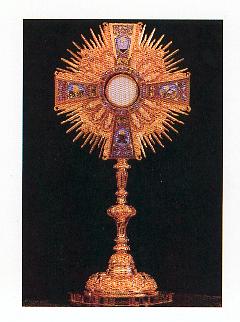
Eucharistic adoration is a practice in the Roman Catholic and some Anglican Churches, in which the Blessed Sacrament is exposed to and adored by the faithful. When this exposure and adoration is constant (that is, twenty-four hours a day), it is called perpetual adoration. In a parish, this is usually done by volunteer parishioners; in a monastery or convent, it is done by the resident monks or nuns...This is all based around the Catholic belief that the Eucharist is the body and blood, soul and divinity of Christ. So when you sit with the Eucharist, you are sitting with Jesus Himself. (Much more information can be found here.)
The host is displayed in a monstrance, typically placed on an altar. The Blessed Sacrament may not actually be exposed, but left in a ciborium, which is likewise placed on an altar. This exposition usually occurs in the context of a service of Benediction or similar service of devotions to the Blessed Sacrament. In services of perpetual adoration, parishioners volunteer to attend for a certain period of time, typically an hour, around the clock. Because of the difficulty of maintaining twenty-four hour attendance, many parishes no longer provide perpetual adoration. In many parishes, the Blessed Sacrament is reserved in an enclosed tabernacle so that the faithful may pray in its presence without the need for volunteers to be in constant attendance (as must be the case when the Blessed Sacrament is exposed).
Could you explain all the initials some of the Catholic groups use. I know SJ is for Jesuits, and OSB is for the order of St Francis but what is OP and are there others??I, myself, have wondered that same thing from time to time. It is like a secret code.
... We can waste our time by doing whatever we want instead of what God wants. For example, we might spend time at our place of work when we are needed at home. Conversely, we might choose to read the newspaper when we should be working. The life of each man and woman exists in the present moment. these are the only moments which we can truly sanctify. The past and the future only exist in our imagination. The memory of our past can inspire us to acts of contrition or thanksgiving, yet even these prayers take place in the reality of the present.This was a big hurdle for me to overcome. I have a vivid imagination and could bring myself to tears quite easily by imaging a future where Tom and the girls were gone, etc. So silly of me but there you go. By keeping the above precepts in mind my life has been much simpler ... and it gets easier with time and practice, y'all.
We should not become overwrought by future events because they may not come to pass. In any event, we will have the grace of God when we need it. The secret to building the city of God within us is this: we have to build on a brick by brick basis in the reality of the present moment. (Ch. Lubich, Meditations) This is the only time which God gives us to sanctify. Hodie, nunc. We must live the present moment with love, with full concentration. What a wonderful offering this will be to the Lord! Let us not miss this opportunity.
 A little something for everyone in that photo, eh? Also, Kate is supposed to be finally choosing between Jack and Sawyer. Word is that she chooses Sawyer since a mystery woman is going to take up all of Jack's time. Let me think, Jack or Sawyer? No contest, even if Sawyer is a frog squasher ... I'd take that bad boy any time over boring Jack.