I have a feeling at our house it will be a choice between two that I don't see on that list but that are among Tom's favorites ... Apollo 13 or Hunt for Red October.
Tags: Catholicism, Christianity

SOLEMNITY OF THE MOST HOLY BODY AND BLOOD OF CHRIST
This Solemnity goes back to the thirteenth century. It was first established in the diocese of Liége, and Pope Urban IV instituted it in 1264 for the whole Church. The meaning of this feast is the consideration of and devotion to the real presence of Christ in the Eucharist. The center of the feast was to be, as Pope Urban IV described it, a popular devotion reflected in hymns and joy. In the same year Saint Thomas Aquinas, at the Pope's request, composed for this day two Offices which have nourished the piety of many Christians throughout the centuries. In many different places the procession with the Monstrance through specially bedecked streets gives testimony of the Christian people's faith and love for Christ, who once again passes through our cities and towns. The procession began in the same way as the feast itself.
In places where the Solemnity of the Most Holy Body and Blood is not observed as a holy day of obligation, it is kept on the Sunday after the Most Holy Trinity as its proper day.
For many years God fed manna to the people of Israel as they wandered in the wilderness. This was an image and symbol of the pilgrim church and of each individual who journeys towards his or her definitive homeland -- Heaven. That food given in the desert of Sinai is a figure of the true food, the Holy Eucharist. This is the sacrament of the human pilgrimage ... Precisely because of this, the annual feast of the Eucharist that the Church celebrates today contains within its liturgy so many references to the pilgrimage of the people of the Covenant in their wanderings through the wilderness (John Paul II)....
Today is a day of thanksgiving and of joy because God has wanted to remain with us in order to feed us and to strengthen us, so that we many never feel alone. The Holy Eucharist is the viaticum, the food for the long journey of our days on Earth towards the goal of true Life. Jesus accompanies us and strengthens us here in this world, where our life is like a shadow compared to the reality that awaits us. Earthly food is a pale image of the food we receive in Holy Communion. The Holy Eucharist opens up our hearts to a completely new reality.In Conversation With God Vol 6
Daily Meditations, Special Feasts: January - June


Justice is the virtue that seeks to promote fair play. It's the desire and resolve to give each person his due. It demands that you reward goodness and punish evil. Justice can be one of three different types: commutative. Distributive, and social.Recommended reading: Back to Virtue by Peter Kreeft. He examines the virtues in depth and also looks specific virtues and Beatitudes as antidotes to each of the seven deadly sins. Not a new concept but one that he writes about superbly (as always).
Commutative justice concerns the relationship between equals -- between two people, such as a customer and a merchant. [This involves fair prices and honesty about merchandise, not cheating the merchant, and restitution in case of theft of damage to property.]
Distributive justice involves the relationship between one and many -- between an individual and a group. This kind of justice is most obvious in the relationship between a citizen and his or her government [such as charging fair taxes or knowing where one's taxes go].
Social justice concerns the relationship of both individuals and groups between one another and everyone. The bottom line is the common good -- the public welfare of all. Social justice is concerned with the environment, the economy, private property, civil rights and church-state relations.Catholicism For Dummies by John Trigilio
Sometimes people set up a false dichotomy between justice and charity. Read the following.
----
Catechism of the Catholic Church
1807 Justice is the moral virtue that consists in the constant and firm will to give their due to God and neighbor. Justice toward God is called the "virtue of religion." Justice toward men disposes one to respect the rights of each and to establish in human relationships the harmony that promotes equity with regard to persons and to the common good. The just man, often mentioned in the Sacred Scriptures, is distinguished by habitual right thinking and the uprightness of his conduct toward his neighbor. "You shall not be partial to the poor or defer to the great, but in righteousness shall you judge your neighbor." "Masters, treat your slaves justly and fairly, knowing that you also have a Master in heaven."
----
Justice makes charity a duty, not an option. Charity serves the glory of God and the authentic good (not necessarily convenience) of my neighbor. Justice is, in the words of the CCC above, "the constant and firm WILL to give" glory to God and to do what is authentically good for my neighbor. It is justice that receives charity as an OBLIGATION. As Jesus put it:
"I give you a new COMMANDMENT-- love another as I have loved you."
When we behave without justice, charity is already dead.
Prudence is basically practical common sense. It's saying or doing the proper thing, at the proper time, and in the appropriate manner. It's also the ability to know and judge whether to say something or do nothing at all...Recommended reading: Back to Virtue by Peter Kreeft. He examines the virtues in depth and also looks specific virtues and Beatitudes as antidotes to each of the seven deadly sins. Not a new concept but one that he writes about superbly (as always).
Prudence takes time and practice, In the olden days, when good manners were more important than income, portfolio, or net worth, noblemen and peasants alike strove to show respect for their fellow man through the practice of prudent speech. Today, manners come in two extremes: The politically correct fear of offending anyone and saying nothing controversial -- even when someone is in danger, and alternatively, the shock-jocks who bluntly bludgeon you over the head with the raw, unadulterated truth, hoping to hurt your feelings and get a violent reaction rather than help you. Prudence, on the other hand, is in the middle of the two extremes. Prudent people speak the truth when needed and appropriate and in a way that doesn't offend, but they never lose their force and conviction.
Acting prudently requires mature deliberation [thinking carefully before acting or not acting], wise choice [determining which option is feasible and appropriate], and the right execution [swiftly and thoroughly follow through without procrastination and haste].Catholicism For Dummies by John Trigilio
Of those for "hinge" or "pivotal" virtues, the one that is the "coordinator" of all other virtues is the virtue of prudence.Good stuff, eh?
Prudence even governs our exercise of charity.
CATECHISM OF THE CATHOLIC CHURCH:
1806 Prudence is the virtue that disposes practical reason to discern our true good in every circumstance and to choose the right means of achieving it; "the prudent man looks where he is going." "Keep sane and sober for your prayers." Prudence is "right reason in action," writes St. Thomas Aquinas, following Aristotle. It is not to be confused with timidity or fear, nor with duplicity or dissimulation. It is called "auriga virtutum" (the charioteer of the virtues); it guides the other virtues by setting rule and measure. It is prudence that immediately guides the judgment of conscience. The prudent man determines and directs his conduct in accordance with this judgment. With the help of this virtue we apply moral principles to particular cases without error and overcome doubts about the good to achieve and the evil to avoid.
It will take time for the Vatican to evaluate and, presumably, approve the text. Because translations of other prayers are still under way, it will be at least two years before parishioners experience these changes, he said.Via Whispers in the Loggia.
Another example is found in the Fourth Eucharistic Prayer in the phrase the fruit of the vine in the Institution Narrative. Currently we say he took the cup filled with wine, as you know, and some argue that the fruit of the vine means the same as the single word wine, and that the simpler expression should be preferred. But we hear the words the fruit of the vine on the lips of the Lord himself in all three synoptic Gospels – which I would consider as being more than enough reason to respect their form. Moreover, though the two expressions refer to the same substance, they do so in an entirely different way. The difference between the single word and the richer phrase is the difference between reading the label on the bottle and actually enjoying a glass-full of the wine itself. Furthermore this phrase has a powerful salvific resonance because of the symbolic value accorded to the vine plant and the vineyard in scripture, as recalled by Jesus’ elaboration in John 15 of the image of Himself as the true vine, His Father as the vinedresser, and ourselves as the branches. This picks up on an even earlier usage in Isaiah 5 – the famous “Song of the Vineyard” - and the Lord’s lament at the degeneracy of his once choice vine in Jeremiah 2. Of course, the word wine connects with this scriptural patrimony, but it does so less evidently, less directly than does the phrase fruit of the vine which, upon each hearing, encourages us in our imaginations to see the particular Eucharistic event as part of the unfolding of God’s universal plan within history to rescue us from the destruction and chaos occasioned by our sinfulness and bring us into communion with Himself and with each other in Christ.Do read the entire thing. Via Whispers in the Loggia.
When I am about to die, I take leave of all from which I must part. I take leave of Holy Church. I thank God I was called to be a Christian and have found real Christian belief. If I were to remain longer here, I would try to help Holy Church, which has many sins.Just reading this is humbling. I'd like to have it read at my funeral but will have to do much personal improving to live up to it first.
I take leave of all poor souls now in purgatory. If I were to remain here longer, I would gladly help expiate their sins. I thank God they will find mercy.
I take leave of all those in hell and thank God that he exercises his righteousness on them. If I were to remain here longer, I would wish them well.
I take leave of all penitents working out their penance. I thank God I am one of them. If I were to remain here longer, I would always love them.
I take leave of all my enemies. I thank God that they have not conquered me. If I were to remain here longer, I would lay myself under their feet.
I take leave of all earthly things. I am sorrowful before God that I never used them according to his holy ordinances.
I take leave of all my dear friends. I thank God and them that they have been my help in need. If I were to remain here longer, I should always be ashamed of the lack of virtue they must have seen in me.
I take leave of all my wickedness. I am sorrowful before God that I have so greatly spoiled his holy gift to my soul, so that no sin is ever so small that it could be hidden in heaven. Even though the sin was paid for, the stain remains. I am sorrowful for you, Lord Jesus, for you bear the shame of my sin.
I take leave of my suffering body. I thank God he has preserved me in many things from many sins. Even if I were to remain here longer, the sins of the body are so numerous that I could never be free of them.Mechthild of Madgeburg, d. 1282
(She was a Beguine and later a nun in Helfta, Germany)
Magnificat June 2006
folding tiny crane
papercuts can cause much pain
i must take more care.
If there was a real Holy Grail -- a cup venerated by the early Christians as the cup used at the Last Supper -- then it would eventually have become so encrusted with jewels and precious metals from the far corners of the earth that the original object would be hard to recognize. The cup would have been unchanged in essence but surrounded by a superstructure of ornamentation designed to draw attention to the beauty of its holiness.Interesting concept isn't it? Certainly it is one that never occurred to me but is fascinating in the implications. Just to make sure I don't lose the trail, the authors then go onto King Arthur and work the same magic ... making connections I didn't know existed.
All this is simply speculation. In spite of the strong claims about some relics in various parts of Europe, we really have no idea what became of the cup that Jesus used. Whether or not the object still exists, the veneration and ornamentation that might have happened to the Holy Grail is exactly what did happen to the story of the Holy Grail. One generation after another added jewels from all kinds of unlikely sources until the thing seemed to have a completely different shape. But the essence -- the original meaning of the Eucharist -- was unchanged. The added layers of ornament only expressed centuries of veneration for the truth of the Eucharist...
It's a lot of fun to chase bits of historical evidence hither and yon, and to pounce on them when they seem to support our favorite theory. But to us, the historical truth about King Arthur is almost irrelevant. What's much more important is what people have believed about King Arthur for most of the last millennium and a half.Wow! I'm just at the beginning of this book but can assure you that it is neither boring nor difficult to read. I'm sure more excerpts will follow as I follow the interesting historical trail the authors have laid out for us in this book.
The story of King Arthur is the story of the creation of a terrestrial paradise -- a paradise that was destroyed by sin. It is also a story of longed-for redemption, the hope that some miracle could restore the perfect world that sin destroyed.
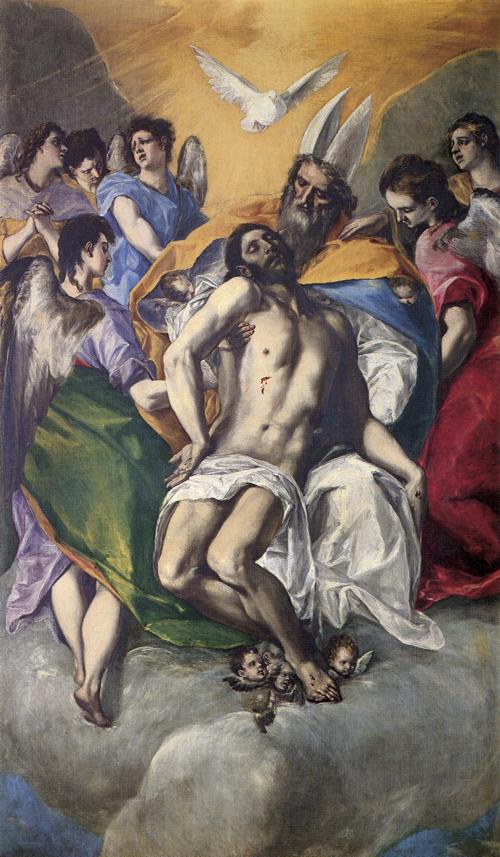
Today the Church celebrates the feast of the Blessed Trinity. This, the ineffable mystery of God's intimate life, is the central truth of our faith an dthe source of all gifts and graces. The liturgy of the Mass invites us to loving union with each of the Three Divine Persons: Father, Son and Holy Spirit. This feast was established for the Latin Church by Pope John XXII, to be celebrated on the Sunday after the coming of the Holy Spirit, which is the last of the mysteries of our salvation. Today we can say many times, savouring it, the prayer: Glory be to the Father, and to the Son, and to the Holy Spirit...
[St. Teresa] writes: Once when I was reciting the "Quicumque vult," I was shown so clearly how it was possible for there to be one God alone and three Persons that it caused me both amazement and much comfort. It was of the greatest help to me in teaching me to know more of the greatness of God and of his marvels. When I think of the most Holy Trinity, or hear it spoken of, I seem to understand how there can be such a mystery, and it is a great joy to me.
The whole of a Christian's supernatural life is directed towards this knowledge of and intimate conversation with the Trinity, who become eventually the fruit and the end of our whole life (St. Thomas). It is for this end that we have been created and raised to the supernatural order: to know, to talk to and to love God the Father, God the Son and God the Holy Spirit, who dwell in the soul in grace.In Conversation With God Vol 6
Special Feasts: January - June

Brilliance is the third element in science's view of the beautiful. Augros and Stanciu explain that "a theory with this quality has great clarity in itself and sheds light on many other things, suggesting new experiments. Newton, for example, astounded the world by explaining falling bodies, the tides and the motions of the planets and the comets with three simple laws." George Thomason adds that "in physics, as in mathematics, it is a great beauty if a theory can bring together apparently different phenomena and show that they are closely connected; or even different aspects of the same thing." This is exactly what Einstein did with his theory of general relativity, and it helps to explain his religious attitude toward the universe, and why he marveled at its comprehensibility, namely, that the human intellects can make sense of it and understand it.Tags: Catholicism, ChristianityEvidential Power Of Beauty by Thomas Dubay
| You Are Storm |
 Exotic and powerful, Storm descended from a line of African priestesses. Emotions can effect your powers, but you are generally serene. Powers: controlling weather, creating winds that lift you into flight, generating lightning |

