| You Are an Oatmeal Raisin Cookie |
 On the surface, you're a little plain - but you have many subtle dimensions to your personality. Sometimes you're down to earth and crunchy. Other times, you're sweet and a little gooey. |
Via Quoth the Maven
| You Are an Oatmeal Raisin Cookie |
On the surface, you're a little plain - but you have many subtle dimensions to your personality. Sometimes you're down to earth and crunchy. Other times, you're sweet and a little gooey. |
Nobody of any real culture ... ever talks nowadays about the beauty of a sunset. Sunsets are quite old-fashioned. They belong to the time when Turner was the last note in art. To admire them is a distinct sign of provincialism of temperament. Upon the other hand they go on. Yesterday evening Mrs. Arundel insisted on my going to the window, and looking at the glorious sky, as she called it. Of course I had to look at it ... And what was it? It was simply a very second-rate Turner, a Turner of a bad period, with all the painter's worst faults exaggerated and over-emphasized.Oh, Oscar Wilde ... how did you manage to be so very funny?Oscar Wilde, as quoted in The Cloudspotter's Guide by Gavin Pretor-Pinney
In his tender affection for children Jesus stood in radical contradiction to the attitudes and practices of the empire of his day. The Romans and Greeks held that children were inferior beings, something less than fully human. Plato, Aristotle, and other philosophers of the ancient world approved the killing of unwanted children through abortion and infanticide, and they saw nothing wrong with using children for sexual gratification.
Jesus said it would be better to have a millstone tied around your neck and be plunged into the depths of the sea than to suffer God's judgment for scandalizing one of his little ones. From the beginning, the church fiercely defended children, even the unborn. The Didache ("Teaching"), the oldest surviving manual of church life, written in the mid-first century, warns: "You shall not kill the embryo by abortion and shall not cause the newborn to perish." The Christian philosopher Athenagoras, in a plea to Emperor Marcus Aurelius in 175, explained: "We regard the very fetus in the womb as a created being and therefore an object of God's care."Catholic Passion by David Scott
Ten minutes into his descent, Rankin should have been reaching the ground, but the enormous draughts of air that surged up the core of the cloud were retarding his fall. Soon the turbulence became much more severe. He had no visual point of reference in the gloomy depths but he sense that, rather than falling, he was being shot upwards with successive violent gusts of rising air -- blasts that were becoming increasingly violent. And then for the first time he felt the full force of the cloud.Pretor-Pinney certainly knows how to get my attention. Frankly, I am not that interested in the science of clouds which makes up about half of each chapter. Possibly anticipating this, he has been quite generous with attractive lures, such as the story of Lieutenant-Colonel William Rankin, a pilot in the US Air Force, who, in 1959, became the only man to fall through the heart of a cumulonimbus and live to tell the tale. Riveting stuff, y'all!
"It came with incredible suddenness -- and fury. It hit me like a tidal wave of air, a massive blast, fired at me with the savagery of a cannon ... I went soaring up and up and up as though there would be no end to its force." ...The Cloudspotter's Guide by Gavin Pretor-Pinney
You all know the big table we have in the living room; that was the dining table in my grandfather's day. It came from his railroad days, as mentioned in the biography and he had it sent from (Cleveland?). People as famous as Carl Sand and Sinclair Lewis ate at it. I seem to remember fried chicken every Sunday, but I was only allowed boiled - how I craved that delicious fried, but it wasn't considered healthy for children. But what wonderful biscuits my grandmother made, and I scarfed them down loaded with her homemade srawberry jam. My grandfather would order a cup of maraschino cherries for me if we went to a restaurant ... my mother always thought they caused boils on my back. Oh well, what did they know.
There were double doors to the living room, and one year my Grandfather dressed up like Santa Claus and flung them open with drama. It was to be a great surprise, but I burst into tears, ran away, and hid. What a flop to a grand enterprise!
At the bottom of the hill was a true country store, selling cattle salt blocks, flour in print bags intended to be dresses, etc., and with gas pumps. I remember driving down there with my aunt; I thought she was the most wonderful person I had ever known. She SMOKED, she was very small, and she was so peppy and had a wonderful accent. Of course, she wasn't married and had no children so it was easy for her.
I actually remember hired hands squirting milk at cats during milking. Yes, trite as it sounds, they actually did that !
As I said before, hired help must have been really cheap. They mowed the grass, did laundry, but unfortunately never were hired to cook to help out my grandmother and mother. Charlie provided chickens, and Helen never had to do anything because she was an artist (my mother said). Don't know what the other two boys did ... one ran away from home and probably with good reason considering my grandfather's autocratic disposition. He was a wonderful grandfather, though.
There were screened porches around three sides of the house, and I seem to remember living out there most of the time. Since we usually visited only in the summer that would be natural. One morning I got up and found one of my shoes filled with cherry pits, apparently tucked in there by a mouse.
My aunt Helen raised Scotties, and Airdales. I loved the dogs, but was especially fascinated by seeing them eat rabbits, always head first. There was a fish pond in the middle of the front yard, and I remember one of the puppies drowning there; Beverly also fell in once but was quickly retrieved. The pond was surrounded by old fashioned petunias, and their fragrance always takes me back to those days and reminds me of my sweet grandmother who loved them.
OK, now you have the best of my very young childhood memories, for better or worse. You might want to compile some of yours for your own children. Old age comes quicker than you think! I have regretted many times not sitting down with my parents and talking with them about earlier years.
St. Augustine, the fifth-century African who was the church's seminal teacher, penned a striking phrase to describe the example of Jesus: Caro quasi vox ("Christ's flesh is like a voice"). What he meant is that at every state of Jesus' earthy life -- his life in the flesh -- he is calling to us, inviting us personally to live in the mystery of divine love that he reveals...Catholic Passion by David Scott
Nightmare
Faded picture in my mind
Of nightmares from the past
Of the present, I am blind
Twenty monsters of a kind
As my heart beats fast
Faded pictures in my mind
I open doors I cannot find
The traps have all been cast
Of the present, I am blind
The roads, the walls, the trees wind
I stumble off the path
Faded picture in my mind
My arms, my legs, my tongue, they bind
I fall, the abyss is vast
Of the present, I am blind
My face is now old and lined
Many years have past
Faded picture in my mind
Of the present, I am blind
Why can't Farmer Johnson solve his own problems? Every time he needs to know how many acres of soy beans, corn and wheat to plant with 80,000 dollars and 600 hours of labor to spare if the cost of seeds is $4 for soy and $6 for wheat or corn and labor is 6 hours per acre for soy, 2 for wheat, and 7 for corn, I have to calculate this bumpkin's assets and tell him how to run a farm.There's pretty much no denying that logic. Obviously the answer is that Farmer Johnson shouldn't have a farm ... or won't for much longer if he can't start figuring these things out for himself.


Our Deliverer and God came by the quietest of signs, in the everyday miracle of a baby being born -- the same way that you and I came into the world. He was born amid tears of joy, swaddled in a blanket, and held in the gentle arms of his father. On the first night of his life, he likely fell asleep nursing, his head nestled against his mother's warm breast -- like countless babies before him and countless babies since.The thing I like about reading this book is that David Scott takes something that I already know, such as the idea that Jesus came to show us what God is like, and then twists it. Adds that phrase or two that makes me rethink what I "already knew" and realize that I do not know it as well as I thought. In this case, talking about God's "autobiographical statement," "full disclosure," and "confession" made me take a fresh look.
Why this way? Why not in power and glory, in fire that swept down from the mountaintops, in the upheaval of nations, or in the blood red stars falling from the sky? Because in coming to us as a child, God was making what amounts to an "autobiographical" statement. The Incarnation was God's confession, his full disclosure. In the baby conceived at Nazareth and later born in a stable in Bethlehem, God revealed himself as a God of love and mercy -- a Father who seeks us in the wilderness of our fallen world. ...Catholic Passion by David Scott
... Christianity has too often been in what appeared at the time to be fatal danger for us now to be frightened by yet another such test. The ways by which Providence ransoms and saves its elect are unforeseeable. At times, our enemy becomes a friend; at times he is despoiled of the capacity for evil that made him fearsome; at times he auto-destructs, or, without desiring it, produces beneficial effects and simply vanishes without leaving a trace. Generally, the Church does not have to do anything but persevere with peace and confidence in the fulfillment of its tasks, remain serene, and await salvation from God. (Cardinal J.H. Newman)I especially like the point that Cardinal Newman made about how many times Christianity has seemed to be in danger and how it always has been saved. It seems that too often we hear Christians bemoaning the fate of the faith's existence in the modern world without remembering that point.
The moments in which we encounter opposition and difficulties without exaggerating them are particularly propitious for exercising a whole range of virtues: we should pray for those who do evil to us even without our knowing it, so that they may leave off offending God; we can strive to make amends to the Lord, to be even more apostolic, and to protect with exquisite charity those weaker brothers in the faith who on account of their age, their lack of formation, or the special situations they find themselves in, could sustain a greater harm to their souls.

WASHINGTON, DC—Over 87 percent of Americans are unprepared to protect themselves from even the most basic world-ending scenarios, according to a study released Monday by the nonpartisan doomsday think-tank The Malthusian Institute....Oh, The Onion ... how do they manage to be so funny? Read the whole hilarious story.
... The study found that many apocalypse-preparedness measures are cost-prohibitive. With virtually no tax incentives in place, many Americans share the "dangerous perception" that only the richest few can afford to survive the extinction of humanity.
"I just renovated my house with cantilevered leaden cofferdams for increased earthquake and radiation protection, and I'm working on a pantheistic altar to appease the god or gods most likely to return to this world with an insatiable wrath," said Seattle resident Tim Hanson, whose actions were praised in the study as a "highly rare display of prescience and vigilance."
"I installed solar panels and a generator so I could live off the grid for a while," Hanson added. "But it cost so much that now I might not be able to have the altar properly gilded. At least not in time." ...
... Life involves so many challenges; by paying attention to the ways that God has gifted us, we can begin to appreciate the ways our gifts enable us to live more fully.I have to admit that I am not in the habit of loving challenges. I hear the word "challenge" and my mind substitutes "problem" or "difficulty" or "hardship." Yep, corporate speak has done a number on me and I know what they mean when they say "challenge."
Great athletes love challenges. While watching the Olympics recently, I was struck by how many athletes talked about wanting to break a world record or beat a particular opponent. Instead of seeing these challenges as roadblocks to their own comfort and ease, they saw them as opportunities to let their gifts manifest themselves. Often, these athletes had to face great hurdles; many did not accomplish what they had hoped. But they were grateful for the chance. I often wish that I could bring a similar drive into ordinary life, with the ability to see challenges as ways to manifest the gifts God has given me. But the truth is that, more often, I see them as unnecessary hassles and often blame God for that.
Notice that the risen Jesus still bears his wounds. How can it be otherwise? In our own lives, times of suffering may lead to times of peace and joy, but we cannot escape the lingering effects of suffering. It permanently changes us -- we cannot pretend that it never happened. That the risen Jesus still bears his wounds is good news, for it tells us that there is a continuity between the lives we have now and the lives that we will enjoy in the Resurrection. Jesus is the same person. His wounds, though, are different: they are not a source of suffering but a source of recognition. It is only through seeing Jesus' wounds that Thomas recognizes him. In the Resurrection, we will still bear the effects of the hurts that have been done to us, but they will no longer cause us pain.
 From my mouth to Apple's ears.
... Through the lens of the Resurrection, life is not bounded by death -- and thus we achieve our freedom in no longer being afraid of it. For while all of us will die one day, our understanding of death changes because of the Resurrection: death becomes little more than the closing of one chapter of our lives and the beginning of another. The resurrected Jesus was almost nonchalant about his own death -- extraordinary, since we might expect that someone in his situation could come back to wreak havoc on the political establishment that executed him. Why didn't he hunt down his enemies? Why didn't he use his return from the dead as a platform to call attention to his own power?And isn't that really the most attractive thing about the real Christians that we know? Their joy, their love of life and wanting to share that joy with others? I know it is for me.
Perhaps the reason is because Jesus was truly free. He was not concerned about the pettiness of so much social and political action; he was alive and wanted to bring good news to his friends. Perhaps too he was more concerned with inviting his friends to share that joy.

CONSTABLEI'd never have guessed ... fascinating!
Now used as on official term for law enforcement officers, this word began in the horse stables. In ancient Rome, the official version was comes stabuli, literally meaning "count of the stable," or the head groom. By the 1200s, the Old French version, conestable, was used to refer to the head officer of a king's household and by the 1500s, the current use had arisen.
The point of reading these stories is not to experience some tabloid thrill, but to understand how grace works in the world. Every day, all day long, God pours out his grace upon us, urging us, coaxing us, to turn away from everything that is base and cheap and unsatisfying, and to turn toward the only thing that is eternal, perfect, and true -- that is, himself.I must admit that I came to this slender book with a lot of preconceptions.
Imagine that Christ came to you one day and said, "I need you and you are the only person in the whole world who can do this. Will you help me?" Who could refuse? Who wouldn't want to be an agent sent by Christ himself? But then imagine that Christ said, "I need you to be a friend to the old woman who lives next door to you." What would you do? There is a certain glamour in having a life purpose, imagining that everything one does in life is oriented toward some great ideal. But it's very different if one's life purpose is to carry out a very mundane task. It is much easier to imagine following Christ as a knight sent on brave errands than as an ordinary person befriending a widow. For most of us, Christ's call will look much more like the second option. It will not be glamorous or exciting; in fact, much of the time it might be pretty ordinary. But if we are following Christ, then even the ordinary becomes part of the fabric of a holy life.
There is no escape from the ordinary. No matter who we are, no matter what we do, there are going to be parts of our lives that are repetitious and boring. What makes these periods tolerable is the knowledge that they contribute to something greater. ...
We will never know whether knitters are addicted to yarn or to the act of knitting. To find out, we'd need to take someone's yarn away and see how she feels. I can't do that to another knitter. The ethical questions are too tricky.I don't have a stash like truly dedicated knitters, although I do have a few balls of sock yarn tucked away for upcoming projects. Even with that small supply, the thought of someone taking it away ... well, let's just not go there.
How to Succeed in Evil is not a self-help page for the maladjusted. It it is the story of Edwin Windsor, Evil Efficiency Consultant. He's like Arthur Anderson for Supervillains.If you listen to no other podcast, please do try this one (I'm beggin' ya here!).
Just because a person can melt walls by winking at them or build a device to threaten the very fabric of our reality doesn't mean that they know how to manage investments or squeeze money out of a scheme. Just look at M.C. Hammer. (Not that he's evil or super -- just that he's exquisitely bad with money.)
But the problem with supervillains is that they are all too egomaniacal to listen to good advice. (They always pay, but they never listen.) So Edwin gets so fed up with this state of affairs and decides to go into business for himself. This results in an efficient, ruthless (and often very funny) brand of evil.
Edwin quickly becomes something more than a villain and less than a hero. He takes out villains because they are "incompetent and inefficient" and heroes because they are "ineffectual and in the way." He often does the right thing for the wrong reason. Which, as fans can tell you, is very entertaining.
According to ancient Hindu and Buddhist beliefs Cumulus clouds are the spiritual cousins of elephants, which is why the animals are worshipped, with a view to bringing rain after India;'s scorching summer heat. "Megha," meaning cloud in classical Hindi, is the name used to address elephants in these prayers. The Sanskrit creation myths describe how elephants created at the beginning of time were white, had wings to fly, could change their shape at will and had the power to bring rain. Although they have now lost these magical powers, the present-day descendants of those early Uber-elephants are still believed to have an affinity with the clouds -- especially the albino ones.I was sent a review copy of this charming book, which I opened with a good amount of trepidation upon receipt. So far it is a real treasure in a typically eccentric British way, with the science of clouds interwoven with a true love of cloud watching and stories. The science is told in a very understandable way. After all, who can resist the image of a lava lamp to describe how heat acts upon water molecules to make Cumulus clouds? I know I can't.
It is somewhat alarming to learn that eighty elephants weigh about as much as the water droplets in a medium-sized Cumulus -- a Cumulus mediocris -- would if you added them all together. (This is assuming the cloud occupies one cubic kilometre (about 0.24 cubic miles), which is not particularly large for a Cumulus. The droplets will commonly have a combined weight of 220 tons. The average Asian elephant weighs 3 tons.) for, although the droplets in a Cumulus cloud are extremely small, there are one hell of a lot of them. ...
The Cloudspotter's Guide by Gavin Pretor-Pinney
"Christian tradition has laid a lot of blame on Satan for things they're causing themselves," said Dr. Kelly, 72, a former Jesuit exorcist and now a medieval scholar at the University of California, Los Angeles and author of three books about the devil. "I am pessimistic about human nature. I think we are totally capable of doing what we have done. You can blame it on psychosis if you want."Ummm, yes. Yes, I can. No amount of spin is going to change the facts. There is an Evil One. Not that we don't create plenty of our own problems on our own. We definitely do. But let's not leave out that other component.
But you can't blame it on Satan, he said.
Book publishers in Turkey have reprinted several children's classics with Islamic elements inserted into the storylines. The move came in reaction to controversy over including such titles in the government's recommended reading list for students.Read the Three Musketeers example. What adds to that revision is the knowledge that Aramis was in the company of religious men because he had decided to become a priest. Luckily, the Turkish Minister of Education feels about this the same way that I do. "'If you like Heidi, then write your own 'Heidi,' he said in the Turkish newspaper Radikal." (Scroll down in Briefs for this story which has other examples of changed books.)
In "Pinocchio," when the wooden puppet arrives at the end of his quest, he exclaims to his maker, Geppetto, "Thanks be to Allah, I am a real boy!" Earlier in the book he says, "If Allah wills it, please give me some bread."
... infinitesimal distinctions between man and man are too paltry for an Omnipotent Being. How these madmen give themselves away! The real God taketh heed lest a sparrow fall; but the God created from human vanity sees no difference between an eagle and a sparrow. . .Hearing it this morning read from Librivox, this jumped out at me from the rest of the story. I thought of pro-abortion people, judging that a tiny baby (even if only a few cells big at the time) is less important than all their daily affairs.

Reveille, the first lady of Aggieland, is the official mascot of Texas A&M University. She is the highest ranking member of the Corps of Cadets, and she is a Five-Star General.Hannah saw Reveille being walked yesterday. She was on the way to class or would have summoned the courage to ask if she could meet and pet the honored Aggie mascot. However, we all showed our distinct lack of appreciation for tradition and the corp by bursting into laughter when she told us that cadets must address Reveille as "ma'am."
In reference to your entry about Charles J. Finger; I had no idea that he was so interestingly involved both in the literary and the down to earth business of making a living.
He was my grandfather, and I remember him as delightfully indulgent of a little girl. There was one afternoon when he encouraged me to look for a four leaf clover, and after finally inding one we went into the house and found another surprise: books! I can remember stealing up the lane to his separate office, which also included a pool table room where I played with the balls. I wasn't supposed to go up there and interrupt him, but of course I did. He died when I was seven years old, but his personal impact must have been immense because I remember him vividly (I'm 72), he was definitely a Leo personality although born in December.
The house was surrounded on two sides by what were known as sleeping porches, screened, and comfortable in Arkansas's hot summers. I remember having an outhouse to go to, and a freestanding "shower house" with cold sulpher water. There was also a wash house, which had its own walled yard (filled with cornflowers) for drying clothes. Neighboring ladies did the wash, and I seem to remember It having a hot water boiler. Lockers on the front screened porch of the house held wood for the cookstove on which water was heated, and I suppose for winter warmth. There was a stove in the middle of the house which heated some rooms; don't remember what the heat source was.
As long as I have started, I might tell more ... just because it's a bygone era. Cows were milked and the milk left to stand in wide pans on another screened porch, after which cream was skimmed for butter. My first food memory is of oatmeal, in an island of cream and topped with sugar.
My grandmother made wonderful plum jelly, quite tart, from wild plums that grew on the farm.
I never fell down a well, although often warned to stay away; they were just irresistable open holes in the ground, often with unfortunate rabbits floating there in.
There was a creek to wander along, always accompanied by one of the family Airdales. Along one side were shale banks where you could sit at the top and slither down on the seat of your pants for an exciting ride.
There were lots of freestanding stone buildings: my grandfather's office, my uncle Charlie's chicken house, the wash house, the shower, and my artist aunt Helen's studio with its two rooms, one of which was for serious drawing and the other of props for her Ozark themes( stone fireplace, milk churn, etc. )The studio and the house both looked west for beautiful sunsets. Apparently there was lots of cheap labor, and of course lots of stone. And speaking of milk churns, we did ours in a glass job where you could see the tiny flecks of butter emerging from the milk until it got too hard to crank.
A small flock of sheep were nutured here; I can still remember the way they smelled (hello... wet wool) as well as the bran they were fed. Once the ram butted me, and my grandfather bapped him on the head with a long pruning tool. And once I took Beverly, a small child, into the sheep lot, where everyone said she could have been trampled and killed. Also, speaking of Beverly, this was the farm where we were walking down the lane and she had to go to the bathroom, so I told her to go home. Unfortunately she walked by the entrance ... no one could find her ... a party was dispatched to see if she had fallen into the outhouse. Eventually an old gent who lived up the hill brought her home, and I hope he was very liberally tipped. The road was suspect, because at the top was a slaughterhouse, so trucks seemed to roar up and down.
I can remember Sunday afternoons when people would just show up at friends' houses and yell "Yoo-hoo". Then they would have to produce iced tea and chat. Oh, and what a yummy memory is the church fest where we had chocolate cake and ate it sitting on a swinging bridge over a creek.
Is this sounding just too Laura Ingalls Wilder? Well, maybe this was a step between her culture and and the time when you were born.
What a lot of memories! Maybe boring to you, but something you might like to know about my childhood years in Arkansas. Just think, I actually lived with these years ... no computers ... no hot water heaters ... and absolutely no air conditioning anywhere. There was running water.
The property was actually called "Gayeta Lodge", which I was always told meant "old soldiers' home".
Idleness is a constant temptation to our human nature. Hitting the snooze button one more time, skipping or shortening our prayer, sitting back and letting others wait on us, not noticing what needs to be done, being content with a shoddy job, finishing what we prefer to do rather than being on time for a commitment, saying no to another’s pressing need—we all face temptations like this every day.This is the kind of thing that is my besetting sin ... literally! I struggle with it all day long. Which makes it rather frustrating if I go to confession and get a priest who tells me, "It's simple. Just set a schedule for yourself and stick to it." Well duh! Problem being that I have trouble with it!Read more at Word Among Us

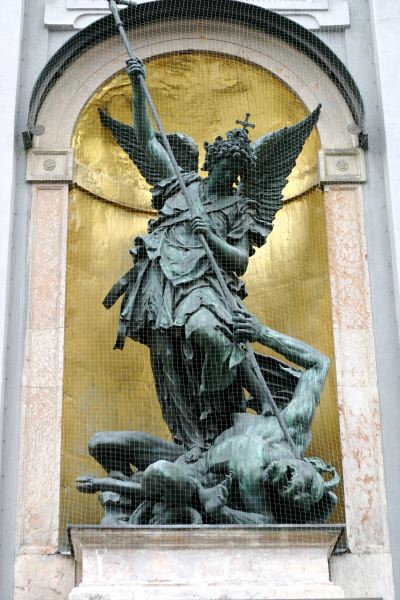
Saint Michael the Archangel, loyal champion of God and His people,
I turn to you with confidence and seek your powerful intercession.
For the love of God, Who made you so glorious in grace and power,
and for the love of the Mother of Jesus, the Queen of the Angels,
be pleased to hear my prayer.
You know the value of my soul in the eyes of God.
May no stain of evil ever disfigure its beauty.
Help me to conquer the evil spirit who tempts me.
I desire to imitate your loyalty to God and Holy Mother Church
and your great love for God and people.
And since you are God’s messenger for the care of His people,
I entrust to you this special request:
(Mention your request).
Saint Michael, since you are, by the Will of the Creator,
the powerful intercessor of Christians,
I have great confidence in your prayers.
I earnestly trust that if it is God’s holy will my petition will be greated.
Pray for me, Saint Michael, and also for those I love.
Protect us in all dangers of body and soul.
Help us in our daily needs.
Through your powerful intercession,
may we live a holy life,
die a happy death, and reach heaven
where we may praise and love God with you forever.
Amen.
Dear Brothers and Sisters in Christ,
I'm writing to you today to share a simple story of a missionary priest in Russia and to ask for your help. I need the help of fellow Catholics that may be willing to help out a friend in need. I have a friend, Fr. John Gibbons, who is a Franciscan missionary priest in Russia who needs our generosity.
Fr. John is living east of Siberia and is the only priest within a hundred miles. In fact, He is one of only a few Catholic priests in Russia at all. His work is not glamorous. He does not work with orphans or any other group that would invoke our deepest sympathies. He is a humble parish priest doing what parish priests are doing all around the world every day: he says Mass, hears confession, and shares in the life of those he pastors. The only difference is that he is doing it in place where priests were forbidden for so long that the Catholic faith was almost destroyed. Now he is starting again to answer the call of the Lord to preach and to baptize to the ends of the earth.
He arrived in Russia three years ago but has been in his parish for one year. His rectory is very small and very poor - so poor, in fact, that I feel that it is a shame to see our priests - or any human being - living in such conditions. He has no indoor plumbing, he uses an outhouse, gets water a block away, and he chops wood for heat. This is especially a sacrifice in a place where the temperature is below zero six months of the year. He lives like this to be "in solidarity" with the people who live in the same impoverished conditions. Our donations are not likely to change these things. What we give will help to bring Christ to them.
Fr. John is there to bring the Gospel to a people who were denied the Goodnews for many years. He is there to build a church - following the call of St. Francis - he is the prime example of "the missionary" that John Paul II spoke about in his letter on the Missionary life, "The special vocation of missionaries "for life"...is the model of the Church's missionary commitment, which always stands in need of radical and total self-giving, of new and bold endeavors."
Hearing about Fr. John is a grace for us too. It gives us a concrete way to contribute to the missionary Church, "...individual believers extend the reach of their charity and show concern for those both far and near. They pray for the missions and missionary vocations. They help missionaries and follow their work with interest."(JPII, RM)
Fr. John is in the United States right now to renew his visa and to raise awareness of the mission Church in Russia. He is here "to beg", as he says, "like a good Franciscan." When I heard the story of my long-time friend and saw the photos of his life I was moved to help. I made a decision to do two things 1) to share his story and 2) to simple ask every Catholic that I know to offer $10 for this mission.
$10 is not much. We spend that much at Starbucks or McDonalds or without even thinking about it. However, $10 for Fr. John's Mission would be much better spent. If enough people respond we can offer Fr. John a gift that will make a difference to his 50 parishioners. Just think, if we raise $5000 that will be $100 per person. With that Fr. John can buy bibles, catechisms, books, food, medicine or anything that his mission needs. Furthermore, I know that he can count on a few prayers to go with the donation. He says that the prayers are far more important because through prayer all his needs are met.

For many of today's Catholics, the ethnic customs that celebrate the birth, life, death, and resurrection of the Christ have been lost, forgotten, or abandoned for the sake of assimilation. And while folk traditions are neither a substitute for faith nor compelling evidence for reverence, they do help to stimulate and sustain awareness. We have to start somewhere.I did a brief review of this book previously at Spero News along with a few others which I find helpful in celebrating liturgical holidays through the year. Now I see that the paperback edition has come out and in looking through it I am reminded of just what a treasure it is to any family that wants to have daily devotion as part of their lives.
I believe that celebrating Catholic customs in the domestic church can serve to reenliven Catholic identity in ways that Mass attendance simply cannot, although I, for one, miss Mass when I miss Mass...
Presently Grant put his hand out, wordlessly, and Carradine gave him a cigarette and lighted it for him.
They smoked in silence.
It was Grant who interrupted the sparrows' performance.
"Tonypandy," he said.
"How's that?"
But Grant was still far away.
"After all, I've seen the thing at work in my own day, haven't I?" He said, not to Carradine but to the ceiling, "It's Tonypandy."
"And what in the heck is Tonypandy?" Brent asked. "It sounds like patent medicine. Does your child get out of sorts? Does the little face get flushed, the temper short, and the limbs easily tired? Give the little one Tonypandy, and see the radiant results." And then, as Grant made no answer: "All right, then; keep your Tonypandy. I wouldn't have it as a gift."
"Tonypandy," Grant said, still in that sleep-walking voice, "is a place in the South of Wales."
"I knew it was some kind of physic."
"If you go to South Wales you will hear that, in 1910, the Government used troops to shoot down Welsh miners who were striking for their rights. You'll probably hear that Winston Churchill, who was Home Secretary at the time, was responsible. South Wales, you will be told, will never forget Tonypandy!"
Carradine had dropped his flippant air.
"And it wasn't a bit like that?
"The actual facts are these. The rougher section of the Rhondda valley crowd had got quite out of hand. Shops were being looted and property destroyed. The Chief Constable of Glamorgen sent a request to the Home Office for troops to protect the lieges. If a Chief constable thinks a situation serious enough to ask for the help of the military a Home Secretary has very little choice in the matter. But Churchill was so horrified at the possibility of the troops coming face to face with a crowd of rioters and having to fire on them, that he stopped the movement of the troops and sent instead a body of plain, solid Metropolitan Police, armed with nothing but their rolled-up mackintoshes. The troops were kept in reserve, and all contact with the rioters was made by unarmed London police. The only bloodshed in the whole affair was a bloody nose or two. The Home Secretary was severely criticised in the house of Commons incidentally for his 'unprecedented intervention.' That was Tonypandy. That is the shooting down by troops that Wales will never forget."
"Yes," Carradine said, considering. "Yes. It's almost a parallel to the Boston affair. Someone blowing up a simple affair to huge proportions for a political end."
"The point is not that it is a parallel. The point is that every single man who was there knows that the story is nonsense, and yet it has never been contradicted. It will never be overtaken now. It is a completely untrue story grown to legend while the men who knew it to be untrue looked on and said nothing."
"Yes. That's very interesting; very. History as it is made."
"Yes. History."
"Give me research. After all, the truth of anything at all doesn't lie in someone's account of it. It lies in all the small facts of the time. An advertisement in a paper. The sale of a house. The price of a ring."

It is with a joyful and humble heart that I announce to you this day, on the memorial of the Queenship of Mary, the decision to pursue a vocation to the religious life as a sister - currently with the Franciscan Sisters of the Renewal. Today marks four months of active discernment following an almost indescribable experience in which I 'just knew' God was calling me to Himself in this most intimate way.She has more about her discernment to this point. Go congratulate her and keep her in your prayers. Woohoo!